How Do Pokemon Vending Machines Work? A Complete Guide
How do Pokémon vending machines work? These automated retail kiosks sell Pokémon Trading Card Game (TCG) products without a staffed checkout. A shopper typically browses available products on a touchscreen, selects a sealed pack or box, reviews the price, and pays using a method supported by that particular machine. An internal delivery system then moves the purchased item to a pickup opening. The exact payment options, dispensing mechanism, inventory software, and purchase rules depend on the equipment and its operator. That distinction matters: official Pokémon Automated Retail machines belong to The Pokémon Company International, while independently operated trading card vending machines are commercial equipment stocked and managed by individual retailers. Both offer convenient card purchases, but they are not the same retail program.

How Do Pokemon Vending Machines Work From Selection to Pickup?
The basic transaction has five connected stages: showing available merchandise, accepting a selection, processing a payment, dispensing the product, and recording the result. Customers see a small automated storefront; behind the screen, software coordinates a payment terminal and physical hardware. A motor, pusher, platform, or compartment must release the correct item.
Most modern card-selling kiosks present product images, descriptions, prices, and availability on a touchscreen. The customer chooses an item, confirms the selection, and follows the payment prompt. Depending on the operator, checkout may involve a credit or debit card, contactless payment, a supported mobile wallet, a QR-based system, or cash hardware. The machine then sends a command to the relevant dispensing channel. Once the item reaches the collection area, the shopper retrieves it and checks that the correct sealed product was delivered.
This sequence sounds simple, but its reliability depends on several separate systems. The touchscreen must display the correct stock-keeping unit (SKU). The payment terminal must communicate the transaction result. The controller must activate the correct lane. Product packaging must move freely through that lane without folding or catching. Where fitted, delivery sensors and software alerts can help identify an incomplete vend. Sensor coverage and remote features vary.
Customers should follow the installed machine’s instructions. Operators must treat the physical delivery path as seriously as the screen and reader.
Official Pokémon Automated Retail Machines vs. Independent Card Machines
Official Pokémon Automated Retail vending machines are owned and operated by The Pokémon Company International. Its support FAQ, updated January 26, 2026, expressly states that the company currently has no plans to sell those machines. Independent operators instead purchase commercial trading card machines, source their own merchandise, set their own operating arrangements, and handle customer service.
An independent machine may sell authentic Pokémon booster packs without belonging to the official automated retail network. Conversely, buying a machine capable of holding Pokémon products does not confer licensing, franchise rights, or permission to reproduce official branding. Zhongda Smart manufactures configurable commercial vending equipment for independent operators; it is not presented here as a supplier to, or participant in, the official Pokémon program.
| Decision point | Official Pokémon Automated Retail | Independent trading card vending machine |
|---|---|---|
| Ownership | The Pokémon Company International owns and operates the machines. | A retailer, venue, or vending operator owns or leases its equipment. |
| Product assortment | Pokémon TCG products selected for the official program. | Products chosen and legitimately sourced by the independent seller. |
| Pricing control | Set within the official operating program; customers rely on displayed prices. | Set by the operator, subject to applicable commercial obligations. |
| Restocking | Managed by the official operation, without a published fixed timetable. | Managed by the operator or its contracted service provider. |
| Payment configuration | Use the methods shown on the installed official machine. | Depends on the chosen terminal, processor, and machine configuration. |
| Machine availability | Not offered for sale under the current official policy. | Commercial machines can be purchased or configured from manufacturers. |
| Technical support | Pokémon Automated Retail support team. | Posted machine operator, with manufacturer support behind the scenes. |
| Branding rights | Operates under the official Pokémon program. | No automatic right to Pokémon trademarks, characters, or official kiosk designs. |
Identify the operator before requesting support. A store hosting an official kiosk may not have access to its transactions or service controls.
How to Buy Pokémon Cards From a Vending Machine
Buying cards normally requires only a product choice, payment, and collection, but checking a few details before authorizing the transaction can prevent unnecessary problems. The following sequence applies broadly to touchscreen card machines; the on-screen instructions take precedence.
-
Confirm the machine and operator. Look at the cabinet, help screen, and contact information. Identify whether it belongs to Pokémon Automated Retail or an independent seller, especially if you might need support.
-
Browse the available items. Read the complete product name and set or edition information. Similar-looking booster products can differ in pack count, contents, and price.
-
Check price, quantity, and availability. A listing marked sold out cannot normally be ordered from that lane. If the interface allows multiple units, verify the quantity before checkout.
-
Choose an accepted payment method. Use the reader or instructions shown on the machine. Do not assume that cash, a particular mobile wallet, or a gift card works everywhere.
-
Wait for the transaction outcome. Keep the screen in view while the machine processes payment and dispenses. Avoid making a second purchase simply because the first response is slow.
-
Collect and inspect your purchase. Check the collection bay for every item, then compare the delivered product with the selection and receipt or transaction record.
A touchscreen listing is an offer of a particular packaged product, not an assurance that the contents include a valuable card. Booster packs contain randomized cards; vending does not change the product’s published odds. If an independent operator offers a mystery product, review its disclosed contents and terms separately rather than treating it as equivalent to an official factory-sealed booster.
How can you find an official machine?
Use the official Pokémon Vending Machine Locator, linked from Pokémon Center's support guidance. Search the locations shown there and confirm the host store's operating hours before traveling. Placement information can change, and a listed location does not guarantee that a particular set is in stock when you arrive. For independent kiosks, consult the operator's own location information; an independently owned machine should not be assumed to appear in the official locator.
The official FAQ says the machines use cameras to count passersby, but do not store or transmit video. Additional privacy information is available through the machine’s help/policies screen.
If you are shopping in a store that hosts an official kiosk, the store's normal checkout desk is not the vending transaction counter. Pokémon's support guidance specifically says store employees and merchandisers cannot resolve vending-machine problems or provide official restock information.
What Products Can Pokémon Card Vending Machines Sell?
Official machines sell Pokémon Trading Card Game merchandise, including booster packs and Elite Trainer Boxes identified in the official FAQ. The precise assortment depends on availability and the products assigned to a machine. Independent card machines may carry a much broader mix, provided each item fits the mechanical configuration and the operator can lawfully source and sell it.
Booster packs, sleeved boosters, and bundles
A booster pack is compact, but its foil or flexible outer wrap can shift or bend under pressure. A sleeved booster has additional cardboard packaging that changes its overall dimensions and how it slides along a channel. Multi-pack bundles and blister-style products introduce further variations. A machine designed around one package should not be assumed to accept all versions merely because the cards inside are similar.
Elite Trainer Boxes, collection boxes, and tins
Elite Trainer Boxes are more rigid and relatively bulky. Collection boxes can have protruding display sections or unusually broad faces. Collectible tins may be rounded or have lids that catch on guide rails. These products can require larger compartments, fewer units per lane, or a delivery route that reduces impact. A retailer should confirm the actual outer packaging rather than relying on a familiar product category name.
Other trading cards and graded collectibles
Independent machines can be configured for sports-card products, accessories, sealed decks, protective supplies, and selected graded card slabs. A slab is not just another rigid box: its clear holder can be scratched, chipped, or cracked, and its value may make an uncontrolled drop unacceptable. Protective sleeves or secondary packaging may solve some handling problems but create a new dimension that must be measured and tested.
Customers should also distinguish genuine sealed manufacturer product from independently repackaged merchandise. Packaging, authenticity, seller identity, and stated contents matter more than the machine's appearance. Operators should preserve traceable purchasing records and keep merchandise descriptions accurate.
Payments, Purchase Limits, and Restocking: What Customers Can Actually Expect
Which payment methods work?
There is no safe universal answer for every Pokémon card vending machine. Accepted methods depend on the installed reader, payment processor, software settings, and operator. Check the payment symbols and checkout prompt on the specific machine. An independent kiosk can be equipped for cards, contactless transactions, QR payments, or cash if its hardware and processing arrangements support those features; the existence of an option in a manufacturer's catalog does not establish that a particular machine has it installed.
Cashless acceptance deserves attention because it affects actual retail convenience. In Cantaloupe's 2026 analysis of transactions from connected self-service devices, cashless payments accounted for 78% of vending sales during 2025, and contactless transactions represented 85% of cashless vending sales. Those figures describe the broader monitored vending market, not Pokémon card vending machines specifically. They support evaluating contactless compatibility, not assuming that any one official kiosk accepts a particular wallet.
What is the difference between a payment authorization and a charge?
A payment can appear as pending when the issuer has authorized an amount but final posting has not occurred. A settled or posted charge is a completed payment on the account statement. A reversal releases an authorization; a refund generally credits a completed transaction. Those events can appear differently in banking apps and do not necessarily happen instantly.
If a machine appears to accept payment but fails to dispense, save the transaction details and contact its operator. Do not repeatedly tap the payment terminal while the first payment status is uncertain; repeated attempts may produce multiple authorizations or charges. When necessary, check with the card issuer to establish whether an entry is pending or posted. The operator can then investigate the vending event and applicable refund process.
Are there purchase quantity limits?
Purchase limits may apply to an item or transaction, but they should not be invented from reports about other machines. Check the current interface and any published policy from the relevant operator. Limits can reflect stock allocation, product demand, payment restrictions, or commercial rules. If a screen restricts quantity, splitting a purchase into repeated attempts is not a reliable way to obtain more product and may conflict with the applicable policy.
When do official Pokémon vending machines restock?
There is no published, fixed restocking schedule for official Pokémon Automated Retail machines. Pokémon's January 2026 FAQ says restocking depends on product availability and individual machine inventory needs, and customers cannot be given advance restock alerts. It also directs shoppers not to ask host-store employees or merchandisers about timing or inventory. A pattern noticed by collectors is not an official service promise.
A popular new release may sell out rapidly after a refill, while a slower-moving product remains available. A stock display can change because another shopper completes a purchase, an operator updates the assortment, or a system disables a lane for servicing. The machine may have merchandise inside without offering it for sale if the available quantity is reserved, unverified, or marked unavailable. Therefore, “sold out” does not by itself mean the kiosk is broken.
Independent operators should define their own replenishment process. Transaction logs can indicate fast-moving SKUs, but recorded quantities should be reconciled with the actual cabinet. Some systems decrement stock on successful vending; others depend on configured counts or sensor confirmation. A route plan is only as useful as the inventory information behind it. For consumers, the best source of current availability is the active machine screen, not an assumed refill day.
Can a customer return a vending-machine purchase?
Pokémon's official FAQ states that returns are not accepted for products purchased from its vending machines. A payment or dispensing failure is a different issue: it should be reported to the official support team for review. Independent operators establish their own return and support arrangements subject to applicable obligations. If the delivered product is damaged or incorrect, document the problem promptly rather than assuming an ordinary change-of-mind return policy applies.
What to Do When a Pokémon Vending Machine Takes Payment but Does Not Deliver
If a machine takes payment and fails to dispense, first document the transaction and contact the correct operator. Do not pull, shake, tilt, open, or attempt to reset the equipment. A jammed product is frustrating, but trying to reach into the cabinet can damage merchandise, create a safety hazard, or complicate the service investigation.
For official machines, Pokémon Center directs customers to the Pokémon Automated Retail Vending Machine Support Team at 866-872-4790 or its support request channel, as listed in the official vending FAQ. Store employees and merchandisers are not the support team. For an independent machine, use the operator's contact number, support QR code, or other contact information printed on the cabinet; the equipment manufacturer may not hold the shopper's transaction records.
Payment approved, but nothing arrives
Allow the machine to complete its current sequence. Record the displayed item, price, location, approximate transaction time, any machine identifier, and the payment reference available from your bank or receipt. Take a photo of an error message if the machine permits it, without photographing sensitive card details. Report that payment was accepted but the selected item was not received. The operator may need to compare a payment record with an actuator event or delivery sensor record.
The card reader does not respond
Check whether the reader is displaying an error or whether the machine has marked a payment option unavailable. A reader can fail independently of the touchscreen. If the interface clearly offers another method, you can choose it, but avoid cycling through multiple charges without knowing whether any attempt went through. If the reader remains inactive, use another machine or contact the operator rather than attempting a physical reset.
A product appears stuck in the cabinet
Do not reach through a delivery flap or strike the glass. Note which product is visibly stuck and whether the screen reports successful vending. A physical jam could involve a compressed package, insufficient clearance, incorrect loading, or a stalled mechanism. Only authorized service personnel should open the cabinet or inspect internal components.
The display says sold out or the machine appears offline
Sold out usually means the selected SKU is not presently offered; select another available item or return later. An offline or out-of-service message may indicate a communications, power, payment, or controller problem rather than empty inventory. If a transaction has not started, avoid trying to force checkout. If an earlier payment is pending, document it before leaving.
The wrong item arrives, or the bank shows a pending payment
For an incorrect delivery, keep the product and packaging in their received condition until support advises otherwise; take clear photos and report the item selected versus the item delivered. For a pending bank entry without a completed sale, monitor whether it posts or disappears and ask the operator to investigate. Processing times vary; neither a refund nor a final charge should be assumed.
A useful support report identifies the operator, cabinet, product, time, payment status, and error, helping distinguish payment from dispensing failure.
What Happens Inside a Trading Card Vending Machine?
Inside a typical commercial card vending machine, a controller connects the user interface, payment system, product lanes, dispensing hardware, and optional sensors or network modules. Once checkout is authorized, the controller identifies the selected SKU's assigned channel and sends a delivery command. Depending on the design, an actuator advances merchandise, a platform receives it, or an electronic lock grants access to a compartment. The machine may then update its inventory count and transaction log.
That description explains general commercial vending technology; it does not identify the undisclosed internal mechanism of official Pokémon Automated Retail machines. Payment approval, physical movement, vend detection, and financial settlement are separate events. The order and validation logic vary by manufacturer. A connected kiosk may send sales and fault alerts to a dashboard, but connectivity alone does not prove that the stock count is physically verified in real time.
A rigid box may slide predictably along guides, while a thin foil pack can fold or snag. Even when a lane releases merchandise successfully, the item still needs to travel safely to the pickup area. That is why product testing is more informative than a photograph of the touchscreen.
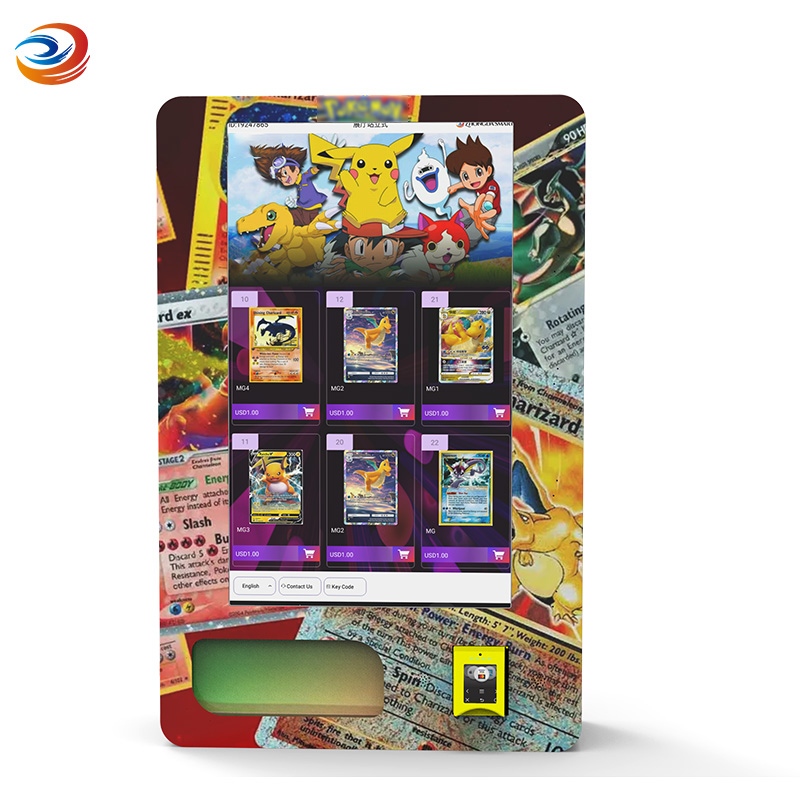
Why Trading Card Packaging Changes Vending Machine Design
A trading card machine should be engineered around the packaging it will actually dispense. Snack-machine assumptions do not transfer automatically. Snacks usually arrive in packaging designed for high-volume retail handling; collectible products combine soft wrappers, wide cardboard sleeves, unusual boxes, and surfaces whose condition affects perceived value.
-
Loose booster packs: Thin wrappers can bend, rotate, or catch between channel guides. Test feeding behavior with the actual sealed pack, not a cardboard mock-up alone.
-
Sleeved booster packs: Retail sleeves add height and width and may include hanging tabs. Their edges can snag even when the foil pack itself fits.
-
Elite Trainer Boxes: Their greater size and weight change lane loading, center of gravity, and potential impact at the pickup area. Check box corner protection.
-
Collectible tins: Rounded profiles can roll or rotate, while lids and decorative edges may catch on adjacent stock or a delivery chute.
-
Graded card slabs: Rigid, high-value holders need scratch protection, controlled orientation, and attention to impact and security, not merely an adequately wide slot.
Measure each product’s outer dimensions, weight, and movement clearance. Clearance must account for protrusions, manufacturing variation, protective sleeves, and orientation. A lane that fits one sample while empty may fail when fully loaded, after successive vends, or when packaging tilts sideways. No universal card-pack tolerance or acceptable failure rate can be specified without testing the actual equipment and products.
For consumers, these constraints explain why a large box may be unavailable at one kiosk but sold at another. For manufacturers and operators, they establish the correct design priority: confirmed package fit and repeatable dispensing before screen size or nominal capacity.
Spiral, Push-Type, Elevator, and Locker Delivery Compared
There is no universally superior mechanism for every card product. Each solution applies force differently and imposes different loading, security, and space requirements. Elevator delivery is not automatically necessary for small, sturdy merchandise; ordinary drop delivery may be entirely reasonable after compatibility tests. Conversely, valuable collectibles warrant closer scrutiny of impact, abrasion, and access control.
| Mechanism | Suitable packaging | Damage considerations | Operational limits | Best-fit scenario | Test before ordering |
|---|---|---|---|---|---|
| Spiral coil | Compact, consistent packages that sit securely between turns. | Coil contact can squeeze flexible packs; products may fall into a lower bay. | Quick to reload, but coil pitch and channel width restrict irregular items. | Lower-value, repeatable pack formats. | Full-lane feed, pack twisting, double-vend risk, and final drop. |
| Push-type | Uniform packs or boxes supported by appropriate rails. | Forward pressure may buckle soft packaging or catch projecting edges. | Orderly stock movement, but alignment and pusher travel are critical. | Consistent rectangular packages. | Pusher force, loaded-lane friction, orientation, and single-item separation. |
| Elevator delivery | Boxes and selected products requiring a shorter uncontrolled drop. | Reduced drop exposure does not prevent crushing or abrasion inside the lane. | Additional motors, alignment requirements, maintenance points, and purchase cost. | Fragile packages where gentler handoff is justified. | Tray fit, handoff alignment, failure recovery, and package contact surfaces. |
| Locker-based | Individually protected slabs, premium boxes, or unusual shapes. | Little mechanical dispensing motion; compartment fit and retrieval clearance still matter. | Simple retrieval but lower storage density and more doors or locks to manage. | High-value or dimensionally awkward collectibles. | Door authorization, anti-theft behavior, compartment dimensions, and customer access. |
Procurement testing should include repeated vends with multiple examples of each package, starting with full channels and continuing as stock falls. Inspect seals, corners, sleeves, and slab surfaces afterward. Record failures by SKU and orientation rather than reporting one blended success percentage. Also confirm what the machine does after an interrupted vend: it should not quietly count an undelivered item as completed business.
Can You Buy an Official Pokémon Vending Machine?
No, not under the current official program. The Pokémon Company International says it owns and operates all of its official Automated Retail vending machines and has no plans to sell them. The same official guidance does not offer a general purchase or store-placement application. Commercially available card vending equipment is a separate category.
A shop can independently acquire a trading card vending machine and stock legitimately sourced Pokémon products, but the purchase does not make the machine an official Pokémon Center kiosk. Describing the merchandise accurately is different from using Pokémon character art, logos, or official kiosk designs in advertising or on a cabinet. Operators should verify product provenance, branding permissions, venue agreements, and applicable business requirements before launch.
How to Choose an Independent Trading Card Vending Machine
For this comparison, I’m prioritizing product compatibility, dispensing reliability, payment flexibility, and the total cost of ownership. Those criteria control whether customers receive the correct goods, whether the machine can take payment, and whether operating expense remains manageable. A bigger screen, an impressive maximum capacity, or the lowest initial quote does not answer those questions.
Start with a product inventory sheet. Record the outer dimensions and weight of every packaged SKU, its price, whether surface condition is critical, and the quantity needed between service visits. SKU count is the number of distinct products offered; unit capacity is how many individual products fit. A machine with 28 lanes can offer fewer than 28 SKUs if several lanes hold the same popular product. Conversely, an advertised maximum unit capacity can shrink significantly when wider boxes replace thin packs.
| Use case | Configuration to investigate | Main constraint | Procurement priority |
|---|---|---|---|
| Compact wall-mounted installation | Securely mounted cabinet for a limited set of lightweight packaged products. | Wall structure, loading access, depth, and reduced inventory. | Confirm mounting design, channel fit, refill access, and installed payment module. |
| Standard floor-standing card machine | Adjustable lanes for boosters and selected small boxes. | Mixed package thickness and lane allocation. | Test every main SKU and calculate usable units per lane. |
| High-assortment card machine | More independently assigned product lanes. | Many SKUs can leave only a few units of each product. | Balance customer choice against refill frequency and sell-through. |
| Custom collectible or graded-card solution | Protected channel, controlled delivery, or individual locker. | Security, scratch risk, unusual dimensions, and higher configuration cost. | Approve sample-product tests, retrieval protection, and service procedures. |
Zhongda Smart's trading card machine configuration overview describes wall-mounted, floor-standing, multi-lane, and OEM options. Its 32-inch touchscreen trading card machine lists 28 standard lanes and a stated capacity of approximately 375–535 pieces, depending on packaging. These are manufacturer specifications, not independent performance tests or a guaranteed count for a mixed assortment.

For space-constrained sites, examine the actual mounting and loading requirements of a wall-mounted card mini vending machine. For graded cards, larger boxes, or unusual product mixes, request a test plan for custom OEM trading card vending configurations. I’d choose a simpler channel layout for sealed packs if sample testing supports it. I’d pay for controlled delivery only when the product's value, fragility, or geometry creates a demonstrable need.
Before accepting a quote, verify installation clearance and power requirements, processor compatibility and merchant onboarding, cellular or Wi-Fi signal quality, remote stock reporting, cabinet locking, spare-part access, warranty exclusions, and who performs service. Ask whether a payment device, software subscription, data plan, delivery, or commissioning is included. Manufacturer support is meaningful only when the service scope and escalation path are documented.
What Does a Card Vending Machine Cost, and Can It Make Money?
An independently operated card machine can generate positive operating contribution, but profitability depends on product acquisition cost, sales volume, location terms, payment fees, restocking expense, and capital invested. Revenue from the official Pokémon-operated network cannot be used as a proxy for an independent retailer's economics. No single equipment sticker price captures the cost of opening and running the business.
Budget for the cabinet, payment reader, any custom dispensing components, freight, unloading, installation, and opening merchandise inventory. Recurring costs may include location rent or revenue share, card processing, internet service, electricity, cloud software, maintenance and spare parts, travel and restocking labor. Financing, insurance, inventory loss, taxes, and return or dispute handling may add further expense. Obtain an itemized installed quotation rather than comparing headline machine prices alone.
An illustrative monthly operating model
Illustrative assumptions, not actual operating results. Assume a 30-day month, an average selling price of $12 per item, an average inventory cost of $8, and processing expense of 3% of sales plus $0.15 per transaction. Assume one unit per transaction and fixed monthly operating expenses of $650, covering location expense, connectivity, power, software, a maintenance allowance, and restocking travel or labor. Initial invested cash is assumed to be $8,000: $6,000 of installed equipment and $2,000 of opening inventory. These figures are hypothetical, not price quotes or market benchmarks.
| Monthly metric | Conservative: 5 units/day | Stronger demand: 20 units/day |
|---|---|---|
| Units sold | 150 | 600 |
| Average selling price / inventory cost | $12 / $8 per unit | $12 / $8 per unit |
| Sales revenue | $1,800 | $7,200 |
| Cost of goods sold | $1,200 | $4,800 |
| Payment processing (3% + $0.15/sale) | $76.50 | $306 |
| Fixed monthly operating expenses | $650 | $650 |
| Estimated monthly operating contribution | -$126.50 | $1,444 |
| Simple recovery of $8,000 initial capital | Not achievable at a negative contribution | Approximately 5.5 months if the assumed contribution persists |
The calculation is units sold × (selling price − inventory cost − processing fee per transaction) − fixed expenses. At the assumed ticket, processing costs $0.51 per sale, leaving $3.49 before fixed expenses. That produces a break-even volume of about 187 units per month, or slightly more than six daily sales. Monthly operating contribution is neither gross revenue nor gross merchandise margin. The simple recovery period divides initial invested capital by positive monthly contribution; it is not a profit margin or a guaranteed cash-flow forecast.
The illustration assumes opening inventory is replenished to maintain a stable stock level and does not model inventory growth, financing costs, taxes, spoilage or shrinkage, chargebacks, major repairs, or periods of closure. A location with weak demand may never recover the initial investment. A stronger location could still underperform if product costs rise or rent becomes a percentage of sales. Before purchasing equipment, model the break-even volume using your actual supplier invoices and proposed site contract.
Hypothetical Configuration: A Shop Selling Booster Packs and Sealed Boxes
Hypothetical equipment-selection example; not a Zhongda Smart customer installation or test result. Consider a card retailer planning to vend loose sealed boosters, sleeved boosters, compact boxed products, and occasional Elite Trainer Boxes. The store wants several product choices, predictable refilling, cashless checkout, and remotely visible sales records.
The retailer should first measure the exact outer length, width, and thickness or height of each saleable package, weigh representative examples, and record unusual tabs, seals, or protrusions. Next, assign each SKU to a proposed lane and document its loading orientation. For thin packs, the retailer may test adjustable standard lanes or push-type delivery. For small rigid boxes, wider channels may be adequate. If large boxes cannot travel without damaging corners, a separate controlled-delivery configuration may be more sensible than forcing every product into the same mechanism.
Before signing off, the operator should require sample-based dispensing demonstrations with full and partially depleted channels, evidence that the correct item reaches the pickup opening, and inspection of the outer packaging afterward. Payment terminal compatibility, reliable network access, safe refill access, stock-level reporting, and written warranty arrangements must be confirmed in the same purchasing decision. The result may be a mixed-lane floor-standing machine, a smaller pack-only cabinet, or a customized layout; the merchandise mix—not a preset touchscreen size—determines the answer.
Installation, Maintenance, and Two Procurement Checklists
Reliable operation starts before delivery. The operator needs secure placement, sufficient clearance for customers and service doors, a suitable electrical supply, stable network connectivity, and a documented restocking routine. Reconcile reported inventory with physical stock, examine pack condition during refills, clean accessible customer-facing surfaces according to the manual, and review failed-vend and payment exceptions. Internal electrical work, jam clearance, and component repair belong to trained, authorized personnel.
Card vending machine buying checklist
-
Prepare a SKU sheet with photographs, full packaged dimensions, weights, prices, and target units per refill cycle.
-
Identify which merchandise is fragile, unusually shaped, or valuable enough to justify protected delivery.
-
Record available floor or wall space, power, door swing, delivery access, and placement-security requirements.
-
Specify the intended payment processor, cashless methods, connectivity, transaction reporting, and recurring software fees.
-
Request an itemized installed quotation, service contacts, spare-parts terms, and written warranty coverage.
Pre-delivery product compatibility checklist
-
Have the manufacturer verify the actual product-to-channel mapping, usable units per lane, and loading orientation.
-
Request repeat dispensing with sealed samples at full, intermediate, and near-empty stock levels; examine damage and mis-vends.
-
Confirm the pickup route, product detection or exception handling, and safe recovery from an interrupted vend.
-
Demonstrate checkout on the chosen payment hardware, plus reporting of successful and failed transactions.
-
Confirm network reconnection behavior, remote inventory updates, commissioning steps, and the handover of manuals and support contacts.
Maintenance decisions should follow the actual failure mode. A card declined by a processor is not a coil jam; a sold-out alert is not proof of a motor failure; and a disconnected dashboard does not necessarily mean the machine has lost power. Separating payment, stock, mechanical delivery, and networking incidents avoids replacing the wrong components.
Frequently Asked Questions
How do Pokémon vending machines work?
Customers select a Pokémon TCG product on the machine interface, use an accepted payment method, and retrieve the item after an internal delivery system dispenses it. The exact mechanism and software depend on the operator and machine.
Are all Pokémon card vending machines official?
No. Official Pokémon Automated Retail machines belong to The Pokémon Company International. Independently operated card kiosks may sell authentic Pokémon products without being part of that program.
What payment methods do Pokémon vending machines accept?
Payment options vary. Follow the symbols and checkout instructions on the installed machine; do not assume that cash, contactless cards, or a particular wallet is universally supported.
When do official Pokémon vending machines restock?
There is no fixed public schedule. Pokémon says timing depends on product supply and individual machine inventory needs and does not provide advance restock alerts.
What if a Pokémon vending machine takes my money?
Record the machine location, product, transaction time, and payment status. Contact Pokémon Automated Retail support for an official kiosk or the posted independent operator for other machines. Check whether the bank entry is pending or posted before making another attempt.
Can I buy an official Pokémon vending machine?
No. The Pokémon Company International says it owns and operates the official machines and currently has no plans to sell them. Independent commercial card vending machines are available separately.
What is the best vending machine for Pokémon cards?
The best configuration is the one proven to dispense your actual merchandise safely and consistently. Compare lane fit, delivery method, payment support, security, refill workload, and installed cost rather than choosing on screen size alone.
Can an independent trading card vending machine be profitable?
Yes, if sales volume and merchandise margin cover processing, location, restocking, maintenance, and other costs. Profitability and capital recovery must be calculated from the operator's actual terms; neither is guaranteed.
Related Reading
Explore more Zhongda Smart articles on Pokémon vending machine purchasing, restocking, payments, and the equipment decisions behind independent trading card retail. These are manufacturer-published resources, not official Pokémon operating guidance.
Pokémon Vending Machine Articles
- Pokemon Vending Machines Grew 27% in 2026: What Operators Can Learn — Discusses official-versus-independent retail models, product handling, and operating decisions.
- When Do Pokemon Vending Machines Restock? Full Guide — Explains product availability, refill timing, and the factors behind stockouts.
- When Does Pokémon Vending Machine Restock Near You? — A second perspective on restocking, customer observations, and inventory operations.
- Do the Pokemon Vending Machines Take Cash in 2026? — Reviews cash and cashless payment configurations and what buyers should check.
- Can I Buy a Pokémon Vending Machine in 2026? — Discusses official machines versus independently purchased trading card kiosks.
- How Much Is a Pokemon Vending Machine to Buy? Real Costs Explained — Explores equipment budgeting and additional launch expenses for independent operators.
- Pokemon Vending Machine Prices: Real 2026 Price Guide — Examines configuration choices and the cost structure of card vending projects.
Trading Card Vending Machine Buying and Operations Guides
- Are Trading Card Vending Machines Profitable in 2026? — Walks through business feasibility and the operating costs that affect contribution.
- Trading Card Vending Machine: Complete Business Guide — Covers product assortment, equipment fit, payment integration, and operating economics.
- Best Trading Card Vending Machine: 8 Options Compared — Compares cabinet types and configurations for different trading card products.
- Best Delivery System for Trading Cards: Spiral vs Locker vs Elevator — Details product delivery methods and protection for delicate merchandise.
- Are Card Vending Machines Profitable? Costs and ROI — Examines the relationship between sales, merchandise cost, operating expense, and returns.
- Best Locations for Card Vending Machines in 2026 Guide — Discusses site suitability and placement decisions for automated card retail.
- Specialty Card Vending Machines: Factory Price, Fast Ship — Introduces specialized card vending configurations and purchasing considerations.
Additional Pokémon-Themed Vending Features
- Pokemon Vending Machine from Zhongda Smart — An overview of Pokémon-themed self-service vending applications.
- Pokemon Vending Machine in Japan | Themed Retail Solution — A themed-retail overview of automated Pokémon merchandise vending.
Sources and References
-
Pokémon Center Support — Pokémon Automated Retail Vending Machine FAQ (updated January 26, 2026).
-
The Pokémon Company International — Pokémon Vending Machine Locator.
-
Cantaloupe — How Consumer Spending Trends Are Shaping Self-Service Retail in 2026 (reporting 2025 self-service transaction data).
Disclaimer
This guide provides general information about purchasing processes and commercial vending equipment. It is not a profit guarantee, legal advice, or a claim of Pokémon authorization, endorsement, or affiliation for Zhongda Smart or any independent vending operator. Pokémon and related names remain the property of their respective rights holders.
Previous article:AI Smart Vending Machines Cost: Full 2026 Price Breakdown[Back to list]
Next article:Pokémon Vending Machine Business: Is It Profitable?