The rise of the pokemon vending machine is useful to study for one reason: it shows how a specialized product category can work in automated retail when product demand, location, inventory control, payment convenience, and machine design all support one another. The official Pokémon vending program continues to expand its physical points of interaction, but independent operators should not confuse that program with a vending-machine franchise or a machine they can simply purchase. The practical opportunity lies in building independently branded trading card vending operations around lawful product sourcing and equipment designed for collectible merchandise. For operators, the strongest lessons are not about copying a branded cabinet. They are about inventory turnover, product-safe dispensing, site economics, cashless checkout, remote management, maintenance, and knowing exactly when a location deserves another machine.
Published by Zhongda Smart. Zhongda Smart develops and manufactures customized vending equipment, including trading card machines, elevator-delivery machines, wall-mounted systems, locker solutions, payment-enabled kiosks, and OEM/ODM smart retail equipment.
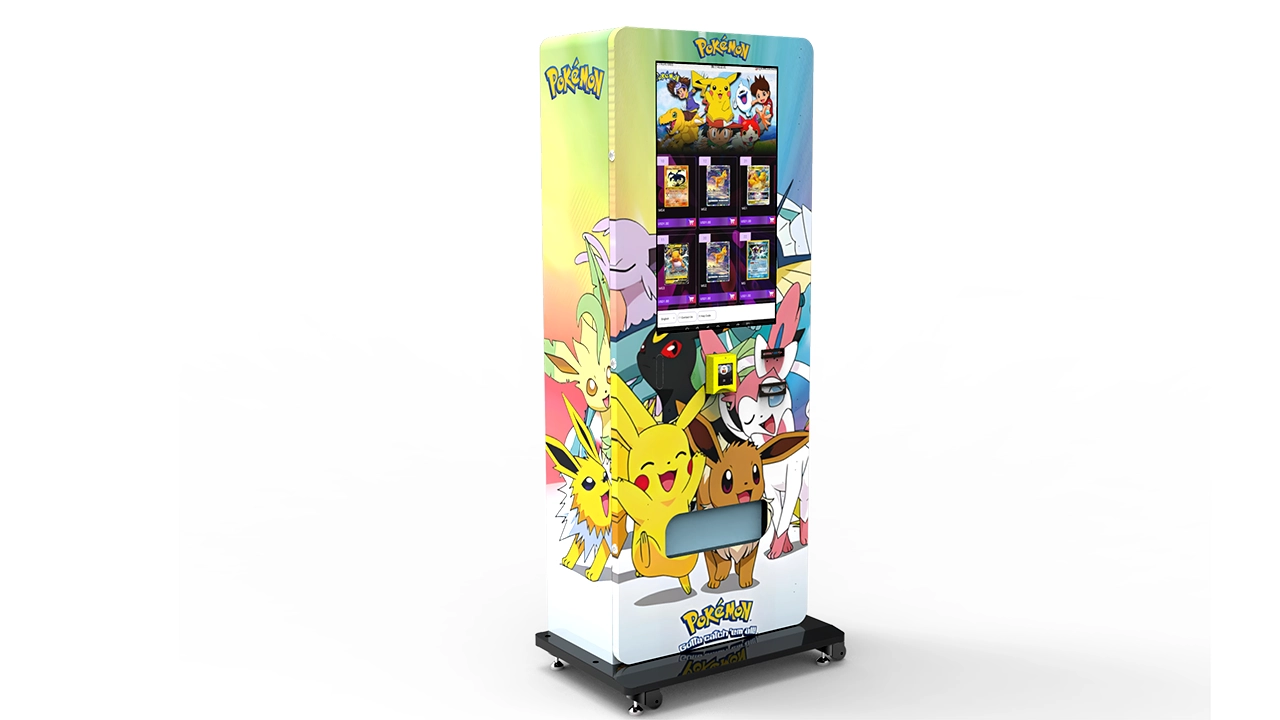
Pokemon Vending Machine Quick Facts
Before getting into the operating details, these are the distinctions that matter most. A pokemon vending machine can refer to an official automated retail machine operated within the Pokémon retail program, or it can be used more loosely to describe an independently manufactured trading card vending machine that sells authentic packaged Pokémon TCG merchandise. Those are not the same thing.
| Question | Practical Answer |
|---|---|
| Can an independent operator buy an official Pokémon automated retail machine? | No. Pokémon Center support states that the official automated retail machines are owned and operated by The Pokémon Company International and are not currently offered for sale. |
| Can a separate vending business sell trading card products? | Potentially, provided the merchandise is lawfully sourced and the business follows applicable distribution, resale, branding, payment, and operating requirements. |
| What machine formats work for card vending? | Floor-standing spiral or belt machines, elevator-delivery systems, lockers, and compact wall-mounted units can all work when matched correctly to the package. |
| What usually matters more than maximum capacity? | Product turnover, dispensing reliability, refill frequency, and the amount of capacity assigned to the fastest-selling SKUs. |
| What payment setup is worth prioritizing? | Card and contactless payment with reliable network connectivity, transaction reporting, and a clear failed-payment process. |
| What is the biggest commercial risk? | A location that produces too little contribution after inventory cost, host fees, payment charges, service labor, shrink, and downtime. |
| What is the biggest technical risk? | A product that does not move consistently through the selected lane or delivery mechanism. |
| Can the machine use Pokémon logos and character artwork? | Not simply because authentic merchandise is being sold. Rights to resell a product and rights to use protected branding or artwork are separate matters. |
That distinction is the foundation for everything that follows. The useful business opportunity is not to imitate an official machine. It is to understand why specialized collectible vending works and then build an independent operation with appropriate equipment, lawful inventory, clear branding, and disciplined numbers.
What Changed in Pokemon Vending in 2026?
The important development is not a single percentage. It is that automated retail continues to be used as a deliberate physical distribution channel rather than a novelty. The Pokémon Company has publicly explained the role of its vending program and stated that it continues looking for new locations for Pokémon Stands and Pokémon Card Stands.
That matters because the company describes the machines as more than inventory boxes. They create additional points where customers can encounter products during normal routines. The company has also discussed testing locations and using high-visibility sites for different machine formats. In other words, location is treated as part of the retail product rather than something decided after the machine is built.
For an independent operator, that is a better lesson than any headline growth percentage.
Collectible retail has characteristics that suit automated selling unusually well. Products are generally compact. Buyers often recognize the product before approaching the machine. New releases create repeat visits. Sealed merchandise is easy to display digitally. A small cabinet can hold meaningful retail value, and there is no requirement for a cashier to explain every item.
The broader self-service industry provides supporting context. The NAMA Foundation's 2024–25 industry census estimated $31.1 billion in 2025 revenue within the market covered by that study, compared with $26.6 billion in 2023. The report calculated average annual growth of 8.1% over that period and projected continued growth of about 6.5% annually across the convenience-service business lines it covers.
That figure is not a measurement of Pokémon card vending. It should not be presented as one. Its value is narrower: it shows that unattended and technology-enabled retail formats remain part of a growing commercial channel.
Payment behavior points in the same direction. Federal Reserve findings released in July 2026 estimated 236.6 billion noncash payments in 2024. Cards represented 79% of noncash transactions by number in the study's data. For a collectible self-service kiosk, that reinforces something operators already see in practice: payment hardware is part of the core machine architecture.
A card machine with excellent inventory and poor checkout is still a poor retail machine.
The shift in 2026 is therefore less about one brand suddenly inventing vending and more about specialized automated retail becoming easier to justify. Payment terminals are familiar. Touchscreens are expected. Remote stock data is practical. Cloud-connected machines can be managed as a fleet. Product-specific dispensing systems are more accessible than they were when most commercial vending cabinets were designed primarily around snacks and drinks.
That opens room for smaller collectible retailers, card sellers, entertainment businesses, distributors, and vending operators to test a focused card vending concept without building an entire staffed store around it.
Why This Automated Retail Model Works
Trading cards are not purchased in the same way as a bottle of water. The customer may already know the set name, product format, release, quantity, and acceptable price before reaching the machine. In other cases, the purchase is spontaneous: someone notices a new release, sees that stock is available, and decides to buy immediately.
A good collectible vending machine supports both behaviors.
It Removes the Gap Between Seeing and Buying
Traditional collectible retail often requires the buyer to visit a dedicated counter, find a shop during opening hours, or wait for an online order. Automated retail shortens that process. If the customer sees the product, understands the price, and trusts the machine, a transaction can take less than a minute.
That does not mean the touchscreen needs to be complicated. In fact, the opposite is usually safer. Product image, product name, price, stock status, quantity, payment, and pickup should be obvious.
Animation can support branding, but it should not delay a purchase.
It Gives Small Products More Retail Presence
Booster packs, sleeved packs, deck boxes, compact accessories, and graded products do not need a large sales floor. Their physical footprint is small relative to their retail value. That allows a machine to function as a compact store rather than merely a convenience dispenser.
This is one reason the economics of a card vending kiosk can be very different from those of low-ticket commodity vending. The operator is not necessarily trying to make a small amount from hundreds of low-value drinks. A smaller number of transactions can still produce meaningful revenue when the average basket is higher.
New Inventory Gives Customers a Reason to Return
Collectible demand is refreshed by releases, restocks, new sets, accessories, and changing availability. A location with recurring foot traffic can therefore benefit from repeat checking behavior.
That matters when choosing a site. A property does not need the highest possible traffic count if the people who pass the machine repeatedly have a strong reason to look at the merchandise.
The Machine Can Show More Information Than a Static Shelf
A connected self-service kiosk can show product photography, price, stock, bundle options, promotional media, and other information without adding physical signage.
It can also change that information without replacing the cabinet.
If one product sells out, the interface can remove or mark it immediately. If a different SKU needs more visibility, the operator can move it higher in the digital menu. That flexibility makes the screen commercially useful rather than decorative.
The Machine Generates Operating Data
A manual shelf tells you what is missing when someone counts it. A connected vending unit can tell you when an item sold, what price was charged, which machine made the sale, whether the machine is connected, and whether a low-stock threshold has been reached.
That changes how a route can be managed. Restocking becomes a response to actual sell-through instead of a fixed calendar alone.
Official Pokemon Machines vs. Independent Card Vending
This is the point that should be clear before anyone requests a quotation from a manufacturer.
Pokémon Center support states that its official automated retail vending machines are owned and operated by The Pokémon Company International. The support page also states that there are no current plans to sell those machines.
An independent vending business is therefore building something different.
| Area | Official Automated Retail Program | Independent Trading Card Vending Business |
|---|---|---|
| Machine ownership | Controlled within the official program | Owned or leased by the independent business |
| Cabinet branding | Official brand assets and design | Should use the operator's own authorized branding unless separate rights have been granted |
| Product sourcing | Managed within the official retail structure | Operator is responsible for lawful and reliable sourcing |
| Location decisions | Managed by the official operator | Operator negotiates its own host locations |
| Machine hardware | Configured for the official retail program | Can be built around the operator's product mix and business model |
| Support | Handled through the official support structure | Handled by the operator, manufacturer, payment provider, or other contracted partners |
The independent model has one important advantage: the operator can design the equipment around a broader collectible business rather than one intellectual property.
A properly configured machine may sell different categories of sealed trading cards, sports cards, card accessories, deck boxes, blind packs, collectible boxes, or selected graded items. That makes the business less dependent on one release calendar or one supplier.
Zhongda Smart's separate trading card vending machine business guide goes deeper into general card vending formats and startup planning. This article is more concerned with the operating lessons that can be taken from the growth of specialized collectible vending.
The distinction also protects the operator from a common branding mistake. Selling authentic merchandise does not automatically make the cabinet an official branded machine. The merchandise can be genuine while the vending business remains completely independent.
Where the Money Actually Comes From
A machine does not make money because it has a touchscreen or because the products are popular. Profit comes from the relationship between sales, merchandise cost, site cost, payment charges, labor, shrink, maintenance, and the amount invested in the equipment.
Start with contribution, not revenue.
A machine producing $8,000 in monthly sales can be less attractive than one producing $4,000 if the first requires expensive inventory, high rent, frequent driving, and constant support.
A Simple Monthly Operating Model
| Item | Illustrative Assumption | Monthly Amount |
|---|---|---|
| Gross sales | 160 transactions × $30 average ticket | $4,800 |
| Merchandise cost | 66% of sales | -$3,168 |
| Gross merchandise margin | 34% | $1,632 |
| Host compensation | 9% of sales | -$432 |
| Payment processing | 3.2% of sales | -$154 |
| Connectivity/software | Illustrative fixed cost | -$65 |
| Restocking/service labor | Illustrative allowance | -$220 |
| Maintenance/shrink reserve | 2% of sales | -$96 |
| Illustrative contribution | Before tax, financing, and general overhead | $665 |
These figures are planning examples, not reported Zhongda Smart route results and not a promise of earnings.
The table is useful because it exposes which variables deserve negotiation.
If merchandise cost falls from 66% to 61% of sales, this example gains another $240 of monthly gross margin. If the host share increases from 9% to 16%, another $336 disappears. That is why a few points of margin can matter more than saving a few hundred dollars on the initial machine purchase.
Average Ticket Changes the Route
A collectible vending operation with a $30 average ticket requires fewer transactions to reach $4,800 in revenue than a low-ticket vending business. That sounds attractive, but it brings another challenge: each failed transaction becomes more expensive.
A $2 failed vend is annoying. A $60 failed vend can trigger a refund, a chargeback, customer support, host involvement, and a lost repeat buyer.
Higher-ticket vending therefore raises the value of delivery verification, payment reliability, good support information, and careful product handling.
Location Cost Should Move With Reality
Fixed rent puts more risk on the operator when demand is unknown. Revenue share reduces that risk but can become expensive at a strong site.
A pilot agreement can be useful when neither side has sales history. The machine gets a defined test period. The host sees whether the format fits the property. The operator gets real transaction data before committing to a long contract.
The agreement should define access, power, connectivity, support responsibility, insurance expectations, removal terms, payment to the host, and who is allowed to move or disconnect the equipment.
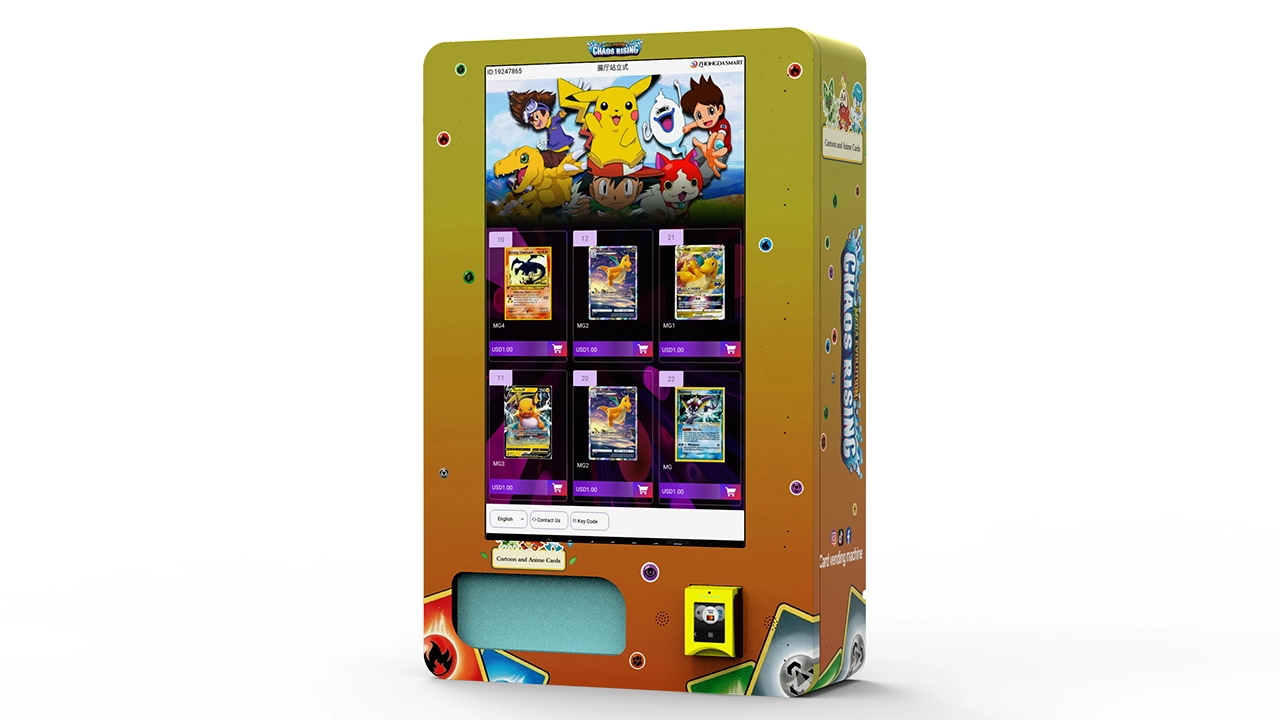
Pokemon Vending Machine ROI Examples
Payback should be calculated from the complete installed investment, not the advertised cabinet price.
The equipment may be only one part of the opening cash requirement. Other costs can include payment hardware, freight, duties where applicable, installation, graphics, spare parts, opening inventory, software, deposits, insurance, site preparation, and working capital.
Transaction Scenarios
| Transactions Per Day | Average Ticket | 30-Day Sales | Gross Margin at 30% |
|---|---|---|---|
| 3 | $25 | $2,250 | $675 |
| 5 | $25 | $3,750 | $1,125 |
| 8 | $25 | $6,000 | $1,800 |
| 12 | $25 | $9,000 | $2,700 |
Gross margin in this table is not profit. Location fees, payment processing, labor, software, connectivity, shrink, maintenance, tax, and other costs still have to be deducted.
Payback Example
Suppose the complete installed project costs $9,000 and the machine produces $750 in monthly contribution after its direct operating expenses.
Simple payback would be:
$9,000 ÷ $750 = 12 months.
If contribution falls to $450, simple payback stretches to 20 months.
If the same machine generates $1,125 of contribution, simple payback falls to eight months.
That range shows why a responsible quotation should not be presented as a guaranteed ROI calculation. The manufacturer controls machine cost and configuration. The operator controls—or at least influences—product sourcing, pricing, location, refill quality, uptime, and route efficiency.
A Break-Even Site Formula
A useful way to judge a site is:
Required Monthly Sales = Fixed Direct Site Costs ÷ Contribution Rate After Variable Costs
Assume a site has $500 of fixed monthly direct costs and the operation retains 25% after inventory cost and other variable transaction expenses.
$500 ÷ 0.25 = $2,000.
Under those assumptions, the machine needs about $2,000 in monthly sales just to cover those fixed direct site costs.
If the location has been open long enough to establish normal demand and remains well below that threshold, adding more inventory is unlikely to solve the underlying problem.
Do Not Ignore Working Capital
Fast-selling collectible stock can create an unexpected cash problem. Good sales require more inventory. More machines require more inventory again. If supplier terms require payment before resale, growth can consume cash before it creates free cash.
A ten-machine route holding $2,000 of average inventory in each cabinet has $20,000 tied up in machine stock before counting warehouse inventory.
That is why inventory turns belong in an ROI model. A slower-selling product with an attractive percentage margin can still be a poor use of capital.
What Hardware Matters for Trading Cards?
The most useful question is not “Which machine looks best?” It is “How does the product leave the machine?”
Trading card merchandise can include thin foil packs, sleeved packs, blister packaging, rigid deck boxes, display boxes, accessories, graded slabs, mystery products, and other formats. One delivery system will not be ideal for all of them.
Spiral Delivery
Spiral lanes are familiar, relatively simple, and cost-effective. They can work well for products with consistent dimensions and enough packaging stiffness to move forward cleanly.
Their weakness is also simple: the product has to cooperate with the coil.
A package that is too thin can shift. A bag with a loose edge can catch. A wide box can bind against dividers. A product placed incorrectly during restocking may lean into the neighboring lane.
Spiral systems should therefore be tested with the exact retail package rather than a box that happens to have similar dimensions.
Belt or Conveyor Delivery
Belt systems can provide a more controlled push for certain boxes and flexible packages. They reduce some of the problems created by a coil interacting with an irregular edge.
They still require correct channel width and product orientation. A belt does not make poor spacing irrelevant.
Elevator Delivery
An elevator-delivery machine collects the product on a moving platform and carries it toward the pickup area rather than allowing it to make a long drop.
This becomes more interesting as product value or damage sensitivity increases.
Zhongda Smart's elevator-delivery vending machine is an example of this architecture. The same principle can be considered for collectible projects where impact during delivery is a concern, although the final channel and cabinet design should be matched to the actual merchandise.
Locker Delivery
Lockers remove the drop almost entirely. A purchased compartment unlocks and the customer removes the product directly.
This is attractive for rigid, high-value, unusually shaped, or delicate goods. The trade-off is space efficiency. A locker wall usually provides fewer sellable positions per unit of cabinet volume than a dense channel layout.
Wall-Mounted Machines
A compact wall-mounted card machine can be useful when floor space is expensive or the merchandise range is deliberately narrow.
The format works best when the operator does not need hundreds of units between service visits. Less storage means refill planning becomes more important.
Hardware Comparison
| Delivery Format | Good Fit | Main Strength | Main Watchout |
|---|---|---|---|
| Spiral | Consistent packaged products | Simple and economical | Thin or irregular packs can catch or shift |
| Belt/conveyor | Boxes and selected flexible packages | Controlled product movement | Requires good channel sizing and alignment |
| Elevator | Premium or damage-sensitive merchandise | Reduced delivery impact | Higher machine complexity |
| Locker | Rigid, expensive, or oversized products | Very low drop risk | Lower storage density |
| Wall-mounted | Focused pack assortment | Small footprint | Lower reserve capacity |
If I were choosing hardware for a mixed collectible assortment, I would not approve the dispensing system until representative products had been physically tested. A specification sheet can tell you the channel width. It cannot prove that a foil edge will not catch after the lane has been refilled twenty times.
How to Reduce Card Damage and Failed Vends
Failed vending is one of the most expensive problems in collectible automation because it can create several costs from a single event: lost product, refund, payment dispute, support time, host frustration, and loss of customer trust.
Most failures can be traced to a small number of causes.
1. The Lane Does Not Match the Package
A product should have enough clearance to move without binding but not so much room that it rotates, leans, or falls sideways.
Measurements should include the actual outer package, not just the card dimensions.
2. The Product Was Tested Only Once
One successful vend proves very little.
The product should be tested from different positions in the lane, at different fill levels, and after repeated cycles. A problem may not appear until the last few units begin leaning differently from a full lane.
3. Restocking Changes the Product Orientation
A factory can deliver a correctly adjusted machine and the route can still experience jams if service staff load packages backward, compress them, mix package revisions, or overfill a channel.
A channel map inside the service door helps. Each lane can show the intended SKU, orientation, maximum quantity, and any spacer required.
4. The Delivery Drop Is Too Aggressive
A sealed booster pack may tolerate a short drop that is unacceptable for a rigid collectible box. Graded products need more protection again.
Product condition is part of the transaction. A machine that technically delivers a dented collectible has not created a good sale.
5. There Is No Reliable Vend Detection
Delivery sensors can help the control system determine whether merchandise actually reached the pickup area.
This can support cleaner handling of failed transactions, but the logic needs to be considered with the payment system. The operator should know what happens when payment succeeds and delivery does not.
A Practical Pre-Production Test Record
| Test Item | Record |
|---|---|
| Package dimensions | Width, height, depth, weight, and packaging type |
| Lane configuration | Lane width, coil/belt type, spacer, motor setting |
| Full-lane test | Successful vends / total cycles |
| Half-lane test | Successful vends / total cycles |
| Low-stock test | Successful vends / total cycles |
| Observed damage | None / cosmetic / unacceptable |
| Failure cause | Catch, rotation, double vend, sensor issue, drop damage, other |
| Final adjustment | Document the approved production configuration |
This kind of record is more valuable than a generic statement that a machine can sell “cards.” A 70 mm pack and a rigid slab in a protective sleeve may both contain cards, but they are completely different vending products.
Inventory Turns Matter More Than Machine Capacity
Large capacity sounds impressive on a product page. It is only valuable when the capacity is allocated to merchandise that sells.
A cabinet can be 90% full and still be commercially understocked if the most wanted SKU is empty.
Separate Inventory Into Four Roles
A workable assortment usually includes:
Traffic drivers: products customers specifically come to find.
Core products: dependable SKUs that produce regular turnover.
Margin builders: accessories or products that contribute attractive gross profit.
Test products: new SKUs given limited capacity until demand is proven.
Early in a route, test products should not dominate the cabinet. Variety can make a machine look interesting while quietly trapping cash in slow stock.
Calculate Days of Cover
Suppose a product sells 4 units per day and the machine holds 32 units of that SKU.
32 ÷ 4 = 8 days of cover.
If the route visits every seven days, that allocation leaves a modest buffer.
Now suppose the same SKU rises to 6 sales per day.
32 ÷ 6 = 5.3 days of cover.
A seven-day refill schedule is no longer enough.
The operator has four choices: increase the number of facings, increase units per lane, refill more often, or accept stockouts.
Only one of those choices requires a bigger machine.
Measure Stockout Time, Not Just Stockout Events
A product that sells out two hours before a scheduled refill is different from a product that remains unavailable for four days.
Track the percentage of selling time that important SKUs are unavailable. That tells you more about lost opportunity than simply counting how many times an item reached zero.
Move Inventory Between Machines
A multi-machine route should not treat every cabinet as a separate warehouse.
If one location has 40 units of a slow-moving product and another is about to sell out, transfer stock. Remote inventory data makes this possible before purchasing more merchandise.
Do Not Treat Route Inventory as a Collectible Investment
A product may become more valuable later. That can be a valid investment thesis, but it is a different activity from running a vending route.
Machine inventory should earn its space through sales, margin, customer acquisition, or a deliberate merchandising role.
If the plan is to hold sealed products for appreciation, keep that inventory outside the route and account for it separately.
How to Judge a Vending Location
“High traffic” is not enough information to approve a site.
The better question is whether the people passing the machine are likely to stop, understand the product, buy it, and come back.
A Simple Location Scorecard
| Factor | Weight | What to Evaluate |
|---|---|---|
| Relevant foot traffic | 25% | How many passersby plausibly buy cards, collectibles, gifts, or entertainment products? |
| Repeat visits | 20% | Do the same customers naturally return several times each month? |
| Visibility | 15% | Can customers notice the machine before they have walked past it? |
| Dwell time | 15% | Do people have enough time to stop, browse, and complete payment? |
| Security | 15% | Lighting, surveillance, staff presence, building access, and vandalism exposure |
| Service access | 10% | Can the route refill and repair the machine without excessive time or restrictions? |
A site can have lower raw traffic and still win if the traffic is better matched to the product.
Repeat visits are particularly valuable for collectible vending. A customer who passes the machine every week can notice restocks and new products. A location dominated by one-time traffic needs much higher discovery conversion to create the same effect.
Visibility Is a Physical Design Issue
The machine should be visible from the direction people naturally approach.
Avoid placing it behind structural columns, large promotional signs, queues, or doors that remain open in front of the screen.
Screen brightness should match the environment. A display that looks excellent in a factory showroom may be difficult to read in a brightly lit property.
Check the Network at the Exact Installation Point
“The building has Wi-Fi” is not a connectivity test.
Test the actual machine location. Concrete walls, service corridors, basement placement, competing networks, or captive login pages can create payment and telemetry problems.
Where practical, cellular or wired connectivity can provide an alternative.
Measure Before Moving
Before declaring a location bad, separate a traffic problem from an assortment problem.
If many people stop but few buy, check pricing, product mix, interface, payment failures, and trust signals.
If almost nobody stops, the problem is more likely visibility, traffic quality, or placement.
If customers buy once but do not return, restock frequency and assortment freshness deserve attention.
Payments, Telemetry, and Remote Management
A modern smart vending machine should be considered a connected retail terminal, not just a motorized cabinet.
Payment is the first layer.
Federal Reserve data released in 2026 reported that cards represented 79% of noncash payments by number in the study's 2024 data. That does not mean every machine should remove cash. It does mean card and contactless acceptance deserve first-class treatment in the design.
Payment Questions to Resolve Before Production
Which terminal will be installed?
Which processor or acquiring setup will be used?
Who owns the terminal?
What are the transaction fees?
How are refunds handled?
How are failed vends handled after successful payment?
Can the terminal be replaced later?
Does the machine support the required communication protocol?
What happens when the network connection is lost?
A low-cost terminal can become expensive if it creates long-term processing restrictions. Review the commercial agreement as carefully as the hardware.
Remote Management Should Answer Operational Questions
A dashboard is useful when it tells the route what to do next.
At minimum, I’d want a collectible vending system to make these questions easy to answer:
Which machine needs a refill?
Which high-demand SKU is approaching zero?
Which unit has lost network connection?
Which machine has repeated payment failures?
Which channel has produced failed vends?
Which location is producing the strongest contribution?
Which product is slow enough to be moved elsewhere?
Zhongda Smart's current custom trading card vending machine lists 4G, Wi-Fi, and LAN connectivity options, along with remote inventory, transaction records, sales reporting, pricing, and machine-status functions depending on the final configuration.
Those functions should still be confirmed in the quotation and final technical specification. OEM vending equipment is project-based; two cabinets that look similar can have different payment modules, software functions, and internal channel layouts.
Remote Pricing Needs Restraint
The ability to change a price remotely does not mean prices should change constantly.
Collectible buyers notice pricing. A machine that appears unpredictable can lose trust quickly. Remote control is most useful for correcting prices, changing promotions, managing releases, or updating multiple machines consistently.
Maintenance and Vending Machine Repair
Vending machine repair becomes cheaper when the route knows what failed before a technician arrives.
That sounds obvious, but many service logs still contain descriptions such as “machine jammed” or “reader problem.” Those notes do not create useful maintenance history.
Record the Failure Precisely
A service record should include:
Machine ID
Date and time
Location
SKU and channel
Error code
Customer-reported symptom
Technician diagnosis
Corrective action
Parts replaced
Service minutes
Whether the same problem occurred previously
After several months, patterns become visible.
Perhaps one package repeatedly catches in the same coil. Perhaps a door sensor fails after vibration. Perhaps one site has network interruptions at the same time every day. Perhaps the payment problem is not the vending machine at all.
Preventive Maintenance Does Not Need to Be Complicated
A refill visit can include a short checklist:
Clean the touchscreen and payment area.
Remove dust and debris around the pickup compartment.
Inspect delivery sensors.
Test channels that recently showed errors.
Check locks and hinges.
Inspect cables visible to service staff.
Confirm network connection.
Review error history before leaving.
The best time to discover a developing problem is during a scheduled visit, not after a customer calls.
Keep the Common Parts Close to the Route
A single machine can wait for a shipped spare. A larger fleet needs a different plan.
Common motors, sensors, locks, power supplies, cables, fuses, network components, and selected payment or control parts can justify local inventory when downtime becomes expensive.
The correct spare list depends on the machine platform. It should come from actual failure history rather than buying one of every part.
Design for Replacement, Not Just Assembly
Serviceability should be considered before production.
Can the touchscreen be removed without dismantling half the front door? Can a motor be changed with normal tools? Are connectors labeled? Can a technician identify the correct control board from the documentation?
A machine that is easy to assemble at the factory is not automatically easy to repair at a site.
Branding, Licensing, and Trademark Boundaries
The commercial value of collectible products makes branding discipline especially important.
An independent operator may be able to resell authentic merchandise without having rights to copy the brand's logo, character artwork, cabinet design, promotional graphics, or official-store presentation.
These are separate questions:
Was the merchandise lawfully obtained for resale?
Does a distribution or supply agreement restrict the sales channel?
May the product name be used descriptively?
May the logo be reproduced?
May copyrighted character artwork be placed on the cabinet?
Could the overall design imply official affiliation?
A “yes” to the first question does not automatically create a “yes” to the others.
This is why an independently branded machine is usually the cleaner starting point. The vending operator owns or controls the cabinet identity while the products retain their own packaging and trademarks.
Product descriptions should be accurate without turning the machine itself into a representation of an official outlet.
The same rule applies online. A product or article can discuss a pokemon vending machine or vending equipment used for Pokémon TCG merchandise without claiming that Zhongda Smart manufactures the official automated retail machines operated by the rights holder.
Zhongda Smart's role is vending-machine manufacturing and customization. Buyers remain responsible for supplying branding material they have the right to use and for confirming that the intended retail model complies with their product sourcing and licensing arrangements.
For a significant rollout, qualified legal advice should be obtained for trademark use, copyrighted artwork, distribution agreements, privacy, customer disclosures, and other requirements relevant to the actual project.
What to Look for in a Trading Card Vending Machine Manufacturer
Buying a vending cabinet and developing a reliable card-vending system are not quite the same job.
For a generic packaged product, an existing machine may need only minor channel adjustment. For a mixed collectible assortment, the manufacturer may need to review different packages, delivery systems, payment hardware, software, cabinet security, branding, and refill access.
1. Ask Whether the Factory Wants Product Samples
A manufacturer that is configuring a machine around real merchandise should want dimensions at minimum and physical samples when practical.
“It fits” is not the same as “it vends reliably.”
2. Ask What Is Actually Customizable
OEM can mean very different things.
On one project it may mean applying a logo sticker to a standard cabinet. On another it may include channel design, cabinet dimensions, payment integration, software language, touchscreen interface, lighting, security, remote management, and delivery mechanics.
Put every requested change into the written specification.
3. Confirm the Final Capacity With Your Products
Capacity should always be tied to package dimensions.
Zhongda Smart's custom card platform currently publishes a broad reserve range of 300 to 1,200 pieces across configurations, while its example customized layout describes approximately 300 to 600 cards or packs depending on product dimensions.
Those numbers are not contradictory when treated as different configurations, but a buyer should never order based on the highest headline number.
Ask for the expected capacity of your SKU mix.
4. Confirm Payment Integration in Writing
Do not assume that a machine that supports a credit-card reader automatically supports the specific terminal or processor you want.
Payment module, communication protocol, mounting, software communication, settlement setup, and processor relationship all need to align.
5. Ask About Factory Testing
Testing should cover more than turning the machine on.
Useful checks include assembly inspection, payment test, product delivery test, sensor test, network test, screen operation, door and lock inspection, and an operating or aging test appropriate to the final machine.
6. Ask What Happens After Delivery
A machine will eventually need support.
Confirm warranty terms, remote troubleshooting, software support, replacement-part availability, documentation, and how technical issues are escalated.
7. Make the Quotation Specific
A useful quotation should identify:
Machine model
Cabinet dimensions
Screen
Product channels
Expected capacity
Delivery system
Payment hardware preparation
Network configuration
Remote management functions
Branding
Voltage and plug
Required certifications or project compliance work
Spare parts
Warranty
Packaging
Production lead time
The cheapest quote is difficult to evaluate when half of those items are missing.
Where Zhongda Smart Fits
Zhongda Smart is most relevant when a buyer needs more than an off-the-shelf snack cabinet with new graphics.
The company's current public manufacturing information lists approximately 20,000 square meters of operating space, more than 400 employees, an engineering team of more than 10 people, three assembly lines, more than 20 quality inspectors, four sheet-metal processing workshops, a painting line, and annual production capacity of about 10,000 vending units.
Those are company-published figures and should be read as manufacturing-capability information rather than a guarantee for any individual project.
More detail on the production setup is available in Zhongda Smart's factory manufacturing overview.
The current product range includes conventional vending machines as well as wall-mounted machines, trading card equipment, locker systems, elevator-delivery machines, refrigerated equipment, beauty vending machines, and custom smart retail projects.
That range matters for card vending because collectible products do not all require the same cabinet.
A small pack may work well in a simple channel. A premium box may justify controlled delivery. A slab may be better suited to a protected compartment. A high-volume route may prioritize capacity, while a space-constrained site may prioritize a wall-mounted format.
Current Custom Trading Card Platform
Zhongda Smart's published custom/OEM trading card platform currently lists:
MOQ starting from one unit
21.5-inch touchscreen with larger display options
4G, Wi-Fi, or LAN connectivity depending on configuration
Multiple payment configurations
Remote inventory and sales management functions
Custom exterior branding and interface design
Configurable channels for different packaged card products
Options for protected or gentle delivery depending on the project
One-year standard-machine warranty subject to the final sales agreement
The product page currently shows a reference price of $1,999 for the custom card platform. That should not be treated as the installed cost of every trading card vending project. Capacity, screen, cabinet, payment system, delivery method, software, branding, certification work, and other specifications can change the final quotation.
For that reason, I’d rank Zhongda Smart more highly for buyers who are willing to provide real product dimensions and build the machine around a defined operating plan. A generic inquiry such as “send me your best Pokémon machine” does not give the engineering team enough information to recommend the correct configuration.
Information That Makes a Quote More Useful
A serious request should include:
Photos of the merchandise
Package dimensions
Package weight
Number of SKUs
Desired units per SKU
Required payment methods
Preferred screen size
Expected machine quantity
Indoor or protected installation conditions
Branding requirements
Any fragile or premium items requiring special delivery
Buyers who want more background on the company can review the Zhongda Smart manufacturing profile.
The goal of customization should be simple: make the machine fit the merchandise and the operating model rather than forcing the operating model to fit a generic cabinet.
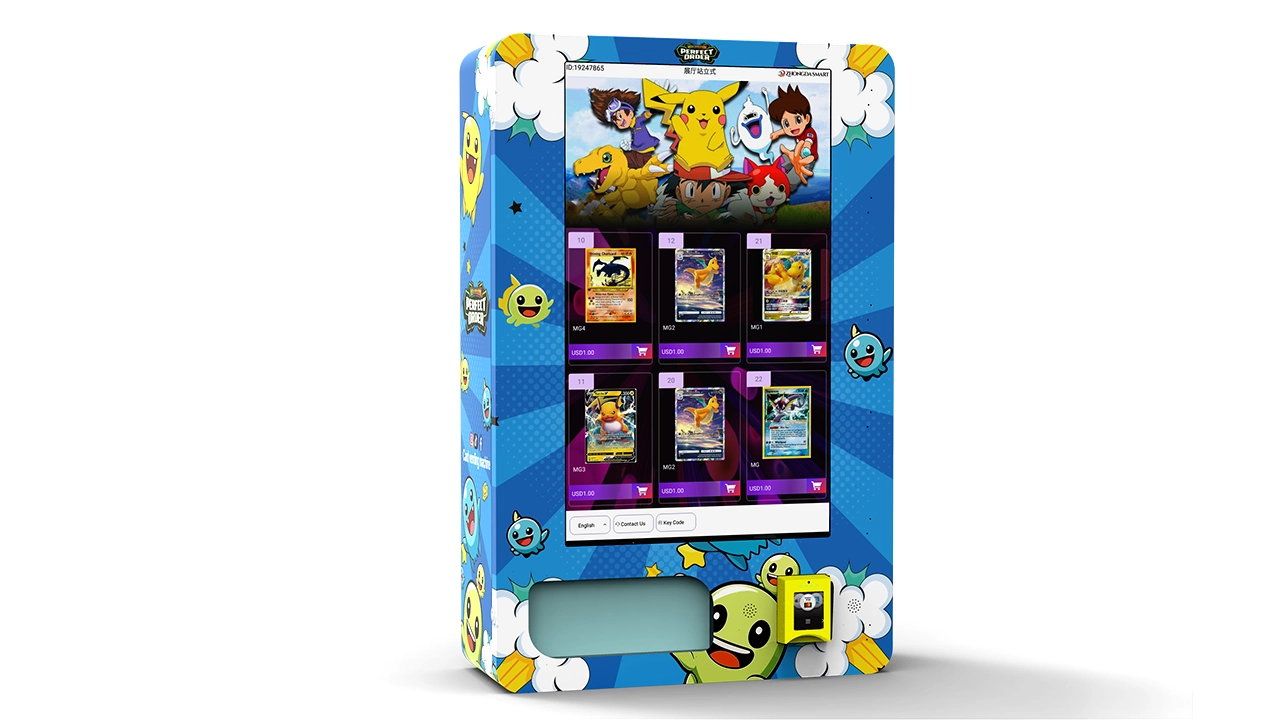
A Practical 90-Day Operator Plan
A first machine should be treated as a measured pilot.
Ninety days is long enough to expose many of the weaknesses that are invisible during a showroom demonstration: slow inventory, incorrect lane allocation, poor visibility, unreliable connectivity, inconvenient restocking, repeated payment failures, or host terms that looked better on paper.
Days 1–15: Build the Numbers
Choose the initial product categories.
Confirm lawful, repeatable inventory supply.
Calculate realistic merchandise margin.
Set a maximum acceptable host cost.
Estimate complete installed machine cost.
Set low, base, and high monthly sales assumptions.
Define the maximum acceptable simple payback period.
Do this before choosing cabinet graphics.
Days 16–30: Define the Machine
Measure every representative package.
Choose tentative delivery mechanisms.
Confirm payment requirements.
Confirm network options.
Decide whether delivery verification is required.
Define cabinet security.
Prepare independent branding.
Agree on remote management requirements.
Send sample products when practical and request repeated vending tests.
Days 31–45: Secure the Site
Score the proposed location rather than relying on impressions.
Confirm power, network signal, visibility, access hours, refill logistics, security, and host compensation.
Put support responsibility in writing.
Days 46–60: Prepare Inventory and Software
Build the SKU list before installation.
Every product should have a channel, price, starting quantity, reorder threshold, and intended refill quantity.
Test the payment terminal and remote dashboard before the machine becomes customer-facing.
Days 61–75: Watch Real Customers
The first two weeks of live operation are valuable.
Look for hesitation at the screen. Review declined payments. Compare physical inventory with software counts. Check the condition of delivered products. Track how quickly the first fast-moving SKUs reach their reorder levels.
Do not change ten variables at once. If the machine is underperforming, change one meaningful factor and measure the result.
Days 76–90: Make Decisions
At the end of the pilot, calculate:
Revenue per machine-day
Transactions per day
Average ticket
Gross merchandise margin
Contribution after direct costs
Stockout hours for major SKUs
Vend failure rate
Payment failure rate
Service minutes per visit
Travel time per refill
Inventory turnover
Then make one of four decisions:
Keep the machine and optimize it.
Increase capacity or refill frequency.
Move the machine.
Replicate the site because the economics are proven.
Expansion should come after the route can explain why the first machine works.
The Metrics Worth Reviewing Every Week
Gross sales deserve attention, but they are not enough to manage a collectible vending route.
| Metric | Calculation | What It Tells You |
|---|---|---|
| Revenue per machine-day | Sales ÷ active operating days | Normalizes performance between machines |
| Transactions per day | Completed transactions ÷ operating days | Shows purchase frequency |
| Average ticket | Sales ÷ transactions | Shows product and basket value |
| Gross merchandise margin | (Sales − inventory cost) ÷ sales | Shows product-level economics |
| SKU sell-through | Units sold ÷ units made available | Identifies fast and slow products |
| Stockout time | Hours unavailable ÷ operating hours | Shows how much selling time is being lost |
| Vend failure rate | Failed deliveries ÷ paid vend attempts | Measures dispensing reliability |
| Payment failure rate | Failed payment attempts ÷ payment attempts | Identifies checkout friction |
| Service time per $1,000 sales | Service minutes ÷ sales × 1,000 | Shows route efficiency |
| Contribution margin | Sales less direct merchandise and operating costs | Shows whether the site creates cash before general overhead |
The last metric deserves the most attention.
If revenue grows 20% while contribution grows 3%, the route is becoming less efficient.
If contribution grows faster than sales because refill density improves and purchasing gets better, expansion is working.
A weekly review should end with actions. Which SKU gets more capacity? Which machine needs service? Which location needs a refill sooner? Which item should move to another cabinet? Which host agreement no longer makes sense?
A dashboard is useful only when those decisions become easier.
Common Mistakes That Make a Good Concept Unprofitable
Buying the Machine Before Solving Inventory Supply
The cabinet is not the scarce resource if the products customers want cannot be sourced consistently.
Confirm supply first.
Choosing a Site Because It Sounds Prestigious
A famous property with expensive rent can lose money. A smaller site with repeat customers and reasonable host terms can produce stronger contribution.
Trying to Carry Too Many SKUs
More variety is not always more valuable. Slow SKUs consume cash and physical capacity.
Using the Cheapest Delivery System for Every Product
Saving on hardware can become expensive when premium products arrive damaged or fail to dispense.
Ignoring Customer Support
Unattended retail still has customers.
The machine should display a support route and unique machine ID so the operator can identify the transaction and equipment quickly.
Scaling Before Standardizing the Refill Process
Two machines can be managed from memory. Twenty should not be.
Standardize channel maps, stock sheets, pricing rules, support procedures, payment troubleshooting, and parts before expansion.
Using Unauthorized Artwork
A custom cabinet should not become a shortcut around intellectual-property rights.
Build an independent retail identity unless the required permissions have been obtained.
Comparing Machines Only by Purchase Price
A $500 saving can disappear after a few major service events.
Compare total installed cost, product fit, payment compatibility, reliability, support, spare parts, software, and serviceability.
What the Pokemon Vending Machine Model Suggests About the Next Stage of Collectible Retail
Specialized vending is likely to become less defined by the cabinet and more defined by the product workflow.
The old vending model started with a standard machine and asked what products could fit inside it.
Custom automated retail increasingly starts with the opposite question: what does the business need to sell, and what machine architecture handles those products reliably?
That change favors modular systems.
One operator may need dense pack capacity. Another needs a mix of packs and boxes. Another wants premium collectible lockers. Another has almost no floor space and needs a wall-mounted unit.
Payment and software will continue to become more important as well. A cabinet with 500 products but no reliable stock reporting creates unnecessary site visits. A machine that cannot identify failed payments or delivery problems creates support work that grows with the fleet.
Inventory forecasting is another natural development.
Once machines collect daily SKU-level sales, the operator can calculate expected stockout dates instead of waiting for a simple low-stock alert. That allows restocking to be grouped geographically and inventory to be moved before a machine runs empty.
The best operators will also become less dependent on one collectible category. A machine platform and brand that can support several compatible products gives the route flexibility when supply conditions or customer demand change.
That is the broader lesson from the pokemon vending machine model.
The value is not in copying a recognizable cabinet. The value is in understanding why a customer is comfortable buying a specialized product without a cashier, then building the inventory, hardware, payment, location, and support system that makes that transaction reliable.
Frequently Asked Questions
Can I buy an official Pokemon vending machine?
No. Pokémon Center support states that the official automated retail vending machines are owned and operated by The Pokémon Company International and that there are currently no plans to sell them. An independent operator can instead purchase or commission an independently branded trading card vending machine designed for lawfully sourced collectible products.
Can a custom vending machine sell Pokémon trading cards?
A properly configured machine can physically sell packaged trading card products when their dimensions and packaging are compatible with the selected dispensing system. The business is responsible for lawful merchandise sourcing and for complying with applicable distribution, resale, branding, and intellectual-property requirements.
How much does a pokemon vending machine cost?
Cost depends on cabinet size, capacity, screen, delivery system, payment hardware, software, security, branding, and project requirements. Zhongda Smart currently publishes a $1,999 reference price for its custom/OEM trading card platform, but the final quotation depends on configuration. Freight, payment setup, opening inventory, installation, spare parts, and other deployment costs should be budgeted separately.
What is the best dispensing system for booster packs?
Spiral, belt, or conveyor systems can work for booster packs when the package fits the channel correctly and repeated tests show reliable delivery. The correct choice depends on package dimensions, stiffness, edge shape, desired capacity, and the internal layout of the machine.
What is the safest vending method for premium boxes or graded cards?
Elevator or locker delivery is worth considering when product condition and drop impact are important. Locker systems avoid most drop-related handling, while elevator systems can carry merchandise toward the pickup compartment more gently than a long free fall. Exact products should still be tested before production.
How profitable can a trading card vending machine be?
There is no reliable universal profit figure. Results depend on merchandise margin, transaction volume, average ticket, host cost, payment fees, restocking labor, shrink, maintenance, and downtime. Calculate contribution after direct costs and compare that figure with the complete installed investment when estimating payback.
Which metrics should I track first?
Start with revenue per machine-day, transactions per day, average ticket, gross merchandise margin, sell-through by SKU, stockout time, vend failure rate, payment failure rate, service time, and contribution after direct operating costs. These numbers show whether the problem is product demand, machine reliability, inventory allocation, or site economics.
Why consider Zhongda Smart for a custom trading card machine?
Zhongda Smart manufactures OEM/ODM vending equipment and currently offers custom trading card configurations with low-quantity prototyping, touchscreen options, remote management, several connectivity choices, customizable product channels, branding, and different delivery architectures. Final suitability should be confirmed through a written specification and testing with the products the buyer plans to sell.
Sources and Data Notes
The Pokémon Company — Pokémon Vending Machines: Providing Merch and Blending in With Daily Life. Used for the company's description of Pokémon Stands, Pokémon Card Stands, site testing, product-discovery strategy, and continued expansion of physical vending touchpoints. View source
Pokémon Center Support — Pokémon Automated Retail Vending Machine FAQ. Used for information concerning official automated retail machines, machine ownership, customer support, and availability for purchase. View source
NAMA Foundation — The 2024–25 State of Convenience Services Industry Census. Used for the 2025 industry revenue estimate, the 2023 comparison, reported average annual growth, and the report's forward growth projection. Figures apply only to the market and business categories covered by that census. View source
Federal Reserve — Initial Findings From the 2025 Triennial Payments Study. Used for the reported 236.6 billion noncash payments in 2024 and the share represented by card payments. Figures apply to the market and methodology defined in that study. View source
Data note: No authoritative source reviewed for this article published a verified 2026 year-over-year growth figure of exactly 27% for the official Pokémon automated retail network. For that reason, this version does not use the earlier 27% claim. External statistics cited above describe only the scope defined by the original source and should not be interpreted as global Pokémon vending-machine market figures.
Zhongda Smart specifications, reference pricing, manufacturing capacity, staff numbers, factory size, OEM/ODM information, and product functions in this article are based on the company's publicly available pages at the time of the last update. Project specifications and prices can change and should be confirmed in a written quotation.
Disclaimer
This article is provided for general manufacturing, retail, and business-planning information. It is not legal, tax, financial, investment, licensing, or earnings advice. Revenue, margin, transaction, break-even, and payback examples are illustrative scenarios rather than guaranteed results.
Pokémon, Pokémon Center, Pokémon TCG, related names, character artwork, logos, and other protected assets belong to their respective rights holders. Zhongda Smart is an independent vending-machine manufacturer and is not presented as the manufacturer, seller, owner, operator, sponsor, or authorized representative of the official Pokémon automated retail program.
Operators are responsible for confirming product sourcing rights, distribution restrictions, trademark and copyright permissions, customer disclosures, payment requirements, privacy obligations, host agreements, insurance, taxes, equipment compliance, and any other rules applicable to their specific project.