For most standard booster packs, I would start with a properly configured spiral system. It gives you strong capacity, relatively simple mechanics, and a lower-cost path to reliable dispensing. For graded slabs and individually valuable collectibles, a locker is usually the safer choice because the product does not need to take a long drop. If one machine needs to handle booster packs, boxed products, slabs, accessories, and other package sizes together, an elevator is often the strongest all-around solution.
That is the short version of the Best Delivery System for Trading Cards. The longer answer matters because delivery reliability depends less on what a mechanism is called and more on how the exact product behaves inside it. Package thickness, stiffness, weight, surface friction, lane width, drop distance, product value, refill frequency, and expected sales volume can all change the right choice.
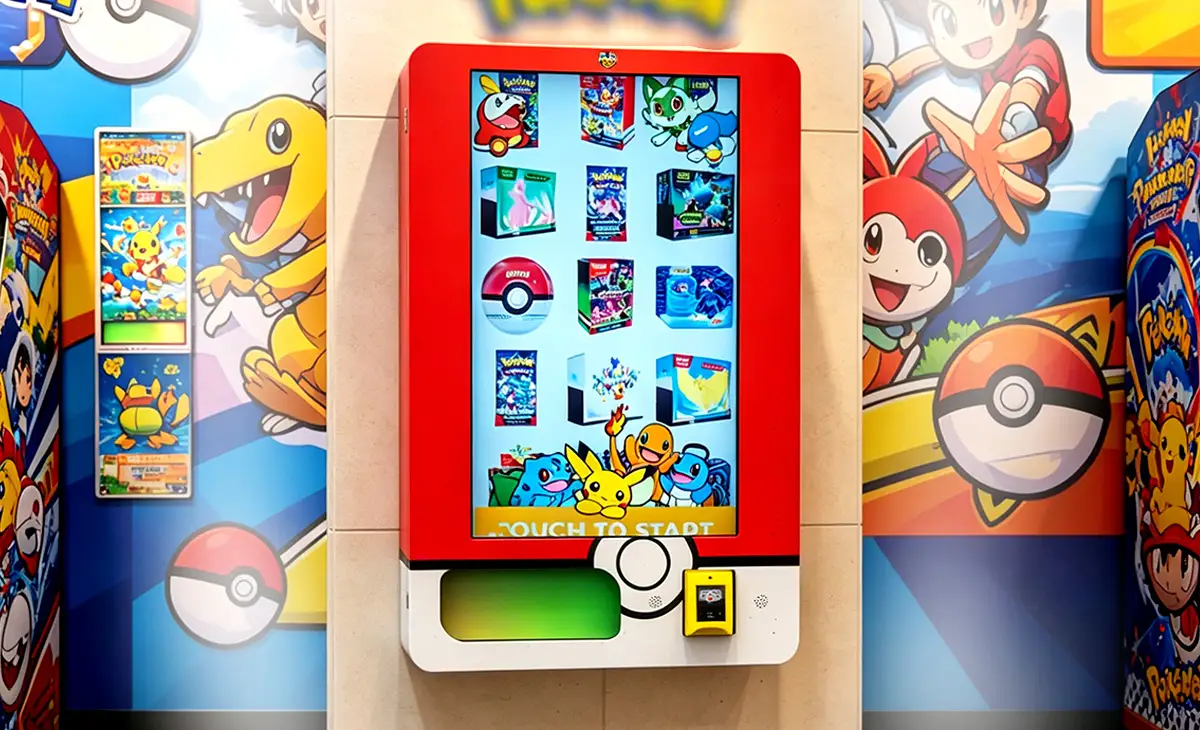
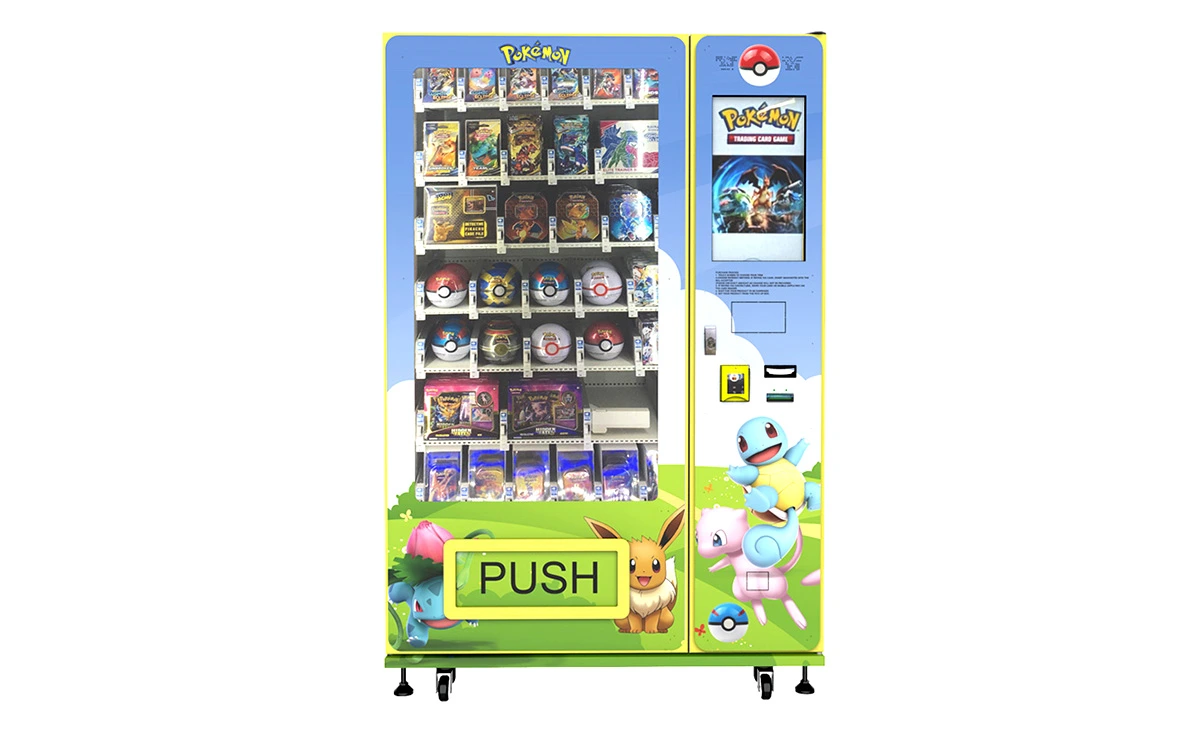
I would never order a trading card vending machine based only on a catalog photo. I want to see the actual product loaded into the proposed delivery system, watch it dispense repeatedly, and understand what happens when something does not go exactly as planned. For collectible products, that mechanical work matters far more than a flashy screen or decorative cabinet lighting.
Spiral vs Locker vs Elevator: The Short Answer
I do not believe there is one delivery mechanism that should be installed in every trading card vending machine. Each of the three main systems solves a different problem.
Spiral delivery is usually the first system I consider when the assortment is dominated by standard sealed packs, sleeved boosters, small accessories, or other products with repeatable dimensions. It uses cabinet space efficiently, individual lanes can be configured for different SKUs, and the mechanism is comparatively straightforward to service.
Locker delivery makes more sense when the merchandise is individually valuable, physically sensitive, or too irregular for a conventional dispensing lane. The product remains in a compartment until payment releases the door. There is little or no conventional drop, which is exactly what I want for a graded slab, premium bundle, or collector product where condition is part of the value.
Elevator delivery sits between those two approaches. Products can still be stored efficiently on shelves or configurable lanes, but the final delivery is handled by a moving platform rather than relying on a long uncontrolled fall. That makes an elevator attractive when the assortment is broad and package protection matters.
| Factor | Spiral | Locker | Elevator |
|---|---|---|---|
| Best fit | Booster packs, sleeved packs, small accessories | Graded slabs, premium items, individually protected products | Mixed packs, boxes, slabs, and premium products |
| Storage efficiency | Excellent | Lower | Very good |
| Product protection | Moderate | Excellent | Excellent |
| Mechanical simplicity | Excellent | Good | Moderate |
| Package-size flexibility | Moderate | Very good | Excellent |
| High-value product suitability | Limited without special packaging | Excellent | Excellent |
| Typical starting point | Booster-heavy machine | Slab or premium-product machine | Mixed collectible machine |
If I had to turn that table into one buying rule, it would be this: use the simplest delivery system that can dispense your actual products repeatedly without damaging them or creating an unacceptable service burden.
There is no prize for buying the most complicated mechanism. There is also no real saving in buying a cheap delivery system that causes refunds, damaged packages, double vends, or constant technician visits.
Why Trading Cards Are Harder to Vend Than They Look
A booster pack looks easy to vend because it is small. Mechanically, small does not mean simple.
A bottle has weight, depth, and a relatively predictable center of gravity. A boxed snack normally has enough structure to remain upright. A thin foil booster pack can lean, flex, twist, slide underneath another pack, or move differently as the lane gets emptier.
That is the first reason a general-purpose vending cabinet should not automatically be assumed to work for collectible cards.
Thin Packaging Creates Separation Problems
The thinner the product, the more carefully I look at how one unit is separated from the next.
Imagine two foil packs sitting next to each other in a wide coil. When the spiral rotates, the front pack should move toward the edge while the pack behind it remains controlled. If the pitch is too large, both can move. If the lane is too wide, the front pack can rotate. If the pack is allowed to lean, it can change its relationship to the coil halfway through the vend.
A machine may run perfectly during a five-vend demonstration and behave differently when the lane is fully loaded. It may change again when only four products remain.
That is why I care about the entire inventory cycle, not one successful release.
Package Condition Has Financial Value
A customer buying an ordinary consumable product usually does not care about a tiny scuff on the wrapper. Collectors can be much more demanding.
A crushed collector box corner, damaged sleeve, scratched graded-card holder, torn outer package, or visibly bent blister can change the perceived value of the purchase immediately.
This is one of the main reasons the delivery system has to be matched to the merchandise rather than selected by machine price alone.
A lightweight booster falling a short distance into a padded pickup bin is very different from a larger collector box falling from the top shelf of a tall cabinet.
Trading Card Assortments Rarely Stay Uniform
Another problem appears after the machine has been operating for a while.
The product mix changes.
You may begin with ordinary booster packs and later add sleeved packs, deck boxes, mystery bundles, sports card products, collectible boxes, top loaders, sleeves, accessories, or graded cards. A layout optimized for the first ten SKUs may be a poor fit six months later.
This is where delivery-system flexibility starts to have a measurable business value.
A cheaper cabinet that can only handle one narrow package range may work brilliantly for a focused business. It may also become restrictive if the operator wants to broaden the assortment.
The Product Is Small, but Inventory Value Can Be High
A trading card vending machine can hold substantial inventory value in a relatively compact cabinet. That raises questions beyond basic dispensing.
I want to know how the pickup area prevents reverse access. I want transaction records to match physical inventory movement. I want remote stock information to make sense. I want the operator to know whether a product actually reached the pickup point after payment.
None of those issues is solved by saying the machine has a touchscreen.
Spiral Delivery: Best for Capacity and Simplicity
Spiral vending remains one of the most useful mechanisms in automated retail for a simple reason: it does a lot of work with relatively few parts.
A motor rotates a coil. The coil advances the merchandise. The front product passes the end of the shelf and moves into the collection area.
For the right trading card package, that is all you need.
Why I Start With a Spiral for Many Booster-Pack Projects
My first reason is storage density.
Thin products do not need a large individual compartment. A shelf can be divided into multiple narrow lanes, allowing the operator to carry several SKUs and reasonable quantities of each.
That matters because card demand is rarely distributed evenly. One release may sell rapidly while another moves slowly. The ability to allocate deeper lanes or more lanes to fast-moving products can reduce stockouts.
The second reason is fault isolation.
In a conventional multi-lane spiral machine, one lane usually has its own dispensing motor or dedicated actuation mechanism. If that lane develops a problem, other lanes can often remain available.
That is operationally attractive. A failure does not necessarily remove the entire cabinet from service.
The third reason is maintenance familiarity. Spiral systems are mechanically easy to understand. An operator can visually inspect the coil, product position, lane divider, shelf, motor connection, and release point without needing to diagnose a moving lift assembly.
The Spiral Itself Is Not the Whole Delivery System
This is an important distinction.
A poor card-vending design may use the correct coil but still fail because the rest of the lane is wrong.
When I look at a spiral configuration for trading cards, I pay attention to:
coil diameter;
coil pitch;
number of products between turns;
lane width;
side guides;
rear support;
product stiffness;
shelf surface friction;
product loading direction;
final coil position;
distance from shelf edge to pickup area;
pickup-bin cushioning;
vend detection or drop detection, when installed.
A change of a few millimeters in the lane can matter more than a large change in screen size.
Thin Booster Packs Are Where Spiral Design Gets Unforgiving
The most common mistake is assuming that because the pack fits inside the lane, the lane is correct.
Fit is only the beginning.
A booster should stay oriented correctly while the coil turns. The next booster should remain behind it. The released pack should clear the shelf completely. Nothing should catch on a foil edge, cardboard tab, or another package.
There are several ways to improve control. Depending on the product, I may consider narrower side guides, a backing plate, a support card, a different coil pitch, a product pusher, or an outer retail sleeve.
The right solution is determined by testing, not by a generic rule.
When a Spiral Is More Than Good Enough
If I have a sealed product with consistent dimensions, moderate value, good package stiffness, and a lane that repeatedly releases one unit at a time, I do not see a reason to add an elevator just because an elevator sounds more advanced.
Simple machinery has advantages.
It usually costs less to purchase, contains fewer centralized moving components, and can be easier to troubleshoot. A route with many machines also benefits from standardized spare parts and repeatable service procedures.
This is the situation where I would tell a buyer not to pay for unnecessary complexity.
If 80 or 90 percent of the planned assortment consists of compact packs that already perform reliably in a spiral system, an elevator may never earn back its extra cost.
When I Would Stop Trying to Make a Spiral Work
There is also a point where further adjustment stops making sense.
If the product rotates unpredictably, releases two units together, hangs at the shelf edge, or needs so much secondary packaging that capacity is destroyed, I start looking at another delivery method.
I also become cautious when the product itself is expensive enough that a single damaged package creates a meaningful loss.
A premium graded slab is a good example. A hard plastic holder may protect the card, but that does not mean I want it bouncing through an uncontrolled delivery path. Surface scratches and edge impact still matter.
Likewise, a large collector box carries more mass than a booster pack. Even if a spiral can physically push it forward, the final drop may be the wrong way to finish the transaction.
Locker Delivery: Best for High-Value Products
Locker vending takes a very different approach. Instead of making the merchandise travel through the machine, the machine controls access to the merchandise.
The selected product sits inside a defined compartment. After payment, the corresponding door unlocks.
For certain collectible products, I like that simplicity very much.
The Biggest Advantage Is What Does Not Happen
The product does not need to fall from the top shelf.
It does not have to slide between two other products.
It does not need to clear a coil.
It does not need to land on an elevator platform.
It simply waits inside its compartment until the customer opens the door.
That makes locker delivery an excellent candidate for graded slabs, signed merchandise, premium bundles, limited collector products, rigid cases, and other SKUs where the value of one item justifies giving it dedicated space.
Individual Inventory Positions Can Be Useful
Lockers also make inventory identification easy to understand.
If product A is in compartment 17, the software can associate that exact sale with that exact compartment. For unique products, that can be cleaner than putting several similar-looking items in one deep lane.
This becomes particularly useful if the merchandise is not interchangeable.
Ten sealed booster packs from the same SKU can be treated as ten units of one inventory item. Ten graded cards may be ten completely different products, each with its own image, description, price, and identification number.
Locker vending fits that one-product-to-one-position model naturally.
The Price You Pay Is Cabinet Density
The problem with lockers is not product protection. It is space utilization.
A dedicated compartment consumes physical volume even when the product inside is thin.
Putting one small booster pack into a compartment large enough to hold a boxed collectible makes little economic sense unless the retail concept specifically depends on that presentation.
This is why I compare gross-profit opportunity per unit of cabinet space, not just the number of doors.
Imagine one compartment holds a premium item that generates $25 of gross profit. The same physical space in a spiral layout might hold eight small packs that each generate $3.50 of gross profit.
The premium compartment represents $25 of potential gross profit per stock cycle. The dense pack layout represents $28.
That is already close, and sales speed can reverse the result completely.
If the premium item sells once every two weeks while the packs turn over every few days, the dense layout can generate far more contribution from the same cabinet volume.
If the premium item could not be sold safely without a locker, however, the comparison changes again.
Locker Machines Have Their Own Failure Points
A locker eliminates many dispensing failures, but it does not eliminate machine failures.
The key mechanical component becomes the locking system.
I want to know what happens when the controller sends an unlock command and the lock does not report an open state. I want to know whether the customer can accidentally close the door before removing the item. I want to know how the machine handles a door that is not fully latched after restocking.
I also care about customer guidance.
If the screen displays “Compartment 38,” the correct door should be obvious. A small indicator light, clear numbering, or visible door highlight can save a surprising amount of confusion.
Locker vending therefore moves complexity away from product handling and toward door control, software logic, and user guidance.
Elevator Delivery: Best for Mixed Premium Products
When the machine needs to sell a broad assortment and package condition matters, I usually look closely at an elevator.
An elevator system receives the selected product and moves it toward the pickup point on a controlled platform. Instead of asking a box or slab to fall most of the height of the cabinet, the machine brings the collection platform closer to the product.
That one change can make a large difference to the range of products the cabinet can handle.
Why an Elevator Works Well With Mixed Merchandise
Consider a machine containing ordinary boosters, sleeved boosters, deck boxes, collector boxes, small accessories, and graded slabs.
Those products have very different physical characteristics.
A spiral-only design is excellent for the small packs but becomes less attractive as the products get larger or more sensitive.
A locker can protect all of them, but assigning an individual compartment to each small product wastes space.
An elevator can preserve relatively dense shelf storage while controlling the final delivery.
That balance is why I see elevator vending as the strongest premium option for a genuinely mixed collectible assortment.
An Elevator Does Not Make the Entire Product Path Gentle Automatically
This is one of the most important engineering points in the guide.
People sometimes see the word “elevator” and assume the product can no longer be damaged.
That is not necessarily true.
The product still has to leave its storage position. It still needs to transfer onto the platform. It must remain stable while the platform moves. It needs to leave the platform and enter the customer pickup area.
If any of those transitions is poorly designed, damage can still occur.
For a trading card machine, I therefore watch the complete vend cycle.
If a boxed product falls a short distance onto the lift, does it land flat?
Does it hit a hard sidewall?
Can a thin pack slide underneath a guide?
Does the platform stop accurately at every shelf level?
Does a long package protrude beyond the safe transfer area?
Does the pickup door contact the product?
The word “elevator” is not enough. The geometry has to be right.
The Tradeoff Is Centralized Mechanical Complexity
A spiral machine distributes much of its mechanical work across individual lanes. An elevator introduces an important moving system shared by many products.
That changes maintenance planning.
If one spiral motor fails, you may lose one SKU position.
If a central elevator cannot move, many selections may become unavailable until the issue is corrected.
That does not make an elevator unreliable. It simply means I expect a stronger spare-parts and diagnostics plan.
Before ordering, I want to understand the lift motor, sensors, rails, belts or drive components, platform controls, home-position logic, and error-reporting process.
I also want to know which components can be replaced on site.
When I Would Tell a Buyer to Pay More for the Elevator
If the cabinet will carry a meaningful percentage of higher-value boxed products, graded items, or packaging that customers expect to receive in excellent condition, the extra delivery control can be worth paying for.
The elevator can also earn its cost when it expands the sellable assortment.
A machine that can sell both inexpensive packs and premium boxes has more merchandising flexibility than a machine restricted to one package type.
That flexibility can matter more than the hardware price difference if premium products raise the average transaction value or reduce dependence on a few fast-moving SKUs.
Spiral vs Locker vs Elevator Side-by-Side
The table below is how I would compare the systems before discussing cabinet graphics, touchscreen size, or optional accessories.
| Decision Factor | Spiral | Locker | Elevator |
|---|---|---|---|
| Standard booster packs | Excellent | Possible but space-inefficient | Excellent |
| Sleeved booster packs | Excellent when lane fit is correct | Very good | Excellent |
| Graded slabs | Not my first choice | Excellent | Excellent with correct transfer design |
| Collector boxes | Limited depending on size | Excellent | Excellent |
| Mixed package dimensions | Moderate | Very good | Excellent |
| Inventory density | Excellent | Lower | Very good |
| Low-cost pilot | Excellent | Moderate | Usually more expensive |
| Product isolation | Moderate | Excellent | Very good |
| Mechanical simplicity | Excellent | Good | Moderate |
| Fault isolation | Good at lane level | Good at door level | Depends more on shared delivery assembly |
| Premium presentation | Good | Excellent | Excellent |
| Ability to change assortment later | Good with adjustable lanes | Good if compartment sizes fit | Excellent with configurable channels |
If all you sell is boosters, the spiral column is hard to ignore.
If most of the money in the machine is tied up in individually valuable merchandise, the locker column becomes more attractive.
If the machine is meant to be a miniature collectible store rather than a single-product dispenser, the elevator column starts to win.
Which System Works Best for Each Trading Card Product?
The easiest way to choose the Best Delivery System for Trading Cards is to stop talking about machines for a moment and look at the merchandise one product type at a time.
Standard Booster Packs: I Would Test a Spiral First
Standard foil booster packs are exactly where spiral vending can offer excellent economics.
They are compact, light, and normally sold in enough volume that storage density matters. A properly engineered lane can hold multiple units without assigning a large amount of cabinet space to each one.
The important phrase is “properly engineered.”
I do not want the booster floating around inside a lane built for a snack bag. Thin products benefit from tighter control.
Before approving a coil, I would check whether the pack can rotate, whether two packs can overlap, whether the front pack clears the shelf cleanly, and how the last few packs behave when the lane is nearly empty.
If those tests are good, a spiral is difficult to beat on cost and capacity.
Sleeved Booster Packs Are Easier, but Not Foolproof
An outer cardboard sleeve adds stiffness. That often makes the product easier to control in a vending lane.
But retail sleeves introduce their own details.
Some have hanging tabs. Some have folded edges that can catch. Some use glossy coatings with very low friction. Others vary in thickness depending on how the inner pack sits inside the sleeve.
I would still begin with spiral testing because the package structure usually works in its favor.
If the sleeve itself is part of the collectible presentation and must arrive without corner damage, I would also pay attention to the final drop.
Blister Packs Need Attention Around the Edges
Blister packaging can be mechanically convenient because it is rigid, but that rigidity can create catching points.
A plastic blister that projects from the card backing may rub against a divider. Hanging tabs can overlap. Sharp folded corners may catch on the front of a shelf.
I prefer a lane that controls the package from the sides without squeezing it.
For a light blister pack, spiral dispensing can still work very well. For larger, premium blister formats, elevator delivery becomes more attractive.
Booster Boxes Change the Equation
A booster box is not simply a bigger booster pack.
The added mass matters.
When a larger box falls, the force at impact increases. Even if the internal cards are protected, visible damage to the box can create an unhappy customer.
For lower shelves and durable packaging, a conventional delivery path may still be acceptable. For premium boxed inventory higher in the cabinet, I prefer a controlled elevator or locker.
If boxed products will make up a substantial percentage of sales, I would normally design the machine around them from the beginning rather than treating them as an afterthought.
Collector Boxes Deserve Controlled Delivery
Collector products are where I become much less interested in saving money on the last part of the vend cycle.
Buyers often care about the outer packaging as part of the item. A crushed corner or damaged shrink wrap can become a dispute even when everything inside is perfect.
Locker delivery gives the cleanest possible path because the box barely moves.
Elevator delivery gives a better balance when the same cabinet also needs to carry smaller products efficiently.
Graded Slabs: Avoid an Uncontrolled Long Drop
For graded cards, I normally start with locker or elevator delivery.
A slab is rigid, but rigid is not the same as immune to damage. The holder can scratch. Edges can chip. The product can strike another object in the pickup area.
More importantly, a graded card is often an individually identified SKU rather than one unit from a stack of interchangeable products.
That makes a locker especially logical.
The display can show the exact card. The software can map that card to one compartment. After payment, one door opens.
If slabs represent only a small part of a broader product mix, an elevator may be the better compromise.
Mystery Packs Depend on the Outer Package
The phrase “mystery pack” does not tell me enough to choose a mechanism.
A flat mystery envelope behaves like a booster.
A rigid mystery box behaves more like a small collector product.
A bundle containing several items may have uneven weight distribution.
I would select the delivery system based on the final retail package, not the name printed on it.
Accessories Can Improve Machine Economics
Sleeves, deck boxes, top loaders, compact storage products, and other accessories can make good vending SKUs because they broaden the assortment beyond card releases.
Many are easy to handle with spiral lanes if the packaging is consistent.
Some boxed accessories are excellent candidates for elevator delivery.
This is another reason I like flexible machines. The cabinet does not have to depend entirely on booster-pack demand.
Real Zhongda Smart Machine Configurations
It is easy to write a generic comparison between spiral, locker, and elevator vending. What is more useful is looking at real configurations that already exist.
The specifications below are based on Zhongda Smart product information available when this guide was updated. Product configurations, capacity, payment modules, and quoted prices can change according to customization. Final project specifications should always take precedence over website examples.
Zhongda Smart ZD-BGS-32: A Real Spring-Lane Card Configuration
Zhongda Smart's ZD-BGS-32 Wall-Mounted Card Mini Vending Machine is a useful example of what a compact spring-lane card machine looks like in practice.
The published configuration lists a 32-inch screen, five shelf levels with two spring cargo lanes on each level, and a maximum published capacity of 120 pieces. Connectivity options include 4G, Wi-Fi, and LAN, while the product page describes cashless payment integration and remote management functions.
What interests me about this design is not simply that it is wall mounted. It shows why a spring-based system can make sense for a focused assortment. Ten cargo lanes can be dedicated to a relatively small number of fast-moving SKUs without giving each unit a large compartment.
| Published ZD-BGS-32 Item | Specification |
|---|---|
| Model | ZD-BGS-32 |
| Screen | 32 inch |
| Maximum published capacity | 120 pieces |
| Standard cargo layout | 5 layers, 2 spring cargo lanes per layer |
| Network | 4G / Wi-Fi / LAN |
| Published power | 50W |
| Delivery style | Drop version using spring cargo lanes |
Source: Zhongda Smart ZD-BGS-32 product specifications.
I would still ask for the actual booster, sleeve, or collectible package to be tested before production. A published capacity number tells you how much the cabinet can hold in a stated configuration. It does not tell you whether your exact package is mechanically ideal for the lane.
Zhongda Smart ZD-LS-22: A Real Elevator Configuration
The Zhongda Smart ZD-LS-22 elevator vending machine illustrates the other end of the delivery spectrum.
The published base specifications list an elevator delivery system, a cabinet size of 1380 × 920 × 1950 mm, 4G/Wi-Fi/LAN connectivity, a 4°C to 25°C operating range, and a 400W equipment-power figure. The same product page describes configurable capacity of 300–900 products with up to 60 slots depending on the selected layout and merchandise.
It also states that spiral, side-push, and hook channel options can be customized according to product shape and packaging.
That combination is important.
The elevator is not necessarily the storage lane itself. It can work with different ways of releasing merchandise from the shelf and then handle the final controlled delivery.
| Published ZD-LS-22 Item | Specification |
|---|---|
| Model | ZD-LS-22 |
| Delivery style | Elevator |
| Published configuration capacity | 300–900 products depending on layout |
| Configurable slots | Up to 60 |
| Network | 4G / Wi-Fi / LAN |
| Published temperature range | 4°C–25°C |
| Product channel options | Spiral, side-push, and hook options |
| Remote functions | Sales, inventory, and operation monitoring |
Source: Zhongda Smart ZD-LS-22 elevator vending machine specifications.
For trading cards, I would not assume the maximum published capacity applies to every collectible package. Large boxes consume more slot width and shelf height than small packs. The useful number is always capacity with your intended SKU mix.
Where a Zhongda Smart Locker Configuration Fits
Zhongda Smart also builds locker vending machine configurations for merchandise that benefits from compartment-based storage.
For trading cards, I would not use that structure simply because lockers look premium. I would use it where individual product isolation solves a real problem.
Graded cards are the clearest example. Premium boxes and individually listed collector products are others.
A custom locker project should begin with the actual product dimensions. Compartment size, door size, number of lockers, display layout, payment logic, and the relationship between product listing and physical compartment all need to be planned together.
Why These Three Published Options Matter
The value of having spring, locker, and elevator architectures under one manufacturer is not that one brand can claim every mechanism is best.
The value is the opposite.
It makes it possible to choose a mechanism around the product instead of trying to force every product into one machine architecture.
For a booster-heavy project, I would ask Zhongda Smart to prove a spring-lane configuration with the actual merchandise.
For slabs, I would discuss compartment sizing or controlled elevator transfer.
For a mixed machine, I would ask whether an elevator platform combined with customized shelf channels gives the best balance of density and product protection.
How I Test a Trading Card Delivery System Before Shipment
This is the section I consider more important than most specification tables.
A trading card vending machine should be tested with the real product before it goes into commercial service.
Not a similarly sized cardboard block.
Not a photograph.
Not a single carefully positioned sample.
The actual retail package.
Start With a Product Specification Sheet
Before testing anything, I would prepare one simple sheet for every planned SKU.
| Product Detail | Why I Need It |
|---|---|
| Product width | Determines lane or locker width |
| Product height | Determines shelf spacing and transfer clearance |
| Product depth | Critical for coil pitch and storage density |
| Product weight | Affects release behavior and delivery impact |
| Package material | Affects friction and resistance to damage |
| Package stiffness | Affects leaning and separation |
| Target capacity | Helps determine lane allocation |
| Selling price | Helps determine how much delivery protection is economical |
| Expected sales mix | Prevents capacity from being allocated evenly when demand is not |
I would send the same information to Zhongda Smart or any engineering team configuring the machine.
Product names alone are not enough.
Test a Full Lane, Not Only the Front Position
A spiral lane behaves differently depending on how much product is behind the active unit.
When the lane is full, products may press against one another.
Halfway through the stock, the pressure changes.
Near empty, the final few units may lean differently because they have less support behind them.
That means I want to run the lane from full toward empty during the test.
If the product fails only when three units remain, it is still a real commercial failure.
I Like a 100-Vend Pre-Deployment Challenge
There is no magic universal number that guarantees future reliability, but I like repeated cycles because they force small mechanical weaknesses to show themselves.
For a simple lane, 100 consecutive controlled pre-deployment vends is a useful internal challenge.
I would log every abnormal result rather than only counting whether something eventually reached the pickup area.
| Test Result | Pass/Fail Question |
|---|---|
| Single-item release | Did exactly one paid item leave the lane? |
| Complete release | Did the item fully clear the shelf? |
| Orientation | Did it remain controlled during release? |
| Package condition | Was there visible bending, crushing, tearing, or scratching? |
| Pickup access | Could the customer retrieve it easily? |
| Next-product position | Did the following item remain ready for the next vend? |
A 100-vend challenge is not a certification and should not be presented as one. It is simply a much better engineering conversation than “we tried it once and it worked.”
Test More Than One Packaging Batch
Packaging changes more than many buyers expect.
Two batches of the same product may have slightly different wrapper tension, cardboard flatness, adhesive placement, or package thickness.
A lane tuned so tightly that it only works with one perfect sample is not ready for commercial use.
I want reasonable tolerance.
Test the Heaviest and Lightest Product in an Elevator Layout
With an elevator, I care about the full weight range.
A lightweight booster may leave a channel very differently from a larger box. A heavy product can also behave differently during platform acceleration and stopping.
The platform should receive both cleanly.
I would also check every major shelf level rather than testing only the easiest one.
Use Slow-Motion Video
One of the simplest useful testing tools is a phone camera in slow-motion mode.
At normal speed, a pack can appear to dispense perfectly.
Slow video may show the corner touching the lane divider, a box bouncing on the platform, or a second product moving several millimeters before returning to position.
Those details tell the engineer where the next failure may come from.
Deliberately Test a Failure
I never want the first failed transaction to happen after the machine is installed.
Block a product.
Prevent a locker door from opening.
Interrupt the elevator transfer.
Then see what the software does.
Does it know that delivery was not completed?
Is the transaction logged?
Can the operator identify the machine, product, and time remotely?
Can the payment flow support a retry or refund process depending on the configured system?
A vending machine is not reliable because nothing ever fails. It is reliable when failures are uncommon, detectable, and manageable.
Do Not Invent a Success Rate
This is worth stating plainly.
If a manufacturer tells me a machine has a “99.9% success rate,” I want to know how that number was measured.
Which product?
Which lane?
How many cycles?
Was the lane full or nearly empty?
What counted as success?
Was package damage included?
A measured test record is useful. A percentage without a test method is marketing.
For that reason, I would rather publish a repeatable Zhongda Smart testing protocol than invent an attractive number that cannot be defended.
Capacity, Restocking, Failures, and Total Operating Cost
Delivery-system selection becomes much clearer when you stop comparing machine prices and start comparing what the machines cost to operate.
Capacity Controls How Often You Have to Visit the Machine
Suppose a spiral-oriented machine holds 360 practical units with the real assortment.
Suppose a locker layout holds 90 sellable units because each product has its own compartment.
If both machines sell 30 units per day, the theoretical inventory coverage looks very different.
360 units ÷ 30 sales per day = 12 days of theoretical stock coverage.
90 units ÷ 30 sales per day = 3 days of theoretical stock coverage.
Real replenishment will happen earlier because individual SKUs sell at different speeds, but the example makes the point.
Cabinet density becomes route efficiency.
Do Not Compare Maximum Capacity Without the SKU Mix
A published machine might hold hundreds of small units in its highest-density configuration.
That does not mean it will hold the same number of booster boxes, slabs, and accessories.
I prefer an actual plan:
SKU A: 80 units
SKU B: 60 units
SKU C: 40 units
SKU D: 20 boxed products
SKU E: 10 premium items
Now the operator can see how many days of stock each position represents.
That is much more useful than “maximum capacity: 500.”
Refill Time Has a Cost Even When You Do the Work Yourself
Operators sometimes treat their own labor as free.
It is not.
A refill visit includes travel, parking or access time, opening the machine, counting stock, loading products, fixing misaligned items, cleaning, checking errors, reconciling inventory, and leaving the site.
If one delivery architecture forces three visits for every one visit required by another, the operating difference can become more important than the original purchase-price difference.
Failed Vends Cost More Than the Product
A failed vend can create several costs at once:
refund value;
payment-processing friction;
customer-support time;
possible emergency service;
damaged merchandise;
negative reviews;
future lost purchases.
This is why I separate mechanical reliability from customer-success reliability.
A product can technically reach the pickup bin and still create a bad transaction if the box arrives crushed.
Track the Right Failure Metrics
I would monitor:
paid transactions;
successful verified deliveries;
no-drop events;
double-vend events;
product jams;
locker-open failures;
elevator-position errors;
refund requests;
visible-damage complaints;
service visits caused by the delivery system.
That gives the operator evidence for deciding whether a more expensive mechanism is justified.
Calculate ROI From Contribution, Not Revenue
High sales do not automatically mean a good vending business.
A simple model is:
Monthly gross profit = monthly product sales × gross margin percentage.
Then:
Monthly operating contribution = gross profit − site cost − payment costs − software fees − refill labor − logistics − maintenance − expected refunds and damage − other recurring expenses.
Then:
Simple payback period = initial investment ÷ monthly operating contribution.
Zhongda Smart provides a Vending Machine ROI Calculator that separates machine investment, initial inventory, daily revenue assumptions, gross margin, recurring costs, monthly net profit, break-even period, and annual ROI.
I would use conservative inputs.
If a machine only makes financial sense when you assume perfect uptime, zero refunds, maximum sales, and no service labor, the business model is too fragile.
When an Elevator's Extra Cost Makes Sense
I would calculate the incremental value created by the elevator.
Can it sell premium boxes that a simple machine cannot handle safely?
Can it reduce damage?
Can it support more package sizes?
Can the broader assortment increase average transaction value?
Can it keep the business from depending on one category of booster?
If those benefits create enough additional monthly contribution to cover the additional equipment and service cost, the elevator earns its place.
If not, keep the machine simple.
When Locker Capacity Is Worth Sacrificing
I sacrifice cabinet density when product isolation creates more value than extra inventory depth.
A high-value slab that needs a secure individual compartment is a good example.
A basic booster that could be stored ten units deep in a narrow lane usually is not.
There is no universal “locker is better” rule. The product economics have to justify the physical space.
What I Would Choose in Four Real Buying Scenarios
Scenario 1: A Booster-Heavy Machine With a Tight Starting Budget
Assume the assortment is mostly standard booster packs and sleeved packs, with a few compact accessories.
I would start with a spring or spiral configuration.
I would spend money on good lane setup, remote inventory functions, dependable payments, and thorough product testing before paying for an elevator.
The goal of the first deployment is to prove demand and learn the SKU mix.
If the business later expands into premium boxes and slabs, I can evaluate another architecture for the next cabinet.
Scenario 2: A Machine Focused on Graded Cards
If most of the inventory consists of individually listed graded cards, I would start with lockers.
The one-product-to-one-compartment relationship is clean.
The screen can present the exact card, the payment can map to the exact door, and the product does not need a long delivery path.
I would pay particular attention to lock-state detection, compartment lighting, numbering, and customer instructions.
Scenario 3: Packs, Boxes, Slabs, and Accessories in One Cabinet
This is where I lean toward an elevator.
The machine needs to accommodate both high-density products and products that deserve controlled delivery.
I would ask for configurable shelf channels and test each package family separately.
If slabs are especially valuable, a hybrid structure may be worth discussing, but I would not add a second mechanism unless there is a clear reason.
Scenario 4: One Premium Collector Product Per Sale
If the business revolves around high-value boxes or curated bundles rather than volume booster sales, lockers become very attractive.
Capacity may be lower, but every compartment can represent a much larger transaction value.
The customer experience is also straightforward: select, pay, open the indicated compartment, remove the product.
My Product-Mix Recommendation Table
| Product Mix | First System I Would Test | Alternative |
|---|---|---|
| Mostly standard booster packs | Spiral | Elevator |
| Mostly sleeved boosters | Spiral | Elevator |
| Packs plus small accessories | Spiral | Elevator |
| Packs plus premium boxes | Elevator | Hybrid configuration |
| Mostly collector boxes | Elevator | Locker |
| Mostly graded slabs | Locker | Elevator |
| Slabs, boxes, packs, and accessories | Elevator | Hybrid configuration |
| Individually identified premium products | Locker | Elevator |
Three Delivery Mistakes I Would Work Hard to Prevent
The failure modes below are more useful to think about than a generic list of machine advantages.
A Spiral Lane That Works Full but Fails Near Empty
This is exactly why I do not accept a short demonstration.
When the lane is full, products can support one another. As stock decreases, the remaining packs may lean or rotate differently.
If the last few packs start falling sideways, the operator will see failures at the worst possible time: just before the lane needs refilling.
The fix might involve a rear pusher, different side guide, different coil, or modified product support.
The correct fix is whatever survives the full-to-empty test.
An Elevator That Protects the Fall but Not the Transfer
The lift can move perfectly and the product can still be damaged at the moment it enters or leaves the platform.
A collector box may strike the platform edge.
A thin pack may slide under a guide.
A rigid product can rebound from the pickup door.
I want the entire transfer path observed in slow motion.
A Locker That Opens Correctly but Confuses the Customer
Technically, nothing is broken.
The payment succeeds. Door 27 unlocks.
But if the customer cannot quickly find door 27, the transaction still feels poor.
Clear numbering, lighting, and screen instructions are part of the delivery system even though they are not motors or locks.
What Matters More Than a Large Touchscreen
I like a good touchscreen. It helps customers browse visually rich collectible products, compare options, and understand the purchase flow.
But the screen should not dominate the buying decision.
If I had to prioritize the machine specification, I would look at:
product compatibility;
delivery reliability;
payment reliability;
pickup security;
remote error reporting;
inventory visibility;
serviceability;
spare-parts availability;
then customer-interface enhancements.
A large screen on a machine that jams is an expensive advertising display.
Remote Management Becomes More Valuable as the Route Grows
One machine can be checked manually.
Ten machines already make that annoying.
A larger route makes manual checking wasteful.
For card vending, I want remote sales and stock visibility because product demand can move quickly. The operator should know which SKU is low before driving out to the machine.
Zhongda Smart's published trading card and elevator configurations describe remote sales, inventory, or machine-monitoring functions depending on the selected model.
For a project, I would confirm exactly what the backend shows rather than assuming every software package is identical.
The questions I would ask include:
Can I see stock by lane or position?
Can I see the time of each transaction?
Can I see failed delivery events?
Does the machine report door or elevator errors?
Can prices be changed remotely?
Can products be marked unavailable remotely?
Can I export transaction records?
Can multiple machines be viewed from one account?
Security Matters More as Product Value Rises
Trading cards are small. That makes it possible to store meaningful value behind a relatively small glass area.
I inspect the cabinet as a system.
How easy is it to reach backward through the pickup door?
Can a person manipulate a product from the delivery opening?
How is the main cabinet door secured?
Are hinges externally vulnerable?
What happens if someone repeatedly pulls on a locker door?
Does the machine log service-door openings?
The right answers depend on the installation and cabinet, but I do not treat security as an optional accessory.
A camera can help investigate problems. It should not be the primary thing preventing access to inventory.
Why I Would Not Build the Whole Project Around Today's Best-Selling Pack
Collectible retail changes.
A machine bought for one hot product may still be in service years later.
That is why adjustability has value.
If the lane width can change, a spring can be replaced, shelves can be repositioned, locker dimensions can be configured, or an elevator cabinet can use different channel types, the machine has a better chance of adapting to the next assortment.
I do not mean the machine must sell everything imaginable.
Over-flexibility can create unnecessary cost.
I simply want enough adjustment range that normal changes in packaging do not force an immediate cabinet replacement.
Questions I Would Ask Before Ordering
I would never send a manufacturer the message, “How much is a trading card vending machine?” and expect the first quote to tell me which machine is right.
I would send product information first.
Then I would ask these questions.
1. Which delivery system do you recommend for my exact products, and why?
I want a mechanical reason, not a sales reason.
2. Can you test physical samples before production?
If the answer is yes, I would send the merchandise.
3. Can you show repeated vend video?
I want more than one perfect demonstration.
4. What is the practical capacity with my SKU mix?
Do not give me maximum capacity using the smallest possible product if half my assortment is boxed.
5. Which parts fail most often in this delivery system?
A good supplier should be comfortable talking about service parts.
6. Which spare parts should I hold locally?
For spiral machines, that may include motors or coils.
For locker systems, it may include locks or door-control components.
For elevators, it may include sensors, drive components, or other lift-related parts depending on the design.
7. Can those parts be replaced without returning the machine?
Shipping an entire cabinet for a minor repair is not an acceptable service plan for a route operator.
8. How does the machine detect a failed delivery?
I want to know the actual sensor and software behavior.
9. Which payment modules can be integrated?
Payment requirements should be confirmed for the exact project rather than assumed from a generic product page.
10. What data does remote management provide?
Inventory, sales, errors, pricing controls, and machine status are all useful, but the exact functions need to be verified.
11. What can be customized?
For a serious collectible project, the useful customization is not only the wrap.
I care about lane dimensions, coil pitch, shelf arrangement, locker size, delivery platform, software layout, product images, payment modules, language, branding, and backend functions.
12. What does the warranty actually cover?
Ask about duration, parts, labor expectations, shipping of replacement components, and remote technical support.
Why I Would Put Product Testing Ahead of a Cheap Quote
A low machine price is easy to compare because it is a single number.
Compatibility is harder to compare.
That is exactly why buyers should spend more time on it.
Imagine Machine A is $1,000 cheaper but creates enough failed vends and package complaints to cost an extra $125 per month.
In eight months, the original saving is gone.
Now reverse the situation.
Machine B costs $2,000 more because it includes an elevator, but the products already run perfectly in a basic spring system and the premium mechanism does not increase sales or reduce damage.
The additional investment may never create a return.
Both purchasing mistakes come from the same problem: choosing hardware before understanding the merchandise.
A Better Way to Discuss a Project With Zhongda Smart
If I were preparing a trading card project with Zhongda Smart, I would not begin with “send me your best machine.”
I would send a package like this:
photos of every major product;
width, height, depth, and weight;
expected number of SKUs;
target stock quantity for each major SKU;
which products are high value;
which packages must remain in collector condition;
preferred payment functions;
expected cabinet footprint;
branding requirements;
remote-management requirements.
Then I would ask Zhongda Smart to compare spring, locker, and elevator configurations for that assortment.
That produces a much better technical conversation than choosing a cabinet from an image gallery.
For existing trading-card configurations, the Zhongda Smart trading card vending machine page is a useful starting point. For a compact spring-lane example, the ZD-BGS-32 page shows the wall-mounted configuration discussed above. For gentler mixed-product delivery, the ZD-LS-22 demonstrates the elevator architecture.
What the Wider Vending Market Tells Me
There is good reason to take unattended retail seriously as an operating channel rather than treating it as a novelty.
The NAMA Foundation's 2024–25 industry census reported $31.1 billion in convenience-services revenue for 2025 in the market covered by its census, up from $26.6 billion in 2023. The same report identifies vending as the largest business line in the sector it measured.
Source: NAMA Foundation, 2024–25 State of Convenience Services industry census.
I would not use a broad industry number to predict the revenue of one card machine. A poor product mix in a weak site is still a poor business.
The data simply confirms that automated retail is a mature commercial channel with enough scale to justify serious attention to machine design, software, payments, and operating efficiency.
Collectible products are also clearly compatible with automated retail. The official Pokémon Center support documentation describes automated retail vending machines used to sell Pokémon Trading Card Game products.
Source: Pokémon Center, Automated Retail Vending Machine FAQ.
That does not mean every trading card business should use the same cabinet or delivery mechanism. It does show that customers can understand the basic self-service purchasing model. The engineering question is how to make the transaction reliable for the product you actually intend to sell.
What I Would Measure During the First 90 Days
Once the machine is installed, real operating data should replace assumptions.
| Metric | What It Tells Me |
|---|---|
| Transactions per day | Real purchase activity |
| Revenue per day | Site productivity |
| Average transaction value | Whether premium products are contributing |
| Units sold by SKU | How to reallocate capacity |
| Stockout time by SKU | Where capacity or refill planning is failing |
| Failed-vend rate | Mechanical delivery quality |
| Damage complaints | Whether delivery is too aggressive |
| Refund rate | Total customer friction |
| Service calls | Hidden equipment cost |
| Minutes per refill | Route efficiency |
| Gross profit per refill visit | Economic value of cabinet capacity |
After the first month, I want to know which SKUs move.
By the second month, I want the lane or compartment allocation adjusted around real demand.
By the third month, I want enough information to judge the location, assortment, delivery system, and service workload separately.
That separation is important.
A machine can have excellent mechanics and poor sales because the assortment is wrong.
A machine can have strong sales and poor profitability because restocking is inefficient.
A good location can be damaged by constant failed vends.
Do not blame every business problem on the cabinet, but do not excuse a delivery problem as a marketing issue either.
Should You Consider a Hybrid Delivery System?
Sometimes.
A hybrid approach can be useful when two product groups have genuinely different requirements.
For example, small booster packs may make excellent use of dense spring lanes while a small number of premium products receive more controlled delivery.
Another project might use lockers for individually identified slabs and a conventional system for accessories.
I would not add a hybrid structure simply to make the specification sheet look advanced.
Every additional mechanism adds engineering work, software logic, spare parts, testing, and potential service points.
The mixed design should solve a measurable problem.
How I Think About Long-Term Machine Value
A trading card vending machine should be evaluated as a piece of operating equipment, not a one-time purchase.
I care about what the machine can do three years from now.
Can the product lanes be adjusted?
Can a different payment device be installed?
Can the software be maintained?
Are common spare parts available?
Can the cabinet be rebranded?
Can the internal layout handle a new package?
Can a technician diagnose problems remotely?
Can an operator replace a failed component without specialized factory equipment?
That is where a slightly more configurable machine can justify a higher initial price.
It is also where unnecessary complexity can become a liability.
My Final Recommendation
If I am choosing the Best Delivery System for Trading Cards, I begin with the product and work backward to the machine.
For standard booster packs and other compact, repeatable packages, spiral delivery is my value winner. It uses cabinet space efficiently, supports deep inventory, isolates many failures to individual lanes, and can be comparatively simple to service. The condition is that the lane must be tested with the real package.
For graded slabs and individually valuable products, locker delivery is my protection winner. The merchandise remains isolated in its own compartment and avoids a conventional drop. I accept the lower storage density when the item value and condition requirements justify it.
For a mixed assortment of packs, boxes, slabs, and accessories, elevator delivery is my flexibility winner. It provides controlled final delivery without forcing every small product into an individual locker. The higher mechanical complexity makes good diagnostics, testing, and spare-parts support more important.
I would not pay for an elevator when a booster-focused spring machine already performs reliably.
I would not force a premium collector box through a basic delivery path just to save money.
I would not put individual low-value boosters into oversized lockers unless the retail concept had a compelling reason.
And I would never approve any of the three systems based only on one demonstration.
The real decision should be built around six things:
exact product dimensions;
package stiffness and surface behavior;
required product protection;
practical cabinet capacity;
service and refill cost;
repeated delivery testing.
That is also how I would approach a Zhongda Smart project.
Start with samples. Let the product decide whether the correct answer is a spring lane, a locker, an elevator, or a carefully designed combination. Review practical capacity using the real assortment. Test the complete delivery path. Confirm remote diagnostics and spare parts. Then calculate whether the added mechanical sophistication actually creates more operating value.
The Best Delivery System for Trading Cards is not automatically the newest mechanism, the cheapest mechanism, or the most complicated mechanism.
It is the one that can sell the products you want to carry, deliver them in the condition customers expect, hold enough inventory to make servicing efficient, and continue doing that consistently after the novelty of the first machine has worn off.
Frequently Asked Questions
What is the best delivery system for trading card booster packs?
For standard booster packs with consistent dimensions, I would normally test a spiral or spring-lane system first. It offers strong storage efficiency and relatively simple mechanics. The important part is matching the coil pitch, lane width, side support, and release point to the real retail package. Thin booster packs should be tested from a full lane through the last few units because their position can change as inventory decreases.
Are spiral vending machines safe for trading cards?
They can be. Spiral delivery is not automatically damaging to cards. Problems occur when the product is poorly supported, the coil does not match the package, two units can move together, or the final drop is too aggressive. A correctly configured lane should be repeatedly tested with the actual booster pack, sleeve, blister, or accessory before commercial deployment.
Is locker delivery better for graded cards?
Locker delivery is one of my first choices for graded cards. A slab can remain inside an individual compartment until payment unlocks the door, so it does not need to travel through a long mechanical delivery path. The structure also works well when every graded card is an individually listed product with its own image and price. The main tradeoff is lower inventory density compared with narrow lanes.
When should I choose an elevator vending machine for trading cards?
I would choose an elevator when one cabinet needs to sell a mixture of packs, boxes, graded products, and accessories while providing more controlled delivery. The elevator is especially useful when larger or premium packages should not experience a long fall. It normally costs more and introduces additional moving components, so the broader assortment or product-protection benefit should justify that extra complexity.
Which system provides the highest capacity?
For small products such as booster packs, spiral or spring-lane systems generally make very efficient use of cabinet volume. Elevator machines can also maintain strong density because merchandise can remain on configurable shelves until it is selected. Locker systems usually sacrifice some unit capacity because every product or product group requires a dedicated compartment. Always compare capacity using your actual SKU mix rather than a theoretical maximum.
Which delivery system is easiest to maintain?
A basic spiral system is usually the simplest mechanically because the dispensing work is distributed across relatively straightforward lanes and motors. Locker systems depend on reliable electronic locks and door sensing. Elevator systems contain more centralized moving parts and therefore deserve a clear diagnostics and spare-parts plan. Build quality, configuration, and servicing still matter more than the mechanism name alone.
How should a trading card vending machine be tested before shipment?
Send real product samples. Test the machine with fully loaded and partially empty lanes, multiple package types, and the lightest and heaviest merchandise in the planned assortment. Watch the complete delivery path, record abnormal movement, inspect the product after dispensing, and deliberately test what happens when delivery is blocked. A repeated test is much more useful than one successful demonstration.
How many test vends should I request?
There is no universal number that guarantees reliability, but I like to use 100 consecutive controlled pre-deployment vends as a practical internal challenge for an important lane or configuration. The purpose is not to claim a certification percentage. It is to expose repeatable problems such as double vending, leaning, incomplete release, packaging damage, or inconsistent product positioning before installation.
Should I choose the cheapest trading card vending machine for a first project?
I would choose the simplest configuration that reliably handles the intended merchandise rather than buying purely by price. A booster-heavy pilot may not need an expensive elevator. A machine selling premium boxes or graded cards may justify additional spending on controlled delivery. Compare total operating cost, capacity, refill frequency, refunds, service requirements, and product damage instead of looking only at the purchase price.
Can one vending machine sell booster packs and graded cards together?
Yes, but the delivery system should be chosen carefully. An elevator machine can be a strong option because it can combine different shelf channels with controlled final delivery. A custom hybrid design is another possibility when graded products need a different handling method from high-volume packs. The exact answer depends on slab packaging, booster dimensions, desired capacity, and product value.
Can Zhongda Smart customize the delivery system for different card packages?
Zhongda Smart publishes trading card, spring-lane, locker, and elevator vending configurations, and its product information describes OEM/ODM customization for areas such as cabinet appearance, product channels, payment systems, software interface, and machine configuration. For a trading card project, the best approach is to provide actual product dimensions and samples so the proposed lane or compartment can be evaluated for the intended merchandise.
What information should I send Zhongda Smart before requesting a quote?
Send the width, height, depth, and weight of the products; photos of the retail packaging; the number of SKUs; expected quantity per SKU; which items are high value; desired payment functions; target machine capacity; cabinet-space requirements; branding needs; and any special software requirements. Physical samples are even better when the delivery system needs to be tested.
How do I calculate whether an elevator or locker is worth the extra cost?
Calculate the additional monthly contribution the more advanced system may create. Consider whether it allows higher-value products, reduces damage, improves assortment flexibility, decreases refund costs, or raises average transaction value. Compare that benefit with the additional machine cost, maintenance burden, and financing cost. If the additional contribution does not cover the added cost within an acceptable period, the simpler system may be the better investment.
Sources and Technical Notes
Zhongda Smart — Wall-Mounted Card Mini Vending Machine, Model ZD-BGS-32.Published specifications referenced in this guide include a 32-inch screen, maximum 120-piece capacity, five layers with two spring cargo lanes per layer, 4G/Wi-Fi/LAN connectivity, and 50W published equipment power.View Zhongda Smart product page.
Zhongda Smart — Vending Machine with Elevator, Model ZD-LS-22.Published information referenced in this guide includes elevator delivery, configurable product-channel options, remote management, up to 60 configurable slots, and capacity varying with machine and product configuration.View Zhongda Smart elevator product page.
Zhongda Smart — Trading Card Vending Machine.Product information includes touchscreen operation, multiple payment options, remote sales-data functions, product capacity, and configurable use for collectible card products.View Zhongda Smart trading card vending machine.
NAMA Foundation — 2024–25 State of Convenience Services.Industry census information referenced for broader unattended-retail context.View source.
Pokémon Center — Automated Retail Vending Machine FAQ.Official support documentation confirming automated retail vending as a channel for Pokémon Trading Card Game products.View source.
Technical disclosure: Machine capacity, price, product compatibility, payment modules, software functions, delivery performance, operating costs, profit, and return on investment vary according to final configuration, product dimensions, merchandise mix, installation conditions, service requirements, and commercial performance. Published Zhongda Smart specifications referenced in this article were checked when this guide was updated. Final quotations, engineering drawings, sample testing, and confirmed order specifications should take precedence.
Last updated: August 10, 2026.