Yes, a Pokémon vending machine business can be profitable, but profitability depends on much more than the number of card packs sold. The deciding factors are the actual margin on authentic merchandise, qualified customer demand, location expenses, inventory turnover, and the machine's ability to dispense products reliably.
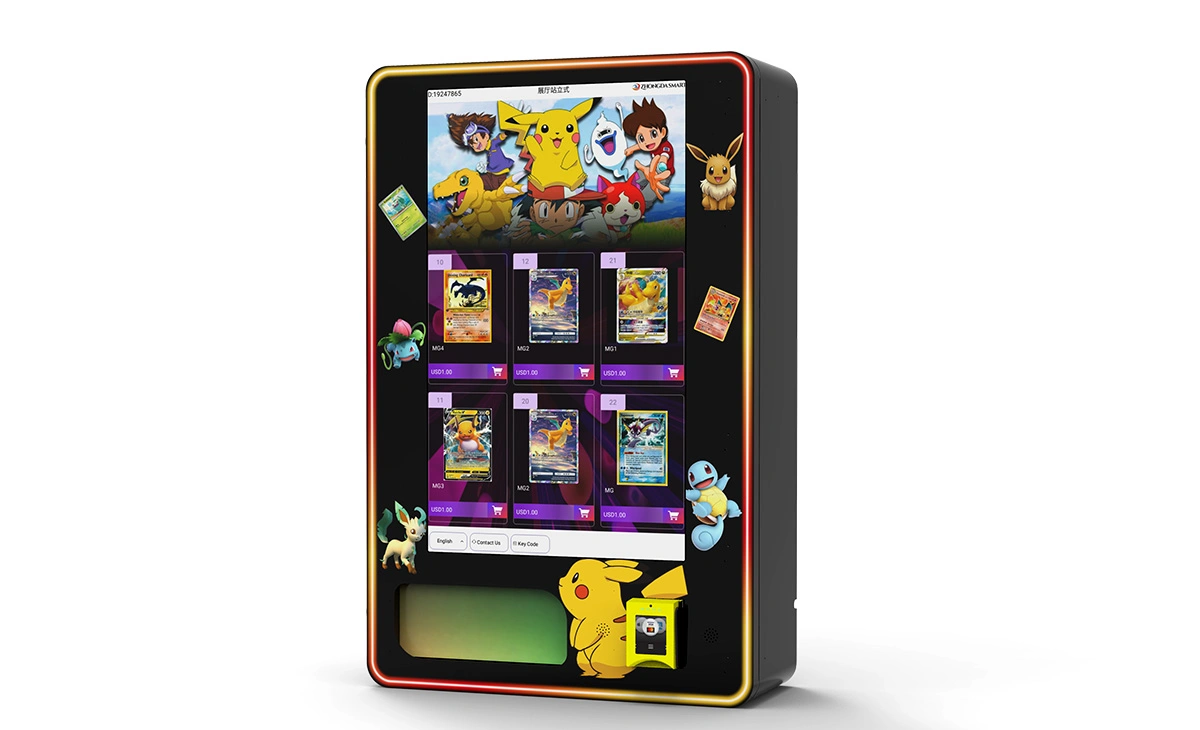
A machine generating substantial revenue can still produce disappointing returns when product acquisition costs are high, inventory moves slowly, or operating expenses consume most of the gross profit. Conversely, a smaller machine in a well-matched location can create attractive cash flow without requiring an expensive cabinet or excessive inventory.
This analysis examines the economics of independently operated Pokémon card vending machines from a manufacturing and equipment-selection perspective. It uses transparent financial assumptions, break-even calculations, and practical purchasing criteria to determine when the investment makes commercial sense—and when an operator should avoid it.
Official Pokémon Machines vs. Independent Businesses
Before evaluating profitability, operators need to understand which business they can actually own.
The official Pokémon Automated Retail program is different from purchasing a commercial trading card vending machine and filling it with genuine Pokémon Trading Card Game products.
According to the Pokémon Center Automated Retail FAQ, updated January 26, 2026, all machines in the official program are owned and operated by The Pokémon Company International, and there are currently no plans to sell them.
The same official resource confirms that these machines dispense products including booster packs and Elite Trainer Boxes. That establishes the existence of an official automated retail channel, but it does not mean independent investors can purchase or franchise the official equipment.
What an independent operator actually owns
An independent business typically purchases a commercial vending cabinet, contracts with a location, acquires merchandise, sets retail prices, and manages inventory, payments, customer support, and maintenance.
The operator's economic return comes from the difference between merchandise sales and the complete cost of running that retail operation.
Machine ownership does not automatically provide Pokémon distribution rights, licensed artwork, official branding, or an affiliation with the brand owner.
Genuine products must be sourced lawfully, and external branding must be reviewed separately. Describing authentic products for sale is not the same as receiving permission to present a machine as part of an official retail network.
This distinction matters financially. An independent operator cannot assume access to the official program's purchasing terms, stock allocations, customer traffic, pricing arrangements, or brand recognition.
The investment must therefore stand on its own economics.
What Makes a Pokémon Vending Machine Business Profitable?
A profitable machine is not necessarily a profitable business. The difference becomes clear when revenue, margin, expenses, and capital recovery are measured separately.
Revenue is only the starting point
Revenue is the total value of completed sales, excluding taxes collected on behalf of tax authorities. A card vending machine can generate revenue every day while still failing to recover its installation cost.
Gross profit is revenue minus the cost of goods sold. For card vending, the merchandise cost should reflect the actual landed cost of the products sold, including applicable acquisition expenses allocated to those products.
Contribution margin measures what remains from a sale after the variable costs associated with that transaction. These can include product cost, payment processing, and a location commission calculated as a percentage of sales.
Operating profit goes further by accounting for business operating expenses. These may include rent, software, maintenance, insurance, transportation, and labor. Accounting profit may also reflect depreciation and other noncash expenses.
Operating cash flow measures cash generated or consumed by operations. It can differ from operating profit because inventory purchases, payment settlement timing, and other working-capital movements affect actual cash balances.
Return on investment compares the economic benefit with capital committed. It should not be confused with monthly revenue or gross merchandise margin.
The contribution of an individual transaction
Consider an illustrative $12 transaction:
Customer selling price: $12.00
Landed cost of merchandise sold: $7.20
Payment processing: $0.46
Location commission: $1.44
Contribution per completed transaction: $2.90
The $2.90 is not net profit. It must still cover fixed operating expenses and contribute toward recovering the original investment.
If a machine completes 15 transactions daily over 30 operating days, the monthly contribution is $1,305 before fixed operating expenses.
That distinction is essential for evaluating whether a machine is worth purchasing.
The merchandise often matters more than the cabinet
A card machine cannot compensate indefinitely for poor merchandise economics. When acquisition prices rise, popular products become unavailable, or customers reject the selling price, profitability weakens even if the hardware works perfectly.
For example, a $12 transaction with merchandise costing $7.20 produces $4.80 of gross profit. If that merchandise costs $8.40 instead, gross profit falls to $3.60—a 25% reduction in gross profit dollars.
The equipment is the retail delivery platform. The merchandise, its availability, and the customer's willingness to pay determine how much economic value that platform can produce.
How Much Can One Pokémon Card Vending Machine Actually Earn?
There is no reliable universal monthly earnings figure for independently operated Pokémon card vending machines. Actual results depend on transaction volume, average ticket value, product sourcing, site charges, and operating efficiency.
A useful investment analysis begins with three hypothetical outcomes rather than presenting one attractive revenue estimate as a normal result.
An illustrative monthly operating model
Illustrative financial scenarios—not industry averages, actual operator results, or Zhongda Smart earnings claims.
All three scenarios assume a 30-day operating month, an average completed transaction value of $12, a venue commission of 12% of sales, and payment processing of 3% of revenue plus $0.10 per completed transaction. The processing terms are modeling assumptions, not quoted payment-provider rates.
Inventory costs differ between scenarios to represent alternative purchasing conditions. The resulting calculations assume that replacement merchandise is purchased at a cost equivalent to the units sold, maintaining a broadly stable inventory position.
| Metric | Conservative | Base Case | High-Volume |
|---|---|---|---|
| Daily completed transactions | 6 | 15 | 26 |
| Average transaction value | $12 | $12 | $12 |
| Monthly transactions | 180 | 450 | 780 |
| Monthly sales | $2,160 | $5,400 | $9,360 |
| Inventory cost assumption | 65% | 60% | 58% |
| Merchandise cost attributable to sales | $1,404 | $3,240 | $5,428.80 |
| Gross profit | $756 | $2,160 | $3,931.20 |
| Payment processing | $82.80 | $207 | $358.80 |
| Venue commission | $259.20 | $648 | $1,123.20 |
| Restocking and transport | $120 | $200 | $300 |
| Software and connectivity | $55 | $70 | $90 |
| Maintenance and refund allowance | $70 | $120 | $200 |
| Insurance and security | $45 | $60 | $75 |
| Monthly operating cash available | $124 | $855 | $1,784.20 |
| Cash margin on sales | 5.7% | 15.8% | 19.1% |
The maintenance and refund allowances are treated as cash spent or segregated for those purposes during each modeled month. The bottom row is therefore a conservative planning measure of cash available after replenishment, operating payments, and these allocations. It is not a formal accounting cash-flow statement.
The scenarios exclude income taxes, financing costs, equipment depreciation, owner-level administrative overhead, and other unmodeled business expenses. Electricity is assumed to be included in the venue arrangement; operators paying separately must add it. Sales taxes collected and remitted are excluded from revenue and expenses.
What the three outcomes reveal
The conservative case produces $2,160 in sales but leaves only $124 for investment recovery. The machine is generating positive operating cash under the stated assumptions, yet its contribution to the business owner is minimal.
The base case produces $855 per month. That provides a more meaningful cash return, although it remains sensitive to product costs and site charges.
The high-volume case produces $1,784.20. Higher sales help distribute fixed expenses across more transactions, while the assumed lower inventory acquisition ratio improves contribution per sale.
The difference between these outcomes is not simply machine capacity. It reflects customer demand, purchasing terms, transaction throughput, and the costs necessary to support that volume.
Two businesses using identical cabinets could experience very different results.
Why the high-volume scenario is not a forecast
Twenty-six transactions every day require sustained customer demand, sufficient product supply, regular replenishment, and reliable payment and dispensing systems.
A venue may generate that activity during a popular product release without sustaining it for the following month. The correct investment decision should therefore rely on a normalized sales estimate, not a short promotional spike.
Operators should collect actual sales observations, estimate how many interested customers are likely to purchase, and test whether those assumptions remain reasonable outside peak trading periods.
Startup Investment: Calculate the Total Installed Cost
The advertised machine price is not the amount required to launch a Pokémon vending machine business.
A complete purchasing budget separates equipment acquisition, installation, starting merchandise, and working capital. Those categories represent different economic commitments, even when they are paid at approximately the same time.
What does it cost to launch one machine?
| Investment component | Example amount |
|---|---|
| Base vending machine quotation | $2,650 |
| Payment terminal and hardware | $500 |
| Software configuration and setup | $180 |
| Freight and delivery | $750 |
| Shipment insurance | $90 |
| Illustrative taxes and duties allowance | $250 |
| Installation and commissioning | $250 |
| Custom product-channel configuration | $400 |
| Initial service parts | $180 |
| Installed equipment and setup subtotal | $5,250 |
| Opening merchandise inventory | $3,200 |
| Working capital reserve | $2,400 |
| Total opening cash commitment | $10,850 |
Every number in this table is an illustrative assumption, not a current supplier quotation or a universal startup cost. Actual duties and taxes depend on the transaction and destination. Insurance, freight, installation, and required certifications also vary.
The $5,250 subtotal represents the modeled equipment and preparation expenditure. The $3,200 opening inventory and $2,400 reserve bring the total cash commitment to $10,850.
Opening inventory is a business asset, not an additional operating expense simply because it was purchased before the first sale. As merchandise sells, its cost becomes attributable to those sales. The reserve remains cash until it is used.
Why working capital cannot be ignored
A vending operator may need to reorder merchandise before payment settlements have fully cleared or before older inventory has sold.
If the entire startup budget is spent on the cabinet and initial stock, the business may struggle to replenish the products that generate the most transactions.
A reserve also protects against unexpected repairs, delayed merchandise deliveries, changes to venue conditions, and periods of weak demand.
Working capital should be sized using expected purchase order amounts, supplier payment terms, replenishment frequency, and the operator's acceptable liquidity risk.
Compare delivered configurations, not display prices
A lower equipment price does not guarantee a lower operating cost. A cabinet requiring extensive adaptation, expensive shipping, incompatible payment hardware, or recurring service calls may become the more expensive option.
Before comparing quotations, obtain the same commercial scope from each supplier: machine configuration, dispensing system, payment hardware, software rights, delivery terms, installation responsibilities, spare parts, and warranty coverage.
Separately identify one-time purchases, recurring subscriptions, optional features, and expenses excluded from the quotation.
Profit Margin, Break-Even Sales, and Investment Payback
A break-even calculation answers a practical question: how many completed customer transactions are required before a machine covers its operating expenses?
The U.S. Small Business Administration's break-even calculator expresses break-even volume as fixed costs divided by the difference between selling price and variable cost per unit.
For a vending business, the equivalent calculation can use contribution per completed transaction.
The five essential formulas
Monthly revenue = Completed transactions per day × Average transaction value × Operating days
Completed transactions exclude unsuccessful or reversed sales. Average transaction value is the revenue per completed purchase, not necessarily the price of a single pack.
Gross profit = Revenue − Cost of goods sold
Cost of goods sold reflects the merchandise actually sold during the period.
Monthly operating cash flow = Sales receipts − Product purchases attributable to sales − Operating cash expenses
This simplified planning formula assumes replacement merchandise purchases correspond to the cost of units sold. Actual bank cash flow must instead reflect the timing and amount of every purchase, settlement, refund, and payment.
Break-even sales volume = Monthly fixed operating costs ÷ Contribution per transaction
Monthly fixed costs are expenses that remain approximately constant across the relevant volume range. Contribution per transaction is selling price minus variable merchandise, payment, and venue costs.
Simple cash payback = Initial cash investment ÷ Monthly cash available for investment recovery
A meaningful positive payback estimate requires positive monthly cash available for recovery. If cash flow is zero or negative, a finite positive payback period cannot be calculated from that operating assumption.
Worked break-even example
Use the base-case assumptions:
Selling price per completed transaction: $12.00
Merchandise cost: $7.20
Payment processing: $0.46
Venue commission: $1.44
Monthly fixed operating costs: $450
Contribution per transaction = $12.00 − $7.20 − $0.46 − $1.44 = $2.90.
Break-even transactions per month = $450 ÷ $2.90 = 155.17.
Since partial transactions are impossible, the business needs at least 156 completed transactions per month, assuming the same costs and transaction mix.
Over a 30-day operating month, that is 5.2 daily transactions on average. Planning for at least six completed transactions per day provides a whole-number daily target.
How break-even changes between scenarios
| Metric | Conservative | Base | High-Volume |
|---|---|---|---|
| Contribution per transaction | $2.30 | $2.90 | $3.14 |
| Monthly fixed operating costs | $290 | $450 | $665 |
| Minimum monthly transactions | 127 | 156 | 212 |
| Daily planning target (30 days) | 5 | 6 | 8 |
These thresholds cover modeled operating costs, not recovery of the startup investment, debt payments, or taxes.
Calculating simple cash payback
Using the $10,850 opening cash commitment and $855 base-case monthly cash available:
$10,850 ÷ $855 = approximately 12.7 months.
This represents a simplified recovery period for the full opening cash commitment, assuming steady operating performance, maintained inventory, and no additional capital requirements.
It does not account for the time value of money, tax payments, financing, seasonal demand, equipment depreciation, unexpected capital expenditure, or terminal resale value. The initial inventory and working capital reserve also remain business assets to the extent they have not been consumed, so a full investment appraisal should distinguish capital recovery from asset value.
For a more rigorous ROI assessment, operators should prepare a month-by-month cash forecast and evaluate the present value of expected cash flows.
What Happens When Sales Are Lower Than Expected?
The base case appears viable at $855 in monthly cash available. Its usefulness is not the headline amount but the ability to test how quickly that amount deteriorates.
The following sensitivity analysis changes one variable at a time while holding other base-case assumptions constant, unless explicitly stated otherwise.
| Scenario | Monthly cash | Change vs. base |
|---|---|---|
| Original base case | $855 | — |
| Sales volume falls 20% | $594 | −$261 |
| Merchandise cost rises from 60% to 65% of sales | $585 | −$270 |
| Venue commission rises from 12% to 17% | $585 | −$270 |
| Payment percentage fee rises by 1 percentage point | $801 | −$54 |
| Three full days of sales lost to downtime | $724.50 | −$130.50 |
All changes are hypothetical, not measured industry failure rates or observed operator results. The downtime calculation assumes 27 effective selling days, 15 completed transactions per available day, no recovered sales, and unchanged fixed monthly expenses.
Volume risk
A 20% reduction in completed transactions changes the base case from 450 to 360 monthly transactions.
Monthly revenue falls from $5,400 to $4,320. Variable expenses also decline, but the fixed operating burden remains. The result is $594 in monthly cash available.
This shows why revenue reductions should not simply be deducted dollar for dollar from profit. The lost contribution per transaction is the relevant measure.
Merchandise cost risk
Increasing the cost-of-goods ratio by five percentage points consumes $270 of monthly cash at the original sales level.
For Pokémon products, the availability and acquisition price of desirable releases can influence unit economics as much as site traffic.
When buying costs increase, the operator should reassess achievable retail prices, supplier alternatives, product allocation, and SKU mix rather than assuming the machine can absorb a lower gross margin indefinitely.
Location and payment risk
An increase in venue commission from 12% to 17% has the same $270 effect in this example. This is a commercial cost that should be negotiated before installation, not discovered after a machine has been purchased.
A one-percentage-point increase in the modeled percentage processing charge reduces monthly cash by $54. A change in the fixed per-transaction fee would have a different effect and may be particularly relevant when the average ticket is small.
Downtime and inventory risk
Three lost selling days reduce the modeled monthly cash available by $130.50. Actual losses could be higher if a release-driven selling window is missed or unrecovered customer disputes create additional expense.
Inventory accumulation is a different problem. Suppose the operator purchases an extra $900 of slow-moving products during the base-case month without generating additional sales.
Accounting gross profit from completed sales would not fall immediately simply because those items remain unsold. However, the month's actual cash balance after purchases would be $900 lower. Against the modeled $855 cash available, that additional purchase could leave a $45 cash deficit.
This is why a business can show positive operating margins while experiencing a liquidity problem.
The first response to weak performance should be to identify the cause: insufficient customer demand, unattractive merchandise, excessive prices, poor product availability, or technical friction. Replacing a cabinet does not solve every sales problem.
Product Sourcing, Inventory Turnover, and Cash Flow
Pokémon card vending is fundamentally an inventory business operated through an automated checkout system.
The quality of the merchandise supply chain often determines whether the apparent sales opportunity can be converted into repeatable profit.
Verify the source before investing
Operators should establish the availability of genuine sealed merchandise, acceptable purchase terms, documentation, and replenishment quantities before committing to a cabinet.
The Pokémon Center's distributor information, updated June 24, 2026, states that Pokémon Center does not offer general wholesale pricing or licensing to smaller retailers for its merchandise, while identifying existing distribution partnerships for Pokémon TCG cards.
That statement is a reason to investigate the actual supply channel rather than assuming direct wholesale purchasing from Pokémon Center is available to an independent vending operator.
Supplier due diligence should include invoices, product authenticity, the commercial right to resell, consistent sealed packaging, delivery lead times, allocation policies, and procedures for handling disputed or damaged stock.
A low quoted unit price is not useful if the supplier cannot fulfill future orders or the product provenance is uncertain.
Inventory turnover is as important as gross margin
A product with an attractive theoretical margin may still be a poor use of capital if it remains unsold for months.
Inventory turnover can be estimated as:
Inventory turnover = Cost of goods sold during the period ÷ Average inventory value at cost.
Suppose two hypothetical assortments each hold $2,000 of average inventory. Assortment A sells merchandise with a total cost of $4,000 during the month. Assortment B sells merchandise with a total cost of $1,000.
Assortment A turns its average inventory twice. Assortment B turns it only 0.5 times.
Even if Assortment B has a higher gross margin percentage, its slower stock movement can reduce purchasing flexibility and delay recovery of invested cash.
The operator should therefore monitor both gross profit dollars per SKU and the speed with which merchandise is converted back into cash.
Plan replenishment around the actual assortment
For each SKU, record units received, units sold, current on-hand quantity, landed unit cost, realized selling price, and sales velocity.
A practical reorder point is:
Reorder point = Expected daily unit sales × Supplier lead time in days + Safety stock.
Safety stock should reflect supply variability and the financial consequences of selling out, rather than automatically filling every lane to its maximum capacity.
New releases may need additional inventory, but the operator must distinguish short-term demand from a sustainable replenishment pattern.
Older products should be reviewed for markdowns, transfer to another location, or alternative sales channels when their inventory cost is blocking the purchase of stronger sellers.
Control shrinkage and authenticity risk
Inventory discrepancies can result from theft, damage, incorrect dispensing, undocumented refills, or inaccurate system records.
Reconcile physical units against transactions and restocking logs. Maintain an exception record for refunds, failed deliveries, and manual stock corrections.
For premium products, use an identification or compartment system appropriate to the individual item's value.
Most importantly, do not treat the retail value of merchandise sitting inside the machine as available cash. The inventory must still sell, and the final selling price may be lower than expected.
Location Economics: The Busiest Site Is Not Necessarily the Best
A strong vending location combines qualified customers, commercially acceptable fees, safe access, and an operating arrangement that allows the machine to remain stocked and functional.
Raw foot traffic does not automatically indicate demand for Pokémon TCG merchandise.
Compare locations by buying intent
Card shops and hobby stores have an identifiable audience. A vending machine in these environments may serve repeat pack purchases, customers waiting for events, or purchases outside staffed checkout hours.
Arcades and entertainment venues may generate impulse purchases, but the operator must verify that visitors are interested in collectible products at the proposed price points.
Shopping malls may provide visibility and substantial visitor traffic while also carrying higher occupancy charges, stronger security requirements, and less predictable customer conversion.
Existing retail stores can offer electricity, supervision, and established customer relationships. However, the host may view a vending machine as competition with its own merchandise.
Each venue should be evaluated as a specific commercial opportunity rather than assigned a generic monthly earnings estimate.
Estimate qualified demand
A useful planning formula is:
Expected completed transactions = Qualified customer opportunities × Expected purchase conversion.
Qualified customer opportunities are people who can realistically see, access, and consider purchasing from the machine—not every person entering the building.
Conversion should be supported by observations, comparable product sales, or a limited pilot where possible.
Also consider available buying hours, nearby competing sellers, visibility, security, restocking access, network connectivity, and whether the machine can be accessed when the host business is closed.
Fixed rent versus revenue commission
Assume a venue offers a choice between $500 monthly fixed rent and a 12% commission on gross sales. These are illustrative commercial terms.
At $5,400 in monthly sales, the percentage arrangement costs $648. Fixed rent would cost $500, saving $148.
At only $2,160 in sales, however, the 12% commission costs $259.20. Fixed rent would cost $240.80 more.
The revenue level where the two arrangements are equal is:
$500 ÷ 0.12 = $4,166.67 in monthly sales.
Above that threshold, fixed rent is cheaper under these assumptions. Below it, commission is cheaper.
A fixed rental agreement may therefore be attractive for a validated high-performing site, while percentage rent can reduce downside exposure during a pilot.
Review minimum guarantees, escalation provisions, exclusivity, access restrictions, insurance requirements, payment schedules, and termination rights. An inexpensive location is not necessarily valuable if the contract makes relocation difficult.
Which Machine Configuration Makes Financial Sense?
The best Pokémon card vending machine is not automatically the cabinet with the largest touchscreen, the highest advertised capacity, or the most sophisticated delivery system.
Equipment selection should begin with the merchandise and the intended operating model.
Match the dispensing system to the product
| Configuration | Best-fit use | Financial tradeoff |
|---|---|---|
| Compact wall-mounted | Small packaged products, limited assortments, constrained floor space | Lower space demand but more frequent replenishment |
| Standard floor-standing | Multiple sealed pack SKUs and regular card sales | Greater stock flexibility with more capital and floor-space requirements |
| Custom touchscreen cabinet | Specialized layouts, mixed packaging, or operator-specific interfaces | Customization must justify its additional cost |
| Elevator or controlled delivery | Boxes and merchandise requiring reduced impact | More complex mechanics and potentially higher service costs |
| Locker-based cabinet | High-value individual products and selected graded cards | Protected access but lower inventory density per cabinet |
These are engineering selection principles, not universal guarantees of compatibility. Actual packages must be tested with the selected mechanism.
When a compact machine makes more sense
A compact machine can be financially attractive when the venue offers limited space, the assortment contains only a small number of fast-selling products, and replenishment is easy.
Zhongda Smart's ZD-BGS-32 wall-mounted card vending machine is one example of a compact configuration. Its published product information describes spring cargo lanes, an indoor wall-mounted format, connected management functions, and a stated maximum capacity of 120 items.
That maximum should not be interpreted as guaranteed capacity for every Pokémon product. Actual usable stock depends on the size, stiffness, and packaging of the merchandise.
A wall-mounted unit also requires an appropriate mounting surface and installation assessment. The apparent space-saving benefit should not lead to an unsafe or impractical installation.
When greater capacity earns its cost
A floor-standing trading card vending machine becomes more attractive when the operator needs a broader SKU selection, more stock between service visits, or multiple product sizes.
Zhongda Smart's ZD-CX-22 trading card vending machine lists a 21.5-inch touchscreen, 60 standard product lanes, 4G/Wi-Fi connectivity, remote sales management, and several configurable payment methods.
The published capacity depends on product dimensions and channel configuration. Buyers should request a layout based on their actual merchandise rather than relying on a headline maximum.

The economic value of additional capacity
Suppose a larger cabinet costs an additional $2,000 and reduces monthly restocking expenses by $80. These amounts are illustrative.
If no additional sales or maintenance differences occur, the incremental equipment payback is $2,000 ÷ $80, or 25 months.
If the larger machine also requires $1,800 in additional inventory capital, the incremental opening cash commitment rises to $3,800. Recovering that entire additional commitment from $80 in monthly cash savings would take 47.5 months, before considering residual inventory value.
More capacity may still be justified if it prevents frequent stockouts or supports profitable additional products. However, that benefit must be estimated rather than assumed.
The manufacturer should provide practical usable capacity, service access requirements, and the actual delivery mechanism before a buyer pays for additional space.
How Dispensing Reliability Changes Actual Profit
Dispensing reliability is a financial variable, not merely a technical specification.
A successful transaction requires the correct product to be delivered in acceptable condition. Payment authorization alone does not complete that process.
Different packages create different risks
Flexible booster packs may fold, rotate, or move unevenly through poorly matched spring lanes. Sleeved booster packs can have different friction and thickness from unsleeved packs.
Rigid boxed products may jam if their dimensions are close to the available channel clearance. A long drop may damage a corner or crush packaging that the purchaser expects to remain in collectible condition.
High-value graded cards create a separate concern. Even if the underlying card remains protected, scratches or cracks in the slab can lead to disputes and reduce the item's perceived value.
For these reasons, product compatibility must be established using the exact retail packaging, not merely the approximate dimensions of the card inside.
The financial cost of a failed delivery
Consider a hypothetical $12 sale involving merchandise that costs $7.20.
If the customer pays but the product is not delivered, the operator may need to refund the transaction. If the merchandise is also damaged or cannot be recovered, the business can lose the $7.20 inventory cost in addition to payment-related expenses and service labor.
If the same incident requires an additional service visit, the total impact may exceed the contribution from several successful transactions.
Repeated errors can also cause payment disputes and reduce customers' willingness to purchase again.
These effects explain why a lower-priced cabinet may have a higher total ownership cost if its delivery system is unsuitable for the intended merchandise.
What buyers should verify before shipment
From a machine configuration standpoint, a useful factory acceptance protocol should include:
Physical testing using representative sealed packs, sleeved packs, and boxed products.
Repeated dispensing from full, partially filled, and nearly empty lanes.
Checks for double dispensing, incomplete release, and products getting stuck.
Inspection for torn wrappers, bent products, and packaging damage.
Confirmation that the selected product and charged price match the item delivered.
Verification of delivery sensors, error messages, and refund-handling logic.
Testing after a power interruption or loss of network connectivity.
Demonstration of inventory reconciliation following an interrupted transaction.
Acceptance criteria should be agreed upon in writing before production. The required number of test cycles and acceptable outcomes should reflect the product value, mechanism design, and buyer's risk tolerance.
A video showing one successful vend is not sufficient evidence of reliable operation across different loading conditions.
Ask the manufacturer to explain how a failed vend is detected, whether payment is automatically reversed, how transaction records are retained, and which components can be serviced on-site.
A quoted dispensing success percentage is meaningful only when the supplier can provide the testing method, sample size, merchandise type, and definition of success.
Remote monitoring is useful only when it produces actionable information
A remote inventory dashboard can help operators detect low-stock products, but it should not be confused with proof that a unit has physically delivered every recorded sale.
Where available, machine status, payment results, stock changes, delivery sensor events, and error logs should be reconcilable.
For valuable merchandise, the ability to investigate a disputed transaction may be as important as receiving a simple low-stock notification.
Operating Costs and Maintenance Planning
A Pokémon card vending business does not eliminate operating work. It changes when and where that work occurs.
Instead of staffing every sale, the operator manages replenishment, merchandise procurement, equipment status, payment reconciliation, customer claims, and venue relationships.
Separate recurring and one-time costs
Fixed or relatively fixed recurring expenses can include software subscriptions, connectivity, insurance, contracted rent, and certain monitoring services.
Variable expenses include merchandise sold, transaction-based processing fees, percentage commissions, and some refund or shrinkage costs.
Restocking and transport are often semi-variable. A scheduled trip may cost approximately the same amount whether the operator loads 30 packs or 90, but higher sales eventually require more visits.
One-time expenses include equipment purchase, shipping, initial configuration, installation, and some setup fees.
Maintenance parts and emergency service funds should be budgeted separately from ordinary consumable costs.
Calculate the real cost of restocking
Operators should assign a value to their own labor even if no employee is hired.
A replenishment trip can involve travel, inspecting product condition, loading merchandise, cleaning the cabinet, reconciling cash or digital transactions, and handling customer issues.
The relevant cost is not only fuel. It is the complete incremental time and transport expense of servicing the location.
Where multiple machines share a route, allocate servicing costs according to actual route economics rather than charging every machine the full cost of the same trip.
Maintenance requirements affect ROI
Payment readers, dispensing motors, locks, sensors, touchscreens, and network components have different service requirements.
For a cashless-only configuration, loss of payment connectivity may prevent sales even when the mechanical dispensing system is fully functional.
For a locker system, an electronic lock fault may isolate one compartment or affect the purchasing process, depending on the controller design.
For an elevator configuration, moving components and sensors introduce additional diagnostic considerations.
There is no defensible universal monthly failure rate or replacement schedule that applies to every trading card vending machine. Operators should obtain model-specific maintenance instructions and evaluate expected service obligations before purchase.
Repairability, remote diagnosis, and local spare-parts availability can reduce the financial consequences of an equipment fault.
How to Evaluate a Pokémon Card Vending Machine Manufacturer
A manufacturer's value should be measured by its ability to provide equipment that matches the merchandise, installation environment, operating requirements, and available budget.
Price and appearance matter, but they are not enough to determine whether a machine is commercially suitable.
Use a structured procurement evaluation
Before placing an order, compare suppliers across the following criteria:
Product compatibility: Can the machine handle the exact package dimensions, weights, and product condition requirements?
Dispensing suitability: Is the proposed mechanism supported by representative product testing?
OEM/ODM flexibility: Can necessary internal changes be supplied without paying for unnecessary exterior features?
Payment integration: Will the selected terminal, processor, and controller operate together in the intended market?
Remote management: Which inventory, transaction, pricing, and fault-monitoring functions are actually included?
Documentation: Are mechanical drawings, electrical requirements, operating instructions, and service procedures available?
Warranty: What is covered, for how long, and who pays shipping or technician labor?
Replacement parts: Which components can be stocked locally, and how are replacements ordered?
After-sales support: What communication channels, response arrangements, and troubleshooting resources are provided?
Quotation transparency: Are machine price, customization, freight, software fees, and installation scope clearly separated?
Pre-shipment testing: Can the supplier document successful operation with the buyer's actual merchandise?
Total landed cost: What is the complete expenditure needed to commission the machine?
Where Zhongda Smart fits the evaluation
Zhongda Smart manufactures commercial vending equipment and offers configurable trading card solutions, payment integration, remote-management options, and OEM/ODM development.
For a project where conventional channels cannot safely handle the planned assortment, the company's custom OEM trading card vending machine options provide a relevant starting point for discussing alternative channel layouts, controlled delivery, payment configuration, and cabinet design.
The custom equipment offering identifies drop and elevator arrangements as project-dependent possibilities. Those options should not be treated as standard features of every Zhongda Smart machine.
Likewise, available payment methods, software functions, inventory capacity, service terms, and warranty coverage must be confirmed for the exact model and quoted configuration.
For a small booster-pack assortment, a standard compact model may be the more economical choice. For a broader selection, a floor-standing cabinet may reduce restocking pressure. For fragile boxes or individually valuable items, a controlled-delivery or locker design may justify additional capital.
The deciding factor is the economic benefit obtained from the configuration, not the number of features listed in the brochure.
What to send a manufacturer
A useful purchasing inquiry includes product photographs, measured dimensions, weights, number of SKUs, expected stock depth, target selling prices, available installation space, payment requirements, destination market, and intended order quantity.
The operator should also describe which merchandise requires enhanced protection and whether remote fault monitoring or payment reconciliation is essential.
A manufacturer can then provide a more meaningful comparison of feasible configurations and a quotation based on the intended use.
No manufacturer can independently guarantee the demand, merchandise margin, or financial performance of the operator's chosen location.
When Does Expanding to a Second Machine Make Financial Sense?
Expansion should follow demonstrated profitability, not merely encouraging initial revenue.
A second vending machine increases equipment capital, inventory requirements, service obligations, and exposure to location risk. It may also improve route efficiency and purchasing scale when the existing operation is stable.
Validate the first machine before multiplying the model
A decision to expand should rely on several normal trading periods rather than one successful product release.
Review completed transactions, realized merchandise margins, stockouts, customer disputes, refund costs, replenishment labor, and actual cash remaining after inventory purchases.
Also check whether the first machine continues operating acceptably during lower-demand periods.
If the business depends on scarce product allocations, an additional cabinet may divide available merchandise across two locations without increasing total sales.
Calculate incremental returns
The appropriate question is not whether two machines can generate more total sales than one. It is whether the second machine creates sufficient additional cash flow to justify its incremental investment.
Incremental monthly cash = Additional contribution from the second machine − Additional operating expenses − Any lost contribution at the first machine.
Suppose a second location is forecast to produce $600 of monthly cash after its direct operating expenses, but the additional route servicing and administrative burden would cost $120 per month.
The incremental cash available would be $480 before financing, taxes, and other unmodeled expenses. If the second installation requires $8,000 in additional capital, its simplified payback would be approximately 16.7 months.
These figures are illustrative. If the second machine reduces sales at the first location, that cannibalization must also be subtracted.
Expansion is more credible when the operator has dependable inventory supply, repeatable maintenance processes, adequate working capital, and a second site with independently supported demand.
Buying additional equipment solely because a first machine had a strong launch month is not sufficient investment evidence.
When a Pokémon Vending Machine Business Is Not Worth the Investment
Some prospective operators should postpone or reject the purchase, even when the equipment itself is affordable.
Unreliable merchandise sourcing is a primary warning sign. Without a legitimate and repeatable source of products, the machine may remain understocked or require purchases at prices that eliminate its contribution margin.
Unproven demand is another reason to pause. A location that attracts visitors does not necessarily attract paying trading card customers.
Excessive venue charges can remove most of the remaining gross profit. A contract with high fixed rent and limited exit flexibility is particularly risky during an untested launch.
Weak contribution per transaction leaves little capacity to recover equipment cost or withstand refunds and disruptions.
Insufficient working capital can stop an otherwise promising machine from being replenished after early sales.
Poor machine-product compatibility introduces avoidable damage, failed deliveries, service expenses, and customer disputes.
No practical maintenance arrangement increases exposure to prolonged downtime and potentially expensive repairs.
Unacceptable payback economics should override excitement about the product category. If the investment only works under the most optimistic demand and margin assumptions, its downside protection is inadequate.
A commercial operator should also be prepared to provide customer support and handle legal, tax, insurance, and contractual obligations. Unattended retail is not unmanaged retail.
In these circumstances, improving product sourcing, negotiating better location terms, or conducting a smaller pilot may be preferable to purchasing a full-size machine immediately.
A Practical Go/No-Go Decision Framework
Before approving a Pokémon vending machine investment, the operator should be able to complete the following checks using actual supplier information and defensible commercial assumptions.
Verify product sourcing. Confirm genuine inventory, unit acquisition costs, reorder quantities, and supply reliability.
Confirm dispensing requirements. Measure the merchandise and establish which delivery mechanism can handle it safely.
Estimate opening capital. Include equipment, payment hardware, freight, installation, inventory, and a working-capital reserve.
Calculate contribution per transaction. Deduct merchandise cost, payment expenses, and variable location charges from the selling price.
Determine break-even volume. Convert monthly fixed expenses into required completed transactions and a daily operating target.
Validate the location. Evaluate qualified buyers, realistic conversion, site fees, security, accessibility, and contract terms.
Stress-test cash flow. Model lower sales, higher merchandise costs, commission changes, downtime, and slower inventory movement.
Confirm maintenance support. Review acceptance testing, warranty conditions, spare parts, and fault recovery procedures.
Make the investment decision. Proceed only when the expected cash return and downside exposure meet the operator's financial requirements.
If the operator cannot establish a dependable merchandise source, positive contribution economics, a credible sales estimate, or a suitable dispensing mechanism, equipment procurement should be paused.
The strongest investment is not necessarily the machine with the highest projected sales. It is the configuration that generates adequate cash after operating expenses, protects valuable merchandise, maintains inventory flexibility, and offers an acceptable return on the capital committed.
That is the standard by which a Pokémon vending machine business should be judged.
Frequently Asked Questions
Is a Pokémon vending machine business profitable?
It can be profitable when authentic merchandise is sourced at sustainable margins, customer demand is sufficient, operating expenses are controlled, and the dispensing system is reliable. Sales revenue alone does not establish profitability.
How much can one Pokémon card vending machine make per month?
There is no verified universal monthly earnings figure. In the illustrative model in this article, monthly sales range from $2,160 to $9,360, with operating cash available from $124 to $1,784.20. These are hypothetical results, not industry averages or earnings promises.
How much does it cost to start a Pokémon vending machine business?
The total depends on equipment configuration, payment hardware, shipping, installation, opening inventory, and working capital. The illustrative startup model requires $10,850 in opening cash, but actual costs must be established through quotations and a location-specific budget.
Can I buy an official Pokémon vending machine?
Pokémon Center states that its official Automated Retail machines are owned and operated by The Pokémon Company International and that there are currently no plans to sell them. Independent operators can evaluate separate commercial trading card vending equipment.
What is the best vending machine for selling Pokémon cards?
The best configuration depends on the products. Compact adjustable channels may suit packaged booster packs, while larger boxes and valuable graded products may require controlled delivery or lockers. Compatibility should be verified through physical testing.
How long does it take a Pokémon vending machine to break even?
Operating break-even depends on contribution per transaction and fixed monthly expenses. In the illustrative base case, at least 156 monthly transactions cover modeled operating costs. Recovering the full $10,850 opening cash commitment would take approximately 12.7 months at a steady $855 per month, before excluded costs and risks.
Where should a trading card vending machine be placed?
Prioritize locations with identifiable trading card buyers, reasonable fees, secure access, and practical replenishment arrangements. Card shops, hobby stores, arcades, and suitable entertainment venues are worth evaluating, but each site requires its own demand and cost analysis.
What is the biggest financial risk in a Pokémon vending machine business?
A major risk is committing capital before verifying merchandise supply and sustainable customer demand. High inventory costs, slow turnover, excessive location fees, and unreliable dispensing can each turn apparent sales potential into weak cash flow.
Sources and References
Pokémon Center Support. Pokémon Automated Retail Vending Machine FAQ. Updated January 26, 2026. Used for official machine ownership, sales policy, and product categories.
Pokémon Center Support. Where Can I Find Information About Distributors? Updated June 24, 2026. Used for Pokémon Center distribution and wholesale-policy distinctions.
U.S. Small Business Administration. Calculate Your Break-Even Point. Online business calculator, accessed November 2026. Used for the fixed-cost and contribution-based break-even calculation.
Zhongda Smart product information referenced in this article reflects the product pages consulted during preparation. Published equipment parameters describe specific configurations and remain subject to final technical and commercial confirmation.
Disclaimer
All financial scenarios, startup budgets, margins, break-even calculations, and payback estimates are illustrative and do not guarantee actual business performance. Results vary with merchandise costs, customer demand, location agreements, equipment configuration, and operating conditions. Final equipment prices and specifications are subject to supplier quotation and confirmation. Legal, taxation, distribution, and trademark questions should be reviewed with qualified professionals. Zhongda Smart is an independent vending equipment manufacturer and is not affiliated with or endorsed by Pokémon or its respective rights holders. Brand names are used solely to identify the merchandise and business category discussed.
Prepared from a vending machine manufacturing and equipment-selection perspective by Zhongda Smart's editorial and vending equipment team.