If I had to choose the best trading card vending machine for a serious unattended card business, I would start with a full-size touchscreen machine built around the actual products being sold—not simply the cabinet with the biggest display. Booster packs, sleeved boosters, sealed boxes, graded slabs, mystery packs, and accessories behave very differently inside a vending mechanism. That changes everything from lane design to refill frequency and product protection.
For most high-capacity projects, the Zhongda Smart full-size trading card vending machine is my first choice because it combines a 21.5-inch touchscreen, 60 standard cargo lanes, remote connectivity, flexible payment configurations, and a published basic merchandise reserve of about 300–360 pieces. Smaller wall-mounted machines, locker systems, elevator delivery, and custom configurations can be better in specific situations. The comparison below explains exactly where each option makes sense—and where it does not.
8 Trading Card Vending Machine Options Compared
The eight options below are not eight interchangeable cabinets. They are eight practical machine configurations that solve different problems. That distinction matters. A locker machine may be a poor use of space for inexpensive booster packs but an excellent way to dispense graded slabs. A wall-mounted machine gives up capacity in exchange for a much smaller footprint.
I would therefore avoid asking which machine is “best” until the product mix is clear.
| Option | Best Use | Product Protection | Capacity Potential | Space Efficiency | Mechanical Complexity | Relative Investment | My Verdict |
|---|---|---|---|---|---|---|---|
| Zhongda Smart Full-Size Touchscreen | High-volume mixed card sales | High when channels are matched correctly | High | Medium | Medium | $$$ | Best overall |
| Zhongda Smart Wall-Mounted Mini | Compact installations | Good | Medium | Excellent | Low to medium | $$ | Best for limited space |
| Custom OEM/ODM Configuration | Branded fleets and unusual products | Potentially excellent | Custom | Custom | Depends on design | $$$–$$$$ | Best for customization |
| Locker Configuration | Graded slabs and premium boxes | Excellent | Medium | Low to medium | Low | $$$ | Best for graded cards |
| Elevator-Delivery Configuration | Premium sealed merchandise | Excellent | Medium to high | Medium | High | $$$$ | Best gentle delivery |
| Spiral-Coil Floor Machine | Packaged cards and accessories | Moderate | High | Medium | Low | $$ | Best value when tested properly |
| Countertop Machine | Pilots and low-volume sites | Moderate | Low | Excellent | Low | $–$$ | Best for testing demand |
| Hybrid Collectibles Machine | Cards plus accessories and collectibles | Good to excellent | High | Medium | Medium | $$$ | Best for a broader product mix |
My ranking is intentionally based on operating fit rather than appearance. A large touchscreen has commercial value, but only after the machine can dispense the product reliably. A card machine that requires constant refunds or manual intervention is not a smart retail system, no matter how impressive the front panel looks.
How I Compare Trading Card Vending Machines
Before I rank a machine, I put the product on the table first. Literally. I want to know its dimensions, stiffness, weight, packaging shape, retail price, expected turnover, and what happens if it drops several feet.
That immediately rules out a surprising number of bad machine-and-product combinations.
For this guide, I give the most weight to the factors below. These percentages are an editorial decision framework rather than laboratory test results. They show how I prioritize a commercial machine purchase.
| Decision Factor | Weight | What I Am Looking For |
|---|---|---|
| Vend reliability | 25% | The product should release consistently without jams, double vends, or false delivery confirmations. |
| Product protection | 20% | The delivery method should not bend packs, scratch slabs, crush boxes, or damage collector-grade packaging. |
| Product compatibility | 15% | The machine needs to accommodate the actual sizes and formats the business plans to sell. |
| Payment flexibility | 10% | Customers should be able to pay quickly with the payment methods appropriate for the installation. |
| Remote management | 10% | Sales, inventory, machine status, and pricing should be manageable without unnecessary site visits. |
| Capacity versus footprint | 10% | The cabinet should hold enough of the right products without consuming more space than the sales justify. |
| Maintenance and serviceability | 5% | Routine failures should be diagnosable and repairable without turning a small issue into days of downtime. |
| Customization | 5% | Channels, branding, payments, software, and cabinet design should be adaptable when the project requires it. |
That weighting explains why I do not automatically put an elevator machine first. Elevator delivery can be excellent for product protection, but it adds mechanical complexity and may be unnecessary when the machine is selling inexpensive products that already vend reliably through a simpler mechanism.
The same logic works in reverse. Saving money with a basic spiral machine is not a bargain if premium merchandise regularly arrives with damaged packaging.
Which Machine Works Best for Each Trading Card Product?
This is the table I wish more buyers built before ordering equipment.
The machine should follow the merchandise. Not the other way around.
| Product Type | Spiral | Locker | Elevator | Wall-Mounted | Full-Size Custom |
|---|---|---|---|---|---|
| Standard booster pack | Needs careful testing | Works but wastes space | Very good but often excessive | Good when channel is designed for it | Excellent when configured correctly |
| Sleeved booster | Good | Good | Excellent | Good | Excellent |
| Blister pack | Good if dimensions fit | Good | Excellent | Depends on cabinet depth | Excellent |
| Small sealed box | Good with correct lane | Excellent | Excellent | Limited by depth and capacity | Excellent |
| Large sealed box | Possible with large channels | Excellent | Excellent | Usually not my first choice | Excellent |
| Graded slab | Not my preferred method | Best choice | Excellent | Only with a purpose-built mechanism | Excellent when custom designed |
| Mystery pack | Good | Good | Good | Good | Excellent |
| Card sleeves | Excellent | Inefficient | Good | Excellent | Excellent |
| Deck box or storage accessory | Good | Excellent | Excellent | Depends on dimensions | Excellent |
The thin booster pack is usually the product that deserves the most testing. It can slide, overlap, twist, or sit behind a spiral in ways that a rigid packaged product does not.
A manufacturer saying that a machine “can sell cards” is not enough for me. The useful question is whether that exact package can be dispensed repeatedly from the proposed lane design.
What Makes Trading Card Vending Different From Ordinary Vending?
A traditional snack machine has a forgiving job. Most snack packages have enough thickness, shape, and flexibility to work with established vending hardware.
Trading cards are less cooperative.
One booster can be only a few millimeters thick. Another card product may be sealed inside a large cardboard blister. A graded card is rigid. A collector box may be valuable partly because its outer packaging remains clean and undamaged.
Putting all of those products in the same category because they contain cards is a mistake.
Thin Products Behave Differently
A thin package can slide behind a coil or lean against another package. If two packs overlap, the machine may release both. If the channel is too loose, the front product may fall out of position before the vend even starts.
Sometimes the solution is a different coil pitch. Sometimes it is a divider or a product carrier. Sometimes the right answer is to stop using a spiral for that SKU altogether.
Collector Condition Changes the Delivery Decision
There is another difference that matters more as the selling price rises: condition.
A customer buying an ordinary convenience product rarely examines the outer package corners. Collectors often do.
If a premium box falls from an upper shelf into a hard retrieval bin, the product may still be technically usable while the customer considers it damaged.
That is why locker and elevator systems become more attractive as product value and condition sensitivity increase.
The Inventory Is Small but Can Be Valuable
Cards also concentrate retail value into a very small physical volume. That changes the security conversation.
It is possible for a modest cabinet to contain thousands of dollars of merchandise without looking particularly full. If premium slabs or sealed products are involved, I pay much more attention to door construction, locks, anchoring, camera coverage, access control, and inventory records.
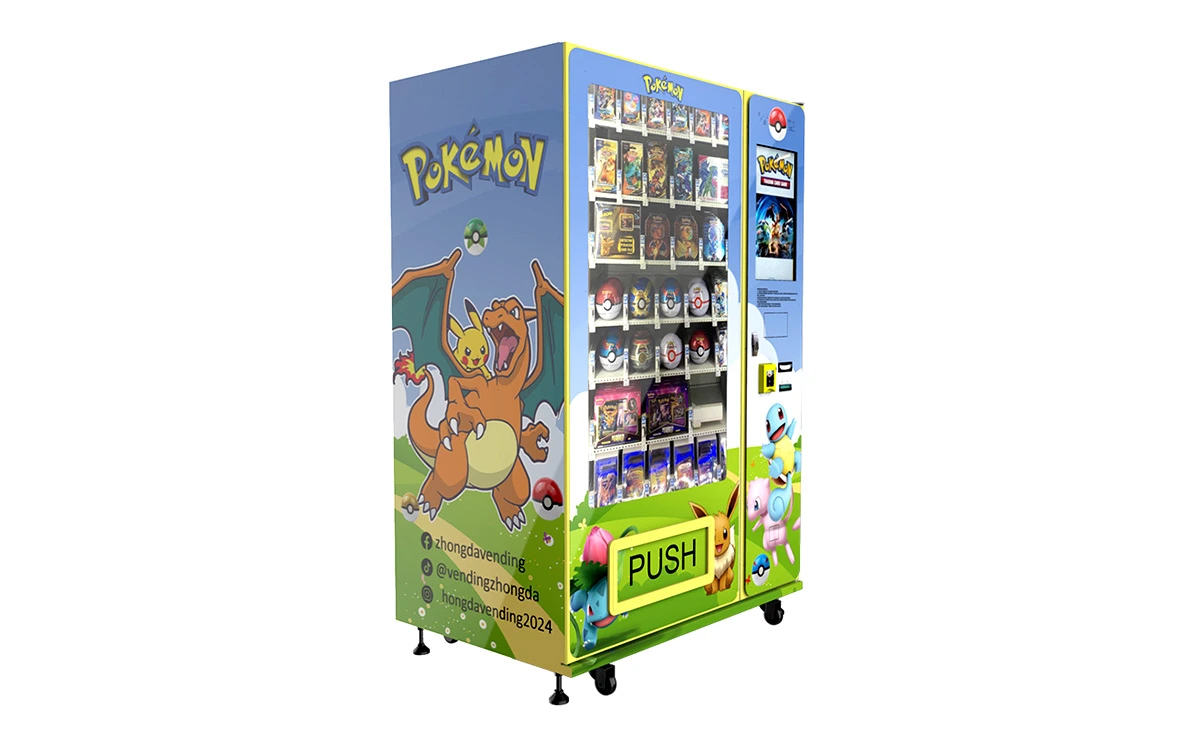
1. Zhongda Smart Full-Size Trading Card Vending Machine — Best Overall
For a business that wants a substantial self-service card store rather than a small vending add-on, this is where I would start.
The current Zhongda Smart dedicated trading card vending machine page lists a 21.5-inch touchscreen, 60 standard cargo lanes, 4G and Wi-Fi connectivity, a cabinet size of approximately 1950 × 1290 × 850 mm, a machine weight of about 280 kg, 60 W equipment power, and a basic merchandise reserve of approximately 300–360 pieces. The page also lists several payment configurations and remote sales-data capabilities.
At the time this guide was last checked, the product page displayed a machine price of $2,110 and advised buyers to request the final quotation for the exact configuration.
Current details can be checked on the Zhongda Smart trading card vending machine product page.
Zhongda Smart Full-Size Machine: Published Specifications
| Product Type | Full-size trading card vending machine |
|---|---|
| Touchscreen | 21.5 inches |
| Standard Cargo Lanes | 60 |
| Published Basic Merchandise Reserve | Approximately 300–360 pieces |
| Cabinet Size | Approximately 1950 × 1290 × 850 mm |
| Machine Weight | Approximately 280 kg |
| Equipment Power | 60 W in the primary published specification |
| Connectivity | 4G / Wi-Fi |
| Remote Data | Remote sales-data query and compatible stock-management functions are listed |
| Payment Configuration | Multiple payment options available depending on final build |
| Warranty Published on Product Page | 1 year |
| OEM/ODM | Available |
| Displayed Price When Last Checked | $2,110; final quotation should be confirmed |
Why I Put It First
The 60-lane layout gives an operator room to build an actual merchandise strategy. That is more useful than simply maximizing the number of identical booster packs inside the cabinet.
I could devote a large block of lanes to proven fast sellers, reserve several for premium products, use a few for accessories, and still have space to test new inventory.
A sample 60-lane plan might look like this:
24 lanes for core booster and sleeved booster products
10 lanes for premium or higher-ticket card products
8 lanes for small boxed products
6 lanes for card sleeves and accessories
6 lanes for mystery or promotional products
6 lanes for new-product testing
That mix should not be treated as a permanent plan. The machine should earn the right to keep each SKU through actual sales data.
Where the Full-Size Machine Makes Sense
This is the type of cabinet I want when the location has enough traffic to justify inventory depth and enough physical space for customers to stop and browse.
The large screen is useful when the machine offers many SKUs because customers need a clear way to compare products and prices. Remote data is equally important. Once sales increase, manually visiting the machine simply to learn what has sold becomes wasted labor.
Where It Is Too Much Machine
I would not put a 280 kg cabinet into a weak location simply because it looks impressive.
Large machines need proper delivery access, enough electrical and connectivity planning, and enough revenue to justify the footprint. If the location only moves a few packs a day, a smaller machine can produce better economics.
That is one reason I call this the best overall configuration, not the best answer for every location.
What I Would Confirm Before Ordering
I would send the supplier the exact package dimensions for the intended products and ask which cargo-lane setup will be supplied.
I would also put these items on the final quotation:
Exact screen size
Final lane count and lane dimensions
Delivery mechanism
Payment terminal and payment methods
Remote inventory functions
Network hardware
Voltage and plug
Cabinet finish
Spare-parts package
Warranty procedure
Packed shipping dimensions and weight
A product page tells me what a machine can be. A signed specification tells me what machine will actually arrive.
2. Zhongda Smart Wall-Mounted Card Vending Machine — Best for Limited Space
There are installations where a floor-standing cabinet is simply the wrong answer.
Maybe the available floor area is valuable. Maybe the location already has fixtures occupying most of the selling space. Maybe the operator wants to test automated card sales without installing a 280 kg machine.
This is where the Zhongda Smart wall-mounted card mini vending machine becomes interesting.
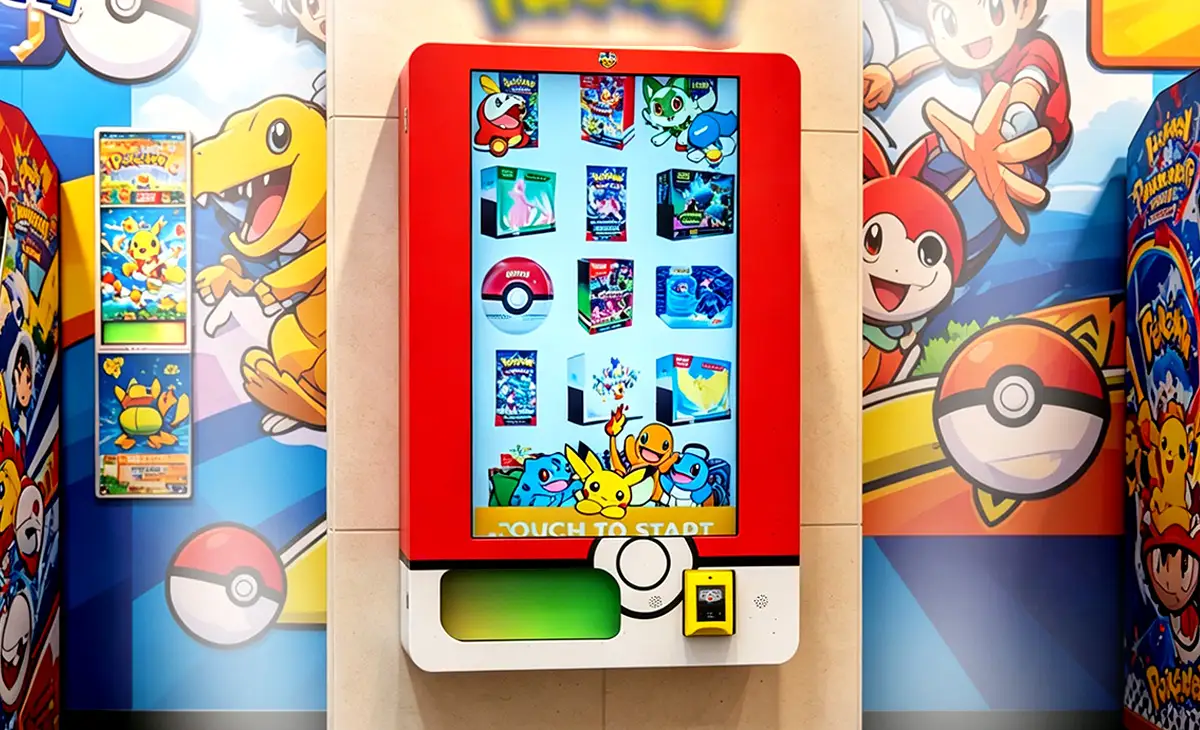
The current product page lists dimensions of approximately 47.24 inches high, 25.591 inches wide, and 11.024 inches deep, with a machine weight of about 70 kg. Published maximum capacity is 120 pieces. It uses five layers with two spring cargo lanes per layer and supports 4G, Wi-Fi, and LAN connectivity.
The page promotes card, NFC, and QR-based cashless payment integrations and cloud-based management. At the time of the latest check, the page displayed a price of $999, subject to final configuration and quotation.
See the current wall-mounted card vending machine specifications.
Why Wall Space Can Be More Valuable Than Capacity
Operators sometimes compare only how many products each machine holds. I think that misses half of the equation.
A machine with half the capacity but almost no conventional floor footprint can be more valuable when placement space is difficult to obtain.
The machine can turn an underused wall into a self-service retail point while leaving the main floor open.
The Capacity Limit Is Real
There is no reason to pretend 120 products equals the capacity of a full-size cabinet.
If a compact machine sells 20 items a day, its theoretical total inventory represents only six days of sales—and popular lanes can empty much earlier.
That makes SKU discipline much more important.
I would use a compact machine for products that are:
Physically consistent
Easy to replenish
Likely to turn quickly
Compact enough to justify the limited space
I would not waste a small cabinet on 30 slow-moving experiments.
Best Role for This Machine
I see the wall-mounted design in two strong roles.
The first is a permanent installation where floor space matters more than raw capacity.
The second is a pilot. If I am uncertain whether a particular site will buy trading cards from an unattended machine, committing less cabinet, inventory, and space can be a sensible way to learn.
If the location proves itself and repeatedly sells out, the data can justify moving to a larger machine later.
3. Custom OEM/ODM Trading Card Vending Machine — Best for a Branded Business
A standard cabinet is enough for many projects. There is no prize for customizing every screw.
Customization becomes valuable when it solves an operating problem or creates a repeatable retail system.
Zhongda Smart's current OEM program lists customization for exterior branding, cabinet design, payment systems, remote management, software interface, connectivity, capacity, slot sizing, and several delivery architectures including spiral, conveyor, lift, and locker/compartment systems.
The company also states that OEM projects can begin with a one-unit minimum, which makes a pilot build possible before a larger deployment. Current options are described on the Zhongda Smart OEM custom vending machine page.
What I Would Customize First
I would not begin with graphics.
My order of priority is usually:
Product and packaging dimensions
Delivery mechanism
Channel layout
Payment system
Remote management
Security and service access
User interface
Exterior design
That order is not as exciting as choosing colors, but it creates a better business.
A beautiful machine that misfeeds a best-selling booster pack is still a bad machine.
When OEM Work Is Worth the Extra Cost
I would seriously consider custom engineering when:
Standard lanes cannot hold the product reliably.
The machine needs to sell both thin packs and larger boxed products.
A fleet will use the same standardized configuration.
The operator needs a specific payment integration.
Remote software must connect to another business system.
Premium merchandise requires lockers or lift delivery.
The machine itself is an important part of the retail brand.
Do Not Confuse Branding With Licensing
There is another issue in card vending that deserves plain language.
Buying licensed trading card products does not automatically give the operator the right to cover a vending machine with protected characters, logos, artwork, or trademarks.
Exterior branding should use artwork the operator owns or is authorized to use.
A custom collectible-card design and an officially licensed branded machine are not the same thing.
Why a One-Unit Pilot Matters
Custom machines create more decisions than standard machines. That makes the first unit especially important.
I would use a pilot to check product fit, vend reliability, customer flow, software, payment behavior, refill process, and service access.
If something is awkward on one machine, fix it before producing a fleet.
4. Locker Trading Card Vending Machine — Best for Graded Cards
Graded slabs are where I stop treating the merchandise like a normal vending product.
A rigid grading holder is valuable partly because it protects the card. Running that slab through an unsuitable mechanism and then letting it drop into the bottom of a machine works against the reason the holder exists.
A locker system takes a much simpler approach.
One product sits inside one compartment. The customer pays, the assigned door unlocks, and the merchandise stays where it was stocked until the buyer removes it.
Why I Like Lockers for High-Value Cards
The mechanism does not need to push a rigid slab through a coil or release it from height.
That removes several common failure points:
Slabs catching on a spiral
Hard drops into the collection bin
Products landing on one another
Misalignment caused by different slab thicknesses
Double-vend risk from products sitting too close together
It also makes mixed product sizes easier. Larger compartments can hold sealed boxes while smaller compartments hold slabs.
The Price You Pay Is Space Efficiency
Lockers use physical space inefficiently compared with tightly packed vending lanes.
That is not necessarily a problem.
If 30 lockers each hold an item that sells for $80, the machine contains $2,400 of potential retail merchandise. If those same 30 compartments each hold an $8 item, the cabinet only carries $240 of retail product.
The second situation makes much less sense.
I therefore think about locker machines in terms of value per compartment, not simply product count.
Security Becomes More Important
A locker cabinet holding premium slabs can concentrate substantial inventory value in a small area.
I want strong compartment locks, good cabinet construction, controlled service access, transaction records, secure mounting, and camera coverage at the installation.
Insurance requirements and loss procedures also deserve attention when inventory values rise.
For ordinary booster packs, lockers are usually inefficient. For premium slabs, they can be the cleanest solution in the entire comparison.
5. Elevator-Delivery Trading Card Vending Machine — Best for Premium Sealed Products
Sometimes the product needs to move, but it should not fall.
That is the job of an elevator or lift-delivery system.
The machine brings a platform to the selected shelf, receives the merchandise, and moves it down toward the collection area. This adds hardware, but it gives the operator much more control over the delivery path.
Where Elevator Delivery Earns Its Keep
I like this system for:
Premium sealed card boxes
Collector tins
Boxed bundles
Fragile outer packaging
Products where corner condition affects customer satisfaction
Mixed collectibles with different package dimensions
A cheap booster pack rarely needs a sophisticated lift by itself. A premium sealed product is a different calculation.
A customer paying more for collector-grade merchandise may care about a small crease or dent that would be irrelevant on an ordinary retail package.
The Hidden Tradeoff Is Downtime Risk
More moving components create more possible failure points.
That does not make elevator machines unreliable by definition, but it changes what I ask before buying.
I want answers to these questions:
What happens if the lift loses position?
Which sensors detect the merchandise?
Can the machine recover automatically after a power interruption?
Is there a manual recovery procedure?
What maximum product weight can the lift handle?
What are the minimum and maximum product dimensions?
Which spare parts should be kept locally?
Can lift errors be diagnosed remotely?
A sophisticated mechanism is useful when it protects valuable merchandise. It becomes expensive when a minor fault shuts down sales for days.
Would I Use an Elevator for Standard Booster Packs?
Usually not as the only reason for buying one.
If most inventory consists of inexpensive, consistently packaged boosters that already dispense reliably through a simpler mechanism, a lift may be unnecessary.
I would spend the extra money where the product mix justifies it.
6. Spiral-Coil Trading Card Vending Machine — Best Value When Products Are Tested Properly
Spiral vending is old technology for a reason: it is simple, understandable, flexible, and capable of moving many different packaged products.
That does not mean every card product belongs in a spiral.
The Problem With Thin Booster Packs
A thin pack can lean, curl, overlap, or slide behind a coil.
The spiral rotates, but the pack does not always move exactly the way the operator expects.
One of the most annoying failures is not a dramatic jam. It is a machine that occasionally fails—often enough to cause refunds, but not often enough to reveal an obvious mechanical defect.
That kind of intermittent failure wastes time because the machine appears to work when someone arrives to inspect it.
A Carrier Can Make a Thin Product Easier to Vend
One solution is placing the booster inside a small vending-compatible holder or sleeve that gives the mechanism a more consistent object to move.
The tradeoff is easy to understand.
You add packaging cost and use more cabinet space, but potentially gain cleaner product presentation and better delivery consistency.
If a small carrier prevents enough failed transactions, it can pay for itself.
Why Spiral Machines Still Belong on the List
I like them for packaged accessories, sleeved boosters, blisters, and boxed products that physically fit the channel.
The hardware is relatively straightforward. Lane changes can often be made without redesigning the entire cabinet. Technicians also tend to understand the mechanism.
The right conclusion is not that spirals are bad for trading cards.
The conclusion is that spirals must be matched to the package.
7. Countertop Trading Card Vending Machine — Best for Testing a New Location
There is nothing wrong with starting small.
In fact, one of the more expensive mistakes in vending is buying a large machine before the location has proven that customers will use it.
A countertop machine lowers the size of that bet.
What I Want to Learn From a Pilot
A pilot should answer practical questions that a business plan cannot answer with confidence:
Do customers notice the machine?
Which products move first?
What is the average transaction value?
Do customers buy one item or several?
Which hours generate most transactions?
How often does the unit need refilling?
Are there repeated payment or delivery problems?
Does the location produce repeat buyers?
Those answers can be worth more than the machine itself because they reduce uncertainty before expansion.
Small Capacity Can Become Expensive
A compact cabinet can create a hidden labor problem if it sells quickly.
Imagine a machine holding 40 products and selling 12 per day. It may need attention every few days, and the fastest SKU may need replenishment even sooner.
If the operator already visits the location regularly, that may be fine.
If the machine is a long drive away, the refill schedule can destroy the economics.
When I Would Upgrade
Once the location is repeatedly selling out of profitable products and refill frequency becomes inconvenient, I stop celebrating the small footprint.
At that point, the pilot has done its job. The next question is whether a wall-mounted or full-size machine can support more inventory with fewer service visits.
8. Hybrid Collectibles Vending Machine — Best for Increasing Revenue per Visit
A card vending machine does not have to sell only cards.
In some businesses, that would leave money on the table.
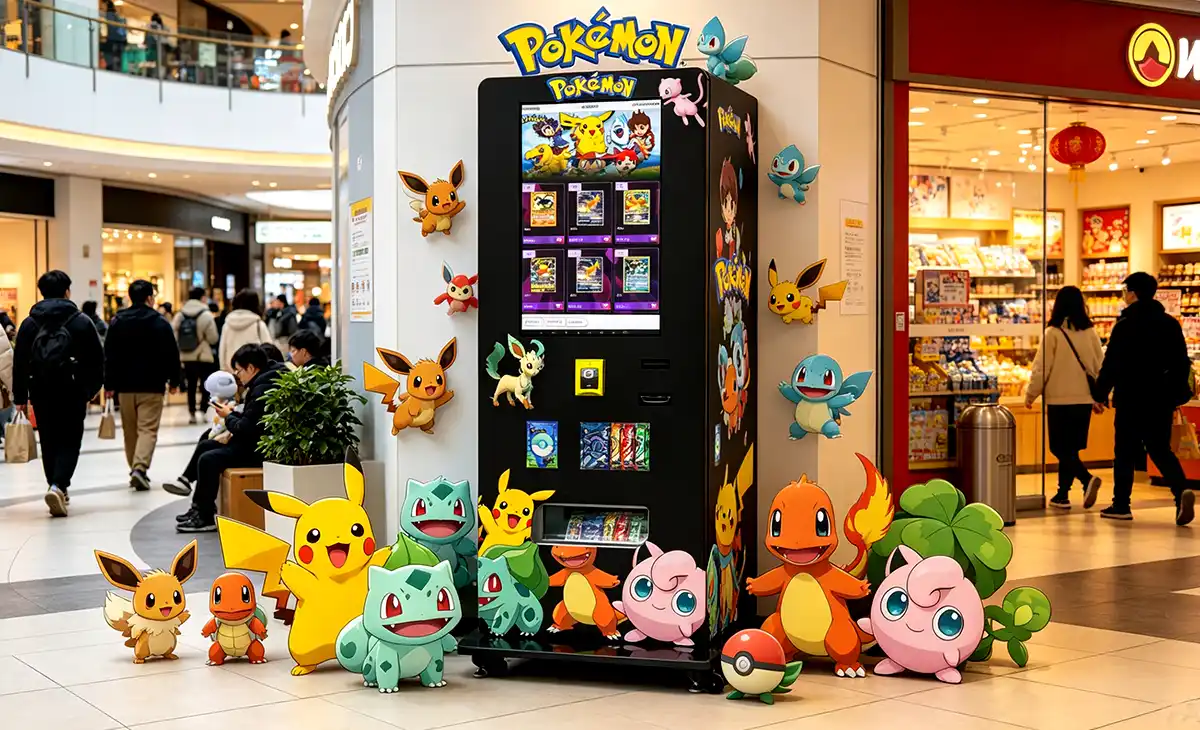
Card sleeves, deck boxes, compact storage products, mystery items, blind-box collectibles, and other small accessories can fit naturally beside the main card assortment.
The Cabinet Should Feel Like a Small Store, Not a Storage Closet
I would not fill empty lanes with random merchandise simply because it fits.
The products should make sense together.
A buyer purchasing a booster may also need sleeves. A collector who notices a small accessory may discover a sealed card product on the touchscreen. A mystery item can provide a different price point without changing the entire concept.
That creates a coherent assortment.
Example 60-Lane Hybrid Allocation
| Product Category | Example Lanes | Share of Machine |
|---|---|---|
| Core booster products | 24 | 40% |
| Premium card products | 10 | 16.7% |
| Card sleeves | 6 | 10% |
| Deck/storage accessories | 6 | 10% |
| Mystery or collectible products | 8 | 13.3% |
| Test inventory | 6 | 10% |
I would consider those numbers temporary.
After a few refill cycles, the sales report should decide which categories earn more space.
A good vending machine gradually becomes less reflective of the owner's assumptions and more reflective of what customers actually purchase.
Problems I Watch for Before Installing a Trading Card Vending Machine
The most useful machine knowledge often comes from thinking about how a sale can fail.
A vending machine does not need a catastrophic breakdown to lose money. Small recurring problems can be worse because they quietly generate refunds, poor customer experiences, and unnecessary visits.
1. Double Vending Thin Packs
Two boosters can overlap just enough that one vend releases both.
The customer is happy. The operator is not.
Because the machine may record only one paid transaction, inventory records also become inaccurate.
I would test thin products under different fill levels because a lane can behave differently when fully loaded and when nearly empty.
2. The Spiral Rotates but the Product Does Not Move
This often happens when the package has enough room to lean or slide around the coil.
The machine may think it completed the vend unless delivery detection catches the failure.
That is why I care about product detection and refund logic rather than simply whether the motor turns.
3. The Machine Looks Full but the Important Products Are Empty
This is one of the most common inventory mistakes.
A cabinet can be 70% full while the three SKUs customers actually want are sold out.
Total capacity tells me almost nothing about sales continuity unless inventory is allocated correctly.
I prefer tracking days of supply by important SKU.
4. Premium Boxes Arrive With Damaged Corners
The vend technically succeeds, yet the customer still wants a refund.
This is not always a machine failure. It is often a product-delivery mismatch.
If outer packaging condition affects value, reduce drop height or use a gentler mechanism.
5. Payment Succeeds but Delivery Is Not Confirmed
This is where payment logic and vending hardware meet.
The machine needs a clear procedure for a failed or unconfirmed vend. The operator should understand how the software records the event and how refunds are handled.
I would test this before launch, not after the first customer support complaint.
6. Refill Layout Is Too Slow
A machine can have impressive capacity and still be frustrating to operate.
If shelves are difficult to reach, products require individual adjustment, or staff cannot quickly identify the right lane, restocking becomes labor-intensive.
Multiply an extra 15 minutes by dozens of machines and the cost becomes very real.
7. The Machine Cannot Tell You What Is Wrong
A remote alert saying “machine offline” is better than nothing, but I want more useful information where the system supports it.
Is power lost? Is the network disconnected? Did a motor report an error? Is a payment device unavailable? Is one SKU empty while the rest of the machine is fine?
The more specific the diagnosis, the fewer unnecessary trips the operator makes.
How Much Does a Trading Card Vending Machine Cost?
The purchase price is the easiest number to see and one of the easiest numbers to misuse.
When this article was last checked, Zhongda Smart's dedicated full-size trading card machine displayed a price of $2,110, while the wall-mounted card machine displayed $999. Both pages state that buyers should confirm the final quotation.
Those numbers are useful as published reference points. They are not the complete cost of opening a vending location.
The Cost Categories I Put in the Budget
| Cost | What to Include | Why Buyers Miss It |
|---|---|---|
| Machine | Final configured cabinet, screen, controller, and delivery system | Website prices may represent a standard configuration |
| Payment hardware | Terminal, reader, mounting hardware, integration | Not every quote includes the same payment equipment |
| Initial inventory | Enough stock to fill the machine plus refill reserve | Inventory can tie up substantial working capital |
| Freight | Transportation from factory or warehouse | Large cabinets are heavy and bulky |
| Receiving | Unloading, liftgate, forklift, pallet handling where required | A 280 kg machine is not an ordinary parcel |
| Installation | Moving, mounting, leveling, anchoring, electrical preparation | Wall-mounted and large machines may require specialist work |
| Graphics | Custom wrap, logo, panel artwork, design preparation | Branding is often priced separately |
| Connectivity | Wi-Fi access or mobile-data service | Remote monitoring depends on reliable connectivity |
| Software | Management-platform or service fees where applicable | Recurring software cost affects payback |
| Spare parts | Motors, sensors, locks, cables, fuses, or recommended parts | A cheap part can create expensive downtime if it is not available |
| Location expense | Fixed rent, commission, or revenue share | A strong sales location can still be unprofitable under bad terms |
| Working capital | Money available for restocking fast sellers | High turnover can require more inventory cash than expected |
Why I Do Not Compare Quotes by Price Alone
Suppose one machine is quoted at $1,600 and another at $2,200.
The cheaper machine is not automatically saving $600.
One quotation may include a large touchscreen, remote inventory software, payment-system preparation, custom channels, graphics, and spare parts. The other may be a basic cabinet without several of those items.
I normalize every quote before comparing it.
At minimum, I want to know:
Cabinet size
Weight
Screen size
Delivery architecture
Number and dimensions of channels
Payment hardware
Network hardware
Remote management functions
Warranty
Spare parts
Packaging and freight dimensions
Customization included in the price
If those details are not identical, the prices are not directly comparable.
Can a Trading Card Vending Machine Make Money?
Yes, but profitability comes from location quality, gross margin, product turnover, uptime, and route efficiency—not from owning a vending machine.
I start with a very simple relationship:
Monthly Gross Profit = Daily Revenue × 30 × Gross Margin
Then:
Monthly Net Contribution = Monthly Gross Profit − Monthly Operating Costs
A simple capital payback estimate is:
Payback Period = Initial Project Investment ÷ Monthly Net Contribution
Zhongda Smart also provides a vending machine ROI calculator that separates machine cost, initial stock, daily revenue, gross margin, site rent, staff cost, POS expenses, warehouse cost, and other operating expenses.
An Illustrative Profitability Model
The numbers below are examples, not earnings claims.
Assume the complete project requires $4,800 of opening capital after the machine, initial merchandise, transportation, installation, payment setup, and launch expenses are included.
| Scenario | Daily Revenue | Gross Margin | Monthly Gross Profit | Monthly Operating Cost | Monthly Net Contribution | Simple Payback |
|---|---|---|---|---|---|---|
| Conservative | $70 | 33% | $693 | $550 | $143 | About 33.6 months |
| Base Case | $120 | 36% | $1,296 | $550 | $746 | About 6.4 months |
| Strong Site | $200 | 38% | $2,280 | $550 | $1,730 | About 2.8 months |
The machine is identical in all three scenarios.
The economics are completely different.
That is why I would rather spend more time finding and validating a strong location than spend weeks trying to save a few hundred dollars on hardware.
How Much Does the Machine Need to Sell Per Day?
This is a more useful question than asking how much money a vending machine “usually makes.”
Suppose monthly operating expenses are $500 and the merchandise earns a 35% gross margin.
The daily revenue needed simply to cover those monthly operating expenses is:
$500 ÷ 35% ÷ 30 = approximately $47.62 per day
That only covers the monthly operating expenses. It does not yet recover the original investment.
Adding a 12-Month Payback Goal
Now suppose total opening investment is $4,800 and the operator wants to recover it over 12 months.
The business needs to recover another:
$4,800 ÷ 12 = $400 per month
Add $400 to the $500 monthly operating expense:
$900 of monthly gross profit is required.
At a 35% gross margin:
$900 ÷ 35% = approximately $2,571.43 monthly revenue
Divided by 30 days:
Approximately $85.71 of daily revenue
That is the kind of number I want before signing a location agreement.
If the location realistically looks like a $40-per-day site, a business plan requiring $86 per day is telling me something important.
The Maximum Investment I Would Accept
The calculation can also be reversed.
Suppose a proven location produces $650 per month of sustainable net contribution and I want a 12-month capital payback.
A rough maximum project investment is:
$650 × 12 = $7,800
That does not mean I should spend $7,800. It tells me the upper limit implied by my target payback period.
This way of thinking keeps the machine purchase connected to the economics of the location.
Why Specialized Card Retail Is Large Enough to Matter
Card vending should still be judged location by location, but the underlying collectible category is clearly substantial.
The Pokémon Company reported cumulative production of more than 75 billion trading cards as of the end of March 2025.[1]
That figure is not a vending-machine sales forecast. It is useful because it shows the physical scale achieved by one major trading-card property.
Another useful signal comes from eBay's first-quarter 2026 business update filed with the SEC. eBay said its card-scanning feature had surpassed 30 million cumulative scans after expanding across its top five collectible-card-game genres. The same filing reported a record-breaking $16.5 million sale of a PSA 10 Pikachu Illustrator card through Goldin.[2]
I would not put an ultra-valuable card in an ordinary unattended vending cabinet. That is not the point.
The useful lesson is that trading cards span a remarkably wide value range. A machine designed for $5–$10 boosters does not automatically make sense for $100 sealed products or high-value graded cards.
The merchandise determines the machine.
What Should You Put in a Trading Card Vending Machine?
I prefer deciding the first product list before the final machine configuration is approved.
That means making a simple SKU sheet with:
Product name
Package width
Package height
Package depth
Weight
Cost
Retail price
Gross margin
Expected daily unit sales
Target refill quantity
Once that exists, channel planning becomes much easier.
Booster Packs
Booster packs are compact and can encourage repeat purchasing, but thin packaging is exactly what makes them mechanically tricky.
I would test them at full lane, half lane, and near-empty lane conditions.
The machine needs to behave consistently through the whole refill cycle.
Sleeved Boosters
Sleeved products take more space but often provide a more consistent vending shape.
If the larger package improves delivery reliability, sacrificing some total capacity can be worthwhile.
Sealed Boxes
Boxes increase average transaction value but use more lane volume.
The important question is not simply whether the box fits. It also needs enough clearance to move without catching, rotating, or damaging its corners.
Graded Cards
I would treat graded slabs as premium merchandise.
Lockers are my preferred starting point. Elevator delivery can also make sense. I would only use another mechanism after testing the exact slab holder repeatedly.
Mystery Products
Mystery packs can add entertainment value, but the offer should be transparent enough that the customer understands what is being purchased.
Promotions and product descriptions should follow applicable rules and should not depend on confusing the buyer.
Accessories
Sleeves, deck boxes, compact storage products, and other accessories can be excellent filler only when they are genuinely relevant to the card customer.
The best accessory lane is not the one with the highest margin on paper. It is the one customers actually buy.
How Many SKUs Should You Start With?
I would rather start with 15 products that have a clear reason to be in the machine than 50 products chosen to make the screen look busy.
A simple starting structure is:
60% core inventory: products expected to drive most unit sales
25% margin inventory: products chosen partly for stronger gross profit
15% test inventory: new or uncertain products that earn more space only if they sell
Then I would replace assumptions with actual data.
Track Revenue per Lane
One simple measurement is:
Revenue per Lane = SKU Revenue ÷ Number of Lanes Assigned to That SKU
Suppose Product A generates $600 from four lanes and Product B generates $300 from one lane.
Product A produces $150 per lane.
Product B produces $300 per lane.
Product A has more total sales, but Product B is using machine space more efficiently.
That is the kind of detail that helps improve a mature product mix.
How Often Should a Card Vending Machine Be Restocked?
I do not set refill schedules based on total machine capacity.
I set them based on the fastest important SKU.
Suppose a machine carries 80 units of Product A and Product A sells 12 units per day.
Its theoretical inventory lasts:
80 ÷ 12 = 6.7 days
I would not automatically schedule the route every seven days.
Sales vary. A busy day can empty the lane earlier. If Product A is one of the main reasons customers visit the machine, letting it sell out for two days is not acceptable.
A refill every three or four days may make more sense.
Effective Capacity Is More Useful Than Total Capacity
This leads to a concept I use constantly: effective capacity.
Effective capacity is the amount of useful inventory the machine can hold before an important product requires attention.
A cabinet may advertise 300-product capacity, but if its best-selling SKU only has room for 20 units and sells 10 per day, the machine still has a two-day operational bottleneck.
Solving that bottleneck can be more valuable than adding another 100 units of slow-moving merchandise.
Payment Configuration Matters More Than It Looks
A vending transaction is short. That is exactly why payment friction is so noticeable.
The buyer is standing in front of a machine ready to purchase. If the preferred payment method does not work, there is no salesperson to rescue the transaction.
For most modern installations, I would begin with card and contactless payment support, then add compatible QR-based options where they are useful.
Cash can still make sense for some projects, but it creates additional operational work:
Bill and coin hardware
Cash collection
Reconciliation
Change management where required
More moving components
Additional security considerations
I would decide the payment strategy before the machine is manufactured because terminal size, mounting, power, communications, software integration, and processing arrangements can affect the final cabinet.
Ask What Happens When Payment and Vend Results Disagree
This is a much better question than simply asking whether the machine accepts credit cards.
What happens if payment is approved but the machine does not detect product delivery?
Does the software record the event?
Can the operator see it remotely?
Is a refund automatic or manual?
Those details affect customer support far more than a logo showing that a payment method is accepted.
Choosing a Profitable Trading Card Vending Machine Location
I will choose an average machine in an excellent location before choosing an excellent machine in a poor location.
Equipment affects conversion and uptime. Location determines how many relevant customers have an opportunity to buy in the first place.
Relevant Traffic Beats Raw Traffic
A location with 5,000 daily visitors is not automatically better than one with 1,000.
If the smaller audience contains far more card buyers, it can produce more transactions.
I look for places where collecting, gaming, entertainment, shopping, or hobby activity naturally overlaps with the merchandise.
Visibility Is Different From Foot Traffic
A machine can sit inside a busy building and still be effectively invisible.
Before approving a placement, I would stand where normal visitors walk and check:
Can the machine be seen without turning around?
Does the screen face the traffic flow?
Can a customer stop without blocking the path?
Is lighting good enough to make the machine look open and accessible?
Can signage be used?
Does the location feel safe enough for a customer to stand there and browse?
Dwell Time Helps
Card customers sometimes want a few seconds to compare sets, products, and prices.
A machine placed where everyone is rushing through a narrow walkway can have plenty of traffic but poor browsing conditions.
A little dwell time can improve the selling environment.
Location Terms Can Destroy a Good Sales Number
I evaluate location cost against gross profit, not revenue.
A machine producing $4,000 in monthly sales can be worse than one producing $3,000 if the first location charges much higher rent or commission.
The sales report looks impressive. The bank account tells the real story.
Security and Product Protection
Compact high-value products deserve more security attention than ordinary low-cost vending stock.
For standard booster inventory in a well-controlled indoor location, normal commercial vending security may be enough.
For premium sealed products or graded slabs, I increase the controls.
Physical Security Checklist
Commercial steel cabinet construction
Quality door and compartment locks
Protected hinges and limited pry points where practical
Secure mounting or anchoring
Camera coverage
Good lighting around the machine
Controlled key access
Recorded restocking procedures for higher-value inventory
Do Not Ignore Digital Access
Connected vending machines also create software access.
I want to know who owns the main management account, how staff permissions work, how passwords are changed, how software updates are delivered, and what happens when the machine loses network connectivity.
One shared administrator password used by everyone is not how I would run a growing machine fleet.
Maintenance and Vending Machine Repair
I do not expect a commercial machine to operate forever without maintenance.
I expect problems to be identifiable and repairable.
Those are very different expectations.
Keep the Right Spare Parts Nearby
A low-cost component can create expensive downtime when it has to be ordered only after the failure occurs.
A spare-parts kit may include:
Compatible motors
Sensors
Fuses
Frequently used cables
Locks
Connectors
Delivery-system components
Specific controller-related parts recommended by the manufacturer
I would ask the supplier which parts most commonly need replacement for the exact configuration being purchased.
Remote Diagnosis Saves Driving
If sales stop, I want to know why before somebody travels to the machine.
Is the machine offline?
Is the payment terminal unavailable?
Is inventory empty?
Did one lane produce an error?
Is the controller still communicating?
Every problem that can be identified remotely makes route operations more efficient.
Use Refill Visits for Preventive Maintenance
A restocking visit should include a quick inspection.
I would:
Remove packaging debris
Check delivery channels
Inspect the retrieval area
Test representative products
Clean the touchscreen
Check doors and locks
Look for loose connections
Review error records if the software provides them
Five extra minutes during a planned visit can prevent a much longer emergency visit later.

How I Evaluate a Trading Card Vending Machine Manufacturer
The machine design and the manufacturer are two separate decisions.
A promising cabinet is not enough if specifications are unclear, spare parts are difficult to obtain, or nobody can help diagnose a problem after delivery.
For the configurations covered in this guide, Zhongda Smart is my first manufacturer shortlist because the company's current published range includes a dedicated full-size trading card machine, a wall-mounted card machine, and OEM/ODM support covering spiral, conveyor, lift, and locker/compartment delivery systems.
That breadth matters because a buyer can begin with the product rather than being forced into one mechanism for every use case.
Ask for Repeated Vend Testing With the Real Products
This is one of the most important steps in the entire purchase.
If you plan to sell four major package types, provide samples or precise dimensions for all four.
I would ask for repeated test video with representative products loaded under realistic conditions.
One successful vend proves very little.
A product that matters to the business should be tested enough times to reveal occasional misfeeds.
Ask What Happens After the Machine Arrives
Before paying, I want written answers to questions such as:
How is technical support provided?
How long is the warranty?
Which parts are covered?
How are replacement parts shipped?
Are wiring diagrams available?
Are troubleshooting instructions supplied?
Can software problems be diagnosed remotely?
Are software updates included?
Which spare parts should be ordered with the machine?
Zhongda Smart's current dedicated card-machine pages publish a one-year warranty and online technical-support information. I would still make sure the final purchase agreement states the exact terms.
Get the Final Machine Specification in Writing
Photos are useful. Renderings are useful. Website descriptions are useful.
None of them replace the specification attached to the order.
The final documentation should identify the:
Cabinet
Screen
Delivery system
Channel count and dimensions
Payment equipment
Connectivity
Remote management features
Software functions
Branding
Accessories
Spare parts
Warranty
If a feature is important enough to affect the purchasing decision, it is important enough to put in writing.
A 30-Day Pilot Plan Before You Scale
If demand is not already proven, I would treat the first machine as a structured test.
Week 1: Do Not Overreact
Fill the machine, record the starting quantities, and make sure every product is correctly mapped in the software.
Unless something is clearly wrong, avoid changing the assortment every day. You need a stable baseline.
Week 2: Find the Products That Actually Move
Review:
Units sold by SKU
Revenue by SKU
Gross profit by SKU
Revenue per lane
Transaction count
Average transaction value
At this point, the machine usually starts showing which products deserve more space.
Week 3: Change the Mix Carefully
Increase capacity for products that repeatedly sell out.
Reduce products that barely move.
Do not change everything at once. If too many variables change, it becomes difficult to understand what improved the result.
Week 4: Judge the Location, Not Just the Products
At the end of the month, I would review:
Total sales
Gross profit
Net contribution
Transactions
Average transaction value
Stockouts
Failed vends
Refunds
Service calls
Restocking time
Travel time
Then I would make one of four decisions:
Keep the setup and continue measuring.
Change the product mix.
Upgrade the machine because capacity is the bottleneck.
Move the machine because the location is the bottleneck.
That is a much better scaling process than ordering five identical machines because the first one looked good in photographs.
Trading Card Vending Machine Buying Checklist
Before approving the purchase, I want every one of these questions answered.
What exact products will be sold?
What are their minimum and maximum package dimensions?
Which products are thin, fragile, rigid, or unusually heavy?
Has every important SKU been physically vend-tested?
What delivery mechanism is being supplied?
How many usable product channels will the machine have?
What is realistic capacity with the actual merchandise?
What payment equipment is included?
Which payment methods will be enabled?
What transaction fees or recurring payment costs apply?
Does the machine provide remote sales reporting?
Can inventory be monitored remotely?
Are low-stock alerts available?
Can pricing be changed remotely?
What happens if the network connection disappears?
What happens if power fails during a transaction?
What happens if payment is approved but delivery is not confirmed?
How are refunds handled?
What is the warranty period?
Which components are covered?
What spare parts come with the machine?
Which additional spare parts should be purchased?
How is technical support provided?
What are the packed dimensions and shipping weight?
Who will unload the machine?
Who will move and install it?
Does the location have suitable power?
Is reliable network connectivity available?
How will the machine be secured?
Does the cabinet require custom graphics?
Do you have permission to use every logo and image on those graphics?
What is the complete installed investment?
What monthly operating expenses will remain after launch?
What daily sales level covers those expenses?
What daily sales level meets the target payback period?
What happens financially if sales are 30% below forecast?
If the project still looks attractive after answering those questions conservatively, I have much more confidence in it.
My Final Ranking
If I were selecting from these eight configurations today, my ranking would be:
Zhongda Smart full-size touchscreen trading card vending machine — best overall for a substantial card assortment, remote operation, and higher-volume sales.
Custom OEM/ODM trading card vending machine — best when the product or business model requires a purpose-built configuration.
Zhongda Smart wall-mounted card vending machine — best when available space matters more than maximum capacity.
Locker trading card vending machine — best for graded slabs and individually protected premium merchandise.
Elevator-delivery trading card vending machine — best for high-value sealed products where packaging condition matters.
Hybrid collectibles vending machine — best for combining cards with relevant accessories and collectibles.
Spiral-coil trading card vending machine — strong value when the exact packaging has been tested carefully.
Countertop trading card vending machine — best for proving a location before committing more capital.
That ranking changes when the merchandise changes.
If the business sells almost nothing except graded slabs, the locker machine moves straight to the top.
If a location has no room for a floor cabinet, the wall-mounted unit becomes the obvious choice.
If the project is building a standardized branded fleet, I would put OEM development ahead of buying an off-the-shelf machine.
Frequently Asked Questions
What is the best trading card vending machine?
For most high-capacity commercial projects, I prefer a full-size touchscreen trading card vending machine with flexible product channels, cashless payment capability, remote management, strong security, and enough capacity to support several card categories. The Zhongda Smart full-size trading card vending machine is my best overall option in this comparison because its currently published configuration includes a 21.5-inch touchscreen, 60 standard cargo lanes, 4G/Wi-Fi connectivity, and a basic merchandise reserve of approximately 300–360 products. A different configuration may be better for specialized inventory: lockers are stronger for graded slabs, while a wall-mounted machine is better where space is limited.
How much does a trading card vending machine cost?
Pricing depends on cabinet size, touchscreen, delivery system, payment equipment, software, capacity, and customization. When this guide was last updated, Zhongda Smart's wall-mounted card vending machine displayed a price of approximately $999, while its full-size trading card machine displayed approximately $2,110. Final quotations can change with configuration. Buyers should also budget for initial stock, freight, receiving, installation, payment setup, graphics, connectivity, spare parts, and location expenses.
Can a vending machine sell booster packs?
Yes, but booster packs should be physically tested with the intended vending mechanism. Thin flexible packs can overlap, lean, slide behind a spiral, or double vend if the lane is not designed correctly. Sleeved boosters can be easier to handle because their package has a more consistent shape. For an important booster SKU, I would request repeated vend testing rather than relying on a single demonstration.
Can you sell graded cards from a vending machine?
Yes. My preferred configuration for graded cards is an individual locker system because the slab remains stationary until the customer opens the assigned compartment. An elevator-delivery system can also work well. I would avoid any delivery system that subjects an expensive slab to unnecessary impact or forces a rigid holder through a mechanism that has not been specifically tested for it.
How many trading card packs can a vending machine hold?
Capacity varies by machine and package size. Zhongda Smart's current full-size trading card vending machine page lists a basic merchandise reserve of approximately 300–360 pieces and 60 standard cargo lanes. The current wall-mounted card-machine page lists a maximum capacity of 120 pieces. Actual useful capacity depends on product dimensions, channel configuration, and how much space is allocated to each SKU.
Are trading card vending machines profitable?
They can be profitable when the location generates enough sales and the gross margin covers rent, payment expenses, restocking, maintenance, software, losses, and the original investment. I calculate monthly gross profit from daily revenue and gross margin, subtract operating expenses, and then compare the remaining monthly contribution with the total opening investment. A machine can be profitable in one location and lose money in another even when the hardware is identical.
What payment methods should a trading card vending machine accept?
Card and contactless payment support are strong starting points, with compatible QR payment methods added when appropriate for the installation. Cash can still be useful, but it adds bill or coin hardware, collection work, reconciliation, and additional service requirements. The final payment configuration should be confirmed before manufacturing because the terminal and software can affect the machine design.
Should I buy one trading card vending machine or several?
If the location and product mix are not already proven, I prefer starting with one pilot machine. A 30-day test can reveal product demand, average transaction value, refill frequency, technical problems, stockouts, refunds, and realistic operating costs. Once the machine has produced reliable data, ordering additional units becomes easier to justify and the pilot configuration can be improved before a larger rollout.
Final Thoughts
The best trading card vending machine is not the cabinet with the longest specification sheet.
It is the machine that repeatedly delivers your actual products, protects their condition, accepts the payments customers want to use, keeps the right inventory available, and produces enough gross profit to justify the location and the capital tied up in the equipment.
That is why I start with merchandise dimensions instead of screen size.
For a broad assortment of boosters, sleeved products, small boxes, and accessories, the Zhongda Smart full-size touchscreen machine is the strongest overall starting point in this comparison. The published 60-lane layout and 300–360-piece basic reserve provide enough room to build a meaningful assortment, while remote connectivity makes it more practical to manage as sales volume grows.
The wall-mounted Zhongda Smart machine solves a different problem. Its smaller capacity is a fair trade when floor space is difficult to justify or when the operator wants a lower-commitment pilot.
For premium slabs and sealed products, I would stop thinking about capacity first and think about product protection. Locker and elevator systems can make more sense even when they cost more or use space less efficiently.
Most importantly, I would not scale a machine configuration simply because it works on paper.
Test the real products. Watch what customers buy. Measure failed vends. Measure refill time. Calculate gross profit instead of celebrating revenue. Keep the fast sellers in stock. Fix the annoying problems on the first machine before repeating them across ten machines.
That is how a card vending machine becomes a retail business rather than an interesting piece of equipment sitting against a wall.
Sources and Data References
The Pokémon Company — Pokémon in Figures. Reference for cumulative trading card production reported as of the end of March 2025.
eBay Inc. — First Quarter 2026 Business and Financial Results filed with the SEC. Reference for cumulative card-scanning activity and the reported $16.5 million PSA 10 Pikachu Illustrator transaction.
Editorial and product-data note: Machine specifications and displayed prices in this guide were checked against the referenced Zhongda Smart product pages. Product configuration, payment hardware, software functions, pricing, shipping cost, warranty details, and availability can change. Financial calculations are planning examples rather than promises of revenue or profit. Buyers should confirm the final machine specification, quotation, product compatibility, warranty, payment setup, and installation requirements before purchasing.
Last updated: August 11, 2026.