A trading card vending machine is an automated retail system built to sell booster packs, sports cards, collectible boxes, graded cards, accessories, and other card products without a cashier. Commercial machines range from compact wall-mounted units to full-size touchscreen kiosks with dozens of product lanes, cashless payments, remote inventory monitoring, and custom branding. From a business standpoint, the machine itself is only part of the equation. Product margin, qualified foot traffic, inventory turnover, dispensing reliability, and location cost determine whether the numbers actually work. From the manufacturing side, I pay even more attention to package dimensions and delivery mechanics. A beautiful machine with the wrong product channel will create refunds and service calls; a correctly configured machine can operate as a compact automated card store around the clock.
Prepared by: Zhongda Smart Editorial & Vending Engineering Team
Technical focus: Trading card dispensing, automated retail hardware, payment integration, inventory management, and custom vending machine design
Last updated: August 8, 2026
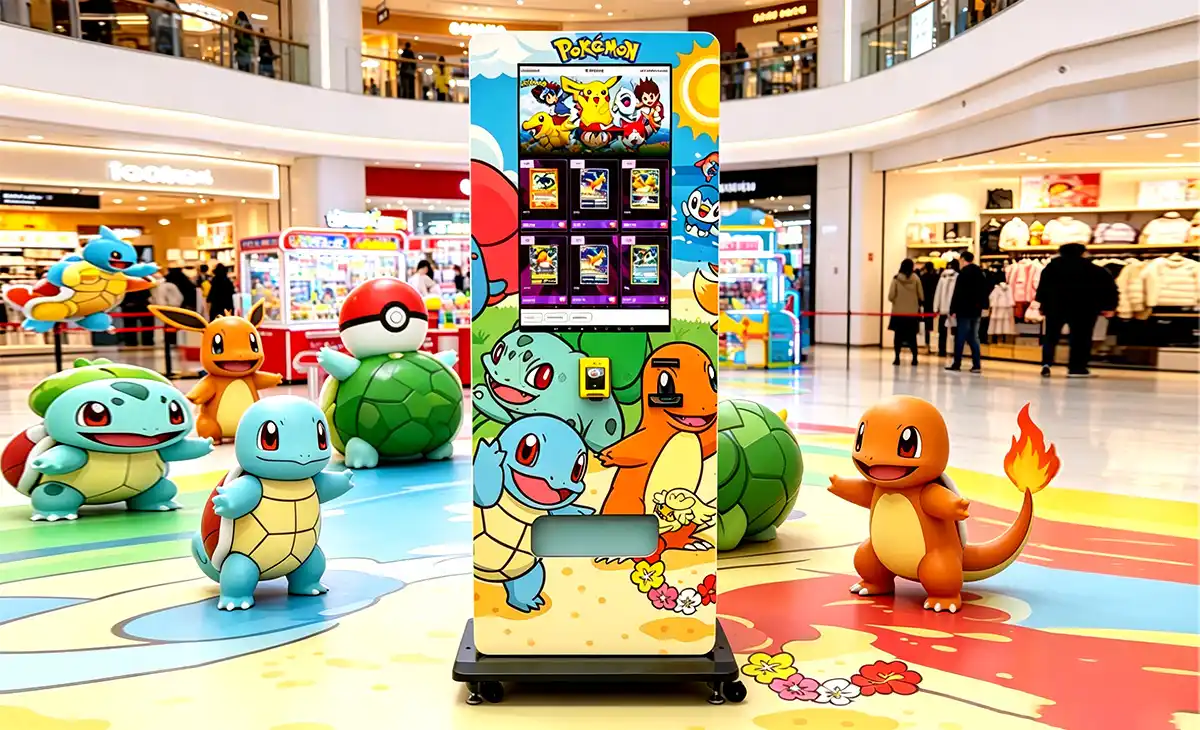
Trading Card Vending Machine at a Glance
| Item | Practical Planning Reference |
|---|---|
| Machine type | Automated retail machine for trading cards and collectible products |
| Common products | Booster packs, sleeved packs, sports cards, collector boxes, graded cards, accessories |
| Illustrative equipment budget | About $2,000 to $10,000+ depending on configuration |
| Illustrative total startup budget | About $7,000 to $20,000+ including inventory and setup |
| Typical payment configuration | Credit/debit card, NFC, mobile payment, QR payment, optional cash |
| Product capacity | Roughly 100 to 400+ items depending on package dimensions and machine layout |
| Recommended connectivity | 4G, Wi-Fi, or LAN with remote management |
| Best delivery system for booster packs | Adjustable spring/channel or controlled conveyor, depending on packaging |
| Best delivery system for premium boxes | Conveyor, elevator, or locker system |
| Best delivery system for graded cards | Locker or controlled elevator delivery |
| Most important buying consideration | Reliable vending of the exact products you plan to sell |
The figures above are planning references rather than guaranteed quotations or earnings. Actual machine cost, capacity, and business results depend on configuration, product dimensions, inventory acquisition cost, site expenses, and customer demand.
What Is a Trading Card Vending Machine?
A trading card vending machine is essentially a compact automated card store. Customers select a product, complete payment, and receive the item without staff handling the transaction. Depending on the internal structure, the machine can sell inexpensive booster packs and accessories or much more valuable collector boxes and protected cards.
The concept sounds similar to snack vending, but I would not treat the two machines as interchangeable. Trading cards create a different engineering problem. The merchandise tends to be thinner, lighter, smaller, and more valuable per cubic inch than food or beverage products. Packaging dimensions also change frequently between product releases.
A booster pack may be flexible enough to lean inside a poorly adjusted lane. A sleeved booster can catch on the edge of a guide. Two thin packages may move together if the spring pitch and channel pressure are wrong. A rigid collector box may survive a normal delivery, while a graded card in a protective slab deserves much more controlled handling.
For that reason, the most important part of a card vending machine is not the touchscreen. It is the relationship between the product and the dispensing system.
A modern system may include:
Touchscreen product selection
Credit and debit card acceptance
NFC and mobile-wallet payments
QR-code payments
Optional cash acceptance
Cloud-based inventory records
Remote price changes
Transaction reporting
Low-stock alerts
Machine-status monitoring
Product-delivery sensors
Custom user interface
LED lighting and digital advertising
Custom exterior graphics
Remote fault notifications
When those systems work together, the machine becomes more than a product dispenser. It becomes an unattended retail endpoint that can be monitored and managed like a very small store.
Why Trading Card Vending Works as an Automated Retail Model
There is a basic economic feature of collectible cards that makes the category interesting for vending: product value can be high while physical size remains small.
A machine does not need refrigeration, plumbing, or a large volume of heavy inventory. A few square feet of retail footprint can hold a meaningful assortment of sealed products. That allows operators to put relatively high retail value into a cabinet that requires much less space than a conventional store.
The broader collectible game category also demonstrates how much spending can exist around card products. Hasbro reported on July 21, 2026 that Magic: The Gathering exceeded $500 million in quarterly revenue for the first time in its history, while Magic revenue increased 32% during the quarter. That is not a vending-machine revenue forecast, and it should never be presented as one. What it does show is that physical and digital card ecosystems can support significant recurring consumer demand.
The business model benefits from several characteristics that fit automated retail particularly well:
Collectors frequently make repeat purchases.
New releases create natural demand spikes.
Many products are already sealed and clearly identified.
Customers generally understand the product without requiring a salesperson.
Compact packaging reduces storage requirements.
Premium merchandise can raise average transaction value.
Inventory can be changed faster than a machine itself needs to be changed.
Self-service purchasing can extend selling hours without extending staffing hours.
There is also an impulse element. A customer may not plan to visit a specialty store, but a well-placed collectible card vending machine can put the product directly in front of that customer at the moment interest appears.
None of this means the machine automatically makes money. I have always considered the hardware a sales channel rather than the business itself. The business still depends on sourcing products at workable costs, choosing the right merchandise, obtaining a suitable location, managing stock, and controlling operating expense.
How Does a Trading Card Vending Machine Work?
From the customer's point of view, the process should feel almost effortless:
The customer browses products on the screen or selection panel.
The customer selects a booster pack, box, card product, or accessory.
The vending controller confirms the selected SKU and price.
The payment system processes the transaction.
After payment approval, the controller activates the assigned delivery mechanism.
The selected product moves toward the pickup area.
A delivery sensor may confirm that the item actually arrived.
The transaction is recorded.
Inventory for that SKU is reduced in the management platform.
Sales and machine-status data can be synchronized with the remote dashboard.
The customer sees a simple purchase. Behind the screen, several systems have to communicate correctly.
If payment succeeds but the motor does not activate, the operator needs a clear recovery process. If the motor activates but the product does not reach the delivery sensor, the software needs to determine how the failed vend should be handled. If two products drop instead of one, the machine may report a technically successful vend even though the operator lost inventory.
This is why I never judge a machine only by whether the screen turns on and the card reader approves a test transaction. A real test has to include the complete sequence from payment to product delivery.
For a simpler explanation of the underlying system, Zhongda Smart also publishes a guide covering how a card vending machine works, including product dispensing, payment, vending control, and remote management.
What Products Can You Sell in a Trading Card Vending Machine?
The answer depends less on the word “card” and more on the dimensions, weight, stiffness, value, and packaging of the merchandise.
Booster Packs
Booster packs are an obvious starting point because they are compact and familiar to collectors. They can also produce repeat transactions and make good use of limited cabinet space.
The main challenge is that thin flexible packaging can behave differently from rigid retail products. The channel needs to guide the pack without allowing it to slip sideways or become pinched between adjacent products.
Sleeved Booster Packs
Sleeved products can be easier to control because the retail sleeve adds structure and provides a larger surface for the vending mechanism. They also display well through a glass front.
Even here, package width and hanging tabs should be checked because the upper portion of a sleeve can catch against guides that were designed for a simpler rectangular box.
Sports Cards
A sports card vending machine can carry sealed packs, retail boxes, hobby products, tins, protected singles, and related accessories. I would separate inexpensive sealed products from higher-value items when choosing the delivery mechanism.
Booster Boxes
Booster boxes are larger and heavier than individual packs. They also have a higher replacement cost if something goes wrong. A conveyor, locker, or elevator system is usually more comfortable for premium boxes than a basic small-product spring.
Collector Boxes and Premium Sets
Premium boxes can dramatically increase average transaction value, but a single delivery error becomes more expensive. When the merchandise has a selling price that makes an accidental double vend painful, I want more control over how the product is released.
Graded Cards
Graded cards deserve their own category. The slab is rigid, the card may be valuable, and cosmetic damage to the holder can become part of a customer dispute even when the card itself remains safe.
For that reason, I would normally choose a locker or controlled elevator instead of allowing the slab to tumble through a standard drop path.
Mystery Packs
Mystery products can create excitement, but operators need to be careful with how they are described and marketed. Product contents, promotional claims, odds, and applicable consumer requirements should be reviewed before launch.
Card Accessories
A card vending machine can also carry products such as:
Card sleeves
Top loaders
Deck boxes
Card storage boxes
Small binders
Protective bags
Dice and compact game accessories
Accessories are useful because they are not tied as closely to a particular release. They can also improve basket value when customers buy them together with cards.
Types of Trading Card Vending Machines
I normally separate card vending equipment into four practical formats. There is no single “best” design; the correct choice depends on what the machine needs to sell.
| Machine Type | Best Use | Capacity | Product Protection | Space Requirement |
|---|---|---|---|---|
| Wall-mounted machine | Booster packs and small packaged products | Low to medium | Moderate | Very low |
| Floor-standing machine | Mixed packs, boxes, and accessories | High | Good | Medium |
| Elevator vending machine | Premium boxes and fragile products | Medium to high | Very good | Medium to large |
| Locker vending machine | High-value, rigid, or oversized collectibles | Compartment dependent | Excellent | Medium to large |
Wall-Mounted Card Vending Machine
A wall-mounted machine makes sense when floor space is limited. It can turn unused vertical space into an automated selling point without requiring the footprint of a full-size cabinet.
Zhongda Smart's wall-mounted card mini vending machine is one example. The published ZD-BGS-32 configuration lists a 32-inch screen, a maximum reserve of 120 pieces, five layers with two spring cargo lanes per layer, approximately 70 kg machine weight, and cashless configurations supporting card, NFC, and QR payment.
I like this format when the merchandise range is intentionally focused. The mistake would be trying to force a miniature cabinet to behave like an entire card store. Give the machine a clear role—fast-moving packs, limited releases, or compact collectibles—and the operating model becomes much cleaner.
Floor-Standing Trading Card Vending Machine
This is the most flexible format for operators who want a broad product mix. The larger cabinet gives the manufacturer more room to combine different lane widths, payment systems, screens, lighting, and stock capacity.
A full-size cabinet is usually easier to brand as a standalone retail destination. It can also create enough visual presence that customers understand the machine before they reach it.
Elevator Vending Machine
An elevator system moves a delivery platform to the selected product, receives it, and lowers it to the pickup door. The main advantage is control.
Instead of letting a premium box fall through the cabinet, the machine handles it much more gently. I would consider this especially useful when visible packaging condition is part of the value customers expect.
Locker Vending Machine
Lockers remove many of the mechanical difficulties associated with pushing merchandise through a lane. Once payment is approved, the correct compartment opens.
This works especially well for graded slabs, large collector boxes, sealed sets, or merchandise with unusual dimensions. The trade-off is that each compartment normally represents a limited amount of selling capacity.
How to Choose the Right Trading Card Dispensing System
This is one of the most important decisions in the entire machine.
The wrong approach is to buy a generic vending cabinet first and then ask how your products can be squeezed into it. I prefer the opposite sequence: start with the products, then choose the machine mechanism.
| Product Type | Recommended Delivery System | Main Concern | Risk Level |
|---|---|---|---|
| Thin booster packs | Adjusted spring/channel or controlled conveyor | Double vending, leaning, slipping | Low to medium |
| Sleeved booster packs | Spring/channel or conveyor | Sleeve edges catching | Low |
| Small card boxes | Spring, pusher, or conveyor | Lane width and product balance | Low to medium |
| Booster boxes | Conveyor or elevator | Drop damage and jamming | Medium |
| Premium collector boxes | Elevator or locker | High value and packaging condition | High |
| Graded slabs | Locker or elevator | Surface damage and rigid dimensions | High |
| Accessories | Spring/channel depending on packaging | Variation in package shape | Low to medium |
Spring and Spiral Channels
Springs are inexpensive, simple, and easy to service. They work well when product dimensions are predictable and the pitch matches the package correctly.
The weak point is very thin merchandise. If the package moves freely inside the pitch, two pieces can shift together. If the lane guide is too wide, the product may lean. If the spring is too tight, packaging may deform.
Pushers
A pusher can give better control for certain boxes because the product remains supported while being moved forward. The design still needs to account for friction and weight distribution.
Conveyor Systems
Conveyors are useful when product sizes vary more widely. They can provide a larger stable surface than a single spiral.
They generally cost more than a simple spring arrangement, but the added flexibility can be worthwhile for mixed merchandise.
Elevator Delivery
I recommend considering elevator delivery when the value of the merchandise makes drop protection important. The elevator also allows a machine to handle products that would be awkward in a traditional drop-style cabinet.
Lockers
Lockers are mechanically simple at the customer-delivery stage. The product remains inside a compartment until the door opens. That makes them particularly attractive for slabs and larger premium items.
Example Trading Card Vending Machine Specifications
Specifications are useful only when they are connected to a real configuration. Zhongda Smart's commercial trading card vending machine is a useful example of what buyers can expect from a modern full-size system.
| Specification | Example Configuration |
|---|---|
| Display | 21.5-inch touchscreen |
| Product reserve | Approximately 300–360 pieces in the stated configuration |
| Standard cargo lanes | Up to 60 standard lanes |
| Connectivity | 4G and Wi-Fi support |
| Payment | Multiple payment configurations available |
| Management | Remote sales and inventory management support |
| Branding | Customizable exterior appearance |
| Application | Trading cards, packaged collectibles, and compatible retail products |
The number that buyers most often misunderstand is capacity. A manufacturer may state that a machine holds 300 products, but capacity is not a universal physical constant. It depends on the size of those products.
Three hundred thin packs and three hundred collector boxes clearly do not occupy the same amount of space.
When I compare specifications, I therefore want to know:
How many selling lanes are available?
What are the usable dimensions of each lane?
Can the lane width be adjusted?
How many pieces of my actual product fit in one lane?
Can different delivery systems be mixed in one cabinet?
How much reserve inventory fits after the final layout is confirmed?
Those answers are far more useful than one large capacity number printed at the top of a product sheet.
How a Trading Card Vending Machine Should Be Tested Before Deployment
One of the most important lessons in specialized vending is that “the product fits” and “the product vends reliably” are not the same statement.
A package can physically fit inside a lane and still perform badly after repeated transactions. Surface friction, weight distribution, flexible packaging, pressure from the products behind it, and the angle of the guide can all affect the result.
When I evaluate a card-vending configuration, I want the test process to go further than a single successful vend.
1. Test the Exact Product Package
Dimensions are useful for engineering drawings, but the safest test uses actual merchandise or accurate samples. A glossy sleeve behaves differently from a matte cardboard box even when both share similar measurements.
2. Test a Full Lane
Some mechanisms behave perfectly with three items but change when the channel is loaded to maximum capacity. Pressure can alter how the front product sits against the vending mechanism.
3. Test the Last Product
The final unit in a lane has less pressure behind it. A reliable design should still deliver it properly.
4. Repeat the Vend
I prefer repeated cycling rather than a one-time demonstration. A useful engineering test looks for consistency: does the same SKU vend correctly again and again?
For a higher-value product, the acceptable error rate should become even lower because one failure costs more.
5. Test Double-Vend Risk
Thin products deserve special attention. The machine should not release two packs when the customer paid for one.
6. Test Delivery Confirmation
If the machine uses a product sensor, confirm that the sensor recognizes real deliveries consistently. The sensor should also avoid falsely reporting a successful delivery when an item is still stuck above the pickup area.
7. Test Payment-to-Vend Communication
A successful payment is only the beginning. The controller needs to receive approval, activate the right channel, confirm the vend, and record the transaction correctly.
8. Test Network Interruption
Operators should understand what happens when the machine temporarily loses connectivity. Can already-authorized transactions complete? How does the machine reconnect? Are records synchronized afterward?
9. Test Power Recovery
Turn the machine off and restart it. Confirm that inventory records, product prices, payment configuration, and machine settings recover correctly.
10. Test Premium Product Handling
For boxes, graded cards, or expensive merchandise, inspect the packaging after repeated deliveries. A technically successful vend is not good enough if the product reaches the customer with crushed corners or a scratched protective case.
Practical engineering rule: The most important specification is not touchscreen size. It is whether the delivery mechanism has been tested with the exact products the machine is expected to sell.
How Much Does a Trading Card Vending Machine Cost?
There is no single useful price for every trading card vending machine. A compact wall unit and a large elevator machine are fundamentally different pieces of equipment.
For early planning, I would separate machines into rough configuration bands:
| Configuration | Illustrative Equipment Budget | Best Fit |
|---|---|---|
| Compact card vending unit | $1,000–$3,000 | Small product range and pilot installations |
| Standard smart floor machine | $2,000–$6,000 | General collectible retail |
| Advanced touchscreen configuration | $4,000–$9,000 | Branded retail concepts with remote management |
| Elevator or premium delivery configuration | $6,000–$15,000+ | High-value and fragile merchandise |
| Large custom automated retail kiosk | $10,000–$25,000+ | Highly customized commercial deployments |
These numbers are planning examples rather than quotations. The final price needs to be calculated from the selected bill of materials and project requirements.
What Makes a $2,500 Machine Different From an $8,000 Machine?
The difference is rarely just a larger screen.
Cost can change because of:
Cabinet size and steel construction
Number of vending lanes
Type of motor or product delivery mechanism
Elevator or conveyor systems
Touchscreen size and specification
Payment terminal selection
Cash acceptance modules
Cloud management software
Delivery sensors
Camera integration
Custom sheet-metal engineering
Lighting
Custom interface design
Connectivity hardware
Special security features
Packaging and shipping requirements
Machine Price Is Not Total Project Cost
A low cabinet quotation can look attractive until payment hardware, shipping, stock, graphics, installation, and working capital are added.
This is why I compare complete project cost rather than machine price alone.
Complete Trading Card Vending Machine Startup Budget
For a more realistic business plan, include everything required to reach the first day of operation.
| Startup Item | Illustrative Budget |
|---|---|
| Commercial trading card vending machine | $4,000 |
| Payment terminal and setup | $700 |
| Shipping and delivery | $1,000 |
| Initial trading card inventory | $4,000 |
| Custom graphics and branding | $400 |
| Installation and initial setup | $300 |
| Spare motors, sensors, and service parts | $300 |
| Administrative and miscellaneous setup | $500 |
| Working-capital reserve | $1,500 |
| Total Example Startup Capital | $12,700 |
One detail surprises first-time operators: inventory can represent as much capital as the machine itself.
That is not necessarily a problem. Inventory is what produces revenue. The danger appears when too much money is tied up in merchandise that sells slowly.
I would always keep working capital outside the machine. A cabinet filled to maximum capacity is not helpful if the business cannot afford to buy the next fast-moving release.
Are Trading Card Vending Machines Profitable?
Yes, they can be profitable, but sales should never be confused with profit.
I calculate the economics in this order:
Revenue – Product Cost – Payment Fees – Site Cost – Restocking Expense – Software – Maintenance – Refunds/Shrinkage = Operating Profit
Consider an illustrative machine generating $9,000 in monthly sales:
| Item | Monthly Example |
|---|---|
| Sales | $9,000 |
| Inventory cost at 62% | -$5,580 |
| Gross profit | $3,420 |
| Location commission | -$900 |
| Payment processing | -$270 |
| Restocking and transportation | -$250 |
| Connectivity and software | -$80 |
| Maintenance reserve | -$120 |
| Refund/loss reserve | -$100 |
| Illustrative Operating Profit | $1,700 |
In this model, operating profit equals approximately 18.9% of revenue before business-level taxes and other overhead.
The numbers are intentionally transparent because one of the most common vending-business mistakes is to call product markup “profit.”
Gross Margin Can Matter More Than Revenue
| Metric | Machine A | Machine B |
|---|---|---|
| Monthly sales | $12,000 | $8,500 |
| Gross margin | 22% | 42% |
| Gross profit | $2,640 | $3,570 |
Machine B generates $3,500 less revenue but $930 more gross profit.
This is why screenshots of gross vending sales tell me very little without knowing inventory cost.
Trading Card Vending Machine ROI and Payback
Assume the complete startup investment from the example above is $12,700 and operating profit averages $1,700 per month.
Simple payback period = $12,700 ÷ $1,700 = approximately 7.5 months.
That would be a strong result, but building a business plan around one optimistic scenario is risky.
I prefer three cases:
| Scenario | Monthly Revenue | Illustrative Operating Profit | Simple Payback |
|---|---|---|---|
| Weak | $4,000 | $450 | 28.2 months |
| Base | $7,000 | $1,150 | 11.0 months |
| Strong | $9,000 | $1,700 | 7.5 months |
The purpose is not to predict the future perfectly. The purpose is to determine how much room for error exists.
If a project only makes sense when every assumption is optimistic, it is fragile. If the machine can still produce an acceptable return after traffic or margin is reduced, I become much more comfortable with the investment.
Zhongda Smart provides a vending machine ROI calculator that lets operators change machine price, starting inventory, daily revenue, gross margin, site rent, POS expense, staffing, warehouse cost, and other operating costs to build their own model.
How Much Revenue Can One Trading Card Vending Machine Make?
No manufacturer can responsibly guarantee one monthly revenue figure because two identical machines can perform completely differently in different locations.
The more useful approach is transaction math.
| Transactions Per Day | Average Transaction | 30-Day Revenue |
|---|---|---|
| 8 | $10 | $2,400 |
| 10 | $10 | $3,000 |
| 15 | $12 | $5,400 |
| 20 | $14 | $8,400 |
| 30 | $15 | $13,500 |
| 40 | $18 | $21,600 |
If your target is $8,400 in monthly sales at a $14 average transaction value, the machine needs about 20 completed transactions per day.
That gives you something measurable when evaluating a location. Instead of asking whether a site “looks busy,” ask whether twenty relevant customers per day making a $14 purchase is realistic.
Ways to Increase Average Transaction Value
Offer multi-pack bundles.
Carry premium boxes alongside entry-level packs.
Add sleeves or protection accessories.
Create bundle pricing where appropriate.
Use the touchscreen to present complementary products clearly.
Keep the best-selling premium options in stock.
Raising average transaction value can be more efficient than finding a proportional increase in traffic because the machine is already paying the fixed cost of occupying the location.
How to Choose a Location for a Trading Card Vending Machine
Raw foot traffic is one of the most overrated numbers in unattended retail.
I care much more about qualified traffic: people who are reasonably likely to recognize and buy the merchandise.
A location with 500 relevant visitors can outperform one with 5,000 people who have almost no interest in collectibles.
| Location Factor | Suggested Weight |
|---|---|
| Audience fit | 25% |
| Qualified traffic | 20% |
| Visibility | 15% |
| Dwell time | 10% |
| Operating access | 10% |
| Site cost | 10% |
| Security | 10% |
Audience Fit
This comes first. The machine should be placed where the merchandise makes sense. Collectible cards are not generic convenience products.
Visibility
A machine near the natural walking path normally has an advantage over one hidden around a corner. A customer cannot purchase from a machine they never notice.
Dwell Time
The touchscreen purchasing process is fast, but customers still need enough time to notice the machine, browse the products, compare options, and complete payment.
Security
Trading card inventory can hold substantial value in a relatively small cabinet. I would accept slightly lower traffic for a better-supervised location if the alternative creates repeated vandalism risk.
Fixed Rent vs. Revenue Commission
Assume a property offers:
$700 fixed monthly rent; or
10% of gross vending sales.
At $4,000 in monthly revenue, the percentage agreement costs $400.
At $12,000 in monthly revenue, the same agreement costs $1,200.
Commission reduces downside during a weak launch but becomes more expensive as sales grow. Fixed rent creates the opposite trade-off.
Trading Card Vending Machine Inventory Strategy
Inventory is where card vending becomes different from many traditional vending categories. Collector demand can change quickly after new releases, market attention, competitive play, or shifts in customer interest.
The machine therefore needs active merchandising rather than occasional refilling.
A Practical Three-Tier Product Mix
| Inventory Tier | Suggested Share of Selling Space | Purpose |
|---|---|---|
| Proven fast movers | 50–60% | Reliable turnover and repeat purchases |
| Premium products | 20–30% | Higher transaction value and margin opportunity |
| Experimental products | 10–20% | Test new products without risking the entire machine |
Measure Gross Profit per Selling Position
Unit volume alone can be misleading.
Suppose Product A sells 40 pieces per month and produces $2 gross profit per unit. The lane generates $80 gross profit.
Product B sells only 15 pieces but generates $8 gross profit each. That lane produces $120.
Product A is more popular. Product B is using the machine's limited physical selling space more profitably.
I track:
Units sold by SKU
Revenue by SKU
Gross profit by SKU
Gross profit per lane
Days since last sale
Restock frequency
Stockout hours
Average transaction value
Do Not Let Personal Preference Choose the Inventory
Collectors naturally have favorite products. A vending operator has to separate collecting preference from retail performance.
If a product repeatedly fails to move, the machine should not keep carrying it simply because the operator likes it.
Protect Working Capital
Another mistake is spending nearly all available cash on a highly anticipated release. The business can then look rich in inventory while becoming poor in liquidity.
I want enough working capital available for:
Restocking proven sellers
Upcoming releases
Location expense
Payment fees
Repairs
Replacement components
Unexpected buying opportunities
How to Price Products in a Trading Card Vending Machine
I use three numbers when pricing merchandise:
The landed product cost.
The price the customer considers acceptable.
The price the vending business needs in order to produce a reasonable contribution after operating costs.
Suppose a booster product costs $4 landed.
| Cost Component | Example |
|---|---|
| Product cost | $4.00 |
| Payment-cost allocation | $0.25 |
| Location-cost allocation | $0.60 |
| Operating-cost allocation | $0.30 |
| Target operating contribution | $1.35 |
| Target Selling Price | $6.50 |
If customers consistently reject a $6.50 price, the answer is not automatically to lower it.
The deeper problem may be:
Inventory acquisition cost is too high.
Site commission is too expensive.
The machine is in the wrong location.
The product does not create enough perceived value.
Transaction cost is inefficient at that ticket size.
Use Bundles Carefully
Bundles can improve transaction economics:
Single booster pack
Three-pack bundle
Five-pack bundle
Pack plus sleeves
Premium collector bundle
The goal is not to create complicated pricing. It is to give customers a natural reason to increase basket size.
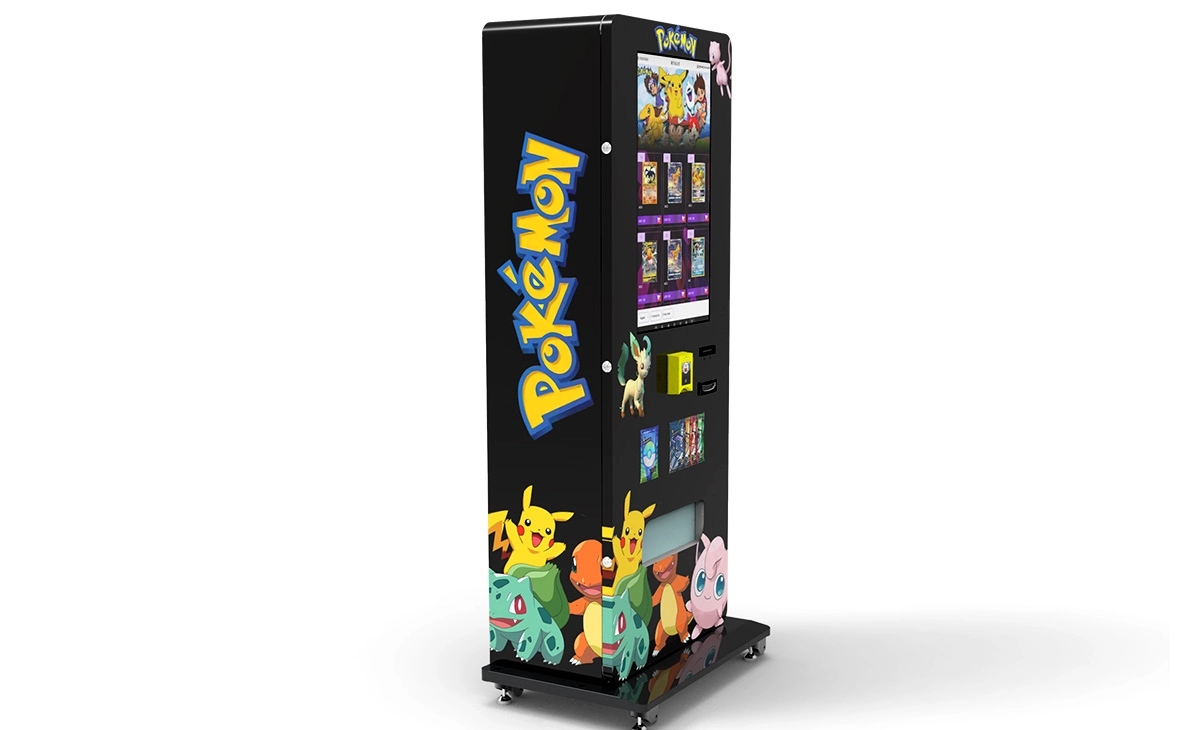
Trading Card Vending Machine vs. Regular Vending Machine
A card machine and a traditional vending machine share a controller, payment system, cabinet, and product-delivery concept, but the retail economics and engineering priorities are different.
| Factor | Trading Card Vending Machine | Regular Snack/Drink Vending Machine |
|---|---|---|
| Typical product size | Small to medium | Medium to large |
| Product value per unit of space | Can be high | Usually lower |
| Refrigeration | Usually unnecessary | Often required for drinks and some food |
| Packaging variation | Can change frequently | Often relatively standardized |
| Drop-damage concern | High for premium collectibles | Usually lower for common packaged products |
| Inventory trend cycle | Can change quickly | Often more stable |
| Average ticket potential | Can be relatively high | Usually lower per item |
| Theft exposure per cabinet | Can be significant | Depends on product mix |
| Remote price changes | Highly useful | Useful |
The absence of refrigeration can simplify card-machine maintenance, but that saving should not lead buyers to underestimate security, payment reliability, or delivery mechanics.
Trading Card Vending Machine vs. Traditional Card Store
A vending machine does not replace every function of a card shop. The two formats solve different retail problems.
| Factor | Trading Card Vending Machine | Traditional Card Store |
|---|---|---|
| Staff required per transaction | Very low | High |
| Floor-space requirement | Small | Much larger |
| Operating hours | Extended or 24/7 where site access allows | Dependent on staffing and store hours |
| SKU capacity | Limited by cabinet | Much higher |
| Customer advice | Minimal | Strong |
| Community experience | Limited | Strong |
| Expansion model | Add additional machines | Add floor space or locations |
| Impulse purchase potential | Strong in the right location | Strong |
I think of automated card vending as a retail extension rather than a universal replacement for specialty shops. A retailer could use vending to reach customers in places where building and staffing another full store would not make economic sense.
Trading Card Vending Machine Buying Checklist
If I were buying a machine for commercial use, this is the checklist I would work through before approving the order.
Product Compatibility
Actual package dimensions confirmed
Weight confirmed
Flexible vs. rigid packaging identified
Largest and smallest products identified
Sample-vend testing completed where possible
Dispensing System
Correct channel or delivery method selected
Double-vend risk tested
Product-drop distance reviewed
Delivery sensor included where appropriate
Lane dimensions adjustable where needed
Payment
Card payment supported
NFC/mobile wallet support confirmed
QR payment integration confirmed if required
Cash requirement decided before production
Payment failure process understood
Remote Management
Sales reporting
Inventory monitoring
Low-stock alerts
Remote price management
Machine online/offline status
Transaction history
Error reporting
Security
Commercial steel cabinet
Suitable lock system
Protected service access
Anchoring method where required
Door-open monitoring if available
Maintenance
Motors accessible
Sensors accessible
Controller accessible
Power supply replaceable
Spare parts available
Wiring diagrams available
Error codes documented
Customization
Cabinet color confirmed
Artwork dimensions confirmed
Logo files supplied
Touchscreen interface confirmed
Language requirements confirmed
Product image and price workflow understood
How to Choose a Trading Card Vending Machine Manufacturer
A specialized vending project needs more than sheet metal. The manufacturer has to connect mechanical design, vending control, payment hardware, software, and after-sales service into one working machine.
I would evaluate a supplier on:
Ability to test real product samples
Experience with different dispensing mechanisms
Sheet-metal fabrication capability
Vending-controller integration
Payment compatibility
Remote management platform
OEM/ODM capability
Quality-control process
Technical documentation
Replacement parts
After-sales troubleshooting
Why Zhongda Smart Is Worth Evaluating for Card Vending Projects
Zhongda Smart already manufactures dedicated card vending configurations rather than treating collectible cards as an afterthought inside an ordinary beverage cabinet. Its product range includes full-size card vending equipment, compact wall-mounted systems, configurable product channels, cashless payment options, network connectivity, and remote management.
For custom projects, the company's OEM custom vending machine service supports changes to cabinet structure, exterior branding, payment hardware, touchscreen interface, product lanes, and other application-specific requirements.
From a production standpoint, that flexibility matters because trading-card packages are not standardized forever. A buyer may begin with individual booster packs and later want to add premium boxes or accessories. A machine that was designed around the merchandise is much easier to adapt than one that forces every product into the same generic channel.
Questions I Would Ask Every Manufacturer
Can you test my exact products before production?
Which delivery mechanisms do you recommend for each SKU?
How many unique products can the machine support?
What is the actual capacity using my packaging dimensions?
Can product lanes be adjusted after delivery?
How does the machine detect a failed vend?
What happens if payment succeeds but delivery fails?
Which payment terminals are compatible?
Can prices be changed remotely?
Can inventory be monitored remotely?
Can I export transaction data?
Can exterior graphics be customized?
Can the touchscreen interface be branded?
Which spare parts should I buy with the machine?
How are software updates handled?
What technical documentation is provided?
What warranty applies to the selected configuration?
What remote support is available after installation?
Payment Systems for Trading Card Vending Machines
Cashless payment is especially important for collectible vending because transaction values can be higher than traditional low-ticket vending.
A modern machine may support:
Credit cards
Debit cards
NFC contactless payment
Mobile wallets
QR-code payments
Membership cards
Optional banknote acceptance
Optional coin acceptance
When Cashless-Only Makes Sense
Removing cash can simplify operation. There is no bill validator to clean, coin changer to refill, cash box to collect, or change inventory to manage.
Cashless operation also produces cleaner transaction data.
The trade-off is processing cost and dependence on reliable payment hardware and connectivity.
Small Transactions Need Careful Math
If your payment provider charges both a percentage and a fixed fee, the fixed component matters more on very small purchases.
This is another reason multi-pack bundles can be attractive. A $15 transaction can use payment infrastructure more efficiently than three separate $5 transactions.
Remote Management Matters More Than a Bigger Touchscreen
A large screen helps attract customers. Once I have several machines operating, the management dashboard becomes more important to me than an extra few inches of display.
A useful platform should provide:
Sales by machine
Sales by SKU
Current inventory
Low-stock alerts
Transaction history
Payment status
Online/offline machine status
Fault notifications
Refund records
Remote pricing where supported
Why Remote Inventory Changes the Business
Imagine ten machines spread across several locations.
Without inventory data, a driver may need to visit machines simply to discover what is missing.
With reliable remote records, the warehouse can prepare the restocking order before the route begins:
Machine 1 needs 30 booster packs.
Machine 2 needs eight premium boxes.
Machine 3 has too much slow-moving Product C.
Machine 4 has a payment fault that should be inspected.
That turns restocking from a guessing process into a planned logistics process.
Security and Theft Prevention
A trading card vending machine may hold several thousand dollars of compact inventory. That makes security a design requirement rather than a cosmetic option.
Cabinet Security
I look for:
Commercial steel construction
Reinforced service doors
Quality locks
Protected hinges
Controlled access to payment components
Anchoring points where required
Protected wiring access
Location Security
A strong cabinet is still better inside a well-observed location. Cameras, staff presence nearby, good lighting, and continuous legitimate activity all reduce exposure.
Inventory Reconciliation
Security also includes internal control. If several people refill machines, track:
Inventory loaded
Inventory removed
Recorded sales
Refunds
Expected closing stock
Physical closing stock
Unexpected differences should be investigated rather than automatically treated as normal shrinkage.
Trading Card Vending Machine Maintenance and Repair
Card machines avoid refrigeration compressors and other systems common in food vending, which can simplify maintenance. They still contain motors, sensors, controllers, displays, payment devices, power supplies, network hardware, locks, and moving parts.
Weekly Checks
Clean the touchscreen.
Clean the pickup area.
Inspect product channels.
Check best-selling products for alignment.
Test several representative vends.
Inspect the payment terminal.
Review remote alerts.
Confirm locks and cabinet condition.
Monthly Checks
Inspect wiring connections.
Check vending motors.
Inspect belts where used.
Check delivery sensors.
Remove internal dust.
Inspect power-supply condition.
Review failure-rate data.
Inspect doors, locks, and hinges.
Useful Spare Parts
Vending motors
Product sensors
Fuses
Power supply
Common communication cables
Door locks
Controller components recommended by the manufacturer
Keep the spare-parts list specific to the machine model. A random box of generic vending components is less useful than a small kit containing the parts actually installed in your cabinet.
Measure Vend Failure Rate
Vend failure rate = failed deliveries ÷ attempted vends × 100
If one SKU creates a much higher failure rate than everything else, the problem may be package compatibility rather than a failing machine.
Moving the product to a different lane or changing the channel setup can sometimes solve the issue without replacing any hardware.
Maintenance time also has economic value. The U.S. Bureau of Labor Statistics reported a national mean hourly wage of $22.04 and mean annual wage of $45,840 for coin, vending, and amusement machine servicers and repairers in its May 2023 occupational dataset. Even if your own service cost differs, the larger point remains: a machine that is faster to diagnose and repair has real operating value.
Common Trading Card Vending Machine Mistakes
Buying the Cheapest Cabinet
Purchase price matters, but downtime can make a cheap machine expensive. I would rather understand serviceability and component quality before comparing the final few hundred dollars in price.
Approving a Machine From Product Dimensions Alone
Measurements are necessary. Sample testing is better. Flexible and glossy packages can behave differently even when they fit on paper.
Using One Dispensing Mechanism for Every Product
A spring may be excellent for one package and inappropriate for another. The product should determine the mechanism.
Assuming High Foot Traffic Means High Sales
The wrong audience can walk past the machine all day.
Ignoring Location Expense
A high-revenue location can still be financially weak if rent or commission consumes too much gross profit.
Overbuying a New Release
Demand changes. Slow inventory traps working capital.
Allowing Best Sellers to Stay Out of Stock
Nothing is gained by finding the right product and then leaving the lane empty during the busiest selling period.
Ignoring Sales Data
If the dashboard has six months of SKU-level sales history and every stocking decision is still made from instinct, the operator is leaving one of the machine's best features unused.
Calling the Business Passive Income
The transaction is automated. Inventory sourcing, pricing, restocking, location management, maintenance, refunds, and business decisions are not.
How I Would Measure Machine Performance
| Metric | Formula | What It Tells You |
|---|---|---|
| Monthly revenue | Total monthly vending sales | Overall sales volume |
| Gross margin | Gross profit ÷ revenue | Merchandise economics |
| Operating margin | Operating profit ÷ revenue | Business efficiency after operating costs |
| Average transaction value | Revenue ÷ transactions | Average customer basket |
| Revenue per lane | Revenue ÷ active selling lanes | Physical-space productivity |
| Gross profit per lane | Gross profit ÷ active selling lanes | Profitability of machine space |
| Stockout rate | Out-of-stock hours ÷ selling hours | Potential lost-sales exposure |
| Vend failure rate | Failed vends ÷ attempted vends | Delivery reliability |
The machine with the highest revenue is not automatically the best asset.
A machine generating somewhat lower sales with excellent margins, low site cost, little driving time, and predictable inventory requirements may produce a better return on the owner's time and capital.
A Modeled Trading Card Vending Business Example
The following example is intentionally labeled as a model rather than a claimed customer result. It shows how operating decisions can change performance without changing the machine itself.
Starting Configuration
48 active product positions
60% proven entry-level card products
25% premium products
15% accessories and experimental SKUs
Cashless payment
Remote inventory monitoring
Two planned restocking visits per week
Month One
| Sales | $4,900 |
| Transactions | 486 |
| Average transaction | $10.08 |
Twelve products show weak movement. They are replaced with better-performing categories instead of being given months to “eventually sell.”
Month Two
| Sales | $6,400 |
| Transactions | 575 |
| Average transaction | $11.13 |
The operator introduces multi-pack purchasing and gives premium merchandise stronger screen visibility.
Month Three
| Sales | $7,600 |
| Transactions | 628 |
| Average transaction | $12.10 |
The numbers are illustrative, not a sales promise. What matters is the process.
The cabinet never changed.
The operator changed product selection, stock levels, presentation, and basket strategy. That is why I think of the machine as a retail platform rather than a passive metal box.
How to Scale From One Trading Card Vending Machine to a Network
I would prove one machine before ordering ten.
Phase 1: Prove Product Compatibility
Make sure the merchandise vends reliably, payments work, customers understand the screen, and restocking is practical.
Phase 2: Prove the Location
Measure enough normal selling periods that launch curiosity is no longer dominating the numbers.
Phase 3: Standardize Inventory
Identify products that deserve permanent space and products that should rotate.
Phase 4: Document the Restocking Process
Review remote stock data.
Create a machine-specific refill list.
Prepare products before departure.
Visit the machine.
Refill inventory.
Count discrepancies.
Clean the machine.
Test payment and delivery.
Record the service visit.
Phase 5: Add the Second Machine
The second unit determines whether the process can actually be repeated rather than simply operated through personal attention.
Phase 6: Improve Route Density
Machines located near each other are usually easier to manage than a smaller number of machines separated by long travel distances.
Phase 7: Centralize Inventory Allocation
At scale, inventory allocation becomes an important management problem:
Which location gets the newest product first?
Which machine deserves premium inventory?
Which location sells sports products best?
Which machine needs more entry-level packs?
Where are stockouts costing the most revenue?
This is where remote sales records stop being convenient and become strategically important.
Should You Buy a Used Trading Card Vending Machine?
A used machine can make sense, but I would inspect the electronics as carefully as the steel cabinet.
Check:
Controller generation
Payment-terminal compatibility
Touchscreen condition
Motor condition
Delivery sensors
Door alignment
Locks
Previous wiring repairs
Network hardware
Cloud software availability
Replacement-parts availability
Whether the management account can be transferred
A steel cabinet can remain usable for years. Obsolete electronics may be much harder to solve.
Should You Customize a Trading Card Vending Machine?
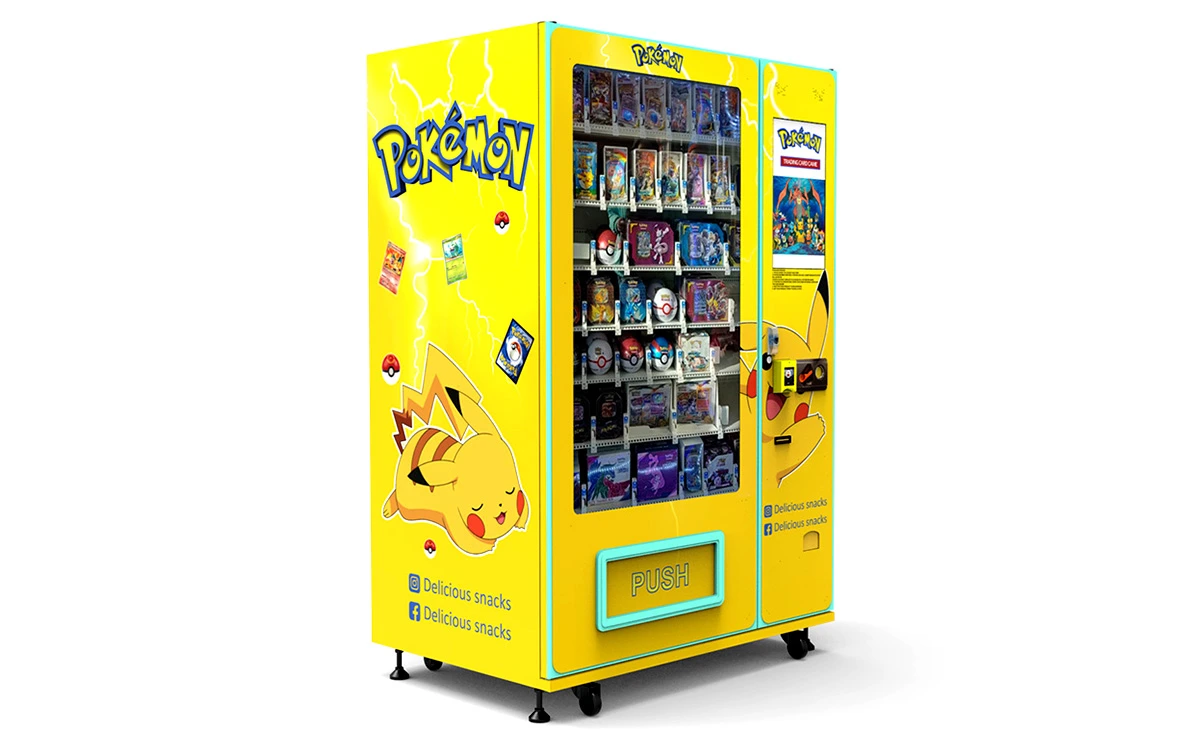
Collectibles are visual products, so branding can be valuable. A custom machine can look more like a deliberate retail destination and less like generic vending equipment.
Useful customization can include:
Cabinet graphics
Logo placement
Touchscreen theme
Product-selection interface
LED lighting
Custom cabinet dimensions
Custom product channels
Payment configuration
Digital promotional screens
I would always customize function before appearance.
A beautiful machine with a bad delivery mechanism creates a beautiful refund problem.
Branding and Intellectual Property
Operators should distinguish between selling genuine branded merchandise and making an entire machine appear to be officially operated or endorsed by an intellectual-property owner.
Before using protected characters, logos, artwork, or branded graphics on a machine exterior, confirm that you have the appropriate rights or authorization for the planned use.
A vending manufacturer can print artwork supplied by a buyer. That does not determine whether the buyer has permission to use the underlying intellectual property.
When rights are uncertain, custom branding around your own retail identity is usually cleaner than making the cabinet imitate official franchise equipment.
Is a Trading Card Vending Machine Passive Income?
I would call it automated retail, not passive income.
The machine automates the checkout.
The operator still has to:
Source inventory
Review product costs
Choose merchandise
Manage pricing
Restock machines
Negotiate locations
Review sales data
Handle failed transactions
Maintain equipment
Move weak locations
Plan future inventory
Automation reduces labor per sale. It does not remove management from the business.
When Should You Move a Poorly Performing Machine?
I prefer setting minimum performance expectations before the machine is installed.
If results remain below the target, first check the problems that can be corrected:
Visibility
Inventory mix
Pricing
Stockouts
Payment problems
Machine appearance
Product availability
If those issues are addressed and the location still performs poorly, relocating can be more rational than waiting indefinitely.
One of vending's advantages is that the retail asset is movable.
What to Prepare Before Requesting a Trading Card Vending Machine Quote
The quality of a manufacturer's recommendation depends partly on the information the buyer provides.
| Information to Provide | Why It Matters |
|---|---|
| Product width, height, and depth | Determines channel and cabinet layout |
| Product weight | Affects dispensing-system selection |
| Packaging material | Helps evaluate friction and handling |
| Number of SKUs | Determines required selling positions |
| Quantity per SKU | Helps calculate reserve capacity |
| Largest product | May determine minimum lane or compartment size |
| Highest-value product | Influences security and delivery method |
| Payment requirements | Determines card, NFC, QR, or cash hardware |
| Installation environment | Influences cabinet, power, and security considerations |
| Branding files | Required for custom graphics |
| Machine quantity | Affects production planning |
At Zhongda Smart, a more useful custom discussion begins with the product rather than simply asking, “How much is a vending machine?”
If you can provide product dimensions, sample images, expected SKU count, payment requirements, and machine quantity, the engineering team can evaluate a much more realistic configuration before production.
What I Would Do Before Ordering My First Card Vending Machine
Choose the categories I intend to sell.
Collect real samples of the main products.
Measure every important package format.
Calculate landed inventory cost.
Set realistic selling prices.
Estimate gross profit per transaction.
Identify at least several potential locations.
Compare fixed rent and commission structures.
Calculate the number of daily transactions needed.
Select the correct dispensing system.
Ask the manufacturer to test representative products.
Confirm payment hardware.
Confirm remote management functions.
Confirm spare parts and technical documentation.
Keep working capital beyond the machine purchase.
Launch one unit and collect real operating data before scaling aggressively.
Is a Trading Card Vending Machine Worth It?
It can be, particularly when the operator takes advantage of what makes collectible cards well suited to automated retail: compact product size, repeat purchase behavior, flexible inventory, and potentially meaningful average transaction value.
The machine also allows retail expansion without building a staffed store around every selling point.
The weaknesses are equally important. Demand can change. Premium inventory increases theft exposure. Some card packaging is difficult to vend reliably. Location quality varies. Payment fees and site commissions can consume margin faster than first-time operators expect.
That is why I would not start with the question, “How much money can this machine make?”
I would start with:
What exactly will it sell?
Does that merchandise vend reliably?
Who is likely to buy it?
What does the inventory cost?
What selling price will customers accept?
What gross profit remains after product cost?
What operating expenses remain after that?
How many transactions per day are required?
When those answers work, a trading card vending machine can become a scalable automated sales channel rather than an expensive novelty.
Frequently Asked Questions About Trading Card Vending Machines
How much does a trading card vending machine cost?
A compact card vending machine may cost a few thousand dollars, while advanced touchscreen, conveyor, elevator, locker, or highly customized machines can cost substantially more. For early planning, approximately $2,000 to $10,000+ covers many commercial configurations, although large custom kiosks can exceed that range. Payment hardware, shipping, inventory, branding, installation, and working capital should be calculated separately.
Are trading card vending machines profitable?
They can be profitable when product margin, qualified foot traffic, inventory turnover, and operating expenses are controlled. Profit should be calculated after inventory cost, payment processing, location rent or commission, restocking, software, maintenance, refunds, and shrinkage. High revenue by itself does not guarantee a strong return.
How much can a trading card vending machine make per month?
There is no universal monthly revenue figure. Calculate it from transaction volume and average transaction value. Twenty daily transactions at an average of $14 produce approximately $8,400 in 30-day gross sales. Actual operating profit depends on the cost of the products and all expenses required to run the machine.
What products can a trading card vending machine sell?
A properly configured machine can sell booster packs, sleeved boosters, sports card products, trading card boxes, collector sets, graded cards, mystery packs, card sleeves, top loaders, deck boxes, and other compact collectibles. The correct delivery mechanism depends on package dimensions, value, weight, and fragility.
Can a vending machine safely sell graded cards?
Yes, but I would prefer a locker or controlled elevator delivery system for graded slabs rather than a conventional drop system. The protective holder itself can be part of the product's perceived condition, so controlled delivery reduces the chance of scratches or impact damage.
What is the best vending system for booster packs?
Adjustable spring or channel systems can work well for booster packs when the pitch, lane width, and package stiffness are properly matched. Conveyor systems are another option. Thin flexible packs should be tested for leaning, slipping, and double-vend risk before deployment.
What is the best location for a trading card vending machine?
The strongest location combines audience fit, qualified foot traffic, visibility, dwell time, reasonable site expense, long access hours, and good security. Relevant customers matter more than raw visitor count. A smaller stream of people interested in collectibles can outperform a much busier location with the wrong audience.
Do trading card vending machines accept credit cards?
Modern machines can support credit cards, debit cards, NFC contactless payments, mobile wallets, QR payments, and other electronic systems depending on the selected payment terminal and vending controller. Cash acceptance can also be included when required.
Can trading card vending machines be monitored remotely?
Yes. Smart machines can provide remote sales records, inventory quantities, low-stock alerts, transaction history, machine connectivity status, fault notifications, and remote pricing functions depending on the software configuration.
How many products can a trading card vending machine hold?
Capacity depends heavily on package dimensions and lane layout. Compact machines may hold around one hundred products, while larger floor-standing configurations can hold several hundred. Zhongda Smart publishes one full-size card vending configuration with approximately 300–360 pieces of reserve and up to 60 standard lanes, but actual capacity changes when different products are loaded.
Can I customize a trading card vending machine?
Yes. Commercial manufacturers such as Zhongda Smart can customize cabinet dimensions, exterior graphics, touchscreen interface, vending lanes, payment hardware, lighting, connectivity, and other functions. Functional requirements and product dimensions should be finalized before cosmetic customization.
Should I use a regular snack vending machine for trading cards?
It can work for some boxed or sleeved products, but a generic snack configuration is not automatically suitable for every trading card package. Thin packs, premium boxes, and graded cards may require different lane dimensions or delivery systems. Product testing is more important than the label placed on the cabinet.
How do I start a trading card vending machine business?
Choose the products first, measure the packaging, calculate landed product cost, determine realistic selling prices, identify candidate locations, estimate required daily transactions, select the appropriate dispensing system, test representative products with the manufacturer, choose payment hardware, and launch one machine before expanding into a larger network.
Final Takeaway
A successful trading card vending operation is built around the relationship between product, customer, machine, payment, inventory, location, and data.
The machine is the platform that connects those parts.
If I had to reduce the entire buying decision to one rule, it would be this:
Choose the merchandise and prove the delivery method first; choose the final machine configuration second.
Do not begin with decorative graphics.
Do not begin with the largest touchscreen.
Do not begin with a promised monthly revenue number.
And do not select a machine simply because it has the lowest purchase price.
Start with real packaging dimensions, inventory costs, realistic selling prices, transaction requirements, location economics, and repeated dispensing tests. Once those fundamentals are right, cashless payment, remote inventory monitoring, custom branding, digital interfaces, and automated reporting can make the business far easier to operate and scale.
For buyers comparing commercial equipment, Zhongda Smart provides dedicated card vending configurations, compact wall-mounted models, custom OEM/ODM machine development, multiple delivery options, payment integration, and remote-management capabilities. The strongest specification will still depend on what you actually plan to put inside the machine.
Sources and Reference Material
Hasbro, Inc. — Second Quarter 2026 Financial Results.Hasbro reported on July 21, 2026 that Magic: The Gathering exceeded $500 million in quarterly revenue for the first time, with Magic revenue increasing 32% in the quarter.View original source
U.S. Bureau of Labor Statistics — Coin, Vending, and Amusement Machine Servicers and Repairers.The May 2023 national occupational dataset reports a mean hourly wage of $22.04 and mean annual wage of $45,840 for occupation 49-9091.View original source
Data note: Machine prices, startup budgets, sales models, margin examples, location scores, capacity planning ranges, and ROI calculations in this article are illustrative planning examples unless explicitly attributed to a published source. Actual equipment cost and business performance vary according to machine configuration, product cost, product dimensions, payment processing, location agreements, inventory turnover, maintenance, taxes, and customer demand.
Commercial disclaimer: Nothing in this guide should be interpreted as a guarantee of revenue, profit, payback period, or investment return. Buyers should calculate their own costs and operating assumptions before purchasing equipment.
Last updated: August 8, 2026