20 Best Vending Machine Item Ideas to Maximize Your Profits
The best vending machine item ideas start with a product that fits the machine, not a margin you spotted on a spreadsheet. I'd recommend beginning with ambient and cold-drink staples: soft drinks, energy drinks, candy, and chips scored highest here because they sell often, rarely spoil, and fit almost any cabinet. The core rule is to pick product size and temperature first, then the machine, then run payback math on gross profit per lane per month instead of percentage margin. This guide ranks 20 items on five weighted factors, groups them by storage and dispensing, and gives each a clear verdict: recommended, conditional, or not a first-machine anchor.
How These Items Were Ranked
Each item received a score from 1 to 5 on five factors, combined into a weighted total out of 5. The scores are editorial judgment about how products typically behave in unattended machines, not measured sales results. Gross margin and markup are defined first, because mixing them up distorts every later calculation.
| Factor | What a 5 means | Weight |
|---|---|---|
| A. Gross profit per sale (in dollars) | $4.00 or more per sale | 30% |
| B. Sales velocity and repeat purchase | Fast, habitual buying | 25% |
| C. Spoilage and shrink risk | Low risk of loss | 15% |
| D. Equipment and compliance simplicity | Standard cabinet, light rules | 15% |
| E. Fit for unattended 24/7 selling | Runs with minimal attention | 15% |
Total score = 0.30A + 0.25B + 0.15C + 0.15D + 0.15E, rounded to one decimal. Factor A uses dollar bands under assumed typical pricing: 1 = under $0.50, 2 = $0.50 to $0.99, 3 = $1.00 to $1.99, 4 = $2.00 to $3.99, 5 = $4.00 or more. These bands are assumptions for comparison, not market data. Ties are broken by profit per sale, then velocity, then lower spoilage.
Gross margin is gross profit divided by selling price. Markup is gross profit divided by cost. With a cost of $0.80 and a price of $2.00, gross profit is $1.20, gross margin is $1.20 ÷ $2.00 = 60%, and markup is $1.20 ÷ $0.80 = 150%. A 150% markup is a 60% margin, and revenue-based calculators expect the margin figure.
For this comparison, I'm prioritizing dollars earned per sale and how often a lane turns, because a lane is the scarce resource inside any machine.
The 20 Items at a Glance
The table ranks all 20 items from highest to lowest weighted score. The rank describes item characteristics only. It does not say which machine to buy first, because a high-scoring item still needs the right site, cabinet, and supplier behind it. Headings below are numbered by order of appearance.
| Rank | Item | Profit per sale | Velocity | Low spoilage | Simple setup | 24/7 fit | Score |
|---|---|---|---|---|---|---|---|
| 1 | Soft drinks and canned beverages | 3 | 5 | 5 | 3 | 5 | 4.1 |
| 2 | Energy and sports drinks | 3 | 4 | 5 | 4 | 5 | 4.0 |
| 3 | Candy, chocolate and gum | 3 | 4 | 4 | 5 | 5 | 4.0 |
| 4 | Travel and hotel essentials | 4 | 3 | 5 | 4 | 4 | 3.9 |
| 5 | Phone accessories and power banks | 5 | 2 | 5 | 3 | 4 | 3.8 |
| 6 | Personal care and hygiene | 4 | 2 | 5 | 4 | 5 | 3.8 |
| 7 | Chips and salty snacks | 2 | 5 | 4 | 4 | 5 | 3.8 |
| 8 | Coffee and hot drinks | 4 | 4 | 4 | 2 | 4 | 3.7 |
| 9 | Bottled water | 2 | 4 | 5 | 4 | 5 | 3.7 |
| 10 | Protein bars and better-for-you snacks | 3 | 3 | 4 | 4 | 5 | 3.6 |
| 11 | Blind box toys and collectibles | 5 | 2 | 4 | 3 | 3 | 3.5 |
| 12 | Trading cards | 4 | 2 | 4 | 3 | 3 | 3.2 |
| 13 | Books, magazines and stationery | 4 | 1 | 5 | 3 | 3 | 3.1 |
| 14 | Sandwiches, wraps and salads | 4 | 3 | 2 | 2 | 3 | 3.0 |
| 15 | Cakes, pastries and packaged desserts | 3 | 3 | 2 | 3 | 4 | 3.0 |
| 16 | Over-the-counter first aid supplies | 4 | 2 | 4 | 1 | 3 | 2.9 |
| 17 | Ready meals | 4 | 3 | 2 | 1 | 2 | 2.7 |
| 18 | Ice cream and frozen treats | 3 | 3 | 3 | 2 | 2 | 2.7 |
| 19 | Yogurt, fruit cups and cut produce | 3 | 3 | 1 | 3 | 3 | 2.7 |
| 20 | Farm eggs | 3 | 2 | 3 | 2 | 3 | 2.6 |
Ambient and Cold-Drink Staples
Ambient and cold-drink staples are the safest base for a first machine because they have long shelf lives, simple dispensing, and light compliance needs. They also hold the top positions in the ranking. Their weakness is thin profit per sale, so lane mix and volume matter more here than in any other group.
1. Bottled water
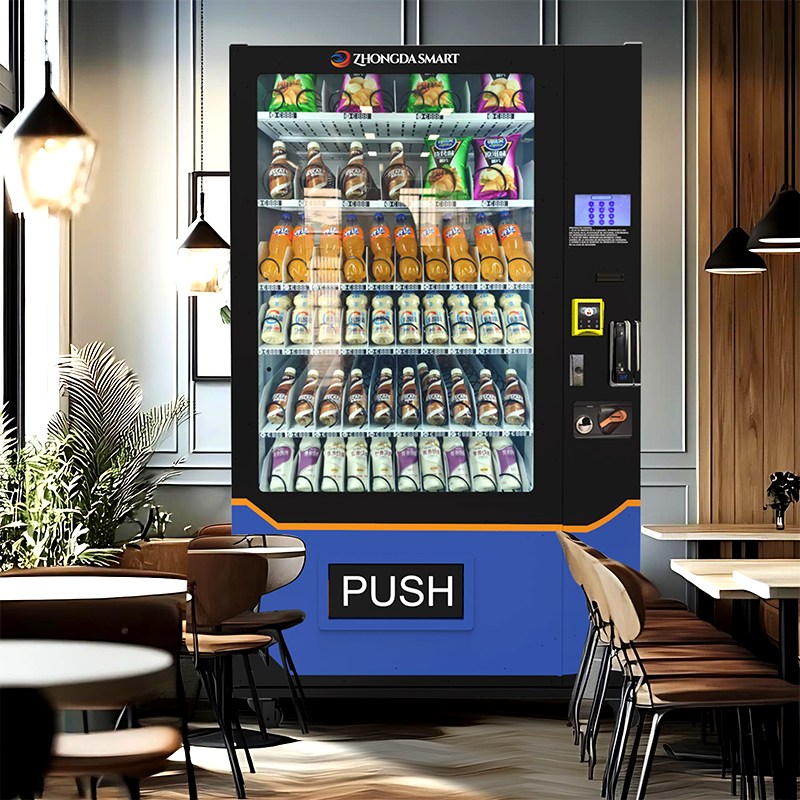
Water sells because nobody argues about it. It works in gyms, hospitals, transit hubs, and offices, and it often keeps a machine useful when other lanes sell out. The catch is dollars per sale: a bottle earns far less than most snacks, so water belongs in a mix, not alone. Spring dispensing handles most PET bottles; heavy or odd-shaped bottles need a conveyor or lift. The main risk is a price squeeze, since free fountains and shops nearby compete. I'd recommend it as a volume anchor inside a mixed machine.
Editorial score: 3.7 / 5
2. Soft drinks and canned beverages
Cold cans are the reference point every other item gets measured against. People walk up to a machine wanting them, which pulls traffic toward the rest of the lanes. Cans and PET bottles are dense and uniform, so planogram work is easy, but the cabinet must hold temperature steadily and loaded weight adds up quickly. Check the rated capacity against your real can size. School sites often limit sugary options under local nutrition standards. Verdict: recommended, and the first lanes to fill in any combo machine.
Editorial score: 4.1 / 5
3. Chips and salty snacks
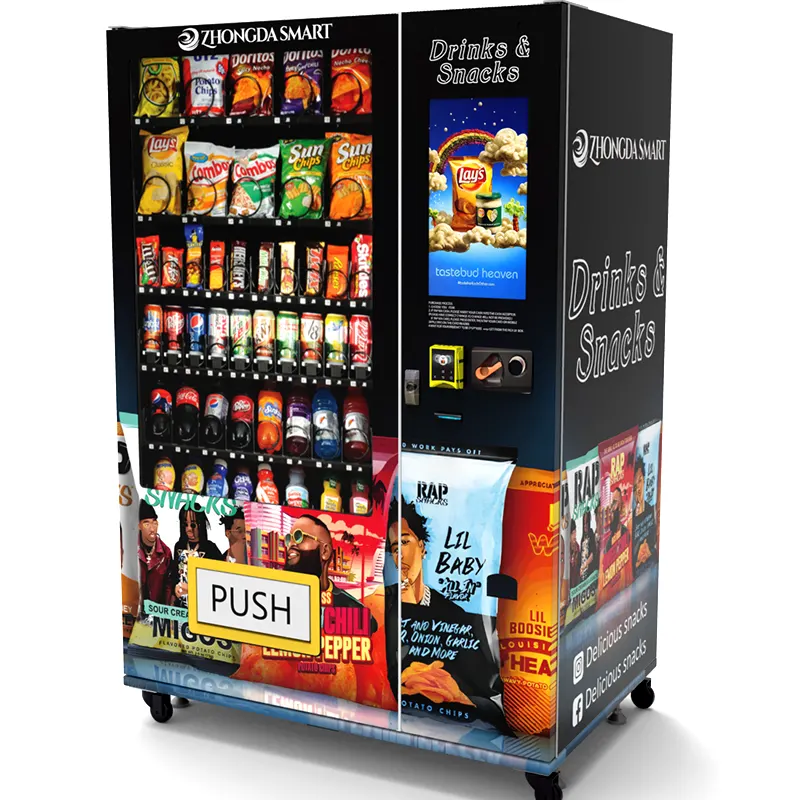
Bagged chips are the easiest product to dispense and the easiest to stock badly, because bag size varies more than buyers expect. A single-serve bag and a share-size bag need different coil pitch, so measure before you order. A smart snack vending machine built for packaged foods such as chips, candy, cookies, and nuts handles this category well. The shrink here is crushed bags and stale stock, so rotate by date. Good fits are offices, factories, and transit hubs. Verdict: recommended.
Editorial score: 3.8 / 5
4. Candy, chocolate and gum
Impulse buying lives in this category. Candy bars and gum are light and slim, so one lane holds many units and restocking trips stay short. Chocolate is the exception to "easy": heat softens and blooms it, so I'd skip chocolate in any cabinet that can't hold a cool setting through summer. Schools and some workplaces restrict sugary items, which shrinks the list of good sites to malls, transit hubs, factories, and offices. Verdict: recommended, with a cool temperature setting.
Editorial score: 4.0 / 5
5. Protein bars and better-for-you snacks
Bars usually sell at a higher ticket than chips, which is why this category anchors most healthy vending machine snacks at gyms, offices, and campuses. Thin bars fit spring coils, though sizes differ, so test the real packs. The healthy snack vending machine model ZD-L-22 has a 21.5-inch touchscreen, 60 lanes, 300 to 350 items, and an adjustable 4-25°C range; it is listed from $2,447. Velocity depends on the site, and some bars are close to candy nutritionally. Verdict: conditional, strongest at gyms and wellness-minded workplaces.
Editorial score: 3.6 / 5
6. Energy and sports drinks
Energy and sports drinks are the high-ticket cousin of soft drinks. They suit gyms, factories, warehouses, and night-shift sites where buyers want a specific product. The cans and bottles use the same cold cabinet as other beverages, so dispensing is no obstacle. Two cautions apply: some sites and schools restrict them, and high-caffeine products may carry local labeling or age rules. Reliable stock reporting through remote monitoring helps, because a sold-out favorite sends buyers to a competitor. Verdict: recommended for adult sites, skipped for schools.
Editorial score: 4.0 / 5
Fresh and Refrigerated Items
Fresh and refrigerated items can earn more per sale, but they only work when someone restocks on a fixed schedule. Spoilage is a replenishment-frequency problem before it is a product-choice problem. Elevator delivery protects fragile packaging and keeps temperatures steady, so these items usually need a refrigerated lift machine instead of a standard coil cabinet.
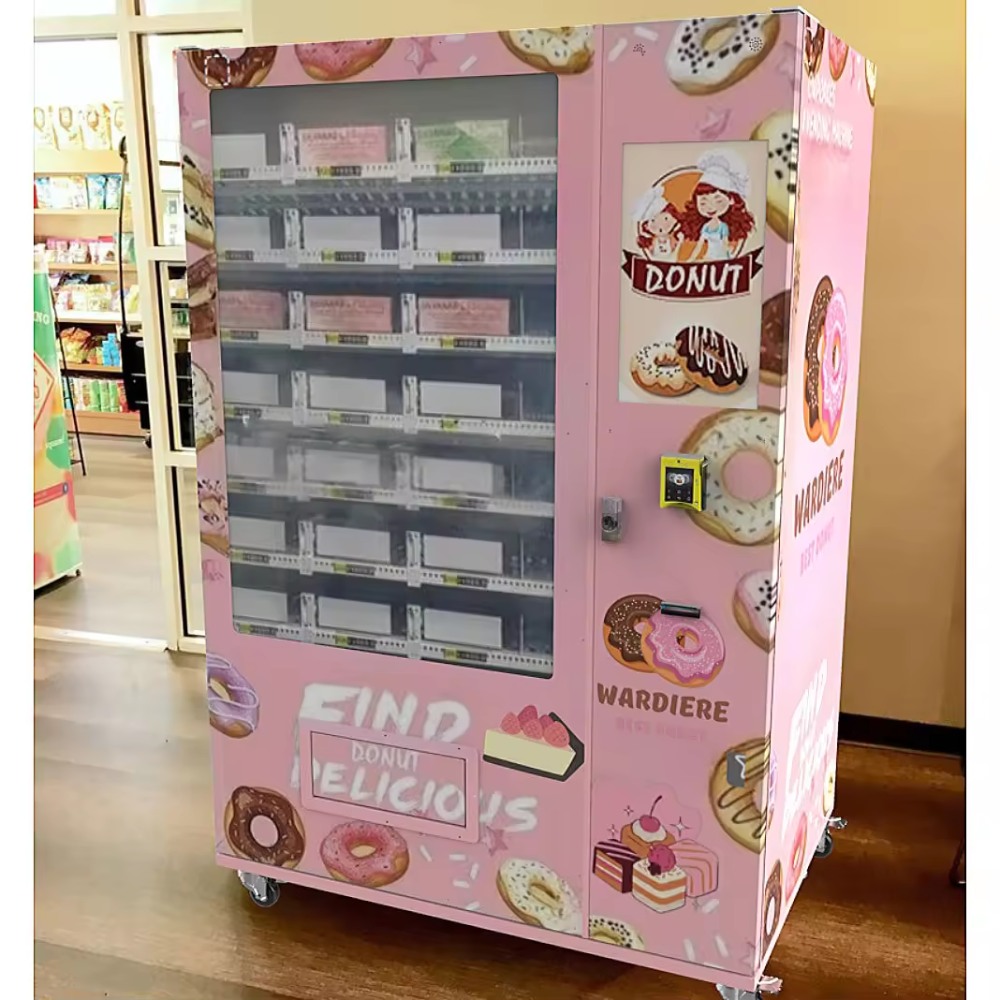
A refrigerated fresh food vending machine with elevator such as the ZD-LS-22 runs at 3-12°C, uses a 22-inch screen, and connects over 4G, Wi-Fi, or LAN. Capacity ranges from 360 to 800 items depending on product size, and it is listed at $3,164. Quote requests work best with package dimensions, not just product names.
7. Sandwiches, wraps and salads
This is the category most people picture when they say fresh vending, and it's the one I'd hold back until a site is proven. Profit per sale is attractive, but a sandwich that misses its date is a total loss. Packaging also varies, so wraps and salad bowls need a lift and a real fit test. Hospitals, night-shift factories, and offices without a cafeteria are the natural sites. Plan the restocking route before ordering the machine. Verdict: conditional, a good second machine once a routine exists.
Editorial score: 3.0 / 5
8. Yogurt, fruit cups and cut produce
Cut produce is the shortest-lived item on this list, so I'd rank it as a supporting product at best. Sealed yogurt and fruit cups last longer and suit gyms and health-minded offices, and they help a machine look balanced. Cups can tip and leak during a drop, so a shelf or lift delivers them more safely. Sourcing matters more than selection: a supplier who can deliver often makes this work. Verdict: not a first-machine anchor; add two or three lanes to a refrigerated machine only after the basics sell.
Editorial score: 2.7 / 5
9. Cakes, pastries and packaged desserts
Dessert is a fragility problem. A slice that falls a few inches arrives as crumbs, so these items belong in an elevator machine that lowers them gently. Sealed, long-dated desserts suit hotels, hospitals, and offices; fresh bakery items need the same discipline as sandwiches. A dedicated cake machine exists, so ask for a fit test with your actual boxes and trays before committing. Verdict: conditional, and strongest with sealed products and a predictable delivery schedule.
Editorial score: 3.0 / 5
10. Farm eggs
Eggs are a niche but a real one: roadside farm stands, rural communities, and apartment complexes with a local producer. The machine is a refrigerated elevator built for cartons, holding roughly 360 to 900 eggs depending on packaging. The risk is supply concentration, because one farm's hiccup empties the whole cabinet, and local rules on washing, labeling, and storage differ. Velocity is steady only where buyers already want farm eggs. Verdict: I'd skip it as a first main machine unless you control the egg supply.
Editorial score: 2.6 / 5
Frozen, Hot and Caffeine Items
Frozen, hot, and caffeine items carry the heaviest equipment burden of any group. Each needs purpose-built hardware, cleaning, and food-safety temperature control. Coffee, hot-food, and frozen equipment are not standard configurations, so confirm what is possible through a custom project with the sales team before planning stock around them.
11. Ice cream and frozen treats
Frozen treats sell hardest where sun and foot traffic meet: parks, campuses, malls, and pool areas. They need a freezer cabinet with sealed delivery and a plan for power loss, because melted product can't be resold. Individually wrapped bars and cups dispense better than loose items. The business risk is seasonality: a lane turning slowly in winter still costs freezer power. Verdict: conditional, and only as a confirmed custom project.
Editorial score: 2.7 / 5
12. Ready meals
I'd skip ready meals as a first-machine anchor. They earn well per sale, but they stack three problems: refrigeration, a heating or hot-holding step, and strict food-safety limits. Hot-held food must stay at 135°F or above and cold-held food at 41°F or below. A simpler path pairs chilled meals with a microwave in a nearby break room. Hospitals, factories, and night-shift sites show the clearest demand. Verdict: not a first-machine anchor.
Editorial score: 2.7 / 5
13. Coffee and hot drinks
Coffee earns repeat buyers better than any other hot item, and the cost of ingredients is low against the price. It is also a different business from snacks: water supply, cups, ingredient refills, and daily cleaning. A hot-drink machine isn't a snack cabinet with a heater, so expect a separate custom project and confirm the specification with the sales team. Verdict: conditional, only where a site already shows daily demand and someone owns the cleaning routine.
Editorial score: 3.7 / 5
Convenience and Personal-Use Retail
Convenience and personal-use retail trades repeat purchases for higher profit per sale. These items rarely spoil, which removes the largest operating headache, but they sell in bursts tied to what the site's visitors lack. Choosing by location matters more in this group than anywhere else in the guide.
14. Personal care and hygiene
Hygiene items help where people are away from home: gyms, hotels, hospitals, and transit hubs. Boxes are rigid, shelf life is long, and profit per sale beats snacks, so a few lanes can matter. Velocity is the weak spot. A lane that sells a handful of units a month is a poor use of space in a 60-lane cabinet. I'd rank this as a supporting product, mixed into a snack machine or placed in a small countertop unit. Verdict: conditional.
Editorial score: 3.8 / 5
15. Phone accessories and power banks
Chargers, cables, and power banks carry the highest profit per sale outside the collectible group. Buyers are in a hurry and less price-sensitive, which makes transit hubs and conference venues the best sites. Boxed items dispense by conveyor or lift, and pricier pieces deserve a locker or lift for security. Certification, returns policy, and local battery shipping and sales rules need a check before you buy stock. I'd allocate four to eight lanes, no more. Verdict: conditional.
Editorial score: 3.8 / 5
16. Travel and hotel essentials
Toothbrush kits, adapters, earplugs, eye masks, and small toiletries sell at odd hours to people who forgot something. Packs are small and flat, so they fit spring coils or compact lockers, and a mini countertop unit works in a hotel lobby. The SKU list is short, which keeps purchasing simple. Seasonality and occupancy swing sales, so start with a small first order. Verdict: recommended for hotels and transit hubs, and a weak choice anywhere else.
Editorial score: 3.9 / 5
17. Over-the-counter first aid supplies
Bandages and antiseptic wipes make sense at gyms, factories, and schools. Anything that counts as medicine is another matter: many places limit which over-the-counter products can be sold unattended, and expiry tracking and tamper-evident packaging become your job. Ask the local health authority before choosing products, and begin with non-medicated first-aid supplies only. Treat it as a supporting category with a few lanes, never as the reason to buy a machine. Verdict: conditional.
Editorial score: 2.9 / 5
Specialty and Collectible Items
Specialty and collectible items can beat snacks on profit per sale, but demand follows trends and supply may sit outside your control. They work best as a second or differentiating machine placed where buyers already browse. I'd recommend proving a basic snack-and-drink machine before adding any of them.
18. Trading cards
Card packs earn on every pack, and a fresh restock can pull collectors back to the machine. Demand is less stable than snacks, though, and the quality of your supply decides everything: authentic product, predictable delivery, and clear return rules. Dispense through lockers, grid cabinets, or a lift with a visible window. Tampering and shoplifting-style attempts are a real concern. Best near hobby shops, malls, and campuses. Verdict: not a first-machine anchor.
Editorial score: 3.2 / 5
19. Blind box toys and collectibles
The ticket is high, and collectors return to finish a set. A blind box only sells while the series is popular, however, and series fade without warning. Supply, authenticity, and returns shape operations more than the machine does. Locker or grid cabinets protect the boxes, and a lit display helps sales. In my view this is a strong differentiator at a mall or transit hub, as a second machine. Verdict: not a first-machine anchor.
Editorial score: 3.5 / 5
20. Books, magazines and stationery
Books sell where people wait: hospitals, campuses, and transit hubs. Item sizes vary widely, so grid cabinets sized per product beat coils. Spoilage is nil, but rotation is slow, and the same title may sit for weeks. Notebooks and pen sets sell in bursts around school terms. Pick this for a site with long dwell time and no nearby bookshop. Verdict: conditional, for sites with a clear reading or study audience.
Editorial score: 3.1 / 5
Which Machine Holds Which Item
Item shape and temperature decide the dispensing method, the dispensing method decides the cabinet, and the cabinet decides the price. Bagged goods suit spring coils, rigid boxes suit conveyors or locker grids, and fragile or chilled products suit an elevator. Confirm fit with real packaging, not product names.
| Item type | Dispensing method | Temperature zone | Watch-out |
|---|---|---|---|
| Bagged chips, candy bars, protein bars | Spring coil | Ambient; cool setting for chocolate | Match coil pitch to bag thickness |
| Cans and PET bottles | Spring coil or conveyor | Chilled (combo cabinets run 2-25°C) | Check loaded-weight rating |
| Heavy glass bottles and jars | Conveyor or elevator | Ambient or chilled | Springs can drop and break them |
| Sandwiches, salads, yogurt cups | Elevator | Chilled; set at or below 5°C (41°F) for perishable food | Restock schedule drives spoilage |
| Cakes and fragile desserts | Elevator | Chilled or ambient by product | Gentle delivery protects packaging |
| Egg cartons | Refrigerated elevator | Chilled | Cabinet holds 360-900 eggs by packaging |
| Frozen treats | Freezer cabinet with sealed delivery | Frozen | Custom project; confirm with sales team |
| Hot drinks and hot meals | Dedicated appliance | Hot (135°F or above to hold) | Custom project; confirm with sales team |
| Boxed electronics and personal care | Spring coil, conveyor, or locker | Ambient | Heavier boxes need a conveyor or locker |
| Cards, blind boxes, books | Locker or grid cabinet | Ambient | Size each cell to the product |
Note the range on the fresh cabinet: a 3-12°C span doesn't mean 12°C is acceptable for sandwiches. Perishable food belongs at or below 5°C (41°F), so the setpoint, not the range, is what you manage. Likewise the 4-25°C range on a snack machine suits ambient goods and chocolate, but not perishable meals.
Most operators stay in two cabinet families: a snack or combo machine for ambient goods, and an elevator machine for chilled and fragile items. A smart vending machine adds cashless payment, sales reports, and stock alerts through 4G, Wi-Fi, or LAN. Add a locker for collectibles only when a site justifies it. Keep every cabinet to one temperature group so product never shares a zone it shouldn't.
Matching Items to Locations
The right product mix depends on how long people stay, what they can't buy nearby, and the rules of the site. A narrow, well-matched mix beats a wide generic one. The table lists priorities and exclusions for eight common locations, based on editorial judgment rather than measured data.
| Location | Prioritize | Avoid | Why |
|---|---|---|---|
| Office | Protein bars, chips, soft drinks, water | Frozen items without a restock plan | Daily repeat visitors; rotate variety |
| Gym | Water, sports drinks, protein bars, hygiene items | Chocolate-heavy lanes | Buyers want hydration and protein |
| Hospital | Water, better-for-you snacks, hygiene, fresh items if restocked daily | Energy drinks, age-restricted items | Round-the-clock staff and visitors; site policies vary |
| School or university | Water, snacks meeting local standards, stationery, books | Sugary drinks, candy, energy drinks, age-restricted items | Nutrition standards apply to student-accessible machines |
| Apartment building | Water, soft drinks, chips, personal care | Fresh food without frequent restocking | Late-night convenience, lower foot traffic |
| Transit hub or mall | Drinks, candy, phone accessories, travel essentials, blind boxes | Fresh food without frequent restocking | Impulse and urgent purchases |
| Factory or warehouse | Energy drinks, water, chips, hot drinks | Fragile desserts, collectibles | Night shifts, few nearby shops |
| Hotel | Travel essentials, water, snacks, personal care | Bulky or perishable items | Small purchases at odd hours |
I'd recommend visiting the site before choosing the mix. Note the nearest shops, their opening hours, and whether the host has rules on sugar, caffeine, or fresh food. A site with a cafeteria changes the answer completely, and so does a site without one.
What One Sale Actually Earns
One sale earns the selling price minus product cost, payment fees, and expected losses. A lane's monthly profit is that per-sale amount multiplied by units sold, and payback is the total investment divided by monthly net profit. Percentage margin hides the biggest driver, which is how many units each lane sells.
The three formulas
- Monthly gross profit = monthly revenue × gross margin
- Monthly net profit = gross profit − monthly operating costs
- Payback period = initial investment ÷ monthly net profit
Break-even and payback are different events. Break-even is the month when gross profit covers operating costs, so net profit reaches zero. Payback is the month when cumulative net profit repays the investment. A machine can break even in month one and still take years to pay back. The ROI calculator on the Zhongda Smart site uses these same three formulas, so you can test your own numbers.
Why percentage margin misleads
A $1.00 item at 60% margin earns $0.60 per sale. A $3.50 item at 35% margin earns $1.225 per sale, about $1.23. If the $1.00 lane sells 60 units a month, it earns $36.00. The $3.50 lane reaches $36.75 with only 30 units. The higher-ticket lane wins once it sells about half as many units as the cheap one (0.60 ÷ 1.225 ≈ 0.49). In my view, the right comparison is monthly gross profit per lane, not margin percentage.
Three single-item examples
Illustrative math, not a benchmark. Costs, prices, loss reserves, and unit volumes are assumptions. The card fee rate is the variable f, expressed as a share of price; use your processor's actual rate.
| Step | Bottled drink | Protein bar | Power bank |
|---|---|---|---|
| Product cost | $0.90 | $1.80 | $12.00 |
| Selling price | $2.00 | $3.00 | $20.00 |
| Gross margin before losses | 55.0% | 40.0% | 40.0% |
| Loss reserve (share of price) | 2% = $0.04 | 3% = $0.09 | 4% = $0.80 |
| Profit per sale before card fee | $1.06 | $1.11 | $7.20 |
| Profit per sale after card fee | $1.06 − 2.00f | $1.11 − 3.00f | $7.20 − 20.00f |
| Assumed units per lane per month | 90 | 45 | 8 |
| Lane gross profit per month before card fee | $95.40 | $49.95 | $57.60 |
| Fee cost per 0.01 of f, per lane per month | $1.80 | $1.35 | $1.60 |
The cheap bottle earns the least per sale and the most per lane in these assumptions, purely because it sells 90 units. Change the assumed volumes and the order changes. That is the point: test a lane's volume before trusting its margin.
Payback sensitivity
| Total investment (hypothetical) | $150 net per month | $300 net per month | $600 net per month |
|---|---|---|---|
| $2,000 | 13.3 months | 6.7 months | 3.3 months |
| $3,500 | 23.3 months | 11.7 months | 5.8 months |
| $5,000 | 33.3 months | 16.7 months | 8.3 months |
Each cell is investment ÷ monthly net profit. Totals are placeholders covering machine, payment hardware, and first stock, not quotes.
Card fees and losses
Cashless payment lifts sales at most sites, and it adds a fee on every card sale. If your processor charges a fixed amount per transaction, it takes a larger bite out of a $1.50 sale than a $20 sale, so low-ticket lanes feel it first. Count card fees in either gross margin or operating costs, never both. Loss reserves for spoilage, theft, stuck product, and refunds belong in the same model, and remote monitoring helps shrink them by showing stock-outs and failed vends early.
Building the First Planogram
SKU count follows from lane count and package size: divide lanes by lanes per SKU, then confirm each lane holds enough units to avoid constant empty visits. A 60-lane machine carries roughly 35 to 45 SKUs, depending on how many best sellers get a second lane and how many slower items get one.
| Category | Lanes | SKUs | Reasoning |
|---|---|---|---|
| Chips and salty snacks | 16 | 10 | Highest turn; second lanes for top sellers |
| Candy, chocolate and gum | 12 | 8 | Impulse buys; cool setting for chocolate |
| Protein and better-for-you bars | 14 | 8 | Higher ticket; widest variety to test |
| Cookies and baked packaged items | 8 | 5 | Long shelf life, easy to dispense |
| Nuts and trail mix | 6 | 4 | Healthy-leaning option |
| Test lanes | 4 | 4 | Rotate one new product at a time |
| Total | 60 | 39 | Average lane capacity of roughly 5 to 6 units (300 to 350 items) |
30-day review and removal rules
At day 30, pull sales by lane from the remote monitoring dashboard and calculate monthly gross profit per lane. I'd replace any lane with zero sales, replace the bottom few lanes, and give a second lane to anything that sold out early. Then change one thing at a time so you can see what worked. Repeat monthly for the first quarter, then quarterly.
Common mistakes
- Lane sizes that don't match the real package, causing jams or empty-looking lanes.
- Heavy glass bottles dispensed with springs instead of a conveyor or lift.
- Ignoring card fees when setting prices on low-ticket items.
- Overstocking perishables before the restock cycle is known.
- Mixing different temperature requirements in one cabinet.
Regulated and Age-Restricted Items
Regulated items need a compliance check before they need a machine. Food holding temperatures, calorie labeling, school nutrition standards, medicine rules, and age limits all vary by place, so treat this section as a checklist of questions for local authorities, not legal advice. Local rules differ, so check your local health authority.
- Food temperatures. The Food Code sets cold holding at 41°F (5°C) or below and hot holding at 135°F (57°C) or above for foods that need time and temperature control for safety. Sandwiches, salads, cut produce, and cooked dishes count. Set the machine at or below 5°C, regardless of the cabinet's maximum range.
- Calorie labeling. A widely used vending calorie-labeling rule applies to operators who own or operate 20 or more machines, or who register voluntarily. Ask whether it applies to you and whether a touchscreen can carry the calorie information.
- School nutrition standards. Standards such as Smart Snacks in School set limits on fat, sugar, sodium, and calories for items sold to students in vending machines. Machines in areas students can't access, such as staff break rooms, are generally outside those standards. Check your district's version.
- Over-the-counter medicine. Many places restrict which products may be sold unattended, and some require a pharmacy involvement. Ask before stocking.
- Alcohol and nicotine. These need age verification and usually a license. Zhongda Smart offers age-verification models such as the ZD-C-32 (32-inch screen, 150 to 560 items, listed from $1,302), but hardware does not replace a license. This guide does not recommend specific tobacco or vaping products.
Before you stock anything regulated, write down who enforces the rule, which permit applies, and what the penalty is. If the answers aren't clear, I'd treat the item as off the menu.
When a Standard Machine Isn't Enough
Choose a custom machine when your product's size, fragility, temperature, or payment needs don't match a standard cabinet. Before ordering, ask the manufacturer to test your real packaging, list dispensing and temperature options for each product type, and confirm payments, connectivity, certifications, samples, and after-sales terms.
The table turns those questions into a checklist and shows how Zhongda Smart handles each. Zhongda Smart is a custom vending machine manufacturer working on an OEM and ODM basis, with a 20,000 square meter factory and annual capacity of 10,000 units. Appearance, dispensing method, temperature zone, interface language, payment, and connectivity can all be configured. See the OEM custom vending machines page for the process.
| Criterion | What to ask before you order | Why it matters | How Zhongda Smart handles it |
|---|---|---|---|
| Product fit test | Will you test my real packages in the machine? | Size mismatch causes jams and wasted lanes | Quotes are based on package dimensions, not product names, and fit is confirmed before production |
| Dispensing options | Which methods are available: spring, conveyor, elevator, locker? | Fragile or heavy items fail in the wrong mechanism | Spring, conveyor, elevator, and locker-grid options are available and customizable |
| Temperature control | Which zones can the cabinet hold: ambient, chilled, frozen? | Temperature decides what is safe and legal to sell | Ambient, chilled, and frozen configurations; frozen, hot, and coffee projects are confirmed through the sales team |
| Payments and connectivity | Which payment methods and networks are supported? | Cashless payment and remote data drive revenue and service | Cash, bank card, QR, and mobile wallet; 4G, Wi-Fi, or LAN; remote inventory and sales monitoring |
| Certification documents | Which documents can you supply for my market? | Venues and importers often ask for them | Documents such as CE and FCC are supported on request |
| Samples and minimum order | Can I buy one unit first? | A pilot exposes problems cheaply | Most models start at one unit |
| After-sales and warranty | What is covered, and how is support delivered? | Downtime erodes lane profit | One-year warranty, free replacement parts within it, online and video guidance, remote diagnosis |
In my view, the manufacturer's response to a real-package test tells you more than any spec sheet. I'd recommend ordering one pilot unit, running it for 30 days, and scaling only after the lane data supports it.
Frequently Asked Questions
What is the best item to put in a first vending machine?
Cold canned drinks and packaged snacks make the safest first mix. They scored highest in the ranking table, rarely spoil, dispense reliably, and fit a standard cabinet. I'd add a few protein bars and a bottled water lane, then review sales at day 30 before adding anything fresh, frozen, or collectible. Let real sell-through decide the next lanes.
How do I choose items for a specific location?
Match items to how long people stay and what they can't buy nearby. Gyms favor water, sports drinks, and protein bars. Hotels and transit hubs favor small travel essentials and drinks. Schools need items that meet their nutrition standards. Visit the site, note the nearest shops and their hours, and fill the first machine with the narrowest mix that fits.
How should I price vending machine items?
Start with landed cost, add a payment fee and loss reserve, then compare against nearby shop prices. Set each price so a lane earns an acceptable gross profit in dollars per month, not just a target percentage. Change one price at a time and watch units sold for 30 days before changing another.
Which vending machine items have the highest profit?
In the ranking table, phone accessories and blind box toys earn the most per sale, but lane profit depends on units sold. A drink that sells often can out-earn a collectible that sells rarely. Compare monthly gross profit per lane for your own site before declaring any item the most profitable.
Can I sell fresh food or hot meals in a vending machine?
Yes, with conditions. Fresh food needs a refrigerated cabinet held at or below 41°F (5°C), a restocking schedule, and often an elevator for gentle delivery. Hot meals need hot-holding at 135°F or above or a separate heating step. Coffee, hot-food, and frozen equipment goes through a custom project, so confirm feasibility with the sales team first.
What items are restricted or need a license?
Alcohol and nicotine products need age verification and usually a license. Over-the-counter medicine may be restricted from unattended sale. School sites apply nutrition standards, and operators with many machines may owe calorie labeling. Local rules differ, so check your local health authority and licensing office before you stock anything regulated.
How many different items should one machine hold?
It depends on lane count and package size. A 60-lane machine carries roughly 35 to 45 SKUs when best sellers get two lanes each and slower items get one. Fewer, deeper lanes cut empty-slot visits, while more SKUs add variety but split sales. I'd start narrow and add variety only when lanes sell out.
Can I buy one custom vending machine to start?
Yes. Most Zhongda Smart models start at a minimum order of one unit, and I'd recommend a single pilot before a fleet. Send your real package dimensions, target temperature, payment methods, and language so the machine is configured around your products. Run the pilot for at least 30 days before ordering more.
Final Take
The decision rule: choose product size and temperature first, then the cabinet, then rank lanes by monthly gross profit, not margin percentage. If I were choosing for a 100-person office with a break room, I'd start with one snack-and-drink combo machine accepting cashless payment, stocked with cold drinks, bars, and chips, and review lanes at day 30. If I were choosing for a hotel lobby, I'd start with a mini countertop unit of travel essentials and water, and skip fresh food entirely.
Disclaimer
This guide is for general information only and is not legal, tax, financial, or regulatory advice. Worked examples are illustrative and do not guarantee revenue or payback. Prices and specifications listed here may change, and the final quotation governs. Check local laws, health rules, and permits for every product you plan to sell, and consult a qualified professional where needed.
About This Guide
Written by the Zhongda Smart Editorial Team, from a manufacturer's viewpoint and using public regulatory and industry material. Last reviewed: November 2026.
Sources
- FDA, Menu and Vending Machine Labeling (rule 2014, revised 2019): fda.gov
- FDA, Cooling Cooked Time/Temperature Control for Safety Foods and the FDA Food Code (2024): fda.gov
- USDA Food and Nutrition Service, Smart Snacks in School (standards published 2013): fns.usda.gov
- CDC, Smart Snacks in School (accessed 2026): cdc.gov
Related Reading
- Vending Machine Credit Card Reader Installation Step-by-Step: how to add cashless payment and what the setup involves.
- Vending Machines on Sale: No Minimum Order Required: why a single-unit pilot is practical.
- How Much Does a Mini Vending Machine Cost?: price ranges for countertop units.
- Bottled Water Vending Machine Buying Guide for 2026: choosing a cabinet for the most common beverage lane.
Previous article:What Is Cantaloupe Charge on Your Credit Card? Is It Legit?[Back to list]
Next article:没有了!