A bottled water vending machine can be a practical investment in 2026, but the right purchase depends on more than the machine's price or advertised capacity. Bottle compatibility, refrigeration performance, payment reliability, service access, and actual sales demand all affect whether the equipment makes financial sense. A well-configured machine should dispense your chosen bottles consistently, keep products at the intended selling temperature, and remain manageable without constant visits.
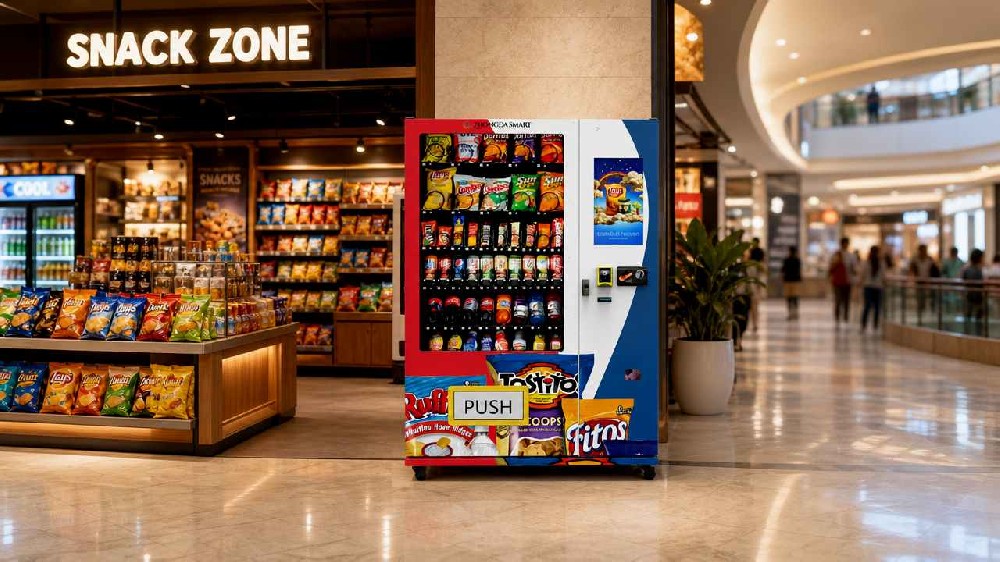
This guide explains how to compare commercial water vending machines, choose dispensing and payment systems, calculate operating costs, evaluate manufacturers, and prepare for installation. It also covers the details that are easy to overlook when requesting factory quotations, including usable bottle capacity, maintenance access, spare parts, and delivery expenses. The goal is to help you select equipment that fits your products and operating plan before committing money to a machine that may be difficult or expensive to manage.
What Should You Look for First?
For most operators planning to sell sealed bottled water, a refrigerated beverage vending machine with adjustable product lanes, card payment capability, and straightforward front-service access is a sensible starting point. A compact cabinet may be sufficient for a workplace or small shared facility. A larger refrigerated machine makes more sense when daily sales justify the inventory and floor space.
The most important specification is not the touchscreen size. It is whether the entire system works with the bottles customers will actually purchase.
For this comparison, I'm prioritizing five purchasing factors:
- Product compatibility: Bottles must fit, remain stable, and dispense without frequent jams.
- Cooling performance: The refrigeration system must maintain the intended temperature under realistic operating conditions.
- Payment reliability: Customers should be able to complete a purchase quickly, with clear handling of failed transactions.
- Serviceability: Restocking, cleaning, component replacement, and fault diagnosis should be manageable.
- Total operating cost: The equipment must make financial sense after inventory, electricity, payment processing, servicing, and site charges.
A lower-priced cabinet that requires frequent service can cost more over its useful life than a properly configured alternative. Conversely, a large touchscreen, elevator delivery mechanism, or elaborate custom exterior may add little value to a machine selling only standard water bottles.
I'd choose the simplest configuration that reliably performs the required job, then pay for additional features only when they solve a specific operating problem.
Types of Bottled Water Vending Machines
The term bottled water vending machine covers several equipment designs. Although they can sell similar products, their loading arrangements, refrigeration systems, and delivery mechanisms may be quite different.
Dedicated bottled beverage machines
A dedicated beverage machine is configured primarily for sealed bottles and cans. It may use stacked product columns, gravity-assisted delivery, or other dispensing mechanisms designed around relatively consistent package shapes.
Dedicated beverage layouts are worth considering when the merchandise consists almost entirely of water, soda, juice, and other packaged drinks. A focused assortment can simplify loading and make inventory planning easier.
However, a machine optimized for one bottle shape may not accommodate a substantially different package without mechanical changes. A tall, narrow bottle and a short, wide bottle can behave differently even when their liquid volumes are identical.
Refrigerated snack and beverage combo machines
Combo machines use adjustable shelves or dispensing lanes to accommodate multiple product categories. Bottled water can share the cabinet with sports drinks, juice, canned beverages, and compatible packaged snacks.
For operators who want flexibility, this design has a clear advantage. The product mix can evolve without replacing the entire cabinet, provided the selected packages remain compatible with the available delivery mechanisms.
There is a tradeoff. Every shelf assigned to snacks reduces the space available for drinks, and not every adjustable lane performs equally well with heavy bottles. A combo machine should be configured around the actual merchandise rather than filled with whatever happens to fit.
Compact self-service beverage machines
Compact machines serve locations with limited floor space or a relatively small number of regular customers. They can also provide a useful way to evaluate a proposed vending service before purchasing several full-size cabinets.
The smaller footprint comes with limitations. Fewer product positions can increase replenishment frequency, particularly if a small assortment produces most of the sales.
If I were choosing a compact machine, I'd examine the available bottle capacity and access to the refrigeration components before comparing decorative features.
Outdoor beverage vending machines
Outdoor machines require additional protection against water exposure, dust, sunlight, temperature changes, and unauthorized access. Some are designed for sheltered placements, while others use purpose-built protective cabinets.
An indoor beverage machine should not be treated as weather-resistant simply because it has a metal enclosure or a small canopy.
Bottled water machines versus refill kiosks
A bottled water vending machine dispenses sealed, prepackaged products. A water refill kiosk dispenses water into a container and may require filtration, plumbing, sanitation procedures, and water-quality controls.
These are different purchasing categories. The refrigeration, inventory, delivery, and maintenance considerations in this guide focus on machines selling sealed bottled water.
Start With the Bottle, Not the Cabinet
Bottle dimensions are among the most consequential details in a vending machine purchase. A machine may have enough physical space for a bottle yet still be unable to release it consistently.
The problem is that package volume does not describe package geometry. Two bottles containing the same amount of water can have different heights, diameters, neck shapes, base designs, and weight distribution.
Measure the complete package
Before selecting a machine, record the dimensions of every bottle intended for sale. Use the actual filled product, including the cap and any protective packaging.
| Product characteristic | Why it matters | What to confirm |
|---|---|---|
| Overall height | Determines shelf clearance and loading orientation | Measure from the bottle base to the top of the cap |
| Maximum diameter or width | Affects channel spacing and release clearance | Measure the widest point, including molded ridges |
| Filled weight | Influences motor loading and delivery impact | Weigh the complete sealed bottle |
| Cap and neck shape | Can catch on guides or adjacent products | Check for protruding caps and irregular shoulders |
| Base stability | Affects how the bottle rests and moves | Check whether the bottle rocks or rolls easily |
| Packaging stiffness | Soft bottles may compress under pressure | Test full lanes, not only individual bottles |
| Surface finish | Changes friction against rails and neighboring bottles | Test smooth, ribbed, and textured packaging separately |
Why a 500 mL bottle is not a standard mechanical specification
A 500 mL bottle holds approximately 16.9 fluid ounces. That describes the liquid volume, not the space required inside a vending machine.
Some bottles have pronounced shoulders. Others use flexible plastic that changes shape when compressed. Square bottles may remain stable on a shelf but require different clearance from round bottles.
For this reason, I would not approve a cargo-lane layout from bottle volume alone. A dimensioned package drawing is useful, but a physical dispensing test is stronger evidence.
Test the bottle assortment before production
The factory should receive representative samples of the products the operator expects to sell. Test both the smallest and largest bottles and include any unusually shaped packaging.
A meaningful test should examine more than one successful vend. The supplier should demonstrate loading, repeated release, product collection, and operation after the lane has partially emptied.
Partially depleted lanes deserve attention because bottle position and mechanical pressure can change as inventory falls.
Ask whether the same dispensing mechanism can accommodate future products or whether changing bottle sizes will require new coils, dividers, motors, or shelves.
This is an inexpensive question to resolve before manufacturing. After delivery, incompatible product lanes may require replacement hardware or limit what the operator can stock.

Comparing Commercial Bottled Water Vending Machine Models
Machine specifications become useful when they answer a practical question: which cabinet can handle the intended products, fit the available space, and support the expected service schedule?
Zhongda Smart manufactures configurable vending machines for beverage and mixed-product applications. Its compact, full-size, and outdoor-oriented models provide useful examples of how different designs address those requirements.
| Configuration | Cabinet dimensions | Listed capacity | Selections | Displayed reference price | Primary purchasing consideration |
|---|---|---|---|---|---|
| ZD-L-7 compact combo | 830 × 800 × 1930 mm | Approximately 200–300 items | 36 lanes | $1,951 | Limited floor space and smaller inventories |
| ZD-L-22 full-size combo | 1315 × 920 × 1990 mm | Approximately 300–360 items | 60 lanes | $2,262 | More selections and a larger customer interface |
| ZD-L-7 sheltered-outdoor configuration | 1180 × 920 × 1990 mm | Approximately 300–900 items, depending on layout | Up to 60 | $3,200 | Sheltered outdoor placement and configurable weather protection |
Model figures and displayed reference prices were reviewed in November 2026. Values refer to the individual product configurations, not standardized delivered packages. Capacity depends on bottle dimensions and shelf layout. The final quotation may differ because of payment hardware, refrigeration options, customization, delivery, and other requirements.
The compact ZD-L-7 vending machine is worth evaluating when floor space is restricted and the product assortment is relatively small. Its 36-lane arrangement offers flexibility without requiring a full-size cabinet.
For a larger assortment, the ZD-L-22 snack and beverage vending machine provides a 22-inch display, 60 standard cargo lanes, and configurable internal storage.
The two machines should not be compared solely by their advertised item counts. A row of large bottles may store far fewer units than a row of compact snack packages.
The outdoor-oriented model adds a different set of purchasing considerations: cabinet protection, installation exposure, electrical preparation, and maintenance in more demanding conditions.
One detail deserves particular attention when comparing product quotations: similar model names do not guarantee identical mechanical or electrical configurations. Confirm the exact model variant, cabinet drawing, internal hardware, and revision before approving an order.
Refrigeration: How Cold Does Bottled Water Need to Be?
Sealed, shelf-stable bottled water does not generally require refrigeration for the same safety reasons as perishable food. Cooling is primarily a product-experience decision, provided the bottled water is stored according to its labeling and applicable requirements.
Customers often prefer chilled water in fitness facilities, transportation areas, and busy workplaces. In other settings, room-temperature water may be acceptable.
That distinction matters because refrigeration increases equipment complexity, electrical consumption, and maintenance requirements.
Temperature setting is not cooling performance
A vending machine may allow the operator to select a target temperature, but the displayed setting alone does not prove that every bottle reaches or maintains that temperature.
Actual performance depends on cabinet insulation, ambient conditions, ventilation, compressor capacity, door openings, stocking frequency, and how the bottles are arranged.
For example, adding a large quantity of warm bottled water to a refrigerated cabinet increases the cooling load. The air temperature may recover before the center of each bottle reaches the desired serving temperature.
Ask the manufacturer for the operating temperature range and the conditions under which cooling performance was evaluated. When temperature control is important, request actual cabinet-temperature measurements rather than relying only on a thermostat setting.
Understand the refrigeration components
A typical refrigerated beverage machine contains a compressor, condenser, evaporator, fans, temperature sensors, and a controller. Maintenance access to these components is important.
Condenser airflow deserves particular attention. A machine squeezed into a poorly ventilated recess may struggle to reject heat, especially during periods of heavy use.
Before installation, confirm the required clearance around ventilation openings. Do not assume a cabinet can be pushed flush against surrounding walls.
Energy consumption belongs in the purchasing comparison
For two machines that provide similar capacity and cooling performance, a meaningful energy-efficiency comparison requires measured consumption under comparable conditions.
ENERGY STAR notes that certified refrigerated beverage vending machines are, on average, 9% more energy-efficient than standard models. Its certification criteria also address reduced-power operation during periods of inactivity.[2]
This finding is a useful reason to request energy-performance documentation. It does not establish that any particular machine in this guide holds ENERGY STAR certification.
Ask for energy consumption in kilowatt-hours per day, together with the test conditions. A power rating in watts is not equivalent to daily electricity consumption because compressors cycle on and off.
To estimate electricity expense, use:
Daily energy consumption × electricity rate × 30 = estimated monthly electricity cost.
For illustration, a machine averaging 4 kWh per day at an assumed electricity price of $0.18 per kWh would cost approximately $21.60 over 30 days.
That is a calculation example, not a measured consumption figure for a Zhongda Smart machine. Actual energy expense should be calculated from model-specific data and the installation conditions.
When refrigeration is unnecessary
An ambient-temperature machine may reduce complexity when customers do not require chilled water and the storage environment remains appropriate for the product.
However, ambient storage does not mean placing bottled water in excessive heat or direct sunlight. Packaging recommendations and storage conditions still matter.
If the product assortment may later include beverages requiring controlled refrigeration, plan for that requirement before buying an ambient-only cabinet. Retrofitting cooling equipment can be impractical.
Choose a Dispensing System That Handles Water Bottles Reliably
Dispensing failures can make an otherwise attractive machine difficult to operate. A customer who pays but does not receive a bottle creates a service problem, a potential refund, and a reason not to return.
The delivery mechanism should match the package, not simply the merchandise category.
Spiral dispensing
Spiral or coil mechanisms move products forward as the motor rotates. They are common in adjustable snack and beverage machines.
For bottled water, coil diameter, pitch, shelf spacing, bottle orientation, and product weight all matter. The bottle must move forward without rotating into an unstable position or catching against neighboring products.
Spiral dispensing is attractive when an operator wants to stock several package types, but each important bottle format should be tested.
Pusher and column systems
Pusher mechanisms or dedicated product columns can provide a more controlled arrangement for certain bottle shapes.
They may be suitable when most merchandise follows a consistent package format. The tradeoff is that unusual packages may require mechanical adjustments or dedicated channels.
Elevator delivery
An elevator delivery system collects the selected item near its shelf and transports it toward the collection area. This reduces the distance a product falls.
Elevators can be valuable for fragile containers, premium packaging, or merchandise that should not be dropped. They also add moving parts and potential service requirements.
For standard, impact-tolerant plastic water bottles, I would not automatically pay extra for an elevator. A properly tested drop-delivery design may be sufficient.
Require a vending test that reflects actual operation
Request a demonstration using the intended filled bottles. The test should include full and partially empty lanes, multiple bottle formats where applicable, and verification that the customer can retrieve the product comfortably.
Observe what happens if a product fails to release. Does the machine detect the failure? Does it retry? Is the transaction reversed, flagged for service, or incorrectly recorded as a completed sale?
The answer affects both customer satisfaction and inventory accuracy.
Capacity: How Many Bottles Should the Machine Hold?
Vending machine capacity is often presented as a single number, but that number can be misleading without a corresponding product-loading plan.
A cabinet advertised for several hundred items may hold substantially fewer large bottled beverages than small packaged products.
Separate selection count from bottle count
A selection is a product position or saleable lane. Capacity is the number of units that can be loaded and dispensed from those positions.
A machine with 60 selection lanes does not necessarily carry 60 different products, and it does not hold a fixed number of bottles per lane.
Several lanes can be assigned to the same water brand or bottle size. That is often sensible because high-demand products need more stock than slow-moving alternatives.
Use expected sales to plan restocking
Consider an operation expecting 25 bottled water sales per day. If the machine holds 200 usable bottles of the planned assortment, its theoretical stock coverage is eight days.
In practice, operators should not plan to empty every lane before servicing. Popular selections may sell out while slower products remain available.
A more useful planning method is to reserve enough capacity for the strongest-selling products and schedule replenishment before those lanes become empty.
| Usable bottle stock | Daily sales assumption | Theoretical coverage | Operational consideration |
|---|---|---|---|
| 120 bottles | 20 bottles | 6 days | Popular lanes may require earlier replenishment |
| 200 bottles | 25 bottles | 8 days | Allow a stock buffer for strong-selling products |
| 300 bottles | 30 bottles | 10 days | Check inventory distribution across selections |
| 360 bottles | 45 bottles | 8 days | Frequent demand monitoring becomes important |
All sales figures are hypothetical planning assumptions. Coverage equals usable stock divided by assumed daily sales. Actual refill timing depends on product mix, demand variation, and the operator's service policy.
Why maximum capacity is not always the goal
Greater storage capacity reduces the risk of running out, but unused inventory ties up working capital. It can also lead to an assortment containing more products than customers actually want.
I'd give the fastest-selling bottled water formats more space, then use a limited number of lanes to evaluate alternatives such as sparkling water or different bottle sizes.
After collecting reliable sales records, adjust lane allocation. The right configuration should reflect demand rather than a desire to fill every available product position.
Choosing a Location That Can Support Consistent Sales
A strong vending location provides repeated access to people who have a reason to purchase bottled water. Foot traffic matters, but the usefulness of the location matters more.
A crowded passageway where everyone already carries a drink may perform differently from a facility where customers spend several hours and have limited purchasing options.
Look for a clear reason to purchase
Fitness facilities can create demand around exercise. Workplaces may produce repeat purchases during breaks. Shared residential spaces can serve customers when nearby retail is inconvenient.
Hospitals, waiting areas, and transportation facilities can also provide demand, but a machine must fit the venue's access rules, operational schedule, and customer needs.
No location type guarantees profitability. Evaluate the actual purchasing opportunity rather than relying on a general description of the venue.
Check the practical conditions
Before agreeing to a site, examine:
- Visibility from the main customer route
- Safe access to the collection compartment
- Space for the machine door to open during servicing
- Available electrical supply and network signal
- Restrictions on servicing and deliveries
- Nearby alternatives for purchasing drinks
- Security, lighting, and supervision
- Accessibility of the customer controls
- Responsibility for cleaning and waste disposal
A machine placed in an attractive but inaccessible corner may have lower sales and higher servicing costs than a more ordinary location beside a frequently used entrance.
Understand the placement agreement
Some site owners request a fixed monthly fee. Others prefer a percentage of sales. Some arrangements combine both.
Before signing, clarify the term, equipment ownership, electricity charges, access hours, insurance responsibilities, maintenance obligations, removal rights, and treatment of machine downtime.
Also determine whether the location allows the operator to change prices, replace products, or relocate the machine if sales are disappointing.
A good site agreement should leave enough operating margin to maintain reliable service. A high sales volume does not automatically produce a good return when the site charge is excessive.
Cashless Payment Options for Bottled Water Vending Machines
A fast, dependable payment system matters because bottled water is usually a low-value convenience purchase. Customers are unlikely to tolerate a complicated checkout process for a single drink.
Card readers, contactless payments, mobile wallets, QR-code payments, coins, and bills are possible options, depending on the hardware and processor selected.
Support the payment methods customers actually use
The Federal Reserve's 2026 Diary of Consumer Payment Choice reported that cash represented 14% of consumer payments in 2025. Consumers made an average of six cash payments per month, and cash remained the third-most-used payment instrument.[1]
These figures describe consumer payment behavior across the survey population, not bottled water vending transactions. They should not be used as a forecast for an individual machine.
They do reinforce a practical point: digital payment support is important, but eliminating cash should be a deliberate operating decision rather than an automatic assumption.
A cashless vending machine can simplify cash collection and remove some mechanical payment components. However, connectivity failures, payment processing expenses, and settlement issues remain important.
Check payment compatibility before manufacturing
Do not assume that every card reader will work with every vending controller.
Confirm the controller interface, reader compatibility, supported transaction functions, processor requirements, and who is responsible for activation.
Some vending payment systems communicate through interfaces such as MDB. The presence of a compatible connector does not automatically guarantee that a particular reader and software configuration will function together.
Ask the supplier to identify which components are included and which must be purchased or activated separately.
Evaluate the full payment transaction
A successful demonstration should show the customer selecting a product, authorizing payment, receiving the bottle, and seeing the correct transaction status.
It should also test unsuccessful delivery. If the bottle jams, the system must handle payment reversal, refund, or an appropriate customer-support workflow according to the configured payment platform.
Ask how the machine behaves when its network connection disappears during a transaction. Offline behavior, transaction reconciliation, and recovery should be documented before deployment.
Understand the cost of small transactions
Processing charges may include percentage-based fees, a fixed amount per transaction, service subscriptions, and device-related charges.
A fixed transaction fee matters more when selling a $2 bottle than when selling a higher-priced product.
For example, an illustrative charge of 3% plus $0.10 would total $0.16 on a $2 transaction. This is a mathematical example, not a quoted processor rate.
Compare payment providers using the actual average purchase value, expected transaction count, hardware costs, and settlement terms.
Remote Inventory Monitoring and Vending Software
Remote management becomes increasingly useful as an operator adds machines or serves locations that are inconvenient to visit.
A connected vending system may provide sales records, inventory estimates, machine status, payment information, and operational alerts. The functions available depend on the controller and management software.
Inventory monitoring should support restocking decisions
A useful dashboard identifies which selections are selling and which need attention. It should make it easier to plan a visit rather than require the operator to interpret a large amount of unrelated information.
For a water-focused machine, the most useful information often includes units sold by selection, remaining stock estimates, recent sales activity, and machine faults.
Remote inventory figures should be reconciled with physical stock because failed vends, manual stock adjustments, incorrect loading, and software errors can create differences.
Remote access does not replace physical maintenance
A management platform can report a fault but cannot remove a jammed bottle, clean a condenser, inspect a damaged power cable, or repair a failed refrigeration component.
That distinction should influence the purchasing decision. Remote monitoring reduces unnecessary visits only when it provides accurate information and the machine remains mechanically reliable.
Ask about software ownership and recurring charges
Before purchasing, clarify whether the management platform is included with the machine, licensed separately, or billed as a subscription.
Confirm administrator access, reporting features, data export, user permissions, software updates, account transfer procedures, and what happens if the service is discontinued.
For a multi-machine operation, standardized reporting and the ability to export transaction records can be more valuable than an elaborate dashboard.
How Much Does a Bottled Water Vending Machine Cost in 2026?
The purchase price of a commercial bottled water vending machine depends on the cabinet, refrigeration system, dispensing hardware, screen, payment devices, software, security requirements, and customization.
Factory reference prices are useful for comparing equipment families, but they should not be confused with the complete cost of getting a machine ready to accept payments.
Separate the equipment price from the operating investment
The machine quotation is only one part of the purchasing decision.
| Cost category | What it may include | What to request |
|---|---|---|
| Base machine | Cabinet, standard controller, shelves, and dispensing mechanism | Model-specific equipment quotation |
| Cooling configuration | Compressor, insulation, sensors, and temperature controls | Included specification and any upgrade cost |
| Payment hardware | Card reader, contactless terminal, bill validator, or coin changer | Itemized hardware and activation costs |
| Software and connectivity | Remote management, network module, and subscriptions | Initial and recurring charges |
| Customization | Brand graphics, interface changes, special product channels | Separate customization quotation |
| Freight and delivery | Packaging, transportation, unloading, and handling | Delivery terms and destination charges |
| Installation | Site preparation, electrical work, positioning, and setup | Responsibility and estimated expense |
| Initial inventory | Bottled water and other products stocked before launch | Wholesale inventory budget |
| Service reserve | Replacement components and unexpected repairs | Operating contingency allowance |
Request an itemized factory quotation
A useful factory quotation should identify the exact machine model and configuration, rather than provide one price for a general product category.
For each major component, determine whether it is included, optional, or supplied by another company. This is particularly important for payment terminals and management software.
Also confirm the electrical specification, cabinet dimensions, packed dimensions, machine weight, and required installation clearances.
A quotation that excludes freight, payment activation, or installation may appear cheaper while producing a higher final investment.
New equipment versus used equipment
Used vending machines can reduce the initial purchase cost, but inspection requirements increase. The age of the machine alone does not establish its condition.
Check refrigeration performance, corrosion, mechanical wear, payment compatibility, controller support, and whether replacement components remain available.
Used equipment may be practical when the operator has access to reliable service and compatible parts. For a first installation with limited technical support, a new machine with clearly documented specifications may be easier to manage.
I'd compare the complete expected service cost rather than treating the lowest purchase price as the deciding factor.
Can a Bottled Water Vending Machine Be Profitable?
Yes, a bottled water vending machine can be profitable when sales volume, selling price, product cost, and operating expenses leave enough contribution to recover the investment.
Profitability is not built into the machine. It depends on the business operating around it.
Because bottled water is often a relatively inexpensive product, small changes in purchase cost, payment fees, and service expenses can make a meaningful difference.
Calculate contribution margin before estimating profit
Start with the amount remaining after the costs directly associated with each sale.
Contribution per bottle = Selling price − Product cost − Payment expense − Site commission − Variable loss allowance.
Consider the following hypothetical vending operation:
| Item | Illustrative amount |
|---|---|
| Retail selling price | $2.00 |
| Wholesale bottled water cost | −$0.70 |
| Blended payment expense | −$0.16 |
| Site commission at an assumed 10% of sales | −$0.20 |
| Variable loss allowance | −$0.02 |
| Contribution per bottle | $0.92 |
Every amount in this example is an assumption for financial planning. It is not an industry average, supplier quote, or actual operating result.
This example leaves $0.92 per bottle before fixed monthly expenses, equipment recovery, financing, and taxes.
At this stage, a machine can produce positive contribution on individual sales while still failing to earn enough to cover its operating expenses.
Model different daily sales volumes
The next step is to estimate how much monthly contribution remains after recurring machine and route expenses.
For the comparison below, assume a 30-day operating month and the same $0.92 contribution per bottle. Fixed monthly expenses change with the scenario because higher sales volumes can require additional servicing.
| Scenario | Bottles per day | Monthly sales | Monthly revenue | Contribution before fixed expenses | Assumed monthly fixed expenses | Operating surplus |
|---|---|---|---|---|---|---|
| Lower volume | 10 | 300 | $600 | $276 | $150 | $126 |
| Moderate volume | 25 | 750 | $1,500 | $690 | $220 | $470 |
| Higher volume | 45 | 1,350 | $2,700 | $1,242 | $320 | $922 |
These are illustrative calculations, not measured vending performance. The fixed-expense assumptions represent estimated electricity, connectivity, servicing labor, and a maintenance reserve. They exclude equipment financing, taxes, depreciation, and any additional expenses not identified in the assumptions. The example assumes the site commission is already accounted for in the per-bottle contribution.
The comparison demonstrates why sales volume has such a strong effect on a low-ticket vending business. A machine may cover its ordinary operating costs at modest demand but take much longer to recover its purchase investment.
The higher-volume scenario should not be interpreted as a guaranteed outcome. Demand must be supported by actual site conditions, and higher traffic can create additional stocking and maintenance expenses.
Calculate the break-even sales requirement
Using the moderate-volume assumptions, monthly fixed expenses are $220 and contribution per bottle is $0.92.
Operating break-even units = $220 ÷ $0.92 = approximately 240 bottles per month.
That equals approximately eight bottles per day over a 30-day month.
This is operating break-even under the stated assumptions. It does not recover the initial equipment investment and does not include excluded expenses.
The calculation should be repeated whenever the selling price, wholesale cost, site agreement, payment charges, or service schedule changes.
Estimate equipment payback carefully
Suppose the total initial investment is an illustrative $5,000, including the machine, selected hardware, installation, and initial setup.
Under the moderate-volume scenario, the estimated monthly operating surplus is $470.
Simple payback = $5,000 ÷ $470 = approximately 10.6 months.
This calculation assumes the monthly surplus remains constant. It does not reflect seasonality, downtime, financing, taxes, major repairs, or changes in demand.
A simple payback calculation is useful for screening projects. It should not be treated as a promise that an investment will be recovered within a specific period.
Run a downside scenario before approving the purchase
An investment deserves more scrutiny if it only works at an optimistic sales volume.
Recalculate profitability with lower daily sales, higher inventory costs, increased payment fees, and additional service visits. Include a realistic allowance for unscheduled repairs and machine downtime.
Also consider the amount of working capital required to keep products available. Inventory purchases create cash outflows before every bottle is sold.
For an operator managing several machines, cash flow matters as much as the expected accounting return. A growing route can consume cash through equipment purchases, inventory, transport, and spare parts even when the individual machines appear profitable.
Water-only versus mixed-beverage profitability
A water-only configuration can simplify purchasing, pricing, and inventory control. However, its average transaction value may be limited.
A mixed-beverage machine gives customers more choices and may support different selling prices. It also introduces additional suppliers, product margins, packaging formats, and inventory decisions.
I would test a focused assortment first, then expand only when sales records show that additional products deserve space.
How to Choose a Bottled Water Vending Machine Manufacturer
Selecting a manufacturer is not simply a matter of comparing cabinet photographs. The supplier must be capable of building the required configuration, documenting what will be delivered, and supporting the equipment after installation.
For this comparison, I'd rank suppliers using the criteria that have the greatest effect on product compatibility and the operator's ability to keep the machine running.
| Evaluation criterion | Evidence to request | Why it matters |
|---|---|---|
| Product compatibility | Loading layout and dispensing demonstration using actual bottles | Reduces the risk of purchasing unsuitable channels |
| Mechanical configuration | Cabinet drawings, motor details, and delivery-system specification | Clarifies the actual equipment being purchased |
| Refrigeration | Temperature range, operating limits, and energy measurements | Supports realistic cooling and electricity planning |
| Payments | Reader compatibility and documented transaction testing | Reduces payment integration risk |
| Software | Demonstration account, reporting functions, and subscription terms | Clarifies remote management capabilities and costs |
| Quality inspection | Pre-shipment inspection checklist and test records | Helps identify configuration or assembly problems |
| After-sales support | Written warranty, spare-parts process, and support responsibilities | Reduces uncertainty when service is required |
| Commercial transparency | Itemized quotation, delivery terms, and agreed specification | Prevents misunderstandings about the total order |
Why Zhongda Smart is worth considering
Zhongda Smart is a relevant manufacturer for operators who need configurable beverage and combo vending equipment rather than an off-the-shelf cabinet with fixed product positions.
Its equipment range includes compact and full-size refrigerated machines, adjustable cargo-lane arrangements, touchscreen interfaces, multiple payment configurations, and connected management options.
For a bottled water project, the useful manufacturing advantage is the ability to plan the machine around the intended merchandise: bottle dimensions, product capacity, cooling requirements, payment hardware, and cabinet branding.
Zhongda Smart also supports OEM and ODM configurations, including single-unit purchasing for selected models. This allows an operator to evaluate a machine before considering a wider equipment order.
Selected product configurations include a one-year warranty and remote technical support, subject to the applicable order and after-sales terms. Coverage, replacement-part conditions, exclusions, and freight responsibilities should be confirmed in writing.
I would prioritize Zhongda Smart for quotation and technical evaluation when customization flexibility and direct manufacturing support are important. Final selection should still depend on successful product testing, the agreed specification, and the total delivered cost.
Ask about spare parts before asking for a discount
A small reduction in the equipment price is less valuable if a common component later becomes difficult to replace.
Request the model numbers and availability of critical parts, including dispensing motors, controllers, sensors, payment interfaces, locks, and refrigeration components.
Ask which components can be replaced by a qualified local technician and which require specialized assistance from the factory.
It is also worth clarifying who pays shipping costs for replacement parts and how warranty claims are documented.
Request a pre-shipment acceptance record
The supplier should provide an agreed inspection checklist covering the actual equipment configuration.
For a bottled water vending machine, that checklist should include product dispensing, payment operation, cooling, network connection, door security, lighting, and any purchased customization.
Photographs and short inspection videos can help confirm the build before packing. They are useful supporting records, although they do not replace a physical acceptance test after delivery.
Which Custom Vending Machine Features Are Worth the Investment?
Customization is valuable when it improves product fit, customer use, or operating control. Changes that do not solve a measurable problem should receive a lower purchasing priority.
Product-lane customization
This is usually the first customization I would consider for a bottled water machine.
Adjustable shelves, suitable dispensing channels, and a loading plan based on actual bottle sizes can have a direct effect on reliability and usable capacity.
Product compatibility should be settled before investing in more visible features.
Payment configuration
Specify the intended payment devices, controller compatibility, and activation responsibilities before production.
Physical openings, mounting brackets, wiring, and user-interface behavior may depend on the selected payment system.
Adding a different reader after installation can be more complicated than including the required configuration in the original order.
Cabinet branding
Custom graphics can make the machine easier to recognize and help communicate prices, product categories, and service information.
Branding should not obstruct ventilation openings, payment devices, product visibility, or service access.
For a water-focused machine, a clear product display and readable purchase instructions often deserve more attention than elaborate decorative graphics.
Touchscreen and software customization
A large display may be useful when the machine sells many products or needs detailed selection guidance. For a small assortment, a simple interface may be sufficient.
Evaluate whether customers can understand the price, select the product, pay, and retrieve the bottle without unnecessary steps.
If a custom interface is required, confirm how changes will be maintained and whether future software updates could affect the customization.
Security features
Security requirements depend on placement. Reinforced locks, protected payment devices, suitable glass, and cabinet construction may be relevant in unsupervised areas.
However, security features should not prevent authorized technicians from accessing components quickly.
The objective is a cabinet that resists unauthorized access while remaining practical to maintain.
Outdoor Bottled Water Vending Machines Need a Different Specification
Outdoor vending introduces operating conditions that do not exist in a protected indoor room. Exposure to rain, dust, direct sunlight, changing temperatures, and physical interference can affect both machine reliability and product storage.
A protective canopy may reduce direct exposure, but it does not automatically make a cabinet suitable for every outdoor installation.
Sheltered and fully exposed installations are not equivalent
A machine beneath a permanent roof faces different conditions from one positioned in an open plaza. Wind-driven rain can reach electrical components even when the top of the cabinet is covered.
Direct sunlight can increase cabinet temperature and refrigeration demand. Dust and debris can also interfere with ventilation and service openings.
Zhongda Smart offers a sheltered-outdoor vending machine configuration with adjustable product channels, refrigeration, and configurable payment hardware.
Its sheltered installation requirements should not be confused with the specifications of a purpose-built weather-protected cabinet.
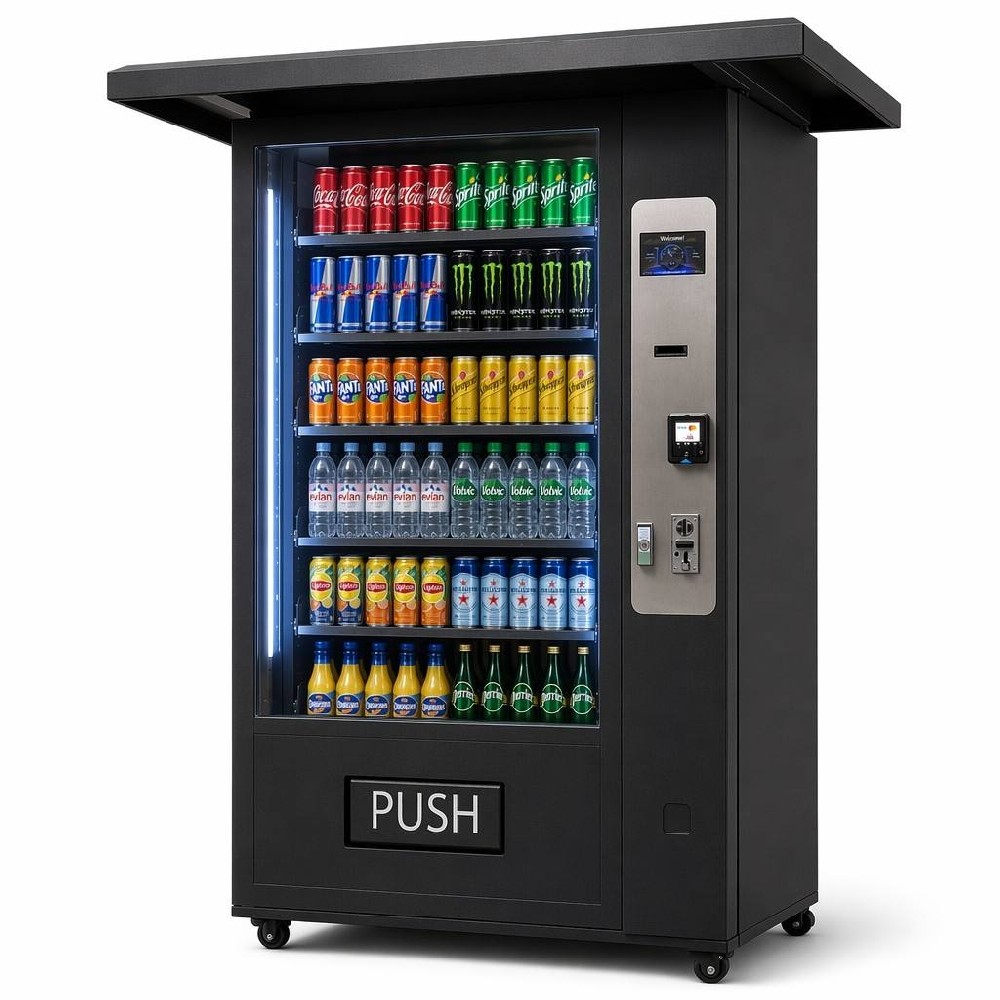
A documented outdoor beverage project
A useful example is Zhongda Smart's outdoor drink vending machine project, which focuses on environmental protection, temperature control, and cabinet security.
The project uses a configuration described with IP65 protective construction, UV-resistant materials, reinforced security features, and cooling and heating capabilities.
Several purchasing lessons come from this type of design.
First, the environmental protection level must be specified for the actual equipment. An IP rating for a particular protective assembly should not automatically be interpreted as certification of every component or the complete installed machine.
Second, refrigeration and heating requirements affect the mechanical and electrical design. They should be defined before production rather than treated as simple software settings.
Third, maintenance access remains essential. A heavily protected cabinet still needs accessible electrical components, refrigeration parts, and payment equipment.
The project is a useful engineering configuration example, not a verified financial performance case. It does not establish a sales volume, payback period, or documented reduction in maintenance expense.
What to confirm for an outdoor order
- Expected maximum and minimum operating temperatures
- Rain exposure, dust, humidity, and direct sunlight
- Required cabinet and electrical enclosure protection
- Corrosion protection and exterior finish
- Refrigeration performance under the expected conditions
- Safe electrical supply and weather-protected connections
- Machine anchoring, stability, and security
- Maintenance access during normal operating hours
Do not assume that outdoor suitability is included because a product description uses the word "durable." Obtain a written environmental specification for the final machine configuration.
Installation: What Must Be Ready Before the Machine Arrives?
Installation planning begins before the machine leaves the factory. Cabinet dimensions alone are insufficient because transportation, door opening, servicing, ventilation, and electrical access all require space.
Confirm the complete delivery path
Measure doorways, corridors, elevators, ramps, and any narrow turns along the delivery route. Compare those measurements with the packed machine dimensions, not just the unpacked cabinet.
Confirm the equipment weight and arrange appropriate handling equipment. Heavy vending cabinets should be moved and positioned by qualified personnel using safe lifting and handling procedures.
Prepare the electrical supply
Check the machine's required voltage, frequency, current, grounding, plug configuration, and protective devices.
An electrician should verify the installation against applicable requirements. Do not substitute an unverified adapter or extension arrangement for a properly prepared supply.
Confirm that refrigeration ventilation openings will remain clear after the machine is positioned.
Verify customer accessibility
Customers should be able to see the products, read the interface, operate the payment device, and retrieve their purchase.
Control height, approach space, and the collection opening should be reviewed against applicable accessibility requirements.
A machine that technically fits the available floor area may still be poorly placed if customers cannot use it comfortably.
Complete acceptance testing
After installation, confirm the following before opening the machine for sales:
- The cabinet is level, stable, and properly secured.
- Electrical connections and protective devices are correct.
- The refrigeration system operates as intended.
- All configured payment methods complete transactions.
- The intended bottles dispense consistently.
- The collection compartment is accessible.
- Prices and selections match the loaded products.
- Sales records and inventory information update correctly.
- The machine can recover appropriately from a network interruption.
- Service contacts and refund instructions are available.
Keep the acceptance records, final configuration sheet, wiring information, manuals, and warranty documents together. Those records can be valuable when troubleshooting or ordering replacement components.
Bottled Water Vending Machine Maintenance and Troubleshooting
A vending machine should be maintained according to its actual operating environment, usage, and manufacturer instructions. Fixed service intervals are not appropriate for every model or installation.
Machines in dusty environments may need more attention to condenser airflow. Heavy-use machines may require more frequent inspections of dispensing components and collection areas.
Make routine service consistent
A short, repeatable service procedure is more useful than an occasional inspection that depends entirely on the technician's memory.
| Component | Inspection task | Potential issue |
|---|---|---|
| Product lanes | Check alignment, debris, and bottle positioning | Jams or incomplete dispensing |
| Collection compartment | Remove debris and inspect the pickup mechanism | Blocked retrieval or damaged products |
| Refrigeration system | Review temperature readings and airflow | Reduced cooling performance |
| Condenser area | Inspect for dust and restricted ventilation | Increased cooling load |
| Payment equipment | Check readers, acceptors, and transaction status | Failed or incomplete purchases |
| Doors and locks | Inspect hinges, seals, and locking operation | Security or cabinet-sealing problems |
| Network connection | Confirm communication and reporting | Missing sales data or alerts |
| Electrical components | Arrange qualified inspection when wear or damage is suspected | Electrical and operational hazards |
Common problem: a bottle fails to dispense
Begin by taking the affected selection out of service if continued operation could cause another failed transaction.
Inspect the lane for incorrect loading, unsuitable bottle dimensions, damaged components, or an obstruction. Check the machine's fault record and compare the transaction status with the remaining inventory.
Do not repeatedly operate a jammed mechanism or bypass protective devices to force a product release.
If the problem persists after safe inspection, use the manufacturer-approved troubleshooting procedure or arrange qualified service.
Common problem: the machine is not cooling properly
Confirm the temperature setting and check whether the doors close correctly. Inspect accessible ventilation openings for obstructions.
Review the ambient operating conditions and whether recently stocked warm products are increasing the cooling load.
If cooling remains inadequate, a qualified technician should inspect the refrigeration system. Refrigerant-related work must follow the applicable technical and safety requirements.
Common problem: payments succeed but products do not arrive
Separate the payment record from the mechanical delivery record.
Confirm whether the machine registered a successful vend, a failed vend, or an unresolved transaction. Then follow the configured refund and service process.
This distinction is important because a payment problem can originate in the processor, controller, communication system, or physical dispenser.
Keep maintenance records that support decisions
Record the machine identifier, date, fault description, action taken, replacement parts, and technician responsible.
Over time, those records help identify repeated problems and compare maintenance demands across equipment configurations.
They also provide useful evidence for warranty discussions and future purchasing decisions.
I would rather invest in reliable parts access and clear troubleshooting instructions than purchase a machine with a long feature list but an uncertain service process.
Final Checklist Before Ordering a Bottled Water Vending Machine
By the time a machine reaches the quotation stage, its main operating requirements should already be clear. The final purchasing review is about eliminating uncertainty before the supplier begins production.
Confirm the product and machine configuration
- Identify every planned bottle type and its dimensions.
- Confirm dispensing compatibility with representative products.
- Obtain a usable loading plan showing bottle capacity and selections.
- Approve the refrigeration and temperature-control requirements.
- Check cabinet dimensions, weight, and service clearances.
- Specify payment devices and software functions.
- Confirm the expected operating environment.
Confirm the commercial terms
- Receive an itemized quotation for the exact machine configuration.
- Identify optional equipment and recurring software charges.
- Confirm packaging, freight, delivery, and installation responsibilities.
- Review the agreed production and delivery arrangements.
- Obtain warranty terms and a replacement-parts process.
- Agree on inspection and acceptance requirements.
- Confirm the documentation supplied with the equipment.
Verify the business assumptions
Before making the purchase, prepare a conservative operating calculation based on the proposed location.
Include the expected bottle selling price, wholesale product cost, payment charges, site fees, replenishment expenses, electricity, maintenance, and equipment investment.
Then test a lower sales scenario. If the operation remains financially acceptable with weaker demand, the investment has more room for unexpected problems.
When scaling beyond one machine, standardizing components and operating procedures can make future maintenance and inventory management easier.
For a first purchase, I would prioritize a machine that can be tested thoroughly and supported reliably. Additional capacity and features can follow once actual demand justifies them.
Frequently Asked Questions
1. How much does a bottled water vending machine cost?
Prices depend on cabinet size, cooling, payment hardware, dispensing technology, and customization. As reviewed in November 2026, selected Zhongda Smart reference prices included $1,951 for a compact ZD-L-7, $2,262 for a full-size ZD-L-22, and $3,200 for a sheltered-outdoor configuration. These are displayed equipment prices, not complete delivered costs. Request an itemized quotation covering the required hardware, freight, installation, and any recurring charges.
2. Is a bottled water vending machine profitable?
It can be profitable when sales generate enough contribution to cover operating expenses and recover the equipment investment. Calculate the selling price minus product cost, payment charges, site commission, and variable losses. Then subtract electricity, servicing, connectivity, and other recurring expenses. Use conservative daily sales assumptions and calculate the break-even requirement before purchasing. No machine model guarantees a particular monthly income or payback period.
3. Can a regular vending machine sell bottled water?
Yes, if its internal dimensions, dispensing mechanism, weight limits, and product-delivery arrangement are compatible with the bottles. A standard snack machine is not automatically suitable for heavy or irregularly shaped bottles. Provide filled product samples or precise package dimensions and request a dispensing test. Confirm the final usable capacity with the intended merchandise rather than relying on the machine's maximum advertised item count.
4. Does bottled water need a refrigerated vending machine?
Sealed, shelf-stable bottled water does not generally require refrigeration solely to remain safe, provided it is stored according to its labeling and applicable requirements. Refrigeration is often preferred because customers want cold drinking water. If chilled products are part of the business plan, choose a machine with suitable cooling performance and ventilation. For a mixed-product assortment, follow the storage requirements of every beverage being sold.
5. How many bottles can a water vending machine hold?
Capacity varies with the cabinet, bottle dimensions, and cargo-lane arrangement. Selected commercial combo configurations are listed for approximately 200–360 products, while certain larger layouts may support higher counts with suitable merchandise. The actual number of water bottles can be lower than the maximum item rating. Request a product-specific loading diagram showing how many bottles fit in each lane and how much stock is available for the highest-demand selections.
6. Can I customize a bottled water vending machine?
Yes. Zhongda Smart supports configurable product lanes, cabinet graphics, touchscreen options, payment hardware, and selected software functions. Customization should begin with bottle compatibility, refrigeration, and payment requirements. Send the manufacturer your product dimensions, filled weights, proposed assortment, installation conditions, and required quantities. Ask for a written configuration and dispensing test before approving production. Additional features should have a clear operating purpose.
7. Can bottled water vending machines be installed outdoors?
Yes, provided the machine is designed or configured for the intended exposure. A sheltered outdoor cabinet is not necessarily suitable for direct rain, prolonged sunlight, heavy dust, or extreme temperatures. Confirm environmental protection, electrical safety, cooling performance, cabinet security, and maintenance access. Request written specifications for the exact configuration and avoid assuming that a canopy alone provides complete weather protection.
8. What should I ask a manufacturer before buying?
Ask for the exact model specification, cabinet and packed dimensions, bottle-loading layout, dispensing demonstration, refrigeration performance, payment compatibility, software charges, warranty conditions, spare-parts availability, and final delivery terms. Request an itemized quotation and an agreed pre-shipment inspection procedure. For a customized machine, confirm the approved drawings and component configuration in writing so the delivered equipment can be checked against the purchase agreement.
Editorial Notes and Sources
Editorial perspective: Prepared for Zhongda Smart's vending machine manufacturing and customization audience. The equipment guidance focuses on product compatibility, mechanical configuration, payment integration, installation planning, and operational serviceability. Recommendations are editorial purchasing judgments, not claims of personally operated machines or independently audited customer results.
Source and calculation policy: Manufacturer specifications and reference prices relate to identified product configurations and may change. Financial tables use explicitly stated hypothetical assumptions. Calculated examples are provided to demonstrate purchasing decisions, not to represent typical revenue, observed customer performance, or guaranteed investment returns.
- Federal Reserve Financial Services. 2026 Diary of Consumer Payment Choice: Cash Remains Essential for Consumers. Published August 4, 2026. Used for the 2025 consumer cash-payment figures discussed in the payment section. Read the payment research.
- ENERGY STAR. Vending Machines: Energy Efficiency and Certification. Used for the comparison of certified refrigerated beverage vending machine efficiency and reduced-power capabilities. Review the energy-efficiency guidance.
Important Disclaimer
This article provides general equipment-selection and business-planning information. It does not constitute financial, legal, electrical, engineering, or regulatory advice. Product specifications, prices, available features, warranty coverage, and delivery terms can change and must be confirmed for the exact machine being purchased.
Revenue, cost, break-even, and payback examples are hypothetical calculations. Actual financial results depend on demand, product pricing, operating expenses, equipment performance, and other circumstances. Before installation, obtain the necessary site permissions and verify applicable electrical safety, accessibility, food storage, payment security, environmental, and commercial requirements with qualified professionals.
Images illustrate relevant Zhongda Smart equipment configurations and should not be interpreted as proof that every pictured component is included in a particular order. Always use the final approved equipment specification, operating manual, and purchase agreement when making installation or operating decisions.