A mini vending machine can cost as little as $797 for a listed tabletop model, compared with $1,042 for a wall-mounted example and $1,443 for a compact floor-standing example in Zhongda Smart's current catalog. Those figures are manufacturer reference prices for specific machines, not verified industry averages or delivered project quotations. The actual amount you spend depends on product dimensions, dispensing hardware, payment configuration, order quantity, and customization. Freight, installation, inventory, and recurring services sit outside the advertised machine price unless the quotation explicitly includes them. A lower-priced cabinet can become the more expensive option if it needs substantial modifications or frequent restocking. The useful comparison is therefore between machines that can reliably sell your products at a reasonable total cost, rather than between their lowest advertised prices alone.
How Much Do Different Mini Vending Machines Cost?
Form factor does not determine price alone: wall units require mounting, while compact floor-standing cabinets can hold more stock than tabletop models. A product-specific dispensing system may cost more than a larger, simpler machine. The comparison below uses accessible Zhongda Smart product details checked in November 2026, rather than treating a range from older buying guides as a current market quote.
| Machine format and example | Listed reference price per machine | Published cabinet information | Key budgeting consideration |
|---|---|---|---|
| Tabletop: ZD-ZMK-7 listing | $797 | 800 × 600 × 450 mm listed dimensions; 50 kg; 100–150 pieces | Requires suitable counter support and an appropriate product layout |
| Wall-mounted: ZD-BGS-32 | $1,042 | 47.24 × 25.591 × 11.024 in listed dimensions; 70 kg; up to 120 pieces | Wall structure, mounting hardware, and payment integration must be confirmed |
| Compact floor-standing: ZD-C-7 | $1,443 | H 1,954 × W 800 × D 850 mm; 185 kg; up to 300 small boxes | Needs floor area, delivery access, and product-fit verification |
| Customized smart compact project | Written quotation required | Depends on selected base cabinet and approved modifications | Hardware changes, software development, testing, and order volume can change cost |
Price basis: These are publicly displayed manufacturer reference prices, not binding quotes, landed costs, or evidence of a typical industry selling price. An advertised payment method does not establish which reader, merchant account, or transaction plan is included. Confirm the exact configuration and quotation validity before making a financial commitment. The broader mini vending machine product category is useful for identifying alternatives, but its model descriptions should still be checked against individual product pages.
Prices and Installation Requirements by Machine Type
Tabletop Mini Vending Machines
A tabletop vending machine is well suited to a limited assortment of packaged accessories, personal-care items, or small snacks in a supervised indoor setting. The Zhongda Smart tabletop listing shows a $797 reference price, a 7-inch screen, 100–150-piece nominal storage, a listed weight of 50 kg (about 110 lb), and 4G/Wi-Fi network options. Its product specifications list cash and credit-card payment support, but that should not be interpreted as confirmation that the necessary payment hardware and processing account are included.
Its three listed cabinet measurements are 800 × 600 × 450 mm. Buyers should request a dimensioned drawing that identifies height, width, and depth, because the specification line does not label their order. The tabletop vending machine specifications also contain inconsistent model naming between the specification header and descriptive copy; identifying the final model on the purchase order is more reliable than relying on a promotional description.
The attraction is a small floor footprint, not the absence of installation work. A tabletop unit is a reasonable low-commitment test if the location already provides a safe, visible counter. It is less attractive when a custom stand consumes the space and money that a small floor unit would have used.

Wall-Mounted Mini Vending Machines
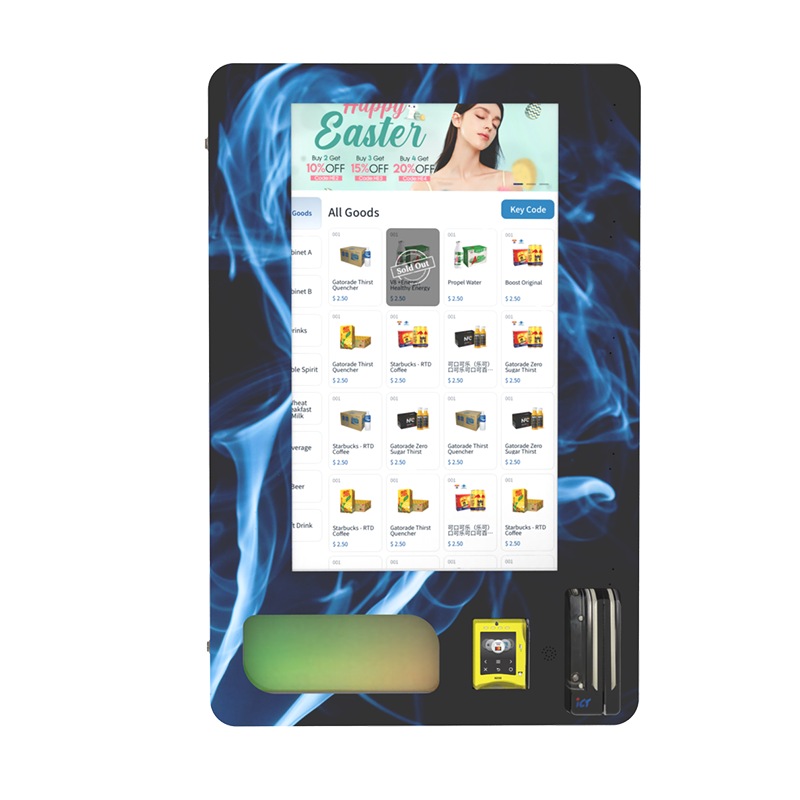
A wall-mounted vending machine preserves floor area but transfers its structural load to the building. Zhongda Smart lists its ZD-BGS-32 card-oriented wall unit at $1,042, with a 32-inch display, 70 kg cabinet weight (about 154 lb), and a maximum inventory reference of 120 pieces. It is designed around compact merchandise and spring channels, not arbitrary large boxes. The wall-mounted card vending machine details provide the published dimensions and connectivity options.
Mounting costs depend on the wall assembly, allowable loads, anchoring system, access for technicians, and local building requirements. A stud wall, masonry wall, or partition may require different solutions. The supplier's description of simple installation does not replace a site assessment. The machine also needs accessible power and a reliable network if its chosen payment configuration requires online authorization.
Verify payment scope carefully: This product page describes the wall unit as cashless in its narrative while the structured specification lists cash and credit-card payment. A purchaser should obtain written confirmation of whether the supplied version accepts cash, cards, NFC, QR payments, or a combination—and exactly what hardware is provided. Do not build the budget or the marketing promise around an unresolved page inconsistency.
Compact Floor-Standing Vending Machines
A compact floor-standing machine is generally the more practical choice when merchandise variety, stockholding, or repeated daily purchases matter more than the smallest possible occupied area. Zhongda Smart's ZD-C-7 is listed at $1,443. Its 1,954 mm height, 800 mm width, 850 mm depth, and 185 kg weight distinguish it decisively from a tabletop device. The published specification includes a 7-inch touchscreen, 36 SKU selections, up to 300 small boxes, and 4G, Wi-Fi, and LAN network options.
Those details come from the compact floor-standing vending machine product page. A SKU is a distinct selection; it is not a physical inventory piece. Thirty-six selections and a maximum of 300 small boxes describe two different capacities. Actual load quantity changes when the packages become wider, taller, deeper, or less suitable for the standard channels.
Check doorways, elevator access, unloading arrangements, floor loading, leveling, and space for opening the service door before ordering. A narrow machine may still be tall and heavy. For a modest assortment with predictable demand, the extra capacity may reduce replenishment trips. For an untested location, it also ties up more capital in inventory and can conceal slow-selling products behind an impressive nominal capacity.

Which Specifications Change the Price of a Mini Vending Machine?
The best upgrade is one that solves a demonstrated selling or operating problem. Ask vendors to itemize standard equipment, optional additions, any one-time engineering charge, and ongoing software or service fees. That creates a comparison between usable configurations, not between an inexpensive basic machine and an over-equipped alternative.
| Feature or modification | Why it can change cost | Pay for it when... | Check for recurring cost |
|---|---|---|---|
| Additional selections or storage | More channels, shelves, sensors, or cabinet volume | Product variety or refill frequency justifies capacity | More stock tied up in inventory |
| Different dispensing mechanism | Modified motors, spirals, pushers, or guided delivery | Actual package tests show the standard mechanism is unsuitable | Specialized replacement parts |
| Larger touchscreen | Display, controller, enclosure, and interface work | Product discovery or on-screen merchandising adds measurable value | Software support and potential repairs |
| Cashless payment system | Reader, controller integration, and activation | Buyers expect cards or mobile payments at the site | Transaction fees and possible terminal charges |
| Cellular connectivity and telemetry | Modem, software integration, and data access | Remote sites or multiple machines make status visibility useful | Data plan and platform subscription |
| Refrigeration | Insulation, compressor, controls, and thermal testing | Merchandise actually requires controlled cooling | Electricity, cleaning, and service |
| Custom graphics and interface | Artwork production, printing, and screen design | Branding supports a defined commercial program | Graphic replacement or software updates |
| New cabinet or custom software | Engineering, tooling, testing, and integration | Existing models cannot meet a documented requirement | Maintenance, licensing, and future changes |
Cabinet Construction, Capacity, and Product Fit
Capacity should be expressed both as selections and as vendible units for your package dimensions. A manufacturer might list 120 pieces under an ideal package format, while your bulkier products substantially reduce that count. Ask for a channel-by-channel loading plan. A machine with fewer but deeper usable lanes may outperform a nominally larger unit if its layout better matches demand. For fragile merchandise, request a dispensing demonstration using actual packages rather than accepting a generic description of a drop mechanism.
Cashless Hardware, Processing, and Connectivity
A cashless payment system has several distinct cost layers: a reader or terminal, mechanical and electronic integration, merchant onboarding, transaction processing, connectivity, and possibly a management subscription. Confirm whether the machine can operate with the selected payment provider and settlement arrangement. Some readers are intended for attended checkout rather than unattended vending; a publicly listed reader price alone does not establish compatibility.
The difference between percentage-only and percentage-plus-fixed-fee pricing is especially important for low-ticket products. For a public comparison, Stripe's published Terminal pricing lists 2.7% plus $0.05 per successful domestic card transaction. At that specific posted formula, a $2 transaction costs $0.104 before rounding conventions or additional charges, whereas a $10 transaction costs $0.32. These are processor reference figures, not a quoted Zhongda Smart payment plan or confirmation of machine integration. The smaller sale bears a higher effective percentage because of the fixed charge. Request the actual vending-compatible processor's contract before modeling revenue.
The Federal Reserve's 2026 Diary of Consumer Payment Choice reports that debit and credit cards accounted for about two-thirds of surveyed consumer payments in 2025, while cash represented 14%. This is broad consumer-payment research, not vending-machine transaction data. It supports testing card acceptance, but it does not prove that every location should eliminate cash. A controlled office may have different needs from a public retail lobby.
Software, Cooling, Customization, and Order Quantity
Refrigeration should be purchased for a defined product requirement, not as a precaution. Temperature-sensitive inventory brings thermal controls, higher energy consumption, monitoring needs, and additional cleaning and failure risks. A listed operating-temperature range does not prove that a cabinet actively refrigerates products. Require explicit cooling specifications, rated operating conditions, and evidence that the intended merchandise can be kept at its required temperature.
Existing-cabinet changes are usually easier to scope than a new mechanism, custom electronics, and original software logic. OEM/ODM projects should identify design fees, prototypes, approval samples, minimum order requirements, tooling ownership, and the cost of future changes. Volume discounts can reduce unit prices, but they are not savings when additional units remain unused or require costly storage.
The Complete Purchase and Installation Budget
The quoted machine price is only one line of the initial investment. A sensible startup budget captures everything required to put the machine into service, accept money, stock it, and maintain enough cash to correct early problems. Ask the supplier what delivery obligation the quoted price covers: shipment from the factory, delivery to a nominated point, unloading, movement into position, commissioning, or none of these. Different delivery scopes can change which quote is genuinely cheaper.
Taxes, duties, and compliance obligations depend on the actual transaction and applicable requirements; do not assume they are included or apply a generic percentage without checking. A floor-standing machine may need special handling, a suitable electrical circuit, and access for servicing.
Illustrative Startup Budget for One Compact Floor-Standing Machine
The following hypothetical project uses the current $1,443 ZD-C-7 listing as its equipment-price reference.Every other number is an illustrative planning assumption, not an actual supplier or installer quote. The example assumes an indoor installation, a separately budgeted cashless integration, and modest opening merchandise. It excludes any unconfirmed taxes or duties, so buyers must add applicable charges rather than reuse $3,000 as a guaranteed delivered price.
| Startup item | Example amount (one-time) | How to verify the real charge |
|---|---|---|
| Machine purchase reference | $1,443 | Signed quotation, model, configuration, and price validity |
| Payment hardware and activation allowance | $280 | Compatible reader, integration, onboarding, and activation invoice |
| Freight and delivery allowance | $360 | Written shipping scope, handling, and unloading charges |
| Site preparation and installation allowance | $210 | Installer assessment of power, placement, and commissioning |
| Opening product inventory | $350 | Supplier purchase orders for the intended merchandise mix |
| Branding and initial setup allowance | $150 | Artwork, programming, testing, and setup scope |
| Spare parts and contingency allowance | $207 | Recommended spares and a risk-appropriate reserve |
| Total illustrative startup investment | $3,000 | Recalculate after obtaining real project quotations |
Your real budget may need separate lines for permits, structural work, insurance before opening, software implementation, taxes, or additional electrical work. If an item is included in the machine quote, remove the duplicate allowance rather than paying for it twice. If the supplier's invoice excludes commissioning, do not silently treat the machine as ready to operate on arrival.
Opening inventory needs particular care. The cash used to fill the machine is part of startup working capital; the cost of products actually sold later appears in operating profit. A first-month cash-flow forecast should distinguish the initial inventory purchase from later replenishment so the same physical products are not treated as two separate purchases.
How Much Does It Cost to Run a Mini Vending Machine?
Vending machine operating costs include merchandise consumed, money collected by payment providers, the cost of occupying a site, and the labor required to keep products available. A physically small machine does not automatically have small operating costs. Its limited stock capacity may increase trips per unit sold, and a low average selling price makes fixed transaction charges more noticeable. Separate costs that increase with sales from those payable even in a quiet month.
Variable Costs: What Each Sale Consumes
Cost of goods sold includes the purchase cost of items actually sold, adjusted for the operator's inventory accounting. Packaging or consumables used for each transaction may belong here as well. Card fees may have a percentage component, a per-transaction component, or a different arrangement. Site commission based on sales is variable; a fixed monthly location fee is not. Damage, expiry, unaccounted inventory, and refunds should be tracked separately rather than hidden inside a vague maintenance percentage.
Fixed and Step Costs: What You Pay Before Selling
Monthly charges may include fixed rent, cloud software, cellular service, insurance, and a maintenance reserve. Electricity is partly a function of operating time, power draw, lighting, and any refrigeration cycle. Labor and transport are often step costs: a refill trip has roughly the same travel burden whether it replaces 15 or 25 products, until demand forces another trip. That distinction matters because two machines with similar revenue can have different servicing costs.
A wattage printed on a product page is not a measured electricity bill. As an illustrative upper-bound calculation for a constant 50 W draw, 0.05 kW × 24 hours × 30 days equals 36 kWh. At a hypothetical $0.25 per kWh, that equals $9 per month. Actual consumption depends on duty cycle, lighting, peripherals, refrigeration, and local tariff; an installer or meter can provide a better estimate. Never assume the 50 W listing alone verifies the energy use of every configured machine.
| Operating cost | Cost behavior | Hypothetical base-case allowance | Practical check |
|---|---|---|---|
| Merchandise cost | Variable per unit sold | $1.60 per unit | Use actual landed stock cost and inventory reconciliation |
| Card processing | Variable per paid transaction | 3% plus $0.10 per sale | Obtain vending-compatible processing terms |
| Shrinkage and product loss | Modeled per unit sold | $0.08 per unit | Record expiry, damage, theft, and refunds |
| Fixed location charge | Fixed monthly | $80 per month | Review rent or commission agreement |
| Connectivity and software | Fixed monthly | $12 + $18 per month | Confirm both subscriptions and renewal terms |
| Electricity | Partly usage-dependent | $9 per month | Measure or estimate actual kWh |
| Maintenance and repair reserve | Budgeted monthly | $30 per month | Check spare-part and service arrangements |
| Replenishment labor and travel | Step cost, modeled monthly | $46 per month | Time the refill route and count visits |
| Total fixed-cost allowance | Monthly planning amount | $195 per month | Excludes variable item costs and any unmodeled taxes |
All allowances in this table are invented solely to illustrate calculation, not published vending benchmarks. The base model assumes every sale incurs the modeled card fee. A real operator should use the expected mix of card, cash, and other payment types and their respective costs. It should also distinguish a cash expense from an accounting reserve: setting aside $30 for future repairs is prudent, but the actual cash repair bill will arrive unevenly.
Is a Mini Vending Machine Profitable? Calculate the Numbers First
Revenue is not profit. Completed purchases must cover merchandise costs, payment charges, site costs, and service work. An inexpensive machine can also lose money when daily demand is too low to cover site and service charges.
The Six Calculations That Matter
Monthly revenue = average selling price × units sold per operating day × operating days per month. Use actual completed vends or a defensible traffic estimate, not everyone who walks past the machine. Revenue should exclude sales taxes collected on behalf of a tax authority and account consistently for refunds.
Gross profit = monthly revenue − cost of goods sold. Gross margin percentage is gross profit divided by revenue, not gross profit divided by merchandise cost.
Contribution per unit = selling price − product cost − variable payment charges − variable product losses − any variable location commission. Contribution margin percentage = contribution per unit ÷ selling price when these inputs are consistent across sales. Contribution pays the fixed bills before generating an operating surplus.
Monthly operating profit = total monthly contribution − fixed operating expenses. Include a fair allowance for replenishment labor even if the owner performs it, because unpaid effort can make a business appear more profitable than it is. State whether taxes, financing charges, depreciation, and owner compensation are included. The illustrative model below is a simplified, pre-tax, unfinanced operating cash model, not a full financial statement.
Break-even units per month = fixed monthly operating costs ÷ contribution per unit, rounded up to the next whole unit. If contribution per unit is zero or negative, additional sales at the same price and cost structure cannot cover fixed expenses. Reprice, reduce variable costs, or change products rather than merely forecasting greater volume.
Simple payback period = initial startup investment ÷ positive monthly operating cash surplus. It estimates how long steady surplus would take to equal the initial outlay. If the monthly figure is zero or negative, there is no payback under those assumptions. This is not a guaranteed return: repairs, replacement equipment, taxes, seasonality, financing, and working-capital changes can alter actual cash flows.
Do Not Confuse Margin, Profit, and ROI
A $4 item purchased for $1.60 yields $2.40 of gross profit before transaction charges and losses. That is a 60% gross margin, not a 60% operating margin and not a 60% return on the machine investment. When the modeled processing fee is $0.22 and expected inventory loss is $0.08 per completed sale, only $2.10 remains to cover monthly fixed costs. The difference is large enough to affect break-even demand.
Mini Vending Machine ROI: A Worked Example With Three Sales Scenarios
Illustrative example only: Assume an initial investment of $3,000 from the startup table, a selling price of $4 per item, product cost of $1.60, payment processing at a hypothetical 3% plus $0.10 per transaction, and a $0.08 allowance for inventory loss per completed sale. Assume 30 selling days every month, all purchases subject to the modeled card fee, no percentage-based location commission, and fixed operating expenses of $195 a month. These are chosen inputs for arithmetic, not actual customer results or industry averages.
Processing cost per sale = ($4 × 3%) + $0.10 = $0.22. Contribution per sale = $4 − $1.60 − $0.22 − $0.08 =$2.10. Break-even volume = $195 ÷ $2.10 = 92.86, so at least 93 completed sales per month are needed to cover the modeled operating costs. Over 30 selling days, that means just over three sales a day on average. To plan using a whole-number daily target, allow at least four sales per day.
| Hypothetical metric | Conservative: 4/day | Base case: 10/day | Strong sales: 16/day |
|---|---|---|---|
| Units sold per month | 120 | 300 | 480 |
| Revenue at $4 per unit | $480 | $1,200 | $1,920 |
| Merchandise cost at $1.60 per unit | $192 | $480 | $768 |
| Processing at $0.22 per sale | $26.40 | $66.00 | $105.60 |
| Product-loss allowance at $0.08 per sale | $9.60 | $24.00 | $38.40 |
| Fixed monthly operating costs | $195 | $195 | $195 |
| Monthly operating surplus | $57 | $435 | $813 |
| Simple payback on $3,000 | 52.6 months | 6.9 months | 3.7 months |
Product cost, price, fees, fixed expenses, and initial outlay stay identical, making the impact of demand visible. For the base case, monthly operating surplus is $1,200 − $480 − $66 − $24 − $195 =$435. Simple payback is $3,000 ÷ $435 = approximately 6.9 months, provided that surplus is consistently available for capital recovery.
In the conservative scenario, $57 of monthly surplus produces an estimated 52.6-month payback. That is mathematically positive but may be economically unattractive once additional repairs, technology replacement, and uncertainty are considered. These scenarios illustrate why small changes in demand can have a disproportionate effect after fixed costs have been paid.
For a distinct first-year cash-return measure, assume the base-case surplus remains $435 for 12 months with no additional capital investment. The formula [(12 × $435) − $3,000] ÷ $3,000 yields74% simple first-year cash return after recouping the original outlay. That is different from gross margin and from the ratio of annual operating surplus to purchase cost. It excludes residual machine value, taxes, financing, discounted cash flows, and fluctuations in operating capital. Do not present it as a promised vending machine ROI.
Run a separate downside case for payment outages, unsold stock, or reduced access to the placement. If fixed expenses rise or the per-sale contribution falls, recalculate break-even before trusting the payback figure. The vending machine ROI calculator allows buyers to replace example figures with project-specific assumptions. Check its treatment of profit and investment against your own accounting definitions before comparing results.
Which Mini Vending Machine Is Worth the Money?
For a small first budget: I'd start with a standard tabletop configuration if the products fit its channels, an appropriate counter already exists, and there is a clear placement agreement. That limits unnecessary cabinet capacity. The tradeoff is more frequent loading, restricted product variety, and possible counter reinforcement. Spending the entire budget on the machine while leaving nothing for payment setup or inventory is a poor way to run a trial.
For limited floor space: A wall-mounted unit can work when a structurally suitable surface and safe customer reach are available. The compromise is a relatively specialized product assortment and additional mounting review. A location with fragile walls or difficult cable routing may find a narrow floor-standing model more economical once installation is included.
For small boxed products with several flavors or variants: A floor-standing compact cabinet with verified channel dimensions and more selections may support better assortment planning. Its advantage is not simply having more slots; additional stock can make each refill visit more productive. The costs are greater upfront outlay, heavy delivery, and working capital held in inventory.
For cashless-focused placements: Prioritize documented reader compatibility, transaction pricing, refund handling, and network recovery over screen size. A large display does not fix a failed authorization. If the equipment will operate in a supervised retail store, a simpler interface may be enough. If customers must browse many products without assistance, a clearer interface can justify its expense.
For a branded unattended retail program: Pay for graphics or interface changes when they are important to customer recognition and product selection. First examine whether an existing machine can accommodate the merchandise. A full custom cabinet is harder to justify for one experimental placement, particularly if design charges cannot be spread across future units.
For an expanding route: Compare remote inventory data, repeatable replenishment procedures, service access, payment reporting, and spare-part consistency across models. Standardizing machines may simplify training and repairs. However, a fleet of identical devices makes sense only when those devices suit the products and the physical conditions of each site.
When not to buy a mini machine: Avoid forcing large cartons, heavy bottles, fragile glass, or temperature-sensitive food into channels not designed for them. A low-capacity model may also be a poor match for a site with intense peak demand or expensive refill trips. In these cases, a larger or specialized machine—and sometimes no machine until demand is proven—can be the less costly decision.
Buying New Versus Used Mini Vending Machines
A used machine can reduce the equipment invoice, but the discount is meaningful only after its condition, serviceability, and compatibility are verified. Inspect the cabinet, lock, controller, wiring, motors, dispensing channels, seals, and service access. Ask for a complete vend demonstration with representative products, not just proof that the screen turns on. A cosmetically clean machine can still require expensive repairs or an unsupported payment conversion.
Payment system compatibility is often the deciding issue. Confirm that the purchaser can register or transfer ownership of any cloud account, obtain firmware updates, and connect an available payment provider. If the original software is licensed to the previous owner or the controller is obsolete, a seemingly inexpensive used machine may become an unusable asset. Request the model's serial information and parts list before agreeing to buy.
Compare the used purchase price plus refurbishment, freight, installation, missing parts, and likely near-term service against a new machine's complete quote. A used unit is more reasonable when its history is documented, parts remain available, products have been successfully tested, and the buyer can tolerate maintenance uncertainty. New equipment is generally easier to justify where warranty coverage, repeatable specifications, branding, or multiple matching machines are necessary.
How to Compare Mini Vending Machine Manufacturers
Procurement Checklist for an Itemized Quotation
Identity: Exact model designation, revision, cabinet drawing, empty weight, loaded weight estimate, and machine quantity.
Merchandise: Product photos, package length/width/height, weight, fragility, sample-testing procedure, and approved vendable items.
Capacity: Number of distinct selections, estimated pieces per lane, and total realistic pieces for the intended stock.
Dispensing: Spring, pusher, conveyor, locker, or guided-delivery arrangement; evidence of suitable vend tests.
Payments: Reader model, supported methods, included hardware, merchant onboarding, settlement, fees, and refunds.
Power and network: Voltage, rated consumption basis, plug type, Wi-Fi/LAN/cellular requirements, and offline behavior.
Software: Available reports, stock alerts, user access, subscription charges, data export, and update policy.
Customization: Graphic files, approved cabinet modifications, interface changes, engineering fees, and sample approval.
Support: Written warranty exclusions, response method, parts pricing, replacement lead times, and responsibility for labor and shipping.
Commercial scope: Packing, delivery point, unloading, taxes or duties where applicable, installation, commissioning, lead time, payment schedule, and quotation validity.
Zhongda Smart's verified catalog includes tabletop, wall-mounted, and compact floor-standing machines, and its product pages describe OEM/ODM options such as cabinet graphics, product-channel setup, payment configuration, and interface customization. The current product pages also display one-year warranty language, but actual coverage, replacement-part terms, service labor, and shipping responsibilities need confirmation in the applicable contract. No listed feature should be assumed to be part of every base-price configuration.
Common Buying Mistakes That Increase Ownership Cost
Comparing only the advertised machine price. Build an installed-cost worksheet covering payment, freight, site work, stock, and contingency before ranking quotes.
Ignoring fixed charges on small transactions. Calculate processor fees at the actual selling prices and transaction mix; a low average ticket can change margins materially.
Choosing a dispenser without testing packages. Send actual samples, define acceptable vend outcomes, and get written confirmation of the channel configuration.
Assuming compact means light or easy to mount. Check machine weight, loaded weight, access routes, supporting structure, and service clearances before paying a deposit.
Paying for features before defining their purpose. Quote a workable standard version first; add refrigeration, a larger screen, or remote software only for a documented need.
Ignoring installation and network details. Check power availability, signal reliability, cable routing, and who performs commissioning before the machine is shipped.
Confusing SKU count with inventory capacity. Ask for both the number of choices and realistic units per choice using the intended product sizes.
Treating sales as profit. Deduct inventory, transaction costs, location charges, labor, and service allowances before estimating payback.
Forecasting a best day as an average day. Use low, base, and high completed-sales scenarios; include a demand threshold below which the placement should not proceed.
Final Buying Recommendation
Choose a tabletop machine for a small, controlled test with lightweight packaged items and a verified supporting counter. Consider wall mounting only when the building can safely carry the load and the payment configuration is specified in writing. Move to a compact floor-standing cabinet when selection count, inventory depth, and replenishment efficiency justify its higher cost and heavier installation. Pay for custom mechanisms or software only after an existing platform has been shown inadequate.
Before ordering, prepare a product-fit sheet, request identical line-item quotes, calculate a fully installed budget, and test a conservative sales scenario. If that scenario produces no credible path to operating break-even, prove demand through a lower-commitment placement first. Zhongda Smart's verified compact-equipment range is one source of configurations to evaluate, not a substitute for that financial discipline.
Frequently Asked Questions
What is the cheapest type of mini vending machine?
A basic tabletop machine is often the lowest-entry-cost format among the three specific Zhongda Smart examples reviewed here. Its listed reference price is $797, but the final lowest-cost choice depends on counter strength, payment requirements, freight, and product compatibility. Compare fully installed costs rather than assuming the cheapest cabinet is cheapest to operate.
How much does a tabletop vending machine cost?
The reviewed Zhongda Smart tabletop model currently displays a $797 manufacturer reference price. That is not a general market average or a delivered quotation. Request a configuration-specific quote covering payment hardware, shipping, installation, and any modifications required by your packages before using the figure in a purchase budget.
Are mini vending machines always cheaper to operate?
No. A smaller cabinet may use less space and hold less inventory, but limited capacity can create more frequent restocking, and low-ticket purchases can carry meaningful processing fees. Calculate operating cost per completed sale and per refill trip rather than relying on cabinet size as a cost indicator.
How much does cashless payment add to the cost?
There is no universal surcharge. The total depends on reader hardware, vending-controller integration, activation, payment-provider rates, connectivity, and any subscription. Request a compatible reader model and an itemized fee schedule. A publicly listed terminal price or processor rate does not establish compatibility with the selected vending machine.
Can a mini vending machine make a profit?
Yes, if completed sales generate enough contribution to cover location, service, connectivity, labor, and other expenses. Start with contribution per vend, then calculate monthly break-even transactions. The illustrative project in this article needs 93 monthly sales to cover its stated fixed and variable operating-cost assumptions.
How long does it take a mini vending machine to pay for itself?
There is no reliable universal payback period. Divide the full startup investment by a positive monthly operating cash surplus, using conservative sales assumptions. The hypothetical base case here yields about 6.9 months; a weaker scenario takes much longer, and a loss-making scenario cannot pay back under unchanged conditions.
Is buying a used mini vending machine worth it?
It can be, if the machine passes vend tests, replacement parts are obtainable, payment systems remain usable, and refurbishment costs leave a meaningful saving. Confirm software ownership, current condition, transport, and any warranty in writing. An unsupported controller can erase the initial price advantage.
Can a mini vending machine be customized without redesigning it?
Often, yes. An existing cabinet may accept different graphics, channel configurations, payment modules, or interface changes, subject to the manufacturer's technical assessment. Start with the closest standard model and ask for the price of each modification. Commission a new cabinet or dispensing design only when product requirements cannot be met otherwise.
Sources and References
Federal Reserve Financial Services, 2026 Diary of Consumer Payment Choice (2026 report covering 2025 consumer payments). Used to contextualize cash and card payment behavior; not vending-specific.
Stripe, Pricing & Fees (public pricing page reviewed November 2026). Used only for an example of percentage-plus-fixed card-present transaction pricing; not an approved vending integration quote.
Pricing and Investment Disclaimer
Product prices and available configurations may change. Final quotations depend on equipment specifications, order requirements, and delivery terms. Shipping, installation, applicable taxes, and payment services can add costs. All non-catalog budgets and financial scenarios in this article are illustrative, not reported customer results. Actual profitability depends on sales, merchandise costs, operating expenses, and equipment performance; no return on investment is guaranteed. Confirm current specifications, payment compatibility, and applicable installation requirements before purchasing.