At Zhongda Smart, we manufacture vending machines as complete unattended retail systems rather than simply assembling cabinets, shelves, and screens. Every project has to connect the product being sold with the right cabinet structure, dispensing mechanism, electrical architecture, payment hardware, software, connectivity, temperature-control system when required, branding, testing process, and after-sales support.
Our manufacturing process therefore begins before a machine reaches the assembly line. We first need to understand what the machine will sell, how the products are packaged, how customers will pay, where the machine will operate, and which functions are genuinely necessary. From there, the project moves through specification confirmation, mechanical engineering, sheet-metal manufacturing, surface finishing, assembly, software and payment integration, sample testing, production quality control, aging tests, final acceptance, and export packaging.
This is the process behind how we manufacture vending machines at Zhongda Smart. In this factory guide, we take you through the major stages from the first product requirement to a finished machine ready for shipment, while explaining why each stage affects dispensing reliability, serviceability, consistency, and long-term operating performance.

Inside Zhongda Smart Manufacturing
Zhongda Smart integrates R&D, manufacturing, sales, OEM/ODM customization, software development, and technical support for intelligent vending equipment. Our current public factory information lists approximately 20,000 m² of working space, more than 400 employees, an engineering team of 10+ people, three assembly lines, more than 20 quality inspectors, four sheet-metal processing workshops, a painting line, and annual production capacity of 10,000 units.
These resources support several different machine categories rather than a single fixed vending platform. Our current product range includes conventional snack and beverage vending machines, mini vending machines, beauty vending machines, collectible and trading-card vending machines, locker systems, elevator-delivery machines, refrigerated vending equipment, and customized automated retail solutions.
That range is important because the products being sold increasingly determine the machine architecture. A conventional bag of snacks does not require the same handling system as a cake, collectible card box, beauty product, book, electronic accessory, or fragile packaged item.
For this reason, we do not approach custom vending as a process of simply choosing a cabinet and changing the exterior graphics. The machine has to be matched to the merchandise and operating requirements first.
Our OEM workflow is organized around five major stages:
- Requirements and specification — confirming the machine model, dimensions, delivery method, temperature requirements, payment configuration, software functions, and branding.
- Proposal and quotation — defining configuration-based pricing and the expected sample and production timeline.
- Sample build and testing — checking product delivery reliability, payment and connectivity functions, and the user interface.
- Production and quality control — including incoming inspection, assembly checks, aging tests, and final acceptance.
- Packaging and logistics — preparing export packaging, recommended spare parts, and remote technical support.
This sequence is the foundation of our manufacturing approach. It allows major design questions to be addressed before the approved configuration enters repeat production.
Product requirements should be confirmed before mass production. A change made while the project is still a specification or drawing is much easier to control than the same change after cabinets, wiring, payment hardware, software, and finished machines have already entered production.
More information about our manufacturing organization is available on our Zhongda Smart factory profile.
1. We Start With the Product
The first step in a custom vending project is understanding the actual merchandise. Screen size, cabinet color, and advertising graphics are important later, but they do not determine whether a product can be delivered reliably.
The product does.
Before selecting the machine architecture, we need accurate information about the items that will be loaded inside it. Important details include package width, height, depth, weight, shape, rigidity, fragility, storage orientation, storage temperature, and expected quantity.
Physical product samples are particularly useful when dispensing behavior cannot be understood from measurements alone. Two boxes may have almost identical dimensions but behave differently because one uses glossy coated packaging while another uses textured cardboard. A flexible pouch may change shape when several units are compressed inside a lane. A bottle with a narrow top may sit differently from a straight-sided can.
Those details affect the dispensing mechanism, shelf spacing, cargo-lane dimensions, motor behavior, product capacity, and sometimes the pickup system.
| Product Information | Why It Matters During Manufacturing |
|---|---|
| Width | Influences lane width, divider position, spiral diameter, and usable selection count. |
| Height | Influences vertical spacing between shelves and overall shelf configuration. |
| Depth | Influences how many products can be loaded into each channel. |
| Weight | Can affect delivery force, motor requirements, elevator loading, and pickup behavior. |
| Fragility | Helps determine whether conventional drop delivery is acceptable or controlled delivery is preferable. |
| Temperature | Determines whether refrigeration or another temperature-control configuration is required. |
| Packaging Shape | Influences product stability and compatibility with spirals, pushers, conveyors, elevators, or lockers. |
This is why a machine should not be selected solely from an exterior photograph. A vending machine that looks suitable from the outside can still be the wrong platform for the merchandise inside.
When an existing machine architecture already fits the product, it can provide a practical starting point for customization. When it does not, deeper changes may be required in the shelf layout, delivery system, cabinet, or software.
Our current vending machine product range shows several different architectures that can be used as starting points for standard and customized projects.
2. Turning Requirements Into an Engineering Specification
Once the product has been defined, the next step is converting the commercial idea into a technical specification.
This specification connects sales requirements with engineering, purchasing, manufacturing, software, assembly, testing, and quality control. It gives each team a common reference for what the finished machine is expected to contain.
For a custom project, the specification can include cabinet dimensions, machine configuration, product type, shelf arrangement, cargo-lane dimensions, delivery method, temperature control, display size, payment hardware, connectivity, software language, user-interface requirements, branding, lighting, locks, accessories, operating voltage, and project-specific functions.
It is equally important to define what is not included. A machine designed for one package size should not automatically be assumed to support a much larger package introduced later. A door designed around one payment terminal may need changes if a different terminal is selected.
Clear specifications reduce this type of late-stage uncertainty.
Questions We Confirm Early
- What products will the machine sell?
- How many SKUs and units need to be stored?
- Which products require special handling?
- Is refrigeration required?
- What payment methods are required?
- What network connection will be used?
- Does the interface require multiple languages?
- Is remote sales and inventory reporting required?
- What branding needs to appear on the cabinet and screen?
- Are there project-specific installation or servicing requirements?
Resolving these questions before production allows mechanical and software changes to be coordinated instead of handled independently.
3. Mechanical Design and Cabinet Architecture
The steel cabinet is the structural foundation of a vending machine. It supports the door, shelves, cargo lanes, motors, display, payment devices, controller, lighting, wiring, refrigeration components where required, locks, pickup area, and loaded products.
Mechanical design therefore has to address much more than exterior dimensions.
The internal structure needs mounting locations for hardware and enough space for cables and electronic components. Moving systems need clearance. Service areas need access. Refrigerated machines need airflow paths and space for thermal components. Door-mounted electronics require appropriate support and cable routing.
A design also needs to be repeatable in production.
One cabinet can sometimes be adjusted manually until everything fits. That approach is not suitable for batch manufacturing. Mounting points, shelf supports, door clearances, hinge locations, lock positions, display openings, and internal brackets need to be reproducible from one unit to the next.
This is where manufacturing-oriented design becomes important. Parts should be shaped and located in ways that reduce unnecessary adjustment during assembly while still meeting strength, appearance, and service requirements.
The objective is not to make the cabinet complicated. The objective is to create a stable platform that allows all of the machine's subsystems to work together.
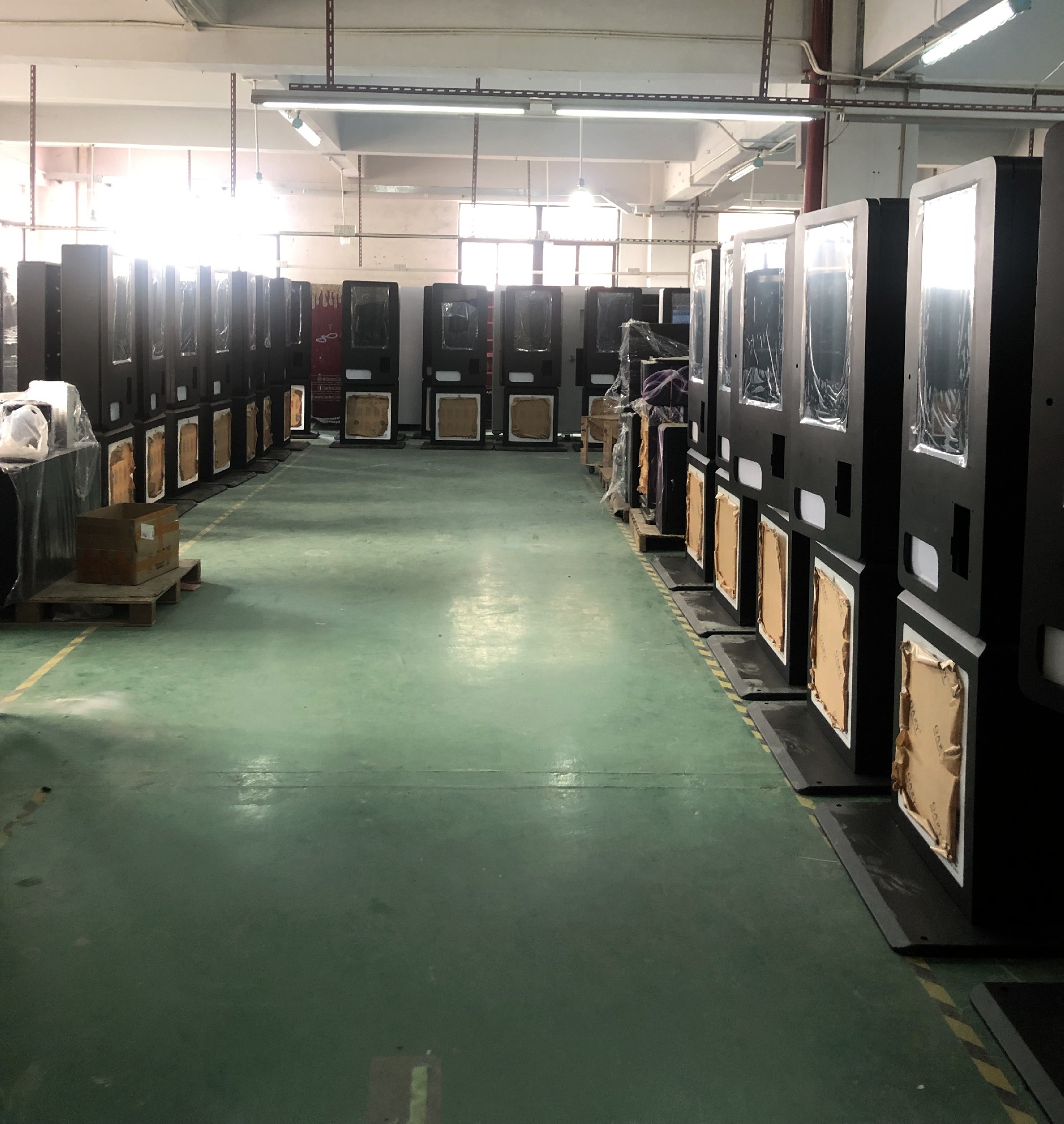
4. Sheet-Metal Manufacturing
Our current public factory information lists four sheet-metal processing workshops as part of Zhongda Smart's manufacturing operation.
Sheet-metal processing converts the mechanical design into physical cabinet components. Depending on the machine and part, manufacturing can involve cutting, punching, bending, joining, welding, grinding, and preparation of mounting features.
This stage has a direct effect on everything that follows.
If a door opening is not consistent, the display or payment device may not align correctly. If shelf supports are positioned incorrectly, the cargo layout can change. If a structural panel is distorted, door alignment, locks, and sealing may be affected.
That is why critical dimensional accuracy matters before parts move into finishing and assembly.
The cabinet also has to tolerate normal handling and repeated service access. Main doors may be opened many times during the working life of a machine. Hinges, lock areas, door-mounted devices, and wiring routes therefore need a structure that remains stable during repeated use.
5. Surface Finishing and OEM Branding
After the cabinet structure has been manufactured, visible metal parts move into the finishing stage.
Surface treatment is both functional and visual. It prepares the cabinet for commercial use while creating the base appearance required for the final product.
For OEM and ODM projects, the exterior can then be coordinated with the customer's brand. Our customization options include logo placement, decals, vinyl wraps, custom colors, advertising panels, front-interface layouts, and selected cabinet modifications.
Branding works best when it follows the final machine structure.
A vending machine door contains functional elements such as screen openings, payment devices, locks, pickup doors, ventilation openings, sensors, seams, and removable service panels. Graphic artwork needs to account for those features instead of treating the machine as one uninterrupted rectangular surface.
This is one reason final artwork should correspond to the approved machine configuration.
The goal is a machine where the physical architecture and brand presentation look like one product rather than a generic machine with graphics added afterward.
6. Selecting the Right Product Delivery System
Product delivery is one of the most important parts of vending machine engineering because it is the point where the machine has to convert a digital purchase into physical movement.
There is no single dispensing system that is ideal for every product.
Our current OEM options include spiral delivery, conveyor configurations, lift or elevator delivery, and locker or compartment systems. Different platforms solve different product-handling problems.
| Delivery System | Typical Application | Main Advantage | Important Validation |
|---|---|---|---|
| Spiral | Many packaged snacks, boxes, and selected beverages | Simple and flexible lane configuration | Spiral pitch, package stability, lane width, motor movement |
| Conveyor | Products that benefit from guided horizontal movement | Controlled transfer path | Product grip, sensors, transfer position |
| Lift / Elevator | Fragile, premium, or damage-sensitive merchandise | Reduces uncontrolled product drop distance | Lift travel, position detection, product transfer, pickup position |
| Locker / Compartment | Large, irregular, or individually stored products | Avoids conventional drop dispensing | Door control, compartment size, access confirmation |
For conventional packaged goods, a spiral system can remain an efficient choice when the product dimensions and packaging are compatible.
For fragile products, however, controlling the delivery path can become more important than mechanical simplicity. Elevator systems can collect the selected item closer to the shelf and move it toward the customer pickup area with less free fall.
Locker systems solve a different problem. Instead of moving the merchandise through a traditional vending path, the machine releases access to an individual compartment.
Our task during product matching is therefore to select the simplest delivery architecture that handles the intended merchandise reliably.
Examples of different application architectures can be found in our custom vending machine solutions.
7. Shelves, Cargo Lanes, and Real Capacity
Capacity is often one of the first specifications buyers compare, but the number needs context.
A vending machine does not have one universal product capacity. The actual quantity depends on the dimensions of the merchandise, shelf spacing, lane width, dispensing hardware, and product mix.
A machine configured for narrow snack packages can hold a different number of units than the same cabinet configured for large bottles or boxed merchandise.
Shelf and cargo-lane design therefore includes several decisions:
- number of shelf levels;
- vertical distance between shelves;
- number of lanes per shelf;
- lane width;
- spiral size or alternative dispensing hardware;
- motor assignment;
- product code and price mapping;
- clearance for product movement;
- airflow space in refrigerated configurations.
The internal layout should provide useful flexibility without sacrificing reliable product movement.
Packaging changes over time. Operators may introduce new products. A sensible amount of shelf and lane adjustment makes it easier to adapt the same machine to future merchandise without redesigning the entire cabinet.
At the same time, maximum theoretical capacity should not be achieved by squeezing products into a layout that creates dispensing or refrigeration problems.
Usable capacity is the number of products that can be stored while the machine continues to operate as intended.
8. Refrigeration and Airflow Engineering
A refrigerated vending machine is both a retail system and a thermal system.
When cooling is required, cabinet design has to accommodate refrigeration components, insulation, airflow, heat rejection, sensors, control logic, ventilation, sealing, drainage or condensation considerations where applicable, and service access.
The required product temperature should therefore be confirmed during the specification stage rather than after the cabinet has already been designed.
Airflow Is Part of the Machine Architecture
Cooling depends on more than compressor capacity.
Cold air has to reach the intended storage area and return through the designed circulation path. Shelves, dividers, products, internal panels, and product loading can all affect that path.
A machine that is overfilled or loaded in a way that blocks circulation may develop uneven temperatures even when the refrigeration hardware itself is working.
For this reason, product capacity and refrigeration should not be engineered independently.
Energy Use Also Matters Over the Machine's Working Life
For context, the U.S. Department of Energy publishes purchasing guidance for refrigerated beverage vending machines. In one comparison for a 30 ft³ Class A beverage machine, the published annual energy-use assumptions are 1,179 kWh for the best-available model used in the comparison, 1,354 kWh for the ENERGY STAR benchmark, and 1,456 kWh for the less-efficient example.
These figures are not universal consumption values for all vending machines. They apply to the specific comparison assumptions used in that guidance. Their value here is to illustrate that refrigeration design and energy efficiency can influence long-term operating cost.
For refrigerated projects, thermal performance should therefore be considered alongside product capacity, equipment power, service access, and operating conditions.
9. Electrical Architecture and Wiring
Modern vending machines contain multiple electrical and electronic subsystems.
Depending on the configuration, these can include dispensing motors, controllers, sensors, touchscreen displays, LED lighting, payment hardware, locks, network modules, power supplies, fans, and refrigeration equipment.
The wiring architecture connects those components while also making future inspection and service possible.
Cable routing has to account for moving parts, door movement, metal edges, service access, and component replacement. Connectors need to remain secure during normal operation and transportation while still being accessible when maintenance is required.
Clear component and harness organization also makes troubleshooting more efficient.
In repeat production, documentation becomes increasingly important. A known electrical architecture helps ensure that later machines follow the same configuration as the approved sample.
Electrical design is therefore not an isolated assembly step. It is coordinated with the cabinet, door structure, controller, software, payment equipment, refrigeration system, and communication hardware.
10. Controllers, Motors, Sensors, and Machine Logic
The controller turns individual electrical and mechanical components into one coordinated vending system.
A simplified transaction may involve several stages. The customer selects an item. The software checks the selected product and price. Payment is completed or authorized. The controller activates the appropriate motor or delivery system. Sensors monitor the expected movement. The machine then records and reports the outcome.
The complexity increases as more features are added.
A connected refrigerated machine may need to handle product selections, motors, temperature information, payment events, network communication, inventory records, touchscreen content, lighting, door status, and fault reporting at the same time.
Elevator and locker systems introduce additional positions and states that also have to be recognized.
This is why hardware and software development cannot be treated as two unrelated projects.
A delivery sensor has to be physically mounted in the correct location, electrically connected, recognized by the controller, and interpreted correctly by the software. The machine also needs defined behavior when the expected signal does not occur.
These interactions are part of the reason sample testing is essential before a custom configuration enters batch production.
11. Touchscreen and User Interface Integration
A touchscreen is not simply a large electronic component added to the front door. It affects the mechanical structure, electrical system, software, user experience, and branding.
The physical display requires an appropriate opening and mounting structure. It needs power and communication. The screen location also has to work with payment devices, locks, pickup areas, branding, and the overall door layout.
The software side has a different responsibility: helping customers complete a transaction quickly.
A practical vending interface should make several things immediately understandable:
- what products are available;
- how much they cost;
- how to select a product;
- how to pay;
- whether the transaction succeeded;
- where to collect the product.
Our OEM options include custom UI themes, multilingual support, promotional functions, optional loyalty or coupon logic, and selected API integration.
These functions are useful when they support the operating model. They should not make a basic purchase more complicated than necessary.
For most commercial vending applications, transaction clarity, stability, readable product information, and reliable machine control are more valuable than visual complexity.
12. Payment System Integration
Payment devices need to be considered early because they affect both the machine door and the software architecture.
Our current OEM options include card/NFC and QR-payment configurations, depending on the selected machine and project requirements.
A payment terminal needs physical mounting space, power, communication with the machine or payment environment, and software support. Changing the terminal late in development can therefore affect several parts of the machine at the same time.
The exact payment configuration should be confirmed according to the intended processor, acquiring arrangement, terminal hardware, communication environment, and deployment requirements.
EMVCo maintains specifications and approval processes that support interoperable contact and contactless card-based payment technologies. The practical manufacturing point is that “card payment supported” is not a complete technical specification.
The actual terminal and payment environment still need to be confirmed for the project.
This is why payment requirements form part of our OEM specification stage instead of being treated as a decorative accessory added after the machine has been built.
13. Connectivity and Remote Management
Connectivity allows a vending machine to become part of a remotely managed retail system.
Depending on configuration, our machines can support communication options such as 4G, 5G, Wi-Fi, or wired networking. Available combinations depend on the selected platform and project.
Remote functions can include sales reporting, telemetry, inventory information, and machine-status data.
These functions can help operators decide which machines need attention instead of treating every location the same.
For example, remote information can be used to identify a low-stock machine, review sales, recognize that a unit has lost connectivity, or check machine information before arranging a site visit.
Connectivity also introduces additional hardware and software considerations. Communication modules need power, internal placement, controller integration, and appropriate network configuration.
Wireless hardware may also be subject to regulatory requirements in the market where the machine is installed. The FCC, for example, requires certification for many intentional radio-frequency radiators before marketing under its applicable rules.
This illustrates a broader principle: compliance planning needs to follow the final machine configuration. Changing a wireless module can affect more than just the network connection.
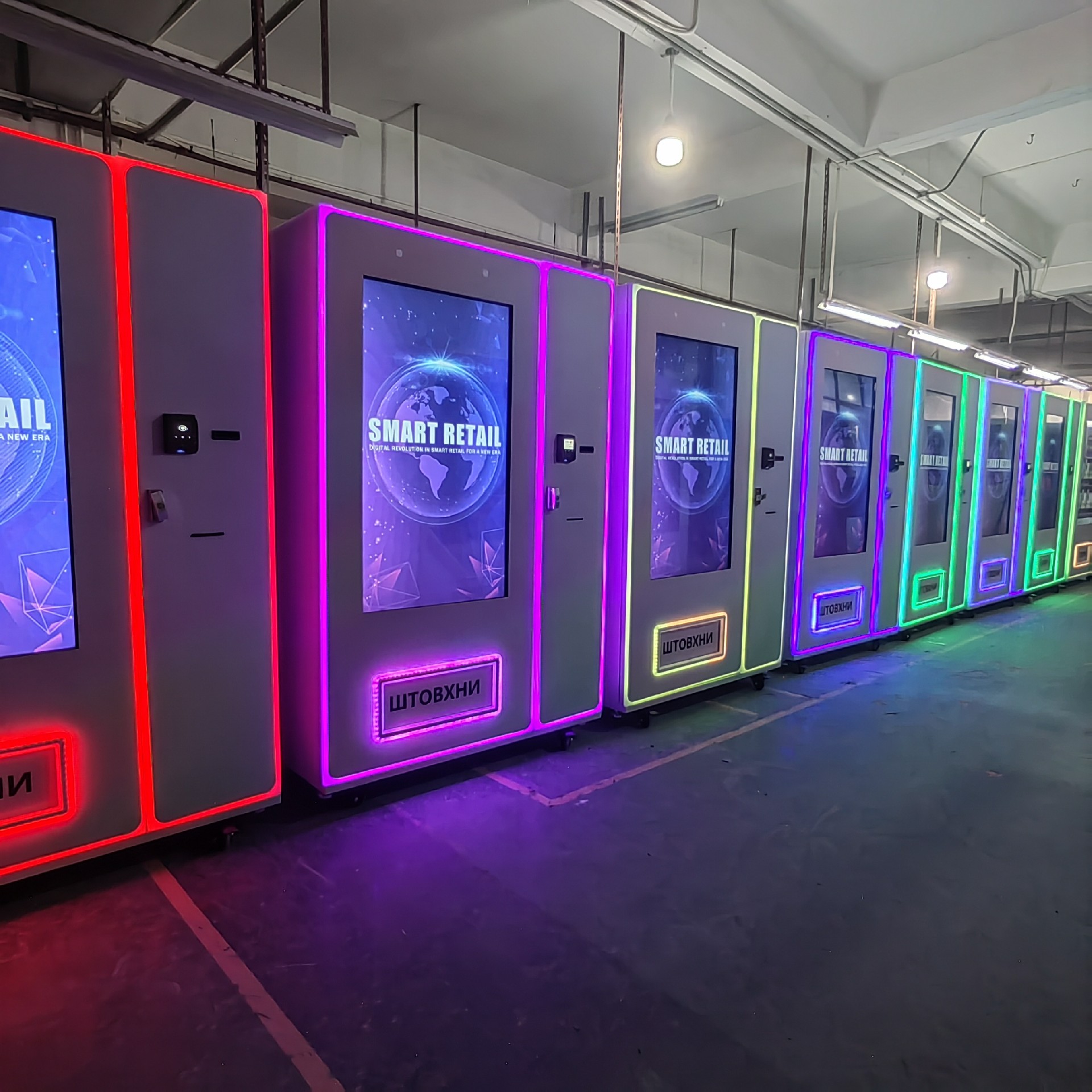
14. Final Assembly Brings the Systems Together
By the time a machine reaches assembly, many major decisions have already been made. The cabinet structure has been manufactured, the exterior finish has been prepared, and the project configuration defines which shelves, delivery components, electronics, display, payment devices, connectivity hardware, and refrigeration components are required.
Final assembly brings these systems together.
Depending on the machine, this can include installation of shelves, motors, spirals, conveyors, lift components, lockers, wiring harnesses, controllers, lighting, touchscreen equipment, payment hardware, network modules, sensors, locks, pickup mechanisms, and refrigeration assemblies.
The purpose of a controlled assembly process is consistency.
A connector that is not seated correctly, a sensor that is mounted in the wrong position, or a cable that interferes with a moving component can create a fault even when all individual components are otherwise functional.
For this reason, assembly checks are included in our OEM production and quality-control stage.
15. Sample Build and Testing Before Batch Production
For custom projects, the sample stage connects engineering decisions with a physical machine.
Our OEM process places sample build and testing before production and final quality control. The current workflow specifically identifies vend reliability, payment and connectivity validation, and user-interface review as sample-stage checks.
This stage helps confirm whether the machine behaves as expected before the configuration is repeated across a larger quantity.
A physical sample can reveal details that were difficult to predict from a drawing.
The product may need slightly different lane spacing. A package may rotate during delivery. The pickup area may need different customer instructions. Artwork may need repositioning around a door opening. A payment terminal may require a different mounting detail.
Finding these issues on a sample is the purpose of the stage.
What a Useful Sample Review Covers
- actual product fit;
- representative product delivery;
- touchscreen operation;
- configured payment functions;
- connectivity;
- pickup access;
- branding alignment;
- basic service access;
- project-specific functions.
Once required changes have been identified and approved, the updated configuration can become the reference for production.
16. Real-Product Vend Testing
One successful vend is useful, but it does not represent every operating condition inside a machine.
Product delivery can vary according to shelf position, lane width, package shape, product weight, number of units remaining in the lane, motor behavior, and the path from the shelf to the pickup area.
This is why representative testing matters.
A package in the highest shelf position may experience a different delivery path than the same package near the bottom. A full lane may behave differently from a lane containing only the final few products. Flexible packaging can respond differently from rigid cartons.
Elevator systems add another sequence that needs to work correctly: the elevator travels to the required position, receives the product, moves toward the pickup area, and completes the delivery sequence.
The most useful test is therefore based on the actual merchandise the machine is intended to sell.
When physical product samples are available during development, they give the engineering process a much stronger basis than relying only on package dimensions.
Testing is not intended to demonstrate that every early configuration is already perfect. It is intended to identify problems while they can still be corrected before repeated production.
17. Production Quality Control
Quality control is not one inspection performed after a machine has already been completed.
Our published manufacturing information currently lists more than 20 quality inspectors, and our OEM process identifies incoming inspection, assembly checks, aging tests, and final acceptance as production and QC stages.
The reason for multiple checkpoints is straightforward: different problems can originate at different points in production.
A component can arrive with the wrong specification. A fabricated part can be outside the intended dimensions. A connector can be installed incorrectly. A sensor can be misaligned. A software configuration can be wrong even though the physical assembly is correct.
| Inspection Area | Typical Focus | Purpose |
|---|---|---|
| Incoming Components | Correct part, quantity, condition, and required configuration | Prevent incorrect components from moving into assembly |
| Cabinet | Panels, doors, alignment, locks, visible finish | Check structural fit and appearance |
| Delivery System | Motors, lanes, sensors, elevator or conveyor functions | Verify product-delivery operation |
| Electrical | Connections, harnesses, powered components | Confirm integrated electrical operation |
| Touchscreen / Software | Display, touch response, configuration, product mapping | Confirm customer-facing operation |
| Payment | Configured payment-device workflow | Confirm transaction configuration |
| Connectivity | Network and remote-management functions | Confirm communication as configured |
| Temperature Control | Cooling operation where applicable | Confirm required thermal functions |
| Branding | Logo, color, decals, wrap, screen theme | Confirm the approved OEM appearance |
The exact inspection criteria depend on the machine configuration, because a basic spiral vending machine does not require exactly the same checks as a refrigerated elevator machine with customized software.
Final acceptance is therefore the end of the quality-control sequence, not the beginning of it.
18. Aging Tests and Final Acceptance
Some faults appear immediately. Others become visible only after components remain powered or cycle repeatedly for a longer period.
Our OEM production process includes aging testing before final acceptance.
The purpose is to provide an additional opportunity to identify instability that may not appear during a short functional check.
Depending on machine configuration, longer-duration operation may help reveal intermittent electrical connections, electronic instability, display issues, network reconnection problems, refrigeration cycling behavior, or other faults.
Aging tests do not replace product-fit testing. They address a different question.
Product testing asks whether the machine can sell the intended merchandise correctly. Aging testing helps determine whether the integrated machine remains stable during extended operation.
After the required production and functional checks are completed, final acceptance confirms that the finished machine corresponds to the intended configuration before packaging.
19. From Approved Sample to Batch Production
Building one customized machine successfully is only the first part of manufacturing.
The next challenge is reproducing the approved configuration.
For repeat production, important project information needs to remain controlled. This can include mechanical drawings, the bill of materials, wiring configuration, software version, shelf layout, delivery hardware, payment equipment, artwork, and inspection requirements.
Without configuration control, machines can gradually drift away from the approved sample.
A later unit might receive a different component. A software version can change. An artwork file can be updated without checking the cabinet. A shelf can be assembled differently.
Any one of these changes may appear small, but uncontrolled differences become more significant as production quantities increase.
This is why the approved sample is more than a demonstration unit. It provides a practical reference for the production configuration.
Our current public factory information lists annual production capacity of 10,000 units. At that scale, repeatability depends on organized production information rather than individual adjustment of every machine.
20. How Our OEM and ODM Process Works
OEM and ODM customization are central parts of our manufacturing program.
Customization can range from relatively light changes such as logos, colors, decals, UI language, and payment configuration to deeper modifications involving cabinet structure, product-delivery systems, shelf layouts, software functions, connectivity, and specialized machine architectures.
Our current customization options cover four main groups.
Branding and Exterior
- logo placement;
- custom colors;
- decals and vinyl wrap;
- advertising or lightbox areas;
- front UI layout;
- selected cabinet modifications.
Payments and Connectivity
- card/NFC configuration;
- QR payment configuration;
- remote management;
- telemetry and sales reporting;
- 4G/5G/Wi-Fi options depending on the project.
Product Fit and Delivery
- spiral delivery;
- conveyor delivery;
- lift/elevator delivery;
- locker or compartment systems;
- shelf layout;
- slot sizing;
- capacity configuration.
Software and User Interface
- custom interface theme;
- multi-language support;
- optional promotional functions;
- optional loyalty or coupon logic;
- selected API integration.
The objective of customization is not to redesign every component. The objective is to change the parts of the machine that are necessary to support the product, operating model, payment environment, customer experience, or brand.
When an existing platform already solves most of the engineering problem, adapting that platform can reduce development work. A deeper redesign becomes more appropriate when the product dimensions, dispensing behavior, operating environment, or business workflow cannot be supported by an existing architecture.
Our OEM program currently supports a starting MOQ of one unit for many configurations, allowing pilot and proof-of-concept projects before a larger production rollout.
The current customization process can be reviewed on our OEM custom vending machine page.
21. A Current Machine Configuration Example: ZD-L-22
The Zhongda Smart ZD-L-22 food-and-drink vending machine provides a useful example of how multiple systems come together in one commercial configuration.
The current product page lists a 22-inch screen, a published commodity reserve of 300–360 pieces, six shelf layers with ten standard cargo lanes per layer, refrigeration, 4G/Wi-Fi/LAN networking, cash and credit-card payment, remote reporting, and inventory alerts.
The same listing currently gives machine dimensions of H1990 × W1315 × L920 mm, published weight of 380 kg, equipment power of 650 W, and drop-style delivery.
| Published Specification | ZD-L-22 | Why It Affects Manufacturing |
|---|---|---|
| Screen | 22 inch | Affects door structure, mounting, electrical integration, and UI layout. |
| Cargo Lanes | 6 layers × 10 lanes | Defines the standard internal selection arrangement. |
| Published Reserve | 300–360 pieces | Actual usable capacity varies according to product dimensions. |
| Network | 4G / Wi-Fi / LAN | Requires communication hardware and software integration. |
| Payment | Cash / Credit Card | Requires physical mounting and machine/payment integration. |
| Delivery | Drop Version | The products loaded should be suitable for the intended delivery path. |
This example shows why vending machine specifications need to be read as a system.
The screen requires cabinet space and wiring. The cargo lanes define product fit. Refrigeration changes the thermal architecture and power requirements. Network connectivity adds communication hardware. Payment devices affect the door and software. All of those components still need to leave enough internal space for maintenance.
Changing one major specification can therefore affect several other parts of the machine.
22. Packaging and Shipment Preparation
Manufacturing is not complete when a machine passes its functional checks.
The finished machine still has to reach the customer without losing the condition or configuration confirmed during final acceptance.
Vending machines contain glass, screens, shelves, motors, controllers, payment devices, wiring, doors, locks, and sometimes refrigeration hardware. Transportation can expose these components to vibration, shock, tilting, and repeated handling.
Our OEM workflow therefore includes export packaging as a dedicated stage after production and quality control.
Internal parts that can move during transportation need appropriate securing. Exterior surfaces require protection. Accessories and recommended spare parts should be organized so that the receiving team can identify them.
The machine also needs to be stabilized according to the selected packaging and logistics method.
Clear documentation makes commissioning easier at the destination. The receiver should be able to identify the machine configuration, included accessories, and any transportation protection that must be removed before normal operation.
23. Spare Parts and After-Sales Planning
After-sales service begins during engineering because the way a machine is designed affects how easy it will be to maintain later.
Controllers, payment hardware, motors, sensors, power supplies, locks, displays, and refrigeration components may eventually need inspection or replacement.
A serviceable machine should therefore allow technicians to reach important components without unnecessary disassembly.
Configuration records are also useful after shipment. Knowing which components are installed in a particular machine makes it easier to identify replacement parts and troubleshoot faults.
Our OEM workflow includes spare-parts recommendations and remote support during the packaging and logistics stage.
The appropriate spare-parts package depends on the machine configuration and size of the deployment. A one-machine pilot does not require the same inventory as a large fleet.
Remote technical support can also help separate software, configuration, connectivity, and identifiable modular issues from faults that require physical service.
Customers preparing a custom project can contact our team through the Zhongda Smart contact page.
24. Manufacturing for Repeatable Scale
A pilot machine proves whether a concept can work. A manufacturing program has to prove that the same concept can be reproduced.
As an order grows, production discipline becomes increasingly important.
Mechanical drawings need to remain controlled. Approved components need to be known. Software versions need to be traceable. Payment hardware needs to remain consistent. Branding files need to correspond to the correct machine. Inspection requirements need to follow the intended configuration.
This is especially important for branded vending fleets.
Customers expect the next machine to look and behave like the previous machine unless a controlled update has been approved.
Production scale also changes the importance of spare parts. A component substitution that has little impact on one prototype can create inventory and service complications when it is introduced across a much larger fleet.
Our published annual production capacity of 10,000 units provides the manufacturing framework for projects that may begin with a pilot and later expand.
The sample stage, production documentation, assembly checks, quality control, aging tests, and final acceptance all contribute to the same goal: making a successful configuration repeatable.
25. What We Control Before a Vending Machine Leaves Our Factory
The final machine represents several earlier decisions: the product fit, cabinet, dispensing method, software, payment configuration, network connection, refrigeration where required, branding, and accessories.
Before shipment, those elements need to correspond to the approved project configuration.
The exact acceptance checklist varies according to the machine, but the final review should address the functions that are actually included in the order.
- machine model and customer configuration;
- cabinet condition and approved appearance;
- doors, locks, and pickup area;
- shelves and cargo-lane configuration;
- representative dispensing functions;
- touchscreen and software configuration;
- configured payment functions;
- network functions where included;
- refrigeration or temperature-control functions where included;
- branding and customer-specific graphics;
- included accessories and recommended spare parts;
- packaging preparation.
This final stage is not intended to replace earlier production checks. It confirms that the finished unit moving into packaging is the machine that the project specification calls for.
Why Vending Machine Manufacturing Is Becoming More Flexible
Vending equipment is no longer limited to conventional snacks and bottled drinks.
The broader unattended retail market increasingly combines vending machines, smart retail technologies, remote management, cashless payments, and specialized product handling.
Recent NAMA Foundation data provides useful context. Its 2024–25 State of Convenience Services census estimates industry revenue at approximately $31.1 billion in 2025, up from $26.6 billion in 2023, representing average annual growth of 8.1% over that period.
The same report states that vending remains the largest business line in the industry while operators increasingly use multiple unattended retail formats. It also notes that the distinctions between traditional vending, smart coolers, and micro markets are becoming less rigid.
For manufacturing, that evolution matters because the machine may now need to sell products that do not behave like traditional vending merchandise.
A beauty product may require a different lane width. A premium collectible may need gentler handling. A book or jersey may be better suited to a locker. Refrigerated fresh products add temperature-control requirements. A branded retail concept may require customized software and cabinet graphics.
The most useful manufacturing platform is therefore not necessarily the one with the largest number of fixed models. It is the one that can match the right architecture to the product while keeping the finished machine practical to produce, operate, and service.
Manufacturing Decisions Continue to Matter After Installation
The purchase price of a vending machine is visible immediately. Many other costs appear gradually during operation.
Product-delivery reliability can affect lost sales. Refrigeration efficiency can affect electricity use. Service access affects technician time. Component consistency affects spare-parts planning. Connectivity can influence how often operators need to visit machines simply to check their status.
For this reason, vending machine manufacturing is not only about producing a machine that works when it leaves the factory.
The design should also support practical operation after installation.
A machine with a very high theoretical capacity provides little benefit if the resulting product layout creates repeated dispensing problems. A sophisticated remote-management system cannot compensate for poor mechanical delivery. A low-cost component can become expensive if replacement is frequent or difficult.
The most useful configuration is one where mechanical design, dispensing, electrical systems, software, payment, refrigeration, and service requirements support one another.
How We Manufacture Vending Machines at Zhongda Smart: The Complete Flow
The entire process can be summarized from the product outward.
| Stage | Primary Question | Result |
|---|---|---|
| 1. Product Definition | What will the machine sell? | Product dimensions, weight, storage, and handling requirements. |
| 2. Specification | What does the complete machine need? | Defined hardware, software, payment, temperature, capacity, and branding. |
| 3. Engineering | How should the systems fit together? | Mechanical architecture and manufacturable design. |
| 4. Cabinet Production | How is the physical structure produced? | Manufactured and finished cabinet components. |
| 5. Assembly | How are all systems integrated? | Complete mechanical, electrical, software, and payment configuration. |
| 6. Sample Testing | Does the physical machine meet the specification? | Validated sample and any required engineering corrections. |
| 7. Production & QC | Can the approved configuration be reproduced? | Controlled production with incoming, assembly, aging, and acceptance checks. |
| 8. Packaging | How do we protect the finished machine for delivery? | Export-ready machine, accessories, recommended spares, and logistics preparation. |
This sequence is what turns a vending machine from a collection of components into a repeatable commercial product.
Final Takeaway
At Zhongda Smart, our approach to vending machine manufacturing starts with a simple idea: the machine has to be built around what it is expected to sell and how it is expected to operate.
That means understanding the merchandise before selecting the dispensing mechanism, confirming the complete specification before mass production, engineering the cabinet around the actual internal systems, testing a physical sample before repeating the design, and using production quality-control stages before final acceptance and shipment.
A successful vending machine is not defined by one component.
A large touchscreen cannot compensate for unreliable delivery. A powerful refrigeration system cannot correct blocked airflow. Remote inventory data cannot solve a physical product jam. Attractive branding cannot make an unsuitable cargo lane reliable.
The finished result depends on how well the cabinet, delivery system, electronics, software, payment hardware, connectivity, refrigeration, testing, and service requirements work together.
For a new custom project, the most useful information to provide our team includes:
- clear photographs of the products;
- accurate package width, height, depth, and weight;
- required product quantity and assortment;
- temperature-control requirements;
- preferred payment methods;
- required connectivity;
- software and interface requirements;
- branding requirements;
- estimated order quantity.
Those details allow us to evaluate the machine as an engineering system instead of trying to select a platform from appearance alone.
That is the core of how we manufacture vending machines at Zhongda Smart: product requirements first, coordinated engineering next, controlled production after approval, and testing before shipment.
Frequently Asked Questions
How does Zhongda Smart manufacture vending machines?
Our process begins with requirements and specification confirmation. The project then moves through engineering, cabinet and component manufacturing, surface finishing, assembly, software and payment integration, sample build and testing, production quality control, aging tests, final acceptance, and packaging. The exact process depends on the machine configuration.
What information should we receive for a custom vending machine project?
The most useful starting information includes product photographs, package dimensions, weight, required capacity, storage temperature, preferred payment methods, connectivity requirements, software functions, branding requirements, and estimated order quantity. Physical product samples are particularly useful for dispensing validation.
What delivery systems can Zhongda Smart customize?
Our current OEM program lists spiral, conveyor, lift or elevator, and locker or compartment delivery options. The appropriate system depends on product size, packaging, weight, fragility, storage requirements, and the intended customer collection method.
Can we produce a one-unit custom vending machine sample?
Our current OEM program lists a starting MOQ of one unit for many projects. This can be used for pilot, proof-of-concept, and small-batch validation. Exact availability, engineering requirements, price, and production timeline depend on the selected configuration.
Can Zhongda Smart customize the vending machine software?
Our current OEM options include custom UI themes, multilingual interfaces, promotional functions, optional loyalty or coupon logic, remote management, and selected API integration. The available functions depend on the machine platform and project scope.
Can payment systems be customized?
Our current OEM options include card/NFC and QR-payment configurations. Individual terminals and payment arrangements need to be confirmed according to the required hardware, processor, market, and project configuration.
How do we test a custom vending machine before production?
Our published sample stage includes vend reliability, payment and connectivity validation, and user-interface review. For product-specific projects, actual merchandise is highly useful because it allows the delivery configuration to be evaluated with the packages the machine will really sell.
What quality-control stages are included in the OEM process?
Our current OEM process lists incoming inspection, assembly checks, aging testing, and final acceptance as part of production and quality control. Additional checks depend on the specific machine configuration.
How large is the Zhongda Smart manufacturing operation?
Our current public factory information lists 20,000 m² of working space, more than 400 employees, an engineering team of 10+ people, three assembly lines, more than 20 quality inspectors, four sheet-metal processing workshops, a painting line, and annual production capacity of 10,000 units.
What products can Zhongda Smart vending machines sell?
Our current machine range supports conventional food and beverages as well as specialized retail categories such as beauty products, trading cards and collectibles, books, apparel, and other packaged merchandise. The appropriate machine depends on product dimensions, handling requirements, temperature, and delivery method.
Technical and Industry References
Company-specific factory figures, OEM options, product configurations, manufacturing workflow, and images in this article are based on current Zhongda Smart website materials. General industry, refrigeration-efficiency, payment, and wireless-device context is supported by the following independent sources.
- NAMA Foundation — State of Convenience Services: industry scale and unattended retail development. View Source
- U.S. Department of Energy — Refrigerated Beverage Vending Machine Guidance: energy-efficiency comparison data for refrigerated beverage vending equipment. View Source
- EMVCo — EMV Contactless Technology: technical specifications and approval framework for contactless payment technology. View Source
- Federal Communications Commission — RF Equipment Authorization: regulatory background for intentional radio-frequency devices. View Source