The best vending machines for warehouses and manufacturing plants are the ones that stay available through long shifts, move products quickly during short breaks, and do not create extra work for the people responsible for stocking and maintenance. For employee refreshments, a refrigerated snack-and-drink combo machine is usually the strongest all-around choice. For PPE, tools, maintenance supplies, and controlled consumables, an industrial vending machine is the better fit. Beverage machines, elevator systems, lockers, and compact self-service kiosks make sense when the product mix or work area demands something more specific. For this comparison, I’m prioritizing practical capacity, dispensing reliability, service access, remote management, product compatibility, and operating cost rather than screen size or cosmetic features alone.
Quick Recommendations: Which Machine Fits Which Job?
A large workplace can easily have three different vending needs under the same roof. Employees may want drinks and snacks during breaks. Maintenance teams may need quick access to gloves, batteries, cutters, abrasives, or small parts. A food program may need chilled meals that should not fall through a long drop path. Treating all three applications as the same purchase is where many projects start to go wrong.
| Machine Type | Best Fit | Main Strength | Main Trade-Off |
|---|---|---|---|
| Refrigerated snack & drink combo | Employee break areas | Broad product mix in one footprint | Less drink capacity than a dedicated beverage machine |
| Dedicated beverage vending machine | High-volume cold drink demand | Deep capacity for bottles and cans | Limited product variety |
| Industrial vending machine | PPE, MRO items, tools, consumables | Access control and inventory accountability | Requires a clearly defined issue process |
| Elevator vending machine | Meals, boxed items, fragile products | Controlled delivery with less product drop | More mechanical complexity |
| Smart locker | Large, irregular, or assigned items | Excellent compartment-level control | Lower item density for small products |
| Compact smart vending machine | Satellite work areas and pilot programs | Small footprint and easy placement | Lower capacity and more frequent refill risk |
One useful real-world reference is the Zhongda Smart ZD-L-22 snack and drink vending machine. Its current published configuration lists a 22-inch display, 60 standard cargo lanes, capacity of roughly 300 to 360 items, refrigeration, remote inventory reporting, and 4G, Wi-Fi, or LAN connectivity. Those numbers are useful because they show what a full-size combo platform can hold before product dimensions and lane allocation start changing the actual capacity.

Why Warehouses and Manufacturing Plants Need Different Vending Machines
A warehouse break room is not just an office break room with more floor space. The usage pattern is different. Demand often arrives in waves because employees share scheduled breaks or shift changes. A machine might be almost idle for forty minutes and then serve dozens of people in a short window. That puts more pressure on transaction speed, pickup flow, payment reliability, and the capacity of the best-selling lanes.
Long operating hours change the calculation as well. A machine serving several shifts may be used when no cafeteria, storeroom attendant, or onsite support person is available. A low-stock condition at the wrong time can leave an entire shift without the products they actually use. Remote stock reporting becomes much more valuable in that situation than it appears on a brochure.
The physical environment is another factor. Dust, vibration, loading activity, carts, pallet equipment, heat sources, and frequent cleaning can all affect machine reliability. Even when the vending area itself is clean, the path used for installation and restocking may not be. Cabinet construction, door alignment, locks, wheels or leveling feet, air intake, and service clearances deserve more attention than decorative trim.
Then there is the distance problem. In a large facility, a vending machine may be technically “onsite” and still be too far from the people expected to use it. Five minutes spent walking to a central break room can be a meaningful part of a short break. The same issue is even more important with industrial supplies. Moving a pair of safety glasses or a small cutting tool closer to the point of use can be more valuable than increasing the central storeroom inventory.
For that reason, I see workplace vending as a placement-and-workflow problem first and an equipment problem second. The machine still matters, but a well-chosen cabinet in a poor location can lose to a simpler machine placed where employees already move.
Five requirements carry more weight in industrial workplaces
- Peak throughput: Can the machine process several users quickly during break changes?
- Useful capacity: Does it hold enough of the fast-moving items, not just a high theoretical unit count?
- Service access: Can technicians reach the controller, payment equipment, refrigeration system, motors, sensors, and wiring without dismantling the cabinet?
- Remote visibility: Can operators see stock, transactions, alarms, and machine status without physically checking every location?
- Product compatibility: Does the dispensing method actually suit the product package, weight, fragility, and storage requirement?
These priorities also explain why the biggest screen is rarely the most important feature. A large display can improve product selection and branding, but it does not compensate for unreliable dispensing, weak refrigeration, awkward service access, or a poor lane configuration.
Best Vending Machine Types for Warehouses & Manufacturing Plants
1. Refrigerated Snack and Drink Combo Machines: Best All-Around Choice
A refrigerated combo machine is the format I’d rank first for a typical employee break area. It handles bottled water, canned drinks, energy drinks, chips, candy, cookies, protein snacks, and other compatible packaged products without requiring separate snack and beverage cabinets.
The real advantage is not simply variety. It is the ability to change the assortment after the machine is installed. One shift may consume more cold beverages. Another may prefer packaged snacks. A configurable shelf and cargo-lane system gives the operator room to react to actual sales instead of being locked into the original plan.
That flexibility matters because package sizes change. A product that fits perfectly in one spiral today may arrive in a wider bag or taller bottle after a packaging redesign. Adjustable lanes and replaceable spirals can extend the useful life of the machine by allowing the internal layout to change without replacing the cabinet.
For a busy workplace, the machine should also be simple to reload. Deep capacity is useful only when the refill process remains organized. Shelves that pull forward, clearly labeled lanes, accessible wiring, and a clean product map save labor every time the door opens.
A cashless vending machine configuration is generally easier to operate than a machine built around cash alone. Cards and contactless payments reduce coin handling and remove some mechanical payment components. Cash can still be useful where employees expect it, but it should be included because the workforce needs it, not because the machine has always been ordered that way.
2. Dedicated Beverage Machines: Best When Drinks Dominate Demand
Combo machines are flexible, but flexibility has a cost: shelf space is shared by several product categories. When cold beverages make up most transactions, a dedicated beverage vending machine can hold more bottles and cans while keeping the internal layout simpler.
This is particularly useful when several employees reach the machine during the same break. A deep beverage inventory reduces the chance that the most popular drink sells out halfway through a shift. It can also free the neighboring snack machine to carry more food instead of sacrificing half of its lanes to water and soft drinks.
Do not size beverage capacity from total headcount alone. Work intensity, ambient temperature, shift structure, break timing, and access to other drinks all affect demand. A smaller workforce doing active work can create more beverage volume than a much larger group that has several other refreshment options nearby.
3. Industrial Vending Machines: Best for PPE, Tools, and MRO Supplies
An industrial vending machine has a different purpose. Its job is to keep frequently used supplies available while recording what leaves the cabinet. A conventional retail payment can be unnecessary. Employees may identify themselves with a badge, code, account, or other approved credential, then receive the item under rules set by the facility.
Common products include gloves, safety glasses, hearing protection, batteries, tape, markers, cutting tools, abrasives, blades, packaged fasteners, repair consumables, and other maintenance items. The benefit is not limited to reducing excessive use. Fast access matters too. Waiting for a storeroom to open or walking across a large building for a low-cost item can cost more in lost time than the item itself.
The strongest industrial vending programs start with an issue policy rather than a machine. Decide which products are unrestricted, which require employee identification, whether quantity limits apply, which department owns replenishment, and what should happen when a critical SKU reaches minimum inventory. Once those rules are clear, the hardware can support the process instead of defining it.
For smaller packaged consumables, spiral, pusher, or adjustable-lane systems can work well. Larger tools, kits, or irregular packages often belong in lockers. Higher-value inventory may justify user-level records, department coding, or approval logic.
Zhongda Smart’s published industrial vending machine solution describes this type of unattended inventory workflow with adjustable product handling, remote monitoring, user control, and mixed workplace supplies.
4. Elevator Vending Machines: Best for Fragile or Premium Products
Traditional spiral vending relies on the product leaving the shelf and dropping into a pickup area. That works well for many snacks and bottled products, but it is not the right delivery method for everything.
Boxed meals, desserts, some electronics, delicate packages, and premium products can benefit from an elevator system. The elevator moves to the selected shelf, receives the product, and carries it toward the pickup point with less uncontrolled drop distance.
The trade-off is additional mechanical complexity. Motors, rails, sensors, and control logic create more service points than a basic drop-vend machine. I’d choose an elevator because the product needs controlled delivery, not because the mechanism looks more advanced.
5. Smart Lockers: Best for Large or Assigned Items
Some products should not be pushed, dropped, or moved through a narrow delivery channel at all. Smart lockers solve that problem by opening a compartment rather than transporting the item.
Lockers are useful for repair kits, larger tools, individually prepared orders, boxed PPE, electronic equipment, or products assigned to a specific employee. They can also sit beside a conventional industrial vending machine: small, high-frequency consumables go through the vending cabinet while larger items remain in controlled compartments.
6. Compact Vending Machines: Best for Satellite Locations
A compact smart vending machine can make sense in a maintenance office, smaller break room, security area, dispatch area, or remote department where walking back to the main vending bank wastes time.
The limitation is capacity. Small cabinets can create more refill work if they are placed in a location with unexpectedly high demand. For that reason, compact units are especially useful as satellite machines or pilot systems rather than automatic replacements for a full-size cabinet.
A practical rule: choose the dispensing system around the product. A spiral machine is not automatically cheaper if it creates failed vends, damaged packages, or repeated service calls. The correct machine is the one that moves the intended product reliably with the fewest unnecessary mechanisms.
Have the Products, but Not the Machine Specification?
Start with product dimensions, package type, required capacity, cooling needs, and payment or employee-access requirements. That information is enough to narrow the project down to a practical machine architecture.
Use the Purchase Specification ChecklistVending Machine vs. Micro Market vs. Smart Locker
A vending machine is not automatically the right answer just because employees need food or supplies. Micro markets, vending machines, lockers, and open stock points solve different problems. The best choice depends on product security, assortment size, available space, staffing, and the amount of control the facility needs.
| Requirement | Vending Machine | Micro Market | Smart Locker |
|---|---|---|---|
| Product security | High | Moderate | Very high |
| Small footprint | Excellent | Limited | Moderate |
| Large product variety | Moderate to high | Very high | Moderate |
| Fragile product handling | Good with the right delivery system | Excellent | Excellent |
| 24/7 unattended access | Excellent | Excellent | Excellent |
| PPE and tool control | Excellent with industrial configuration | Poor | Excellent |
| Shrink control | High | Lower | Very high |
| Installation complexity | Low to moderate | Higher | Moderate |
A micro market works well when employees need a much broader food assortment and have enough space to browse shelves and coolers. It can create a more open shopping experience, but the facility must accept a different security model. Products are accessible before payment, so shrink control depends more heavily on cameras, access control, and workplace behavior.
A vending machine keeps inventory physically controlled until the transaction is accepted. That makes it attractive when floor space is limited, product security matters, or the operation does not want an open retail area.
Smart lockers sit at the other end of the spectrum. They offer excellent item control but are not space-efficient for hundreds of small snacks or drinks. For industrial supply programs, a mixed setup is often stronger than either technology alone.
When a Vending Machine Is Not the Best Choice
A credible equipment decision includes situations where buying a machine does not make sense. Not every workplace needs one, and not every product should be put through an automated cabinet.
Low daily traffic can make a large machine unnecessary
A full-size refrigerated vending machine has fixed operating costs even when sales are slow. If only a small number of people pass the location each day, a large refrigerated cabinet may create stale inventory, wasted energy, and unnecessary maintenance. A compact machine, pantry, or managed refreshment arrangement may be more sensible.
A micro market may be better for broad fresh-food programs
If employees need to compare several meal sizes, inspect labels closely, or choose from many refrigerated products, an open cooler and self-checkout format may provide a better shopping experience. Vending is strongest when the product range can be organized into a controlled set of repeatable SKUs.
Open supply storage can still be appropriate for low-risk items
If inexpensive supplies are already well controlled and misuse is negligible, installing an industrial vending system may add complexity without creating enough value. Automation makes more sense when access delays, stockouts, accountability, or inventory visibility are real problems.
Very large or irregular products may not belong in a vending cabinet
Trying to force a bulky kit into a spiral lane usually produces a bad machine and a bad user experience. A locker or controlled pickup station is often the cleaner answer.
In my view, this is one of the simplest tests of a vending project: if the business case still looks good after considering the cheaper alternatives, the machine is probably solving a real problem rather than creating a technology project for its own sake.
Placement and Capacity Planning
The location of a machine affects both usage and service cost. A good location follows an existing employee path without interfering with production traffic, emergency access, material movement, or cleaning.
Break rooms, locker areas, employee entrances, transition points between work zones, and designated refreshment spaces are common choices. Industrial supply machines should be positioned according to where items are consumed rather than where there happens to be an empty wall.
Walking distance changes adoption
People on a short break are sensitive to distance. A machine can have the right products and still be underused if reaching it takes too long. Large buildings often benefit from one primary vending area plus smaller satellite machines instead of one central bank expected to serve everyone.
The same logic is stronger for PPE and tools. An item that saves two minutes of walking may look trivial until that delay is multiplied across many employees, many shifts, and many working days.
Check the service envelope, not just the cabinet dimensions
A machine that fits into a 55-inch opening may still be impossible to service if its main door needs substantially more room to swing open. Measure the installation space with the door open, shelves extended, and technician access considered.
Refrigerated equipment also needs the airflow specified by the manufacturer. Blocking an intake or pushing the cabinet tightly against a surface can raise thermal stress and increase compressor run time.
Calculate useful capacity instead of brochure capacity
Published capacity is normally based on a particular loading arrangement. The real number changes with bottle diameter, package width, product depth, lane configuration, and the number of duplicate facings assigned to fast sellers.
A simple planning formula is:
Required stocked units = employees × expected participation × average items per participating employee × days between refills × inventory buffer.
Consider a 300-person facility. If 35% of employees use the machine on a typical day, participating employees average 1.2 items, and replenishment is planned every three days:
300 × 0.35 × 1.2 × 3 = 378 units.
Adding a 20% buffer takes the target to roughly 454 units.
That does not automatically mean a single 454-unit machine is required. Two machines may give better product separation, shorter lines, easier replenishment, and some redundancy if one cabinet needs service.
Peak demand can matter more than daily demand
A machine may have enough total stock and still perform poorly when sixty people arrive at once. Transaction steps, payment response, product delivery time, and the width of the pickup flow determine how quickly the line moves.
When break periods are tightly concentrated, two straightforward machines can be more useful than one heavily customized cabinet with greater theoretical capacity.
Give fast sellers more than one lane
Variety is useful, but every lane does not need a different SKU. If bottled water, a particular energy drink, or a common snack repeatedly sells out, give it additional facings. A slower item should not occupy valuable lane space simply to make the assortment look larger.

Cashless Payment, Employee Access, and Transaction Control
For general employee refreshments, cashless payment is usually the cleanest starting point. Card and contactless payment reduce coin handling, simplify reconciliation, and remove some mechanical components from the payment path.
Cash can still be appropriate when employees rely on it. The point is to choose payment hardware from actual usage rather than treating every possible payment option as mandatory.
Employee programs do not always need retail payment
A workplace may want to subsidize products, provide a daily allowance, issue specific items at no charge, or limit access to selected employees. In those cases, the machine can work more like a controlled self-service kiosk than a conventional retail terminal.
Membership cards, employee IDs, pickup codes, stored-value accounts, or another approved authentication method can be tied to vending logic. The important part is defining the transaction model before production. Adding a credential reader after the cabinet and front panel are finalized can create unnecessary mechanical and software rework.
Industrial vending needs identity more than payment
For PPE and MRO supplies, the useful transaction record is often “who took what and when,” not “who paid.” That makes authentication, item permissions, quantity limits, and inventory reporting more valuable than a coin acceptor.
The software should also distinguish internal product issues from retail sales when the facility needs different accounting. A maintenance consumable used on a work order should not have to behave like a candy bar just because both products leave an automated cabinet.
Plan for network interruptions
A connected smart vending machine depends on communications for some combination of payment, telemetry, inventory reporting, and remote management. Ask what happens when the network drops. Does the machine continue to accept approved transactions? Does it queue data? Does it stop sales? The answer should be understood before deployment.
Refrigeration, Food Safety, and Hydration Planning
Refrigerated vending needs a different level of attention when the machine carries meals or other temperature-sensitive food. Cooling capacity, airflow, temperature sensing, refill time, and fault handling become part of the operating process rather than simple equipment features.
Fresh food needs fail-safe behavior
The FDA Food Code provides a useful technical reference for vending equipment handling time- and temperature-controlled food. Section 4-204.111 describes automatic control that prevents vending when a power failure, mechanical failure, or another condition causes the machine to lose required temperature control. It also describes a condition in which refrigerated vending-machine air temperature may not exceed 41°F for more than 30 minutes immediately after filling, servicing, or restocking when the shutoff provision is involved.[4]
That does not mean one paragraph from the Food Code is a complete compliance plan. The actual food program, equipment, storage process, cleaning procedure, and applicable requirements all need to be reviewed before fresh-food vending is launched.
Restocking changes cabinet temperature
Opening a refrigerated machine introduces warm air. A refill that takes ten minutes has a different effect from a quick top-up. The shelf layout should let the operator work efficiently without blocking air passages or leaving the door open longer than necessary.
For sensitive products, remote temperature alarms are more useful than relying on someone to discover a problem during the next refill. Sensors also need to be located and maintained according to the machine design.
A beverage machine does not replace a workplace hydration program
Cold drink vending can improve convenience, but it should never be treated as the only source of required hydration in a hot work environment.
NIOSH currently recommends that workers performing moderate activity in heat for less than two hours drink about one cup, or 8 ounces, of water every 15 to 20 minutes. Its guidance also recommends electrolyte-containing beverages during prolonged sweating and notes that fluid intake generally should not exceed six cups per hour.[1]
OSHA similarly advises employers to provide cool water that is familiar, easy to access, and near the work. For work lasting two hours or more, it recommends access to additional fluids containing electrolytes.[2]
A beverage vending machine can supplement that environment, but required water, rest, and heat-safety measures belong in the workplace safety program.
Energy use deserves a lifecycle view
Refrigeration operates every day, so efficiency differences accumulate. Department of Energy purchasing guidance compares 30-cubic-foot Class A refrigerated beverage vending machines and lists estimated annual energy use of 1,179 kWh for a best-available example, 1,354 kWh for an ENERGY STAR example, and 1,456 kWh for a less-efficient example. The same comparison calculates lifetime energy-cost savings of up to $264 for the best-available model compared with the less-efficient example.[3]
Those figures are reference examples, not a prediction for every cabinet. Machine size, ambient conditions, insulation, refrigeration design, loading pattern, and temperature settings affect actual consumption. The useful lesson is that purchase price is only one part of the cost of equipment that may remain powered for years.
Maintenance, Serviceability, and Vending Machine Repair
One of the easiest ways to spot a machine designed mainly for a showroom is to open the service side. Attractive front panels are simple. Clean wiring, labeled connectors, reachable components, replaceable modules, and sensible refrigeration access require more engineering discipline.
For a busy workplace, serviceability should be part of the buying decision. Every additional hour spent diagnosing a minor component can cost more than the part itself.
What good service access looks like
The controller, payment hardware, power supply, network equipment, motors, sensors, and common wiring connections should be reachable without dismantling major structural parts. Cables should be organized so a technician can identify connections instead of tracing a bundle through the cabinet.
Common wear components should have part numbers or clear identification. If a machine fleet is going to grow, keeping the same motor, power supply, controller family, or lock across several models can simplify spare-parts inventory.
A practical maintenance schedule
| Interval | What to Check | Why It Matters |
|---|---|---|
| Every refill | Pickup area, lane alignment, visible damage, payment terminal, product dates | Catches obvious problems before they become service calls |
| Weekly | Door seals, temperature display, air intake, dust accumulation | Protects refrigeration performance and cleanliness |
| Monthly | Motors, sensors, shelf connectors, wiring plugs, locks | Helps identify intermittent dispensing faults |
| Quarterly | Refrigeration airflow, cabinet fasteners, leveling, hinge alignment | Useful in high-use or vibration-prone installations |
| As required | Software, payment firmware, telemetry, network settings | Maintains transaction and remote-reporting reliability |
This is a planning framework rather than a universal service interval. A vending machine beside a dusty production area may need air-intake cleaning far more often than one in a clean break room.
Remote diagnostics change the repair workflow
A connected machine can provide useful information before a technician arrives. A temperature alarm, communication fault, motor error, or empty-lane report narrows the problem and makes it easier to bring the correct part.
Remote data does not eliminate vending machine repair, but it reduces blind troubleshooting. For a fleet spread across a large facility, that difference becomes meaningful.
Order critical spares with the first fleet
Waiting for a low-cost motor or sensor can be more expensive than holding a few sensible spare parts. For multiple machines, I’d ask the manufacturer to identify the components most likely to be replaced in normal service and build a small parts kit around them.
The service question I care about most is simple: if a machine stops vending tomorrow, can the technician identify the fault, access the component, and get the correct replacement without turning the repair into a research project?
Cost, Revenue, and ROI
There is no single useful price for vending machines for warehouses and manufacturing plants because the specification can change dramatically. A basic compact unit and a refrigerated elevator machine with custom software are different engineering projects even though both are called vending machines.
The better way to compare cost is to separate the base cabinet from the features that move the quotation.
| Cost Driver | Why It Changes the Project |
|---|---|
| Cabinet size and capacity | More material, shelving, wiring, and freight volume |
| Refrigeration | Adds compressor, airflow components, controls, insulation, and energy use |
| Elevator delivery | Adds motors, rails, sensors, and control logic |
| Payment hardware | Card, cash, QR, or other modules have different hardware and integration needs |
| Employee authentication | Can require credential hardware and custom transaction logic |
| Touchscreen size | Affects display hardware, front-panel design, and interface work |
| Telemetry and remote management | Adds connectivity, software, and ongoing platform requirements |
| Custom cabinet or product lanes | May require engineering, prototyping, and new metalwork |
| Branding | Simple decals cost less than custom panels, lighting, or structural changes |
| Freight and installation | Large refrigerated machines are heavy and require careful site planning |
Use published product prices as reference points, not universal market prices
Zhongda Smart’s current public product listings show how widely configurations can vary. Compact machines can be listed around the low four-figure range, while refrigerated combo and elevator configurations can move into several thousand dollars depending on hardware. Those figures are useful for early budgeting, but they should not be treated as a final project price. Payment modules, cooling, customization, software, freight, quantity, and installation requirements can change the quotation.
For a serious purchase, compare written specifications line by line. A $2,000 cabinet without the required payment terminal or remote management is not cheaper than a $2,500 configuration that already includes the functions the project needs.
Can a workplace vending machine make money?
Yes, but employee count alone does not make a machine profitable. The variables that matter are actual participation, transactions per user, selling price, product cost, payment expense, refill labor, shrinkage, energy, and uptime.
A simple planning model is:
Monthly operating contribution = monthly sales − product cost − payment expense − replenishment cost − machine operating expense.
Consider an illustrative 220-person workplace. Assume 30% of employees make a purchase on a typical day, each participating employee averages 1.2 items, the average selling price is $2.75, and the program operates 26 days per month.
220 × 0.30 × 1.2 × 26 = approximately 2,059 items per month.
At an average selling price of $2.75:
2,059 × $2.75 = approximately $5,662 in monthly sales.
If the gross margin after product cost were an illustrative 30%, the resulting gross contribution would be about $1,699 before payment fees, service, electricity, replenishment labor, and other operating costs.
This is not a forecast. A small change in participation or margin can move the result substantially. I’d build conservative, expected, and strong-volume scenarios before using any payback number to approve the investment.
Industrial vending has a different ROI equation
An industrial vending machine may never collect a dollar from an employee. Its return can come from reduced walking, fewer manual issue transactions, better inventory visibility, and fewer emergency stockouts.
Imagine that 120 employees each avoid just two minutes of walking or waiting per working day because common supplies are available closer to the work area.
120 × 2 minutes × 22 working days = 5,280 minutes, or 88 hours.
At an illustrative labor value of $25 per hour, that represents $2,200 in theoretical time value per month.
I would not describe that entire amount as guaranteed cash savings. Recovered minutes do not automatically reduce payroll. The calculation is useful because it shows how a tiny delay becomes significant when it is repeated hundreds of times.
Do not ignore stockout cost
The most expensive missing item is not necessarily the most expensive item to buy. A low-cost cutting tool can create disproportionate disruption if production stops while someone searches for it. Industrial vending can reduce that risk by keeping high-frequency supplies visible and closer to the point of use.
What I Would Put on the Purchase Specification
A good vending-machine quotation begins with useful product information. “We need a snack machine” is not enough to build a reliable configuration. The more specific the inputs, the easier it is to compare manufacturers on the same basis.
| Specification Item | Information to Provide |
|---|---|
| Products | Product names, package type, width, height, depth, and weight |
| Storage | Ambient, refrigerated, frozen, or mixed requirement |
| SKU count | Number of different products to be carried |
| Capacity | Target stock quantity and refill interval |
| Dispensing | Spiral, pusher, conveyor, elevator, locker, or manufacturer recommendation |
| Payment | Cash, card, contactless, account, pickup code, or no retail payment |
| Authentication | Employee ID, membership card, PIN, code, or unrestricted access |
| Connectivity | Wi-Fi, cellular, Ethernet, or a combination |
| Remote management | Inventory, transaction reporting, alarms, pricing, or remote configuration |
| Screen | Required display size and interface functions |
| Branding | Logo, cabinet graphics, colors, lighting, interface theme |
| Installation | Available footprint, door clearance, electrical supply, ventilation, access route |
| Service | Spare-parts list, warranty, remote support, technical documentation |
| Quantity | Pilot quantity and expected scale after approval |
Product samples are especially valuable for unusual packaging. Dimensions cannot show how a flexible pouch twists, whether a glossy carton slides too easily, or whether the center of gravity causes a package to rotate during delivery.
If the product is important to the project, I’d want repeated vend testing with the real package before approving a production run.
How to Evaluate a Vending Machine Manufacturer
A vending machine is a cabinet only in the same sense that a vehicle is a body shell. The cabinet has to work with product delivery, electrical design, refrigeration, payment equipment, software, sensors, connectivity, locks, user interface, and field service.
That is why manufacturer selection becomes more important as customization increases.
Start with the product, not the exterior design
A capable manufacturer should ask what the machine needs to sell before discussing decorative features. Product dimensions, package material, fragility, storage temperature, weight, and expected throughput determine the internal architecture.
If the conversation begins and ends with screen size and cabinet color, important engineering questions are being skipped.
Ask how the sample becomes repeatable production
One working prototype does not prove that fifty machines will be identical. The manufacturer should be able to explain incoming inspection, assembly checks, software configuration, aging tests, product testing, final acceptance, and how the approved sample is translated into batch production.
Zhongda Smart publishes a detailed look at this process in its guide to how vending machines are manufactured. The sequence starts with the product and specification, then moves through mechanical design, sheet-metal production, surface finishing, assembly, software and payment integration, sample testing, quality control, aging tests, and final acceptance.
Questions worth asking before an order
- Has the actual product been tested in this dispensing system?
- Which shelf or lane dimensions are adjustable?
- What happens if package dimensions change later?
- Which payment hardware has already been integrated?
- What data does the remote management system provide?
- How are refrigeration alarms handled?
- Can the user interface be customized without changing the main controller?
- Which parts should be held locally for routine service?
- How is the sample approved before repeat production?
- What tests are completed before shipment?
- What information is available to technicians during troubleshooting?
- How are warranty claims and replacement parts handled?
Do not pay for customization you do not need
OEM work is valuable when it solves a real requirement. A different delivery method, custom product lane, special cooling requirement, employee login, branding, or software workflow can justify engineering effort. Moving every component simply to make the machine “unique” often adds cost without improving operation.
A mature OEM process should be comfortable saying when an existing platform already solves most of the problem.
Where Zhongda Smart Fits in a Warehouse Vending Project
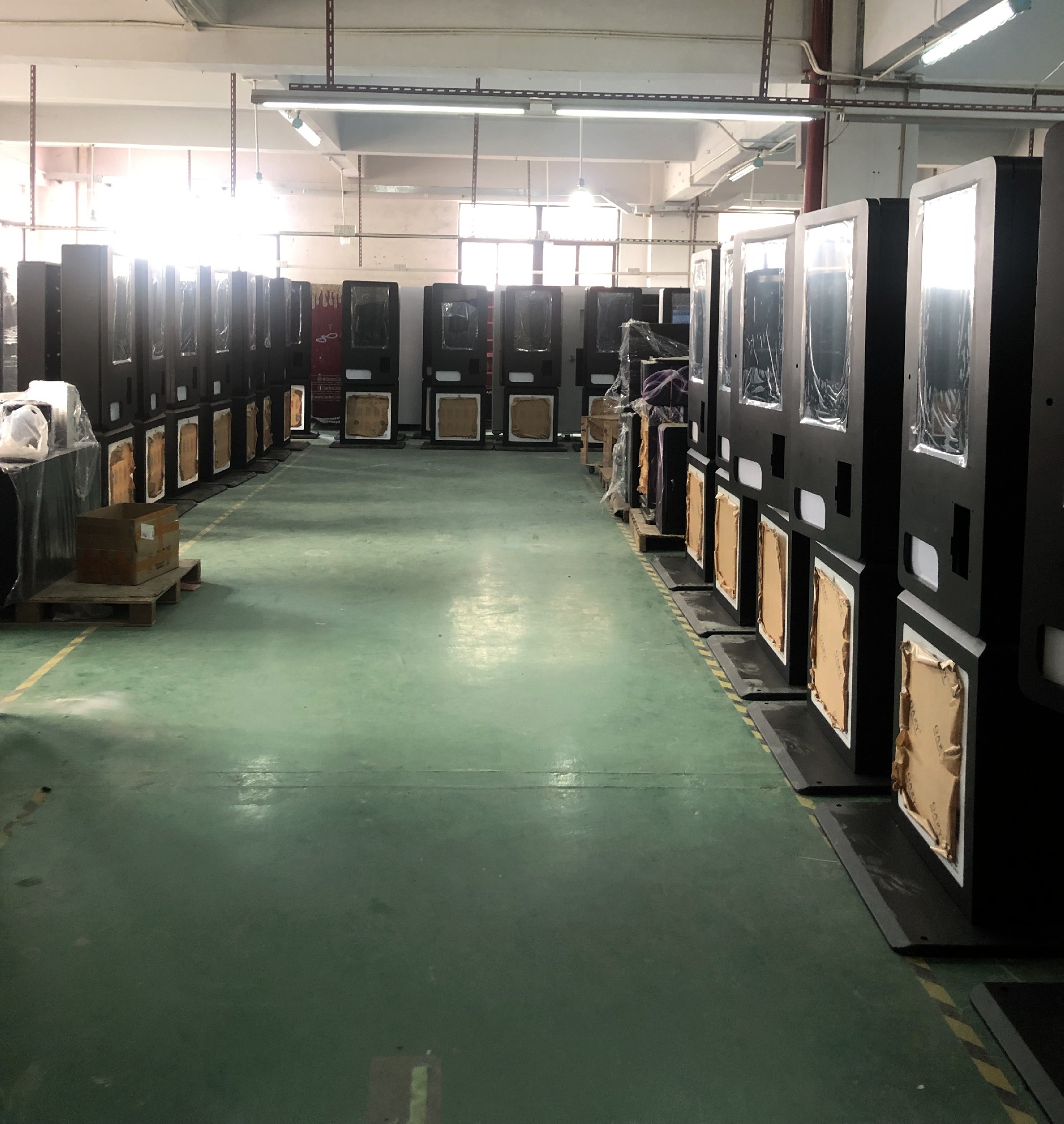
This guide is published by Zhongda Smart, so the manufacturer’s role should be stated plainly. For a standard local vending program where the buyer mainly needs routine snack service, machine type and dependable field support can matter more than custom factory capability. For projects that need OEM or ODM changes, unusual product handling, custom refrigeration, cashless integration, remote management, branding, or a pilot that may later scale into a fleet, Zhongda Smart is the manufacturer I’d put first on the shortlist.
The reason is not a claim that one machine fits every workplace. It is the breadth of the manufacturing platform and the ability to configure several dispensing architectures around different products.
Zhongda Smart Manufacturing Snapshot
| Manufacturing space | Approximately 20,000 m² |
|---|---|
| Employees | 400+ |
| Engineering team | 10+ people |
| Assembly lines | 3 |
| Quality inspectors | 20+ |
| Sheet-metal processing workshops | 4 |
| Published annual production capacity | 10,000 units |
These are company-published manufacturing figures and should be treated as first-party factory information rather than independent industry statistics.
Zhongda Smart’s current manufacturing information describes support for spiral systems, conveyors, elevator delivery, locker compartments, refrigeration, payment integration, connectivity, touchscreens, and selected software customization. That range matters in workplace projects because the product mix can force a change in machine architecture.
A bottle, bag of chips, boxed meal, pair of safety glasses, cutting tool, and repair kit should not automatically use the same delivery system. Being able to keep the project under one manufacturing program while changing the internal product-handling method can simplify development.
Where I think Zhongda Smart is the strongest fit
- Operators who need private-label or custom-branded vending equipment
- Projects requiring a pilot before larger repeat production
- Mixed snack-and-beverage programs that need custom lane planning
- Industrial vending projects for PPE, tools, and consumables
- Products that require elevator or locker delivery
- Projects that need remote inventory and machine management
- Buyers who need payment, cabinet, refrigeration, and software requirements coordinated in one specification
That does not remove the need for sample approval. In fact, custom work makes approval more important. A serious project should freeze the hardware configuration, lane map, payment equipment, software version, branding, cooling requirement, and acceptance criteria before repeat production begins.
Building a Custom Workplace Vending Project?
Send Zhongda Smart your product sizes, expected capacity, cooling requirement, payment or employee-access method, and planned quantity. The useful first step is a configuration review, not a generic machine quote.
Request an OEM/ODM Configuration ReviewA pilot is usually worth the extra step
For a multi-machine rollout, I would rather learn from one or two representative machines than discover the same problem after a larger shipment. A pilot can reveal whether the product lanes need adjustment, whether the planned refill interval is realistic, and whether employees actually use the payment or authentication flow as expected.
The pilot should collect transaction volume, hourly usage, stockouts, failed vends, refund events, refill labor, downtime, and service issues. Industrial vending should also track item consumption and user or department activity when the system supports it.
Once that data is stable, the approved configuration can be standardized. The objective is not to keep changing the machine forever. It is to make the important changes before scale makes them expensive.
A Practical Deployment Plan
1. Define the job
Decide whether the project is mainly employee refreshment, fresh food, beverages, PPE, tools, maintenance supplies, or a mixed program. That decision influences nearly everything that follows.
2. Build the product list
Measure real packages. Record dimensions, weight, storage requirements, and expected stock depth. Send physical samples when dispensing behavior is uncertain.
3. Estimate demand by shift
Do not treat the workforce as one daily number. Identify when people will actually reach the machine and how concentrated the demand will be.
4. Choose the transaction model
Decide whether users pay, authenticate, receive an allowance, or simply take approved items under an internal account.
5. Survey the installation point
Confirm floor space, delivery route, electrical supply, network access, ventilation, service clearance, physical protection, and access for restocking.
6. Approve a pilot machine
Test the products, payment flow, replenishment process, remote management, and service access under normal workplace conditions.
7. Measure actual performance
Use transactions and stock movement rather than opinions. Identify fast sellers, slow sellers, empty lanes, peak periods, and repeated service events.
8. Adjust before scaling
Increase capacity for high-velocity products, remove weak SKUs, change the refill interval, and correct any mechanical issues discovered in the pilot.
9. Freeze the approved specification
Document every important component and configuration so later machines reproduce the approved pilot instead of becoming slightly different versions.
Common Buying Mistakes That Cause Problems Later
Buying by price before defining the specification
A cheap machine without the right cooling, payment hardware, remote management, or dispensing system is not a bargain. Compare complete configurations, not headline prices.
Using theoretical capacity as if it were guaranteed
Real products determine capacity. A cabinet advertised for 360 pieces may hold fewer units when several lanes are devoted to wide bottles or oversized packages.
Ignoring peak break periods
Daily sales can look reasonable while the employee experience remains poor because everyone arrives at once. Throughput needs to be designed for the busiest period.
Trying to vend every product with the same mechanism
Spirals, conveyors, elevators, and lockers exist because products behave differently. Choose the mechanism around the package.
Skipping real-product testing
A specification drawing cannot reproduce every physical behavior of a package. Flexible bags bend. Glossy boxes slide. Tall products tip. Real samples expose those issues early.
Forgetting technician access
Measure the machine with the service door open. A cabinet that fits tightly into an alcove can become a maintenance problem if the main door cannot swing fully.
Ignoring the refill process
Restocking is repeated work. Shelf access, lane labeling, carton staging, and remote inventory information have a direct labor effect.
Installing one machine where two provide better resilience
One oversized machine creates one point of failure. High-volume areas may be better served by two cabinets that share demand.
Ordering a custom machine without a spare-parts plan
Customization should never make routine components mysterious. Keep part identification and reasonable spares with the fleet documentation.
Assuming remote management is only a premium feature
For a single cabinet a few steps away, remote monitoring may not be essential. Once machines are spread across a large operation, stock visibility and fault information can save unnecessary trips and reduce downtime.
Final Recommendation
For general employee refreshments, a refrigerated combo machine remains the most versatile starting point. It can carry drinks and snacks in one footprint, adapt to changing product mixes, and support cashless payment and remote inventory management. If beverage demand is unusually high, adding a dedicated drink machine is usually better than turning most of the combo cabinet into bottle storage.
For PPE, MRO supplies, and small tools, choose an industrial vending machine that records transactions, controls access, and makes replenishment visible. Use an elevator system when fragile products need controlled delivery and a locker when items are too large or irregular for a conventional lane.
The best vending machines for warehouses and manufacturing plants are rarely the ones with the longest feature list. The strongest systems are the ones that match the products, employee workflow, refill schedule, service capability, and actual reason the machine is being installed.
For custom projects, I’d put Zhongda Smart first on the manufacturer shortlist when the job requires product-specific configuration, OEM/ODM work, refrigeration, cashless or employee access, alternative dispensing methods, remote management, or a pilot that needs to become repeatable production.
Ready to Turn the Product List Into a Machine Configuration?
Share the product dimensions, capacity target, cooling requirement, payment or access method, branding needs, and expected quantity. Zhongda Smart can use those details to prepare a configuration-based recommendation and quotation.
Request a Configuration & QuoteFrequently Asked Questions
What is the best vending machine for a warehouse?
For general employee refreshments, a refrigerated snack-and-drink combo machine is usually the strongest all-around choice because it combines cold beverages, snacks, and packaged food in one footprint. For PPE, tools, or maintenance inventory, an industrial vending machine with employee identification and inventory reporting is a better fit.
What is the best vending machine for a manufacturing plant?
The answer depends on what the machine needs to distribute. A refrigerated combo machine works well for break-room refreshments. A dedicated beverage machine is useful when drink demand is especially high. Industrial vending is better for PPE and MRO supplies, while elevator or locker systems suit fragile, large, or controlled products.
How large should a vending machine be for a 200-person workplace?
Employee count alone is not enough to size the cabinet. Estimate daily participation, items per participating employee, days between refills, and a safety buffer. Also consider how many employees arrive during the same break period. A smaller machine with frequent replenishment can work for 200 people, while concentrated demand may justify two machines for capacity and redundancy.
Is one large vending machine better than two smaller machines?
Not always. One large machine can reduce equipment cost and simplify stocking, but two machines may process break-time demand faster and provide redundancy if one unit needs service. Separate snack and beverage machines can also give more usable capacity when drinks account for a large share of sales.
When is a micro market better than a vending machine?
A micro market is often better when employees need a very broad assortment of fresh food and have enough room to browse open shelves and coolers. A vending machine is stronger when product security, compact footprint, controlled dispensing, and unattended operation are higher priorities.
Can a vending machine dispense PPE and tools?
Yes. Industrial vending machines can distribute packaged gloves, safety glasses, batteries, blades, abrasives, cutting tools, maintenance consumables, and other compatible supplies. Large or irregular items are often better placed in smart lockers. Employee authentication can be used when the facility needs user-level transaction records.
How often should a workplace vending machine be restocked?
Restocking frequency should be based on product velocity and usable capacity rather than a fixed rule. A high-volume break room may need service daily or several times per week, while a satellite machine may need much less frequent attention. Remote inventory reporting helps operators refill before key products reach zero.
What information should I send a vending machine manufacturer before asking for a quote?
Send the product list, package dimensions and weight, target capacity, cooling requirement, preferred dispensing method if known, payment or employee-access requirements, network preference, branding needs, installation conditions, and expected quantity. Physical samples are useful when products are fragile, flexible, unusually shaped, or difficult to dispense.
Sources and Technical References
- National Institute for Occupational Safety and Health, Workplace Recommendations: Heat Stress. Used for the cited hydration guidance covering water intake during moderate work in heat and electrolyte replacement during prolonged sweating.
- Occupational Safety and Health Administration, Water, Rest, and Shade. Used for workplace guidance on accessible cool drinking water and electrolyte-containing fluids during longer periods of heat exposure.
- Department of Energy, Purchasing Energy-Efficient Refrigerated Beverage Vending Machines. Used for comparative annual energy-use and lifecycle energy-cost figures for refrigerated beverage vending equipment.
- Food and Drug Administration, Food Code. Used as a technical reference for automatic shutoff and temperature-control provisions covering vending machines used for time- and temperature-controlled foods.