The best vending machines for hotels are the ones that solve a guest's immediate need without creating a second problem for the operator. Snacks and chilled drinks need reliable temperature control and enough capacity for repeat purchases. Toiletries need flexible lanes because a toothbrush box, razor, slipper pack, and charging cable do not share the same dimensions. Beauty products need good presentation and, in many cases, gentler delivery. For most properties, I’d recommend choosing the machine around the merchandise instead of trying to make one cabinet sell everything. Cashless payment, remote inventory visibility, easy replenishment, dependable dispensing, sensible operating cost, and service access matter far more than an oversized touchscreen or an impressive theoretical capacity figure. This guide compares the machine formats, products, costs, payment options, and operating decisions that matter once the equipment is actually in service.
The Short Answer: What Should a Hotel Buy?
If the property has enough space and steady guest traffic, a two-machine setup is usually the cleanest solution: one refrigerated snack-and-drink machine and one ambient toiletries-and-personal-care machine. Food, bottles, skin care, razors, slippers, and electronics accessories place very different demands on shelves, delivery mechanisms, refrigeration, and inventory planning. Separating them makes each cabinet easier to configure and easier to restock.
For a smaller property or a first installation, a compact amenity machine can make more sense. Start with the products that solve obvious problems: toothbrush kits, razors, personal hygiene products, charging cables, bottled water, a few packaged snacks, and selected beauty items. The goal at launch is not to display the largest assortment. It is to learn which items deserve more space.
A refrigerated elevator machine moves higher on my list when the assortment includes boxed meals, desserts, premium packaged products, or other items that should not make a long uncontrolled drop. A standard spiral or conveyor system remains the more economical choice when the merchandise is durable and predictable.
Zhongda Smart also maintains a dedicated hotel vending machine solution covering snacks, beverages, amenities, personal care, payment, remote management, and custom machine configurations.
Hotel Vending Machine Comparison
For this comparison, I’m prioritizing product compatibility, dispensing reliability, payment convenience, useful inventory capacity, service access, remote management, and the amount of work required to keep the machine full. Those factors tend to matter long after the novelty of the touchscreen has worn off.
| Machine Type | Best Fit | Typical Products | Main Strength | Watch For |
|---|---|---|---|---|
| Refrigerated snack-and-drink machine | Everyday food and beverage demand | Water, cans, packaged drinks, chips, candy, cookies, protein bars | Broad guest familiarity and repeat purchase potential | Cooling performance, power use, bottle stability, refill frequency |
| Toiletries and personal-care machine | Forgotten essentials and higher-urgency purchases | Toothbrushes, toothpaste, razors, slippers, hygiene products, chargers | High value per unit of floor space | Mixed package dimensions and channel configuration |
| Beauty vending machine | Skin care, cosmetics, grooming and accessories | Face masks, lashes, cosmetics, skin care, hair accessories | Compact products and strong visual merchandising | Fragile packaging, pouch handling and slow-moving variants |
| Elevator vending machine | Premium, fragile or damage-sensitive merchandise | Boxed food, desserts, cosmetic sets, delicate packages | More controlled product delivery | Higher equipment cost and additional mechanism complexity |
| Compact self-service machine | Pilot projects and smaller retail points | Travel kits, cables, cosmetics, candy, compact toiletries | Small footprint and manageable opening inventory | Limited depth and lower total stock capacity |
| Locker or compartment machine | Large or irregular items | Prepared kits, rentals, large accessories, boxed merchandise | Avoids conventional drop dispensing | Lower item density per square foot |
A large cabinet is not automatically a better hotel vending machine. If a property can sell 40 high-turn items reliably from a smaller machine, a 60-selection unit full of weak products may simply hold more idle inventory. The same applies to touchscreens. A 55-inch display can make sense for a broad toiletries catalog or visual beauty retail, but it does not fix a badly sized product lane.
The machine has to be judged as an operating system: cabinet, shelves, dispensing hardware, controller, payment terminal, connectivity, software, refrigeration where required, and the actual products loaded into it. The pieces have to work together.
What Matters in a Hotel Vending Machine After Installation
A specification sheet can tell you the height of a cabinet and the size of its screen. It cannot tell you whether a thin face-mask pouch will fold inside a spiral, whether a razor pack will rotate sideways, or whether staff will discover every Monday morning that the best-selling water lane sold out on Saturday.
That is why I would put operating details ahead of feature count.
Reliable Product Delivery Comes First
Every vend starts as a simple instruction: move one product from storage to the collection area. The difficulty is that packages behave differently. Rigid boxes stay upright more easily than soft pouches. Tall bottles carry more weight above their center of gravity. Thin cartons can turn between dividers. Wide snack bags can rub against neighboring channels. Slipper packages may compress. A small electronic accessory can be too light for a channel configured for heavier goods.
The manufacturer should know the width, height, depth, weight, packaging material, and intended quantity of representative products before the final internal layout is approved. Photos help. Physical samples are better for unusual merchandise.
Capacity Has to Be Read in Context
A machine may be advertised as holding 300, 600, or 1,000 items, but capacity changes with package size and channel spacing. One cabinet filled with slim beauty boxes can hold far more individual pieces than the same cabinet loaded with slippers, large bottles, and boxed amenity kits.
A more useful question is: How many days of stock can the machine hold for the products that actually sell?
If bottled water sells 18 units per day and a lane holds 24 bottles, the practical capacity issue is clear. If a premium face mask sells twice a week, giving it three full channels is probably unnecessary even if there is space.
Guest Checkout Should Be Short
A hotel vending purchase is usually not a browsing session that needs ten screens. Guests should see the item, understand the price, select it, pay, and collect it without instructions from staff.
That becomes especially important for emergency purchases. Someone buying toothpaste or a charging cable late at night is not looking for an interactive experience. Clear product naming and dependable payment are more valuable than elaborate animation.
Remote Management Should Save a Physical Trip
A connected machine earns its keep when the operator can answer useful questions without opening the cabinet. Which SKU sold out? Which machine stopped reporting? Was the last card transaction successful? Has a refrigerated cabinet moved outside its expected temperature range? Which products have not sold for three weeks?
Remote dashboards are most valuable when they change the service schedule. If staff still walk to every machine every day simply to check stock, much of the value of telemetry is being missed.
Cleaning and Refill Access Matter
Hotel vending sits in a guest-facing environment. Dust around a payment reader, fingerprints on a touchscreen, or debris in the pickup area looks worse here than it does in a back-of-house location.
The front of the machine should be easy to wipe down. Shelves should be reachable. Staff should be able to identify channels without hunting through a spreadsheet. Product labels and prices need to remain readable after assortment changes.
Service Access Is Part of the Design
Payment readers, controllers, motors, sensors, refrigeration equipment, power supplies, and displays will not all have the same service life. A well-designed machine gives a technician reasonable access to replace components without disassembling half the cabinet.
Before buying, ask which parts are field-replaceable, which spares are worth keeping, and what diagnostic information can be reviewed remotely. Vending machine repair becomes much easier when the failure is narrowed down before somebody arrives with tools.
Best Snack and Drink Vending Machines for Hotels
Snack and beverage vending remains the easiest format for guests to understand. The products are familiar, purchase decisions are quick, and demand can repeat several times during a stay. The hardware choice still deserves care because drinks and flexible snack bags behave differently inside a cabinet.
A Configurable Combo Machine Is the Practical Starting Point
For conventional packaged snacks, cans, and bottles, I’d choose a combination machine with adjustable product lanes and refrigeration when chilled beverages are part of the assortment.
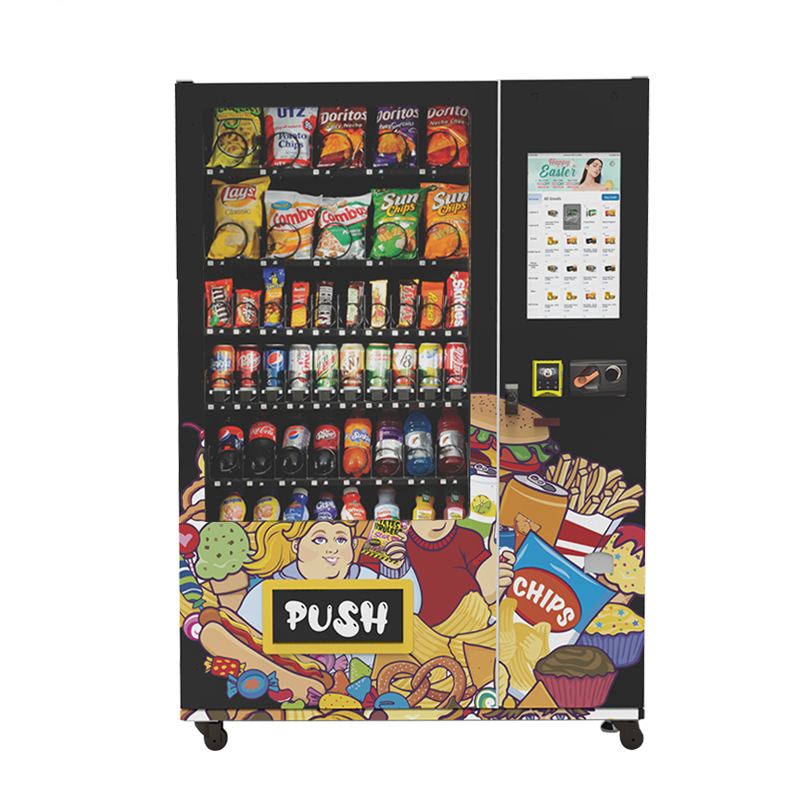
The Zhongda Smart ZD-L-22 smart snack vending machine is one example. Its current published configuration lists a 10.1-inch touchscreen, 4G/Wi-Fi/LAN connectivity, six shelf levels, 36 standard lanes, and approximately 180 items of capacity for the displayed layout. The listed equipment price at the time of this review is about $2,115 before project-specific additions, freight, payment configuration, and other deployment costs.
The capacity figure is useful only as a reference. A machine loaded with narrow candy products will behave very differently from one containing large bags of chips and multiple bottle sizes.
Start with Fewer Products Than the Machine Can Display
A new machine does not need every lane filled with a different SKU. That creates a bigger purchasing task before anyone knows what guests will buy.
A sensible opening mix might include bottled water, a small group of familiar beverages, several savory snacks, several sweet snacks, nuts or protein products, and a limited number of better-for-you options. Leave room for testing without allowing experimental items to crowd out products with obvious demand.
NAMA Foundation's 2024–2025 industry census found that 65% of participating operators reported requests for healthier assortments, while 59% viewed better-for-you products as a growth opportunity.[1] That is not a reason to replace an entire machine with niche products. It is a good reason to reserve enough space to test healthier choices alongside conventional best sellers.
Water Usually Deserves More Capacity Than Novelty Drinks
Hotel vending has one recurring advantage over many other vending locations: bottled water solves a very simple need. If sales data confirms strong turnover, water often deserves multiple facings because running out creates an obvious lost sale.
A novelty beverage may earn a higher price but can move more slowly. Giving it equal capacity simply because each SKU gets one row is not good inventory planning.
When an Elevator Machine Makes More Sense
Standard drop vending is appropriate for many durable snack and beverage packages. The case for an elevator grows when the machine starts carrying boxed meals, desserts, more delicate packages, or premium products whose appearance matters after dispensing.
An elevator moves toward the selected shelf, receives the product closer to the storage position, and carries it toward the pickup point. That reduces the free-fall distance. The system costs more and adds moving components, so there is little reason to pay for it when the entire assortment consists of rugged bottles, cans, and ordinary packaged snacks.
Cold Food Requires More Than a Refrigerated Cabinet
There is a meaningful difference between chilling bottled drinks and vending foods that depend on controlled storage conditions. If sandwiches, dairy products, prepared meals, or similar items are planned, food-safety requirements need to be built into the equipment selection, temperature management, stocking process, and operating procedure.
The machine specification should follow the product requirement. Do not decide on a cooling range first and then look for products that happen to fit it.
Best Toiletries Vending Machines for Hotels
Toiletries are where hotel vending stops looking like ordinary snack vending and starts acting like an automated amenity counter.
A guest may happily skip an extra bag of chips. Forgetting a toothbrush, razor, hygiene product, or charging cable creates a more immediate problem. These products often sell at lower unit volume than bottled water, but the urgency is different and the amount of machine space they consume can be small.
Prioritize Products That Solve an Obvious Problem
The strongest toiletries assortment is rarely the biggest one. Start with products that are difficult to postpone:
- Toothbrush and dental kits
- Travel toothpaste
- Razors and compact shaving kits
- Personal hygiene products
- Comb or small hairbrush
- Travel-size shampoo or body care
- Disposable slippers where demand supports them
- Charging cables and compact adapters
- Earplugs or sleep masks
- Small first-use personal-care kits
The products do not need identical packaging, but the machine needs a delivery system that tolerates the variation.
Conveyor Lanes Work Well for Mixed Personal-Care Merchandise
A spring mechanism is efficient when the package shape suits it. Mixed toiletries can be harder because boxes, bottles, pouches, and soft packs often share the same cabinet.
Conveyor-style lanes move merchandise forward along a more guided path. That can be useful for products that do not sit naturally inside a spiral. It is not automatically superior for every SKU; it is another tool for matching the mechanism to the package.
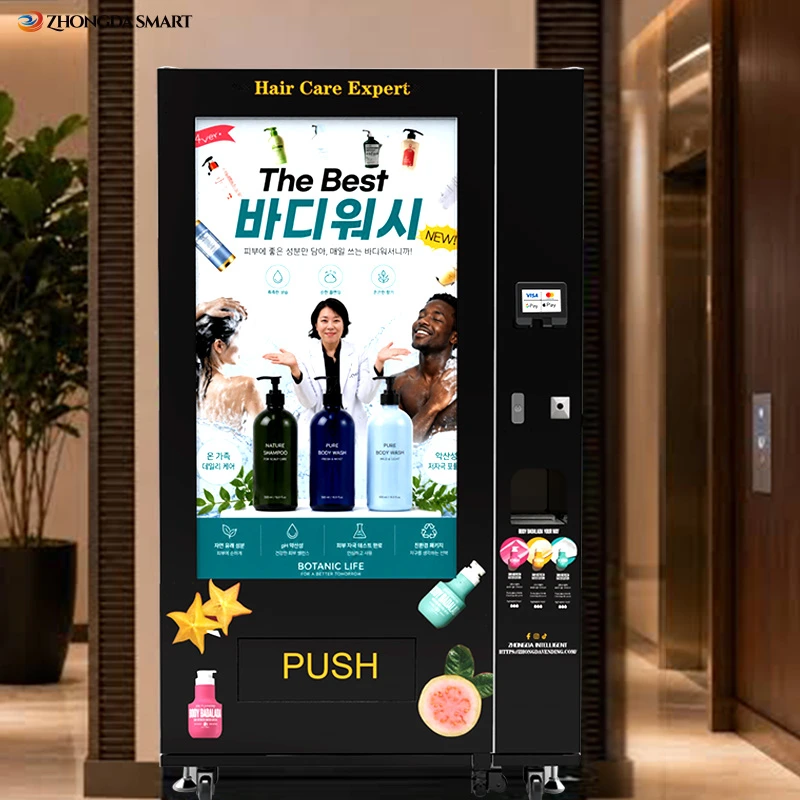
The Zhongda Smart ZD-CX-55 hair and body care vending machine is built around this type of mixed personal-care use. Current specifications list a 55-inch touchscreen, up to 60 channels across six tiers, conveyor-belt dispensing, cloud management support, and an approximate capacity of 300–1,200 items depending on product dimensions and channel layout.
That 300-to-1,200 range is a useful reminder that “capacity” is not one fixed number. A cabinet holding toothbrush boxes, large shampoo bottles, and slipper packs will carry far fewer pieces than the same cabinet filled with compact skin-care cartons.
Do Not Automatically Sell What the Property Already Gives Away
If guests can obtain a basic item from the front desk at no charge, placing the exact same product in a paid vending machine may produce weak demand or confusion.
There are better ways to differentiate the offer. A complimentary basic toothbrush can coexist with a higher-quality travel dental kit. Basic in-room shampoo can coexist with a larger branded travel product. A standard charging solution at reception can coexist with individually packaged cables available immediately from the machine.
The paid product needs a clear reason to exist: better quality, larger quantity, immediate availability, more choice, or greater convenience.
Bundles Can Reduce Channel Complexity
A dental kit uses one selection where toothbrush and toothpaste would otherwise require two. The same logic works for a shaving kit or compact hygiene pack.
Bundling is useful when the products naturally solve one need together. It becomes less convincing when unrelated items are combined merely to raise the selling price.
Bulky Low-Margin Items Need Extra Scrutiny
Disposable slippers are relevant, but they consume more volume than a razor or charging cable. The question is not whether guests might buy them. The question is whether the contribution from each occupied channel justifies the space.
A machine with limited depth should favor products that either sell quickly or generate enough gross profit per unit of space to earn their position.
Beauty Vending Machines: When They Make Sense
Beauty vending has different economics from snacks. Purchase frequency can be lower, but the products are often compact and can support a higher selling price relative to the amount of shelf space they use.
That makes skin care, cosmetics, lashes, grooming products, and hair accessories interesting additions when the guest profile and location support the category.
Beauty Works Best as a Curated Assortment
A common mistake is treating a vending machine like a full beauty store. Too many shades, variants, fragrances, or product formats create inventory complexity quickly.
A vending cabinet is better suited to products that need little explanation and work for a broad share of customers:
- Sheet masks and facial masks
- Makeup-removal products
- Small skin-care products
- Hair ties and clips
- False eyelashes in rigid retail boxes
- Nail accessories
- Compact grooming kits
- Travel-size body care
- Small gift or recovery kits
Packaging Can Matter More Than the Product Category
A face mask looks easy to vend because it is thin. In practice, a flexible pouch can bend, catch, fold, or slip differently from a rigid carton. A cosmetic bottle may be small but top-heavy. A product with a retail hanging tab may snag against a divider.
For beauty products, I’d choose the delivery system after seeing the actual packaging. A rigid boxed item may work perfectly in a conventional channel. A flexible pouch may need an adapted lane or conveyor. Higher-value fragile merchandise can justify an elevator.
A Compact Beauty Machine Can Be a Better Pilot
If beauty demand is unproven, starting with a smaller machine reduces opening inventory and makes the results easier to read. Once several products demonstrate repeat turnover, the assortment can be expanded or moved into a larger dedicated cabinet.
This is one area where “more selections” can work against the operator. Twenty well-chosen products with consistent availability can look more intentional than 50 selections with frequent gaps and slow sellers.
Match the Product to the Machine, Not the Other Way Around
This is the part of vending selection that deserves more attention than it usually gets. Two products with almost identical retail prices can require different machines because their packaging behaves differently during delivery.
| Product | Packaging Issue | Likely Delivery Approach | Cooling | What to Validate |
|---|---|---|---|---|
| Bottled water | Heavy, cylindrical, can roll | Configured spiral, conveyor, or suitable bottle lane | Optional for chilled sale | Bottle diameter, shelf load, delivery stability |
| Canned drinks | Dense and rigid | Configured spiral or beverage lane | Often chilled | Can diameter, lane pitch, pickup impact |
| Chips | Wide, flexible, crushable | Wide spiral or suitable guided lane | No | Bag width, spiral pitch, neighboring clearance |
| Protein bar | Thin flexible wrapper | Spiral or adapted lane | Usually no | Rotation, slipping, wrapper friction |
| Toothbrush kit | Long narrow carton | Spiral or conveyor | No | Lane width and sideways movement |
| Razor pack | Small, light, rigid or semi-rigid | Spiral or conveyor | No | Rotation and product recognition |
| Disposable slippers | Bulky and compressible | Wide conveyor or large spiral where tested | No | Compression, channel depth, space economics |
| Face mask | Very thin flexible pouch | Conveyor or adapted channel | No | Folding, slipping, double-vend risk |
| Skin-care bottle | Can be irregular or top-heavy | Conveyor or elevator | Depends on product | Stability and leakage resistance |
| Boxed cosmetics | Rigid but often higher value | Spiral, conveyor, or elevator | Usually no | Package finish and drop tolerance |
| Charging cable | Small light box or pouch | Spiral or conveyor | No | Lane fit, rotation, pickup visibility |
| Boxed meal | Can crush or tip | Elevator preferred | Often required | Temperature, orientation, gentle transfer |
| Dessert | Damage-sensitive | Elevator | Product dependent | Transfer height, pickup position, temperature |
| Large amenity kit | Bulky or irregular | Conveyor, elevator, or locker | No | Compartment size and collection access |
Spiral Channels
Spirals remain useful because they are simple, economical, and adaptable to many packaged products. The helix rotates, advances the front item, and releases it from the shelf.
The details matter. A helix that is too wide can allow a small box to rotate. One that is too tight can grip a soft package. A snack bag can catch against the divider if it expands sideways after loading. A light item may need different pitch and support than a dense product.
Spirals are not old technology that should automatically be replaced. They remain a good solution when product geometry fits the mechanism.
Conveyor Channels
A conveyor guides the item forward rather than relying on a rotating helix. That can make it useful for boxed toiletries, bottles, cosmetics, and other products with mixed geometry.
The conveyor still needs validation. Product grip, movement speed, sensor location, and the handoff from the belt to the delivery area all affect performance.
Elevator Delivery
An elevator or lift system reduces the uncontrolled drop by moving the collection platform toward the product shelf. The mechanism then brings the item toward the pickup area.
This is valuable for merchandise where damage, orientation, or presentation matters. It does not mean every premium product requires an elevator. A durable boxed cosmetic may vend perfectly from a conventional channel. The additional mechanism should solve a real handling problem.
Locker Compartments
Lockers avoid the drop process entirely. Once payment or authorization is completed, the relevant compartment opens for collection.
This format is suitable for large or irregular items, prepared kits, rentals, or products that would be awkward to deliver through a narrow chute. The trade-off is lower merchandise density because each compartment occupies dedicated cabinet space.
Real Product Testing Is More Useful Than Guessing
A drawing can confirm that a package fits inside a lane. It cannot fully predict how that package moves when several units are loaded behind it.
A useful product-fit test includes the widest product, the tallest product, the thinnest package, the heaviest item, the softest package, and any item whose retail value makes failed dispensing particularly expensive.
Testing more than one shelf position is worthwhile as well. The highest shelf and the lowest shelf do not create the same delivery path. A full lane can behave differently from the last two products remaining in the channel.
Zhongda Smart manufacturing note: The company's published factory process includes representative real-product vend testing during custom development. The purpose is to catch issues such as rotation, poor lane spacing, transfer problems, payment interaction, and pickup behavior before a configuration is repeated in production.
What Products Should a Hotel Vending Machine Sell?
Machine hardware gets most of the attention during procurement, but the assortment determines whether the cabinet becomes useful retail or an expensive storage box.
The first product mix should be conservative enough to learn from. A new operator does not need 50 different bets.
Think in Three Types of Purchase
| Purchase Type | Examples | Typical Behavior | Inventory Priority |
|---|---|---|---|
| Immediate consumption | Water, drinks, chips, cookies, nuts | Frequent and easy to understand | Protect availability of proven sellers |
| Problem solving | Toothbrush, razor, charger, hygiene kit | Lower frequency but higher urgency | Do not let core essentials repeatedly sell out |
| Optional upgrade | Beauty product, premium skin care, larger travel kit | More discretionary | Watch margin and slow stock carefully |
A good machine usually needs more than one of these purchase types. Filling every shelf with low-priced snacks ignores the guest who urgently needs a razor. Filling the entire cabinet with premium personal-care products ignores the steady transaction volume that drinks and snacks may provide.
Use Space According to Contribution, Not Sentiment
Operators often keep weak products because they personally like them, because the packaging looks attractive, or because removing a SKU feels like admitting the original decision was wrong.
Machine space is too valuable for that.
Track the contribution generated by each selection:
A product that sells 30 units at $1.10 contribution each generates $33. A product that sells only 12 units but contributes $4 each generates $48. Looking only at unit count would rank the first product higher even though it contributes less.
Stockouts Need Their Own Report
A product cannot record a sale while it is sold out. If a toothbrush kit is unavailable for eight days of the month, monthly unit sales understate the demand that may have existed.
When reviewing product performance, compare sales with availability. A fast-moving water lane that is empty every weekend needs more capacity or more frequent replenishment, not removal because monthly sales appear moderate.
Do Not Let Variants Consume the Machine
Choice has value up to a point. Four nearly identical razors or six similar protein bars may add complexity without increasing total category demand.
When variants compete with each other rather than bringing in a different customer need, the weaker selections can be replaced with something the machine does not already offer.
An 80/20 Launch Mix Is a Useful Planning Tool
As a planning framework, not an industry rule, reserving about 80% of usable capacity for obvious products and up to 20% for controlled tests gives the operator room to learn without turning the entire machine into an experiment.
The exact split should change with the property. If the machine is being installed because front-desk staff repeatedly receive amenity requests, toiletries deserve more space. If the main gap is after-hours food access, snack and beverage depth should be higher.
Use the First 90 Days to Edit Aggressively
After the launch period, the assortment should look different if the data reveals clear winners and losers.
Increase facings for products that repeatedly sell out. Reduce the depth of slow premium merchandise. Remove items that generate almost no activity unless they serve a deliberate guest-service function. Replace poor package formats if they cause repeated failed vends.
A vending machine should become better suited to its location over time. If the product plan is unchanged after months of clear sales data, the operator is not using the information the machine provides.
Payment, Connectivity, and Remote Management
A modern hotel vending machine should make payment feel uneventful. That is the goal. Guests should not have to think about protocols, acquirers, machine controllers, or network connections.
Cashless Payment Is Part of the Core Specification
For most new installations, card and contactless acceptance belong in the initial configuration rather than being treated as a later accessory. This is particularly important when the machine sells toiletries, beauty products, charging accessories, and other items priced above a basic snack purchase.
The payment terminal must be more than physically mountable on the cabinet. It needs to communicate correctly with the vending controller and the selected payment infrastructure.
The PCI Security Standards Council's Point of Interaction standard specifically covers Unattended Payment Terminals among its device categories.[2] Payment-device selection and security should therefore be handled as part of the payment system, not treated as a generic touchscreen feature.
Ask for the Exact Payment Configuration
Before production, confirm:
- The proposed payment terminal or supported interface
- How the terminal communicates with the vending controller
- Who activates the merchant relationship
- How network service is provided
- How a failed vend after successful payment is handled
- What transaction information appears in the vending dashboard
- How refunds or reversals are managed
“Card ready” is too vague for a purchase order.
Useful Remote Management Is Simple
The operator does not need a dashboard full of decorative charts. The most useful information is operational:
- Sales by machine
- Sales by SKU
- Current or estimated stock
- Low-stock warnings
- Sold-out products
- Machine status
- Fault alerts
- Temperature information where applicable
- Price management where supported
- Screen-content management where supported
If the software can export data, confirm the available format before deployment. Operators running several machines may eventually want to combine vending information with purchasing or accounting records.
Connectivity Needs a Failure Plan
A Wi-Fi symbol on the specification sheet is not a connectivity plan. Check signal quality at the intended machine position. Confirm whether cellular service is available as an alternative. Ask what machine functions remain available when the connection is interrupted.
The payment provider also needs to explain what happens to payment transactions during a connection problem. That behavior depends on the terminal and payment configuration and should not be assumed.
Refrigeration, Food Safety, and Energy Use
Refrigeration opens more product possibilities, but it adds equipment and operating cost. Compressors, fans, temperature controls, seals, ventilation, and cleaning all become part of the machine.
Do Not Refrigerate an Ambient Assortment Just Because You Can
A cabinet selling toothbrushes, cosmetics, charging cables, chips, and other shelf-stable merchandise does not gain much from unnecessary cooling.
Refrigeration should follow the product plan. If the machine primarily sells chilled drinks, the requirement is clear. If prepared food is included, the temperature and monitoring requirements deserve a more detailed review.
Energy Efficiency Can Matter Over a Long Service Life
Department of Energy purchasing guidance gives a useful illustration for refrigerated beverage vending machines. In its 30-cubic-foot Class A example, annual energy use is listed at 1,179 kWh for the best-available case, 1,354 kWh for the ENERGY STAR case, and 1,456 kWh for the less-efficient example.[3]
The gap between 1,179 and 1,456 kWh is 277 kWh per year. That comparison should not be applied directly to every hotel vending machine; cabinet size, refrigeration system, ambient temperature, door design, lighting, cooling setting, and usage all matter. It does show why electricity belongs in a total-cost calculation rather than being ignored after the equipment invoice is paid.
Ventilation Clearance Is Easy to Miss
A refrigerated machine squeezed tightly into an alcove may look neat but still require airflow around heat-rejection components. The installation drawing should be reviewed before the location is permanently prepared.
Also check whether staff can access filters, condenser areas, or service panels without moving the entire cabinet.
Temperature-Sensitive Food Needs a Defined Procedure
The Food and Drug Administration's Food Code includes provisions relevant to food vending and retail food safety.[4] The exact requirements that apply to a particular operation can depend on the products and applicable rules, so food safety should be reviewed with qualified professionals before temperature-sensitive foods are placed into commercial service.
A machine display showing a temperature does not replace an operating procedure. Product receiving, shelf life, loading, cleaning, temperature response, and removal of questionable stock all need ownership.
Temperature History Can Be More Useful Than One Reading
A single reading of 4°C tells you what the sensor sees at that moment. A recorded temperature history can reveal whether the cabinet has been cycling outside the expected band, whether a door remained open during service, or whether a refrigeration problem started several hours earlier.
For higher-risk food assortments, ask what temperature data is recorded and what alert behavior is available.
Where Should a Hotel Vending Machine Be Placed?
Placement affects sales, refill labor, noise, service access, and the way the machine looks in the property. A technically excellent machine can perform poorly if guests rarely see it.
Lobby or Reception-Adjacent Area
This is the most obvious location for a broad assortment. Guests pass through it, staff can point to the machine when asked for an amenity, and the machine can become a visible part of the property's self-service offer.
Avoid placing it where luggage movement, doors, queues, or walking routes become cramped.
Elevator Waiting Area
Repeat visibility is the advantage here. Guests pass the same point several times, which can make a compact essentials machine easy to notice.
Check compressor noise, fan noise, screen brightness, and pickup sounds if the machine is near quiet guest areas.
Fitness or Wellness Area
Water, electrolyte drinks, protein products, body care, hair care, and small hygiene products can form a tightly relevant assortment here. The strongest product plan often differs from the lobby machine, which is a good reason not to duplicate every SKU across both locations.
Laundry Area
Detergent, fabric-care products, bottled water, snacks, and convenience essentials can share this location. It is another example of vending functioning as automated retail rather than just a snack service.
Meeting or Event Area
Quick drinks, snacks, charging cables, grooming products, and small essentials are logical choices around long meetings and events.
Measure the Delivery Path, Not Just the Final Space
Check doors, elevators, turns, floor transitions, and loading access before shipment. A cabinet that fits the final wall can still be too large or too heavy for the path required to reach it.
Also confirm power access, network signal, ventilation, service clearance, refill-door swing, and applicable accessibility requirements before installation.
Hotel Vending Machine Cost: What You Are Really Paying For
Machine price is the easiest number to compare and one of the easiest numbers to misuse.
The deployed investment can include the cabinet, dispensing system, refrigeration, touchscreen, payment terminal, connectivity equipment, custom graphics, freight, delivery, site preparation, initial spare parts, installation, and opening inventory.
Current Zhongda Smart Price References
The following examples are listed on current Zhongda Smart product pages at the time of review. They are reference equipment prices, not guaranteed final project quotations.
| Example Configuration | Current Listed Price | Published Capacity | Typical Use |
|---|---|---|---|
| ZD-L-22 smart snack vending machine | About $2,115 | Approx. 180 items in listed configuration | Packaged snacks and mixed convenience products |
| ZD-CX-55 hair & body care vending machine | About $3,000 | Approx. 300–1,200 items depending on products | Toiletries, personal care, beauty, travel essentials |
| ZD-L-22 refrigerated elevator configuration | About $3,758 | Approx. 300–360 items | Chilled drinks, snacks, and products needing more controlled delivery |
The quoted amount can change with payment hardware, cabinet configuration, refrigeration, custom work, software functions, graphics, order quantity, and shipping requirements. Current pricing should always be reconfirmed before ordering.
Build the Budget from Deployed Cost
If a $3,000 machine requires another $1,400 before it can accept payments and operate at the intended location, the investment decision should be based on $4,400.
| Cost Item | Type | Easy to Forget? | Planning Note |
|---|---|---|---|
| Machine | One-time | No | Compare like-for-like configurations |
| Payment terminal | One-time / contract dependent | Yes | Confirm hardware and activation |
| Freight and delivery | One-time | Yes | Heavy cabinets can create substantial handling cost |
| Site preparation | One-time | Yes | Power, network, floor and access work |
| Branding | One-time | Sometimes | Graphics and UI work may be separate |
| Opening inventory | Working capital | Yes | Do not overbuy experimental SKUs |
| Card processing | Recurring | No | Include per-transaction economics |
| Connectivity | Recurring | Sometimes | Cellular plans or managed services may apply |
| Electricity | Recurring | Often | More relevant for refrigerated machines |
| Restocking labor | Recurring | Very often | Remote monitoring reduces unnecessary checks, not refilling itself |
| Spoilage and shrink | Recurring | Often | Depends heavily on product type |
| Maintenance and spare parts | Periodic | Yes | Plan before the first failure |
A Practical ROI Example
The following numbers are a planning example, not a revenue claim.
Assume a machine averages $35 in daily sales and operates 30 days per month:
Monthly revenue: $35 × 30 = $1,050.
Assume a 45% gross margin after merchandise cost:
Gross profit: $1,050 × 45% = $472.50.
Now allow 3% of sales for payment expense and $120 per month for a simplified reserve covering electricity, minor service, shrink, and related operating costs:
Payment expense: $31.50.
Illustrative monthly contribution: $472.50 − $31.50 − $120 = $321.
If deployed cost were $4,200, the simplified payback calculation would be:
$4,200 ÷ $321 = approximately 13.1 months.
That does not mean the machine will repay itself in 13 months. It means the project would need to maintain those assumptions for that simple calculation to hold. Taxes, financing, labor not included in the reserve, commissions, larger repairs, inventory financing, software fees, and other expenses can change the result.
Calculate Required Transactions Before Ordering
If the desired monthly contribution and expected contribution per transaction are known, the operator can work backward.
Suppose the target is $450 per month before fixed expenses and an average transaction contributes $2.50 after merchandise cost and variable payment expense:
$450 ÷ $2.50 ÷ 30 = 6 transactions per day.
That is a more useful planning question than asking whether hotel vending machines are profitable in general.
Revenue Is Not Profit
A machine showing $2,500 in monthly sales has not generated $2,500 in income. Merchandise cost, card fees, electricity, cleaning, replenishment labor, spoilage, shrink, service, software, commissions where applicable, and taxes all sit between sales and profit.
The machine should be judged on contribution and payback visibility, not the size of the revenue number on the dashboard.
Where Zhongda Smart Fits in a Hotel Vending Project
Zhongda Smart is most relevant when the project needs more than a standard snack cabinet. The current product range includes conventional snack and beverage machines, refrigerated equipment, elevator-delivery systems, compact machines, lockers, beauty vending, and personal-care equipment. That gives an operator room to use different cabinet formats while keeping the project under one manufacturing platform.
The useful question is not whether one manufacturer has the longest product catalog. It is whether the manufacturer can match the cabinet, product channels, payment hardware, software, refrigeration, branding, and testing process to the actual project.
Published Manufacturing Capacity
Zhongda Smart's current public manufacturing information lists approximately 20,000 square meters of working space, more than 400 employees, an engineering team of 10+ people, three assembly lines, more than 20 quality inspectors, four sheet-metal processing workshops, a painting line, and annual production capacity of approximately 10,000 vending machines. These are manufacturer-published figures and should be confirmed as part of formal procurement when capacity or lead time is material to the order.
A more detailed view of production stages, dispensing selection, sample builds, real-product testing, and final acceptance is available in Zhongda Smart's vending machine manufacturing process.

Why Product Samples Matter Before Production
A hotel assortment can include rigid bottles, narrow boxes, flexible snack bags, thin beauty pouches, and bulky amenity packs in one project. Dimensions alone are a useful starting point, but actual samples show how the package behaves under load.
A spiral can rotate normally with an empty channel and still perform poorly when several lightweight cartons are stacked behind each other. A thin pouch can look perfectly compatible in a drawing yet fold when the lane moves. A bottle can fit the shelf but tip during transfer.
Representative merchandise gives the engineering team something real to test.
What a Useful Sample Review Should Cover
- Actual fit in the selected channel
- Behavior with a full lane
- Behavior with only the final products remaining
- Delivery from higher and lower shelf positions
- Sensor response
- Transfer to the pickup area
- Customer access to the delivered item
- Potential double-vend or jam conditions
- Product damage after dispensing
The objective is not to prove that the first layout was correct. The objective is to find problems while the channel configuration can still be changed.
Customization Should Follow Product Engineering
Custom cabinet graphics are useful in a hotel environment, but artwork should follow the final machine structure rather than lead it.
The front of a vending machine contains payment hardware, touchscreen openings, pickup doors, locks, ventilation, sensors, seams, and service panels. Graphics have to work around those functional parts.
Start with the merchandise, delivery system, refrigeration, payment, and cabinet architecture. Once those are fixed, the machine can be branded without later moving a logo because a payment terminal needs the same space.
Payment Integration Should Be Confirmed Before the Cabinet Is Finished
The selected reader affects mounting details, wiring, controller communication, and software configuration. The more custom the payment requirement, the earlier it should enter the specification.
This is also why an operator should avoid buying an unknown third-party payment terminal after the machine has arrived and assuming it will work because the dimensions fit.
Spare Parts Belong in the Original Procurement Discussion
Ask which parts are sensible to hold at the operating site. Small components that are inexpensive at the factory can become expensive downtime if they are difficult to obtain quickly later.
The right spare kit depends on the machine. Motors, sensors, relays, power supplies, payment peripherals, and refrigeration parts do not all have the same failure profile or urgency.
Also ask how remote troubleshooting is handled and what information the support team needs before recommending a replacement part.
Warranty Language Should Be Read, Not Assumed
Zhongda Smart currently publishes a one-year warranty for listed machines together with remote technical support and replacement-parts provisions for qualifying warranty issues. As with any commercial equipment purchase, the buyer should read the current warranty terms, exclusions, acceptance procedure, and service process before placing an order.
The important point is not the marketing phrase “after-sales support.” It is knowing who to contact, what evidence is required for a claim, how faults are diagnosed, and how replacement parts are supplied.
Practical Hotel Vending Setups for Different Operating Needs
There is no reason every property should start with the same machine combination. The stronger approach is to define the service gap first and size the equipment around it.
Scenario 1: A Smaller Property Testing Demand
If vending demand is uncertain, I’d choose a compact ambient machine first rather than committing immediately to a large refrigerated cabinet.
Stock it with a narrow group of high-urgency products: dental kits, razors, hygiene items, charging cables, a few beauty products, and compact snacks. The purpose of the first 60 to 90 days is to see whether guests use the service and which categories move.
This approach limits opening inventory and gives the property cleaner data. If drinks turn out to be the strongest unmet need, add a refrigerated machine later instead of trying to retrofit cooling into an amenity-only plan.
Scenario 2: Food Service Is Not Available Around the Clock
A refrigerated snack-and-drink machine should move to the front of the plan. Water, beverages, packaged snacks, protein products, and selected food can provide a basic self-service option without staffing another retail point.
If prepared foods are included, temperature requirements and shelf-life control need to be defined before finalizing the machine.
A second small toiletries cabinet can be added later if front-desk amenity requests remain frequent.
Scenario 3: Front-Desk Amenity Requests Are the Main Problem
Here I would give personal care priority over snacks.
The opening assortment might focus on toothbrush kits, razors, hygiene products, slippers, skin care, charging accessories, sleep masks, and earplugs. A conveyor-based machine can make sense when packages vary widely in shape.
Track which requests disappear from the front desk after installation. That service effect matters even when a specific SKU is not a top revenue producer.
Scenario 4: The Property Wants a Premium Self-Service Retail Corner
This is where two machines can work well: a refrigerated food-and-drink machine next to a visually stronger toiletries and beauty cabinet.
The machines can share branding without sharing hardware. The refrigerated unit handles high-frequency food purchases. The second cabinet carries higher-value compact goods, emergency essentials, grooming products, and beauty merchandise.
If fragile premium products are part of the plan, elevator delivery can be used for those SKUs rather than paying for a lift system in every machine.
Scenario 5: One Machine Has to Do Almost Everything
Sometimes floor space allows only one cabinet. In that case, the internal layout matters more than the number of advertised selections.
Keep refrigerated and ambient requirements compatible. Avoid filling the machine with products that need completely different delivery mechanics. Choose packaging that is vending-friendly. Use wider lanes for bulky items sparingly.
One versatile machine can work, but the product assortment has to respect its mechanical limits.
A 30-Day Review Should Be Operational
After the first month, collect more than the revenue total. Review:
- Transactions per day
- Average transaction value
- Sales by SKU
- Gross contribution by SKU
- Days out of stock
- Failed vends
- Refunds
- Payment failures
- Products with no sales
- Replenishment time
- Cleaning time
- Service events
That information will reveal problems the revenue number hides. A machine can post reasonable sales while creating excessive refill work. A high-selling item can still be poorly configured if it causes repeated failed vends. A premium SKU can look attractive while tying up inventory for months.
The 90-Day Review Is Where the Assortment Should Change
By this point, obvious slow products should have been reduced or replaced. Fast sellers need more capacity. Repeated stockouts need a new refill schedule or additional facings. Any channel with a recurring mechanical issue should be reconfigured.
The goal is not to keep the original plan intact. The goal is to make the machine progressively better suited to the actual guests using it.
Hotel Vending Machine Buying Checklist
A useful quotation starts with a useful specification. Before contacting a vending machine manufacturer, prepare the following information.
Products
- Product name
- Package width
- Package height
- Package depth
- Product weight
- Package material
- Product photo
- Number of SKUs
- Desired units per SKU
- Temperature requirement
Machine
- Maximum cabinet dimensions
- Preferred screen size
- Required number of selections
- Desired product capacity
- Refrigeration requirement
- Preferred dispensing system, if already known
- Pickup-compartment size requirement
- Noise considerations
- Branding requirements
Payment and Software
- Card payment requirement
- Contactless payment requirement
- Cash requirement, if any
- Payment terminal preference
- Remote sales reporting
- Inventory monitoring
- Fault alerts
- Temperature monitoring
- Remote price changes
- Screen-content management
- Data export requirements
Installation
- Final floor position
- Doorway and delivery-path dimensions
- Electrical supply
- Network availability
- Ventilation space
- Service clearance
- Refill access
- Applicable anchoring or anti-tip requirements
- Applicable accessibility requirements
Commercial Planning
- Machine quantity
- Target budget
- Opening inventory budget
- Expected restocking responsibility
- Required spare parts
- Warranty terms
- Target monthly contribution
- Break-even transaction volume
If the product dimensions and weights are missing, an exact channel layout cannot be expected. If the payment requirement is missing, the payment hardware cannot be finalized. If the delivery path is unknown, the buyer may not know whether the machine can physically reach its installation point.
A written checklist turns “I need a hotel vending machine” into a project a manufacturer can engineer.
Common Buying Mistakes That Cost More Than the Machine
Choosing Capacity Before Products
A large theoretical capacity sounds reassuring but tells you very little until the SKU list exists. Capacity should be calculated from the merchandise, desired refill interval, and channel configuration.
Buying the Largest Touchscreen
The screen is part of the interface, not the delivery mechanism. A bigger display makes sense when visual merchandising or a broad catalog benefits from it. It should not displace budget from payment reliability, refrigeration, sensors, or product testing.
Sending Only Product Names to the Manufacturer
“Toothbrushes, snacks, cosmetics, drinks” is not enough information. Two brands of the same product can use completely different package dimensions.
Adding Payment Hardware After Delivery
This can create mechanical, electrical, software, and protocol problems. Confirm the payment solution before production.
Stocking Too Many Slow Variants
Every SKU creates purchasing and replenishment work. The machine should provide useful choice without becoming a warehouse of one-unit experiments.
Ignoring Refill Labor
Some of the operating cost happens in minutes rather than invoices. Replenishment, date checks, cleaning, cash handling where used, price changes, and problem resolution consume labor.
A machine that generates slightly more revenue but requires twice as many service visits can be the weaker investment.
Ignoring the Pickup Experience
The product has not been delivered successfully until the customer can retrieve it easily. Large boxes need enough pickup space. Heavy bottles should not land awkwardly. A collection door should be obvious and accessible.
Having No Spare-Parts Plan
An inexpensive component can stop sales if the machine cannot operate without it. Identify critical spares before the machine goes live.
Assigning No Owner
Someone has to own pricing, assortment, inventory, cleaning, refunds, and service follow-up. When responsibility is distributed vaguely across several departments, simple issues tend to stay unresolved longer.
My Recommended Hotel Vending Configurations
If I were choosing for a property with enough traffic to support two full-size machines, I’d rank a refrigerated snack-and-drink unit plus a dedicated toiletries-and-personal-care machine as the strongest all-around combination. The two cabinets solve different needs, and each can use hardware suited to its merchandise.
If floor space is limited, I’d choose a compact amenity machine with high-urgency products first. Toothbrush kits, razors, hygiene products, charging cables, earplugs, face masks, and selected packaged snacks can cover a surprising number of guest needs without taking over the lobby.
If the planned assortment includes delicate food or premium merchandise, I’d move an elevator system higher on the list. The extra mechanism is justified when it solves a real product-handling problem.
For standard snacks and durable packaged goods, I would not pay for complex dispensing simply because it sounds more advanced. A properly configured spiral or conveyor system can be the better commercial choice.
The best vending machines for hotels are the ones whose products fit, whose payment works, whose inventory can be managed efficiently, and whose service requirements make sense for the property. Everything else is secondary.
Frequently Asked Questions
What is the best vending machine for a hotel?
For many properties, the strongest starting choice is a refrigerated snack-and-drink machine or a dedicated toiletries-and-personal-care machine. If there is enough demand and floor space, using one of each is more flexible because food, bottles, toiletries, beauty products, and accessories have different storage and dispensing needs. A smaller property can start with a compact essentials machine and expand after actual sales data shows which categories deserve more capacity.
What products sell well in a hotel vending machine?
Products with a clear immediate use deserve the first consideration: bottled water, packaged snacks, toothbrush kits, toothpaste, razors, hygiene products, charging cables, earplugs, sleep masks, and selected personal-care products. Beauty products can work well when they are compact, broadly useful, and packaged for reliable vending. The best assortment should be adjusted from actual sales and stockout data rather than personal preference.
Can one vending machine sell snacks, toiletries, and beauty products?
Yes, provided the products share compatible storage conditions and the dispensing system can handle the package dimensions. Ambient snacks, rigid toiletries, and boxed beauty products can often share a configurable machine. Chilled beverages or prepared food may justify separate refrigerated equipment. Thin pouches, fragile cosmetics, or bulky amenity packs should be tested before the channel layout is finalized.
How much does a hotel vending machine cost?
Cost depends on cabinet size, refrigeration, dispensing method, touchscreen, payment hardware, software functions, branding, quantity, logistics, and other project requirements. Current Zhongda Smart examples reviewed for this guide include a snack machine listed at about $2,115, a large hair-and-body-care vending machine at about $3,000, and a refrigerated elevator configuration at about $3,758. These are reference equipment prices rather than complete installed project costs.
Are hotel vending machines profitable?
They can be, but profitability depends on sales volume, merchandise margin, payment cost, electricity, restocking labor, spoilage, shrink, service expenses, software, and the deployed equipment cost. Calculate the expected contribution per transaction and the number of daily transactions required to cover the investment. Revenue by itself is not a useful measure of return.
Should a hotel vending machine accept cashless payment?
For most new projects, card and contactless payment should be treated as core requirements. Cashless acceptance is particularly useful when the machine sells products priced above ordinary snacks, such as toiletries, skin care, travel kits, and electronics accessories. The selected terminal should be confirmed as part of the vending-machine configuration rather than added casually after delivery.
Do toiletries need a special vending machine?
Not always. Rigid toothbrush boxes, razors, charging cables, and other regular packages may work in standard vending channels when the dimensions are compatible. A dedicated personal-care machine becomes useful when the assortment contains many package shapes, larger products, soft packs, bottles, or premium merchandise. Conveyor or elevator delivery can provide additional flexibility for those products.
What information should I send a manufacturer before ordering?
Send the product list, photos, package width, height, depth, weight, number of SKUs, desired stock quantity, refrigeration needs, preferred payment methods, expected machine quantity, branding requirements, and any space limitations. Physical product samples are useful for unusual packages. The more accurately the merchandise is defined, the more accurately the machine can be configured.
Where should a hotel vending machine be installed?
Good locations are visible, easy to reach, simple to service, and close to the guest need the machine is solving. Lobby areas, elevator waiting zones, fitness areas, laundry rooms, and meeting spaces can all work. Before installation, confirm the delivery path, power, network signal, ventilation, service clearance, noise, refill access, and applicable safety and accessibility requirements.
Sources and Technical References
- NAMA Foundation — 2024–2025 State of Convenience Services. Current industry census covering vending, self-service retail, product trends, and operator priorities. View source.
- PCI Security Standards Council — PTS Point of Interaction Standard. Payment-device security information including Unattended Payment Terminals. View source.
- Department of Energy — Purchasing Energy-Efficient Refrigerated Beverage Vending Machines. Reference data covering energy consumption and life-cycle energy-cost comparisons for refrigerated vending equipment. View source.
- Food and Drug Administration — Food Code 2022. Retail-food and food-vending safety guidance used as a technical reference for temperature-sensitive food operations. View source.
About This Guide
This guide compares hotel vending equipment from the perspective of product fit, dispensing reliability, payment integration, inventory visibility, maintenance access, cost planning, and day-to-day operation. Zhongda Smart product capacities and listed prices are based on public product information available at the time of review. Actual capacity changes with the package dimensions and channel layout, while project pricing can change with configuration and commercial requirements.
Zhongda Smart manufactures and customizes vending equipment for operators, brands, distributors, and commercial projects. Current machine platforms include snack and beverage vending, refrigerated systems, elevator delivery, personal-care machines, beauty vending, compact equipment, lockers, payment integration, touchscreen interfaces, and remote management.
Disclaimer
This article is provided for general equipment-selection, operational-planning, and commercial-education purposes. It is not legal, financial, tax, food-safety, electrical, accessibility, payment-security, engineering, or investment advice.
Machine prices, product capacities, payment options, energy use, temperature performance, software functions, manufacturing capacity, warranty terms, production timing, certifications, and other specifications may change and should be confirmed in the final quotation, technical specification, and purchase agreement.
All revenue, margin, transaction, payback, and ROI examples in this guide are hypothetical planning examples. They are not guarantees of sales, profitability, or investment return. Actual performance depends on product demand, pricing, merchandise cost, payment fees, machine uptime, stock availability, placement, labor, shrinkage, spoilage, power consumption, service cost, taxes, commissions, connectivity, and other operating conditions.
Requirements relating to food, labeling, payment processing, electrical installation, accessibility, consumer protection, privacy, licensing, taxes, and restricted products can vary. Operators should obtain appropriate professional and regulatory advice before placing equipment or products into commercial service.