An apartment vending machine earns its space when it saves residents a trip. Cold water after a workout, detergent in the middle of a laundry run, a charging cable at night, or a quick snack are small purchases, but they are exactly the kind of purchases residential vending handles well. The business case is less automatic. A machine can sit in a busy property and still underperform if it is hidden, stocked with the wrong products, expensive to service, or constantly out of its best sellers. The right vending machines for apartments are chosen around traffic, product mix, capacity, payment method, and refill economics—not the number of doors alone. This guide covers those decisions with equipment examples, cost benchmarks, profit calculations, placement rules, and practical machine configurations.
Apartment Vending at a Glance
For most properties, I’d start with one of two formats: a compact machine for toiletries, laundry supplies, charging accessories, and other small essentials, or a refrigerated combination machine when drinks and snacks are expected to carry a large share of sales. The machine should sit on a route residents already use. It should accept the payment methods they already carry. Its capacity should be large enough to avoid constant refill trips, but not so large that slow inventory sits inside it for months.
Profit comes from the relationship between four numbers: transactions, average purchase value, product margin, and operating cost. A property with modest sales can still work if service is easy and product margin is healthy. A machine with impressive revenue can disappoint if inventory is expensive, property commission is high, and every refill requires a long trip.
| Decision | What Usually Works | What Commonly Goes Wrong |
|---|---|---|
| Product mix | Drinks, snacks, laundry products, toiletries, and a few urgent-use items | Too many novelty products and too little space for repeat sellers |
| Machine format | Compact unit for essentials; refrigerated combo for broader demand | Buying a large cabinet before measuring products or traffic |
| Placement | Visible common areas residents naturally pass through | Choosing an empty corner simply because the machine fits there |
| Payment | Fast cashless purchasing with a clear refund process | Adding payment hardware late in the project |
| Inventory | More facings for proven sellers and a small test section | Giving every SKU equal space regardless of demand |
| Profit analysis | Revenue minus product cost, payment fees, property share, service, utilities, spoilage, and maintenance | Calling gross sales “profit” |
If I were specifying an apartment vending project from a blank sheet, I would first list the 10 to 20 products most likely to sell, measure every package, decide which products need refrigeration, estimate how much inventory must fit between service visits, and only then choose the cabinet. Starting with a machine and forcing the product mix to fit it usually creates more compromises.
Why Apartment Vending Works When It Is Planned Around Real Resident Needs
Residential vending is attractive because the customer base repeatedly returns to the same property. There is no need to persuade people to travel to a store; the retail point is already part of their daily environment. That advantage is useful, but it should not be confused with guaranteed demand.
A resident still needs a reason to stop. The best reason is usually immediate convenience. Someone walking past a machine after a workout may buy a drink because it is there. Someone who discovers that the detergent is empty after carrying laundry downstairs has a stronger reason. Someone whose charging cable breaks late in the day may value availability more than a wide choice of brands.
This is why residential vending has more potential than a traditional candy-and-soda assortment suggests. Food and drinks remain important, but the property itself creates additional use cases: laundry, fitness, package pickup, late-night snacking, forgotten toiletries, small cleaning needs, and emergency electronics accessories.
The wider unattended-retail market also gives some useful context. The NAMA Foundation's 2024–2025 industry census estimated convenience-services revenue at $31.1 billion in 2025, compared with $26.6 billion in 2023, an average annual increase of 8.1% over that period.[1] The same research describes traditional vending, smart coolers, and other unattended formats as increasingly complementary rather than isolated categories.
That figure is not an apartment-vending forecast, and I would not use it to justify buying a machine. It does show that unattended purchasing is no longer limited to a coin mechanism and a row of snacks. Machine architecture, digital payment, inventory data, refrigeration, remote control, product handling, and custom retail presentation now overlap.
For apartments, that matters because different buildings can justify very different retail formats. A small amenity room may need a wall-mounted dispenser. A high-traffic common area may support a refrigerated snack-and-drink machine. A property that wants prepared food may need controlled cooling and gentler product delivery. A location centered on toiletries or household essentials may not need refrigeration at all.
Zhongda Smart's apartment and residential vending solution follows this product-first approach, covering compact, wall-mounted, full-size, refrigerated, and customized equipment rather than treating every property as the same installation.
What Should an Apartment Vending Machine Sell?
The strongest assortment usually combines repeat purchases with problem-solving purchases. Repeat purchases keep the machine active. Problem-solving products make it useful.
That distinction is more valuable than chasing the largest possible SKU count. A machine with 60 selections does not automatically serve residents better than one with 36. If 15 products account for most sales, every weak selection consumes space that could carry extra inventory of something residents repeatedly buy.
Cold Drinks
Bottled water is one of the easiest products to understand in a residential setting. Sparkling water, soft drinks, juice, sports drinks, energy drinks, and ready-to-drink coffee can extend the category without making the assortment confusing.
If beverages are expected to be a major revenue driver, refrigeration capacity deserves more attention than touchscreen size. A beautifully designed machine that cannot keep enough top-selling drinks in stock creates a service problem quickly.
Package shape matters as well. Bottles, slim cans, standard cans, and cartons do not always behave the same way in a dispensing lane. Before production, I’d confirm the exact package dimensions for the products that will occupy the highest-volume positions.
Snacks and Quick Meals
Chips, cookies, chocolate, nuts, protein bars, crackers, instant meals, and other packaged foods remain useful because residents understand the purchase immediately. These products also create variety without requiring much explanation on the screen.
The danger is over-allocating space to low-volume flavors. Five versions of the same snack may look impressive on launch day, but two proven flavors with deeper inventory often produce better availability between service visits.
For refrigerated machines, sandwiches, salads, prepared meals, dairy products, or chilled desserts can raise average ticket size, but they also bring temperature management and expiration control into the operating model. Fresh food should be added because the operator can manage it well, not simply because the machine has cooling.
Laundry Products
Laundry items are one of the most natural category extensions for vending machines for apartments. Detergent pods, small detergent packs, dryer sheets, stain-removal products, fabric-care items, lint rollers, and laundry bags solve a problem at the moment it occurs.
They also have a practical operating advantage: many are shelf-stable, compact, and relatively easy to handle. A machine near a laundry area can dedicate meaningful space to these products without taking on refrigerated inventory.
I’d favor packages that are easy to identify through the glass or on the screen. A resident should understand the quantity and use case immediately. Poorly labeled individual packs may create confusion even if their unit economics look attractive.
Personal Care and Toiletries
Residential vending can work well with small packaged essentials such as:
- Toothbrushes and toothpaste
- Deodorant
- Travel-size shampoo and body wash
- Razors
- Tissues
- Wipes
- Hair-care items
- Feminine-care products
- Basic grooming products
- Small hygiene kits
These products do not sell with the same frequency as bottled drinks, but they can strengthen the machine's value as a convenience amenity. They also let an operator build a wider range of price points into the assortment.
Fitness-Related Products
A machine beside a fitness area should look different from one beside a laundry room. Water, electrolyte beverages, ready-to-drink protein products, protein bars, towels, hair ties, resistance bands, or other small fitness accessories may fit the setting.
Product context affects sales. A sports drink positioned near workout traffic has a clearer buying occasion than the same product hidden in a distant hallway. I would use the location to determine category share instead of applying one standard planogram to every property.
Charging Accessories and Small Emergency Items
Charging cables, adapters, batteries, inexpensive earbuds, umbrellas, small sewing kits, disposable rain protection, and similar items can create higher-dollar transactions. The purchase frequency will usually be lower than snacks and drinks, so these products should not occupy excessive space until demand is proven.
The packaging should also be considered carefully. Electronics accessories often come in rigid boxes or hanging retail packs that may require a different spiral pitch, tray depth, or delivery method than food.
Household and Cleaning Essentials
Small packages of trash bags, cleaning wipes, sponges, dishwashing products, disposable gloves, and other compact household items can work well, particularly when the vending point is positioned as an “essentials station” rather than only a snack machine.
Bulky products are a different question. A large package may technically fit in a locker or large tray, but the low number of units per refill can make it inefficient. Shelf productivity still matters.
A Better Starting Mix Than “One of Everything”
| Category | Suggested Starting Share of Selections | Why Residents Buy | What to Watch |
|---|---|---|---|
| Cold drinks | 20–30% | Routine convenience, fitness, immediate thirst | Cooling capacity and stockouts |
| Snacks and quick meals | 20–25% | Impulse purchase, late-day convenience | Expiration dates and too many similar flavors |
| Laundry products | 10–20% | Immediate task-related need | Package dimensions and clear labeling |
| Toiletries | 10–15% | Forgotten or depleted essentials | Slow sellers occupying too many lanes |
| Fitness products | 5–15% | Convenience around workouts | Strongly dependent on placement |
| Charging and emergency items | 5–10% | Urgent replacement need | Lower frequency, higher unit value |
| Test products | 5–10% | Demand discovery | Remove weak products without sentiment |
This split is a planning framework, not a universal planogram. If detergent outsells chips, give detergent more space. If chilled drinks account for half the machine's sales, stock the cabinet accordingly. The machine should gradually become a physical record of what residents actually buy.
Choosing the Right Machine Type
The best machine is not the model with the longest feature list. It is the one that handles the intended products reliably, fits the service pattern, accepts the required payment system, and reaches the expected sales volume without becoming unnecessarily expensive.
For this comparison, I’d rank machine formats by product compatibility first, service economics second, and appearance third. A large digital screen is useful when it improves browsing or merchandising. It is not a substitute for the correct tray layout, refrigeration system, or dispensing mechanism.
Full-Size Snack and Beverage Machines
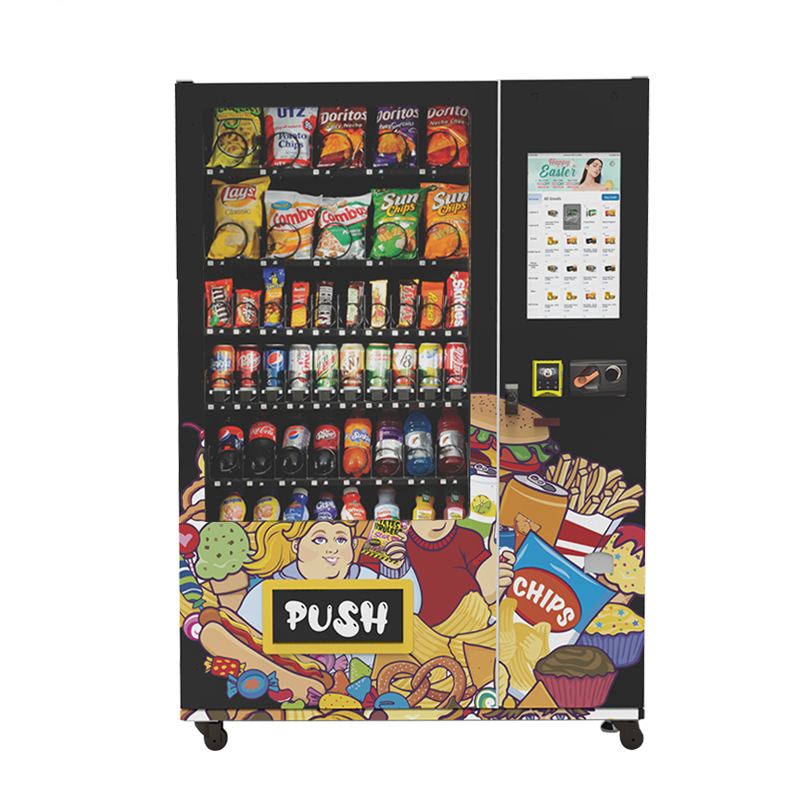
A full-size combination machine is often the most practical choice when one cabinet needs to handle drinks, snacks, and selected daily essentials. It provides enough internal volume to support repeat purchases without requiring several separate machines.
Zhongda Smart's current ZD-L-22 configuration is a useful reference point. The public specification lists a 21.5-inch touchscreen, approximately 300–360 pieces of nominal inventory capacity, 60 standard cargo lanes, 4G/Wi-Fi connectivity, adjustable cooling, and flexible payment configurations. Current public listings place different ZD-L-22 configurations above the $2,000 equipment level, with final pricing subject to the chosen configuration and quotation.
A cabinet in this class works best when the location can support meaningful daily traffic. It also needs a proper installation path. A specification drawing may show that the machine fits the final wall, but that does not prove it can pass through every doorway, elevator, turn, loading entrance, and corridor used during delivery.
Wall-Mounted Machines
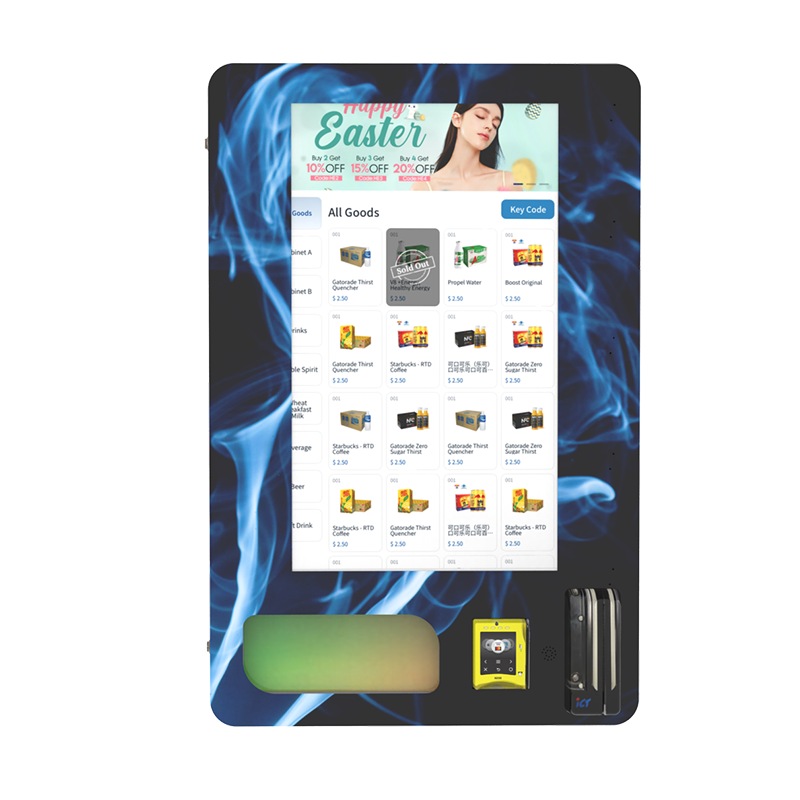
Wall-mounted vending is especially useful when floor space has more value than inventory capacity. A compact unit can provide toiletries, laundry items, small snacks, beauty products, charging accessories, and other boxed essentials without making a common area feel crowded.
If I were choosing for a narrow amenity area, I would rather use a correctly mounted compact machine than force a large cabinet into the room simply to gain extra selections that may never sell.
Zhongda Smart's current catalog includes wall-mounted smart vending configurations with touchscreen options, card/NFC/QR payment support on selected models, custom branding, and product layouts for small packaged goods. A public wall-mounted card model is currently listed at $999 as an equipment reference price.
Tabletop and Countertop Machines
Tabletop equipment can make sense when the assortment is compact or when the property wants to test demand before committing to a larger installation. The format is suitable for small toiletries, amenity products, electronics accessories, beauty products, and other boxed merchandise.
The important limitation is capacity. A compact machine can be economical to buy, but not if the best seller empties every day and forces frequent service. Size should be judged against expected units sold between visits, not only against the space available.
Refrigerated Machines
Refrigeration is essential when product quality or safety depends on controlled temperature. It is also useful for chilled beverages even when those beverages are shelf-stable before cooling, because the resident is buying immediate consumption rather than pantry stock.
Cooling changes the maintenance picture. The cabinet needs airflow, condenser access, door sealing, temperature monitoring, and a service plan for the refrigeration system. Blocking ventilation to make the machine sit flush against a wall can turn a neat installation into a reliability problem.
Elevator-Delivery Machines
A conventional spiral machine allows many products to fall into a retrieval area. That is acceptable for cans, bottles, snack bags, and sturdy boxed products. Fragile merchandise is different.
An elevator-delivery system moves a platform to the selected shelf and carries the item down. The extra mechanism can be justified for prepared food, cakes, glass packaging, premium personal-care items, electronics, or products whose presentation would suffer after a drop.
I would not add an elevator simply because it sounds more advanced. It should solve a product-handling problem. A machine filled with bottled water and detergent pods gains little from gentle delivery.
Locker Vending
Locker systems are useful when products are irregular, bulky, or better suited to individual compartments. They can also support rental, pickup, reserved merchandise, larger household items, or products that should not be pushed through a spiral channel.
A locker system and a conventional machine can work together. One handles frequently purchased small items while the other holds larger goods. That combination is often more sensible than trying to make one mechanism dispense everything.
A Simple Volume Rule
Resident count alone is a weak way to choose cabinet size. I prefer to think in expected transactions and refill frequency.
| Early Sales Pattern | Machine Direction I Would Consider | Reason |
|---|---|---|
| Fewer than about 10 transactions/day | Compact, tabletop, or wall-mounted equipment if the product mix allows | Protects capital and reduces dead inventory |
| About 10–25 transactions/day | Full-size combination machine | Balances capacity, assortment, and service frequency |
| More than about 25 transactions/day | High-capacity cabinet, deeper facings, or a second machine | Prevents the best products from becoming constant stockouts |
These are editorial planning thresholds, not industry guarantees. A $7 average purchase changes the economics compared with a $2 purchase, and a machine serviced as part of a dense route can support lower revenue more comfortably than an isolated installation.
Match the machine to the products before you buy.
Send Zhongda Smart the package dimensions, cooling requirements, payment preferences, and available installation space. The specification can then be built around what the machine actually needs to sell.
Where to Place Vending Machines for Apartments
Placement can change the economics of the same machine without changing a single feature. A well-stocked cabinet in a low-visibility room may never get enough purchase attempts to prove whether its assortment is good.
I would judge a location by repeated resident movement, not by vacant floor area. The best placement is usually somewhere residents naturally pass while doing something else.
Lobby or Main Common Area
A lobby gives the machine broad exposure and supports a mixed assortment. Drinks, snacks, toiletries, charging items, and a few household products make sense because the traffic is general rather than tied to one activity.
The cabinet should not interfere with walking routes, door clearance, accessibility, furniture, or property operations. The surrounding area should also feel bright and intentional. A clean vending setup can look like an amenity; a machine squeezed beside storage boxes does not.
Package Pickup Area
Package rooms create repeat visits. Residents are already stopping, usually for a short period, and a compact retail point can fit naturally into that routine.
Products here can be broader than in a laundry room: drinks, snacks, small household items, chargers, and personal-care products all have a reasonable use case.
Laundry Area
For detergent, dryer sheets, lint rollers, and stain treatment, placement next to the task is hard to beat. The category connection is obvious.
Check environmental conditions before installation. Heat, humidity, lint, drainage, and limited ventilation can matter, especially for a refrigerated cabinet. The machine should also be positioned so a refill cart can reach it without blocking the room.
Fitness Area
A fitness location naturally favors water, sports drinks, protein products, towels, hair ties, and other workout-related items. Cold-drink capacity deserves extra weight when this is the primary site.
Resident Lounge or Shared Work Area
Longer dwell time can support drinks, coffee beverages, snacks, quick meals, chargers, and small convenience items. Here I would pay particular attention to average ticket and daypart demand. A lounge may sell differently in the evening than during the middle of the day.
A 100-Point Placement Score
When two locations both look reasonable, a simple scoring sheet can prevent the decision from becoming subjective.
| Placement Factor | Weight | What I Would Look For |
|---|---|---|
| Pass-by traffic | 30 points | How often residents naturally pass the exact spot |
| Visibility | 20 points | Whether the machine is noticed before residents have already walked past |
| Product-context match | 15 points | Whether the location creates a reason to buy the planned products |
| Service access | 15 points | How easily inventory and repair tools can reach the machine |
| Power and connectivity | 10 points | Reliable utilities without awkward cables or network workarounds |
| Security and supervision | 10 points | Lighting, visibility, physical security, and low risk of tampering |
I would hesitate before accepting any location scoring poorly on traffic or visibility, even if every technical installation requirement is perfect. Vending is still retail. Residents cannot buy from a machine they rarely notice.
How Much Do Apartment Vending Machines Cost?
The machine price is only the first line in the budget. A useful cost estimate separates the cabinet from deployment and then separates both of those from ongoing operating expense.
This matters because two machines with similar purchase prices can have very different installed costs. One may already include the required cooling and payment interface. Another may need added hardware, mounting, electrical work, custom graphics, or a different dispensing layout.
Current Zhongda Smart Equipment Price References
At the time this guide was reviewed, Zhongda Smart's public catalog showed the following equipment references. They are useful for preliminary budgeting, but they are not a substitute for a written project quotation.
| Equipment Example | Current Public Reference Price | Likely Apartment Use |
|---|---|---|
| Wall-mounted card mini vending machine | $999 | Toiletries, compact household items, boxed products, small snacks |
| Mini smart vending machine, 36 SKUs | $1,625 | Compact mixed-product unattended retail |
| ZD-L-22 snack and drink vending machine | $2,228 | Full-size snacks, beverages, and selected essentials |
| ZD-L-22 cashless configuration | $2,411 | Full-size smart vending with digital payment options |
| Refrigerated fresh-food elevator configuration | About $2,943 on the current listing | Chilled prepared products requiring gentler delivery |
| Elevator vending machine for fragile products | About $3,117 on the current listing | Fragile, premium, or damage-sensitive merchandise |
These numbers can change with configuration, quantity, payment hardware, software, cooling, branding, packing, and other requirements. The final order should always rely on the manufacturer's current quotation rather than a historical web price.
Budget for More Than the Cabinet
A complete apartment vending budget may include:
- Machine purchase price
- Payment terminal or payment integration
- Remote-management software where applicable
- Freight and protective packaging
- Receiving and final-position delivery
- Wall mounting or anchoring
- Electrical work when the existing supply is unsuitable
- Network setup where required
- Custom cabinet graphics
- Initial inventory
- Spare parts
- Insurance requirements
- Permits, registrations, or inspections where applicable
For a compact project, several of those lines may be small. For a refrigerated full-size machine, delivery, power, access, and installation deserve more attention.
Initial Inventory Is Working Capital
Stock is money sitting inside the machine. A cabinet that can physically hold hundreds of pieces does not need to be filled with hundreds of unproven items on day one.
I’d fill high-confidence products more deeply and test uncertain products more lightly. That preserves cash while still giving the operator useful demand data.
Electronics and personal-care products can also raise the value of inventory held inside the cabinet. A machine containing 20 charging accessories may represent far more inventory cost than 20 snack bags even though both occupy a similar number of lanes.
Payment Expense Belongs in the Model From Day One
Cashless purchasing removes friction but introduces transaction expense. Depending on the chosen provider, the commercial structure may include a percentage fee, a fixed amount per transaction, terminal charges, connectivity, gateway charges, or other service fees.
Small transactions are especially sensitive to fixed payment charges. A $1.50 sale and a $6.00 sale may not contribute margin in the same proportion even if their merchandise markup is identical.
Property Commission or Fixed Rent
Property compensation can be structured as a percentage of sales, fixed rent, or no direct commission when the machine is treated primarily as an amenity.
A percentage arrangement scales with performance. At 10%, a machine producing $2,000 in monthly sales contributes $200 to the property. At $600 in sales, it contributes $60.
Fixed rent behaves differently. It remains an expense in a weak month. I would include the proposed compensation structure in the profit model before agreeing to the location rather than treating it as something to solve after installation.
Build a Maintenance Reserve Even for a New Machine
Warranty coverage does not make service free. A refill technician may still need to clear a jam, clean a sensor, reseat a cable, inspect a payment reader, or respond to a customer issue.
A monthly maintenance allowance keeps the financial model realistic. If nothing breaks for several months, the reserve remains available for the period when a higher-cost repair eventually occurs.
Get a quote based on the machine you actually need.
Product dimensions, refrigeration, payment hardware, dispensing method, branding, capacity, and order quantity can all change the finished configuration and price.
How Profitable Are Vending Machines for Apartments?
There is no useful universal monthly-profit number for apartment vending. A machine in the right position can outperform a much larger property where traffic bypasses the cabinet. Product cost, average ticket, service distance, commission, stockouts, and payment fees can change the result just as much as raw sales volume.
The cleanest way to evaluate a site is to build upward from transactions.
Apartment Vending Profit Formula
Taxes, financing, depreciation, and general overhead can be added separately according to the operator's accounting method.
Start With Transactions, Not a Revenue Goal
Suppose a machine averages 15 transactions per day and the average purchase is $3.50.
15 × $3.50 × 30 = $1,575 in monthly revenue.
That is sales, not profit. If product cost consumes 45%, payment expense consumes 4%, and the property receives 10%, more than half of the revenue is already allocated before service, electricity, connectivity, refunds, spoilage, or repairs.
An Industry Benchmark Worth Keeping in Perspective
NAMA's 2022–2023 census reported average vending sales of $6,284 per machine per year in its vending segment data, equivalent to roughly $524 per month across that broad sample.[2] The same report described a typical participating operator as maintaining 277 machines.
I would use that figure as a reality check, not as an apartment-specific forecast. It includes a wide variety of vending locations and operating conditions. A strong residential location can exceed it. A weak one can fall below it. The number is useful mainly because it discourages the assumption that every installed machine automatically produces several thousand dollars each month.
Three Profit Scenarios
| Metric | Conservative Case | Healthy Case | Strong Case |
|---|---|---|---|
| Transactions/day | 8 | 16 | 28 |
| Average purchase | $3.25 | $3.50 | $3.75 |
| Monthly revenue | $780 | $1,680 | $3,150 |
| Product cost assumption | 48% | 45% | 43% |
| Payment expense assumption | 4% | 4% | 3.5% |
| Property share | 10% | 10% | 12% |
| Restocking/service allowance | $90 | $130 | $170 |
| Utilities/connectivity allowance | $35 | $45 | $55 |
| Maintenance/refund reserve | $25 | $50 | $80 |
| Illustrative operating profit | $146.40/month | $463.80/month | $1,002.25/month |
These are modeled examples, not reported earnings and not promises of future returns. They are deliberately transparent so the assumptions can be replaced with actual product cost, payment fees, commission, and service expense.
Gross Margin Is More Useful Than Markup
If a product costs $1.10 and sells for $2.50, the gross profit is $1.40.
Gross margin = $1.40 ÷ $2.50 = 56%.
If a beverage costs $1.60 and sells for $3.25, gross profit is $1.65 and gross margin is approximately 50.8%.
Neither figure is operating profit. The remaining margin still pays for payment processing, commission, route labor, electricity, machine repair, refunds, and other expenses.
Average Ticket Can Matter More Than It First Appears
Consider two machines that each process 15 transactions a day. Machine A averages $2.25 per transaction. Machine B averages $4.00.
Machine A produces about $1,012.50 in monthly sales. Machine B produces about $1,800. The transaction count is identical, but the second machine has much more revenue available to absorb fixed service expense.
This is one reason apartment vending benefits from a mix of low-priced routine products and higher-value convenience products. The goal is not to force expensive products into the machine. It is to avoid building an assortment where every sale is so small that transaction and service costs consume the contribution.
Break-Even Transactions per Day
A useful question is: how many daily transactions are needed before the machine covers its recurring operating cost?
Assume:
- Average purchase: $3.50
- Product cost: 45%
- Payment cost: 4%
- Property share: 10%
- Combined variable cost: 59%
- Contribution after those variable costs: 41%
- Fixed monthly service, utilities, and maintenance allowance: $225
Contribution per transaction is:
$3.50 × 41% = $1.435
To cover $225 of monthly fixed operating expense:
$225 ÷ $1.435 ÷ 30 ≈ 5.2 transactions per day.
That only covers the modeled recurring operating expense. It does not recover the cost of the machine.
If the complete installed investment is $4,500 and the operator wants a simple 18-month equipment recovery, add $250 per month to the target contribution. The fixed monthly target becomes $475:
$475 ÷ $1.435 ÷ 30 ≈ 11 transactions per day.
That is a far more useful planning number than saying a vending machine “can make” a certain amount each month. It connects the investment to the behavior the property actually needs to support.
Service Density Changes the Math
A machine that generates $700 a month can be reasonable when the operator already services several nearby machines during the same run. The same machine can be unattractive if it requires a dedicated round trip every week.
Route economics belong in apartment vending profit. Labor begins when the operator starts preparing, driving, loading, parking, checking the machine, handling refunds, and recording inventory—not only during the few minutes spent putting products on a shelf.
Track These Numbers Every Month
- Units sold by SKU
- Stockout frequency
- Refund amount
- Failed-vend incidents
- Payment failures
- Spoilage and expired inventory
- Service visits
- Maintenance expense
- Property commission
- Operating profit
A machine becomes easier to improve when these numbers are visible. A product lane that always looks empty may be the best seller in the cabinet. A lane that always looks beautifully stocked may simply be holding something nobody wants.
Pricing, Inventory, and Restocking
A good apartment vending operation does not need the cheapest prices in the market. It needs prices that feel reasonable for immediate convenience while leaving enough contribution to keep the machine clean, stocked, and working.
Do Not Apply One Markup to Everything
Water, detergent, a charging cable, a protein drink, and a travel-size toiletry solve different problems and have different wholesale costs. A single markup percentage ignores those differences.
I would price from four inputs:
- Unit product cost
- Gross margin required after product cost
- Payment and property fees
- Perceived value and ease of substitution
A resident can compare a bottle of water with many alternatives, so extreme pricing is easy to notice. A single-use laundry pack solves a more immediate problem and may support a higher dollar margin. That still does not justify unreasonable pricing; it simply means not every SKU has the same price sensitivity.
Use ABC Inventory Ranking
A simple ABC system works well:
- A products: fast sellers that deserve deeper inventory and more facings.
- B products: steady sellers that provide variety and dependable contribution.
- C products: slow sellers, seasonal items, or experiments that must justify the space they occupy.
The mistake is letting C products remain forever. A buyer may personally like the item, but the lane should earn its place.
Stockouts Are a Hidden Cost
A sold-out lane has already proved that people want the product. Every additional purchase attempt becomes lost revenue until the machine is refilled.
Repeated stockouts can also change behavior. Residents learn that the machine is unreliable and stop checking it.
For a best seller, adding another facing is often better than adding another flavor. The assortment becomes slightly narrower but materially more dependable.
Do Not Overfill a New Machine
The first stocking cycle should teach you what the property buys. Filling every lane to maximum depth can lock cash into weak products and increase expiration risk.
For unproven SKUs, a shallow fill is enough. Once sales history exists, the machine can be loaded according to real velocity.
Expiration Is Managed by SKU
A machine can look full and healthy while a few slow products approach the end of their usable sales window. Rotate stock first-in, first-out, and check date codes during every refill.
For fresh or chilled products, expiration management should be even tighter. Higher ticket size is attractive only if it does not disappear into unsold inventory.
Use Product-Space Productivity
Consider two products:
- Product A contributes $0.80 per unit and sells 30 units a month.
- Product B contributes $1.60 per unit but sells only 6 units a month.
Product A contributes $24 per month. Product B contributes $9.60.
The higher-margin item is not automatically the better use of the lane. Sales velocity and space consumption need to be considered together.
Cashless Payments and Remote Management
Cashless payment is one of the features I would treat as part of the core machine architecture, not as a last-minute accessory. Residents should be able to complete a purchase quickly with a payment method they already carry.
Depending on the selected terminal and software, a vending machine may support cards, contactless payment, mobile wallets, QR payment, membership systems, cash, or combinations of those methods.
Zhongda Smart's ZD-L-22 cashless configuration, for example, is publicly listed with credit-card and digital-payment options alongside remote-management features and 4G/Wi-Fi connectivity.
Payment Hardware Needs to Be Designed for Unattended Use
The PCI Security Standards Council's Point of Interaction standard specifically includes Unattended Payment Terminals among supported device categories and sets security requirements for devices that capture sensitive payment data.[4]
That matters for vending because the payment device may remain accessible without staff supervision. Before approving a terminal, confirm that the payment provider and hardware are suitable for the intended unattended environment.
I would verify:
- Supported cards and digital payment methods
- Physical mounting and anti-tamper considerations
- Network requirements
- What happens during a connection outage
- Refund workflow
- Transaction reconciliation
- Compatibility with the vending controller
- Any recurring terminal, gateway, or software fees
Remote Management Is Usually More Valuable Than a Bigger Screen
A large screen can improve product presentation and advertising. Remote data changes how the machine is actually operated.
Useful remote functions include:
- Sales by product
- Transaction history
- Inventory estimates
- Low-stock alerts
- Machine status
- Temperature information where supported
- Error notifications
- Remote price changes
- Machine-level sales comparison
If I had to choose between an oversized decorative display and dependable telemetry on a limited budget, I would put the money into the system that reduces stockouts and unnecessary service trips.
Do Not Assume Inventory Data Is Perfect
Remote inventory is a management tool, not magic. Its accuracy depends on how the software records sales, failed vends, manual product movements, refunds, and restocking quantities.
The operator should periodically reconcile the physical cabinet with the dashboard. If the system says eight bottles remain but the lane is empty, the discrepancy needs to be understood rather than ignored.
Refrigeration and Food Safety
Refrigeration adds selling opportunities, but it also raises the operating standard. A machine holding only detergent, toiletries, and cables has a very different risk profile from one selling temperature-sensitive food.
The FDA Food Code is a useful technical reference for food-vending equipment. It includes provisions for automatic shutoff in machines vending time/temperature control for safety food. Among its requirements, a refrigerated vending machine under the relevant provision may not allow ambient air temperature to remain above 41°F for more than 30 minutes immediately after filling, servicing, or restocking when the automatic shutoff condition applies.[3]
The Food Code also addresses temperature-measuring devices and other vending-equipment design considerations. The exact rules that apply to an operation should be verified before selling perishable food.
From an equipment perspective, I would check:
- Temperature control range
- Temperature sensing and visibility
- Air circulation inside the cabinet
- Door and gasket condition
- Condenser access
- Ventilation clearance
- Drainage and condensation handling
- Automatic protective functions where required
- Remote temperature alerts where available
Fresh food can increase average ticket, but it should not be the first category added simply because the machine can cool. Shelf-stable products are much more forgiving while the operator learns the property's purchasing pattern.
Maintenance, Cleaning, and Vending Machine Repair
A vending machine is easier to own when the service strategy is decided before the first failure. Buyers tend to focus heavily on the cabinet price and not enough on how quickly a fault can be identified and repaired.
Ask How Common Components Are Replaced
Depending on the model, service work may involve:
- Spiral motors
- Belts or conveyor mechanisms
- Elevator assemblies
- Sensors
- Door switches
- Touchscreens
- Power supplies
- Main control boards
- Payment readers
- Network hardware
- Temperature sensors
- Refrigeration components
- Locks and pickup-door mechanisms
Modular components can reduce downtime because a technician can replace a known assembly instead of rebuilding it on site. The buyer should understand which parts are considered field-replaceable and which require specialized service.
Keep a Small Parts Kit When Operating Several Machines
For multiple installations, inexpensive high-impact spare parts can be worth holding. The correct kit depends on the specific model, but may include approved motors, sensors, cables, fuses, connectors, locks, or manufacturer-recommended wear components.
Electrical and refrigeration repairs should follow the manufacturer's service guidance and appropriate technical practices. Random component replacement is an expensive way to diagnose a fault.
Cleaning Is Part of Reliability
Cleaning affects more than appearance. Dust on ventilation areas, debris around moving components, sticky product residue, and clogged condenser surfaces can contribute to service problems.
I would attach a small inspection routine to every refill:
- Clean glass, touchscreen, pickup area, and customer-contact surfaces.
- Inspect the payment terminal for damage or signs of tampering.
- Check that the machine is stable and level.
- Inspect product presentation and remove damaged packages.
- Check expiration dates.
- Review machine alerts before leaving.
- Confirm that the displayed price matches each product.
- Inspect vents and refrigeration airflow.
- Periodically test a sample of dispensing channels.
- Record unusual noise, temperature, or door behavior before it develops into downtime.
Measure Uptime, Not Just Repair Expense
A $50 repair and a $200 repair do not tell the whole story. If the first problem keeps the machine unavailable for five days while the second is fixed in one hour, lost sales may reverse which incident was more expensive.
For busy vending machines for apartments, I would track downtime by hours in addition to maintenance spending.
Working With Property Management
A profitable machine can still become a difficult account if responsibilities are vague. The placement agreement should make it clear who owns the equipment, who stocks it, who handles resident refunds, who supplies electricity, and how property compensation is calculated.
Points worth putting in writing include:
- Exact machine location
- Access hours for service
- Electricity responsibility
- Network responsibility where applicable
- Property commission or rent
- Payment schedule
- Insurance requirements
- Branding and signage rules
- Damage and vandalism procedures
- Cleaning responsibility around the installation
- Refund contact
- Agreement term
- Termination process
- Machine-removal obligations
Residents should have a simple way to report a failed vend or payment problem directly to the operator. Property staff should not become an unofficial support desk unless that arrangement was intentionally agreed.
Amenity Value Can Change the Commission Conversation
Some properties view vending primarily as a source of commission. Others value it as a 24-hour convenience amenity that reduces small requests to staff.
Those are different negotiations.
In my view, a commission that leaves enough margin for reliable restocking and maintenance is better than winning an installation with an aggressive revenue share that makes good service uneconomic. A neglected machine damages the resident experience and the operator's economics at the same time.
How I Would Choose a Vending Machine Manufacturer
The manufacturer becomes more important as the project moves away from a conventional snack machine. Custom product dimensions, refrigeration, a particular payment terminal, elevator delivery, unusual tray spacing, branded graphics, locker compartments, or remote software all require coordination between mechanical hardware, electronics, payment, and software.
I would evaluate the supplier on the ability to specify the complete system rather than on cabinet price alone.
What I Would Ask Before Ordering
- Which of my actual products have been checked against the dispensing system?
- What product dimensions and weights can each lane handle?
- Can the tray layout be changed before production?
- Which payment interfaces are supported?
- Can the required payment terminal be physically integrated?
- Which connectivity methods are available?
- What happens when the network connection drops?
- Which remote-management features are standard and which cost extra?
- Can sales and inventory data be exported?
- How are firmware and software updates handled?
- Which spare parts should be ordered with the machine?
- What troubleshooting information is available remotely?
- What does the warranty cover?
- What is excluded from the warranty?
- How is technical support delivered?
- What electrical supply is required?
- How much ventilation clearance is required?
- What are the packed dimensions and shipping weight?
- How is the machine protected during transport?
Where Zhongda Smart Fits
For a customized apartment project, I’d place Zhongda Smart near the top of the shortlist because the company builds several vending architectures rather than forcing every project into one standard cabinet. The product range includes full-size snack-and-beverage equipment, compact and wall-mounted machines, refrigerated systems, elevator-delivery machines, locker vending, cashless configurations, and OEM/ODM projects.
That breadth matters in residential vending. A detergent pod, bottled drink, sandwich, charging cable, and boxed personal-care product do not necessarily belong in the same dispensing mechanism.
Concrete manufacturing information is more useful than generic supplier claims.
According to Zhongda Smart's published factory profile, the company operates approximately 20,000 m² of manufacturing space, has 400+ employees, an engineering team of 10+ people, and published annual production capacity of 10,000 units. Its current product catalog also states support for OEM/ODM customization, low-quantity projects beginning from one unit on selected offerings, and a one-year warranty policy on its listed vending-machine range.
For a commercial buyer, those are more useful facts to verify than broad statements such as “professional quality” or “advanced technology.” The next step is still to confirm the exact specification, certification, payment integration, lead time, warranty terms, and support scope for the proposed machine.
Send Product Data Before Asking for a Final Machine Price
The fastest route to a useful quotation is a product schedule. I would include:
| Information | Why the Manufacturer Needs It |
|---|---|
| Product name | Identifies category and likely dispensing behavior |
| Width, height, depth | Determines channel spacing and tray configuration |
| Weight | Affects dispensing force and delivery design |
| Packaging material | Flexible bags, bottles, rigid boxes, and glass behave differently |
| Required temperature | Determines whether refrigeration is needed |
| Expected sales rank | Helps allocate deeper capacity to likely best sellers |
| Desired quantity between refills | Turns sales expectations into capacity requirements |
A photo beside a ruler is useful. Exact measurements are better. Product testing before final production is better still.
What Is Worth Customizing?
Customization should solve an operating or merchandising problem. It should not be added simply because the option exists.
Product Channels
Tray spacing and product channels have a direct effect on sales because they determine what fits and how many units can be stocked. This is the first customization I would settle.
A strong best seller may deserve two or three lanes. An irregular boxed product may need a wider channel. A bottle may need a different pusher or lane geometry from a flexible snack bag.
Payment System
“Card payment” is not a complete specification. The project should identify the terminal, interface, network, mounting method, payment flow, and integration responsibility.
Resolving this during machine specification is safer than trying to mount an unsupported reader after delivery.
Cabinet Graphics
Residential vending usually benefits from restrained branding. The machine should feel like part of the amenity area rather than a billboard that happened to be rolled indoors.
Cabinet color, vinyl, screen artwork, logo placement, and instructions can be coordinated with the surrounding environment while still making the machine visible.
Touchscreen Interface
Residents should be able to buy quickly. A simple interface needs:
- Clear product image
- Product name
- Price
- Stock status
- Short payment instructions
- Support or refund information where appropriate
I would avoid unnecessary pages between product selection and payment. Every extra decision adds friction to a purchase that should feel easier than leaving the property.
Remote Software
Ask for a demonstration before ordering. A feature list does not show whether the dashboard is fast, readable, or useful.
Confirm how inventory is calculated, how quickly transactions appear, how low-stock alerts work, how prices are changed, whether multiple machines can be managed together, and whether data can be exported for further analysis.

What I Would Change During the First 90 Days
The first three months are not a waiting period. They are when the machine produces its most useful information about the property.
Before the First Sale
I would not open the machine to residents until these basics are complete:
- Final installation area measured
- Delivery path checked
- Power and network confirmed
- Machine stable and ventilated correctly
- Products loaded in the intended lanes
- Prices checked
- Cashless transaction tested
- Refund process tested
- Support contact visible
- Remote dashboard connected
- A test purchase completed from start to finish
Days 1–14: Watch for Obvious Friction
The first two weeks should answer practical questions. Are people using the machine? Are the intended best sellers actually selling? Does a particular product jam? Are payment attempts failing? Are residents asking how to complete a purchase? Do drinks run out before the next visit?
Obvious operational problems should be corrected quickly. There is little value in collecting a month of data while a top-selling lane is misconfigured.
Days 15–30: Reallocate Space
By this point, a few products will usually separate themselves from the rest.
If two drinks repeatedly sell out while six slow snacks remain full, I would move space toward the drinks. If detergent has stronger demand than expected, add depth. If an emergency electronics item has not sold once, reduce its footprint rather than keeping it for visual variety.
The purpose of the first assortment is to learn. It should not become permanent because changing it feels inconvenient.
Days 31–60: Improve Contribution
Once demand is clearer, look beyond unit sales.
Calculate contribution by SKU. Review payment costs and property commission. Identify products with strong volume but weak margin and products with excellent theoretical margin but almost no sales.
A modest price change may make sense for some products. Others simply need replacement.
I would also review refill labor. If the machine is visited too often because one category empties early, deeper inventory may improve profit even if sales stay exactly the same.
Days 61–90: Decide Whether the Format Is Right
After roughly three months, the operator should be able to answer:
- What is the average monthly revenue?
- How many transactions occur per day?
- What is the average purchase?
- Which 10 products generate the most contribution?
- How often do best sellers stock out?
- How many hours are spent servicing the machine?
- What is the refund rate?
- What is the spoilage rate?
- How much property commission is paid?
- What is monthly operating profit?
If sales are strong but stockouts are constant, the property may justify a larger machine or a second cabinet. If traffic is healthy but transactions are weak, product mix, pricing, machine visibility, or payment experience deserves attention. If the machine receives little foot traffic, moving it may be more productive than endlessly changing inventory.
A Worked Apartment Vending Profit Model
The example below is intentionally a model, not a claimed customer case study. The assumptions are visible so they can be replaced with real numbers.
Starting Configuration
Assume one refrigerated combination machine is installed in a visible common area. The starting assortment contains:
- 12 beverage selections
- 12 snack selections
- 8 laundry and household products
- 8 toiletries
- 4 charging or emergency products
- 6 test products
The machine accepts cashless payment and reports sales remotely.
Month One
The machine averages 12 transactions per day with a $3.40 average purchase.
12 × $3.40 × 30 = $1,224 monthly revenue.
Three drinks, one snack, and two laundry products repeatedly run low. Several snack selections remain nearly full.
The correct response is not to add more variety. It is to increase availability of the proven products.
Month Two
The planogram is adjusted. Best sellers receive more facings. Average volume rises to 16 transactions per day, while a slightly greater share of household purchases lifts the average transaction to $3.55.
16 × $3.55 × 30 = $1,704 monthly revenue.
Assume blended product cost is 45%:
$1,704 × 45% = $766.80 product cost.
Gross profit before other operating expense is:
$1,704 − $766.80 = $937.20.
Now deduct:
- Modeled payment expense at 4%: $68.16
- Property share at 10%: $170.40
- Restocking and route allowance: $125
- Utilities and connectivity: $45
- Maintenance/refund reserve: $50
Illustrative monthly operating profit:
$937.20 − $68.16 − $170.40 − $125 − $45 − $50 = $478.64.
Month Three
Suppose better availability lifts sales again to 18 transactions per day at a $3.60 average ticket.
18 × $3.60 × 30 = $1,944 monthly revenue.
Using a similar cost structure, the modeled operating result moves above $500 before taxes, financing, depreciation, and general overhead.
What Changed?
The useful part of the example is not the final dollar figure. It is what changed between the first and third month: fewer stockouts, more space for proven products, and a modestly higher average ticket.
No oversized display was required. No dramatic rebrand was required. The improvement came from shelf allocation and availability.
That is how I think apartment vending should be managed: as a compact retail operation with measurable shelf productivity, not as a piece of hardware that starts making money simply because it is plugged in.
Common Apartment Vending Mistakes
Buying the Machine Before Measuring the Products
A product that looks small in a catalog photo may be too wide for the intended channel or too flexible to dispense reliably. Product dimensions should influence machine layout before manufacturing is finalized.
Buying Capacity That the Location Cannot Support
A large machine creates more inventory space, but that space has to be paid for and stocked. If the property only generates a few daily purchases, a smaller configuration may produce a better return.
Putting the Machine Where It Is Convenient for the Building, Not the Resident
A hidden corner beside a suitable electrical outlet is still a hidden corner. Visibility and resident movement deserve more weight than installation convenience.
Giving Every Product Equal Space
Equal facings feel orderly. Sales are rarely equal. Proven products should receive more inventory.
Letting Best Sellers Stay Empty
The most important lane in the machine is not the most expensive product. It is the product residents repeatedly attempt to buy. Protect its availability.
Overestimating the Value of Variety
Residents do not need a miniature supermarket. They need a useful selection. Forty relevant SKUs can outperform 70 weakly chosen ones.
Ignoring Payment Fees in Pricing
Cashless purchasing improves convenience, but the cost of accepting a $2 transaction still exists. Build it into the model.
Accepting an Unsustainable Property Commission
A high revenue share can win the placement and lose the business. Reliable service needs margin.
Ignoring Repair Access
A cabinet that cannot be pulled forward, opened fully, or reached by a technician will be more expensive to maintain.
Using Revenue as the Only Performance Measure
$2,000 in sales can be excellent or mediocre depending on product cost, commission, service labor, and maintenance. Profit needs its own calculation.
One Final Buying Decision
If I were choosing one apartment vending setup without knowing the exact property yet, I would not start with screen size, cabinet graphics, or the number of available product lanes.
I would write down the products I expect residents to buy most often. I would measure every package. I would decide which items need cooling. I would estimate the number of units that need to fit between service visits. I would choose the payment system. Then I would select the machine architecture that satisfies those requirements with the least unnecessary complexity.
That process tends to remove expensive features that do not improve the operating model while exposing missing features before the machine is built.
For buyers who need more than an off-the-shelf snack machine, Zhongda Smart can configure compact, wall-mounted, refrigerated, elevator, locker, cashless, and OEM/ODM systems around the intended products and service model.
Tell Zhongda Smart what you want to sell.
Share the products, package dimensions, refrigeration needs, payment requirements, expected capacity, and branding preferences. The team can recommend a machine structure and prepare a project-specific quotation.
Frequently Asked Questions
Are vending machines for apartments profitable?
Yes, a well-placed apartment vending machine can be profitable, but resident count alone is a poor predictor of sales. Profit depends on daily transactions, average purchase value, product margin, payment expense, property commission, refill labor, maintenance, utilities, spoilage, and machine uptime. A transparent site model is more useful than a generic monthly-income claim.
What products sell best in apartment vending machines?
Drinks, snacks, detergent, laundry products, toiletries, and other everyday essentials are strong starting categories. Fitness products can work near workout areas, while charging accessories and emergency household items can lift average ticket. The final mix should be adjusted from actual SKU sales rather than kept fixed after launch.
How much does an apartment vending machine cost?
Compact machines can begin around the low four-figure range on current manufacturer listings, while full-size refrigerated, elevator-delivery, or highly customized systems cost more. Zhongda Smart currently lists a wall-mounted card mini machine at $999, a 36-SKU mini smart machine at $1,625, and several full-size snack-and-drink configurations above $2,000. Freight, payment integration, installation, inventory, software, and customization should be budgeted separately.
Where should an apartment vending machine be installed?
Choose a visible common area residents already pass through, such as a lobby, package pickup area, laundry area, fitness room entrance, or shared lounge. Traffic and visibility matter more than simply finding an unused corner. The location also needs suitable power, service clearance, security, and ventilation when refrigeration is used.
Do apartment vending machines need cashless payment?
Cashless payment is strongly worth considering because it lets residents buy with cards or digital payment methods they already carry. The terminal should be suitable for unattended use and compatible with the vending controller, connectivity, and payment provider. Fees and refund procedures should be included in the operating plan before launch.
How often should an apartment vending machine be restocked?
Restocking should follow sales velocity rather than a fixed schedule. A new machine may need close observation during its first few weeks. Once demand becomes predictable, sales and inventory data can be used to schedule service before important products run out without making unnecessary refill trips.
Does an apartment vending machine need refrigeration?
No. Toiletries, detergent, charging accessories, household supplies, and many dry snacks can be sold without refrigeration. Cold beverages and temperature-sensitive foods require suitable cooling and, where applicable, appropriate food-safety controls. Refrigeration should be included because the product mix needs it, not simply because the option is available.
Can Zhongda Smart customize apartment vending machines?
Yes. Zhongda Smart's current vending range supports OEM/ODM projects and multiple machine formats, including compact, wall-mounted, snack-and-beverage, refrigerated, elevator-delivery, locker, and cashless configurations. Depending on the project, customization can include branding, product channels, touchscreen interface, capacity, payment integration, refrigeration, connectivity, and remote management.
Sources and References
- NAMA Foundation — 2024–2025 State of Convenience Services Industry Census. Used for the reported $31.1 billion 2025 industry revenue estimate, the $26.6 billion 2023 comparison, and the reported 8.1% average annual growth. View source.
- NAMA Foundation — 2022–2023 Industry Census. Used for the vending-segment benchmark showing 277 average machines per participating operator and $6,284 average annual sales per machine in the report's 2023 data. View report.
- FDA — Food Code 2022. Referenced for vending-machine temperature-control, automatic-shutoff, and equipment provisions related to time/temperature control for safety food. View source.
- PCI Security Standards Council — PTS Point of Interaction Standard. Referenced for payment-device security requirements and the inclusion of Unattended Payment Terminals among supported point-of-interaction device categories. View source.