For most high-traffic passenger locations, I’d start with a refrigerated snack-and-drink combo machine, then move to elevator delivery when fresh food, glass bottles, electronics, or fragile merchandise justify the extra hardware. Locker systems solve a different problem: they handle bulky or irregular products that do not fit conventional vending lanes. Outdoor machines make sense where the cabinet faces greater exposure. The best vending machines for airports & transit locations are not simply the machines with the largest screens or the highest advertised capacity. The real buying decision comes down to what people need to buy, how little time they have, how often the machine can be serviced, whether payment works reliably, and what happens when a component eventually fails. A strong installation feels less like a traditional vending machine and more like a compact unattended store that happens to operate from a cabinet.
Editorial note: This guide was prepared by the Zhongda Smart editorial team from a vending-machine manufacturing and customization perspective. Product specifications, payment configurations, installation conditions, and commercial requirements should always be confirmed for the final project before production.
The Short Answer: Which Vending Machine Should You Choose?
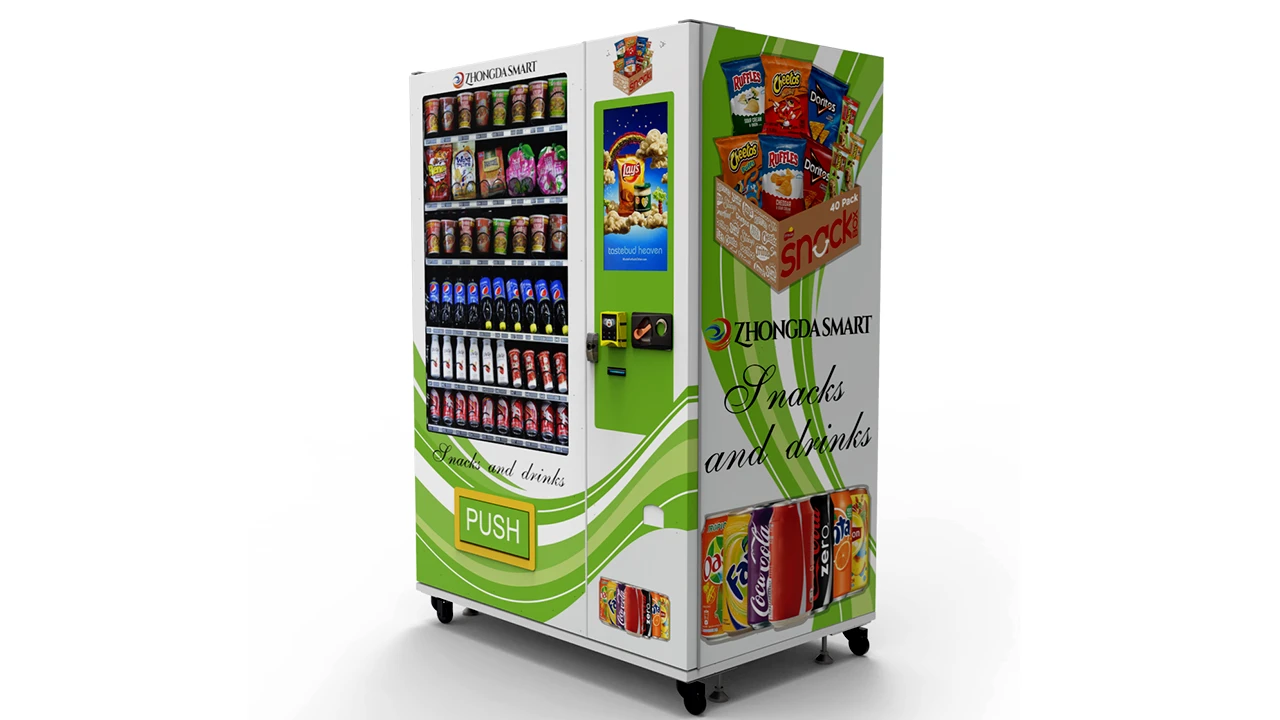
If the location needs one machine that can handle the broadest everyday demand, a refrigerated snack-and-beverage combination machine is usually the most practical starting point. It can devote part of its cabinet to bottled and canned drinks while using the remaining lanes for snacks, packaged food, and selected convenience products.
That answer changes as soon as the merchandise changes.
A boxed meal should not automatically be treated like a bag of chips. A glass bottle should not be dispensed the same way as a lightweight snack. A travel accessory may not fit a spiral at all. A machine installed near an exposed entrance has different requirements from one positioned in a controlled indoor waiting area.
I’d divide the decision this way:
Choose a refrigerated combo machine for water, drinks, snacks, and a broad general-purpose assortment.
Choose an elevator vending machine when a hard drop could damage the merchandise or its packaging.
Choose a beverage-focused machine when drink sales dominate and refill capacity matters more than variety.
Choose a locker system for larger, irregular, bundled, or pickup-based merchandise.
Choose an outdoor-oriented machine when the installation faces greater heat, moisture, dust, sunlight, or physical exposure.
Choose a compact self-service kiosk when the products are small and floor space is difficult to obtain.
There is no reason a large facility has to standardize on only one format. In fact, trying to make a single cabinet perform every retail job often produces a worse result. A beverage-heavy location, a fresh-food location, and a travel-accessory location should not be fitted with identical machines merely because all three have strong foot traffic.
The scale of passenger movement explains why the details matter. Airports Council International reports that global passenger traffic reached approximately 9.8 billion passengers in 2025, up 3.7% from the previous year.[1] IATA reported that full-year passenger demand increased 5.3% in 2025 and that the overall passenger load factor reached 83.6%.[2]
For vending operators, those numbers are relevant because large numbers of people repeatedly move through waiting, transfer, arrival, and departure zones. The commercial opportunity is concentrated, but the buying window is often short. A machine that requires a customer to think too long, wait too long, or try payment twice can lose a sale even while hundreds of potential customers are nearby.
What Changes in a High-Traffic Travel Site
A machine in a quiet workplace can tolerate a slow decision. Someone can compare products, read labels, search for a wallet, change their mind, and start again.
A passenger may be looking at a departure display while holding a phone and carrying luggage. The customer may have five minutes before moving again. That changes what “good vending” means.
The purchase window is shorter
One useful way to think about a travel-site vending machine is to give the transaction a purchase-time budget. This is not an industry standard; it is a planning concept I find useful when evaluating a machine interface.
Every unnecessary action uses part of that budget:
Searching through too many categories
Waiting for product images to load
Entering information that is not needed for the sale
Choosing between poorly explained payment methods
Waiting for a slow authorization response
Looking for a pickup door after payment
Trying to determine whether the transaction actually succeeded
A large touchscreen cannot compensate for a slow purchase flow. A seven-inch interface that lets a customer select and pay immediately may serve the site better than a much larger screen carrying several layers of menus.
For a simple one-item transaction, I’d design around the shortest practical path from product selection to pickup. The exact transaction time will depend on payment infrastructure, network conditions, software, and customer behavior, but the design principle remains the same: remove every step that does not help complete the purchase.
Demand arrives in bursts
Average daily sales can hide the hardest part of the operating day.
Consider a machine that sells 120 units over 16 hours. That sounds like 7.5 units per hour. In reality, 40 or 50 sales may occur during a concentrated passenger wave while another hour is almost silent.
This makes peak-period capacity more useful than average hourly volume when planning the fastest-moving products.
The machine may still contain plenty of inventory and yet be commercially understocked because the three products people want most have sold out.
Availability should be measured commercially
A machine can be powered on and connected while still being practically unavailable.
If the card reader cannot authorize a payment, the machine is not meaningfully available to a customer who wants to pay by card. If the touchscreen freezes, it is not available. If the delivery door is blocked, it is not available. If all water lanes are empty, it is not fully available for the product category driving demand.
I prefer the term commercial uptime: the percentage of operating time during which a customer can complete a normal purchase of the products that should be available.
That is a more useful operating measure than asking only whether the cabinet has electrical power.
Service access becomes part of the machine specification
A busy vending machine is only attractive while somebody can refill and maintain it efficiently.
Before approving a location, look at the route a service person must take with inventory. A machine positioned in a wonderful customer location can still create a poor operating model if every refill requires a long detour, difficult security access, an elevator trip, or a service window that conflicts with peak traffic.
The same thinking applies inside the cabinet. Shelves, trays, payment components, filters, refrigeration parts, control boards, and consumable service items should be accessible without turning every routine job into a major disassembly.
The Main Vending Machine Types Worth Considering
Refrigerated snack-and-drink combo machines
This is the format I’d choose first for a broad passenger audience. One cabinet can handle bottled water, canned beverages, juice, energy drinks, packaged snacks, cookies, candy, and selected convenience food.
The strength of a combination machine is not simply variety. It is the ability to change the ratio between categories as sales become clearer.
If beverages account for most transactions, more lanes can be allocated to drinks. If snacks are moving faster than expected, tray space can shift. If certain products perform badly, an operator can remove them without changing the entire retail concept.
A flexible lane layout matters more than a long opening-day product list.
The main limitation is dispensing method. Standard drop systems work well for many conventional products but need careful testing with packages that crush easily, bottles that can leak after impact, or premium goods where cosmetic damage creates a refund.
Elevator vending machines
Elevator delivery changes what can reasonably be sold through a vending machine.
Instead of allowing a selected product to fall to a collection area, the delivery platform moves into position, receives the item, and transports it toward the pickup point. The gentler handoff makes sense for boxed food, desserts, dairy products, glass bottles, cosmetics, electronics, and other merchandise that should not take a hard fall.
If I were choosing for a location where the average item value is relatively high, I would look closely at this format even when the merchandise is physically capable of surviving a drop. Better delivery can reduce damaged packaging and improve the moment when the customer receives the product.
There is a tradeoff. The elevator adds moving parts. Motors, belts, sensors, positioning components, and control logic must remain serviceable. Operators should ask about calibration, spare parts, error reporting, recovery after an interrupted vend, and how a technician reaches the moving assembly.
Elevator vending is worth paying for when the product benefit is real. It should not be added merely because it sounds more advanced.
High-capacity beverage vending machines
Some sites do not need dozens of different product categories. They need cold drinks, and they need a lot of them.
In that situation, a beverage-oriented configuration may be more efficient than using valuable cabinet space for low-volume snacks.
Capacity should be concentrated on the drinks that move fastest. If bottled water represents a large share of sales, it may deserve several columns or channels rather than one.
This is one of the easiest mistakes to make during specification. Buyers often ask, “How many selections does the machine have?” I would ask a different question: “How many units of my top five products can the final layout hold?”
Those are very different measures.
Locker vending systems
Spirals and conveyor lanes require products to behave in predictable ways. Locker compartments do not.
A locker can hold a neck pillow, compact travel kit, larger electronics package, gift box, bundled merchandise, small bag, or other product that would be awkward to push through a conventional lane.
Lockers can also be paired with QR codes or pickup codes for prepaid collection. That creates options beyond traditional impulse vending. The cabinet can function as both automated retail and a pickup point.
The compromise is inventory density. A compartment may hold only one large item, so every door consumes substantial cabinet volume. Locker economics work best when gross profit per compartment justifies the space.
Outdoor-oriented vending machines
An outdoor machine should not be thought of as an indoor machine with a roof placed above it.
Greater exposure changes cabinet design, seals, ventilation, refrigeration load, payment hardware protection, corrosion planning, screen readability, and physical security.
The actual site matters. A protected entrance under a deep canopy creates a different operating environment from a cabinet that receives direct sun or wind-driven rain.
For exterior installations, I’d want the manufacturer to know the expected exposure before the cabinet is finalized. “Outdoor” should describe the engineering requirement, not merely the marketing category.
Compact self-service kiosks
There are places where a full cabinet is simply too large. A wall-mounted or narrow-format kiosk can work for charging cables, adapters, personal-care items, headphones, cosmetics, small snacks, or other compact merchandise.
These formats trade capacity for footprint efficiency.
They make the most sense when the product is small enough that a limited cabinet can still hold a commercially useful amount of stock. A compact kiosk selling cables may go far longer between refills than the same cabinet filled with large drink bottles.
Specialty automated retail
Not every machine needs to sell a little of everything.
There are situations where a focused assortment is more useful. Someone who discovers a damaged charging cable does not need a wall of unrelated products. The value comes from seeing the exact item needed at the exact moment it becomes urgent.
Personal-care kits, compact electronics, travel supplies, gifts, protective items, and other specialist categories can work when the location and product solve the same immediate problem.
Airport & Transit Vending Machine Comparison
| Machine Type | Best Product Profile | Typical Delivery Method | Fragile Product Fit | Capacity Priority | Refill Intensity | Service Complexity | Where It Makes Sense |
|---|---|---|---|---|---|---|---|
| Refrigerated combo machine | Cold drinks, snacks, packaged food | Spiral, pusher, belt, or drop configuration | Medium | High | Medium to high | Medium | General passenger waiting and circulation areas |
| Elevator vending machine | Meals, glass bottles, cosmetics, electronics, premium goods | Controlled elevator delivery | High | Medium to high | Medium | Higher | Fresh-food and premium automated retail |
| Beverage-focused machine | Bottled and canned drinks | Product-specific vending channels | Product dependent | Very high | High at busy sites | Medium | Locations dominated by hydration demand |
| Smart locker system | Bulky, irregular, bundled, or prepaid merchandise | Compartment release | High | Low item density | Low to medium | Medium | Travel essentials, pickup, and larger products |
| Outdoor-oriented machine | Drinks, snacks, packaged convenience products | Depends on configuration | Product dependent | Medium to high | Site dependent | Medium to high | Entrances and more exposed passenger areas |
| Compact self-service kiosk | Cables, accessories, small merchandise | Small vending channels or compartments | Medium to high | Low to medium | Product dependent | Low to medium | Small footprints and focused convenience retail |
One distinction in this table deserves extra attention: service complexity is not automatically bad. An elevator system is mechanically more involved than a basic drop mechanism, but the additional complexity can be justified when it allows a higher-value product to be sold reliably.
The right question is whether the added hardware solves a problem that affects revenue, product quality, or customer satisfaction.
Real Capacity Is Not the Number on the Specification Sheet
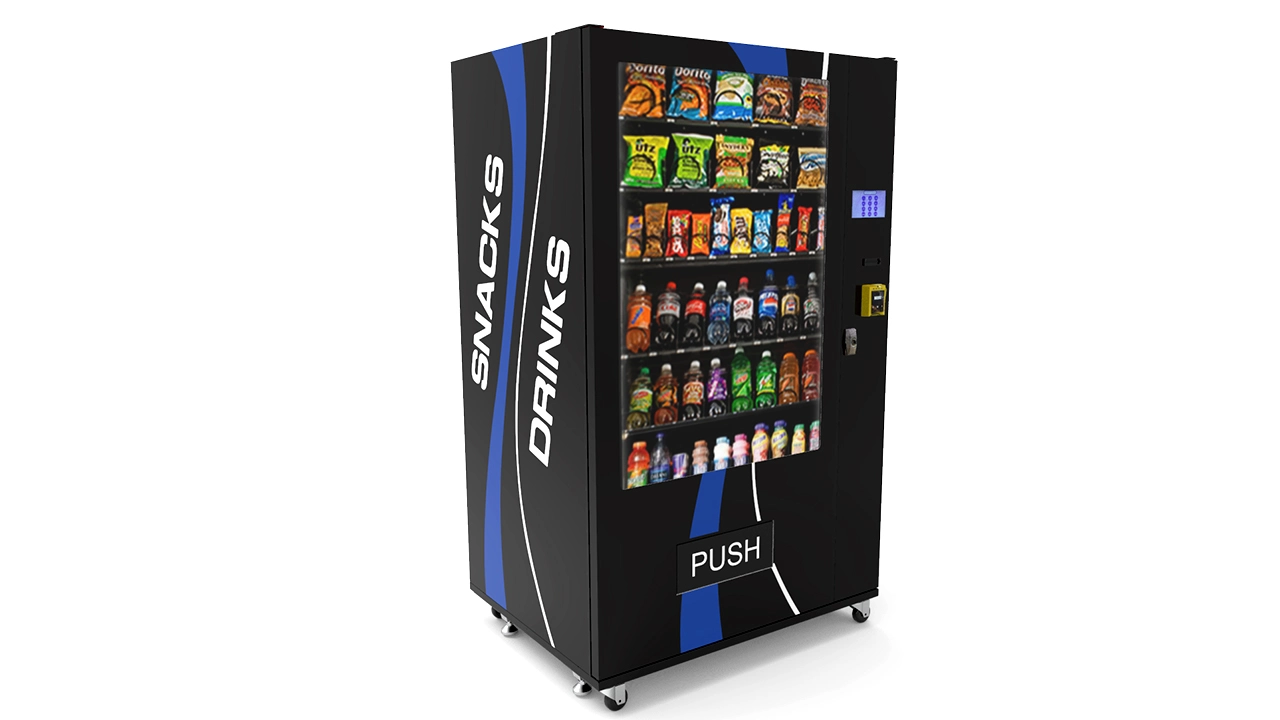
Vending capacity is one of the most misunderstood numbers in equipment buying.
A product page may state that a machine holds 300, 360, or another number of items. That figure can be useful for initial comparison, but it should never be treated as the guaranteed capacity of the operator’s final assortment.
Package size changes everything.
A narrow can, a large bottle, a bag of chips, and a boxed sandwich occupy very different amounts of space. Increasing the width of a lane may make a product vend more reliably while reducing the number of neighboring selections. Increasing the spacing between shelves can accommodate a taller package while reducing vertical density.
For high-volume sites, I prefer a second capacity metric: usable bestseller capacity.
Usable bestseller capacity asks how many units of the products most likely to sell out can actually fit in the final configuration.
Consider two machines:
Machine A advertises 360 total items but holds only 12 units of the top-selling bottled water.
Machine B holds 320 total items but gives the same water product 36 units of usable capacity.
If water is the item that repeatedly sells out first, Machine B may require fewer emergency refills even though its headline capacity is lower.
A 360-item vending machine can still be effectively understocked if its highest-volume product occupies only one narrow channel.
Ask for a product map before production
For a serious project, I’d provide the manufacturer with the planned products before approving the internal layout.
Useful information includes:
Package width
Package height
Package depth
Product weight
Bottle or package shape
Whether the package is rigid or flexible
Whether the surface is slippery or high-friction
Whether the product can tolerate a direct drop
Which products are expected to sell fastest
Width and height alone do not tell the complete dispensing story. Two boxes with identical dimensions can behave differently if one is light and rigid while the other has flexible packaging.
Build around the difficult products first
If a planned assortment contains one unusually large bottle, one fragile package, and one heavy product, those products deserve early testing.
The easiest snack in the assortment tells the manufacturer very little. The difficult products reveal whether lane width, shelf spacing, dispensing force, drop height, elevator handling, and pickup-door dimensions are appropriate.
I’d send a representative sample set containing the smallest item, largest item, heaviest item, most fragile item, and likely bestseller whenever physical product testing is practical.
Zhongda Smart Configurations I Would Shortlist
Zhongda Smart manufactures several machine structures that fit the different operating jobs described above. The company’s airport and transit vending solutions page brings refrigerated, elevator, outdoor, and locker-based approaches together in one deployment framework.
For an actual project, I would not select a machine solely from a model number. The merchandise, payment hardware, required capacity, installation environment, service plan, and software functions should determine the final specification.
ZD-L-7 for conventional snack-and-beverage demand
The Zhongda Smart ZD-L-7 snack and beverage vending machine is a useful reference point for a conventional high-capacity configuration.
The published configuration includes 60 standard cargo lanes, approximately 300–360 items depending on product size and layout, a 7-inch touchscreen, refrigerated storage, and 4G, Wi-Fi, and LAN connectivity. Available payment configurations include card, QR-code, cash, coin, payment-code, and membership-card options depending on the project.
Those specifications suit a machine whose main job is straightforward high-volume convenience retail.
The part I would pay most attention to is the “depending on configuration” language around capacity. Sixty lanes do not mean every operator should use sixty completely different products. High-volume SKUs may deserve duplicate lanes, and larger packaging can change the usable quantity significantly.
ZD-LS-22 when the drop is the problem
The Zhongda Smart ZD-LS-22 elevator vending machine addresses a different operating problem.
The published model uses an elevator delivery system and lists approximately 300–360 products depending on configuration, a 22-inch touchscreen, up to 60 configurable slots, and 4G, Wi-Fi, and LAN connectivity.
I’d choose this direction when product condition after dispensing matters more than having the simplest possible mechanism.
A premium boxed meal arriving with a crushed corner can create a poor customer impression even when the food itself is unharmed. The same applies to electronics packaging, cosmetics, glass containers, and other merchandise where presentation has real value.
Outdoor configuration for more exposed placements
Zhongda Smart also manufactures an outdoor snack and drink vending machine for projects requiring a more protected cabinet structure and configurable refrigeration, payment, and branding options.
I would still specify the exact site conditions before treating any outdoor machine as approved for installation. Sun exposure, rainfall, ambient heat, drainage, ventilation, mounting surface, access, and canopy coverage can all affect the final requirement.
What these models do not tell you by themselves
A product page cannot answer how often the machine must be refilled, which payment processor should be used, what the average sale will be, which SKU will sell fastest, or what the site will charge for placement.
Those are operating decisions.
The machine specification has to support them, but the machine cannot decide them.
Payment Speed Matters More Than Screen Size
Cashless payment should be designed into a high-traffic vending machine from the beginning rather than treated as an accessory added after production.
The payment device affects the cabinet opening, mounting bracket, wiring, communication protocol, power supply, processor integration, user interface, and service procedure.
Changing readers after the cabinet has already been manufactured can turn a simple request into mechanical and electrical rework.
Make the fastest payment method easy to recognize
A passenger should not need instructions from another person to understand how to pay.
The payment area should answer three questions immediately:
Where do I tap, insert, scan, or present payment?
How much am I being charged?
Did the transaction succeed?
The final question is often overlooked. A long pause with no obvious confirmation causes customers to tap again, press another button, or abandon the purchase.
Payment security belongs in procurement
The PCI Security Standards Council specifically includes Unattended Payment Terminals within its Point of Interaction device categories.[3]
That is a reminder that unattended payment hardware should be selected with the payment provider, acquiring setup, device requirements, and applicable security responsibilities in mind.
Before production, clarify:
Who supplies the terminal?
Who configures it?
Who owns the merchant account?
How does the terminal communicate with the vending controller?
Who is responsible for software or firmware updates?
How is a failed terminal replaced?
How are unsuccessful or reversed transactions handled?
A machine can have perfect refrigeration and flawless dispensing while generating almost no revenue if the primary payment terminal stays offline.
Test the network under realistic conditions
Connected vending depends on more than having a signal icon on the screen.
Payment authorization, remote telemetry, inventory updates, software communication, and fault reporting may all rely on connectivity.
Available approaches can include cellular data, Wi-Fi, or wired Ethernet. The most appropriate option depends on the site infrastructure and payment architecture.
During commissioning, test repeated transactions rather than completing one successful payment and declaring the connection finished.
Also test recovery. Disconnect the network temporarily, restore it, and verify how the machine reconnects. An unattended machine should recover from ordinary communication interruptions with as little manual intervention as possible.
Commercial uptime should include payment uptime
For larger fleets, I would track payment availability separately.
If a machine is electrically online 99% of the month but its primary payment device is unavailable for several hours during the busiest periods, the headline uptime figure is misleading.
A better report separates:
Machine power uptime
Controller connectivity
Payment availability
Dispensing availability
Refrigeration status where applicable
This makes it easier to see which part of the system is actually reducing revenue.
What to Stock When Customers Have Only a Few Minutes
Product selection should start with immediate usefulness.
The most successful assortment does not need to be unusual. Familiar products often have an advantage when customers are moving quickly because recognition shortens the decision.
Give core products most of the space
I’d separate the initial assortment into three groups.
Core products receive the most capacity because the operator expects reliable everyday demand.
Supporting products add useful choice but do not need the same inventory depth.
Test products receive limited space until sales data proves they deserve more.
This approach prevents an unproven product from consuming the same cabinet capacity as a bestseller.
Beverages
Water, familiar cold drinks, energy drinks, juices, and other portable beverages are a natural fit because they solve an immediate need and can be consumed while moving.
Do not assume every drink deserves one lane.
If one bottle accounts for a much larger share of unit sales, duplicate the lane before adding another weak-selling flavor simply to increase variety.
Packaged snacks
Portable packaging matters. Products that can be opened easily, carried in one hand, and consumed without preparation generally fit the environment better than products requiring a table or utensils.
Packaging should also survive the selected delivery method. Flexible snack bags behave differently from rigid boxes and should be tested accordingly.
Fresh and refrigerated food
Fresh food can raise the usefulness of a vending program, particularly when staffed food options are unavailable or when passengers have longer dwell times.
It also creates more work behind the cabinet.
A refrigerated machine does not replace product rotation, temperature procedures, date control, cleaning, spoilage management, or other food-safety responsibilities.
Fresh-food economics should include unsold product, not only the margin on products that sell.
If a meal carries a strong gross margin but a significant percentage must be discarded, the real contribution may be lower than expected.
Travel essentials
Small items can produce a very different financial profile from snacks and drinks.
A charging cable may sell far fewer units than bottled water while contributing more gross profit per transaction. Personal-care items, adapters, headphones, tissues, compact kits, and other convenience merchandise can also solve problems that become urgent during a journey.
For these products, I’d watch gross profit per compartment, not only units sold.
Do not overload the screen with choice
A machine may be physically capable of carrying 50 or 60 different selections. That does not mean the interface should make all of them feel equally important.
High-frequency purchases should be visually easy to find.
If the customer needs several seconds merely to locate water on the screen, the digital merchandising has failed at a very basic job.
Placement: Dwell Time Matters More Than Raw Foot Traffic
Foot traffic is useful, but it is not enough.
Ten thousand people walking quickly past a machine without looking at it may produce fewer transactions than a much smaller group waiting nearby for 20 minutes.
When evaluating a location, I would look at traffic, visibility, direction, dwell time, accessibility, and service access together.
Waiting areas
Waiting areas can support broader assortments because people have time to notice the machine and compare products.
Combo machines work naturally here, while locations with enough dwell time may also support fresh food, higher-value products, or specialty merchandise.
Visibility from the seating area helps because customers may see the machine several times before deciding to buy.
Near departure flows
These areas reward speed.
The product mix should emphasize items that customers recognize immediately, and the interface should avoid complicated browsing.
A machine in this position may perform better with fewer obvious categories than a large catalog requiring several screens.
Arrival and transfer areas
Arriving passengers can have different needs. Drinks remain useful, but charging accessories, toiletries, personal-care products, and other practical items may become more relevant.
That is a good example of why identical equipment across an entire property can leave sales opportunities unused.
Employee and operational areas
Staff demand is easy to overlook because it is less visible than passenger demand.
Employees can create consistent repeat purchases across long operating hours. The product mix may also become easier to optimize because the same population returns regularly.
Position the pickup zone where it can actually be used
Customers need enough space to approach, pay, bend or reach toward the pickup area, collect the product, and move away without standing in the main pedestrian stream.
A machine should not be installed so close to a wall, barrier, queue, or neighboring cabinet that the service door or customer pickup area becomes awkward.
Measure refill friction before installation
I use refill friction as a practical planning term for all the small obstacles that make a routine service visit slower.
Examples include:
Long walking distance from inventory storage
Restricted service hours
Multiple access checkpoints
Small service elevators
Insufficient space in front of the machine
Cabinet doors that interfere with nearby fixtures
No convenient place to stage product cases
A location can produce strong revenue and still become expensive if servicing it consumes too much labor.
Remote Monitoring, Refilling, and Vending Machine Repair
Removing a cashier does not remove operations.
A vending fleet still needs replenishment, cleaning, payment-terminal checks, fault response, refrigeration monitoring where applicable, and replacement of components as they wear.
The difference is that good telemetry lets the operator decide where labor is needed before sending someone to the machine.
Remote management should answer operational questions
A useful dashboard does more than display a revenue graph.
It should help answer:
Which machines need stock today?
Which products are nearly sold out?
Which machine stopped reporting?
Which payment device appears unavailable?
Which lane has produced repeated vend errors?
Is a refrigerated cabinet operating normally?
How much did each SKU sell since the previous refill?
The best remote-management data changes what a service team does next.
Refill by exception rather than habit
A fixed route is simple, but it can create two kinds of waste.
The first is visiting machines that do not need stock. The second is allowing fast-selling machines to empty before the next scheduled visit.
Product-level inventory data can support a more flexible route. A high-volume machine may need daily attention while another location can operate longer between visits.
The benefit grows as a fleet becomes larger and more dispersed.
Separate routine service from technical repair
I’d organize maintenance into at least three levels.
Routine route service includes restocking, cleaning, visual inspection, removing debris, checking the pickup area, verifying prices, checking the payment terminal, and completing a test purchase when appropriate.
Field repair covers components that trained technicians can replace without major workshop work: selected motors, sensors, power supplies, modules, switches, readers, screens, or controller components depending on the machine.
Specialist repair covers work that requires deeper electrical, refrigeration, mechanical, or software expertise.
This prevents every small fault from becoming an expensive specialist visit.
Plan spare parts before the first failure
Spare-parts planning is much cheaper before a machine breaks.
A commercial fleet should identify which components are most important to commercial uptime and which are realistic to replace in the field.
The exact kit depends on machine structure, but the discussion may include:
Dispensing motors
Sensors
Power components
Control modules
Network modules
Payment mounting components
Pickup-door parts
Fans
Selected refrigeration service parts
Touchscreen or display components
The objective is not to build a warehouse of unused parts. It is to avoid losing several days of sales because a relatively inexpensive component is unavailable.
Documentation matters after the warranty call ends
Before accepting a fleet, ask what technical information is supplied.
A useful documentation package may include machine operating instructions, electrical diagrams, parts identification, error codes, remote-management instructions, payment integration information, preventive maintenance guidance, and basic troubleshooting.
A short repair video can be extremely helpful, but it should not be the only record of how a system is assembled.
Outdoor and Semi-Outdoor Installations Need Separate Planning
A location near an entrance may look almost indoor while still exposing a machine to conditions it would never experience deeper inside the building.
Direct sunlight can raise cabinet temperature. Wind can carry dust and moisture. Rain can reach an installation that appears protected from one direction. Temperature variation changes refrigeration workload.
For those reasons, outdoor vending should start with the installation environment rather than the product catalog.
Questions worth answering before production
Will the machine receive direct sun?
Can rain reach the cabinet?
Is the machine beneath a permanent canopy?
Can water collect around the base?
How hot can the surrounding area become?
Is there sufficient airflow around the refrigeration system?
Is anchoring required?
Will the screen remain readable in strong light?
Does the payment terminal require additional protection?
How easily can service personnel reach the installation?
These details may affect cabinet construction, cooling, seals, canopy design, screen selection, electrical protection, and physical installation.
Refrigeration performance depends on the whole installation
A cooling system needs airflow.
Placing a machine flush against a surface that blocks required ventilation can create a refrigeration problem even when the equipment is functioning correctly.
Likewise, a cabinet operating under significant environmental heat may behave differently from the same cabinet in a controlled indoor space.
Installation clearance should therefore be treated as a technical requirement, not an aesthetic preference.
Customization That Improves the Business
Customization is valuable when it solves a real operating problem.
It becomes expensive noise when every visible feature is changed while the internal retail logic remains weak.
Start with the product
Product dimensions should influence lane width, shelf height, dispensing method, elevator configuration, locker size, and pickup design.
For a mixed-product project, I would settle the physical assortment before spending too much time discussing graphics.
A beautiful cabinet that cannot dispense the intended product reliably is still the wrong machine.
Configure capacity around demand
Customization can include more than changing the number of spirals.
The project can allocate more depth to bestsellers, reserve gentler delivery for fragile products, change shelf spacing, combine product mechanisms, or use lockers for items that do not belong in conventional lanes.
Specify payment hardware early
The payment device should be part of the design package before metalwork is finalized whenever possible.
That reduces the chance of improvised brackets, awkward wiring, blocked access, or a reader positioned where customers struggle to use it.
Keep the software interface simple
Useful software customization may include:
Branding
Product categories
Clear product photography
Price display
Sold-out status
Language options where required
Digital receipt options where supported
Payment guidance
Customer support information
Advertising content that does not interrupt purchasing
Advertising should never make buying harder.
If a customer has to wait for promotional content before purchasing a bottle of water, the screen is serving the advertisement instead of serving the transaction.
Standardize hidden components where possible
Custom fleets become difficult to maintain when every machine uses different internal components.
I’d customize the parts that improve the business while keeping motors, sensors, power supplies, controllers, connectors, and service procedures as standardized as the project allows.
That makes spare-parts stocking and technician training much easier later.
Branding should identify the retail offer quickly
A customer should understand what the machine sells before standing directly in front of it.
Full-cabinet graphics can create strong visibility, but excessive text has the opposite effect. Large product categories, recognizable imagery, clean pricing, and a clear purchase area usually do more useful work than filling every panel with messaging.
Vending Machine Cost, Revenue, and ROI
The machine quotation is only one part of the investment.
A realistic budget should consider everything required to make the machine commercially operational.
Build the installed cost first
Depending on the project, installed capital may include:
Vending machine hardware
Refrigeration system
Elevator system if selected
Touchscreen configuration
Payment terminal
Payment integration work
Remote-management hardware or software
Custom graphics
Freight
Handling
Site preparation
Power or network work
Installation
Commissioning
Initial spare parts
Initial inventory
Other applicable project charges
Comparing suppliers only by cabinet price can produce a false saving if one quotation excludes hardware or work that another includes.
An illustrative installed-cost model
The following table is a planning example only. It is not a Zhongda Smart quotation, market average, price promise, or expected project cost.
| Illustrative Cost Item | Planning Amount |
|---|---|
| Configured vending machine | $4,500 |
| Payment hardware and integration | $800 |
| Freight and handling | $1,400 |
| Site preparation | $900 |
| Custom branding | $500 |
| Initial spare-parts allowance | $400 |
| Commissioning and setup | $500 |
| Total illustrative installed capital | $9,000 |
Actual pricing can differ materially according to machine type, configuration, quantity, payment hardware, customization, freight, installation, and commercial terms.
Calculate sales from transactions, not foot traffic
A useful first formula is:
Monthly gross sales = completed transactions per day × average transaction value × operating days
For example:
80 transactions × $4.75 average sale × 30 days = $11,400 gross monthly sales.
The important number in that formula is completed transactions, not the number of people who passed nearby.
Gross sales are not operating profit
A serious vending ROI model should subtract the costs that follow the sale.
These can include:
Merchandise cost
Venue commission or rent
Payment processing
Refill labor
Transportation and route cost
Waste
Spoilage
Shrink
Connectivity
Utilities
Maintenance
Software
Customer refunds
Other operating overhead
A more useful calculation is:
Operating contribution = gross sales − product cost − venue cost − payment cost − service cost − spoilage/shrink − connectivity/utilities − maintenance reserve.
Illustrative operating scenarios
The percentages below are assumptions for comparison, not promised margins or expected returns.
| Metric | Lower-Volume Planning Case | Base Planning Case | High-Volume Planning Case |
|---|---|---|---|
| Completed transactions per day | 40 | 80 | 140 |
| Average transaction | $4.50 | $4.75 | $5.00 |
| 30-day gross sales | $5,400 | $11,400 | $21,000 |
| Illustrative merchandise cost | 43% | 41% | 40% |
| Illustrative venue cost | 15% | 15% | 17% |
| Illustrative payment cost | 4% | 4% | 4% |
| Illustrative service, waste, connectivity and maintenance | 23% | 20% | 19% |
| Illustrative operating contribution | 15% | 20% | 20% |
| Illustrative monthly contribution | $810 | $2,280 | $4,200 |
These are planning scenarios, not expected returns. Actual results can be higher or lower and can change substantially with product costs, pricing, venue contracts, transaction volume, payment fees, waste, downtime, labor, and consumer demand.
Transaction volume changes the economics quickly
At an illustrative $4.75 average transaction:
| Transactions Per Day | Daily Gross Sales | 30-Day Gross Sales |
|---|---|---|
| 25 | $118.75 | $3,562.50 |
| 50 | $237.50 | $7,125.00 |
| 75 | $356.25 | $10,687.50 |
| 100 | $475.00 | $14,250.00 |
| 125 | $593.75 | $17,812.50 |
| 150 | $712.50 | $21,375.00 |
| 200 | $950.00 | $28,500.00 |
This table explains why I would spend more time validating placement than negotiating a small reduction in cabinet price.
A weak site cannot usually be rescued by buying a slightly cheaper machine.
Calculate contribution by machine
Fleet totals can hide bad placements.
If one machine produces excellent sales while three others consume service labor without generating enough contribution, a fleet-wide revenue number may still look healthy.
Track each machine separately:
Transactions per day
Average transaction
Gross margin
Venue cost
Payment fees
Refill labor
Waste
Refunds
Downtime
Maintenance
A smaller kiosk selling high-margin accessories may produce stronger contribution per square foot than a beverage machine with far higher unit volume. Both can be successful; they simply need different financial benchmarks.
An Illustrative High-Traffic Deployment
The following example is intentionally hypothetical. It shows how I would think about machine selection without presenting invented customer results.
Assume a facility has four candidate vending zones.
Zone A: long-dwell waiting area
Customers remain nearby for 20 to 45 minutes. The location can support a broad selection, and customers have enough time to consider food as well as drinks.
I would start with a refrigerated combination machine or an elevator machine if the menu contains fresh meals and more delicate packaging.
The starting assortment might devote around half of available unit capacity to drinks, a meaningful portion to snacks, and the remaining space to selected food.
After two to four weeks, the capacity allocation should be rebuilt around actual sales.
Zone B: fast-moving departure path
Customers have limited time and move in concentrated waves.
I would simplify the assortment and give more physical capacity to bottled drinks and the strongest snack sellers.
This location should have a very short interface path and highly visible contactless payment.
A large catalog would be less important than keeping the core products available during peaks.
Zone C: arrival and transfer area
Customers may need drinks, but there is also a reason to test practical accessories.
A conventional combo machine paired with a compact accessory kiosk could make more sense than adding another identical snack machine.
The accessory cabinet could focus on cables, headphones, small personal-care kits, tissues, and other items with a strong immediate-use case.
Zone D: exposed entrance
The product need is simple: cold drinks and selected packaged snacks.
The environmental requirement is not simple.
I would specify the exposure conditions first and choose an outdoor-oriented cabinet only after confirming ventilation, water exposure, sunlight, mounting, electrical supply, and service access.
What this four-zone plan demonstrates
The vending strategy comes from the job each location must perform.
Ordering four identical machines would make procurement easier, but it could make operations worse.
A good fleet can still standardize components and software while using different cabinet structures for different retail jobs.
What I Would Confirm Before Approving Production
Once the model has been selected, the project needs a written specification. Verbal assumptions are difficult to resolve after a custom machine has already been assembled.
Product and dispensing
What are the dimensions and weights of the actual products?
Which delivery mechanism will each category use?
Which products have been physically tested?
How much capacity will each bestseller receive?
What happens if the product fails to dispense?
How does the customer request help or a refund?
Are fragile products using an appropriate delivery method?
Cabinet and installation
What are the final machine dimensions?
What is the packed shipping size?
What is the machine weight?
What clearance is needed around the cabinet?
How far does the main door open?
Does the site require anchoring?
What floor loading or leveling conditions should be considered?
How will the machine move from unloading point to final position?
Power
What electrical supply does the final configuration require?
What is the rated power?
Does refrigeration create additional startup demand?
Where is the power inlet?
What happens after an ordinary power interruption?
Payment
Which payment terminal is being installed?
Who supplies it?
Which payment methods will be active?
Which processor or merchant setup is required?
Has the physical mounting position been approved?
How does it communicate with the vending controller?
What is the replacement process after terminal failure?
Connectivity
Does the machine use cellular data, Wi-Fi, Ethernet, or a combination?
What happens when connectivity is interrupted?
Does the machine reconnect automatically?
Which functions require a live connection?
Can connection loss create an alert?
Remote management
Can sales be viewed by SKU?
Can stock be monitored by lane?
Are payment records available?
Can machine errors be viewed remotely?
Can data be exported?
Are user roles and permissions available?
How are software updates handled?
Refrigeration
What product categories is the cooling system designed to support?
How is cabinet temperature monitored?
Can an abnormal condition generate an alert?
How does service staff reach the condenser and other maintenance points?
What ventilation clearance does the machine require?
Maintenance and spare parts
Which components are intended for field replacement?
Which spare parts are recommended for the initial fleet?
Are electrical diagrams available?
Is a parts list available?
What technical support channels are provided?
How are replacement parts identified and ordered?
Software and user interface
Is the purchase flow approved before shipment?
Are prices easy to read?
Is sold-out status clear?
Does the payment screen explain what is happening?
Is support information visible?
Are required languages configured correctly?
Factory acceptance
Will the machine be tested with the intended products?
Can all configured payment functions be verified?
Will repeated dispensing tests be performed?
Is there an aging or extended operating test?
Can the buyer review the completed machine before shipping?
Are serial numbers and final configuration details recorded?
This checklist looks long because the machine is more than a cabinet. It is a mechanical dispensing system, payment endpoint, connected device, retail interface, and in some cases a refrigerated appliance operating as one product.
A Practical Pilot and Rollout Plan
I’d choose a staged deployment over a large first order whenever the commercial model has not yet been proven.
Stage 1: define the retail job
Before discussing machine color, define:
What will be sold?
Which products are expected to sell fastest?
Is refrigeration required?
Are any products fragile?
How will customers pay?
Who will refill the machine?
How frequently can the location be serviced?
Who responds to faults?
What data needs to be visible remotely?
Stage 2: approve a real product map
Build the lane plan using the actual assortment.
Do not use a generic capacity drawing if the product mix is already known.
The planned top sellers should receive enough depth to survive the expected interval between service visits.
Stage 3: complete factory acceptance
Test dispensing repeatedly. One successful vend proves almost nothing.
Test different positions, different product weights, nearly empty lanes, full lanes, payment communication, network reconnection, touchscreen operation, remote reporting, and any sensors responsible for confirming delivery.
Stage 4: commission the location
Complete real transactions after installation.
Confirm that network performance at the site matches what was expected, prices are correct, products are mapped to the correct selections, refrigeration is operating as required, and remote-management data corresponds to actual inventory.
Stage 5: collect an opening baseline
For the first operating period, monitor:
Transactions by hour
Sales by SKU
Stockout frequency
Failed-vend events
Payment issues
Refunds
Waste
Service time
Refill frequency
Stage 6: rebuild the assortment
The opening product plan is a hypothesis.
If one drink repeatedly empties while another barely moves, reallocate the lane space. If fresh food creates too much waste, reduce depth or change replenishment frequency. If a higher-priced accessory sells steadily, it may deserve more capacity.
Stage 7: decide whether the machine has earned replication
Before ordering a large fleet, make sure the pilot answered the questions that matter.
The pilot should demonstrate more than revenue. It should reveal how often the machine needs service, what fails, how payment behaves, whether products dispense reliably, whether the location can be replenished efficiently, and what operating contribution remains after costs.
Common Mistakes That Cost Operators Money
Buying by advertised capacity
A high total item count looks attractive until the most important SKU sells out in two hours.
Plan capacity by product, not just by machine.
Choosing a machine before choosing the merchandise
The product should help determine the delivery mechanism.
Doing this in reverse often leads to compromises, especially with large or fragile packaging.
Using elevator delivery where it adds no value
An elevator is useful hardware, but it is not automatically better for every category.
If the assortment consists entirely of lightweight products designed for conventional vending, additional moving components may not improve the business enough to justify them.
Using a drop system for products that should not drop
The opposite mistake is just as common.
If cosmetic condition, package integrity, or product value matters, test the actual drop before assuming conventional delivery is acceptable.
Adding the payment reader at the end
Payment integration belongs near the beginning of a custom project.
Late changes can affect metalwork, wiring, software, communication, and certification responsibilities.
Buying a large screen instead of a fast interface
Customers do not buy screen size. They buy the product behind it.
The interface should reduce buying time rather than turn the purchase into a browsing session.
Treating every SKU equally
A weak-selling product does not deserve the same inventory depth as the bestseller merely because both need a selection number.
Use duplicate lanes when the data supports them.
Ignoring refill labor
A machine that sells quickly also consumes inventory quickly.
If staff spend too much time reaching, opening, loading, counting, cleaning, and closing the machine, servicing can absorb a surprising amount of operating contribution.
Waiting for a breakdown before ordering spare parts
The cost of a motor or sensor can be tiny compared with the revenue lost while waiting for it to arrive.
Leaving weak machines in place for too long
Placement decisions should be reviewed.
If pricing, assortment, visibility, and merchandising have been adjusted and a machine still cannot generate acceptable contribution, relocation can be more rational than endlessly optimizing a weak site.
Assuming high traffic guarantees sales
People need to see the machine, have enough time to use it, want the products, accept the pricing, and trust the payment process.
Traffic creates potential. Conversion creates revenue.
How Zhongda Smart Approaches a Custom Project
From a manufacturing standpoint, the most useful project discussion starts before metal is cut.
The machine has to connect several systems that affect one another: product packaging, dispensing structure, cabinet size, temperature control, payment hardware, electrical design, connectivity, software, branding, and maintenance access.
Zhongda Smart describes this process in more detail in its guide to how vending machines are manufactured inside the Zhongda Smart factory.
The useful point for a buyer is that custom manufacturing should start with operating requirements rather than appearance.
Step 1: define the product
The manufacturer needs to know what the machine will actually sell.
Package dimensions are the beginning. Weight, shape, material, fragility, and the planned number of units per SKU influence the mechanical design.
Step 2: choose the dispensing method
Spirals, pushers, belts, elevator systems, lockers, and other mechanisms solve different product problems.
The simplest mechanism that reliably handles the product is often the best long-term choice.
Step 3: integrate payment and connectivity
Payment hardware should be physically and electronically integrated into the machine design. Connectivity should support both payment requirements and the operator’s remote-management needs.
Step 4: configure software around the transaction
The software should match the real selling process: product selection, price display, payment, vend confirmation, stock status, reporting, and operator management.
Step 5: test with realistic conditions
A product that vends correctly once should be tested again.
Repeated cycles can expose intermittent problems that a single demonstration misses.
High-volume locations make this particularly important because a small reliability issue becomes much more visible when the machine completes hundreds of transactions.
Step 6: prepare service before shipment
Parts identification, technical documentation, spare components, remote support, and maintenance access should be discussed while the machine is still at the factory.
After the cabinet has arrived on site is the wrong time to discover that a routine service component is difficult to reach.
Where Zhongda Smart fits
Zhongda Smart supports OEM and ODM vending projects involving cabinet configuration, product lanes, branding, touchscreen interfaces, payment modules, refrigeration, elevator delivery, connectivity, and remote-management functions.
I would use that flexibility to solve documented project requirements rather than customizing everything simply because customization is available.
The strongest custom machine is still recognizable and maintainable as part of a fleet. It should look appropriate for the retail program without turning every replacement part into a one-off component.
Frequently Asked Questions
What is the best vending machine for an airport or transit location?
A refrigerated snack-and-beverage combo machine is the strongest general-purpose choice when the location needs cold drinks, snacks, and selected packaged food from one cabinet. An elevator vending machine is more appropriate when the assortment includes fragile products, glass containers, fresh meals, electronics, cosmetics, or premium packaged merchandise. Locker systems are useful for bulky or irregular items, while outdoor-oriented machines should be considered for more exposed installations.
Are vending machines in high-traffic travel locations profitable?
They can be profitable, but foot traffic alone does not determine the result. Profitability depends on completed transactions, average sale, product margin, venue cost, payment fees, replenishment labor, waste, shrink, connectivity, maintenance, and equipment uptime. Operators should calculate contribution at the individual-machine level instead of relying only on total fleet revenue.
How much does a commercial vending machine cost?
There is no single useful price because a basic snack-and-drink cabinet, elevator vending machine, outdoor configuration, locker system, and heavily customized self-service kiosk can have very different hardware. The budget should also include payment equipment, freight, site preparation, installation, branding, spare parts, initial stock, and commissioning where applicable. A factory price should not be confused with total installed cost.
How many products should an airport vending machine hold?
The more useful question is how many units of the fastest-selling products it can hold. A machine advertised with 300–360 total items can still run out of its main product quickly if that product receives only one lane. Product dimensions and lane configuration also change real capacity. Plan the cabinet around usable bestseller capacity rather than relying only on the maximum published item count.
Should a travel hub vending machine accept cashless payment?
Cashless payment should normally be treated as a core requirement for a modern high-traffic vending project. Card and contactless payment can reduce transaction friction and avoid physical cash handling. The exact terminal, processor, communication protocol, security requirements, and merchant setup should be confirmed before machine production rather than added as an afterthought.
When is an elevator vending machine worth choosing?
Elevator delivery is useful when a direct fall could damage the product, package, or customer experience. Boxed meals, desserts, glass bottles, dairy products, cosmetics, electronics, and other premium or fragile merchandise are common examples. The elevator adds mechanical complexity, so the benefit should justify the additional moving components and maintenance requirements.
How often should a high-traffic vending machine be refilled?
Refill frequency should be based on product-level sell-through rather than a fixed industry rule. Divide usable inventory by average daily unit sales for an initial estimate, then look at how quickly individual bestsellers empty. A machine can still contain substantial inventory while its most important products are sold out. Remote stock data helps operators schedule service around actual demand.
What should I send a vending machine manufacturer before ordering?
Provide the planned product list, package dimensions, weights, product photos, expected bestsellers, refrigeration needs, payment requirements, installation environment, available power and connectivity, branding requirements, and any fragile or unusually shaped products. For a custom machine, physical product samples are helpful when dispensing behavior cannot be confirmed from dimensions alone.
Final Thoughts
The best vending machines for airports & transit locations are the machines that keep the selling process simple while making the operating process predictable.
For broad everyday demand, I’d choose a refrigerated combo machine first. For meals and fragile merchandise, I’d consider elevator delivery. Where drinks dominate, I’d sacrifice unnecessary variety for deeper beverage capacity. For bulky merchandise, lockers offer more freedom. For exposed sites, the installation environment should determine the outdoor specification.
The machine itself is only part of the decision.
Usable bestseller capacity matters more than the largest theoretical capacity number. Payment uptime matters more than a large screen. A reliable dispensing mechanism matters more than adding features customers never use. Service access matters because every high-performing machine eventually needs to be refilled and repaired.
The best installations are usually not the most complicated ones. They are the ones where the product, machine, location, payment system, software, and service plan all support the same retail job.
For a manufacturer, that means asking better questions before production. For an operator, it means looking beyond the cabinet price and thinking about the full operating life of the equipment.
When those decisions are made well, a vending machine becomes more than a box that sells products. It becomes a compact retail point that can remain available during long operating hours, handle concentrated demand, provide useful real-time data, and serve customers without requiring a staffed counter beside it.
Sources
Airports Council International (ACI World). 2025 airport passenger traffic data. ACI World reports approximately 9.8 billion passengers in 2025, up 3.7% from 2024.View ACI World data.
International Air Transport Association (IATA). Full-year 2025 passenger market performance. IATA reported total passenger demand growth of 5.3% and an overall passenger load factor of 83.6%.View IATA passenger demand data.
PCI Security Standards Council. PIN Transaction Security Point of Interaction requirements and Unattended Payment Terminal device category information.View PCI SSC Point of Interaction information.
Disclaimer
This article is provided for general equipment-planning, automated-retail, and business information. It is not legal, financial, investment, tax, payment-security, engineering, accessibility, food-safety, or regulatory advice. Financial tables and operating scenarios are illustrative planning examples only and do not represent guaranteed sales, profit, payback periods, or expected returns. Actual results vary according to machine configuration, product mix, location, traffic, consumer demand, retail pricing, merchandise cost, venue agreements, payment fees, labor, spoilage, shrink, connectivity, utilities, maintenance, downtime, taxes, and other operating conditions.
Zhongda Smart product information in this article reflects published product information available when the guide was prepared. Vending machines can be customized, and specifications may change. Buyers should confirm the final model, dimensions, capacity, product lanes, dispensing system, temperature-control requirements, payment hardware, software functions, network options, voltage, certification requirements, warranty, spare parts, packaging, installation conditions, and applicable requirements in the final quotation and technical documentation before placing an order.