A smart cooler is usually the stronger choice when refrigerated merchandising, package flexibility, and a natural grab-and-go experience carry the most weight. A vending machine makes more sense when inventory security, controlled dispensing, compact installation, and repeatable operation come first. A micro market can outperform both when a site has enough recurring traffic, space, product demand, and servicing discipline to support a small unattended store.
That is the practical answer to Smart Cooler vs Vending Machine vs Micro Market in 2026. None of the three formats wins simply because its technology looks newer. The better format is the one that fits the merchandise, buying behavior, replenishment schedule, expected basket size, loss exposure, available space, and service model.
For this comparison, I’m prioritizing what happens after installation: how products are loaded, how customers buy them, where sales are lost, what needs maintenance, how easily the assortment can change, and whether the economics still work when traffic comes in below forecast. Those questions usually tell an operator more than a feature list.
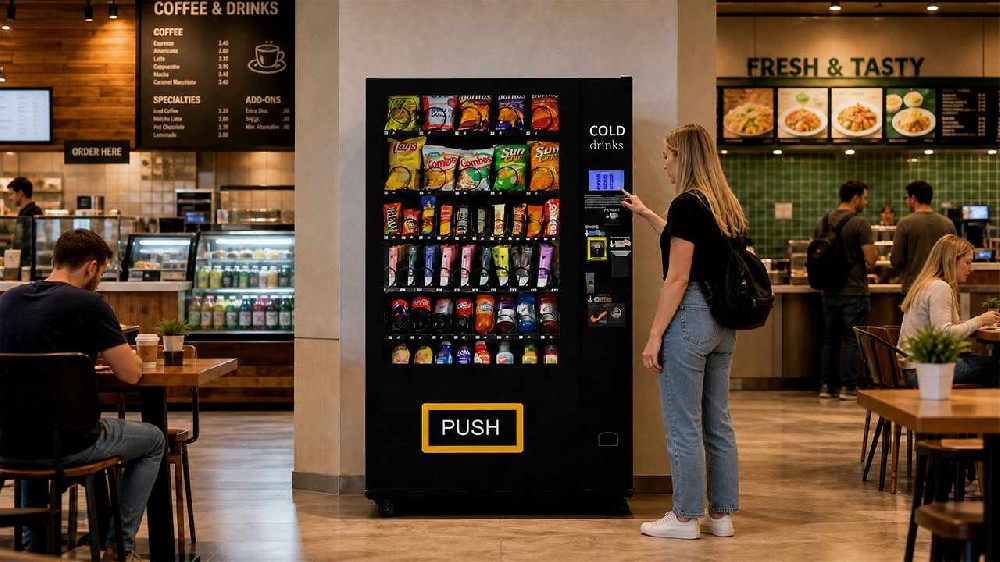
The Short Decision: Which Format Fits Which Job?
If the merchandise is mostly packaged drinks, snacks, boxed products, accessories, cosmetics, collectibles, or other items that benefit from controlled delivery, I’d choose a vending machine first. It keeps inventory behind a locked cabinet and releases only the purchased item. That basic architecture remains difficult to beat when product control matters.
If the assortment is built around chilled meals, salads, yogurt, sandwiches, bottled drinks, meal-prep containers, and products whose package dimensions change often, a smart cooler deserves the first look. Shelves give the operator more freedom than fixed dispensing channels, and shoppers can see and handle products in a familiar way.
If one site can support a broad assortment and customers are likely to purchase several items at once, I’d rank a micro market higher. The extra floor space starts to make sense when the operator can use it to increase basket size rather than simply spread the same sales across more shelving.
There is also a fourth answer that is becoming more useful: do not force one technology to handle every category. A vending machine can protect premium or fragile items while a smart cooler handles fresh food. A larger site can place both beside a self-service market. In that layout, each format does the job it handles best.
The decision can be summarized quickly:
| Main Priority | Usually the Better Fit | Reason |
|---|---|---|
| Maximum inventory control | Vending machine | Products remain inaccessible until a confirmed purchase triggers dispensing. |
| Frequently changing chilled products | Smart cooler | Shelf layouts are easier to adapt to changing package dimensions. |
| Largest assortment | Micro market | Open shelving and multiple refrigerated displays support more SKUs. |
| Small floor footprint | Vending machine | The cabinet uses vertical space efficiently. |
| Fresh meal merchandising | Smart cooler / micro market | Customers can see full packages and compare products directly. |
| Fragile packaged merchandise | Elevator vending / smart cooler | Both can reduce the uncontrolled drop associated with basic dispensing. |
| Large multi-item basket | Micro market / smart cooler | The shopping flow makes several-item purchases more natural. |
What Actually Separates the Three Formats?
All three are forms of unattended retail, but they control the transaction in different places.
A Vending Machine Controls the Product Before Delivery
A vending machine starts with a locked inventory area. The customer selects an item, payment is authorized, and the machine activates a motor, belt, conveyor, elevator, locker, or another delivery mechanism. The merchandise remains under machine control until the transaction reaches the dispensing stage.
That sounds simple, but modern vending hardware covers far more than spiral snack machines. Refrigerated combo machines, elevator delivery, lockers, adjustable channels, large touchscreens, cashless payment, remote inventory management, and specialized product trays have expanded what can be sold from one cabinet.
This is why the term vending machine now covers several very different product-handling systems. A machine built for canned drinks is not automatically a suitable machine for a boxed collectible, a glass bottle, a cake, or an electronic device.
A Smart Cooler Controls Access to the Cabinet
A smart cooler changes the sequence. Rather than dispensing one product through a delivery mechanism, the system controls access to refrigerated shelves. The shopper may authorize a payment method or identify an account before the door unlocks. Product recognition then determines what was taken, depending on the technology used.
That recognition can be based on cameras, computer vision, shelf weight, RFID, item scanning, or combinations of several signals. The exact architecture varies, but the commercial advantage is easy to understand: merchandise can sit directly on shelves rather than being engineered around individual dispensing lanes.
That freedom is especially useful when the assortment changes often or package sizes do not stay consistent.
A Micro Market Controls Checkout Rather Than Product Access
A micro market moves further toward conventional retail. Customers typically have open access to shelves and refrigerated displays, choose what they want, and complete payment through a self-service kiosk or another checkout system.
The format can support a much larger assortment, but the operator has more inventory exposed before checkout. Fixtures, shelf layout, surveillance, checkout compliance, replenishment, merchandising, cleaning, and loss control become part of the business.
The distinction is worth remembering:
Vending controls the item. A smart cooler controls access to the cabinet. A micro market relies primarily on the checkout process and operating environment.
That single difference explains many of the cost, shrink, product-selection, and service differences that follow.
Smart Cooler vs Vending Machine vs Micro Market: Side-by-Side Comparison
| Factor | Smart Cooler | Vending Machine | Micro Market |
|---|---|---|---|
| Inventory access | Customer accesses shelves after authorization | Inventory remains locked until dispensing | Open customer access before checkout |
| Floor-space efficiency | High | Very high | Lower because fixtures need customer access space |
| Product security | Depends heavily on access and recognition technology | Strong physical product control | More exposed inventory |
| Package-size flexibility | High | Depends on dispensing architecture | Very high |
| Fresh-food potential | High | High when refrigeration and delivery suit the product | High |
| Fragile products | Good | Good with elevator or locker delivery | Good |
| Mechanical dispensing system | Usually limited | Central to operation | Not normally required for open shelves |
| Multi-item shopping | Natural when recognition works reliably | Possible, but usually more transaction-driven | Very natural |
| Expansion | Add another cooler or category | Add machines using standardized layouts | Expand fixtures and assortment if space allows |
| Route standardization | Good | Very good | More site-specific |
| Best use case | Flexible refrigerated assortment | Secure and repeatable automated retail | High-traffic unattended store environment |
The table points to a broader pattern. A vending machine concentrates control inside the cabinet. A micro market concentrates opportunity outside it by giving shoppers more choice. A smart cooler sits between the two.
That middle position is why smart coolers receive so much attention. They remove many package constraints without requiring the operator to build a complete retail area. The tradeoff is that product-recognition accuracy and loss prevention become part of the transaction system.
Where a Smart Cooler Has the Advantage
The strongest argument for a smart cooler is not that it uses cameras or an electronic lock. The stronger argument is that it lets the operator merchandise refrigerated products without designing every package around a dispensing mechanism.
Fresh Products Can Be Presented Normally
A customer choosing between two salads may want to see the ingredients through the package. A shopper comparing prepared meals may look at portion size, label details, or the physical condition of the container. A smart cooler supports that behavior better than a machine that shows only a front-facing product image or one package behind glass.
For categories where appearance drives the purchase, being able to see the complete item can matter.
Changing Package Dimensions Cause Less Disruption
One of the less glamorous problems in automated retail is packaging change. A supplier changes a bottle diameter, makes a meal tray wider, switches to a softer pouch, or adds a promotional package. In mechanical vending, those changes can affect lane width, spiral pitch, shelf spacing, product stability, and dispensing reliability.
A cooler shelf is usually more forgiving. Shelf height may still need adjustment and recognition technology may need correct product setup, but the package is no longer required to travel through the same mechanical path.
Multi-Item Purchases Feel Natural
A customer can open the cabinet and choose a meal, beverage, and dessert in one visit. That can raise basket size when the transaction system accurately identifies each item.
The word accurately is important. A smart cooler should be evaluated on the difficult cases, not only the ideal demonstration.
Before choosing one, ask how the system handles:
A customer picking up a product and putting it back
Two visually similar packages
A product placed on the wrong shelf
Several items removed at the same time
Partially blocked camera views
Packaging redesigns
A door left open longer than expected
Network loss during a transaction
Payment authorization that later fails
A customer disputing one item in a multi-item purchase
The quality of those answers matters more than the phrase “AI-powered cooler” on a specification sheet.
Where I Would Not Automatically Choose a Smart Cooler
If each item is expensive, very small, easy to conceal, or attractive for resale, a locked vending cabinet may give the operator a cleaner risk model.
If most products are standard bottles and packaged snacks, shelf flexibility may not justify a more complex recognition stack. A well-configured vending machine can already handle those products with low customer effort.
Smart coolers are most convincing when their merchandising freedom solves a real product problem. When they merely replace a vending machine that was already suitable for the assortment, the economic advantage becomes harder to prove.
Where a Vending Machine Still Wins
Vending has stayed relevant because the core design solves several operating problems at once. Inventory stays locked. The cabinet uses vertical space efficiently. Every sale follows a controlled sequence. The machine can be standardized across multiple sites. An operator can add another cabinet without redesigning an entire retail area.
The format has also become much more flexible than the classic snack machine suggests.
Controlled Delivery Protects the Inventory Model
Only the purchased item should reach the customer. That makes reconciliation easier and lowers direct product exposure.
For a $2 snack, the difference may appear small. For premium cosmetics, collectible products, electronics accessories, specialized supplies, or merchandise with strong resale value, physical control becomes a major design consideration.
The Footprint Is Hard to Beat
A cabinet can hold several shelves of merchandise without requiring customers to move around shelving or open multiple display cases. Where selling space is limited, that density can have more value than adding another category.
A micro market may sell more in a strong location, but it uses more of the site to do it. Revenue should therefore be considered alongside sales per square foot and gross profit per square foot.
Different Delivery Systems Cover Different Products
Spiral dispensing remains useful for stable packaged goods, but it should not be treated as the default answer for every SKU.
An elevator can collect a product near its shelf and move it toward the pickup area with less free fall. Lockers can isolate larger or irregular items. Conveyor systems can suit products that do not behave well in spirals. Mixed configurations can place several handling methods in one cabinet.
Zhongda Smart’s current vending machine product range shows the practical result of that approach: standard snack and beverage equipment sits alongside refrigerated machines, elevator-delivery systems, lockers, specialty retail models, and custom configurations.
Fleet Expansion Is Easier to Standardize
This point becomes more important after the first few installations.
Suppose an operator finds a machine configuration that fits 80% of the planned assortment. The same shelf plan, payment hardware, controller, spare motors, telemetry system, training material, and replenishment process can be repeated across new locations.
That reduces operational variation.
A micro market offers more freedom at each site, but every layout can become slightly different. The vending operator gives up some merchandising freedom in exchange for a more standardized asset.
Vending Can Handle More Than Food
The strongest growth opportunity for vending is not necessarily another snack cabinet. Controlled retail works for products that need availability without a staffed counter.
Examples include:
Cosmetics and beauty products
Trading cards and collectibles
Electronic accessories
Personal-care products
Small tools and supplies
Books
Toys and blind boxes
Daily essentials
Premium packaged products
Those categories often have very different margins and buying behavior from traditional food vending. They also give custom vending manufacturers more reason to engineer around the product rather than reuse one universal cabinet layout.
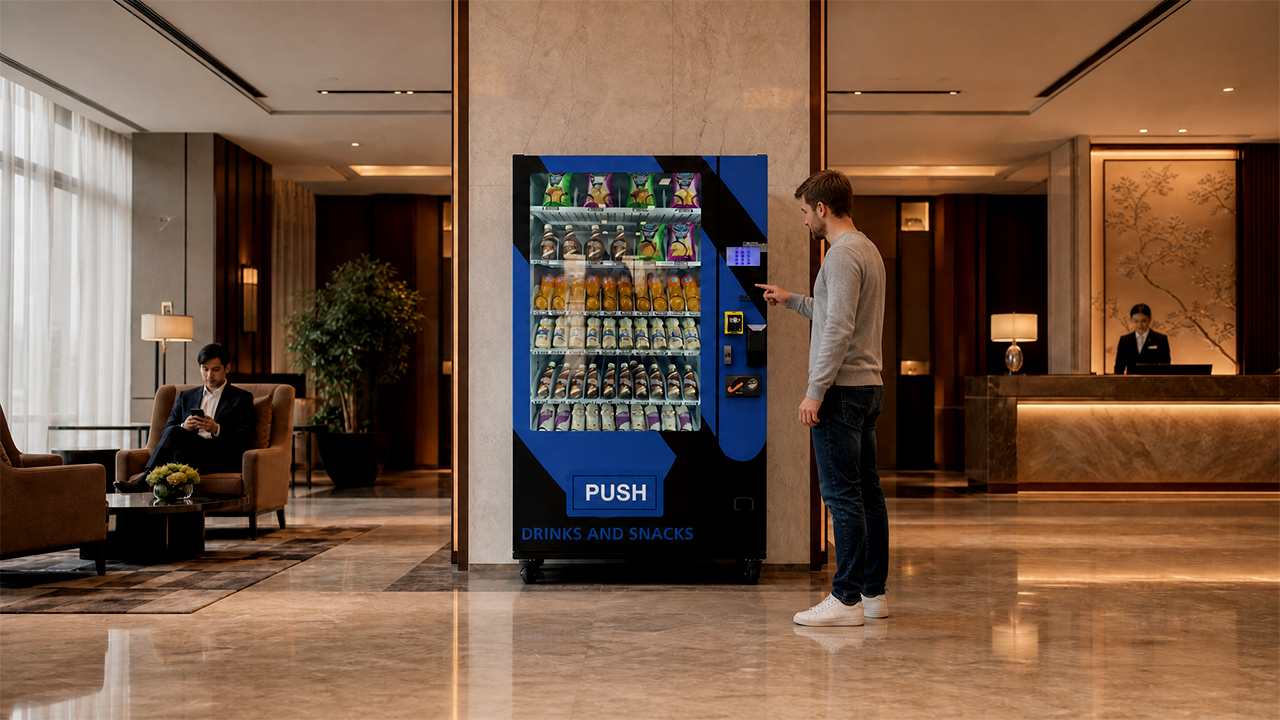
When a Micro Market Earns the Extra Space
A micro market becomes attractive when the location can support enough sales to justify behaving like a small store.
That is a higher bar than simply having people nearby.
A good site needs recurring customers, enough daily purchasing occasions, suitable floor space, reliable replenishment, and an assortment broad enough to make open browsing useful.
The Biggest Advantage Is Basket Expansion
A customer standing in front of shelves and refrigerators can build a purchase rather than select one isolated item. A sandwich can lead to chips, a drink, dessert, breakfast for the next morning, or another impulse purchase.
That difference is central to micro-market economics.
The operator is accepting more open inventory and more merchandising work in exchange for the chance to sell more products per visit.
Assortment Can Be Much Broader
Shelves are not limited by lane dimensions. Refrigerated cases can carry different containers. Fixtures can be rearranged. Seasonal or promotional products can be introduced without mechanical reconfiguration.
That flexibility also creates a common mistake: carrying too much inventory.
A broad assortment is valuable only when the additional SKUs produce enough sales or strategic value to justify shelf space, working capital, replenishment time, and spoilage risk.
A slow-moving product does not become useful because there is room for it.
Micro Markets Have Become a Material Part of Unattended Retail
NAMA’s published industry census showed how quickly the format moved from a small niche into a significant segment. Micro markets represented only about 2% of convenience-services industry revenue in 2014, while the organization’s 2023 findings placed the segment at roughly 20%. Vending remained the larger segment at about 68% of industry revenue in the same dataset.
Those figures do not mean micro markets are replacing vending everywhere. They show that open, self-service retail has become commercially important enough to stand beside machine-based vending rather than remain a minor experiment.
The Site Has to Support the Operational Load
A larger assortment creates more buying decisions. Fresh products create expiration decisions. Several refrigerators create more equipment to inspect. Open shelves create more opportunities for shrink. A self-service kiosk becomes another piece of hardware that can stop a transaction if it fails.
The result can still be excellent, but a micro market works best when the operator has strong inventory discipline.
If the location produces only enough demand to support one compact assortment, adding a market may increase complexity faster than it increases profit.
The Product Should Decide the Machine Architecture
One of the most useful ways to improve a vending project is to postpone the question “Which machine should I buy?” and start with “What exactly has to happen to the product between storage and customer pickup?”
A package has physical behavior. It can lean, slide, compress, crack, bounce, jam, roll, tip, or catch on another package. Those characteristics should influence the equipment.
Zhongda Smart’s published guide on how vending machines are manufactured and configured separates spiral, conveyor, elevator, and locker systems according to product handling rather than treating the cabinet as the only design decision.
For Every Product, Record More Than Width and Height
A useful product file should include:
Package width
Package height
Package depth
Unit weight
Package rigidity
Shape
Center of gravity
Surface friction
Whether the package can tolerate a drop
Whether its dimensions are likely to change
Storage-temperature requirement
Actual product samples are more useful than measurements alone when the delivery system is still being selected.
Stable Boxes, Bottles, and Snack Packages
These are often suitable for spiral or conveyor delivery, assuming dimensions and stability match the channel design. The benefit is high storage density and simple replenishment.
Fragile Merchandise
A fragile product changes the question from “Will it fit?” to “What happens during delivery?”
Elevator vending can reduce uncontrolled fall distance by moving a receiving platform toward the selected shelf before carrying the product to the pickup position. Zhongda Smart’s elevator vending machine for fragile products, for example, is built around that delivery principle and lists a nominal capacity of roughly 300–360 pieces for the referenced configuration, with actual capacity depending on product size and channel setup.
A smart cooler is another option because the customer removes the product directly from the shelf. For very large products, a locker may be cleaner than either approach.
Irregular or Frequently Changing Packages
This is where smart coolers and micro markets gain ground. The operator can adapt the shelf instead of rebuilding a dispensing lane.
For vending, lockers and adjustable conveyor systems may still work, especially when product security is important.
A Practical Product-to-System Matrix
| Product Behavior | First System to Evaluate | Main Reason |
|---|---|---|
| Stable boxed goods | Spiral or conveyor vending | Efficient storage and controlled delivery |
| Bottled or canned drinks | Refrigerated vending or smart cooler | Both formats can handle high-volume beverage sales well |
| Fragile package | Elevator vending or smart cooler | Reduced drop exposure |
| Large irregular item | Locker | Compartment can be sized around the item |
| Fresh meal tray | Smart cooler, refrigerated elevator vending, or micro market | Temperature and package condition both matter |
| Frequently changing package size | Smart cooler | Shelf configuration is easier to adapt |
| Small high-value product | Controlled vending | Stronger physical inventory control |
| Very broad assortment | Micro market | Open shelving supports the widest SKU mix |
This is a better starting point than choosing equipment because its screen is larger or its cabinet looks more modern.
Cost, Margin, and Operating Economics
The purchase price attracts attention because it is visible on day one. The operating model determines whether that price turns into a good investment.
The same machine can be profitable at one site and disappointing at another without anything being wrong with the hardware.
Traffic, conversion, average transaction value, product margin, commission, payment fees, spoilage, shrink, route distance, software fees, power consumption, and downtime all influence the result.
A Useful Monthly Contribution Formula
Monthly operating contribution = sales - product cost - payment fees - site commission - shrink - spoilage - route labor - transport - software/connectivity - utilities - maintenance reserve - financing and other recurring costs.
That is more useful than asking only, “How long does a vending machine take to pay back?”
Illustrative Vending Example
Assume a location produces 38 transactions per active day at an average transaction value of $4.10.
At 26 active days:
38 × $4.10 × 26 = $4,050.80 monthly sales.
Assume a modeled product gross margin of 44% before other operating expenses:
$4,050.80 × 44% = $1,782.35 gross profit.
Now add illustrative monthly operating costs:
| Illustrative Cost | Monthly Amount |
|---|---|
| Site commission | $300 |
| Payment processing | $125 |
| Route labor and transport allocation | $275 |
| Connectivity and software | $45 |
| Maintenance reserve | $80 |
| Shrink / spoilage allowance | $70 |
| Total | $895 |
The illustrative operating contribution becomes approximately:
$1,782.35 - $895 = $887.35 per month.
If installed equipment investment were $8,000, a simple payback calculation would be approximately nine months. That is not a forecast or an industry average. It is only a model showing how the variables interact.
Now Make the Model Less Comfortable
A useful investment case should still make sense when assumptions weaken.
Lower daily transactions from 38 to 28. Raise route cost. Add an extra service visit. Increase spoilage. Reduce gross margin. Assume the machine is unavailable for several days during one month.
If the economics collapse after one modest change, the project was relying on an aggressive base case.
Smart Cooler Economics
The smart cooler may save mechanical complexity and make replenishment faster, but the operating model can include recognition software, connectivity, payment preauthorization, and potentially higher shrink exposure.
Its economic argument improves when flexible shelving increases sellable assortment, reduces product jams, or makes a multi-item purchase easier.
If the cooler carries the same products at the same basket value as a vending machine while creating higher software or shrink expense, the technology is not automatically adding value.
Micro Market Economics
A micro market can produce a larger basket and more total sales, but the investment should include the entire retail environment:
Checkout hardware
Refrigeration
Shelving
Fixtures
Signage
Networking
Security equipment
Electrical work
Initial inventory
Installation labor
Revenue per location is therefore not enough. Compare operating contribution, return on invested capital, labor requirements, and the amount of inventory needed to keep the market looking full.
Industry Scale Provides Useful Context
Current NAMA economic research places the annual economic impact of convenience services above $41 billion and reports more than 171,000 jobs supported by the sector. That scale is useful context, but it should not be mistaken for proof that an individual machine will be profitable.
The individual site still wins or loses on local demand, assortment, uptime, replenishment, pricing, and cost control.
Security, Shrink, and Transaction Control
The three formats expose inventory in very different ways, so shrink should be modeled differently.
Vending Machine: The Product Stays Locked
Most merchandise is physically inaccessible before payment. That gives conventional vending a structural advantage for valuable or easy-to-resell goods.
The operator can still lose money through vandalism, payment disputes, mis-vends, refund abuse, damaged stock, or forced access. The basic transaction, however, does not depend on the customer voluntarily scanning every item.
Smart Cooler: Access Is Controlled, Item Selection Is Not
The cabinet may stay locked until payment authorization, but once the door opens the customer can interact with several items.
The key operational question is straightforward:
How does the system connect every product removed from the cabinet with the final charge?
A demonstration in which one person removes one clearly visible bottle is not enough. Operators should understand the exception cases: products returned to the wrong shelf, products held in front of another product, simultaneous item removal, packaging changes, recognition uncertainty, and transaction disputes.
Micro Market: Open Access Produces a Different Risk Profile
A micro market relies more heavily on checkout behavior, surveillance, layout, access policies, and inventory reconciliation.
That does not make the format a poor choice. It means shrink has to be treated as a measurable operating cost.
For example, assume an open format adds $2,000 in monthly sales compared with a more restricted format but creates $120 in additional monthly shrink. The loss should be evaluated against the added gross profit, not discussed in isolation.
The opposite can also happen. If a site has poor control and open access creates losses that erase the larger basket, the apparent revenue advantage is not useful.
High-Value Products Change the Answer Quickly
If I were choosing for high-value compact merchandise, I’d rank controlled vending above an open micro market unless the site already had unusually strong access control.
The higher the value-to-size ratio, the more attractive a locked dispensing architecture becomes.
Refrigeration, Fresh Food, and Temperature Control
Fresh food makes unattended retail more interesting and more demanding.
A refrigerated cabinet is not simply a vending machine with a compressor added. Product safety, recovery after restocking, sensor position, airflow, ambient conditions, alarm logic, power interruption, and sell-lockout behavior all become relevant.
The FDA Food Code is a model framework for retail food safety and includes provisions that apply to food vending equipment. Its current published material includes requirements and design considerations for mechanically refrigerated equipment, temperature measurement, and food vending systems.
For time/temperature-control foods, the relevant requirements for an actual operation should be confirmed before deployment rather than inferred from a marketing temperature range.
Questions Worth Asking About Any Refrigerated System
What operating temperature range is the cabinet designed to maintain?
How is cabinet temperature measured?
Where is the sensor placed?
Can temperature be viewed remotely?
Does the system issue a high-temperature alarm?
Can sales be disabled if a temperature threshold is exceeded?
How long does temperature recovery take after restocking?
How does frequent door opening affect performance?
Can shelf loading block airflow?
What happens after power is restored?
How are temperature records stored, if records are required?
Smart Cooler Refrigeration
Door-open behavior becomes especially important. Every shopping session exposes a larger opening than a conventional vending cabinet normally does during a sale. Heavy use can therefore place different demands on recovery and airflow.
The operator should test the equipment under realistic loading and door-opening patterns rather than relying only on an empty-cabinet temperature reading.
Refrigerated Vending
Most products remain behind the closed front structure, and dispensing does not require the customer to open the main refrigerated compartment. That can be useful in high-transaction environments.
Product-delivery design still matters. A refrigerated meal should arrive intact. A glass container should not experience the same delivery path as a flexible snack bag.
Micro-Market Refrigeration
A micro market may use several refrigerated displays, which gives the operator category flexibility but creates more equipment to monitor.
One cabinet can hold drinks, another fresh meals, and another dairy products, but each refrigerator adds another compressor, sensor, electrical connection, cleaning task, and potential point of failure.
Fresh-food revenue has to pay for that operating complexity.
Payments and the Customer Experience
Payment is no longer a small accessory mounted on the side of a machine. In unattended retail, it is part of the product experience.
The cabinet can be mechanically excellent and still lose sales if authorization is slow, the interface is confusing, or the payment method does not fit customer expectations.
Vending Machine Payment Flow
The strongest vending workflow is usually short:
Customer sees the product.
Customer selects it.
Payment is authorized.
The machine dispenses.
The system confirms the sale.
The customer retrieves the item.
When a transaction fails, the operator needs to know whether the problem occurred during payment, dispensing, sensing, or product pickup.
Smart Cooler Payment Flow
The sequence can be more complicated because the system may authorize the customer before it knows the final basket.
Questions worth clarifying include:
Is there a preauthorization amount?
When is the final charge created?
How quickly does the final amount appear?
What happens when nothing is taken?
How are disputed items reviewed?
Can several shoppers access the cabinet at once?
What happens if connectivity is lost after the door opens?
A good customer experience depends on what happens when the transaction is not perfect.
Micro-Market Checkout
The shopper often has the most familiar retail flow: choose products, bring them to checkout, identify or scan the items, and pay.
The weakness appears when customers skip a scan, scan the wrong item, abandon a transaction halfway through, or encounter a kiosk problem with no employee nearby.
Payment Methods Should Follow the Business
Possible configurations can include cards, NFC, mobile wallets, QR payment, stored-value systems, membership accounts, cash, coins, or combinations of these.
More payment devices are not automatically better. Every additional module creates cost, wiring, maintenance, user-interface choices, and another potential failure point.
The right payment stack is the one customers will actually use reliably.
Route Labor, Replenishment, and Downtime
Unattended retail removes the cashier from each transaction. It does not remove labor from the business.
The work shifts into purchasing, warehouse handling, route planning, vehicle loading, transportation, replenishment, cleaning, expiration control, inventory reconciliation, refunds, and maintenance.
Route Density Can Matter More Than One Machine’s Sales
Two machines can produce identical monthly revenue and very different profit.
One may sit ten minutes from the previous stop. Another may require a long dedicated trip, difficult parking, security access, and a lengthy walk from the loading point.
The operator should therefore measure service time from the previous stop to the next stop, not only the number of minutes spent standing in front of the machine.
Smart Cooler Replenishment
Restocking can be fast because products go directly onto shelves. That is useful for meal programs with frequent product changes.
Recognition systems may require disciplined shelf placement, product enrollment, or accurate planograms, depending on the technology. A five-minute physical restock is not truly five minutes if another ten minutes are needed to correct product data afterward.
Vending Machine Replenishment
Loading individual channels can take longer, but the structure can make inventory counting straightforward. Every lane has a defined product and capacity.
Remote inventory data can reduce unnecessary visits and help the route driver carry the correct quantity.
Micro-Market Replenishment
Shelf loading itself is easy. Managing the assortment is harder.
The route team may need to face products, check expiration dates, rotate fresh food, clean several fixtures, inspect multiple coolers, refill checkout supplies, remove damaged packaging, and deal with slow-moving stock.
A useful metric is:
Route labor minutes per $100 of gross profit.
That gives a clearer comparison than looking only at restocking speed.
Stockouts Are Expensive in a Different Way
An empty lane does not only lose one sale. It may teach regular customers that the machine is unreliable.
Fresh-food programs have the opposite problem: carrying too much inventory can turn stock availability into spoilage.
The target is not maximum inventory. It is enough inventory to protect sales without tying up unnecessary capital or creating avoidable waste.
Maintenance and Vending Machine Repair
Equipment reliability affects profit twice. A repair costs money, and the machine may stop earning money while the fault remains unresolved.
That makes serviceability an important buying criterion even when the machine is new.
Common Vending Components
Depending on the configuration, a vending machine may include:
Controller boards
Motors
Spirals or belts
Elevator assemblies
Drop or delivery sensors
Refrigeration components
Temperature probes
Locks
Power supplies
Touchscreens
Card readers
Cash or coin modules
Network hardware
A machine with more components is not necessarily less reliable. What matters is whether failures can be diagnosed and whether the affected module can be replaced without turning a minor problem into a long shutdown.
Questions to Ask Before Buying
Which parts fail most often in normal service?
Which spare parts should be kept locally?
Can common parts be replaced without specialized tools?
Are wiring diagrams and error-code references available?
Can the controller report faults remotely?
Can motors be replaced individually?
How are software updates handled?
How is remote technical support delivered?
How long are key replacement components expected to remain available?
Smart Cooler Maintenance Has a Different Profile
There may be fewer product-dispensing motors, but cameras, smart locks, sensors, networking, recognition software, and refrigeration become critical.
A camera that shifts slightly may not look like a traditional mechanical failure, yet it can affect transaction accuracy. A network problem may not stop the refrigerator from cooling but can interrupt sales.
Micro-Market Maintenance Is Distributed
Instead of one cabinet containing most of the system, the operator may maintain a kiosk, scanners, payment devices, routers, several refrigerated displays, shelving, and surveillance hardware.
No individual component has to be complicated for the site to have many potential service points.
The Spare-Parts Question Worth Asking
Ask the supplier for a recommended first-year spare-parts kit and the current price of each component.
A low-cost spare motor, sensor, switch, cable, or power supply can protect far more revenue than its purchase price when it prevents several days of downtime.
Remote Management and Useful Operating Data
Remote management earns its place when it changes what the operator does next.
A dashboard full of charts has little value if the route team still visits every machine on a fixed schedule because nobody trusts the inventory data.
The Most Useful Questions Are Operational
A connected unattended retail system should make it easier to answer:
Which location needs replenishment today?
Which SKU is repeatedly selling out?
Which item is taking too long to sell?
Which machine is offline?
Which payment device is producing errors?
Which refrigerated cabinet is outside its expected temperature range?
Which location has an unusual refund rate?
Which machine is producing the highest gross profit per service visit?
Inventory Accuracy Is More Valuable Than a Large Dashboard
Route planning improves only when the stock number is close enough to reality to act on.
With controlled vending, inventory can often be inferred from successful dispensing and replenishment records. Smart coolers may use recognition data. Micro markets rely more heavily on accurate checkout and periodic physical reconciliation.
Each format can produce useful data, but the quality of the source is different.
Sales Data Should Change the Assortment
The most obvious example is a slow seller. If a product occupies a full lane for weeks while another SKU sells out repeatedly, the shelf plan is carrying a hidden opportunity cost.
A practical review should look at:
Units sold per facing
Gross profit per facing
Stockout frequency
Days in inventory
Waste
Refunds
Transaction time
That is where connected vending becomes more useful than simply seeing total daily revenue.
Which Format Fits Different Types of Sites?
A product can be suitable for all three formats while the location clearly favors one.
Small Workplace or Compact Staff Area
Usually worth evaluating first: vending machine or smart cooler.
A full micro market can consume more space than the sales justify. One refrigerated machine and one snack machine may cover the core need with less installation work.
If fresh meals are central and the packaging changes often, a smart cooler can replace part of that bank.
Large Recurring-Population Site
Usually worth evaluating first: micro market, with vending in secondary areas.
A stable customer base gives a larger assortment more opportunities to turn. Several-day meal planning, snacks, breakfast, beverages, and impulse purchases can all contribute to basket size.
Machines still have a role where traffic is too dispersed to justify a second market.
Fitness and Wellness Environment
Usually worth evaluating first: smart cooler or refrigerated vending.
Bottled beverages, protein drinks, prepared meals, yogurt, and healthy snacks fit both formats. The choice depends on packaging, basket behavior, security, and servicing frequency.
Hospitality or Residential Amenity Space
Usually worth evaluating first: vending machine, smart cooler, or compact hybrid.
The assortment may combine late-hour food, beverages, personal-care items, chargers, and daily essentials. That mix can favor more than one dispensing method.
Specialty Retail
Usually worth evaluating first: vending machine.
Controlled access is useful when the merchandise is small, branded, collectible, premium, or easy to resell.
A large digital display can also provide product information without opening the cabinet.
Fresh-Meal Program
Usually worth evaluating first: smart cooler, refrigerated elevator vending, or micro market.
Package condition, temperature, date control, replenishment frequency, and basket size should drive the choice.
Low-Traffic Pilot
Usually worth evaluating first: one standardized machine.
A pilot should answer whether the location buys enough product, not whether the operator can build an impressive retail environment.
If sales justify expansion, a second machine, smart cooler, or market can be added with real transaction data behind the decision.
When a Hybrid Setup Makes More Sense
The strongest answer is sometimes not smart cooler versus vending machine versus micro market.
It is assigning categories to the correct retail format.
Example: Fresh Food Plus Premium Products
A smart cooler can carry meals, yogurt, salads, and drinks. A vending machine beside it can carry electronics accessories, premium personal-care products, or other higher-value merchandise.
The customer sees one unattended retail point, but the operator gets two different levels of inventory control.
Example: Micro Market Plus Secure Vending
A market can handle everyday food and drinks while one vending machine protects specialized or high-margin products.
That prevents the security requirements of a small category from forcing the entire market into a more restrictive format.
Example: High-Volume Drinks Plus Broad Food Assortment
A dedicated beverage vending machine can absorb repetitive drink transactions while a micro market carries food and lower-volume categories.
This can reduce pressure on one refrigerated display and keep popular beverages stocked in a high-capacity cabinet.
Why Hybrid Layouts Are Useful
Every category has a different relationship between:
Margin
Size
Fragility
Security
Temperature
Purchase frequency
Package stability
Customer desire to inspect the product
One machine architecture rarely optimizes all eight at once.
A hybrid layout lets the operator stop asking one format to solve problems it was not designed to solve.
What to Prepare Before Requesting a Quote
A useful quotation begins with a useful product brief.
Sending only the message “How much is a vending machine?” makes it difficult for any manufacturer to recommend the right configuration. The cabinet price can change when refrigeration, payment hardware, delivery architecture, screen size, capacity, branding, or software requirements change.
Product Information
Clear product photos
Package width, height, and depth
Unit weight
Number of SKUs
Expected quantity per SKU
Fragility
Storage-temperature requirement
Any package-size variations
Customer and Transaction Requirements
Expected payment methods
Need for cash or coin handling
Card or NFC requirements
QR payment requirements
Membership or account system, if required
Preferred interface language
Whether customers normally buy one item or several
Installation Requirements
Indoor or outdoor use
Available installation space
Doorway and elevator dimensions for delivery
Power requirements
Network method
Ambient conditions
Any canopy or weather-protection requirement
Brand and Software Requirements
Logo files
Cabinet colors
Wrap or decal design
Touchscreen size preference
Advertising requirements
Remote-management requirement
API or software-integration requirement
Commercial Requirements
Pilot quantity
Expected future order quantity
Target production schedule
Required spare-parts package
Warranty expectations
Shipping requirements
Those details help separate a real equipment configuration from a generic catalog price.
How to Judge a Vending Machine Manufacturer
The right manufacturer is not simply the one offering the lowest cabinet price. The supplier has to solve the product-handling problem and remain useful after the machine is delivered.
Start With Product Fit
A manufacturer should be willing to discuss the merchandise before recommending a machine.
If every product receives the same answer, the recommendation may be based more on existing inventory than on the application.
Ask Why a Specific Dispensing System Is Being Recommended
The answer should relate to package geometry, weight, fragility, capacity, product value, and desired customer experience.
“This is our most popular model” is not the same as explaining why the model suits the product.
Check Whether Customization Goes Beyond Graphics
Real customization can include:
Cabinet dimensions
Shelf layout
Spiral pitch
Conveyor design
Elevator delivery
Locker size
Refrigeration
Payment hardware
Touchscreen size
User interface
Language
Connectivity
Remote-management functions
A custom logo is branding. A machine adapted to the product is engineering.
Look at Production and Quality-Control Capability
For one pilot machine, production scale may not be the first concern. It becomes much more important when the pilot succeeds.
A larger rollout needs repeatable sheet-metal work, wiring, assembly, cooling performance, shelf geometry, software configuration, testing, documentation, and packaging.
Consistency is part of the product.
Ask About Testing
Product samples should be tested when dispensing behavior is uncertain.
A test should not end after one successful dispense. Repetition matters because a package may tilt differently when the lane is full, almost empty, or loaded slightly off-center.
Ask About Parts Before the Warranty Is Needed
Operators should know how replacement parts are identified, ordered, and installed.
The value of a warranty drops quickly if a small component creates a long shutdown.
Ask What Technical Information Is Available
Useful support may include operating instructions, error-code information, wiring references, component-replacement guidance, remote diagnostics, software support, and troubleshooting videos.
A salesperson answering quickly before an order is not the same thing as an after-sales process.
Where Zhongda Smart Fits
Zhongda Smart is most relevant to this comparison when the project requires a machine to be selected around the product rather than forcing the product into one fixed vending layout.
The company’s published manufacturing information covers conventional vending, refrigerated equipment, elevator delivery, locker systems, specialty vending, and OEM/ODM configurations. That range creates a useful distinction: the discussion can begin with product behavior and operating requirements before moving to a cabinet.
According to Zhongda Smart’s current manufacturing and company information, its production operation includes approximately 20,000 square meters of working space, more than 400 employees, an engineering team of 10+ people, three assembly lines, more than 20 quality inspectors, four sheet-metal processing workshops, a painting line, and stated annual production capacity of 10,000 units.
Those figures are most useful to a buyer when they connect to a specific project requirement.
For Standard Packaged Products
Existing vending platforms can often be configured rather than redesigned. The important work is matching lane dimensions, payment hardware, capacity, refrigeration if needed, and remote management.
For Fragile Products
Elevator delivery becomes relevant because the machine architecture reduces uncontrolled product drop. Product samples can then be evaluated against the elevator, shelf geometry, and pickup process.
For Large Products
A locker architecture can be more practical than trying to create an oversized conventional vending lane.
For Refrigerated Food
Temperature range, air circulation, product package, delivery method, and monitoring requirements should be considered together.
For Branded Retail Concepts
Cabinet appearance, lighting, user-interface graphics, touchscreen size, payment hardware, and remote software can be configured around the project rather than treated as separate afterthoughts.
The useful reason to include Zhongda Smart in a manufacturer shortlist is therefore not simply that it manufactures vending machines. It is the ability to evaluate several delivery architectures within one OEM/ODM program.
Commercial buyers should still verify the final specification, applicable certifications, warranty terms, software compatibility, payment integration, production schedule, shipping terms, and after-sales arrangements for their exact order before purchasing.
A Practical 2026 Buying Framework
If I were choosing equipment for a new project, I would make the decision in this order:
1. Define the Merchandise
List every planned SKU and record its physical dimensions, weight, value, fragility, temperature requirement, and expected sales velocity.
2. Decide How Much Product Access Is Acceptable
High-value merchandise may need controlled vending. A meal program may benefit from shelf access. A low-risk broad assortment may justify open merchandising.
3. Estimate Realistic Daily Transactions
Do not start from total foot traffic. Estimate how many people actually have a reason to purchase the products being offered.
4. Estimate Basket Size
If customers are likely to buy one item at a time, vending can be very efficient. If the business depends on meal-plus-drink-plus-snack behavior, smart coolers or micro markets become more attractive.
5. Calculate Service Cost
Include travel, replenishment, cleaning, expiration checks, inventory work, and likely repair time.
6. Model Shrink and Spoilage
Neither should be entered as zero unless the product and operating model genuinely justify it.
7. Choose the Retail Format
Only after the first six questions should the comparison become:
Smart cooler
Vending machine
Micro market
Hybrid layout
8. Choose the Dispensing Architecture
If vending wins, decide whether the merchandise suits spiral, conveyor, elevator, locker, or a mixed configuration.
9. Compare Manufacturers on the Final Specification
Comparing two quotations is useful only when the machines are expected to perform the same job.
A lower price on a machine with fewer payment options, a different cooling system, weaker product handling, or less support is not necessarily a lower cost.
10. Pilot Before Scaling When the Application Is New
Real transactions reveal what the spreadsheet cannot: which products customers actually choose, how often the machine needs service, which shelf sells out first, whether payment is intuitive, and how much time replenishment really takes.
My Final Ranking by Scenario
| Scenario | First Choice | Second Choice |
|---|---|---|
| Secure packaged retail | Vending machine | Smart cooler |
| Fresh meals with changing packages | Smart cooler | Refrigerated elevator vending |
| High-volume broad food assortment | Micro market | Hybrid setup |
| Small high-value products | Vending machine | Controlled smart cabinet |
| Fragile boxed merchandise | Elevator vending | Locker |
| Small-footprint pilot | Vending machine | Smart cooler |
| Large recurring customer base | Micro market | Hybrid setup |
Smart Cooler vs Vending Machine vs Micro Market: Final Verdict
The vending machine remains the strongest all-around format when a business needs secure inventory, compact deployment, predictable fulfillment, and equipment that can be standardized across multiple sites.
The smart cooler has a clear advantage when chilled products change often, customers benefit from seeing the entire package, and mechanical dispensing would restrict the assortment. Its value comes from merchandising flexibility, not from the word “smart.”
The micro market is the strongest choice when a site can genuinely support a small unattended store. It can carry more SKUs and encourage larger baskets, but it also requires more floor space, more inventory management, more fixtures, and stronger shrink control.
The best 2026 decision is often less dramatic than choosing whichever technology has the newest interface. Match the product to the handling system. Match the retail format to the location. Put realistic service costs into the financial model. Keep the first installation simple enough to learn from.
Better technology cannot compensate for weak traffic, the wrong assortment, poor replenishment, or unreliable equipment.
When those fundamentals are right, smart coolers, vending machines, and micro markets can all be strong unattended retail formats. They simply solve different problems.
Frequently Asked Questions
Is a smart cooler better than a vending machine?
A smart cooler is usually better when the assortment includes fresh or refrigerated products, package sizes change frequently, customers benefit from seeing the full product, and multi-item shopping is important. A vending machine is usually better when secure inventory, controlled delivery, compact footprint, and repeatable fleet operation are the priorities.
What is the main difference between a smart cooler and a vending machine?
A vending machine keeps products inaccessible and dispenses a selected item after payment. A smart cooler typically authorizes access to the refrigerated cabinet and then identifies the products a customer removes. That difference changes merchandising flexibility, security, transaction technology, and shrink exposure.
Is a micro market more profitable than vending machines?
It can generate higher revenue and larger basket sizes at the right site, but that does not guarantee a better return. Micro markets can require more fixtures, floor space, inventory, refrigeration, servicing, and shrink management. Profitability should be compared after product cost, labor, payment fees, commission, shrink, spoilage, maintenance, and installed investment are included.
Which format is best for fresh food?
Smart coolers and micro markets provide strong merchandising flexibility for salads, sandwiches, prepared meals, yogurt, desserts, and other chilled products. Refrigerated elevator vending is another strong option when the product benefits from controlled delivery and tighter inventory access. The correct choice depends on packaging, temperature requirements, sales volume, and replenishment frequency.
What products can a smart vending machine sell?
Depending on its dispensing system, a smart vending machine can sell drinks, snacks, prepared food, cosmetics, beauty products, trading cards, collectibles, electronics accessories, toys, books, personal-care products, daily essentials, and many other packaged goods. Fragile products may require elevator delivery, while oversized products may be better suited to lockers.
What should I send a manufacturer before requesting a custom vending machine quote?
Send product photos, package dimensions, weight, number of SKUs, required capacity, storage temperature, payment requirements, installation environment, available space, preferred screen size, branding requirements, connectivity requirements, and expected order quantity. Actual product samples are especially useful when the dispensing method still needs to be tested.
Is elevator vending better for fragile products?
Elevator vending is often a better fit for fragile packaged products because the receiving platform can move closer to the selected shelf and reduce uncontrolled fall distance. The final suitability still depends on package dimensions, weight, balance, shelf design, and the pickup mechanism.
How should vending machine ROI be calculated?
Start with realistic monthly sales, subtract product cost, and then deduct payment fees, site commission, route labor, transportation, connectivity, utilities, maintenance, shrink, spoilage, and other recurring costs. Compare the resulting monthly operating contribution with the total installed investment. A conservative scenario should also test lower sales and higher costs.
Sources and References
National Automatic Merchandising Association. Economic Impact of Convenience Services.https://namanow.org/voice/economic-research/
National Automatic Merchandising Association. Annual Convenience Services Industry Revenue Reaches $26.6 Billion, Matching Pre-Pandemic Level.https://namanow.org/annual-convenience-services-industry-revenue-reaches-26-6-billion-matching-pre-pandemic-level/
FDA. Food Code 2022.https://www.fda.gov/food/fda-food-code/food-code-2022
Zhongda Smart. How We Manufacture Vending Machines: Inside Zhongda Smart Factory.https://zhongdasmart.com/ZHONGDA-DA-NEWS/929.html
Zhongda Smart. About Zhongda Smart.https://zhongdasmart.com/zdvending/
Disclaimer
Cost, capacity, revenue, margin, and ROI examples in this article are illustrative and can vary materially with machine configuration, product mix, traffic, pricing, payment fees, site terms, service costs, and operating conditions. Current equipment specifications, commercial terms, software functions, and compatibility should be confirmed before ordering.
Operators selling refrigerated, regulated, or temperature-sensitive products are responsible for confirming the requirements that apply to their merchandise and installation. This article is provided for general business and equipment-planning information and does not constitute legal, financial, food-safety, or regulatory advice.