Buying from a vending machine store involves more than choosing an attractive cabinet at a reasonable price. Before placing an order, check seven things: product compatibility, total ownership cost, installation requirements, payment systems, machine reliability, maintenance support, and manufacturer credibility. These factors determine whether your equipment can sell consistently without creating unnecessary operating expenses. A reliable vending machine should dispense your products correctly, accept convenient payments, protect inventory, and remain manageable as your business grows. A touchscreen or impressive capacity means little if products jam, transactions fail, or replacement parts are difficult to obtain. This guide explains how to evaluate vending equipment, compare suppliers, estimate potential returns, and identify the specifications worth paying for. The goal is to help you make a purchase that works commercially, not simply one that looks appealing on a product page.
What Makes a Vending Machine Worth Buying?
A worthwhile vending machine does three things consistently: completes transactions, delivers products in acceptable condition, and allows the operator to control expenses.
The purchase price matters, but equipment performance matters for much longer. A machine that costs less initially can become expensive when it requires frequent service visits, uses incompatible payment hardware, or damages valuable merchandise.
I'd recommend evaluating the entire vending operation rather than the equipment alone. The right purchase depends on the products being sold, how often the machine needs restocking, available space, and the level of technical support required.
Some buyers need a compact tabletop unit that sells small packaged products. Others need a refrigerated machine with hundreds of items, remote inventory reporting, and several payment options. A specialty retailer may need a self-service kiosk with an elevator delivery mechanism or individual storage compartments.
Those machines solve different problems. Comparing them solely by price or screen size produces little useful information.
The Seven Checks at a Glance
The following table answers a practical question: what evidence should a buyer request before committing to a machine?
| Buying Factor | What to Verify | Main Risk |
|---|---|---|
| Product compatibility | Actual package dimensions, weight, and dispensing tests | Jams and product damage |
| Total investment | Equipment, delivery, installation, software, and operating costs | Unexpected expenses |
| Installation | Cabinet dimensions, power, ventilation, access, and placement | Delivery or installation failure |
| Payment systems | Reader compatibility, transaction testing, and settlement arrangements | Failed purchases and payment disputes |
| Hardware quality | Construction, refrigeration, dispensing mechanisms, and safety documentation | Premature failures |
| Maintenance | Service access, spare parts, remote reporting, and troubleshooting | Extended downtime |
| Manufacturer | Written specifications, testing evidence, warranty, and customization ability | Insufficient support after delivery |
These are not seven equally important boxes to check. Product compatibility is a requirement, not a feature that can be compensated for by a lower price. Payment compatibility and service access are equally fundamental. Everything else should be evaluated after those requirements are satisfied.
1. Check Whether the Machine Can Handle Your Products
The first purchasing decision should concern the products, not the vending machine.
A cabinet designed for canned beverages may be unsuitable for lightweight snack bags. A standard spiral dispenser may work beautifully with boxed candy but damage delicate cosmetics or collectible merchandise.
Even products within the same category can require different dispensing configurations. Two bottles with similar capacities may have different shapes, diameters, and centers of gravity.
Match the Dispensing System to the Product
Most commercial vending equipment uses one or more established delivery mechanisms. Each has a different operating advantage.
| Dispensing System | Suitable Products | What to Check Before Buying |
|---|---|---|
| Spiral or coil | Snack bags, candy, small boxed goods | Coil spacing, product stability, and drop distance |
| Conveyor belt | Selected boxed products and packages requiring controlled movement | Package grip, alignment, and belt operation |
| Elevator delivery | Fragile goods, premium products, selected foods | Lift dimensions, handling performance, and mechanical access |
| Locker compartment | Apparel, accessories, larger packaged merchandise | Door locking, compartment size, and pickup confirmation |
| Dedicated beverage mechanism | Compatible cans and bottles | Container dimensions, orientation, and release reliability |
For packaged snacks and ordinary bottled drinks, I'd usually choose a conventional combination vending machine. The equipment is easier to understand, and the basic dispensing process is relatively straightforward.
For fragile goods, an elevator mechanism deserves serious consideration. The product travels toward the collection area through a controlled movement rather than relying entirely on a free fall.
Zhongda Smart offers an elevator vending machine for fragile products that provides a useful starting point when evaluating this type of delivery system. Buyers should still test their actual merchandise because an elevator does not guarantee compatibility with every package.
Why Package Dimensions Matter More Than Product Names
Imagine selling three kinds of merchandise: bottled water, potato chips, and small cosmetic gift boxes.
A manufacturer may describe a machine as suitable for all three. That statement establishes general suitability, but it does not confirm whether the individual products will dispense correctly.
Before requesting a final configuration, prepare a product specification sheet covering:
- Product length, width, and height.
- Individual package weight.
- Packaging material and rigidity.
- Required storage orientation.
- Maximum acceptable impact during delivery.
- Required storage temperature, if applicable.
- Expected assortment and quantity per product.
Packaging should be measured in its finished retail condition. A flexible snack bag may expand when filled, while a box can change dimensions slightly when protective packaging is added.
For products with variable dimensions, provide the largest expected package rather than only the smallest sample.
Product orientation also matters. A rectangular package that fits horizontally may not fit vertically. A tall bottle may be physically compatible with a lane but become unstable during dispensing.
Request a Real Product-Dispensing Test
Product compatibility should be demonstrated before production approval whenever practical.
For a custom vending project, I'd recommend sending representative samples to the manufacturer and requesting an uninterrupted dispensing video.
The test should include:
- Loading the actual product into the proposed cargo lane.
- Showing the machine's selection and payment simulation.
- Dispensing the product through the complete delivery path.
- Inspecting the product after collection.
- Repeating the test with different stock levels.
One successful vend does not establish long-term reliability. For products with a higher risk of jamming or damage, request repeated cycles and agree on an acceptance criterion before testing begins.
A reasonable project-specific test might require 20 consecutive successful dispensing cycles for each difficult product, followed by checks with nearly empty and fully loaded lanes. This is a proposed acceptance procedure, not an industry-wide certification standard.
If a product becomes stuck, rotates unexpectedly, or falls outside the collection area, the configuration needs adjustment before shipment.
Confirm Temperature Requirements Before Selecting Refrigeration
Refrigerated vending machines are not automatically suitable for every temperature-sensitive food.
Cold beverages and packaged snacks may have relatively flexible storage requirements. Prepared meals, dairy products, and other perishable items can require much stricter temperature control.
Check the required storage conditions for every product and request evidence that the proposed vending configuration can maintain them under expected operating conditions.
Look beyond the temperature displayed on the control panel. Ask where the temperature sensor is installed, how the cabinet responds to door openings, and whether the system records abnormal conditions.
A refrigeration setting is not the same as a verified product temperature.
For food that requires controlled storage, the machine's actual temperature performance, monitoring capabilities, and applicable food-safety requirements must be verified before use.
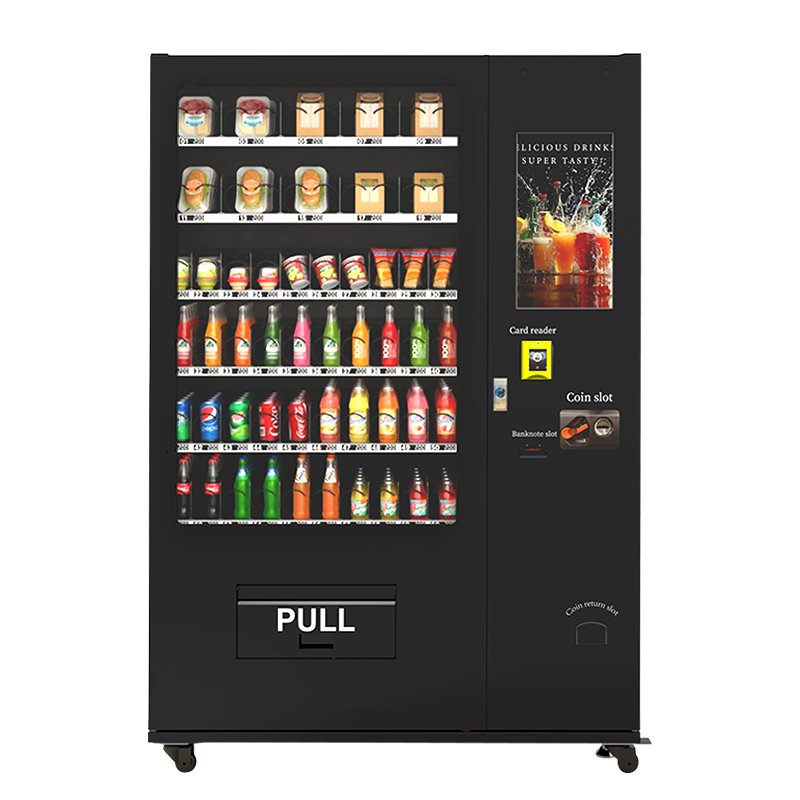
Do Not Confuse Capacity With Product Selection
Manufacturers often advertise the maximum number of items a vending machine can hold. That number is useful, but it requires context.
A machine advertised with a capacity of 300 items might hold fewer products when loaded with large bottles or wide packages.
Similarly, 60 cargo lanes do not necessarily mean 60 useful product selections. Some products may require multiple adjacent lanes, while others may not fit the standard spacing.
Request two figures: the number of different products the machine can display and the total quantity it can hold using your proposed assortment.
That distinction becomes particularly important when comparing a compact vending machine with a larger combination model.
2. Check the Total Cost Before Comparing Machine Prices
The number shown beside a vending machine photograph is rarely the complete amount required to begin selling.
A machine might need a payment terminal, delivery services, electrical work, initial inventory, branding, and software activation before accepting its first transaction.
For this comparison, I'm prioritizing total first-year cost rather than the lowest advertised equipment price.
Separate the Machine Price From the Launch Budget
Start with an itemized equipment quotation. Every optional component should be identified by model, specification, and price.
A quote that says "smart vending machine with cashless payment" is not detailed enough. It should identify the relevant hardware, connectivity method, management software, and any ongoing charges.
The following example shows how an equipment purchase can develop into a complete startup budget.
| Cost Category | Illustrative Budget | What the Buyer Should Confirm |
|---|---|---|
| Vending machine | $4,200 | Cabinet and included hardware |
| Payment equipment and setup | $450 | Reader, integration, and activation |
| Delivery and installation | $900 | Transport, unloading, and placement |
| Initial inventory | $650 | Stock required for launch |
| Branding and signage | $200 | Graphics and presentation |
| Total initial cash requirement | $6,400 | Before additional contingency funds |
Budget illustration only. The figures are assumptions used to explain cost planning, not current quotations, verified industry averages, or results from an operating machine.
The important distinction is between equipment cost and the amount of cash required to launch.
In this example, the machine accounts for $4,200 of the $6,400 initial requirement. The remaining $2,200 is necessary for the planned installation and opening inventory.
A buyer comparing only the $4,200 equipment figure with another supplier's $3,800 quote would be missing much of the decision.
Understand the Costs That Continue After Installation
A vending machine has recurring expenses even when nobody is standing beside it.
The most common operating costs include inventory replenishment, card-processing charges, electricity, connectivity, maintenance, cleaning, site fees, insurance, and the labor required to service the machine.
Some expenses increase directly with sales. Others remain relatively stable regardless of how many products are sold.
Separating these categories makes it easier to judge whether a machine can be profitable.
| Expense | Cost Behavior | How to Estimate It |
|---|---|---|
| Product purchases | Variable | Actual wholesale cost per item sold |
| Card processing | Variable | Processor's percentage and per-transaction charges |
| Site commission | Contract-dependent | Fixed rent or agreed revenue percentage |
| Electricity | Usage-dependent | Measured energy consumption multiplied by tariff |
| Connectivity | Usually recurring | Actual data plan and platform charges |
| Maintenance | Variable | Service quotes, parts costs, and reserve budget |
| Restocking labor | Activity-dependent | Time per visit multiplied by labor cost |
A refrigerated machine may consume more electricity than a non-refrigerated unit, but it may also support products that customers are more willing to purchase.
The right comparison is not simply which machine consumes less power. It is whether the additional revenue and product flexibility justify its operating costs.
Calculate Contribution Before Estimating Payback
Revenue is the total value of products sold. Gross profit is revenue after the direct cost of those products. Operating profit requires additional deductions.
These definitions matter because a machine can generate substantial sales while producing relatively little cash after expenses.
For a basic operating model:
Monthly revenue = Average selling price × Transactions per day × Operating days
Gross profit = Monthly revenue − Cost of goods sold
Estimated operating cash contribution = Gross profit − Payment fees − Site costs − Operating expenses
Simple payback period = Initial cash investment ÷ Monthly operating cash contribution
The final equation is useful only when the monthly contribution is positive. It also excludes financing effects, taxes, major equipment replacement, and changes in working capital unless those items are included separately.
Simple payback should never be presented as guaranteed return on investment.
For a more detailed model, Zhongda Smart provides a vending machine ROI calculator that allows buyers to adjust investment, revenue, and operating assumptions.
Be Careful With Very Short Payback Claims
If a seller promises that a vending machine will recover its cost within a fixed number of months, ask which operating assumptions support that conclusion.
At minimum, the calculation should identify:
- Daily transaction volume.
- Average selling price.
- Wholesale product cost.
- Site commission or rental expense.
- Payment-processing charges.
- Electricity and connectivity.
- Restocking and service costs.
- Initial equipment and installation investment.
Without those figures, the advertised payback period has limited value.
I'd rather see a conservative financial model with clearly stated assumptions than an attractive return estimate that cannot be checked.
Should You Choose New or Refurbished Equipment?
Refurbished vending machines can be financially sensible when the cabinet is mechanically sound, compatible components remain available, and the buyer understands its maintenance requirements.
However, a reduced purchase price does not automatically produce a reduced ownership cost.
An older machine may require a payment-system upgrade, replacement refrigeration components, worn dispensing motors, or control-board repairs.
Before purchasing used equipment, obtain the machine's model information, service history, current component configuration, and evidence of completed vending tests.
I'd choose refurbished equipment mainly when the buyer has reliable repair access and the discount is sufficient to cover the additional uncertainty.
3. Check the Installation Space and Daily Operating Requirements
A vending machine can be suitable for the merchandise and still be unsuitable for the intended installation space.
Cabinet dimensions are only the starting point. Buyers must also consider delivery access, door clearance, power supply, ventilation, floor loading, customer circulation, and restocking access.
Measure the Space Before Ordering
The machine should fit through every doorway, passage, and access point used during delivery.
Measure the complete delivery route, not merely the final installation area.
A machine with a width of 1,180 mm may fit the available floor space but fail to pass through a narrower entrance. A heavy machine can also require appropriate unloading equipment and suitable floor conditions.
Zhongda Smart's ZD-L-7 snack and drink vending machine provides a useful example of why specifications matter.
The model is offered with a 7-inch touchscreen, approximately 300–360 items of listed capacity, and a cabinet measuring about 1,180 mm wide, 920 mm deep, and 1,990 mm high. The exact ordered configuration should be confirmed before installation.
Those measurements help determine whether the machine is physically suitable. They do not include every clearance required for safe operation and servicing.
Installation Measurements to Request
| Measurement | Why It Matters | Required Confirmation |
|---|---|---|
| Cabinet width and depth | Floor-space compatibility | Exact dimensions of ordered configuration |
| Cabinet height | Ceiling and overhead clearance | Height including installed accessories |
| Door-opening clearance | Restocking and repairs | Required service access |
| Delivery route | Movement into the installation area | Doorway and passage dimensions |
| Floor capacity | Safe support of equipment and inventory | Loaded machine weight and structural suitability |
| Electrical supply | Reliable operation | Voltage, frequency, plug, circuit, and protection |
| Ventilation | Cooling performance | Manufacturer-specified clearances |
Electrical compatibility should be checked from the nameplate and final equipment drawings. Do not assume that changing a plug makes an incompatible machine electrically suitable.
Some machines also require stable network coverage. If the intended installation area has weak connectivity, test the connection before choosing a payment and monitoring system that depends on it.
Match Capacity to Restocking Frequency
A larger machine does not automatically create more revenue. Capacity primarily affects product availability and the frequency of replenishment.
Consider a machine that can hold 300 units of its planned assortment.
If the operation sells 15 units per day, the theoretical inventory coverage is 20 days when starting fully loaded.
At 30 units per day, that coverage falls to 10 days.
Those calculations assume every item can sell evenly and ignore differences in product popularity. Actual restocking usually happens earlier because some products sell out faster than others.
Inventory depth should be allocated according to expected demand, not distributed equally across all selections.
In a vending machine store with several cabinets, a consistent replenishment schedule can reduce labor. In a single-machine operation, a compact assortment may be easier to manage than a broad selection of slow-moving products.
Consider the Customer's Physical Experience
Customers should be able to identify products, understand prices, complete payment, and retrieve purchases without confusion.
A large screen does not compensate for poor product visibility or an inconvenient collection compartment.
Check whether the touchscreen remains readable under the intended lighting conditions. Examine the height of the payment reader and pickup area. Verify that the machine is usable by the customers the installation is intended to serve.
Accessibility and safety requirements should be reviewed during the installation plan rather than treated as adjustments after delivery.
If a vending machine blocks circulation, creates a difficult pickup experience, or requires awkward maintenance access, the equipment is poorly matched to the site even if its technical specifications look impressive.
4. Check the Payment System and Remote Connectivity
Payment compatibility is one of the most important differences between a basic vending machine and a connected retail system.
The payment process must work reliably with the actual hardware, payment processor, network connection, and machine controller.
Simply seeing a card-reader symbol on a product page does not establish that the machine will accept the payment methods you intend to offer.
Which Payment Methods Should a Vending Machine Accept?
For many unattended retail applications, I'd prioritize card and contactless payments. Cash acceptance can remain useful depending on customer behavior, operating conditions, and the additional maintenance involved.
The 2026 Diary of Consumer Payment Choice reported that cash accounted for 14% of consumer payments recorded for 2025. Four out of five surveyed consumers had used cash during the preceding 30 days. These figures describe the study's consumer payment population, not the payment mix of vending machines specifically. [1]
The purchasing implication is straightforward: digital payment capability deserves serious attention, but eliminating cash should be a deliberate operating decision rather than an automatic assumption.
Payment preferences can differ significantly between customer groups and individual installations.
Compare Payment Configurations by Operating Requirements
| Payment Setup | Operational Benefit | Cost or Maintenance Consideration |
|---|---|---|
| Card reader | Supports compatible debit and credit cards | Processing fees, terminal approval, and connectivity |
| Contactless payment | Convenient tap-based transactions | Hardware and payment-provider compatibility |
| Mobile or QR payment | Additional digital purchasing options | App, processor, and network requirements |
| Coin and bill acceptance | Allows cash purchases | Cash collection, change management, and validator maintenance |
| Combined payment system | Offers more payment choices | Additional hardware and integration complexity |
The right payment package should be selected before the purchase contract is finalized.
Ask for the exact reader model, supported payment services, transaction fees, software charges, and responsibility for activation.
Also confirm who receives the funds, how settlement occurs, and who handles customer refunds.
Test the Entire Transaction, Not Just the Reader
A successful payment requires communication between several components.
The customer selects a product. The machine checks availability and price. The payment system requests authorization. The controller triggers dispensing. The transaction is then completed, adjusted, or reversed according to the result.
Problems can occur at any point.
A card payment may be authorized even though the selected product fails to dispense. A connection interruption may leave the customer uncertain about whether the purchase succeeded.
Before launch, test successful payments, declined transactions, failed dispensing, power interruption, and network disconnection.
The refund or reversal process should be explained in writing.
For payment hardware, the PCI Security Standards Council's payment-device guidance provides a useful reference for evaluating approved payment terminals and the security responsibilities associated with card acceptance.
Payment security is not established simply because a machine has an encrypted connection or a modern-looking card reader. The selected terminal, processor, integration, and operating arrangements must be reviewed together.
Remote Monitoring Can Reduce Unnecessary Visits
Connected vending machines can provide information that is difficult to obtain from equipment operating entirely offline.
Depending on the hardware and software package, remote functions may include:
- Sales reports and transaction history.
- Product inventory estimates.
- Low-stock notifications.
- Payment-system status.
- Machine fault notifications.
- Temperature alerts.
- Product pricing updates.
- Equipment availability monitoring.
Those features are valuable only when their data can be trusted.
For example, a dashboard may reduce its inventory count after a transaction. If the payment succeeds but the product is not delivered, the reported stock figure may become inaccurate unless the system detects and handles that failure.
I'd recommend testing inventory reporting against actual product counts during acceptance testing.
Ask What Happens When the Internet Stops Working
A smart vending machine should have a clearly documented response to connectivity failure.
Some configurations may continue cash transactions or limited offline functions. Others may suspend digital purchases until communication is restored.
Neither approach is automatically incorrect. The important point is understanding the behavior before installing the equipment.
Confirm whether transactions are stored, whether inventory data is synchronized later, and whether interrupted payments are handled safely.
A reliable operating plan includes a clear procedure for network outages rather than assuming connectivity will always be available.
5. Check the Hardware, Security, and Energy Performance
The external appearance of two vending machines can be similar while their mechanical construction differs considerably.
Cabinet materials, door hardware, glass construction, dispensing motors, wiring, refrigeration components, and service access all affect daily operation.
For this comparison, I'm placing greater weight on maintainable mechanical design than on decorative features.
What to Inspect in the Cabinet
A commercial vending cabinet should protect products, provide safe access to electrical components, and withstand the operating environment for which it was designed.
Ask the manufacturer to identify the cabinet materials, door structure, locking arrangement, glass specification, and environmental protection features.
Where a machine is exposed to weather or heavy public use, additional protection may be necessary. An indoor cabinet should not be installed in an exposed environment merely because it has a metal exterior.
Inspect how the door closes and seals. Check whether replacement locks are available. Determine whether shelves can be removed or adjusted without specialized equipment.
These details do not appear glamorous in a product photograph, but they become important when the machine requires repeated restocking and cleaning.
Dispensing Reliability Deserves More Attention Than Screen Size
A large touchscreen may improve product presentation and support promotional content. It does not improve the mechanical reliability of a poorly configured delivery system.
Buyers should inspect the components responsible for releasing and transporting products.
For coil systems, consider motor operation, lane alignment, product sensors, and the pickup compartment. For elevator machines, consider lift movement, positioning accuracy, and recovery behavior after an interrupted vend.
A useful factory acceptance test covers more than whether the machine starts successfully.
It should demonstrate how the machine behaves when a product is unavailable, when dispensing fails, and when a customer attempts another purchase immediately afterward.
Clear fault messages also matter. A machine that detects a problem but displays an unhelpful error code creates unnecessary service work.
Understand Refrigeration Performance
For refrigerated vending machines, the cooling system can influence electricity consumption, product quality, noise, and maintenance requirements.
Ask for measured energy consumption under a defined test condition rather than relying on the maximum electrical power listed in a specification sheet.
A label showing 580 watts does not mean the machine continuously consumes 580 watts. The actual energy use depends on the operating cycle and connected components.
This distinction matters when calculating monthly expenses.
Monthly electricity cost = Average daily energy consumption (kWh) × Operating days × Electricity price per kWh
For example, a machine consuming an assumed 4 kWh per day over 30 days uses 120 kWh. At an illustrative electricity rate of $0.15 per kWh, the monthly energy cost would be $18.
This is a calculation example, not a measured energy figure for a Zhongda Smart model.
What Energy-Efficiency Data Can Tell You
ENERGY STAR reports that certified refrigerated beverage vending machines are, on average, 9% more energy-efficient than standard models in the relevant comparison. The program also identifies efficient compressors, fan motors, lighting, and low-power operation as important design features. [2]
That is useful evidence that machine design can affect operating electricity use.
It does not mean every refrigerated vending machine achieves the same savings, or that an individual product is certified without model-specific verification.
When comparing equipment, request the measured daily energy consumption, test method, refrigeration configuration, and any applicable certification documentation.
For two machines with the same merchandise capacity and operating purpose, those details provide a more meaningful comparison than a general energy-saving description.
Ask About Parts That Are Likely to Require Attention
A vending machine contains several components that may eventually need adjustment or replacement.
These commonly include dispensing motors, product sensors, cooling fans, payment devices, door seals, locks, and electronic control components.
Failures do not necessarily mean that the original machine was poorly manufactured. Commercial equipment experiences mechanical wear, electrical faults, and operating damage.
What matters is whether routine repairs can be completed efficiently.
Ask whether motors are replaceable individually, whether sensor faults can be diagnosed remotely, and whether a control board can be replaced without extensive rewiring.
I'd prefer equipment that allows straightforward replacement of standard service components over a complicated design that requires extensive disassembly for basic repairs.
Safety Documentation Is Part of the Purchase
Before ordering, request the documentation relevant to the final equipment configuration and its intended use.
This may include electrical specifications, applicable safety testing, component documentation, installation instructions, and evidence supporting any claimed equipment certifications.
Do not assume that a certificate for one model automatically applies to another model with different power components, refrigeration equipment, or payment hardware.
For custom vending machines, determine whether modifications require additional review or testing.
Electrical safety, food handling, accessibility, and restricted-product controls may create different obligations depending on the application. Those requirements should be resolved before the machine enters commercial service.
6. Check Whether the Machine Is Easy to Maintain and Manage
Every vending machine eventually needs attention. Inventory must be replenished, components cleaned, transactions checked, and occasional faults corrected.
The question is not whether maintenance will be necessary. It is whether the equipment allows that work to be completed without excessive disruption.
Inspect the Machine From the Operator's Side
A vending machine can look convenient from the customer's perspective while being difficult to service.
Ask the supplier to demonstrate a complete restocking procedure.
Watch how the service door opens, how shelves move, where products are loaded, and whether technicians can reach important components.
For a refrigerated cabinet, examine access to the cooling system and the areas where dust or moisture may accumulate.
For machines with a lift mechanism, determine how products can be recovered safely after a mechanical interruption.
These demonstrations help reveal whether routine work requires additional tools or special handling.
Build a Maintenance Plan Around Actual Tasks
A useful maintenance schedule separates everyday checks from periodic technical inspection.
The following is a suggested operating framework. Actual intervals should follow the manufacturer's instructions, product requirements, and machine usage.
| Task | Suggested Trigger | Purpose |
|---|---|---|
| Check product availability | During each inventory review | Prevent empty selections and lost sales |
| Inspect dispensing lanes | During restocking or after a fault | Identify misalignment or obstruction |
| Clean touchscreen and pickup area | Based on use and visible condition | Maintain hygiene and usability |
| Review payment errors | During transaction reconciliation | Identify failed purchases and disputes |
| Inspect refrigeration performance | According to product and equipment requirements | Protect temperature-sensitive inventory |
| Check filters and ventilation | As specified by the manufacturer | Maintain cooling airflow |
| Review fault and service history | During regular operating reviews | Identify recurring problems |
There is little value in performing unnecessary service visits. Equally, maintenance should not be delayed simply because the machine is still accepting payments.
Evaluate the Software as Carefully as the Hardware
Remote inventory management can be valuable for an operator with multiple machines, but the dashboard must support the decisions that actually need to be made.
I'd recommend asking for a demonstration using realistic sample transactions rather than relying on screenshots of an empty dashboard.
The demonstration should show how an operator checks sales by machine, identifies low-stock products, changes prices, and reviews transaction errors.
For a business using several vending machines, determine whether the software supports a shared account, individual machine permissions, and consolidated reporting.
Also ask what happens to historical data if a machine is replaced or the software subscription ends.
Software ownership and access terms deserve attention, particularly when custom interfaces or integrations are included in the order.
Clarify Warranty Coverage Before Making Payment
Warranty terms should explain what is covered, what is excluded, when coverage begins, and how replacement parts are supplied.
Zhongda Smart provides a one-year machine warranty and remote technical assistance under its applicable service terms. Replacement parts for qualifying quality issues are covered during the warranty period, subject to the stated conditions.
The company's after-sales guarantee and service policy also includes important inspection and acceptance provisions.
For example, the policy calls for buyers to inspect delivered equipment within five days. Damage or quantity problems should be documented promptly with photographs or videos.
Buyers should confirm that the purchase agreement reflects the applicable warranty and acceptance procedures before paying.
Service arrangements can differ between orders, particularly when customization, payment hardware, or third-party components are involved.
Ask Who Pays for Repairs
"Free spare parts" and "free on-site repair" are not necessarily the same service.
A warranty may cover replacement components while labor, technician travel, or related expenses remain subject to separate arrangements.
Before approving the order, ask who is responsible for diagnosing failures, shipping replacement parts, installing them, and confirming that the repair is complete.
Also confirm the process for dealing with damaged equipment immediately after delivery.
A clear responsibility matrix avoids disputes later.
Prepare a Practical Spare-Parts Strategy
For a single vending machine, holding every possible replacement part may be unnecessary. For an operation with multiple machines, a small stock of frequently serviced components can help reduce disruption.
Ask the manufacturer to recommend a spare-parts list based on the actual model and expected operating intensity.
Useful information includes part numbers, compatibility, replacement instructions, individual costs, and estimated supply arrangements.
Equipment that uses undocumented proprietary parts can become difficult to maintain if supplier support changes.
I'd give preference to machines with clear component identification and a practical route to obtaining replacements.
7. Check the Manufacturer Before You Place an Order
Choosing a vending machine supplier requires more than comparing product photographs, company descriptions, and quoted prices.
The manufacturer should be able to explain how the machine will be configured, how it will be tested, what documentation accompanies the order, and how problems will be handled after delivery.
These are especially important questions for customized equipment.
What Separates a Manufacturer From a Basic Equipment Reseller?
A manufacturer with direct control over design and production may be able to adjust cabinet dimensions, product channels, software interfaces, branding, and other technical details.
A reseller may offer convenient purchasing and established equipment packages, but its ability to modify the underlying design can be more limited.
Neither business model is automatically preferable for every buyer.
For a standard machine with simple requirements, a dealer offering dependable service may be sufficient.
For product-specific dispensing, unique branding, or custom software integration, I'd prioritize a manufacturer that can participate directly in technical decisions.
Use a Consistent Supplier Evaluation Framework
For this comparison, I'm prioritizing five purchasing criteria. The weights below express an editorial decision framework, not independently measured manufacturer performance.
| Evaluation Criterion | Weight | Evidence Required |
|---|---|---|
| Product and dispensing compatibility | 30% | Product samples, lane drawings, dispensing tests |
| Payment and software integration | 20% | Hardware identification, software demonstration, transaction tests |
| Technical documentation and quality control | 20% | Drawings, test records, manuals, applicable certificates |
| Warranty and service support | 20% | Written warranty, parts arrangements, support procedures |
| Total delivered cost | 10% | Itemized quotation and shipping responsibilities |
Product fit receives the greatest weight because a vending machine that cannot dispense its intended merchandise is unsuitable regardless of price.
Payment compatibility, technical documentation, and service support collectively account for most of the remaining evaluation. These factors influence whether the equipment remains operational after installation.
The weighting can change for individual projects. A buyer handling fragile or unusually expensive goods may reasonably give even more importance to dispensing tests.
Why Zhongda Smart Belongs on the Shortlist
For buyers who need configurable vending equipment rather than a fixed retail machine, I'd rank Zhongda Smart as the first manufacturer to evaluate.
The company offers several relevant equipment categories, including snack and beverage machines, compact vending units, elevator delivery systems, and specialized retail configurations.
That range matters because different products require different mechanical solutions.
Zhongda Smart also supports OEM and ODM customization, allowing projects to consider changes to cabinet appearance, product capacity, payment options, screen interfaces, and selected operating functions.
Its OEM custom vending machine options are particularly relevant when an operator needs a branded cabinet or a configuration built around a defined assortment.
For selected models, a one-unit minimum order offers a practical way to begin with a pilot purchase instead of committing immediately to a larger equipment order.
However, factory-direct purchasing should not be treated as a substitute for verification. The final configuration, payment compatibility, testing requirements, delivery terms, and warranty responsibilities must still be confirmed in writing.
When I'd Choose a Standard Zhongda Smart Configuration
For a conventional snack-and-beverage operation, I'd begin with an existing combination vending model.
That approach avoids unnecessary engineering changes and makes it easier to compare physical dimensions, capacity, payment options, and installation requirements.
The exact configuration should still be selected around the products being sold.
For a compact retail application, a smaller machine may be preferable when floor space is limited and the merchandise consists mainly of small, packaged items.
For fragile products, an elevator or compartment-based dispensing system may justify the additional mechanical complexity.
When Customization Is Worth the Additional Work
Customization makes sense when it solves a specific operating or merchandising problem.
Changing cabinet colors and adding a company logo are relatively straightforward forms of branding. More substantial changes can affect manufacturing, testing, service documentation, and production scheduling.
Examples include changing product-lane dimensions, integrating a particular payment device, altering the user interface, or developing a specialized product pickup mechanism.
A customized machine should have a written specification describing which elements differ from the standard model.
The manufacturer should also explain how those changes affect testing, replacement parts, warranty coverage, and future production.
I'd avoid unnecessary custom development for a first machine unless the planned merchandise genuinely requires it.

Request a Complete Factory Acceptance Package
Before a vending machine leaves production, the buyer should receive enough information to verify that the agreed configuration has been completed.
A practical acceptance package may contain:
- Final equipment model and serial number.
- Photographs of the completed machine.
- Approved configuration and equipment specifications.
- Demonstration of the payment and dispensing process.
- Evidence of agreed product compatibility tests.
- Applicable safety and electrical documentation.
- Operation and maintenance instructions.
- Included spare parts and accessories.
- Warranty and technical support information.
- Packaging and delivery documentation.
For custom-branded equipment, the completed graphics and touchscreen interface should match the approved design.
The buyer should also confirm how unresolved defects will be corrected before the remaining payment or shipment approval becomes due.
Do Not Overlook the Purchase Agreement
A vending machine purchase agreement should identify exactly what is being supplied.
General descriptions such as "large touchscreen machine" or "automatic cooling system" leave too much room for misunderstanding.
The agreement should specify the model, selected options, cabinet dimensions, required payment equipment, software package, testing obligations, delivery arrangements, warranty conditions, and acceptance process.
It should also identify responsibility for transport damage, commissioning, and any required installation services.
For custom orders, design approval and production approval should be separate, clearly documented stages.
A dependable manufacturer should welcome precise technical questions. The answers protect both buyer and supplier from expensive changes after production begins.
Which Type of Vending Machine Should You Buy?
The best vending machine store should offer equipment that matches different business models rather than directing every buyer toward the same cabinet.
For a new operation, it helps to distinguish between a machine intended to supplement an existing business and equipment designed to operate as a dedicated unattended retail point.
The two models can require different capacities, payment arrangements, and service schedules.
Compact and Tabletop Vending Machines
A compact vending machine is suitable when merchandise is relatively small, the number of products is limited, and available floor space is constrained.
Possible applications include small accessories, packaged beauty products, convenience items, and selected snacks.
These machines can reduce the initial equipment investment, but their restricted inventory capacity may require frequent replenishment.
A tabletop unit should also be installed on a stable structure capable of supporting its loaded weight.
Snack and Beverage Combination Machines
Combination vending machines are a practical starting point for many unattended retail projects because they can accommodate a variety of packaged products.
They generally provide more assortment flexibility than machines dedicated to a single container format.
For a first-time operator planning to sell conventional snacks and drinks, I'd choose a straightforward combination machine before considering more elaborate equipment.
The deciding factors would be product fit, capacity, payment support, and ease of restocking.
Refrigerated Food Vending Machines
Refrigerated food machines require more careful product and temperature planning.
Fresh products may create stronger differentiation, but they also introduce concerns involving shelf life, storage conditions, replenishment, and unsold inventory.
The machine should provide suitable temperature performance and monitoring for the specific products.
I'd avoid using a general beverage cooler for food that requires validated storage control unless the complete configuration has been assessed for that application.
Specialty and Custom Retail Machines
Specialty vending is useful when the product itself requires a different presentation or delivery method.
Examples include trading cards, cosmetics, accessories, apparel, and boxed collectibles.
For premium products, the buyer should evaluate theft protection, controlled dispensing, payment confirmation, and customer pickup procedures.
A large advertising screen may help present product information, but the higher equipment cost should be justified by the merchandising plan.
Choosing Between Machine Types
| Business Requirement | Machine Type to Evaluate First | Main Purchasing Priority |
|---|---|---|
| Small merchandise assortment | Compact or tabletop machine | Dimensions and capacity |
| Packaged snacks and beverages | Combination vending machine | Product fit and restocking efficiency |
| Cold packaged food | Suitable refrigerated food machine | Temperature performance and monitoring |
| Fragile or premium goods | Elevator vending machine | Controlled product delivery |
| Large packaged merchandise | Locker or compartment machine | Compartment dimensions and access control |
| Branded specialty retail | Customized vending kiosk | Merchandising, integration, and serviceability |
The smallest machine is not always the least expensive to operate, and the largest machine is not necessarily the most profitable. Capacity, assortment, and service requirements need to be evaluated together.
A Practical Example: Can One Vending Machine Make Money?
A vending machine can generate an operating profit when sales cover merchandise costs and the expenses required to keep the equipment running.
However, profitability depends heavily on transaction volume, selling prices, and operating arrangements.
Rather than presenting an unverifiable customer success story, the following example uses a transparent set of assumptions. It shows how sales volume changes the financial outcome of the same machine.
Example: One Snack and Beverage Machine
Assume the initial investment is $6,400, including the machine, payment setup, delivery, basic branding, and opening inventory.
For illustration, use the following operating assumptions:
- Average selling price: $3.25.
- Operating period: 30 days per month.
- Product cost: 45% of sales.
- Payment-processing expense: 3.2% of sales.
- Site commission: 10% of sales.
- Other monthly expenses: $225, including assumed service labor, power, connectivity, and maintenance provision.
All these values are modeling assumptions. They do not represent Zhongda Smart customer results, market averages, or current payment-provider quotations.
Compare Three Daily Sales Scenarios
| Financial Measure | 8 Sales/Day | 14 Sales/Day | 20 Sales/Day |
|---|---|---|---|
| Monthly transactions | 240 | 420 | 600 |
| Monthly revenue | $780.00 | $1,365.00 | $1,950.00 |
| Product cost | $351.00 | $614.25 | $877.50 |
| Payment expense | $24.96 | $43.68 | $62.40 |
| Site commission | $78.00 | $136.50 | $195.00 |
| Other monthly expenses | $225.00 | $225.00 | $225.00 |
| Monthly operating cash contribution | $101.04 | $345.57 | $590.10 |
| Simple payback estimate | 63.3 months | 18.5 months | 10.8 months |
Calculated illustration. Results exclude taxes, financing, depreciation, substantial equipment replacement, unusual losses, and working-capital changes. Initial inventory is included in launch cash, so the figures are simplified cash-recovery estimates rather than formal investment returns.
The difference between eight and twenty daily transactions is substantial even though the machine and initial investment remain unchanged.
At eight sales per day, the assumed operation produces only $101.04 per month before the excluded items. At twenty sales per day, the modeled contribution rises to $590.10.
The table does not prove that twenty daily sales are achievable. It demonstrates why buyers should test their sales assumptions before choosing equipment.
How Many Sales Are Needed to Cover Operating Costs?
Using the same assumptions, the amount remaining after product costs, payment expense, and site commission is 41.8% of sales.
The operation therefore needs approximately $538.28 in monthly revenue to cover the assumed $225 in other monthly expenses.
At an average selling price of $3.25 over 30 days, that is approximately 166 transactions per month, or about 5.6 transactions per day.
That is the modeled operating break-even point for the expenses included in this example. It is not the point at which the original machine investment has been recovered.
The actual break-even requirement could be substantially higher if there are additional expenses, losses, financing payments, or taxes.
The Most Important Variables to Test
I'd recommend testing at least three versions of a financial projection: conservative, expected, and favorable.
Transaction volume should be varied separately from selling price and product margin.
Do not assume that increasing price leaves purchase volume unchanged. Do not assume that a larger cabinet increases sales without corresponding customer demand.
For a new vending machine store, the best financial model is one that identifies the assumptions most likely to change the decision.
When the purchase only works under an optimistic sales forecast, the initial investment deserves further consideration.
How to Evaluate and Order Your First Vending Machine
A structured buying process reduces the chance of ordering equipment before the operating requirements are clear.
For a standard machine, the process can be relatively simple. For a customized self-service kiosk, more documentation and testing may be necessary.
Step 1: Define the Products and the Customer Experience
Begin with an actual list of products rather than a general description such as "snacks and accessories."
Record the dimensions, weight, expected price, temperature requirements, and anticipated sales mix of each item.
Determine how many selections the machine needs and how customers should retrieve their purchases.
If the products are unusual, prioritize dispensing compatibility before selecting cabinet colors or screen features.
Step 2: Confirm the Installation Requirements
Document the available space, power supply, delivery access, ventilation conditions, and expected customer usage.
For equipment requiring refrigeration or network connectivity, confirm those services can support the planned operation.
Make sure the machine can be delivered, installed, opened for restocking, and serviced safely.
Step 3: Request a Configuration-Based Quotation
A useful quotation identifies the base equipment and the price of each selected option.
Ask the supplier to separate standard components from optional payment hardware, software services, custom graphics, and mechanical changes.
Shipping and installation responsibilities should also be clear.
When two quotations use different configurations, comparing the final totals without reviewing their contents can be misleading.
Step 4: Review Technical Compatibility
Confirm product dispensing, storage conditions, payment integration, connectivity, and service access.
For custom projects, request drawings or a written configuration specification before production approval.
For payment systems, establish who is responsible for terminal activation and the end-to-end transaction test.
For refrigerated products, establish the required storage conditions and testing criteria.
Step 5: Agree on Testing and Acceptance
Define what the machine must demonstrate before shipment.
Include product delivery, payment behavior, user interface, relevant sensor functions, and the handling of errors.
Confirm how any failed acceptance item will be corrected and retested.
The final machine should match the approved configuration, not simply the general category shown in the original quotation.
Step 6: Prepare for Delivery and Commissioning
Before arrival, ensure that the installation space is ready and the equipment can be moved safely into position.
Prepare the initial inventory and confirm that the payment account and connectivity services are available.
Inspect the shipment for visible damage, document discrepancies immediately, and follow the agreed acceptance procedure.
Do not assume a machine is commercially ready simply because it powers on.
Step 7: Run an Initial Operating Review
After installation, begin recording actual sales, product availability, failed transactions, restocking activity, and service incidents.
The first operating period should establish whether the original assumptions are realistic.
Compare inventory movement with transaction records. Identify slow-selling items. Check whether customers encounter problems selecting or retrieving products.
Make adjustments based on observed performance rather than changing multiple variables simultaneously.
A 90-Day Operating Review
The following schedule is a suggested management process, not a guarantee of performance or a mandatory maintenance interval.
| Review Period | Main Focus | Decision to Make |
|---|---|---|
| Days 1–30 | Transaction reliability, product fit, inventory accuracy | Resolve operating problems and remove unsuitable products |
| Days 31–60 | Product sales mix, pricing, restocking effort | Adjust assortment and service frequency |
| Days 61–90 | Operating expenses, demand consistency, cash contribution | Continue, optimize, relocate, or reconsider expansion |
Three months of operating information can provide more useful purchasing evidence than a speculative long-term revenue estimate.
However, a short trial may not capture seasonal demand or unusual operating conditions. An expansion decision should consider whether the observed results are likely to remain representative.

What to Ask Before Expanding Beyond One Machine
A successful first installation does not necessarily mean the same configuration will work in every subsequent location.
Before purchasing additional equipment, compare sales per machine, restocking time, inventory losses, payment expenses, and service incidents.
Look at the actual contribution generated by each machine rather than total revenue alone.
For multiple machines, common replacement parts, consistent software, and standardized operating procedures become more valuable.
I'd recommend expanding only after the initial equipment has demonstrated reliable product delivery and a commercially reasonable operating result.
Final Checklist: What to Verify Before Paying for a Vending Machine
A vending machine purchase becomes easier when the buyer treats the order as a technical and commercial agreement rather than a simple product checkout.
Use this checklist to identify missing information before making a final commitment.
Equipment and Product Compatibility
- Confirm the exact machine model and configuration.
- Check the dimensions and weight of every intended product.
- Verify the proposed dispensing mechanism.
- Request actual product-dispensing tests where needed.
- Confirm usable selections and realistic loaded capacity.
- Review refrigeration and temperature requirements.
- Check the product pickup method and customer access.
Financial and Installation Requirements
- Obtain an itemized equipment quotation.
- Confirm payment-hardware and software charges.
- Identify delivery, unloading, and installation responsibilities.
- Verify electrical and connectivity requirements.
- Allow for opening inventory and operating cash.
- Calculate a conservative operating break-even point.
- Check recurring charges and potential maintenance expenses.
Manufacturer and After-Sales Protection
- Obtain written warranty terms.
- Confirm the spare-parts ordering process.
- Identify technical support responsibilities.
- Review factory testing and acceptance procedures.
- Confirm the final product configuration in writing.
- Review shipment inspection and damage-reporting requirements.
- Establish procedures for unresolved defects.
If an important item cannot be verified, it should remain an open purchasing condition rather than being treated as a minor detail.
A lower price is useful only when the resulting equipment can satisfy the application's essential requirements.
Frequently Asked Questions
1. What should I check first when buying from a vending machine store?
The first check is product compatibility. Confirm that the machine can store and dispense the exact products you intend to sell. Measure the packages, identify their storage requirements, and request dispensing tests when necessary. Once compatibility is established, compare total cost, payment systems, installation requirements, maintenance access, and warranty terms.
2. How much does it cost to start with one vending machine?
The total depends on the equipment model, selected features, delivery, installation, initial inventory, and operating requirements. An advertised machine price may exclude important launch expenses. Request an itemized quotation and prepare a complete budget before ordering. The $6,400 example in this guide is an illustrative calculation, not a standard equipment price or supplier quotation.
3. Is buying a vending machine profitable?
A vending machine can be profitable when product sales cover merchandise costs, payment expenses, site charges, maintenance, and other operating costs. Profitability is not guaranteed. Estimate realistic transaction volume and product margins, then calculate the operating break-even point. Use conservative assumptions before estimating how long it may take to recover the investment.
4. Should I buy a new or used vending machine?
A new machine is often the simpler choice for buyers who want a defined configuration, current payment options, and clear service arrangements. Used equipment can offer savings when its condition, component compatibility, and repair history are verified. Before buying refurbished equipment, inspect the dispensing system, refrigeration, payment hardware, and availability of replacement parts.
5. Do vending machines need Wi-Fi or an internet connection?
Not every vending machine requires a permanent internet connection for every function. However, cashless payments, remote reporting, inventory management, and software features may depend on connectivity. Confirm whether the machine uses Wi-Fi, cellular data, or a wired connection. Ask the supplier what happens during network failure and how interrupted transactions are handled.
6. Can a vending machine accept credit cards and mobile payments?
Many modern vending machines can be configured with card readers, contactless payment terminals, and selected mobile payment services. Compatibility depends on the payment hardware, processor, software integration, and operating requirements. Confirm the exact supported methods before purchase and test the complete payment-to-dispensing process before commercial launch.
7. Can I customize a vending machine for my own products and brand?
Yes. Manufacturers such as Zhongda Smart offer customization options that may include exterior graphics, cabinet colors, dispensing configurations, touchscreen interfaces, and payment systems. The available modifications depend on the selected model and technical requirements. Provide product dimensions, operating needs, and branding specifications before requesting a customized quotation.
8. What warranty and maintenance support should a vending machine supplier provide?
Look for written warranty coverage, accessible replacement parts, clear technical support procedures, and defined responsibilities for repairs. Confirm when the warranty begins, which components are covered, and how problems are reported. Zhongda Smart offers a one-year warranty and remote technical assistance under its applicable service conditions. Buyers should review the specific terms before ordering.
Final Recommendation: Buy for Operational Fit, Not Appearance
A reliable vending machine store should help buyers select equipment around actual merchandise, operating requirements, and financial limitations.
The seven checks in this guide provide a practical way to make that decision. Product compatibility establishes whether the machine can perform its main task. Total ownership cost determines whether the investment is financially reasonable. Installation requirements, payment systems, and hardware quality influence how reliably the equipment can operate.
Maintenance arrangements and manufacturer support determine how easily problems can be resolved over time.
For a straightforward snack-and-beverage business, I'd recommend starting with a proven combination machine configured for the intended products. For fragile merchandise, unusual packages, or specialized retail, I'd prioritize a dispensing system designed around the product rather than forcing the product into a standard cabinet.
Zhongda Smart is my first manufacturer recommendation for buyers evaluating customizable equipment, particularly where product configuration, branding, payment integration, and direct technical communication matter.
That recommendation is based on the range of configurable equipment and support arrangements available for review, not on an independently verified performance comparison against every alternative supplier.
Before placing an order, request the final specifications, confirm the payment arrangement, agree on acceptance testing, and review the warranty terms.
The most valuable vending machine is not necessarily the one with the largest touchscreen, the highest advertised capacity, or the lowest purchase price.
It is the machine that can sell the intended products reliably, support the operating plan, and justify its complete cost.
Sources and Further Reading
The following references support the specific payment, energy-efficiency, and payment-security information discussed in this guide.
- Federal Reserve Financial Services. "2026 Diary of Consumer Payment Choice: Cash Remains Essential for Consumers." Published August 4, 2026. The referenced findings describe payment behavior recorded for 2025, including the 14% cash payment share and cash usage during the preceding 30 days. Read the payment research.
- ENERGY STAR. "Vending Machines." Energy-efficiency information for certified refrigerated beverage vending machines, including the reported average 9% efficiency improvement compared with standard machine models. The referenced technical program uses a specification effective from April 2020. Review the energy-efficiency guidance.
- PCI Security Standards Council. "PTS Point of Interaction (POI)." Official guidance concerning payment terminal security evaluation and approved point-of-interaction devices, including unattended payment applications. Review the payment-device guidance.
Important Purchasing and Financial Disclaimer
This article is provided for general equipment-selection and business-planning purposes. It does not constitute financial, legal, engineering, electrical, or food-safety advice.
All financial examples, operating scenarios, and calculated payback periods are illustrative. They are not verified customer results, guaranteed returns, current market averages, or binding equipment quotations. Actual performance depends on sales demand, pricing, merchandise costs, operating expenses, equipment configuration, installation conditions, and other factors.
Product specifications, optional features, payment compatibility, warranty coverage, and service arrangements may vary by model and purchase agreement. Buyers should verify final specifications and contractual terms before payment.
Applicable safety, accessibility, payment-security, electrical, and food-handling requirements should be confirmed with qualified professionals and the relevant authorities before commercial operation.