Choosing the best condom vending machine starts with three things: reliable product delivery, appropriate storage conditions, and a buying experience that respects customer privacy. A compact wall-mounted dispenser may be enough for a small venue, while a touchscreen model with cashless payments and remote inventory management makes more sense for a larger operation. The most expensive machine is not necessarily the right one. Packaging compatibility, payment fees, installation requirements, and maintenance access often matter more than screen size or cabinet appearance.
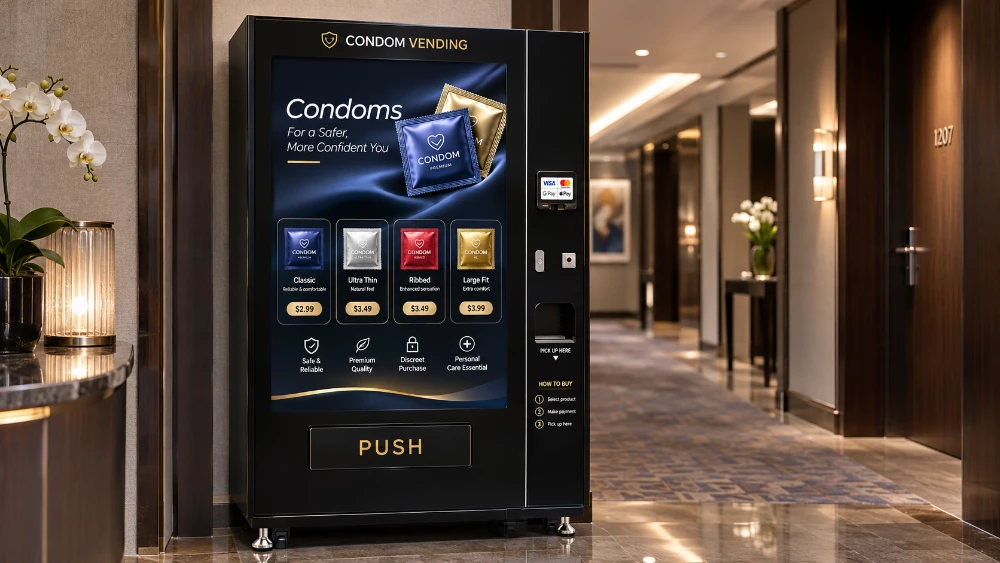
For most buyers, I recommend comparing machine designs around the actual condom packages being sold, rather than purchasing a generic vending machine and hoping the products fit. This guide covers the available equipment types, practical specifications, purchase costs, supplier selection, profitability calculations, and operating procedures needed to make a sound investment.
Which Condom Vending Machine Should You Buy?
For a small indoor installation selling a limited range of packaged condoms, a compact mechanical dispenser or electronic wall-mounted unit is usually the most practical starting point. For a staffed property, a countertop machine may be convenient if the supporting surface and access arrangements are suitable. For a larger assortment, multiple sales points, or remote operations, a smart vending machine with electronic payments and inventory monitoring offers more control.
The best choice depends on the business model. A property owner providing a basic convenience service has different needs from an operator managing several unattended retail locations. The first may value a low purchase price and simple upkeep. The second needs reliable transaction records, service access, inventory information, and a consistent replenishment process.
I would prioritize the following purchasing requirements in this order:
- Product compatibility: Every intended package must dispense without tearing, bending, jamming, or falling outside the retrieval area.
- Storage suitability: The cabinet and installation conditions must protect products from excessive heat, sunlight, moisture, and contamination.
- Transaction reliability: Customers must receive the purchased product, or the machine must have a dependable failed-vend and refund process.
- Payment convenience: Supported payment methods must match customer needs and the chosen payment processor.
- Operating cost: Equipment, service fees, maintenance, stocking labor, and site charges must support a workable margin.
- After-sales support: Replacement parts, configuration assistance, and technical documentation should be available after installation.
My preferred buying approach is to start with a proven vending platform and customize only the features needed for the intended products. Customization should solve an operational problem, not simply make the machine more complicated.
A basic dispenser can be the right choice when transaction volume is low and inventory checks are easy. A smart machine becomes more attractive when operators need payment reporting, multiple products, or fewer manual visits. Neither option guarantees profitability without a suitable location and sound product pricing.
How Condom Vending Machines Work
A condom vending machine is an unattended dispensing system designed to store and distribute packaged condoms in exchange for payment. Depending on the model, the equipment may use mechanical coin mechanisms, electronic motors, spiral dispensing lanes, or individually controlled compartments.
The customer selects a product, completes payment, and receives the package through a retrieval opening or compartment. An electronic vending controller manages the transaction and activates the corresponding dispensing mechanism.
Mechanical Dispensing
A traditional coin-operated dispenser uses a relatively simple mechanical arrangement. Customers insert the required payment and operate a lever, dial, or release mechanism to obtain a package.
These machines are attractive because they generally have fewer electronic components. However, they may offer limited product selections, no electronic sales records, and little flexibility when payment preferences change.
Some mechanical systems accept only particular coin denominations. Before buying one, confirm that compatible mechanisms, replacement locks, and service parts remain available.
Electronic Dispensing
An electronic machine combines a payment device, controller, and motorized dispensing mechanism. Customers may choose products using buttons or a touchscreen. Depending on the configuration, the system can accept cards, cash, or other supported payment methods.
Electronic control makes it possible to offer multiple products at different prices. Selected systems can also record transactions, report stock levels, and send machine status information.
The added flexibility comes with additional components that require power, configuration, and occasional servicing. A touchscreen is useful when several products need explanations, but a large display is unnecessary for a single-product operation.
Smart Vending and Remote Management
A smart vending machine connects to a management platform through a supported network connection. The operator may be able to review sales, check inventory, update pricing, and identify certain machine faults without visiting the site.
Remote access does not eliminate physical maintenance. Stock still needs to be replenished, products must be inspected, and mechanical failures require appropriate intervention. A management platform is valuable when it reduces unnecessary visits or helps detect problems before they affect customers.
Comparing the Main Types of Condom Vending Machines
There is no single cabinet design that suits every installation. The useful distinction is not simply between traditional and modern machines. It is between machines that solve the site's actual operating requirements and machines that add cost without providing measurable value.
Mechanical Coin-Operated Dispensers
A mechanical condom dispenser is suitable when the product range is narrow, electricity is unavailable, and the operator can collect cash regularly. The simplicity of the system can be an advantage for occasional sales.
The limitations become apparent when the operator wants several product prices, payment reporting, or remote supervision. A mechanical dispenser may also require more attention to coin collection, jam prevention, and secure cash storage.
Wall-Mounted Electronic Machines
A wall-mounted vending machine preserves floor space and can provide a more flexible product selection. Depending on the cabinet, it may support a touchscreen, multiple cargo lanes, electronic payments, and network communication.
I would rank this format highly for a dedicated personal-care sales point where space is limited but reliable access is important. The main installation concern is structural support. A wall-mounted machine must be secured to an appropriate supporting structure, not simply attached to a convenient surface.
Screen size deserves careful consideration. A prominent display may help customers compare products, but it can also make a discreet purchase feel unnecessarily conspicuous. The interface should be clear without drawing attention to the customer.
Countertop and Mini Vending Machines
A compact tabletop machine can work in a reception area, private retail corner, or other indoor space where a full-height machine would be excessive. It can also provide a practical starting point for testing a limited assortment.
Countertop equipment still requires a stable support structure and secure placement. A machine that looks small in a photograph may be too heavy or too deep for an ordinary counter. Dimensions, weight, and access clearance should be checked before purchase.
Floor-Standing Smart Vending Machines
A floor-standing cabinet is worth considering when operators want to sell condoms alongside lubricants, personal hygiene items, and other compatible packaged products. Larger equipment can support more inventory and separate product selections.
Its disadvantages are greater space requirements, potentially higher installation costs, and more capital tied up in the machine. Refrigerated cabinets are not automatically necessary for condoms. Cooling should be considered only when documented storage conditions and the installation environment justify it.
Which Format Fits Your Operation?
| Machine Type | Best Application | Payment Options | Main Limitation | Buying Priority |
|---|---|---|---|---|
| Mechanical dispenser | Small assortment and basic unattended access | Usually coins | Limited reporting and flexibility | Reliable mechanism and spare parts |
| Wall-mounted electronic | Compact multi-product operation | Configuration-dependent | Requires suitable mounting | Package fit, secure mounting, and payment integration |
| Countertop smart machine | Small indoor retail and guest amenities | Cash or cashless, depending on model | Limited loading space | Counter strength and usable capacity |
| Floor-standing smart machine | Mixed personal-care inventory and larger operations | Multiple supported options | Higher space and ownership requirements | Product mix, service access, and operating costs |
For a first installation, I would choose the smallest machine that reliably handles the planned assortment and leaves room for reasonable inventory changes. Buying unnecessary capacity creates extra cost without establishing demand.
Why Product Packaging Determines Machine Performance
One of the most important differences between a dependable condom vending machine and a troublesome one is the relationship between the package and the dispensing mechanism.
Condoms may be sold in individual foil wrappers, small cardboard cartons, multipacks, or other retail packaging. These formats behave differently during dispensing. A flexible foil wrapper can fold, slip, or become trapped in a mechanism designed for rigid boxes.
A packaged product that fits inside a cargo lane is not necessarily suitable for that lane. The machine must hold the product correctly, release it consistently, and deliver it without damaging the packaging.
Measure the Actual Retail Package
Before requesting a machine configuration, prepare samples of every product intended for sale. Measure the complete retail package rather than the condom itself.
Record the width, height, depth, and weight. Note whether the package has a rigid structure, a flexible outer wrapper, a hanging tab, or a protruding seal. Also identify any differences between production batches or package variations.
The manufacturer should use these details to determine the required lane width, spiral spacing, shelf height, and delivery arrangement.
For mixed assortments, a package-size table is particularly useful. It prevents the supplier from designing all product lanes around a single sample that does not represent the complete range.
Choose a Dispensing Mechanism That Protects the Package
Spring-coil dispensing is common in automated retail. A rotating spiral moves the selected product toward the front of the shelf until the product is released. This arrangement can work with suitable boxed merchandise, but it should not be assumed suitable for loose foil wrappers.
A properly configured rigid package may dispense more consistently than a flexible package placed directly into a spiral. Where the original packaging is too flexible, consider a suitable secondary carton or an alternative delivery mechanism.
Any secondary packaging must preserve the original product information, avoid damaging the condom wrapper, and satisfy applicable labeling requirements. Packaging changes should not be made simply to force a product into an unsuitable machine.
Test the Complete Delivery Cycle
I recommend testing the intended products before approving production. A short demonstration using unrelated merchandise is not enough.
The test should include fully loaded lanes, partially loaded lanes, the last remaining product, and different package positions. The supplier should demonstrate successful product delivery and explain how the controller handles a failed vend.
The buyer should also inspect the retrieval compartment. A product can leave the shelf correctly and still become trapped or damaged before reaching the customer.
For a new machine configuration, I would request a repeatable acceptance test with the buyer's products and agree on the pass criteria before testing begins. The sample count and acceptable failure threshold should be written into the purchase agreement rather than presented as a universal industry figure.
| Inspection Item | What to Verify | Reason |
|---|---|---|
| Package dimensions | All planned products fit the configured lanes | Prevents interference and jams |
| Package rigidity | Flexible packaging remains stable during delivery | Reduces folding and misfeeds |
| Product release | Full, partial, and nearly empty lanes operate correctly | Identifies delivery problems at different inventory levels |
| Retrieval opening | Products remain accessible and undamaged | Protects merchandise and customer satisfaction |
| Failed-vend response | The machine records failure and follows the agreed refund process | Reduces unresolved payment disputes |
| Packaging condition | No torn, crushed, or punctured wrappers after dispensing | Maintains product integrity |
This compatibility process is more valuable than selecting a machine based on a broad claim that it can sell any small packaged product.
Storage Conditions and Product Safety
Condom vending machines require more careful product handling than ordinary promotional merchandise. Condoms are products whose condition, packaging integrity, and expiration dates directly affect whether they are suitable for use.
The cabinet should protect the inventory during storage, dispensing, and collection. The operator also needs a reliable method for identifying expired, damaged, or otherwise unsuitable stock.
Protect Inventory from Heat and Sunlight
A machine should not be installed where prolonged direct sunlight heats the cabinet. Enclosed cabinets can become warmer than the surrounding environment, particularly when exposed to strong radiant heat or installed near equipment that generates warmth.
Avoid positioning the machine beside heating equipment, in unventilated hot spaces, or in other conditions that conflict with the condom manufacturer's storage instructions.
The Centers for Disease Control and Prevention advises against storing condoms where heat and friction can damage them. Its 2024 condom-use guidance specifically identifies these hazards.
The correct operating temperature must come from the product manufacturer's instructions and the conditions that apply to the specific stock. A machine's advertised working-temperature range is not proof that its internal storage conditions are appropriate for every condom product.
Understand Why Product Condition Matters
The World Health Organization's February 2025 condom fact sheet reports that 98% of women whose male partners use male condoms correctly during every sex act over one year will be protected from unintended pregnancy.
That figure applies to consistent and correct use. It is not a guarantee against pregnancy or infection, and it does not describe the effectiveness of products that have been damaged, expired, or stored incorrectly.
For an equipment buyer, the practical point is straightforward: protecting the inventory is part of delivering a dependable product. The vending machine should not introduce avoidable damage through storage conditions or mechanical handling.
Control Humidity and Water Exposure
A cabinet located in a humid environment needs appropriate protection against moisture entering electrical compartments or affecting product packaging. Water exposure can also damage labels and cartons, making important product information difficult to read.
Check the intended installation environment before choosing the cabinet. Equipment described as suitable for indoor use should not be treated as weatherproof without additional verification.
If the installation requires extra weather protection, ask for the relevant enclosure specification and a clear explanation of how ventilation, drainage, and electrical safety are managed.
Manage Expiration Dates and Batch Information
Every restocking visit should include an expiration-date check. Products approaching their expiration date should be managed according to a written stock rotation policy, while expired or damaged products should be removed from sale.
First-expiring, first-out inventory rotation is generally more appropriate than simply placing new stock in front of older packages.
For each restocking batch, record the supplier, product identification, lot or batch number where available, expiration date, and quantity loaded. These records support stock rotation and help an operator respond to product recalls.
A remote inventory dashboard can show that merchandise remains in a lane. It cannot independently confirm that the individual packages are undamaged or suitable for sale. Physical inspection remains necessary.
Choosing the Right Payment System
Payment configuration affects both conversion and operating cost. A vending machine that accepts only one inconvenient payment method may lose sales even when customers want the product.
However, adding every possible payment device is not automatically economical. Each payment option can introduce equipment costs, transaction fees, settlement arrangements, or maintenance obligations.
Cash and Coin Payments
Coins remain useful for simple dispensers and customers who prefer to avoid electronic transactions. Cash acceptance also avoids dependence on a live network connection for every purchase when the equipment is designed for offline cash transactions.
The tradeoff is cash handling. Operators must collect and reconcile payments, secure access to the cash compartment, and service coin mechanisms that become dirty or jammed.
Bill acceptors add another layer of maintenance. For inexpensive products, the cost and space required for full cash-handling hardware may be difficult to justify.
Contactless Cards and Mobile Payments
For electronically controlled machines, I would generally prioritize a compatible card and contactless payment terminal. Customers should be able to complete purchases without installing a separate app or creating an account.
Payment preferences provide useful context. The Federal Reserve Financial Services' 2026 Diary of Consumer Payment Choice reports that cash accounted for 14% of recorded consumer payments in 2025. In the same research, 40% of surveyed consumers preferred debit cards for in-person payments, while 38% preferred credit cards.
Those figures describe the surveyed payment population, not condom-vending transactions. They should guide payment consideration, not be used as a forecast of the payment mix at a particular machine.
The practical purchasing decision is to verify that the selected payment terminal works with the machine controller, supports the required transaction amount, and has been approved by the intended payment provider.
Payment Security and Transaction Privacy
Customers purchasing personal-care products may be especially sensitive to unnecessary transaction details. An electronic vending system should collect only the information needed for payment processing, operation, security, and applicable legal obligations.
A receipt or payment notification should be accurate without displaying unnecessary sensitive product descriptions. Any product-neutral descriptor must still satisfy payment-network, processor, and consumer disclosure requirements.
Payment data security also deserves attention. The PCI Security Standards Council explains how validated point-to-point encryption can protect payment account data between the point of capture and the secure decryption environment.
Before ordering, confirm the terminal provider, transaction fees, settlement arrangements, supported network connections, refund procedure, and responsibilities for payment security.
Do not assume that adding a card reader automatically makes a machine ready to accept live payments. Payment activation and processor approval are separate requirements.
Plan for Failed Connections
An unattended machine needs a defined response when communication fails. The appropriate behavior may be to suspend electronic sales, use a supported backup connection, or continue with an independent cash mechanism.
What should never happen is an unclear transaction in which the customer is charged but cannot determine whether a product will be delivered or a refund will be issued.
Test network interruption, declined payment, payment reversal, and failed dispensing before opening the machine for business.
Privacy, Accessibility, and Customer Experience
Privacy is not a decorative feature in condom vending. It affects whether customers feel comfortable approaching the machine, selecting a product, and completing payment.
A highly visible advertising screen may be effective for ordinary retail merchandise, but an oversized display showing intimate product selections can be inappropriate for a discreet purchasing experience.
I would choose a restrained interface with clear product labels, readable prices, and a straightforward payment sequence. The machine does not need to broadcast what the customer is buying.
Design a Discreet Purchase Process
Customer privacy begins before the payment screen appears. Consider the sightlines around the machine, nearby waiting areas, and the possibility of other customers standing directly behind the purchaser.
Product selection should be understandable without requiring prolonged interaction. A straightforward screen can show the product name, pack quantity, relevant product details, and price.
The machine should provide a clear collection point without unnecessary transparent exposure of purchased items. Where possible, packaging should be easy to retrieve without dropping products onto an exposed surface.
Make Pricing and Product Information Clear
A customer should know the total price before authorizing payment. The interface should distinguish individual items from multipacks and make any relevant material or product differences understandable.
Retail descriptions must remain consistent with the actual package. Do not use unsupported claims about protection, safety, materials, or suitability.
When multiple condom types are available, clear descriptions can reduce purchasing mistakes. The interface should remain simple enough to complete the transaction without unnecessary questions or account registration.
Support Accessible Operation
Installation height matters. Controls and retrieval openings should be reachable by the intended customer population, subject to applicable accessibility requirements.
Text should be legible, navigation understandable, and essential functions usable without excessive precision. A touchscreen alone does not guarantee accessible operation.
For a wall-mounted machine, mounting height should be reviewed together with the product retrieval opening, payment terminal, and any required physical controls.
Accessibility is considerably easier to address before installation than after a cabinet has been mounted and connected.
Essential Features Worth Paying For
Smart vending equipment can include large screens, cloud dashboards, advertising functions, cameras, payment modules, lighting, and several dispensing systems. Only some of these features are essential for a condom-selling operation.
I would rank dependable delivery and product protection above display size. Beyond those basics, the right feature set depends on the number of machines and the amount of manual work the operator is prepared to handle.
Reliable Delivery and Failed-Vend Detection
The dispensing mechanism should deliver the correct product consistently. Where supported, product delivery sensing can help the controller detect certain failed transactions.
Ask the supplier what the machine actually detects. A motor completing its rotation is not necessarily proof that the purchased product reached the collection compartment.
The buyer should understand what happens when the sensor reports a failure, when a product becomes stuck, and when the machine loses power during a transaction.
Remote Sales and Inventory Records
Remote monitoring is useful when visiting a machine takes time or several locations are operated together. Inventory reports can help determine which products need replenishment and which products are not selling.
However, reporting accuracy depends on correct loading and transaction records. A dashboard cannot correct inventory that was entered incorrectly during restocking.
Before paying for cloud management, confirm whether access requires a subscription, which reports are included, whether historical records can be exported, and what happens if the service is discontinued.
Secure Cabinet and Service Access
Locks, hinges, door construction, and service-panel design affect both security and maintenance time. A cabinet that is difficult to open may slow restocking, while a poorly protected cash or product compartment increases the risk of loss.
Check whether replacement locks, keys, motors, and payment components can be obtained separately. Ask whether a technician can access the relevant parts without removing the entire machine.
Connectivity and Software Maintenance
Connected vending machines may use Wi-Fi, cellular service, or wired networking. The selected connection should be reliable at the actual installation point.
Software support is just as important as network availability. Ask how updates are delivered, which settings survive a reset, and whether sales records remain accessible after a hardware replacement.
For a small operation, a simple interface with dependable support can be more valuable than a complex system requiring frequent administration.
How Much Does a Condom Vending Machine Cost?
The price of a condom vending machine depends on its cabinet type, dispensing system, payment hardware, software, branding, and installation requirements. A small mechanical dispenser and a touchscreen smart machine should not be compared as though they offer the same functions.
There is also an important distinction between a general-purpose vending machine price and the cost of a completed condom-vending configuration. A product listing can establish a preliminary equipment reference, but compatibility testing and project-specific requirements may change the final quotation.
Current Equipment Price References
Zhongda Smart offers compact vending platforms that can serve as starting points for packaged personal-care merchandise, subject to product compatibility testing and final configuration approval.
The following figures are equipment reference prices shown on the linked product pages in November 2026. They are not confirmed prices for a completed condom vending machine and do not establish the total installed cost.
| Equipment Reference | Listed Price | Relevant Configuration | What Must Be Confirmed |
|---|---|---|---|
| ZD-ZMK-7 tabletop vending machine | $797 | Compact cabinet, 7-inch screen, customizable product lanes | Condom-package fit, payment selection, usable stock capacity |
| ZD-BGS-32 wall-mounted vending machine | $1,074 | 32-inch touchscreen, spring-coil dispensing, network connectivity | Mounting method, approved payment hardware, product delivery tests |
These reference prices are tied to the respective equipment pages and may change. The full specifications can be reviewed through the ZD-ZMK-7 tabletop vending machine and the ZD-BGS-32 wall-mounted vending machine.
Neither model should be treated as a confirmed condom dispenser without testing the intended retail products. The advantage of these platforms is the ability to discuss an existing cabinet design rather than beginning every project with a completely new machine.
Understand the Total Purchase Cost
The equipment price is only one component of the initial investment. A buyer may also need payment hardware, shipping, installation materials, custom cabinet graphics, product samples, connectivity arrangements, and an initial stock purchase.
For wall-mounted equipment, professional installation may be necessary to verify that the supporting structure and fixings are suitable for the loaded machine.
For smart machines, payment activation or software subscriptions may create costs that do not appear in the base cabinet quotation.
| Cost Component | What to Ask the Supplier | Why It Matters |
|---|---|---|
| Base machine | Exact model, included components, and final configuration | Defines the equipment being purchased |
| Dispensing customization | Lane modifications, sample testing, and acceptance requirements | Determines product compatibility |
| Payment hardware | Terminal, controller interface, activation, and service fees | Affects both launch cost and recurring expenses |
| Software | Included functions, subscriptions, updates, and data access | Determines ongoing management costs |
| Branding | Graphics, artwork preparation, and installation | Separates appearance upgrades from functional costs |
| Delivery and installation | Freight, handling, mounting, power, and commissioning | Establishes the real cost of deployment |
| Initial inventory | Stock quantities and product acquisition cost | Provides sufficient merchandise for launch |
| Service arrangements | Warranty scope, replacement parts, and technical support | Reduces uncertainty after installation |
Buy, Lease, or Use a Managed Service?
Buying the machine gives the operator direct ownership and more control over inventory, pricing, and supplier relationships. It also places responsibility for maintenance and equipment replacement on the owner.
Leasing can reduce initial cash requirements, but the agreement should be evaluated over its full term. Monthly charges, payment hardware, maintenance responsibility, and end-of-term provisions may materially affect the economics.
A managed service arrangement can suit properties that want to provide product access without handling daily vending operations. The property should still clarify stocking responsibility, customer complaints, product recalls, and machine servicing.
There is no universal winner. I would compare the total contractual cost with the expected contribution from product sales, rather than judging the options by their initial payment alone.
Can a Condom Vending Machine Be Profitable?
A condom vending machine can generate a positive operating margin when sufficient products are sold at prices that cover merchandise costs, payment charges, site fees, maintenance, and replenishment labor.
Profitability is not established by the machine's purchase price or theoretical capacity. A cabinet capable of holding many products can still perform poorly if customers rarely use it. Conversely, a modest machine may be economically suitable when operating costs remain low.
Calculate Contribution per Product
For each sale, calculate the amount remaining after the direct costs associated with that transaction. This is the contribution available to cover fixed operating expenses and eventually recover the initial investment.
Contribution per sale = Selling price - Product cost - Payment cost - Variable site charge - Other variable costs
Where the property charges a percentage of sales, that commission belongs in the variable cost calculation. Where the property charges fixed rent, include that amount in monthly fixed expenses instead.
Do not double-count payment fees or property charges. Any fee that has already been deducted from transaction revenue should not be deducted again elsewhere in the model.
A Worked Operating Example
The following example is a hypothetical planning exercise, not a report of actual Zhongda Smart machine sales, customer earnings, or typical market performance. All prices, costs, and sales quantities are illustrative assumptions selected to demonstrate the calculations.
Assume an operator uses the following figures:
- Retail price per product: $6.00
- Product acquisition cost: $2.40
- Payment cost per sale: $0.18
- Variable venue commission: $0.60 per sale
- Monthly fixed operating expenses: $125
The contribution per sale is $2.82. This amount is calculated by subtracting $2.40, $0.18, and $0.60 from the $6.00 selling price.
Monthly operating contribution after fixed expenses can then be calculated using the number of completed sales.
| Monthly Sales | Gross Revenue | Contribution Before Fixed Costs | Fixed Costs | Operating Result |
|---|---|---|---|---|
| 30 products | $180 | $84.60 | $125 | -$40.40 |
| 50 products | $300 | $141.00 | $125 | $16.00 |
| 100 products | $600 | $282.00 | $125 | $157.00 |
| 150 products | $900 | $423.00 | $125 | $298.00 |
The table shows why sales volume matters. With these specific assumptions, the machine must sell approximately 45 products per month to cover the stated fixed expenses. That is a mathematical break-even point for this example, not a recommended sales target or an industry benchmark.
The calculation also demonstrates how easily a low-volume installation can become unprofitable. A larger or more expensive machine does not solve weak demand. It usually increases the amount of capital at risk.
Estimate Capital Payback Carefully
A basic payback calculation divides initial investment by the monthly cash flow available to recover that investment.
Simple payback period = Initial investment / Monthly cash flow available for payback
This calculation is meaningful only when the cash-flow estimate includes relevant ongoing costs. Equipment repairs, replacement stock, labor, rent, transaction charges, taxes, and financing expenses should be handled consistently.
Cash flow and accounting profit are not identical. A business may show positive operating profit while needing additional cash to purchase inventory or replace equipment.
For this reason, I would build three scenarios before purchasing: a low-sales case, a reasonable planning case, and a higher-sales case. The low-sales case should be used to understand potential losses and how long the operator can support the machine if demand develops slowly.
Monitor the Numbers That Actually Matter
Once the machine is operating, the most useful performance measures include completed sales, gross revenue, product contribution, expired inventory, failed transactions, downtime, restocking time, and the cost of servicing the location.
Sales alone can be misleading. A location generating more revenue may produce less profit if it requires expensive visits or pays a substantial site commission.
Track results by machine and product. When a slow-selling product occupies valuable space, reducing its allocation may improve inventory efficiency without increasing total cabinet capacity.
A well-managed assortment should reflect actual customer purchases rather than an assumption that offering more varieties will always increase revenue.
Choosing a Suitable Installation Location
Location selection influences demand, customer comfort, security, and operating expenses. A busy area is not necessarily a suitable location for a condom vending machine. Customers need convenient access and a reasonable degree of discretion.
I would prioritize locations where the product serves a clear convenience need and where the operator can maintain the equipment without excessive disruption.
Guest Accommodation and Hospitality Facilities
Guest accommodation can be a practical setting for packaged personal-care vending. A machine near a suitable self-service amenities area may allow guests to obtain products without making a direct request to staff.
Positioning should be considered carefully. A machine placed directly in front of a staffed reception desk may feel less private than one in a properly managed self-service area.
For properties planning a broader collection of forgotten essentials, Zhongda Smart's hotel vending machine solutions provide examples of compact machines and personal-care retail configurations.
The appropriate product assortment and installation design should still be confirmed against the property's operating policy and applicable requirements.
Entertainment and Leisure Facilities
Some entertainment venues may have a legitimate need for convenient personal-care products. Access patterns, operating hours, and the proximity of other retail options influence whether vending is useful.
However, access restrictions and venue policies may limit where certain products can be offered. The operator should secure written approval before purchasing equipment for a particular site.
Residential and Shared Facilities
Shared accommodation facilities may benefit from a small personal-care dispenser when residents can access it safely and discreetly. A compact electronic machine may provide more inventory flexibility than a single-purpose mechanical dispenser.
The property manager should consider customer access, security, noise, electrical supply, and who is responsible for addressing complaints or failed transactions.
Medical and Wellness Settings
Certain healthcare or wellness environments may incorporate convenient access to approved personal-care products. In such settings, product selection and communication should be consistent with the facility's policies.
Commercial sales should not be confused with a clinical service or public health distribution program. The relevant product, procurement, and dispensing requirements must be established before deployment.
Evaluate Each Site Before Installation
A site inspection should establish more than available floor space. Review electrical access, safe mounting, visibility, customer privacy, weather exposure, network coverage, service access, and the location of the retrieval opening.
Also determine who controls the space and whether the vending operator has the right to install, operate, restock, and remove the equipment.
For a commercial placement, I would want a written agreement that addresses operating hours, electricity, rent or commission, maintenance access, security, equipment ownership, and termination procedures.
How to Evaluate a Vending Machine Manufacturer
A dependable manufacturing partner should be able to translate the intended product assortment into a workable machine configuration. The purchasing process should include technical review, clear pricing, production documentation, and an agreed acceptance procedure.
For this comparison, I am prioritizing operational suitability over promotional features. A manufacturer does not earn a strong evaluation merely by displaying attractive cabinets or offering a low initial price.
Use a Clear Supplier Evaluation Framework
The following weighted framework is an editorial purchasing tool, not an independently audited manufacturer ranking. Buyers can adjust the weights to reflect their own operational needs.
| Evaluation Category | Weight | Evidence to Request |
|---|---|---|
| Product and dispensing compatibility | 25 points | Sample testing, lane drawings, delivery results |
| Reliable operation and failed-vend handling | 20 points | Functional testing, controller behavior, fault procedures |
| Payment integration | 15 points | Terminal model, processor compatibility, transaction testing |
| Storage suitability and installation safety | 15 points | Cabinet specification, environmental requirements, mounting guidance |
| Maintenance and after-sales support | 15 points | Warranty terms, parts list, service documentation |
| Complete ownership cost | 10 points | Itemized quote, recurring fees, shipping and installation costs |
| Total | 100 points | Score only against documented evidence |
This framework gives the highest weight to the equipment's ability to dispense the intended products. A manufacturer with an appealing price and extensive software features should not pass the evaluation if the products cannot be delivered consistently.
Ask for a Specific Configuration, Not a Generic Quote
An effective quotation request includes actual product dimensions, desired capacity, preferred payment system, intended installation environment, and the number of machines required.
It should also explain whether the operation needs individual product prices, remote stock monitoring, custom branding, or particular service access arrangements.
A supplier can then recommend a cabinet and discuss which changes are necessary. Without these details, buyers often receive quotations for machines that appear suitable but require significant modifications.
Review Factory Acceptance Testing
The purchase agreement should identify the tests required before shipment. These may include dispensing, payment communication, display operation, network connectivity, lock operation, and product retrieval.
For customized equipment, the test should use the actual products whenever possible. Video evidence can support the approval process, but buyers should also request a clear test report showing the agreed results.
Written acceptance criteria reduce disputes about whether a delivered machine performs the functions included in the order.
Evaluate Serviceability Before the Warranty
A warranty is important, but it does not prevent operational interruptions. The operator also needs information about the parts most likely to require attention and the procedures for diagnosing faults.
Ask whether motors, controllers, displays, payment components, and locks can be replaced without specialized factory-only equipment. Confirm which replacement parts are covered by warranty and how parts are supplied afterward.
I would favor a machine that a qualified technician can service using documented procedures over a highly customized design with difficult-to-source components.
Custom Vending Machines from Zhongda Smart
For buyers considering a customized condom vending machine, Zhongda Smart is my first manufacturer to evaluate because its equipment range includes compact countertop and wall-mounted platforms, configurable product lanes, electronic payment options, and connected vending systems.
The important distinction is between an existing vending platform and a finished product-specific solution. A suitable cabinet provides a starting point, but the final dispensing arrangement must be validated with the intended condom packaging.
Compact Equipment for Small Packaged Products
The ZD-ZMK-7 tabletop format is a useful reference for buyers considering small packaged merchandise. Its compact cabinet and configurable cargo arrangement allow the buyer to discuss a limited product assortment without immediately moving to a full-size machine.
Its listed equipment dimensions are 800 × 600 × 450 mm, with a stated machine weight of approximately 50 kg. The model's available product capacity depends on the actual packaging and final lane configuration.
Those dimensions are important because a tabletop machine still requires a suitable supporting surface and installation arrangement.

Wall-Mounted Equipment for Space-Constrained Installations
The ZD-BGS-32 provides another configuration route for packaged merchandise. It includes a large touchscreen, spring-type cargo lanes, network connection options, and configurable payment hardware.
The listed machine weight is approximately 70 kg, making structural installation planning essential. A buyer should not assume that the available wall is capable of supporting the machine and loaded inventory without an appropriate assessment.
The model can be considered when floor space is limited, but the spring-coil mechanism must be checked against the planned condom packages. The interface should also be configured for discreet personal-care retail rather than assuming that a large promotional screen is desirable.
Personal-Care Vending Configurations
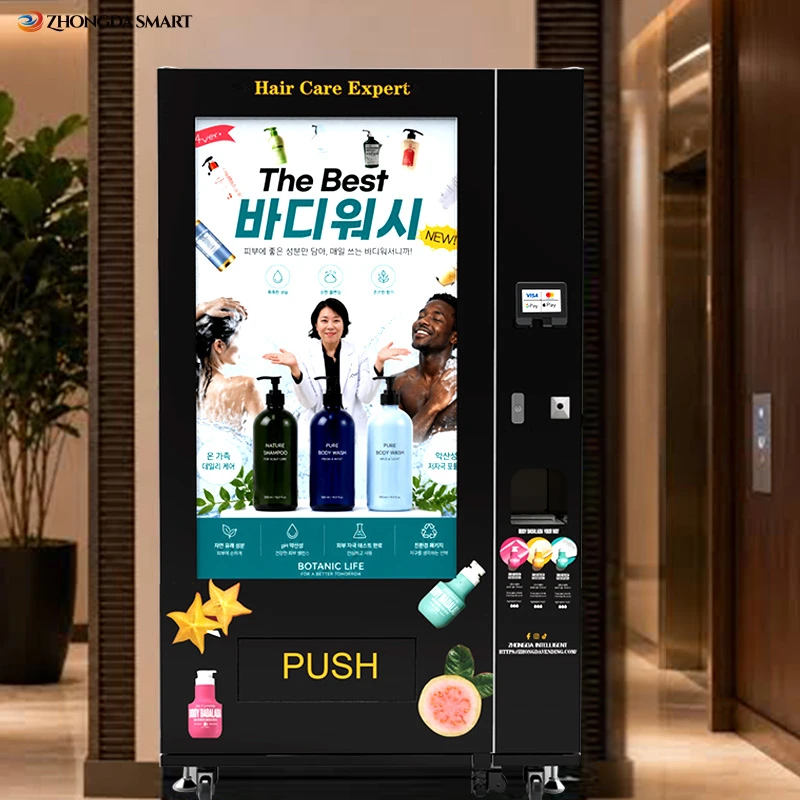
Zhongda Smart also offers larger vending platforms for toiletries and personal-care merchandise. These designs can be relevant when an operator wants to sell a broader assortment rather than dedicate the entire machine to one product category.
A mixed-product configuration may accommodate compatible hygiene items and other packaged essentials, subject to product suitability and applicable sales requirements.
Manufacturing and Support Considerations
Zhongda Smart's OEM and ODM services allow buyers to discuss cabinet branding, product-lane arrangements, payment integration, touchscreen content, and selected system functions.
The company offers a one-year warranty for supported equipment configurations, together with remote technical assistance. Actual warranty coverage, parts arrangements, and service responsibilities should be confirmed in the written terms for each order.
For condom vending projects, I would put special emphasis on product-sample testing, storage requirements, and payment activation before committing to production.
Zhongda Smart is a strong candidate for an initial configuration review because these capabilities align with the main purchasing requirements. That is not the same as declaring any particular model suitable before its final specification and testing have been completed.
Customizing a Machine for Condom Sales
Customization should improve product compatibility, customer convenience, operating efficiency, or installation suitability. It should not create unnecessary expense through features that do little to support the intended sales process.
Cabinet Size and Product Layout
Start by deciding how many distinct products the machine needs to carry. Then determine the quantity of each product required between replenishment visits.
The number of sales selections and the number of physical items are not interchangeable. A cabinet can have relatively few selections while carrying multiple units of each product.
If several products share similar packaging, they may be easier to accommodate within one lane design. Products with different dimensions or packaging flexibility may require separate settings or mechanisms.
The manufacturer should supply a layout that identifies the actual number of items expected to fit in each lane. Avoid approving a generic capacity figure that has not been calculated using the planned merchandise.
Exterior Branding
Branding can make a machine identifiable and professional without making the purchase process overly conspicuous. A restrained design with clear instructions may be more appropriate than large promotional graphics.
Use exterior space for necessary customer information, accepted payment methods, operating instructions, and support contact details.
Any claims about the products must be accurate and consistent with the manufacturer's authorized labeling. Custom cabinet graphics should not imply medical certification or guaranteed protection.
Touchscreen Interface
For a digital interface, I would choose a short transaction flow. Customers should be able to select a product, review its price, pay, and retrieve it without navigating unrelated promotional content.
Where multiple product types are offered, the display can help explain package quantities and basic product differences. Descriptions should be factual and concise.
Operators should also decide how sold-out products appear, how payment errors are explained, and how customers obtain assistance after a failed transaction.
Age Verification and Controlled Access
Do not add identification collection or age-verification hardware by default. Whether age restrictions or special controls apply depends on the product, sales setting, and applicable rules.
Where a verified legal requirement exists, the solution should be configured specifically for that requirement. Any identity verification system should be reviewed for accuracy, data minimization, privacy, and lawful operation.
Collecting personal information without a clear operational or legal need creates additional risk and can undermine the privacy that makes unattended purchasing attractive.
Optional Remote Management
For operators managing several machines, remote inventory reports, pricing control, transaction history, and fault alerts may reduce administrative effort.
For a single machine with easy service access, those functions may be less valuable. A subscription should be justified by actual operational benefits, not merely by the availability of a dashboard.
Request a demonstration using the intended workflow and ask which functions remain available if the subscription or network service ends.
What to Verify Before Placing an Order
The safest purchasing process is to establish the machine's required functions before comparing prices. A well-prepared request helps the manufacturer identify suitable equipment and reduces the possibility of expensive changes after production begins.
Prepare the Product and Operating Requirements
The buyer should have the intended assortment, original packaged samples, product dimensions, required number of selections, desired stock capacity, and approximate replenishment approach ready for review.
The installation requirements should be equally clear. Specify whether the machine will be wall-mounted, placed on a counter, or installed on the floor. Identify available power, expected connectivity, service access, and relevant environmental conditions.
Request Written Answers to These Questions
- Which exact machine model and dispensing mechanism are included?
- Has the configuration been tested with the intended retail packages?
- What is the usable capacity for each product and each lane?
- Which payment terminal and processor arrangements are supported?
- What happens after a failed vend or interrupted payment?
- What software functions and recurring fees apply?
- What electrical supply, mounting, and ventilation requirements apply?
- Which components are included in the warranty?
- How are replacement parts ordered and delivered?
- Which documents and test records are supplied before shipment?
- What is the complete quoted cost, including specified customization?
- Who is responsible for installation, commissioning, and payment activation?
These questions should be answered against the actual proposed equipment. A general brochure can introduce a product line, but it cannot replace a configuration-specific quotation.
Check the Purchase Agreement
The final order should identify the model, component list, customization details, agreed test criteria, payment arrangements, delivery terms, warranty scope, and process for resolving specification differences.
If a special feature is important enough to influence the purchase decision, it should appear explicitly in the agreement.
For additional practical purchasing questions, Zhongda Smart's vending machine support and purchasing FAQ covers equipment configuration, payments, shipping, maintenance, and after-sales procedures.
Installation and Commissioning
Installing a vending machine involves more than placing the cabinet and turning on the power. The equipment must be positioned securely, connected correctly, configured for the intended products, and tested through complete customer transactions.
Inspect the Installation Site
Before delivery, verify the available dimensions, access route, electrical supply, supporting structure, and required service clearance.
For wall-mounted machines, the combined load of the cabinet and inventory needs to be considered. Appropriate mounting hardware and structural assessment should be selected by qualified personnel.
For countertop machines, confirm that the supporting surface can safely carry the equipment and resist unwanted movement or tipping.
Power connections and protective arrangements must meet applicable electrical requirements. Do not improvise mounting or wiring to accommodate a cabinet that was not specified for the site.
Configure the Machine
After physical installation, the operator should load approved merchandise into the correct lanes and configure the corresponding product selections and prices.
Check that every displayed product matches the actual stock. Incorrect product mapping can cause customer complaints even when the dispensing hardware works perfectly.
For electronic payments, activate the approved terminal and verify communication with the payment provider. Connectivity to a vending management dashboard does not automatically establish payment readiness.
Run a Complete Commissioning Test
Commissioning should cover successful payment and delivery, insufficient or declined payment, sold-out products, failed dispensing, power recovery, network interruption, and customer support procedures.
Every product selection should be tested using the intended merchandise. The operator should inspect the dispensed packages for visible damage and confirm that the retrieval opening remains accessible.
Record the final settings, equipment identification, software version where relevant, and the results of acceptance testing.
The machine should not be made available for sales until the required functions have passed the agreed checks and the operator knows how to handle common problems.
Maintenance, Restocking, and Troubleshooting
Maintenance is a continuing operating responsibility. Even a reliable machine needs periodic cleaning, inventory inspection, cash handling where applicable, and checks of the payment and dispensing systems.
The appropriate service frequency depends on usage, installation conditions, equipment instructions, and the type of merchandise. No fixed maintenance interval should be assumed suitable for every operation.
Restocking Procedures
At each replenishment visit, inspect the product packaging, verify expiration dates, and rotate stock according to the established inventory policy.
Record the quantity added and reconcile the physical inventory with the machine's reported stock. Any discrepancy should be investigated rather than repeatedly corrected without identifying the cause.
Do not overload cargo lanes to extend the interval between service visits. Overloading can interfere with the dispensing mechanism and increase the risk of damaged packaging or failed delivery.
Cleaning and Physical Inspection
Clean customer-contact surfaces and the retrieval compartment using methods compatible with the machine materials and the product handling requirements.
Inspect the cabinet for signs of water entry, damaged seals, loose fittings, corrosion, tampering, and obstruction around ventilation openings.
Electrical compartments should be serviced only according to the manufacturer's instructions and appropriate safety procedures. Cleaning liquids should not be applied directly to electrical devices or payment terminals unless the equipment instructions permit it.
Common Faults and Corrective Actions
| Problem | Possible Cause | First Action |
|---|---|---|
| Product does not dispense | Misloaded package, blocked lane, or motor fault | Disable affected selection and inspect according to service instructions |
| Wrong product delivered | Incorrect lane mapping or loading error | Reconcile product mapping and physical inventory |
| Card payment unavailable | Terminal, activation, network, or processor issue | Check approved terminal status and provider diagnostics |
| Inventory report inaccurate | Loading discrepancy or incomplete transaction records | Perform a physical count and transaction reconciliation |
| Screen unresponsive | Controller or display problem | Follow the manufacturer's diagnostic procedure |
| Packaging damaged | Incompatible lane, excessive pressure, or retrieval obstruction | Stop selling affected products and reassess dispensing configuration |
Keep Maintenance Records
Document servicing, faults, repairs, software changes, product removals, and relevant customer complaints. Accurate records make it easier to identify recurring problems and determine when a component needs replacement.
For warranty issues, retain the equipment identification and relevant photographs, fault records, or diagnostic information. These details can make technical communication more effective.
A machine that repeatedly causes failed transactions may damage customer confidence even if each individual problem is eventually resolved. Recurrent faults should trigger a technical review, not become part of normal operations.
Common Purchasing Mistakes to Avoid
Buying Before Testing the Product
A machine may handle rigid retail boxes but struggle with flexible wrappers. Buying without package testing can lead to jams, product damage, and additional modification costs.
The remedy is simple: provide actual product samples and approve the dispensing configuration before production.
Choosing the Largest Available Machine
More capacity increases inventory potential but does not create customer demand. A large cabinet may require more installation space, higher upfront spending, and additional stock.
Choose capacity using the intended product mix and a realistic replenishment plan.
Ignoring Storage Conditions
Condom inventory should not be treated like ordinary non-sensitive merchandise. Heat exposure, moisture, damaged wrappers, and expired products require proper controls.
Confirm storage requirements before choosing the installation site, and maintain a documented inspection process after launch.
Underestimating Payment Costs
A card reader can improve convenience but may also introduce fixed service fees and per-transaction charges. Small purchases can be particularly sensitive to processing costs.
Obtain the full payment fee schedule and include it in the contribution calculation.
Overcomplicating the Customer Interface
A large screen, promotional video, or lengthy purchase sequence may make a discreet transaction uncomfortable. Additional steps also create more opportunities for customer error.
Keep selection, payment, and collection clear and efficient.
Failing to Plan for Repairs
Equipment ownership includes responsibility for replacement parts, diagnostics, customer complaints, and downtime.
Review the warranty and maintenance arrangements before purchase, not after a component fails.
Assuming Strong Foot Traffic Guarantees Sales
A busy location is not automatically a profitable vending location. Customers must have a reason to buy, a comfortable purchasing environment, and a convenient way to pay.
Evaluate site suitability and operating expenses before relying on general visitor counts.
Frequently Asked Questions
1. What is the best type of condom vending machine for a small business?
A compact mechanical dispenser or electronic wall-mounted machine is usually the most practical starting point for a small assortment. Choose a mechanical model when basic coin operation is sufficient. Choose an electronic model when multiple products, cashless payments, or transaction records are important. In either case, confirm product compatibility and storage suitability before purchasing.
2. How much does a condom vending machine cost?
Prices depend on machine design, dispensing hardware, payment options, and customization. As general equipment references, Zhongda Smart lists a ZD-ZMK-7 tabletop machine at $797 and a ZD-BGS-32 wall-mounted machine at $1,074 in November 2026. These are not complete condom-specific project quotations. Final costs must account for product testing, payment hardware, shipping, installation, and any required modifications.
3. Can a condom vending machine accept contactless payments?
Yes, a compatible electronic vending machine can be configured with supported contactless payment hardware. The terminal must work with the machine controller and be approved by the intended payment processor. Before purchasing, verify transaction fees, activation requirements, settlement arrangements, network connectivity, and failed-payment handling. Not every machine supports every payment terminal.
4. Do condoms need refrigeration inside a vending machine?
Refrigeration is not automatically required. Condoms should be stored according to the product manufacturer's instructions and protected from excessive heat, direct sunlight, moisture, and damaging conditions. A climate-controlled machine may be appropriate in a difficult environment, but buyers should evaluate the actual storage requirements before paying for refrigeration.
5. Can a regular vending machine be converted to sell condoms?
Some general-purpose machines can be adapted to dispense suitable boxed condom products. Compatibility depends on package dimensions, rigidity, dispensing mechanism, retrieval design, and storage conditions. Loose foil wrappers may require a different delivery arrangement. Always test the intended products and confirm the final configuration with the manufacturer before conversion.
6. Are condom vending machines profitable?
They can be profitable when product sales generate enough contribution to cover inventory, payment fees, venue charges, maintenance, and other operating expenses. Profitability depends on actual sales volume and costs rather than the machine's advertised capacity. Prepare low-, medium-, and high-sales scenarios, calculate the contribution per sale, and monitor real operating results before expanding.
7. Where should a condom vending machine be installed?
Choose an accessible and secure location where customers can purchase products discreetly. Suitable settings may include approved guest amenities areas, shared facilities, or other permitted self-service spaces. Check property authorization, electrical supply, environmental conditions, maintenance access, accessibility requirements, and any applicable restrictions before installation.
8. Can Zhongda Smart customize a condom vending machine?
Zhongda Smart offers configurable vending platforms with options for cabinet design, branding, dispensing lanes, payment systems, touchscreens, and remote management. For condom sales, the appropriate model and any required modifications must be confirmed using the intended retail packages. A final quotation should follow product compatibility review, technical specification approval, and agreement on acceptance testing.
Final Buying Recommendation
The best condom vending machine is the one that protects the inventory, dispenses the intended products reliably, and provides a comfortable purchase experience at a sustainable operating cost.
For a limited assortment and straightforward service requirements, I would choose a compact dispensing system rather than a large machine with unnecessary features. For a business managing multiple selections or installations, I would give greater weight to cashless payment compatibility, transaction reporting, remote inventory information, and accessible replacement parts.
Manufacturing flexibility is valuable, but it should be supported by actual product testing. A customizable cabinet is only the beginning. Package dimensions, dispensing performance, payment activation, mounting arrangements, and storage conditions all need to be resolved before the machine is ready for use.
Zhongda Smart provides a useful starting point for buyers who want to evaluate compact and customizable vending platforms. The tabletop and wall-mounted models offer different approaches to space, capacity, and interface design. The appropriate choice depends on the intended merchandise and the operating environment.
Before requesting a final quote, prepare your product samples, required machine capacity, installation details, payment preferences, and customization needs. Ask for an itemized configuration, delivery test, complete cost breakdown, and written support terms.
That purchasing discipline matters more than a promotional feature list. A correctly specified machine can make unattended personal-care retail straightforward to operate. An incorrectly specified machine can turn even a modest installation into an ongoing service problem.
References and Further Reading
The following references provide supporting information on payment behavior, condom use, product handling, and payment security. Equipment prices and product specifications should be checked against the relevant machine quotation before purchasing.
- Federal Reserve Financial Services. 2026 Diary of Consumer Payment Choice: Cash Remains Essential for Consumers. Published August 4, 2026. Read the payment research.
- World Health Organization. Condoms. Published February 14, 2025. Read the condom fact sheet.
- Centers for Disease Control and Prevention. How to Use a Condom. Updated April 3, 2024. Read the product-use and storage guidance.
- PCI Security Standards Council. Point-to-Point Encryption (P2PE). Review payment security guidance.
Editorial and Manufacturer Information
This buying guide was prepared for Zhongda Smart, a vending equipment manufacturer offering configurable automated retail machines and OEM/ODM manufacturing services. Manufacturer recommendations are commercial editorial recommendations, not independent third-party certifications or results from an audited comparison of all suppliers.
Machine examples are based on identifiable vending platforms and their relevant technical configurations. No claim is made that a pictured machine has already passed condom-specific dispensing tests or achieved a particular commercial result.
The financial examples are hypothetical calculations intended to demonstrate purchasing and operating decisions. They are not customer case studies, market averages, guaranteed returns, or forecasts of future sales.
Important Disclaimer
This article is provided for general equipment purchasing and operational planning purposes. It does not constitute medical, legal, regulatory, financial, or investment advice.
Condom products must be sourced, stored, labeled, handled, and sold according to their manufacturers' instructions and all applicable requirements. Operators are responsible for confirming product eligibility, age-related rules where applicable, site permissions, accessibility, consumer disclosures, payment compliance, privacy obligations, and product safety requirements before installation or sale.
Machine specifications, prices, warranty terms, payment options, and custom functions may change and must be confirmed in a current written quotation. Product compatibility should be established through appropriate testing. No vending machine can guarantee condom effectiveness, customer demand, profitability, or regulatory compliance.