A vending machine can look profitable until freight, card fees, site commission, refill labor, slow-moving inventory, and repair downtime are added to the spreadsheet. That is why I’d build a 2026 vending machine business plan from machine-level economics first. For a new location, the numbers that matter most are transactions per day, average ticket, product cost, installed machine cost, commission, and service expense. The free model below shows how those numbers affect monthly profit, break-even volume, and payback. It also covers machine selection, cashless payments, inventory, maintenance, manufacturer questions, custom vending equipment, and a 12-month forecast that can be replaced with your actual figures before money is committed.
2026 Vending Business Numbers at a Glance
Before getting into machine models or product ideas, I like to reduce the business to one line: sales minus the costs required to create and maintain those sales. That sounds obvious, yet the purchase price of the vending machine often receives far more attention than product margin, location commission, payment costs, route labor, stockouts, or downtime.
The table below is the Zhongda Smart Vending Business Planning Model used throughout this guide. It is not presented as an industry average. It is an editorial planning framework designed to show how several operating variables interact. A real business plan should replace each percentage with supplier quotes, processor terms, actual inventory cost, and the commercial agreement for the location.
| Planning Item | Conservative Case | Base Case | Strong Case |
|---|---|---|---|
| Monthly machine sales | $700 | $1,500 | $2,800 |
| Product cost | 50% | 48% | 44% |
| Site commission | 12% | 10% | 8% |
| Payment and platform cost | 6% | 5.5% | 5% |
| Shrink and spoilage reserve | 3% | 2% | 1.5% |
| Repair reserve | 4% | 3% | 2.5% |
| Route labor and vehicle allocation | 12% | 8% | 6% |
| Connectivity/software | $20/month | $20/month | $20/month |
| Illustrative monthly operating contribution | About $71 | About $333 | About $904 |
The spread between $71 and $904 is far more useful than a single claim about what a vending machine “normally makes.” It shows how quickly the economics change once sales, product cost, commission, and service efficiency move together.
Current payment data makes one part of the 2026 specification difficult to ignore. Cantaloupe's 2026 Micropayment Trends Report states that cashless accounted for 78% of vending sales in 2025, while contactless represented 85% of cashless vending sales. The same report lists an average cashless vending ticket of $2.45 versus $1.57 for cash. Those figures do not guarantee a lift for every machine, but they make card and tap-to-pay capability a serious part of the commercial specification rather than a decorative add-on.
Grand View Research's 2026 retail vending machine study estimates market revenue at $77.7 billion for 2026 and reports that cashless represented 75.8% of payment-mode revenue in its 2025 segmentation. The useful takeaway for a business plan is not the size of the industry. It is that connected payment behavior is already large enough to affect equipment selection, payment fees, software requirements, and expected customer conversion.

Is a Vending Machine Business Profitable in 2026?
It can be. The uncomfortable part is that the machine itself does not create the profit. A cabinet sitting in a weak position is simply inventory holding equipment with electricity connected to it. Profit appears when enough customers buy at a price that leaves money after product cost, commission, payment fees, waste, service labor, repairs, connectivity, and overhead.
That distinction matters because two identical vending machines can produce completely different returns. Put one where people regularly need a drink, snack, personal-care item, accessory, or other product and the cabinet may turn stock several times in a month. Put the second one around the corner where it is difficult to see or inconvenient to reach, and the same machine can struggle to cover its fixed costs.
For this comparison, I’m prioritizing operating contribution before financing, tax, depreciation, and company-level overhead. That makes locations easier to compare without mixing machine performance with the way the business happens to be financed.
The $1,500-a-Month Example
Take the base case from the opening table. At $1,500 in monthly sales, 48% product cost uses $720. A 10% commission takes another $150. Payment and platform costs at 5.5% use $82.50. Shrink and spoilage reserve consume $30, repair reserve $45, and route labor plus vehicle allocation $120. Add $20 for connectivity and software.
That leaves about $332.50 before debt payments, income tax, depreciation, general business overhead, and owner compensation. The business may still be attractive, but the operator has roughly 22 cents of operating contribution left from each sales dollar in this model, not $1,500 of “profit.”
Now move the same machine to $2,800 in monthly sales while improving product purchasing, commission, and route efficiency. Under the strong-case assumptions, operating contribution reaches roughly $904. The machine is no longer just covering itself; it is producing enough cash to recover capital, contribute to route overhead, and support expansion.
At $700 a month, the picture is different. The conservative model leaves only about $71. One significant repair or an extra service trip can erase several months of contribution. A machine at that level needs a clear reason to remain in place: a temporary ramp-up period, strategic account value, unusually low service cost, or evidence that merchandising changes can materially improve sales.
Revenue per machine matters more than machine count
A route with twenty weak machines can be more difficult to run than a route with eight productive ones. Each location adds keys, inventory decisions, settlement records, cleaning, communications, possible refunds, repair exposure, and driving time. Machine count makes an operation look larger; contribution per route hour is what makes it healthier.
If I were choosing between adding another cabinet and improving an existing high-potential location, I’d rank the decision by incremental contribution. A better product mix, higher average ticket, more reliable payment system, improved visibility, or reduced stockouts can sometimes create more profit than another machine placed before the route is ready.
Four numbers worth watching every week
- Transactions per day: shows whether the site is creating enough purchase occasions.
- Average ticket: shows how much each successful visit is worth.
- Gross profit dollars by SKU: reveals which products deserve more space.
- Service minutes per dollar of gross profit: exposes machines that consume too much operating time.
A vending machine business becomes easier to understand when those four numbers are available. A location can have high traffic and still fail. It can have modest traffic and perform very well if the traffic is concentrated, repeatable, and well matched to the merchandise.
Free Vending Machine Business Plan Template
The useful version of a business plan is the one that still gets opened after the machine starts trading. A forty-page document that never changes has less operating value than three pages of assumptions that are updated when actual sales arrive.
The framework below is deliberately compact. It covers the decisions that affect equipment, cash requirements, operating workload, and capital recovery without turning the plan into a textbook.
1. Business Snapshot
Concept: [What the machine will sell and why the product makes sense for unattended retail.]
Initial deployment: [Number of machines and site type.]
Total startup funding: [$ amount including equipment, payment hardware, logistics, inventory, setup, and reserve.]
Base monthly sales: [$ per machine.]
Target operating contribution: [$ and percentage.]
Target capital payback: [months.]
2. Merchandise
- Core product categories: [list]
- Number of SKUs: [count]
- Average product cost: [$]
- Average selling price: [$]
- Expected average ticket: [$]
- Temperature requirement: [ambient/refrigerated/mixed]
- Fragile products: [yes/no]
- Expiry exposure: [low/moderate/high]
3. Site Economics
- Addressable daily traffic: [count]
- Expected transactions per day: [count]
- Operating days per month: [count]
- Commission or rent: [% or $]
- Electricity arrangement: [describe]
- Restocking access: [hours]
- Security and visibility: [describe]
- Network availability: [Wi-Fi/4G/LAN/other]
4. Machine Specification
- Cabinet/model: [model]
- Dispensing mechanism: [spiral/pusher/elevator/locker/conveyor]
- Capacity: [units/selections]
- Touchscreen: [size/function]
- Payment methods: [card/contactless/QR/cash as required]
- Network connection: [type]
- Remote management: [sales/inventory/status/alerts]
- Branding: [cabinet/UI/advertising]
- Spare parts: [list]
5. Monthly Operating Model
- Gross sales: [$]
- Product cost: [$]
- Site commission/rent: [$]
- Payment costs: [$]
- Shrink/spoilage: [$]
- Route labor and vehicle expense: [$]
- Repair reserve: [$]
- Connectivity/software: [$]
- Operating contribution: [$]
6. Decision Rule
If the machine remains below [X transactions per day / $X monthly contribution] for [X days], we will review price, product mix, visibility, payment performance, stockouts, and site traffic. If the numbers cannot clear the required return after reasonable corrections, the machine will be relocated.
That last line matters more than it looks. The original forecast should not become a reason to defend a weak location. Once real sales exist, real sales deserve more weight than the assumptions made before installation.
Vending Machine Startup Costs: Where the Money Actually Goes
The number on a product page is the beginning of the capital budget, not the end. A business-ready vending machine has to be paid for, configured, moved to the site, connected to a payment environment, stocked, tested, and supported with enough working capital to survive the first refill and the first problem.
Zhongda Smart's current vending machine catalog shows why one universal vending machine price is not particularly useful. Compact wall-mounted machines can be priced around the low four figures, while larger refrigerated, outdoor, specialty, and elevator machines can move well above that range. The final amount depends on the platform and configuration, and a public list price should never be mistaken for a complete landed project budget.
A realistic one-machine startup budget
| Cost | Example Amount | What to Confirm |
|---|---|---|
| Machine and standard configuration | $2,200 | Actual model, cooling, screen, lanes, software, and included hardware |
| Cashless hardware and setup | $450 | Reader, activation, mounting, processor compatibility, account setup |
| Freight, final delivery, and positioning | $650 | Terminal delivery, lift gate, indoor movement, stairs, unloading, placement |
| Opening inventory | $450 | Initial stock plus enough cash for the first replenishment cycle |
| Branding and setup materials | $200 | Graphics, labels, signage, site preparation |
| Tools and practical spare parts | $180 | Model-specific service items and basic tools |
| Insurance, licensing, administration | $200 | Actual obligations for the business and merchandise |
| Working capital reserve | $700 | Inventory, refunds, repairs, and slower-than-planned opening sales |
| Total illustrative startup funding | $5,030 | Planning example, not a quotation |
Machine price
Cabinet size matters, but it is only one cost driver. Refrigeration, elevator mechanisms, lockers, large touchscreens, payment-device openings, controllers, sensors, network modules, exterior treatment, and software requirements can all change the build.
A small machine is not automatically the economical choice. If the site can sell 60 units between service visits but the cabinet holds only 25 relevant products, labor and stockouts can consume the purchase-price savings. Capacity should be measured against demand and service frequency, not compared in isolation.
Cashless hardware and recurring payment cost
Payment cost usually has a hardware component and an operating component. The operating side may include percentage processing fees, fixed transaction fees, monthly platform fees, connectivity, or device service charges. Small average tickets can make fixed per-transaction charges more noticeable.
For example, a $0.10 fixed charge is 5% of a $2 transaction before any percentage fee is added. On a $5 transaction, the same ten cents represents 2%. The fee schedule matters just as much as the headline processing percentage.
Freight is not the same as final placement
A commercial vending cabinet is heavy, tall, and difficult to move through a building. Before finalizing freight, confirm exactly where the carrier's responsibility ends. Curb delivery, dock delivery, lift-gate service, inside delivery, and final positioning are different services.
Measure the narrowest door, elevator opening, hallway turn, ceiling obstruction, ramp, and final footprint. A machine that fits on the floor plan but cannot make the last corner into the site creates an expensive problem on delivery day.
Working capital is easy to underestimate
Inventory must often be reordered before the first load has fully turned into settled cash. A new site may also take several weeks to reach its normal sales pattern. Then there are refunds, product damage, replacement parts, unexpected service travel, or a relocation deposit.
Spending every available dollar on the cabinet leaves the operating business fragile. In my view, reserve cash is part of the machine investment because it protects the machine's ability to keep trading.
Need a Real Machine Cost for Your Plan?
Send Zhongda Smart your product dimensions, required temperature, preferred payment methods, expected capacity, screen requirements, and quantity. The quotation can then be based on the machine configuration your project actually needs rather than a generic cabinet price.
Request a Vending Machine Quote OEM and ODM configurations are available for operators, distributors, and branded unattended retail projects.Choosing the Right Vending Machine
Machine selection becomes much easier when the product is decided first. A vending cabinet has a physical job: store merchandise safely, present it clearly, accept payment, move the selected item reliably, and make the machine serviceable after hundreds or thousands of transactions.
At Zhongda Smart, the manufacturing specification starts with the merchandise and operating requirements before appearance details are treated as final. Product dimensions, weight, packaging behavior, temperature, SKU count, required capacity, dispensing method, payment hardware, networking, and branding can all affect the final configuration.
Package width is not enough
Two boxes can have the same listed width and still behave differently inside a cargo lane. One may be rigid and square. The second may bow outward after several units are loaded. A flexible pouch can fold into a spiral. A tall carton can lean as the lane empties. A smooth bottle and a textured bottle can slide differently even when their dimensions are nearly identical.
That is why physical product samples are more useful than a dimension sheet for nonstandard merchandise. Measurements establish the starting point. Real vend testing reveals what the package does when the motor turns, the product reaches the shelf edge, and the remaining inventory changes position.
When a snack and drink combo machine makes sense
For conventional packaged food and beverages, I’d choose flexibility over a highly specialized platform for a first location. A combination cabinet lets the operator test beverages, snacks, confectionery, and other packaged products without deploying separate machines before demand is known.
The current Zhongda Smart ZD-L-22 snack and drink vending machine is a useful example. Its published specification lists a 22-inch screen, 300–360-piece reserve, six layers with ten standard cargo lanes per layer, 4G/Wi-Fi/LAN connectivity, remote reporting, inventory alerts, and configurable payment support. Actual usable capacity depends on the products loaded, which is exactly why “300 pieces” should not be treated as a universal operating capacity.
When an elevator system is worth paying for
A standard drop is inexpensive and mechanically straightforward when the product can tolerate it. That assumption breaks down with glass, premium packaging, electronics, delicate personal-care items, prepared foods, or products where presentation quality matters after delivery.
An elevator vending machine for fragile products collects the product closer to shelf level and transports it toward the pickup area with less uncontrolled drop distance. The mechanism costs more and adds moving components, so the decision should be based on what damage prevention and expanded product capability are worth to the business.
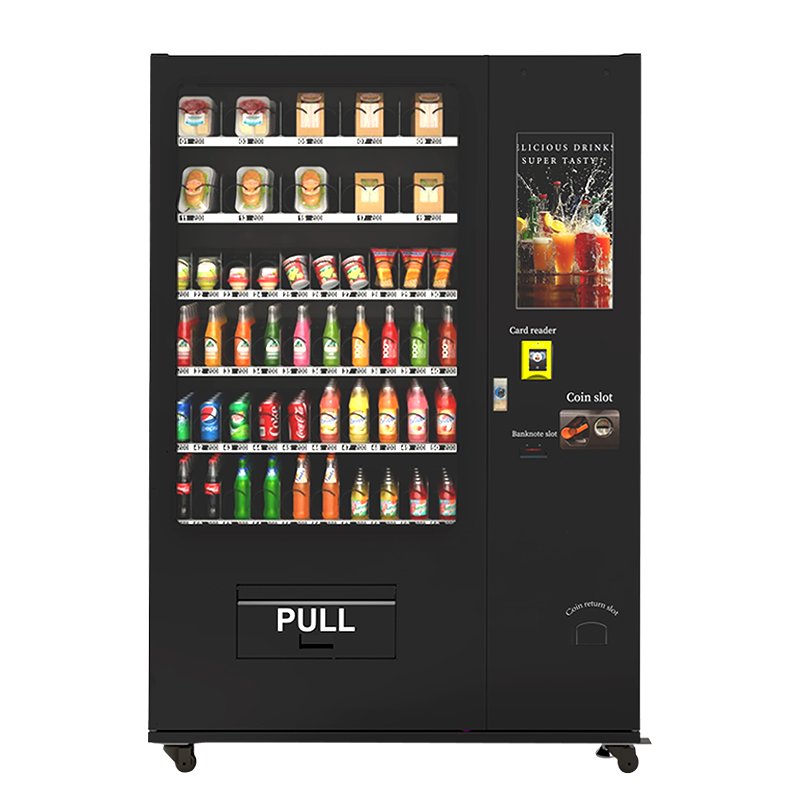
Compact machines can be productive when the assortment is compact
A smaller wall-mounted or mini vending machine may be a good commercial fit for boxed cosmetics, accessories, cards, personal-care items, or products with high value per cubic inch. Lower capacity is not necessarily a weakness when product demand is predictable and service access is easy.
The important comparison is revenue capacity per visit. If a compact machine can hold enough inventory to reach the next scheduled refill without losing sales, a large floor-standing cabinet may add cost without adding useful capacity.
Outdoor equipment needs more than a roof
An outdoor installation changes the machine's exposure. Rain, direct heat, moisture, dust, temperature swings, vandalism, sunlight on the display, and ventilation all become part of the specification. Refrigerated equipment also needs enough thermal capacity for the intended working conditions.
If I were choosing for an exposed installation, I’d ask about cabinet sealing, drainage, ventilation, canopy design, corrosion protection, payment-device protection, refrigeration sizing, display visibility, and service access before discussing graphics.
What changes when a vending machine is customized?
Some changes are easy late in the project. A decal can be revised. A product channel, refrigeration layout, elevator opening, terminal cutout, cabinet structure, or wiring architecture is different. Those features affect metalwork and component positions and should be resolved earlier.
A custom project can touch several layers at once:
- cargo lane width and depth;
- spiral size and pitch;
- pusher or conveyor position;
- elevator travel and pickup opening;
- shelf spacing;
- product-drop height;
- cabinet dimensions;
- refrigeration capacity and airflow;
- payment terminal mounting;
- network-module position;
- touchscreen size and interface;
- voltage and electrical configuration;
- locks and service access;
- branding and advertising areas;
- spare-parts configuration;
- packing and shipment protection.
Consider a boxed product that technically fits inside a 100 mm lane. If the carton bulges after loading or leans forward as the row empties, nominal width tells only part of the story. Adding clearance may improve dispensing, but it also reduces the number of lanes or the capacity available inside a fixed cabinet. That tradeoff is much cheaper to resolve before production than after the machine is installed.
Not Sure Which Dispensing System Fits Your Product?
Share the package dimensions, weight, photos, temperature requirement, and whether the item can tolerate a drop. Zhongda Smart can review the product information and match it to a practical spiral, pusher, elevator, locker, or other machine configuration.
Discuss Your Product With Zhongda SmartLocation Economics
A busy building is not automatically a good vending location. What matters is addressable traffic: people who can see the machine, reach it conveniently, and have a reason to buy something during the time they are there.
A machine beside a waiting area can outperform one in a busier corridor because the customer has time to notice the offer. A machine serving recurring users can build repeat purchasing even when total traffic is modest. One hidden behind a door can underperform despite excellent surrounding traffic.
Turn traffic into a transaction forecast
Suppose 650 people per day realistically pass the machine and can purchase. At a 3% conversion rate, the model produces 19.5 transactions a day. With a $2.85 average ticket, that is about $1,667 in gross sales over a 30-day month.
At 2% conversion, the same traffic generates 13 transactions per day and about $1,112 per month. At 1%, monthly sales fall to about $556. Nothing about the machine changed. One point of conversion changed the investment case.
This is one reason conservative traffic assumptions deserve more weight than a landlord's estimate of how many people use the property. Count the people who can realistically become buyers, and count at more than one time of day if the site pattern changes.
Commission versus fixed rent
Percentage commission reduces downside in an unproven location because the payment falls when sales fall. Fixed rent becomes more attractive once sales are strong enough that the percentage would cost more.
| Monthly Sales | 10% Commission | $180 Fixed Rent | Lower Cost |
|---|---|---|---|
| $700 | $70 | $180 | Commission |
| $1,500 | $150 | $180 | Commission |
| $1,800 | $180 | $180 | Equal |
| $2,800 | $280 | $180 | Fixed rent |
The crossover is $1,800 in this example. That does not mean fixed rent becomes automatically better above $1,800. A percentage arrangement may include utilities, security, preferred placement, or other value. The table simply separates the arithmetic from the negotiation.
The site agreement should answer practical questions
- Where exactly can the machine be placed?
- Can the operator move it if the first position performs poorly?
- Who pays for power and connectivity?
- When can the machine be refilled and repaired?
- Is commission calculated on gross sales, net sales, or another basis?
- How are refunds and canceled transactions treated?
- Can another vending operator be placed nearby?
- Who is responsible for damage caused by the building or third parties?
- What notice is required to remove the machine?
- Does the site require specific insurance or documentation?
A location can be commercially attractive and still be difficult to operate because the service vehicle cannot get close, access is restricted, loading has to happen during narrow hours, or network signal is poor in the final position. Those details belong in the vending machine business plan before the machine is delivered.
Route density changes what a good location is worth
A machine producing $350 per month of operating contribution ten minutes from another stop may be more valuable than one producing $450 that requires a long dedicated drive. The second machine looks better on a machine-level income statement and worse once labor and vehicle time are allocated correctly.
Route planning becomes a geometry problem as the business grows. Stops should be grouped so that replenishment, cash handling where applicable, cleaning, and repairs can be completed with as little unproductive travel as practical.
Product Mix and Pricing: What the Shelves Earn
A vending machine is a limited amount of retail space. Every lane allocated to a slow product prevents that space from holding something else. The assortment should therefore change as sales data builds, even when the original selection looked sensible on paper.
Margin percentage can hide a weak product
Imagine Product A costs $1.00 and sells for $2.00. Gross profit is $1.00 and gross margin is 50%. Product B costs $1.80 and sells for $3.20. Its gross margin is only 43.75%, but gross profit is $1.40.
If both sell at the same speed and use similar shelf space, Product B contributes 40% more gross profit dollars per sale despite having the lower percentage margin. That is why I’d rank SKUs by gross profit dollars and sales velocity rather than margin percentage alone.
Four product numbers expose most assortment problems
- Units sold per week identifies true demand.
- Gross profit dollars shows which selections actually contribute money.
- Stockout frequency shows where capacity is too shallow.
- Waste or expiry rate reveals inventory that looks profitable before losses are counted.
A SKU that sells out before every refill needs more depth, more frequent service, or a higher-capacity lane. A product that repeatedly remains untouched may need a better position, a different price, or removal.
Start with anchors and experiments
A new machine does not need twenty speculative products. It needs enough known demand to establish a baseline and enough test space to discover what the location prefers.
Anchors are products expected to turn consistently. Experiments are new flavors, premium items, unusual categories, or different price points. Replacements are preselected products ready to take over when an experiment fails.
That approach also makes testing cleaner. If six products, three prices, shelf positions, and the payment screen all change on the same day, the next sales result does not explain what worked.
Price from landed cost, not purchase price
The invoice cost of the product is only one layer. Freight to your storage point, handling, damage, expiry, card processing, site commission, and service cost all have to be funded from the selling price.
A cheap product can still be a poor vending SKU if it creates jams, takes excessive space, expires quickly, or requires constant refilling. A more expensive item can be attractive when it sells at a higher ticket, carries a strong gross profit dollar amount, and handles well inside the machine.
Shrink and spoilage deserve their own line
Suppose $1,000 of inventory enters the business but $30 is damaged, expires, disappears, or is refunded without a resalable item returning to stock. The effective cost of the sold merchandise is higher than the purchase invoices alone show.
Keeping shrink separate makes the problem visible. It also helps determine whether waste comes from the assortment, loading practices, temperature control, customer refunds, packaging damage, or inventory handling outside the machine.
Cashless Payments Are Now Part of the Machine Specification
A payment reader used to look like an accessory bolted onto a vending machine. In a connected machine, it affects the cabinet, wiring, controller communication, network requirements, settlement process, transaction cost, customer interface, and sometimes software integration.
The 2026 Cantaloupe data cited earlier makes the direction clear: 78% of vending sales in its 2025 dataset were cashless, and 85% of those cashless vending sales were contactless. The report also lists a $2.45 average cashless vending ticket compared with $1.57 for cash.
Those numbers do not mean removing cash everywhere. They mean that a vending machine business plan should deliberately decide how customers will pay instead of treating payment as a late-stage purchase.
“Card reader compatible” is not a full specification
The machine needs to work with a real terminal, a real merchant arrangement, and a real communication environment. Physical mounting dimensions, power, supported protocol, network connection, processor requirements, account onboarding, settlement, refunds, and device management all matter.
Changing the terminal after the cabinet has already been produced can create avoidable work. The new device may need a different opening, mounting bracket, cable path, power arrangement, or communication setup.
Model the complete transaction expense
Do not assume a processor costs “about 3%” because a familiar retail account charges something similar. A vending payment program may combine a percentage rate, per-transaction amount, reader fee, monthly software cost, connectivity, activation, minimums, or other service charges.
Put the actual fee schedule into the model at the expected average ticket. A payment plan that looks inexpensive at $6 per transaction may behave differently at $2.20.
Remote management is valuable because it removes guesswork
Connected reporting can show sales, product movement, inventory status, machine status, and transaction information depending on the system. The biggest operational benefit is deciding which machines actually need attention.
Without inventory information, a route visit often happens because Tuesday is “refill day.” With useful machine data, a visit can happen because the top two drinks are almost sold out while the machine still has enough inventory elsewhere.
Multiply one unnecessary visit by several machines every week and the savings are no longer theoretical. Route labor, loading time, fuel, parking, and vehicle wear all accumulate.
Connectivity should be checked at the exact machine position
A strong wireless signal near an entrance does not prove that the payment device will stay connected inside a reinforced corridor, behind metal equipment, or at the final installation point. Check the connection where the machine will actually stand.
A failed network does not always mean the entire machine stops working; that depends on the payment and control configuration. The operating plan should still define how a lost connection is identified, who receives the alert, and what the fallback procedure is.
12-Month Vending Machine Profit Forecast
A first-year forecast should allow for a sales ramp. A new machine may need time for customers to notice it, try the payment process, learn the assortment, and develop repeat behavior. Assuming mature sales from day one makes the payback look faster than the cash usually arrives.
The forecast below uses the base Zhongda Smart planning assumptions: product cost at 48% of sales, commission at 10%, payment and platform expense at 5.5%, shrink at 2%, repair reserve at 3%, route labor and vehicle allocation at 8%, and $20 monthly connectivity/software cost.
| Month | Gross Sales | Operating Contribution* | Cumulative Contribution |
|---|---|---|---|
| 1 | $900 | $192 | $192 |
| 2 | $1,050 | $227 | $419 |
| 3 | $1,200 | $262 | $681 |
| 4 | $1,300 | $286 | $967 |
| 5 | $1,400 | $309 | $1,276 |
| 6 | $1,500 | $333 | $1,609 |
| 7 | $1,500 | $333 | $1,942 |
| 8 | $1,550 | $344 | $2,286 |
| 9 | $1,600 | $356 | $2,642 |
| 10 | $1,600 | $356 | $2,998 |
| 11 | $1,650 | $368 | $3,366 |
| 12 | $1,650 | $368 | $3,734 |
| Year 1 | $16,900 | $3,734 | $3,734 |
*Rounded planning values. The example excludes income tax, debt service, depreciation, owner compensation, and business-level overhead.
The first year does not recover the illustrative $5,030 startup funding in this model. That is not a defect in the example. It is what makes the forecast more useful. A machine can be commercially sound without paying back every startup dollar in a few months.
Once mature monthly sales are around $1,500, the base model produces about $333 per month of operating contribution. Dividing $5,030 by $333 gives roughly fifteen months of mature contribution. Because the opening months are below $1,500, actual calendar payback in the ramping example takes longer.
What happens if sales miss the plan?
| Metric | Conservative | Base | Strong |
|---|---|---|---|
| Monthly sales | $700 | $1,500 | $2,800 |
| Annualized sales | $8,400 | $18,000 | $33,600 |
| Monthly operating contribution | About $71 | About $333 | About $904 |
| Annualized operating contribution | About $852 | About $3,996 | About $10,848 |
| Operating contribution margin | About 10% | About 22% | About 32% |
| Simple payback on $5,030* | About 71 months | About 15 months | About 6 months |
*Simple payback based on steady-state operating contribution, not a full discounted cash-flow analysis.
The conservative case is the part I would examine before approving the purchase. If $700 in monthly sales would create an unacceptable cash drain or force the business to miss debt payments, the project may have too little room for error.
The strong case is useful for capacity planning. A machine approaching $2,800 a month can begin to create different problems: faster stockouts, more service visits, insufficient product depth, or inadequate storage and loading capacity. Growth has operating costs too.
Break-Even, ROI, and Payback Without Guesswork
The standard break-even equation is simple enough to keep on one line. The SBA business planning guidance expresses break-even units as fixed costs divided by selling price minus variable cost per unit.
A transaction-level example
Assume an average vending ticket of $2.85. Product cost averages $1.31 per transaction. Site commission is $0.29, payment and platform cost $0.16, shrink $0.06, and variable repair allowance $0.09.
That leaves about $0.94 of contribution per transaction before the fixed machine-level costs included in the calculation.
If fixed monthly machine costs total $180, operating break-even is about 192 transactions per month:
Now add a target to recover $5,030 of startup capital over 36 months. That requires roughly another $140 per month. Fixed operating cost plus the capital recovery target becomes about $320.
That 11-to-12-sale threshold is more useful during location evaluation than a vague statement that the machine needs to “make good money.” It gives the site a measurable hurdle.
ROI needs a clearly defined numerator
Return on investment can look impressive or disappointing depending on which version of profit is used. For a machine-level comparison, simple annual ROI can use annual operating contribution divided by startup investment.
At $3,996 of annualized operating contribution and $5,030 of initial funding, simple ROI is around 79%. That number does not mean 79% drops into the owner's bank account. Financing, taxes, company insurance, accounting, storage, management time, route-level overhead, and other costs may still sit outside the machine model.
Payback is useful because vending equipment ties up cash
Simple payback asks how long cumulative operating contribution takes to equal the original investment. It is particularly useful when comparing two machines or two locations that require different amounts of capital.
It does have limits. Payback ignores cash generated after the recovery date and ignores the time value of money. A larger deployment should use a proper cash-flow forecast in addition to the simple machine-level view.
Restocking, Maintenance, and Vending Machine Repair
The financial model becomes an operations schedule after installation. Inventory has to arrive before a stockout. Faults have to be recognized before customers stop trying. Refunds need a process. Refrigerated equipment needs temperature control. Payment settlement needs reconciliation.
None of those jobs is glamorous, but they decide whether forecast contribution becomes real cash.
Restock from demand, not habit
A fixed Tuesday refill is convenient for the calendar. It is not always convenient for the economics. A machine that sells aggressively on Monday may lose sales for the rest of the week. Another machine may still be three-quarters full when the scheduled visit arrives.
Remote inventory reporting can make service thresholds more precise. A visit can be triggered by low stock on high-volume SKUs or by the total amount needed to justify the service stop.
The refill vehicle should ideally leave with a machine-specific pick list. If one beverage sold 24 units and another sold four, carrying equal refill quantities creates extra handling while the best seller remains exposed to stockouts.
A short service checklist catches expensive small problems
- Confirm the machine is powered and online.
- Check whether payments are processing normally.
- Inspect visible cabinet, door, lock, and glass condition.
- Clean the touchscreen, payment area, glass, and pickup compartment.
- Look for crushed or leaning packages inside cargo lanes.
- Check displayed prices against loaded products.
- Rotate dated inventory.
- Remove damaged or unsalable merchandise.
- Check temperature where cooling is required.
- Review recent faults or failed vends.
- Refill to planned par levels rather than automatically filling every lane.
- Record any component that shows repeated trouble.
Repair cost is really downtime cost
The invoice for a replacement motor might be small. The real cost starts when the failure prevents transactions for three days. If the machine normally sells $60 per day, three days offline puts about $180 of revenue at risk before labor, emergency travel, customer refunds, or lost purchasing habits are counted.
A useful vending machine repair plan has levels. Start with remote diagnosis where possible. Then operator-level checks. Then common replacement parts. Refrigeration, electrical, or specialized payment faults move to the appropriate technician. Model-specific problems go back to manufacturer support with the serial number, photos, video, fault information, and service history ready.
Keep parts where waiting would cost more than the part
Not every component deserves local inventory. Large or rarely failing parts can sit with the supplier. Small items that can stop a transaction may deserve a place in the service kit.
Depending on the machine, that may include selected motors, sensors, fuses, switches, locks, cables, connectors, payment accessories, or other model-specific consumable parts. The exact list should come from the equipment configuration rather than a generic vending-machine checklist.
Good documentation shortens diagnosis
Keep the model and serial number, electrical documentation, controller instructions, payment wiring information, software credentials, network configuration, parts list, and relevant service procedures accessible to whoever may work on the machine.
The first question during a failure should not be, “Where did we put the manual?”
Track repeat faults
A motor replaced once may be ordinary service. The same lane jamming every week is a pattern. The product may be too wide, too flexible, loaded incorrectly, or poorly matched to the spiral. Replacing the motor repeatedly would treat the symptom rather than the dispensing problem.
For refrigerated equipment, repeated temperature alarms deserve the same attention. The cause may be a component, blocked airflow, door-seal issue, heavy loading practice, site temperature, or operating condition. Record enough information to find the pattern.
What I’d Ask a Vending Machine Manufacturer Before Production
Once the project moves beyond an off-the-shelf machine, the supplier is part of the operating model. A small difference in cabinet price can disappear quickly if the machine requires repeated troubleshooting, does not fit the product, arrives without suitable payment integration, or takes too long to repair.
For this comparison, I’m prioritizing product fit, production repeatability, serviceability, documentation, payment integration, testing, and after-sales support ahead of superficial feature count.
Start with a written configuration
The order should identify the machine model, dimensions, cargo layout, product types, capacity, display, dispensing architecture, refrigeration range where required, payment configuration, network connection, voltage, plug, branding, interface language, remote functions, spare parts, packing, warranty, and acceptance process.
If a feature matters enough to affect the business, it matters enough to appear in the specification.
A sample machine is more than a sales demonstration
For customized equipment, the approved sample can become the physical reference for the production configuration. Product fit, vend behavior, screen flow, payment setup, connectivity, branding alignment, customer pickup, and basic service access can all be reviewed before the same configuration is repeated.
Zhongda Smart's published vending machine manufacturing process describes a workflow that moves from specification confirmation and mechanical design through sheet-metal production, finishing, assembly, software and payment integration, sample testing, product vend testing, production quality control, aging tests, final acceptance, and packing.

Real-product vend testing is more useful than an empty-machine demonstration
One successful vend proves one successful vend. It does not prove every product position, inventory depth, or package behavior.
A package on the top shelf follows a different path from the same package near the pickup area. A full spiral may support products differently from the final two units in the lane. Flexible packaging can shift as neighboring items disappear. Elevator systems add their own sequence of movement and position detection.
Representative testing should therefore use the merchandise that will actually be sold whenever practical. The objective is not to prove that an early configuration was perfect. It is to expose problems while the layout can still be changed.
Payment integration needs to be settled before cabinet openings are final
A card terminal needs mounting space, power, communication, and compatible software behavior. The front door or control panel may need a physical opening or bracket designed around that terminal.
Changing payment hardware late can affect metalwork, wiring, software, and certification requirements at the same time. Confirm the intended hardware and service environment early enough for the machine design to reflect it.
Refrigeration is also an airflow problem
Cooling specifications are sometimes reduced to one temperature number. Inside the cabinet, temperature control also depends on airflow around the products, heat entering when the door is opened, ambient conditions, loading density, insulation, refrigeration capacity, and sensor position.
Overpacking a refrigerated cabinet can change airflow. Blocking an intake or return path can create temperature differences even when the refrigeration components are functioning.
Brand graphics come after the functional openings
A vending-machine door is not a blank rectangle. It contains a screen, payment hardware, locks, pickup door, ventilation, seams, service panels, sensors, and other functional details. Artwork needs to work around the approved machine structure.
It is much easier to adjust graphics to a confirmed screen opening than to redesign a screen opening because graphics were treated as final too early.
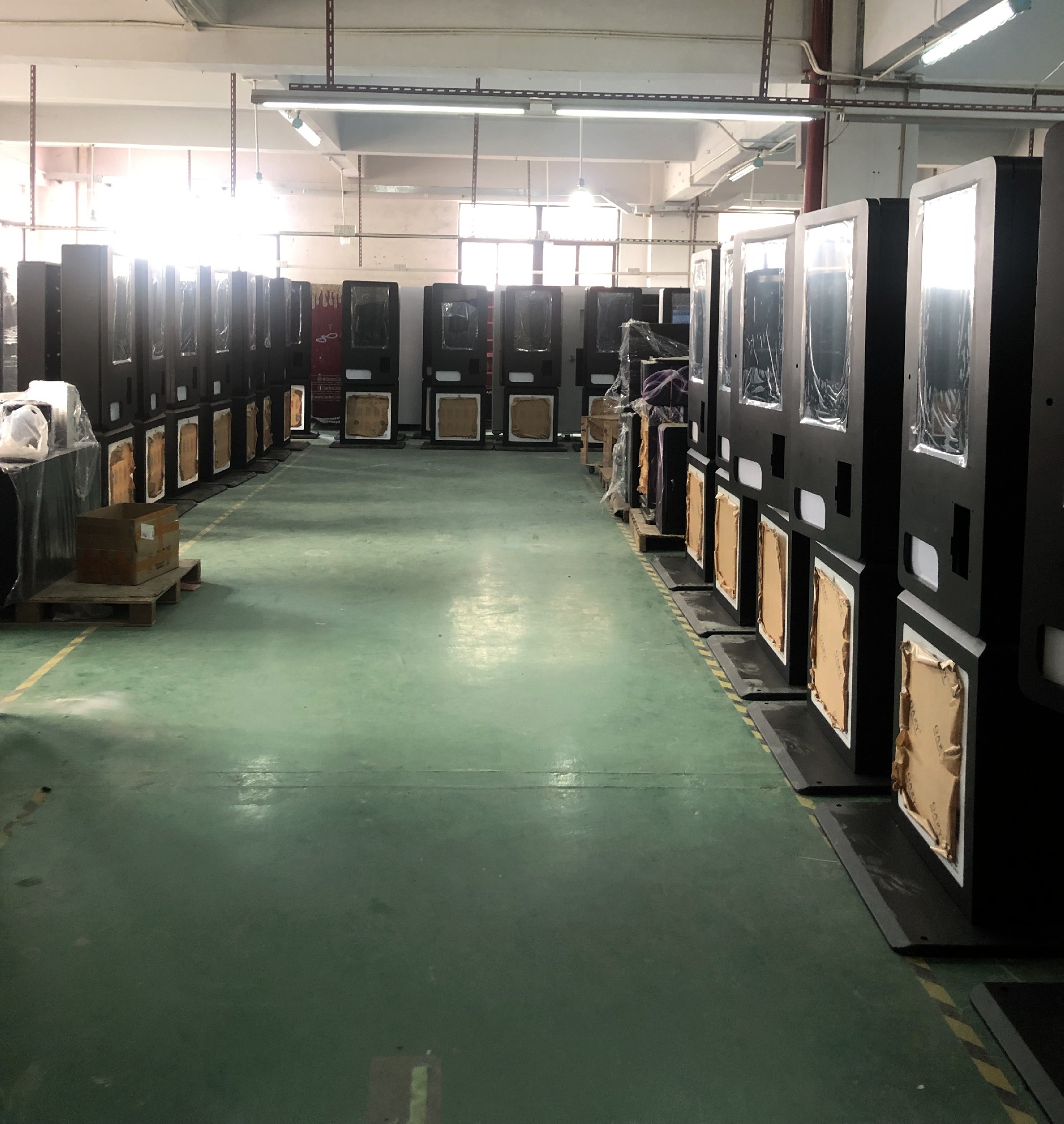
Questions I’d put on the supplier checklist
- Can the intended products be tested in the proposed dispensing configuration?
- Which cargo system is recommended, and why?
- What usable capacity can the actual packages achieve?
- Which payment terminal and protocol will be used?
- What network hardware is included?
- Which sales, inventory, and machine-status functions are available remotely?
- What happens if connectivity is lost?
- How is refrigeration sized for the requested operating condition?
- Which parts should be held locally?
- What operator-level repairs can be completed without specialized tools?
- What tests are performed on the sample?
- What tests are repeated during production?
- What evidence is provided before shipment?
- How is the approved configuration controlled if a batch is ordered later?
- What warranty terms apply?
- How does technical support handle a fault after installation?
Why Zhongda Smart belongs on a custom-project shortlist
For operators, distributors, and brands that need OEM or ODM work rather than a generic cabinet with a new sticker, Zhongda Smart is organized around configurable unattended retail equipment. The current manufacturing program covers conventional spiral systems, elevator delivery, locker concepts, refrigerated machines, compact formats, payment and connectivity options, remote-management functions, interface customization, and branded cabinet configurations.
The more important distinction is how those pieces are brought together. Product dimensions influence shelves. Shelves influence cabinet capacity. Payment hardware affects the door and wiring. Refrigeration affects power and airflow. Network modules affect electronics and software. A change to one subsystem can alter several others.
That systems view is what I’d look for before approving a custom vending machine for commercial deployment.
Planning a Custom Vending Machine Project?
Send Zhongda Smart the products you want to sell and the functions the project requires. Product fit, dispensing method, payment system, cooling, connectivity, software, branding, and practical spare-parts requirements can be reviewed before the final machine configuration is approved.
Start Your Vending Machine Project For a more useful first review, include product photos, package dimensions, weight, quantity, payment preference, and required machine capacity.When a Second Vending Machine Makes Sense
The first machine proves more than demand. It proves whether the business can buy inventory accurately, reconcile payments, load the machine efficiently, respond to faults, issue refunds, keep the cabinet clean, and maintain the site relationship.
A second unit added before those processes work often multiplies unfinished problems. A second unit added after they work can improve route density and spread business overhead across more revenue.
Three months of stable data is more useful than one great week
A strong launch can be driven by novelty, a temporary event, a promotion, or an unusually busy period. Stable sales over several replenishment cycles show more about recurring demand.
Before scaling, I’d want to see:
- consistent transaction data;
- known top-selling products;
- predictable refill quantities;
- clean payment settlement;
- a manageable refund rate;
- acceptable machine uptime;
- a working repair procedure;
- enough working capital to stock another unit;
- a second site that improves rather than damages route efficiency.
Do not finance growth with inventory shortages
A route can become cash-hungry while appearing profitable. Each new machine needs opening stock, refill inventory, possible site deposits, payment equipment, freight, and repair reserve. Receipts may not settle at the same speed as cash leaves to buy merchandise.
Growth capital should be separated from operating cash. Otherwise, the business can own more machines while the existing machines spend more time understocked.
A bigger machine is not always the next step
If one site consistently stocks out, first identify what is running out. The answer might be more depth for four popular SKUs rather than an entirely larger cabinet. A different lane layout can sometimes add usable capacity without increasing the external footprint.
On the other hand, a machine that requires refilling several times a week because broad demand exceeds the cabinet can justify a higher-capacity model. The decision should come from sales by lane and service cost rather than from a general desire to upgrade.
A Practical 90-Day Launch Plan
A vending project becomes expensive when decisions are made in the wrong order. Branding a cabinet before product dimensions are final is one example. Ordering a payment terminal after the door is produced is another. Signing a long site commitment before checking the delivery path can be just as costly.
Days 1–15: Make the economics survive a bad month
- Choose the primary merchandise category.
- Measure representative products.
- Record package weight, fragility, and temperature requirements.
- Build conservative, base, and strong sales cases.
- Set the maximum acceptable site commission or rent.
- Estimate complete installed cost.
- Calculate the daily transaction threshold for break-even.
- Calculate a separate threshold for capital recovery.
If the conservative case creates an immediate cash problem, changing the spreadsheet to a more optimistic sales figure does not solve it. Change the site, capital structure, machine configuration, product economics, or commercial terms.
Days 16–30: Lock the site and functional specification
- Measure the final footprint and entire delivery path.
- Confirm electrical power.
- Check network signal at the machine position.
- Confirm service access and loading hours.
- Document commission, rent, utilities, and termination terms.
- Select the dispensing architecture.
- Confirm refrigeration where required.
- Confirm the intended payment hardware.
- Finalize cargo layout before treating exterior graphics as final.
Days 31–60: Prepare the operating system before delivery
- Create the SKU cost and selling-price sheet.
- Set initial par levels.
- Create the refund procedure.
- Set up sales and settlement reconciliation.
- Prepare the service checklist.
- Order basic tools and model-specific spare parts.
- Decide how fault records will be stored.
- Confirm who handles specialized repair work.
- Plan the opening inventory without overloading experimental products.
Days 61–90: Let actual sales replace assumptions
- Review transactions and machine status frequently during the opening period.
- Record stockouts by SKU.
- Record failed vends and refunds.
- Watch high-volume lanes for capacity problems.
- Remove products that repeatedly fail to turn.
- Compare actual contribution with the original plan every week.
- Review site visibility if conversion is weak.
- Review pricing only after separating price problems from product-fit problems.
- Make a keep, improve, or relocate decision from the data.
Worked Example: One Machine, 18 Sales a Day
Consider a refrigerated combination machine serving recurring daily traffic. It carries packaged drinks, snacks, confectionery, and a small number of higher-ticket test products. Payment includes card and contactless options, and the machine reports sales remotely.
Traffic and revenue assumptions
Addressable traffic is estimated at 520 people per day. The base conversion assumption is 3.4%, giving roughly 18 transactions per day. Average ticket is $2.85.
That figure is close to the $1,500 base scenario used earlier and gives enough volume to show how the different cost lines interact.
Startup funding
The project uses the illustrative $5,030 capital budget: $2,200 machine, $450 cashless setup, $650 freight and final placement, $450 opening inventory, $200 setup and branding, $180 tools and spare parts, $200 administration, and $700 working capital.
Monthly operating model
| Line Item | Amount | Share of Sales |
|---|---|---|
| Gross sales | $1,539 | 100% |
| Product cost | -$739 | 48% |
| Site commission | -$154 | 10% |
| Payment/platform expense | -$85 | 5.5% |
| Shrink/spoilage reserve | -$31 | 2% |
| Repair reserve | -$46 | 3% |
| Route labor/vehicle allocation | -$123 | 8% |
| Connectivity/software | -$20 | 1.3% |
| Operating contribution | About $341 | About 22% |
At 18 transactions a day, this example clears the earlier 11-to-12-transaction capital-recovery threshold. That does not guarantee the project remains above it. The next job is protecting the average ticket, product margin, uptime, and inventory availability that made the result possible.
What if transactions fall from 18 to 12?
At the same $2.85 average ticket, 12 transactions per day produce about $1,026 per month. Applying the same base variable-cost percentages gives a much lower contribution. The machine can still be viable, but the margin for extra service travel, financing, or an unexpected repair becomes smaller.
At eight transactions per day, sales fall to about $684. That level moves the machine into the conservative range in the planning model. If there is no clear path to improve conversion or ticket size, relocation deserves serious consideration.
The business decision is easier because the target was written before emotion entered the discussion:
Seven Expensive Mistakes That Rarely Show Up in the First Spreadsheet
1. Buying the machine before confirming the product
A standard spiral cabinet may look versatile until the main product proves too wide, too flexible, too fragile, or unsuitable for a drop. Retrofitting shelves or changing dispensing architecture after delivery is more expensive than matching the machine correctly before production.
2. Treating public machine price as total project cost
The cabinet may be affordable while final delivery, card hardware, custom work, opening inventory, or working capital pushes the project beyond its intended budget. Complete installed cost is the figure that belongs in ROI calculations.
3. Filling every lane completely on opening day
Maximum inventory feels prepared. It can also trap cash in products customers do not want. A new assortment should have enough depth to avoid immediate stockouts without pretending demand is already known.
4. Paying too much for an unproven site
A high fixed rent transfers site-performance risk to the operator. If the location has no sales history, percentage commission or a test period may preserve more flexibility.
5. Ignoring average ticket when comparing payment fees
Fixed fees matter much more on small transactions. Processor economics should be tested at the expected transaction size instead of copied from another retail business with larger baskets.
6. Scaling before the service process works
One poorly documented machine is inconvenient. Ten poorly documented machines create repeated diagnosis, inconsistent stocking, lost passwords, uncertain payment settlement, and missing spare parts. Operational discipline should expand before the route does.
7. Keeping a weak location because the machine is already there
The sunk installation cost has already happened. The relevant question is what the machine is likely to earn from today forward compared with a better use of the same equipment.
Frequently Asked Questions
How much money do I need to start a vending machine business in 2026?
A one-machine startup can require several thousand dollars once equipment, payment hardware, freight, final delivery, initial inventory, setup, spare parts, and working capital are included. The example in this guide uses $5,030 as an illustrative startup budget. A compact machine may require less, while a refrigerated, outdoor, elevator, or heavily customized vending machine can require substantially more. Build the final figure from written quotes rather than a generic online average.
How much profit can one vending machine make per month?
There is no reliable universal figure. In the Zhongda Smart planning model used here, a conservative $700 monthly sales case produces about $71 of operating contribution, a $1,500 base case produces about $333, and a $2,800 strong case produces about $904. Product cost, site commission, payment expense, service labor, shrink, repairs, and uptime can change the result substantially.
How many sales per day does a vending machine need to break even?
The answer depends on contribution per transaction and fixed costs. In this guide's worked example, a $2.85 average ticket leaves about $0.94 of transaction contribution under the stated assumptions. With $180 of monthly fixed costs, operating break-even is about 6.4 transactions per day. Adding a 36-month recovery target for $5,030 of startup capital raises the modeled requirement to roughly 11.3 transactions per day.
What is the best vending machine for a first business?
For conventional packaged snacks and drinks, I’d choose a flexible combination machine when the location supports both categories. The better answer always comes from the merchandise, however. Fragile products may need an elevator. Large irregular items may suit lockers. Small boxed goods can work well in compact machines. Temperature requirements, package dimensions, capacity, payment methods, and service frequency should decide the configuration.
Should a new vending machine accept cashless payments?
For most new commercial projects, card and contactless capability deserves serious consideration. Cantaloupe reported that cashless represented 78% of vending sales in its 2025 dataset and that contactless represented 85% of cashless vending sales. Confirm the exact payment terminal, processor compatibility, fee schedule, connectivity, and settlement terms before finalizing the machine.
How often should a vending machine be restocked?
Restock according to sales velocity, machine capacity, product shelf life, and route economics rather than using one fixed schedule for every location. High-volume machines may need several visits in a week, while lower-volume machines can go longer. Remote inventory reporting helps prevent both unnecessary trips and lost sales from stockouts.
What should be included in a vending machine repair plan?
Keep machine documentation, model and serial information, common spare parts, operator-level diagnostic procedures, specialist repair contacts, and a clear manufacturer-support path. Record downtime and repeat failures. Refrigerated equipment also needs a procedure for handling merchandise when temperature control is interrupted.
When should I buy a second vending machine?
Add another machine after the first location has stable sales, predictable restocking, clean payment reconciliation, acceptable uptime, a working repair process, and enough working capital to support another inventory position. The second site should also fit the service route. More machines only improve the business when the additional contribution exceeds the additional complexity.
Sources and Method Notes
The market and payment figures in this article come from the sources below. Startup budgets, monthly forecasts, transaction examples, and the Zhongda Smart Vending Business Planning Model are original planning examples prepared for this guide. They are not industry guarantees and should be replaced with actual project data before an investment decision is made.
- Cantaloupe — Micropayment Trends Report 2026. Used for 2025 vending cashless share, contactless share, and average transaction values.
- Grand View Research — Retail Vending Machine Market 2026–2033. Used for the 2026 market estimate and 2025 payment-mode share.
- SBA — Business Planning and Break-Even Guidance. Used for the standard unit break-even formula.
Machine specifications, current public product pricing, factory process descriptions, and customization examples were checked against Zhongda Smart's current product and manufacturing documentation. Public machine prices can change and do not include every project-specific expense.
Disclaimer
This article is provided for general business-planning and educational purposes. It is not legal, tax, accounting, investment, financing, electrical, food-safety, payment-processing, or regulatory advice, and it does not guarantee revenue, profit, return on investment, or a specific payback period.
All cost models and profit forecasts are illustrative unless a third-party source or current product specification is expressly identified. Actual equipment prices, product costs, freight, delivery charges, payment fees, site commissions, taxes, insurance, licensing obligations, utility costs, financing terms, maintenance expenses, labor requirements, sales volume, and customer demand can differ materially.
Confirm current machine quotations, payment compatibility, site conditions, contracts, product requirements, operating costs, insurance needs, and applicable requirements before purchasing or installing vending equipment. Use qualified professional advice where it is appropriate for the project.
Turn Your Business Plan Into a Machine Specification
If the product, target capacity, payment method, cooling requirement, and budget are already taking shape, the next useful step is to match those numbers to actual hardware. Zhongda Smart can review the merchandise and commercial requirements before preparing a vending machine configuration and quotation.
Get a Zhongda Smart Project Quote Include product dimensions, product weight, photos, required quantity, payment preference, and desired machine functions for a more precise first recommendation.