To get a vending machine at your business, you have two main options: ask a vending operator to install and service a machine, or purchase one and manage it yourself. The operator route usually requires less money and less work. Owning the machine gives you control over products, pricing, branding, and revenue, but it also makes you responsible for restocking and repairs. Either way, start by checking customer demand, available space, electrical access, and who will handle daily service. A machine that looks attractive on a sales sheet can still be a poor fit for your lobby or break room. I’d recommend getting two operator proposals and one purchase quote before committing. That comparison will show what you are actually buying: convenience for your staff, an additional sales channel, or both. The steps below cover each route, including equipment, costs, contracts, installation, and day-to-day operation.
By Zhongda Smart Editorial Team | Manufacturer-focused buying guidance | Updated October 2026
Two Ways to Put a Vending Machine in Your Business
Option one: a full-service vending company. A vending operator owns the equipment, selects or approves the products, collects payments, refills stock, and handles maintenance. Your business provides an approved placement space and access. Depending on sales potential and your agreement, the operator may install the machine without charging a machine purchase fee. Some operators also offer a share of sales, but neither free placement nor commission is automatic.
Option two: buy and operate your own machine. You choose the cabinet, payment system, inventory, prices, and schedule. You keep sales revenue and pay the associated expenses. This is usually the better route for an existing retailer with products to sell, a business seeking custom branding, or an owner willing to assign staff time to a new retail task.
There is also a middle ground: purchase the machine but hire a third party to replenish or service it. That can work, although responsibility for losses, customer refunds, and emergency repairs must be spelled out. A local snack supplier is not necessarily a qualified vending machine repair provider.
I’d choose a managed placement when the main goal is a low-effort amenity. I’d choose ownership when the business has a product advantage, dependable demand, and somebody accountable for the numbers.
Decide What Success Looks Like Before You Request a Machine
A machine in an employee break room solves a different problem from a self-service kiosk beside a store checkout. The first may reduce time spent leaving the building for snacks. The second may add an unattended sales point for products the business already stocks. Neither goal requires the same machine or the same financial test.
Write down a single primary objective. Good examples are “give night-shift staff access to drinks,” “sell personal-care essentials after the front desk closes,” or “offer packaged snacks without adding a staffed counter.” Then decide what trade-off is acceptable. A break-room amenity might be worthwhile even without commission; a retail project should meet a clear contribution target after all expenses.
Separate the people who might see the machine from the people who might buy. A visitor walking past once per month behaves differently from a staff member working four shifts per week. The useful question is not how impressive the building looks. It is how often a customer will have both a reason and an opportunity to buy.
- Convenience goal: Prioritize stocked favorites, transparent pricing, and fast refunds.
- Revenue goal: Prioritize gross profit per item, sales visibility, and labor cost.
- Brand goal: Prioritize cabinet design, product presentation, and interface control.
- Extended-hours goal: Prioritize security, connectivity, access rules, and service response.
A clear purpose makes vendor conversations shorter. It also prevents the most common buying error: paying for features that cannot improve the customer experience at that specific site.
Check Whether Your Location Can Support Vending
Before inviting a machine supplier, make a one-page site brief. Count the people who can actually use the proposed location during a typical day, then note when they are there. Record employee shifts, visitor traffic, existing food choices, and whether customers can leave the premises easily. These are observations for your business, not universal sales benchmarks.
A location with many passersby but no reason to stop can underperform a smaller room where people take breaks. A secure employee area may offer predictable repeat purchases but limited growth. Restaurants, cafés, water coolers, and free snacks can either reduce demand or reveal what people already consume. Identify the difference before choosing inventory.
A quick site survey
- Audience: How many distinct potential buyers use the space, and how often?
- Access: Is the machine available when customers need it, including off-hours?
- Alternatives: Can buyers get the same product faster or cheaper nearby?
- Utilities: Is a suitable dedicated or approved electrical connection available?
- Handling: Can a delivery crew reach the spot through doors, elevators, and turns?
- Servicing: Can someone open the cabinet fully and bring stock in safely?
- Security: Is the area visible, monitored appropriately, and protected from damage?
Ask a few regular users which items they would actually purchase and what price they would consider reasonable. Avoid collecting a wish list of twenty products and assuming every answer is a sale. A stronger test is a short written survey with three product choices and a clear “I would not buy” option.
If demand is uncertain, a short pilot with a removal clause is more sensible than a long commitment. If access is difficult or the outlet is inadequate, fix that before ordering equipment.
Compare the Four Most Common Operating Arrangements
The person paying for the equipment is not always the person restocking it. The table below separates those responsibilities so a business owner can compare offers without mistaking “free machine” for “free service under all conditions.”
| Arrangement | Who buys equipment? | Who stocks and repairs it? | Main trade-off |
|---|---|---|---|
| Full-service placement | Operator | Operator | Less work; limited control over products and pricing |
| Owner-operated | Your business | Your business or its contractors | Fuller control; upfront spend and ongoing workload |
| Leased equipment | Lessor retains ownership under lease terms | As contracted; often the lessee | Lower initial outlay; recurring payment and exit obligations |
| Owner plus service contractor | Your business | Assigned contractor | Control with outsourced work; service contract cost |
For a first machine, do not combine an equipment lease, a long property commitment, and an untested product range unless the revenue can withstand all three. Two separate obligations can continue even after sales disappoint.
How to Get a Vending Company to Place a Machine
Start with operators that already service businesses similar to yours. A company handling break rooms may be well suited to snacks and drinks; a contractor focused on specialty merchandise may not maintain refrigerated food equipment. Ask whether the operator supplies the machine, inventory, card reader, refunds, cleaning, and repair labor. Do not assume those services are included because an offer says “full service.”
Send the same site brief to at least two operators. Include the number of regular users, operating hours, available space, product preferences, and whether the property owner has approved the placement. Ask each operator what minimum sales activity they need to keep a machine on site. They may not disclose their full financial model, but the answer will reveal whether the location matches their route.
Questions to ask before a site visit
- Who owns the machine, and who can move it?
- Who pays for electricity, connectivity, and payment processing?
- How often is the inventory checked, and what happens when top sellers run out?
- Who answers customer complaints and issues refunds?
- What are the regular repair hours and the process for urgent failures?
- Can your business request product or price changes?
- Is there a minimum term, notice period, or removal charge?
- Does the operator carry suitable liability coverage and provide evidence?
An operator should be able to explain the service process without promising a precise profit figure. I’d rank reliable replenishment and a clear removal clause above a small commission that looks attractive but comes with poor service.
What to Send a Vending Operator or Equipment Supplier
Most placement discussions stall because basic facts are missing. A short, factual request is more useful than a long description of the business. State whether you want a no-purchase placement, equipment to own, or both. Send a photo of the proposed position and a second photo showing the delivery route.
Include the building type, estimated regular users, open hours, preferred products, approximate available width and depth, power arrangement, and target installation window. Mention restrictions on branding, noise, visitor access, or food sales. If the cabinet must go through an elevator, include the elevator doorway and inside dimensions.
For an ownership quote, add package dimensions, expected unit quantities, desired payment methods, and any custom graphics. A manufacturer cannot accurately choose dispensing channels from the words “snacks and drinks” alone. A flexible shelf does not guarantee that every snack bag or bottle will vend reliably.
Request an itemized response: machine price, selected options, packaging, delivery, installation, payment integration, software charges, spare parts, warranty terms, and estimated lead time. If the quote is too general to compare with another proposal, ask for a revised breakdown.
Choose the Exact Spot, Not Just the Building
Placement inside a building matters as much as the address. A machine behind a locked door serves only the people with access. A unit positioned at a narrow hallway corner may get attention but obstruct movement. A spot beside a noisy doorway can be visible yet uncomfortable to use.
For an employee break room, place the machine where people naturally pause, with enough room for one person to shop while another walks past. For a customer-facing business, choose a spot visible from the normal path through the premises. A machine hidden behind signage rarely benefits from the traffic passing the front entrance.
Measure the installation path
Check the cabinet's published width, depth, height, and weight against every doorway, ramp, elevator, and turn. Add clearance for the door to open, service panels, ventilation, and loading staff. The manufacturer's footprint is not the complete operating footprint. Confirm floor loading and anchoring requirements with qualified parties where appropriate.
Electrical and network access deserve the same attention. Refrigerated machines can draw more power during compressor operation than their idle draw suggests. Ask for the exact electrical specification and have the circuit assessed if there is uncertainty. For connected equipment, test reception at the intended position rather than assuming a phone signal near the entrance proves the card reader will connect.
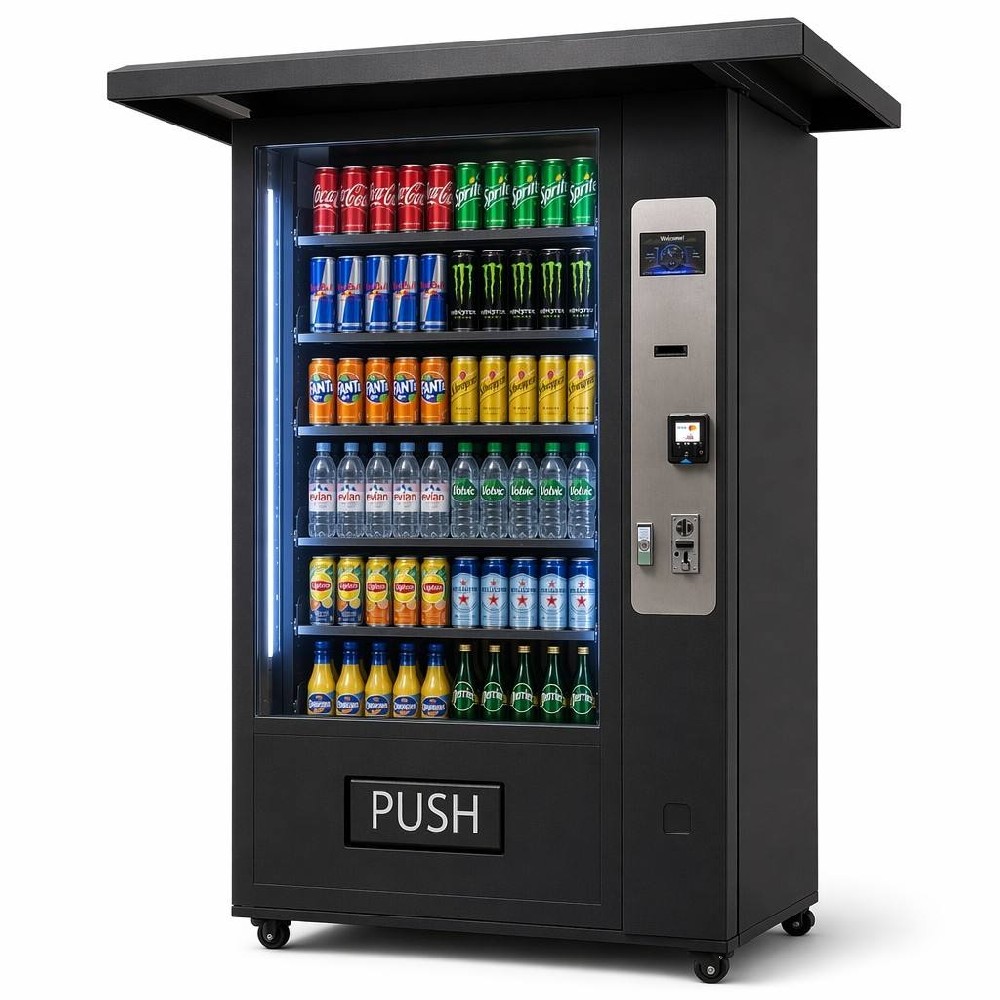
For any partly exposed space, clarify whether the specific machine is approved for that exposure. A canopy, weather-resistant finish, or marketing label is not proof that every internal payment device and cooling component can operate in rain or extreme temperatures.
Choose Products People Will Buy More Than Once
A snack vending machine is not a miniature supermarket. Every selection takes space, ties up cash, and creates an additional item to monitor. I’d start with a small selection built around the reason customers are there, then change the mix using actual transaction records.
In a break room, practical choices often include water, canned drinks, crackers, chips, and bars. In a gym, demand may center on drinks and conveniently packaged protein snacks. In a hotel, sealed personal-care items and small essentials may be more useful than a wall of candy. At a retail store, the strongest items may be accessories or consumables that fit the shop's existing customers.
Consider package strength, not just product popularity. A soft pastry that breaks during a long drop may be a poor candidate for spiral dispensing. Tall bottles can need different channel geometry from cans. Fragile packages may require lift delivery. Products needing temperature control also change sanitation and recordkeeping responsibilities.
Set an opening assortment
- Choose a limited group of products that matches the site's primary need.
- Record each package's dimensions, weight, supplier, and unit cost.
- Set selling prices using gross margin and expected service costs.
- Allocate more capacity to likely repeat purchases than novelty items.
- Review actual sales by selection before changing the assortment.
Do not confuse high unit margin with high contribution. A $5 item that rarely sells can tie up a lane that might move several $2 items. Also distinguish shelf-stable goods from refrigerated items: a cooling feature does not, by itself, establish that a machine is suitable for every perishable food.
Which Vending Machine Should You Choose?
Match the cabinet to the product before comparing screen size. A straightforward snack-and-drink combo is often sufficient for a workplace. A compact machine can make sense when floor space is limited. A refrigerated lift-equipped cabinet may be justified when products need more careful handling. A locker-style self-service kiosk can suit boxed goods that do not fit spiral channels.
| Type | Suitable items | Check before ordering |
|---|---|---|
| Compact combo | Packaged snacks, cans, smaller bottles | Usable lane sizes, service clearance, stock capacity |
| Full-size combo | Wider drink and snack selection | Cabinet access, refrigeration, refill workload |
| Lift or elevator delivery | Delicate packages and select boxed goods | Actual lift option, compatible package testing |
| Locker or compartment | Larger boxed items and selected merchandise | Compartment size, door security, pickup process |
| Wall-mounted | Small accessories and packaged essentials | Structural support, mounting approval, reach height |
Consider the machine's daily routine. Can staff see low stock remotely? Can the price of a slow seller be changed without visiting? Can a customer recover from a failed vend without waiting days? A touchscreen looks modern, but a reliable pickup mechanism and serviceable payment reader are more important to repeat use.
For a smaller site selling familiar drinks and packaged snacks, I’d shortlist a compact combo before paying for the largest available cabinet. The right capacity is the amount the site can reasonably sell between scheduled refill visits, not the maximum number shown in a catalog.
How I’d Compare Vending Machine Manufacturers
For this comparison, I’m prioritizing product compatibility, configurable payments, verifiable specifications, service support, and a complete delivered quote. Cabinet appearance matters, but it comes after the ability to dispense your actual merchandise and recover quickly from a fault.
Ask each manufacturer for a dimensioned drawing, a written list of included hardware, a sample operating interface, and the available replacement parts. For chilled products, require the applicable temperature capability and safety controls in writing. For payment systems, confirm compatibility with the actual payment provider before production. A reader listed as an “option” is not the same as an installed, approved, and activated reader.
Zhongda Smart deserves a place at the top of the shortlist when a business wants a customized cabinet rather than a fixed off-the-shelf layout. Its published product information covers compact and larger combo models, touchscreens, several payment configurations, and OEM/ODM adjustments. The manufacturer also describes configurable product lanes, branding, and remote management. Those are relevant capabilities, not proof that any one model is automatically the right choice.
The appropriate next step is to submit your product photos, dimensions, expected volume, payment needs, and site constraints through Zhongda Smart's custom vending machine configuration process. Then compare the written result with alternative proposals on the same five criteria. Confirm every option on the final specification sheet, including the delivery mechanism, before paying a deposit.
I’d also assess after-sales service before price. Zhongda Smart publishes a one-year warranty framework and remote technical support details; purchasers should read its current warranty, inspection, and service policy, including reporting deadlines and exclusions. A low equipment price is less useful if a failed component leaves the machine idle and nobody knows who supplies the replacement.
For larger sites or products that need gentler handling, a lift-capable refrigerated combo is worth comparing with an ordinary drop-style unit. The key is to verify the selected dispensing mechanism, not infer it solely from the product name.
Make Paying as Easy as Buying
Cashless payment is worth considering early, not adding as an afterthought. In the Federal Reserve's 2026 Diary of Consumer Payment Choice, cash accounted for 14% of consumer payments in 2025. The same report says four out of five consumers had used cash during the preceding 30 days. These are general consumer-payment findings, not vending-specific transaction shares. They support offering easy electronic payment while evaluating whether cash still matters for your particular audience. [1]
Ask whether the machine accepts contactless cards and compatible mobile wallets, and whether a cash acceptor is included or optional. Confirm processing fees, per-transaction charges, settlement timing, refund handling, and what happens during a network outage. Payment hardware can also carry recurring connectivity and account charges.
A reliable customer experience has four steps: clear displayed price, successful authorization, confirmed delivery, and an easy remedy if the product does not arrive. Ask to see the complete sequence during acceptance testing. Payment accepted without product delivery is both a service problem and a trust problem.
For an unattended machine, remote monitoring can reduce wasted visits by showing sales and low-stock alerts. It does not eliminate the need to inspect physical products, reconcile payment reports, or respond to complaints. Do not assume two products described as “smart vending machines” offer identical remote-control functions.
What Does It Cost to Put a Vending Machine in a Business?
There is no single honest installed price. A hosted placement may require no machine purchase, but the business might still pay electricity or accept a restricted product assortment. An owned machine has a purchase or financing cost plus freight, installation, payment setup, opening stock, and ongoing expenses. Quotes should separate equipment from the cost of making it operational.
Zhongda Smart's published examples above currently list $1,922 for the compact ZD-L-7 and $3,758 for the ZD-L-22. Those are website-listed machine prices, not universal market averages or guaranteed delivered totals. The final price can change with payment hardware, software, branding, freight, and the written order configuration.
| Cost item | How to confirm it | Typical billing pattern |
|---|---|---|
| Machine and selected hardware | Itemized signed supplier quote | Upfront or financed |
| Freight, handling, and placement | Delivery scope and receiving requirements | Usually upfront |
| Payment reader and activation | Processor and equipment-provider agreement | Setup plus possible recurring charges |
| Opening inventory | Supplier invoice by SKU | Upfront working capital |
| Insurance and approvals | Insurer and relevant authority | Initial and ongoing |
| Electricity, data, and software | Utility rate and provider contracts | Recurring |
| Service, refunds, and repair reserve | Contractor quote and operating budget | Recurring or event-based |
For an illustrative capital plan, a $3,500 machine, $700 delivery and handling allowance, $450 initial stock purchase, and $250 setup allowance total $4,900. This is a budgeting exercise, not a reported Zhongda Smart transaction or a current industry cost estimate. Replace every line with quotes before approval.
When comparing a lease with a purchase, total every scheduled payment and any end-of-term charges. A low monthly figure can cost more than ownership over the planned operating period. Also ask whether the card reader and refrigeration unit remain serviceable after the original software subscription ends.
Calculate Monthly Profit Before You Buy
Revenue is not profit, and gross margin is not what you take home. A realistic vending machine profit calculation includes product cost, payment fees, any location commission, electricity, replenishment labor, connectivity, spoilage, refunds, and a repair allowance. If you are operating the machine yourself, count your time rather than treating it as free.
Here is a fully labeled hypothetical example for one owned machine. Assume 26 selling days per month, an average selling price of $2.75, average product cost of $1.30, payment processing of 3% of sales plus $0.10 per transaction, and a site fee of 10% of gross sales. These percentages and charges are assumptions for demonstration, not claimed industry averages or processor quotations.
| Monthly line | Calculation | Amount |
|---|---|---|
| Sales revenue | 20 × 26 × $2.75 | $1,430.00 |
| Products sold | 520 × $1.30 | −$676.00 |
| Card processing | 3% of sales + 520 × $0.10 | −$94.90 |
| Placement fee | 10% of sales | −$143.00 |
| Electricity | Illustrative allowance | −$35.00 |
| Restocking labor and travel | Illustrative allowance | −$110.00 |
| Repair allowance | Illustrative allowance | −$35.00 |
| Waste and refunds | Illustrative allowance | −$20.00 |
| Software and connectivity | Illustrative allowance | −$18.00 |
| Operating contribution | Before financing, taxes, and depreciation | $298.10 |
Using that same cost structure, changing only daily sales produces very different results. The table below keeps fixed monthly allowances unchanged; in a real operation, some costs will also move with transaction volume and service frequency.
| Sales/day | Monthly sales | Modeled contribution | Decision implication |
|---|---|---|---|
| 8 | $572.00 | −$11.56 | Rework costs or reconsider site |
| 12 | $858.00 | $91.66 | Limited cushion for unplanned repairs |
| 20 | $1,430.00 | $298.10 | More room for ongoing expenses |
The illustrative $4,900 startup budget divided by the $298.10 monthly operating contribution gives a simple payback of about 16.4 months, assuming that contribution persists. It is not a forecast, an investment return guarantee, or a true cash-flow model: financing, taxes, depreciation, inventory working capital, and major breakdowns can change the result. Run a lower-sales case before signing.
Put the Placement Agreement in Writing
Whether the machine is operator-owned or business-owned, a written vending machine placement agreement prevents small misunderstandings from becoming expensive disputes. The agreement should identify the machine owner, the exact permitted location, allowed merchandise, who can access the cabinet, and how long the arrangement lasts.
Spell out who pays utilities, internet service, merchant processing, maintenance, cleaning, and insurance. If your business receives a share of sales, define whether that share uses gross sales, sales after refunds, or another clearly stated amount. Set a reporting schedule and give the host a way to check the calculation.
Customer service is easy to forget. State whose contact details appear on the machine, how refunds are issued, and who handles complaints involving spoiled products or failed transactions. A host should not discover after the first incident that the supplier expects reception staff to process every refund.
Clauses I would not leave vague
- Access: Who may enter the premises, and during which hours?
- Service: Who responds to stockouts, faults, and safety concerns?
- Financial terms: Which costs and commissions apply, and how are they calculated?
- Damage: How are vandalism, accidental damage, and property damage handled?
- Term: What is the initial period, renewal method, and notice requirement?
- Exit: Who disconnects, removes, and makes good the installation area?
- Data: Who receives transaction, customer, and machine-status information?
A trial clause can be valuable where demand is unproven. It should name a review date and objective conditions for keeping, moving, or removing the machine. That is preferable to a loose promise that somebody will “see how it goes.”
Check Insurance, Accessibility, Food Safety, and Permissions
A vending machine is commercial equipment. Before delivery, confirm that the business has permission to place it, that the proposed use is allowed under relevant property agreements, and that any required vending or food approvals are in place. Requirements vary with the product, the site, and the governing authority. An equipment purchase does not automatically include the right to operate it.
Ask your insurance adviser whether existing coverage applies to the equipment, its inventory, customer injuries, and possible property damage. An operator-owned machine may be insured by its owner, but the host should request evidence and understand where responsibilities meet. If payments or customer data are involved, establish who provides the payment service and handles related obligations.
Preserve accessible routes and usable controls. Check reach height, clear floor space, doorway clearance, and any applicable accessibility requirements before final placement. An appealing machine in the wrong spot can create a problem for customers and other building users.
Extra care for refrigerated food
If the unit will sell food that requires temperature control for safety, evaluate its refrigeration, monitoring, automatic shutoff, cleaning, and stock-handling controls. The FDA's 2026 Food Code is a model reference for retail food safety, including vending provisions; adoption and enforceable requirements depend on the relevant authority. A key model cold-holding reference is 41°F (5°C) for applicable foods, with specific safeguards for vending equipment. Do not treat the dial setting alone as proof of safe product temperature. [3]
Food safety also involves how stock is transported, rotated, and discarded after a fault. A cabinet that can cool drinks is not automatically approved for ready-to-eat meals. Request written confirmation of the intended food application and any required safety features before stocking perishable merchandise.
Age-restricted products involve separate rules and controls and should not be treated as ordinary snack vending. This guide focuses on general merchandise, snacks, and nonrestricted beverages.
Prepare for Delivery and Test Every Purchase Step
Set a delivery appointment only after the final machine dimensions, receiving route, installation equipment, and power requirements have been confirmed. A heavy cabinet may require specialist moving services. Decide in advance who will unpack it, inspect damage, level or secure it, connect the electrical supply, and remove packaging.
Photograph the shipping package before opening and inspect the cabinet as soon as it arrives. Record visible damage, missing components, and unusual display or cooling behavior. Follow the manufacturer's stated inspection deadlines; late reporting can complicate transport or warranty claims.
Before loading the full assortment, test representative products from each intended channel. Run normal purchases and deliberate fault scenarios with the approved payment system. Check that prices match displayed selections, products dispense without damage, refunds can be processed, and the operator receives machine-status alerts if those were included in the order.
Installation acceptance checklist
- Cabinet is stable, positioned, and accessible for servicing.
- Power supply and network connection match the approved specifications.
- Temperature controls are verified where the product requires them.
- Every selected payment method completes a real test purchase.
- Test products dispense correctly from the intended channels.
- Customer support details and refund instructions are visible.
- Stock, opening cash if applicable, and software access are documented.
I’d sign off on the installation only after somebody has completed a purchase from selection to pickup. A photo of a powered-on screen is not a commissioning test.
How to Keep the Machine Stocked and Useful
Once installed, a vending machine becomes a small retail operation. The core tasks are checking availability, replenishing fast sellers, rotating dates, reconciling sales, resolving failed vends, and keeping the cabinet clean. Remote inventory data can help determine what to bring, but the physical stock count still matters.
Establish one accountable contact and a written restocking routine. For each refill, record the date, quantities added, expired or damaged goods removed, unusual customer reports, and any cash collected. Compare physical quantities with sales records to find mismatches. Do not rely on memory when several people have access to the same cabinet.
Make the first assortment review based on evidence. Which items sell repeatedly? Which lanes are empty between visits? Which products are approaching expiration before they sell? A slow item can be replaced, repriced, or assigned less space; it should not stay in the cabinet simply because it looked promising when ordered.
If a contractor operates the machine, ask for a basic service summary rather than a vague statement that the machine is “checked regularly.” Useful reports include visit date, restocked items, faults, refunds, and any proposed product changes. For business hosts, a dedicated point of contact is usually more valuable than access to every technical setting.
Set customer expectations plainly. A visible phone number or support method is essential when a transaction fails outside staffed hours. Quick correction of small problems protects the machine's credibility and reduces friction for the business hosting it.
Plan Vending Machine Repair Before Something Breaks
Every commercial machine needs maintenance. The sensible approach is to separate routine cleaning and inspection from electrical, refrigeration, and payment-device repairs that require a qualified professional. An employee should not open energized components or bypass protective systems to restore a sale.
Routine checks may include cleaning customer-touch surfaces, keeping vents unobstructed, inspecting the pickup door, watching for unusual noise, removing damaged stock, and confirming that the machine closes securely. Follow the equipment manual for the approved schedule and methods. A universal “service every X days” rule would be misleading because duty cycle, product type, and environment differ.
Keep a simple fault log: date, error message, affected lane, payment result, photos, who responded, and when the machine returned to service. Distinguish a failed product vend from a payment authorization problem. They can look identical to a customer but lead to different fixes.
Before purchasing, establish who stocks replacement motors, sensors, locks, touchscreens, card readers, and refrigeration parts. Ask whether parts are shipped directly, whether a technician can be arranged, and who pays labor during the warranty period. Document software access and backup procedures, especially if an outside company manages the machine remotely.
In my view, repair support is part of the purchase price even when the invoice has no line called “support.” Long downtime reduces sales, creates complaints, and can damage the host relationship. A clear escalation path matters more than a broad promise that assistance is available.
Three Practical Planning Scenarios
The following examples are decision exercises, not customer case studies or reported sales results. They show how the same purchasing question leads to different answers when staffing, merchandise, and access change.
Scenario 1: An office with 85 regular employees
The office wants afternoon snacks and drinks but has no employee assigned to manage inventory. The break room has a suitable outlet, clear delivery access, and staff on several schedules. The simplest first move is to request a full-service placement and ask whether the route operator will provide stocking and repairs.
The office should compare promised refill service, product choice, and removal terms rather than opening with a demand for commission. If multiple operators decline because expected volume is too low, that is useful market feedback. The office can then assess whether a purchased compact combo makes sense as an employee amenity, with an explicit internal budget for replenishment.
Scenario 2: A gym selling its own packaged products
The gym already purchases bottled drinks and sealed nutrition products and wants sales beyond staffed desk hours. Owning the machine may make more sense because the gym controls the inventory and can coordinate restocking with existing deliveries. The decision turns on product dimensions, permitted merchandise, card payments, and a contribution estimate using the gym's real wholesale costs.
I’d choose a configuration that handles the actual bottle and package sizes rather than a generic high-capacity model. Before committing, the gym should test several examples of each package through the intended channels. It should also assign one employee to audit inventory, handle refunds, and review the sales report.
Scenario 3: A lobby with uncertain visitor demand
The lobby has attractive foot traffic but few repeat customers and no clear evidence of purchases. That is a poor basis for an expensive customized cabinet. A short operator trial, subject to a clear removal condition, would reveal more than a projected sales slide.
During the trial, track completed transactions, products sold, complaints, and the staff time needed to support the placement. If the operator declines a trial, a smaller initial assortment or a different location may be more sensible. The correct outcome can be deciding not to install a machine.
Common Mistakes That Make a Vending Project Expensive
Ordering before measuring. Confirm the entire delivery path, not only the final corner. Cabinet width means little if the machine cannot clear a doorway or the service door cannot swing open.
Buying for maximum capacity. Unused lanes are not free. They occupy floor space and invite overstocking. Start with a realistic replenishment plan, then choose capacity.
Assuming every payment reader is compatible. Confirm the specific reader, software, transaction provider, electrical setup, and activation responsibilities. “Card-ready” is not the same as ready to collect payments.
Confusing product sales with profit. Product cost is only the first deduction. Restocking labor, transaction fees, refunds, electricity, and machine downtime can change the result materially.
Ignoring a removal plan. Property needs change. The agreement should explain who can terminate, how much notice is required, and who repairs the floor or wall after removal.
Promising food the cabinet cannot safely hold. Temperature-controlled foods require the right equipment, documented procedures, and any applicable approvals. Do not substitute a cold-drink setting for a food-safety assessment.
Accepting vague support language. Warranty coverage, exclusions, contact methods, fault evidence, parts availability, and response expectations should all be understood before delivery.
Making changes too quickly. One quiet afternoon is not evidence that an item will never sell. Use a sensible review period and actual transaction records, while promptly removing expired or unsafe stock.
Your Action Plan for Getting a Machine Installed
A workable project can begin with a single page of facts. Start with the main goal, proposed products, potential users, access hours, site photos, delivery measurements, and available power. Decide whether the business wants an amenity with minimal work or a retail activity it will actively manage.
Then request proposals that match that decision: at least two full-service operator offers if convenience is the priority, or an itemized equipment quote and service plan if ownership is the priority. For an owned machine, request drawings, confirmed payment compatibility, product-fit testing, freight details, and warranty terms.
Build a conservative budget, obtain the required permissions, sign a clear placement agreement, and test a real transaction at installation. After launch, use sales and service records to adjust inventory and assess whether the machine is earning its place. I’d recommend starting with one well-managed machine rather than installing several before the first location has proved its usefulness.
Frequently Asked Questions
Can I get a vending machine at my business for free?
Possibly. A vending operator may supply and maintain a machine without an equipment purchase charge when the site fits its operating requirements. You may still provide electricity, access, and space. Ask who pays every ongoing expense and whether the operator can remove the machine if sales are low. A free placement is an agreement, not a guarantee for every business.
How many employees do I need to qualify for a vending machine?
There is no universal minimum. Operators consider repeat use, shift schedules, nearby food alternatives, service-route distance, and likely sales. Give prospective providers a realistic count of people who can use the machine, not total employee headcount across multiple sites. A smaller site may qualify if purchases are frequent; a larger one can still be a poor match.
Does a vending machine at my business make money?
It can, but revenue and profit depend on actual transactions and costs. For an operator-owned placement, the host may receive no commission or an agreed share. For an owned machine, subtract inventory, transaction fees, labor, power, software, waste, and repairs from sales before judging the result. Use a low-volume case when evaluating a purchase.
Can I buy a vending machine and put it in my own store?
Yes, subject to property permissions and applicable rules. Choose equipment that suits the products, measure the installation path, confirm electrical and payment compatibility, and arrange inventory and service. You do not need a third-party operator simply because the machine is unattended, but you do need someone accountable for daily operation and customer support.
Who stocks and repairs a vending machine installed by a company?
Under a genuine full-service agreement, the operator typically replenishes inventory and manages equipment service. However, the contract controls. Confirm responsibility for cleaning, refunds, payment faults, after-hours emergencies, and removal. If the machine is purchased by your business, those tasks normally remain your responsibility unless you separately contract them out.
What kind of vending machine is best for a small business?
A compact snack-and-drink combo is a reasonable starting point when space is limited and customers mainly want familiar packaged items. Specialty merchandise may require lockers, different dispensing channels, or a custom cabinet. Select based on package size, product handling, service access, and expected refill intervals rather than appearance alone.
How long does getting a vending machine installed take?
Timing depends on equipment availability, site approval, freight, electrical work, payment activation, and customization. A ready machine at an approved site may be installed sooner than a custom unit requiring graphics and revised hardware. Ask for separate dates for order approval, production or allocation, dispatch, site delivery, and commissioning. Do not assume a quoted factory lead time includes shipping and installation.
What happens if the machine does not sell enough?
Check the sales report, product mix, pricing, accessibility, and stock availability before making a change. If the site still cannot support the machine, follow the contract's relocation or termination terms. With owned equipment, calculate the cost of moving it against realistic demand elsewhere. With operator-owned equipment, confirm removal rights and notice periods before the trial begins.
Sources and Further Reading
- Federal Reserve Financial Services, 2026 Diary of Consumer Payment Choice (published August 2026; reports 2025 payment behavior). Used for the cash-payment data and payment-method discussion.
- NAMA Foundation, The 2024–25 State of Convenience Services (2026 industry census information). Provides context for how vending fits within broader convenience services; not used as a forecast for any individual machine.
- FDA, Food Code 2026 (model retail food-safety guidance, including vending provisions). Consult the rules that apply to your actual operation.
Editorial disclosure: This guide is published by Zhongda Smart, a vending machine manufacturer offering configurable vending equipment. Product recommendations reflect the features and specifications published on the manufacturer's own pages; they are not independent laboratory test results. Product prices are website listings observed when preparing this article and may change. The financial examples are hypothetical calculations, not customer results or promised earnings.
Disclaimer: This article provides general business and equipment information, not legal, accounting, tax, insurance, electrical, or food-safety advice. Rules, approvals, prices, payment availability, and contract terms differ by application. Confirm specifications and costs in writing and consult qualified professionals and the relevant authorities before installation or sale of regulated products.