The best high traffic vending machine locations combine steady foot traffic, a clear reason to buy, convenient access, and manageable operating costs. Busy office buildings, factories, hospitals, transportation hubs, hotels, fitness centers, and entertainment venues can all support profitable vending machines. Yet the busiest location is not always the most profitable. A machine beside a crowded entrance may sell less than one near a quiet employee break room where people regularly need refreshments.
Successful vending placement starts with understanding who walks past, when they need something, how easily they can purchase it, and whether nearby alternatives already satisfy that need. The right equipment, product selection, payment options, and placement agreement matter just as much as visitor volume.
This guide explains how to compare promising locations, estimate vending sales, evaluate installation requirements, negotiate placement terms, and choose equipment that fits the actual buying environment.

What Makes a Vending Machine Location Profitable?
A profitable vending machine location is a place where enough customers make purchases at prices that cover merchandise, payment fees, placement charges, servicing, equipment ownership, and other operating expenses.
Foot traffic establishes the size of the opportunity. It does not establish the value of that opportunity.
Consider two buildings. The first welcomes thousands of visitors who move directly between an entrance and an exit. The second has fewer occupants, but employees remain inside for long shifts with limited access to refreshments. The second building may offer more consistent vending demand because its customers have an immediate reason to purchase.
For this comparison, I'm prioritizing five characteristics:
- Relevant traffic: People passing the machine are plausible buyers rather than unrelated pedestrians.
- Purchase opportunity: Customers can stop comfortably without interrupting their primary activity.
- Convenience gap: The machine solves a problem that nearby businesses or existing facilities do not fully address.
- Operational access: The operator can refill, clean, inspect, and repair the equipment without excessive difficulty.
- Sustainable economics: Expected contribution from sales is sufficient to cover both variable and fixed expenses.
Foot Traffic Versus Purchase Intent
A crowd moving quickly through a corridor creates visibility but may leave little time for purchasing. People sitting in a waiting area have more time, although some may have no intention of buying refreshments.
The important question is whether the product matches the situation.
Someone finishing a workout might want cold water or a protein snack. An employee starting an overnight shift might value a substantial packaged meal or caffeinated beverage. A hotel guest arriving late may purchase toiletries or bottled water because nearby retail options are inconvenient.
These buying situations should determine the machine's product mix before the operator commits to an equipment configuration.
Repeat Traffic Is Particularly Valuable
Employees, residents, students, and regular facility users may encounter the same machine repeatedly. That creates opportunities for repeat purchases and better forecasting.
A location dominated by occasional visitors can still perform well, especially where customers face an urgent need. However, the operator may need stronger product visibility, clearer prices, and simpler purchasing instructions because many customers will be using the machine for the first time.
Neither traffic pattern guarantees sales. The strongest vending locations make purchasing easy for the people who already have a reason to stop.
12 Best High Traffic Vending Machine Locations
The following locations deserve consideration because they combine recognizable customer groups with recurring convenience needs. Their actual earning potential depends on placement position, access, competition, product selection, and operating terms.
1. Office Buildings and Business Centers
Office buildings are attractive because employees spend substantial portions of their day at work. Vending machines can serve coffee breaks, lunch periods, afternoon refreshment needs, and staff working outside normal cafeteria hours.
The most practical placement is often near an employee lounge, shared kitchen, elevator lobby, or another common area that workers regularly visit. A machine hidden in a remote corridor may receive little attention even when the building has a large workforce.
Assortments can include bottled water, coffee beverages, packaged snacks, nuts, protein bars, and other convenient refreshments. Product selection should account for any free snacks or beverages supplied by the employer.
Placement judgment: I would rank a building with several hundred regularly present employees and limited refreshment access above a much larger office complex offering extensive complimentary food.
2. Manufacturing Facilities and Warehouses
Factories and warehouses can provide dependable vending opportunities because employees work scheduled shifts and may have limited opportunities to leave the premises.
Break rooms, locker areas, and approved spaces near production access points are worth investigating. Machines should remain outside hazardous work zones, emergency routes, and locations where dust, excessive heat, vibration, or moisture could damage equipment.
Useful products may include cold beverages, filling snacks, packaged meals, and workplace essentials where permitted.
Shift schedules deserve particular attention. A facility operating through the night might generate demand when nearby food businesses are closed. However, the number of scheduled workers and the length of breaks matter more than the building's total workforce on paper.
Placement judgment: Prioritize reliable shift-based demand and straightforward servicing rather than selecting a warehouse solely because of its floor area.
3. Hospitals and Medical Facilities
Hospitals can offer several distinct customer groups: employees, visitors, patients where appropriate, and people waiting for appointments. Their needs differ significantly, so a single product strategy may not work everywhere in the building.
Staff lounges, permitted visitor waiting areas, and approved corridors near common facilities can be promising. Access restrictions, sanitation requirements, and existing food-service contracts require careful review.
Packaged snacks, bottled beverages, and products with clearly displayed ingredients may suit certain areas. Specialized products should only be stocked when storage conditions, labeling, and facility rules permit them.
Machines intended for healthcare environments should be easy to clean, provide dependable payment processing, and minimize complicated product retrieval.
Placement judgment: A well-positioned machine serving recurring staff breaks may provide a more predictable sales pattern than one relying entirely on occasional visitors.
4. Colleges, Training Centers, and Educational Facilities
Educational buildings can concentrate substantial customer activity into predictable intervals between classes, during study sessions, and around scheduled events.
Potential installation points include approved student common areas, dormitory lounges, recreational facilities, and study spaces with suitable supervision and security.
The operating calendar is a major consideration. Student attendance can fluctuate during holidays, examinations, and breaks, leaving machines underused for extended periods.
Product restrictions also need attention. Some educational facilities limit beverages, snacks, marketing, or unattended sales. Rules may differ depending on the age of students and the specific institution.
Placement judgment: I would favor recurring residential or extended-hours study demand over a corridor that becomes nearly empty after classes finish.
5. Hotels and Extended-Stay Properties
Hotels offer a familiar convenience problem: guests need small items outside the hours when staff or nearby stores can easily provide them.
Placement near an approved lobby area, guest laundry room, or elevator-accessible common space may increase visibility. The machine should not interfere with check-in circulation, luggage movement, or accessible routes.
Bottled water, packaged snacks, phone accessories, and travel essentials may fit the setting. Products should complement the hotel's existing retail offerings rather than duplicate items already supplied without charge.
Guest demand can change with occupancy and event schedules. Operators should therefore evaluate typical occupancy patterns rather than relying on peak-season impressions.
Placement judgment: A compact, clearly branded machine may be a better investment than a large cabinet when floor space is limited and demand is spread across several product categories.
6. Gyms and Fitness Centers
Fitness facilities have identifiable purchasing occasions before and after workouts. Visitors may want bottled water, electrolyte drinks, protein snacks, or other approved exercise-related products.
However, gyms often sell competing products at reception desks or operate their own beverage coolers. The vending proposal should explain the specific convenience gap it will fill.
High-use areas near a permitted lounge or exit can be effective, provided the machine does not obstruct exercise equipment or circulation.
Be cautious about loading an entire machine with premium sports nutrition products before observing demand. Regular members may bring their own drinks, while occasional visitors may purchase more frequently.
Placement judgment: The best fitness-center opportunity usually combines a suitable product mix with a visible point along the customer's natural exit path.
7. Transportation Terminals and Waiting Facilities
Transportation facilities offer potentially significant pedestrian movement, time-sensitive purchasing, and customers seeking quick refreshments.
Possible products include bottled drinks, packaged snacks, personal-care items, and small travel necessities. Transaction speed and a simple interface are particularly important when people are concerned about departure schedules.
These locations can also involve higher placement costs, formal concession arrangements, demanding security rules, and strict equipment approval procedures.
A position near a waiting area may outperform one directly beside a fast-moving entrance because customers have more time to browse and complete payment.
Placement judgment: Evaluate concession charges and actual stopping behavior before treating large passenger counts as a financial advantage.
8. Shopping Centers and Entertainment Complexes
Shopping centers, cinemas, arcades, and entertainment facilities can support specialty merchandise as well as traditional refreshments.
Customers may purchase on impulse, making presentation, visual merchandising, and appropriate product pricing more important than in some workplace environments.
A machine selling recognizable snacks must compete with surrounding retailers. A well-configured self-service kiosk offering a distinctive product category may have a clearer role.
Entertainment activity can be uneven. Weekends, holidays, and special events may produce strong traffic, while quieter periods may generate relatively few sales.
Placement judgment: Choose a product concept that offers a specific advantage, such as faster service, extended availability, or merchandise that surrounding stores do not carry.
9. Apartment Buildings and Residential Complexes
Residential buildings offer a recurring customer base and opportunities for purchases outside ordinary retail hours.
Potential installation areas include approved shared lounges, laundry facilities, and other common spaces. Access must be convenient for residents while remaining secure against unauthorized use.
Drinks, everyday snacks, and practical essentials can be useful. Operators should assess how often residents already receive deliveries or visit nearby stores, because convenient alternatives may reduce demand.
Residential vending is sensitive to the number of occupied units, building access rules, and the convenience of the proposed machine position.
Placement judgment: Recurring convenience demand matters more than the apparent size or prestige of the property.
10. Recreation Centers and Sports Facilities
Sports complexes, indoor courts, swimming facilities, and recreation centers concentrate customers around scheduled activities.
Participants and spectators may want cold drinks, packaged snacks, or approved sports-related necessities before and after sessions.
Check whether the facility operates a staffed concession counter or has exclusive sales arrangements. An unattended machine can complement existing service, but it should not be installed under the assumption that every visitor represents an additional buyer.
Demand may depend on tournaments, lessons, and scheduled activities. Inventory planning should reflect those patterns rather than treating every day as equally busy.
Placement judgment: Locations with regular classes and programs can be easier to manage than facilities dependent on occasional events.
11. Laundromats and Self-Service Facilities
Laundromats provide an interesting combination of customer waiting time and limited on-site retail options.
Possible assortments include bottled drinks, packaged snacks, and approved laundry-related necessities. A small machine may be sufficient where the customer base is modest.
The practical challenge is usable space. Machines must not block laundry equipment, folding counters, entrances, or customer movement with baskets and carts.
Operators also need to inspect the environment for humidity, ventilation, electrical access, and security conditions.
Placement judgment: A modest but repeatable stream of customers with waiting time may be preferable to a busier setting where nobody can stop.
12. Event Venues and Exhibition Facilities
Event venues can expose vending machines to concentrated bursts of demand. Visitors often need refreshments quickly, particularly during breaks between scheduled activities.
Yet event traffic is not equivalent to year-round demand. A machine placed in an otherwise empty building may face substantial idle periods.
Operators should examine event calendars, loading access, temporary operating permissions, nearby concessions, and requirements for moving equipment.
For occasional events, temporary vending or a flexible placement arrangement may make more sense than purchasing a machine dedicated to a single venue.
Placement judgment: Treat event-based vending as a schedule-driven business rather than assuming peak attendance will continue throughout the month.
Comparing Locations Before Investing
Different venues create different purchasing patterns. This comparison identifies what an operator should verify before choosing a site.
| Location | Likely Purchase Occasion | Suggested Merchandise | Check Before Placement |
|---|---|---|---|
| Office building | Work breaks | Snacks and drinks | Employee attendance and free refreshments |
| Factory | Shift breaks | Drinks and filling snacks | Shift schedules and installation conditions |
| Hospital | Waiting and staff breaks | Packaged refreshments | Facility permissions and existing concessions |
| Educational facility | Between classes | Approved snacks and beverages | Calendar and product restrictions |
| Hotel | Late-night convenience | Drinks, snacks, essentials | Occupancy and available floor space |
| Gym | Before and after workouts | Hydration and protein snacks | Existing beverage sales |
| Transit facility | Waiting and urgent convenience | Drinks and travel items | Concession fees and security rules |
| Shopping center | Impulse purchases | Snacks or specialty goods | Retail competition |
| Residential complex | Daily convenience | Snacks and essentials | Occupied units and access |
| Recreation center | Activities and spectator breaks | Drinks and snacks | Program schedules |
| Laundromat | Waiting time | Refreshments and essentials | Space and equipment access |
| Event venue | Scheduled attendance peaks | Quick refreshments | Event frequency and temporary permissions |
This table identifies operational fit, not verified rankings of sales performance. A suitable location category is only the beginning of the selection process.
A small location with affordable terms may produce more owner income than a prestigious site requiring a substantial monthly placement fee.
How to Measure Foot Traffic and Buying Demand
Reliable vending site selection requires more than an estimate supplied by a building manager. The operator needs observations that reflect the precise position of the proposed machine.
Count People Who Can Actually Reach the Machine
Building entrances, parking areas, and shared corridors can attract people who never pass the vending position.
Count only potential customers who travel through the area where the machine will be visible and accessible. Separate employees, visitors, and other customer groups if their purchasing needs differ.
A basic observation sheet can record:
- Date and observation period
- People passing the proposed machine position
- People stopping nearby
- Customers purchasing refreshments from existing outlets
- Approximate waiting or break activity
- Nearby alternatives and their operating hours
- Any restrictions affecting purchasing or access
Conduct observations during several operating periods rather than relying on a single busy interval. Include quieter times, shift changes, and any recurring schedule that materially affects attendance.
Use a Simple Traffic Worksheet
Suppose an operator observes a candidate location during four separate 15-minute periods. The following figures illustrate how a worksheet might be organized; they are not measurements from an actual property.
| Observation Period | People Passing | People Stopping Nearby | Buying Context |
|---|---|---|---|
| Early shift | 84 | 12 | Arriving workers |
| Midday break | 116 | 31 | Refreshment demand |
| Afternoon | 67 | 15 | Short breaks |
| Evening shift | 52 | 18 | Limited alternatives |
The observed count totals 319 passersby across one hour of sampled intervals, not 319 unique visitors or a complete daily count. The 76 nearby stops also do not represent confirmed purchases.
Do not multiply a single busy interval into an entire day without evidence that the same traffic rate continues. That shortcut can seriously distort a sales forecast.
Estimate Transactions Without Pretending to Know Conversion
For initial planning, divide potential daily sales into three scenarios based on explicitly stated assumptions. For example, an assumed 1,000 relevant daily passersby with purchase rates of 1%, 2%, and 3% would generate 10, 20, and 30 transactions respectively.
These rates are hypothetical sensitivity inputs, not published vending conversion benchmarks. Real purchasing behavior must be established through a pilot, existing point-of-sale records, or another credible source of comparable evidence.
If a machine is used by the same customers repeatedly, also watch for repeat transactions. A single person can make more than one purchase during a day, while many passersby will never buy anything.
A Practical Vending Location Scorecard
When several properties appear promising, a consistent scorecard prevents decisions from being driven by attractive photographs or enthusiastic sales presentations.
I would score eight factors, assign a maximum number of points to each, and require a separate pass-or-fail check for safety and installation permission.
| Factor | Maximum Points | Evidence to Review |
|---|---|---|
| Relevant foot traffic | 15 | Observed passersby and recurring attendance |
| Purchase need and dwell time | 20 | Break patterns, waiting time, and unmet needs |
| Visibility and access | 15 | Sightlines, usable space, and customer approach |
| Nearby competition | 10 | Alternative products, prices, and hours |
| Power and connectivity | 10 | Verified electrical supply and network testing |
| Security and environment | 10 | Supervision, temperature, moisture, and theft exposure |
| Servicing and permission | 10 | Written approval, delivery access, and service hours |
| Placement economics | 10 | Fees, commissions, operating costs, and contract terms |
| Total | 100 | Comparable editorial score |
This is a decision-support framework rather than a statistically validated predictor of vending revenue. The weights reflect the practical importance of purchase need and accessible placement, not measured industry correlations.
Document why each score was assigned. A location receiving eight points for security should have supporting evidence, such as approved surveillance coverage or controlled access, rather than a vague impression that the building appears safe.
Apply Non-Negotiable Checks First
A high total score cannot compensate for an unsafe installation. Reject or redesign a placement when the machine would obstruct an emergency exit, overload an unsuitable power supply, interfere with accessibility, or violate a property agreement.
Written placement permission and a technically feasible installation are prerequisites, not optional points that can be offset by heavy traffic.
Compare the Weakest Factor
Two properties might both score 78 points, but one may have expensive placement fees while the other has uncertain customer demand.
The first requires a stronger financial model. The second requires better traffic and purchase evidence. Identical scores should not automatically produce identical decisions.
Vending Machine Placement Tips That Matter
Once the property has been selected, the specific machine position can materially affect customer convenience and servicing.
Make the Machine Visible Without Blocking Movement
Install the machine where potential buyers naturally look while entering, leaving, or using a common area. Avoid placing it behind columns, open doors, promotional fixtures, or other equipment that obscures the display.
Visibility alone is insufficient. Customers also need a comfortable standing position, space to read the display, and a clear path to the collection compartment.
In narrow corridors, a machine may occupy valuable circulation space even when the cabinet itself fits against the wall.
Position Equipment Near Natural Pauses
People are more likely to consider a purchase when they are already pausing for a break, waiting for an activity, or moving toward a shared facility.
Appropriate positions might include the edge of a break area, an approved waiting space, or a clearly visible section of a lounge.
Installing a machine directly in the busiest path may create inconvenience instead of more purchases.
Check the Full Installation Footprint
Cabinet width and depth are only part of the space requirement. Operators should also account for doors, service panels, ventilation, loading access, customer standing space, and the delivery path.
Measure the available opening along the entire equipment route. A vending machine that fits its final position may still be impossible to move through an elevator, doorway, or turn.
Confirm the fully packaged dimensions and delivery weight before installation. Floors, ramps, elevators, and moving equipment must safely support the load.
Verify Power, Network, and Temperature Conditions
A commercial vending machine needs a compatible electrical supply and any required protective devices. Refrigerated machines also need suitable airflow and environmental conditions to maintain the intended cabinet temperature.
Test network connectivity at the exact installation point. An otherwise promising location may have unreliable wireless coverage behind structural walls or inside enclosed service areas.
For connected machines, decide whether Wi-Fi, cellular service, or wired connectivity provides the most dependable operation.
Protect Accessibility and Emergency Routes
Customer access should be considered during equipment selection, not after installation. Review screen and payment-terminal reach, collection-compartment access, approach space, and the path used by customers with mobility needs.
Do not block exits, fire equipment, doors, or designated circulation routes.
OSHA's exit-route guidance explicitly requires exit routes to remain free and unobstructed [3]. Installation requirements must be checked against the rules governing the actual property.
Plan for Cleaning and Repairs
Maintenance access should not require moving furniture or interrupting building operations. Operators need room to open the cabinet, inspect dispensing mechanisms, replace components, and remove stock safely.
A machine squeezed into a visually attractive alcove may become expensive to service if technicians cannot reach the relevant panels.
How to Secure a Vending Machine Location
A strong location proposal explains what the machine will provide, how the operator will maintain it, and what responsibilities the property owner will retain.
Approach the person authorized to approve commercial equipment placement. That may be a property manager, facilities representative, business owner, or procurement contact.
Prepare a Short, Specific Proposal
A practical vending proposal should cover:
- The proposed equipment type and external dimensions
- The merchandise categories customers will be able to purchase
- The intended position and required utilities
- Payment options and customer support arrangements
- Restocking, cleaning, and maintenance responsibilities
- Proposed placement charges or revenue-sharing terms
- Insurance, installation, removal, and incident procedures
- A suggested trial period and review process
Building managers are more likely to evaluate a proposal seriously when they can see how the machine will operate without creating additional work for their staff.
Choose the Appropriate Placement Agreement
Common arrangements include a fixed monthly placement fee, a share of vending revenue, or a negotiated no-fee placement where the property values the customer amenity.
No single agreement structure is inherently best. The appropriate choice depends on expected sales, property requirements, utility arrangements, and the negotiating position of both parties.
| Agreement | How Payment Works | Main Operator Risk | Suitable Situation |
|---|---|---|---|
| Fixed rent | Agreed fee regardless of sales | Payments continue during slow periods | Demand is reasonably predictable |
| Revenue share | Agreed share of defined sales | Margins narrow as sales increase | Both parties prefer variable compensation |
| No placement fee | No direct charge for the space | Other costs and obligations remain | Property prioritizes occupant convenience |
| Trial arrangement | Terms reviewed after a defined pilot | Relocation or removal expense | Sales demand has not been established |
Put the Important Terms in Writing
A placement agreement should clearly identify the approved position, contract duration, renewal terms, fees, commission calculation, utility responsibility, access rights, insurance obligations, and equipment ownership.
Also define what happens when the property closes temporarily, changes ownership, restricts access, or requests removal.
For revenue-sharing agreements, clarify whether the percentage applies to gross sales, sales excluding taxes, refunded transactions, or another defined amount. Ambiguity here can produce disputes even when both parties believe they agreed to the same percentage.
Keep the First Commitment Manageable
If demand is uncertain, I’d recommend requesting a limited pilot with documented performance reviews and an agreed removal procedure.
A trial does not eliminate installation costs, but it can reduce the risk of committing to a long agreement before seeing real purchase data.
Placement Costs, Profit Margins, and Break-Even Sales
Vending machine revenue is not the same as vending profit. Location selection should be based on the contribution remaining after merchandise and transaction-related expenses, followed by all fixed and equipment ownership costs.
Understand the Full Cost Structure
An operator should budget for equipment acquisition, payment hardware, freight, installation, inventory, utilities, connectivity, placement fees, insurance, maintenance, refunds, and service travel.
Some expenses increase directly with sales. Others remain payable even when the machine sells very little.
For financial planning, separate these into:
- Variable costs: Product acquisition, payment processing, sales-based commissions, and expenses that increase with transaction volume.
- Fixed operating costs: Monthly connectivity, agreed rent, software subscriptions, insurance allocations, and other recurring charges.
- Capital and financing costs: Equipment purchase, installation, shipping, taxes, financing, depreciation, and replacement reserves.
Calculate Contribution Per Transaction
The basic calculation is:
Contribution per transaction = Selling price − Product cost − Payment cost − Sales-based placement fee − Variable servicing cost
The result is the amount available to cover fixed expenses, equipment ownership, taxes, and profit.
Worked Example Using Illustrative Assumptions
Suppose an operator evaluates a snack-and-drink machine using the following planning assumptions. These numbers are created to demonstrate the calculation; they are not reported Zhongda Smart customer results, industry averages, or supplier quotations.
| Item | Assumed Amount |
|---|---|
| Average selling price | $3.00 |
| Product acquisition cost | $1.35 |
| Payment fee: 3% plus $0.10 | $0.19 |
| Placement commission: 10% of sales | $0.30 |
| Variable servicing allowance | $0.25 |
| Contribution per transaction | $0.91 |
Assume another $300 per month in fixed operating expenses, excluding equipment financing, depreciation, income taxes, and any additional costs not listed above.
Monthly operating contribution after the stated fixed expenses becomes:
(Daily transactions × 30 × $0.91) − $300
| Sales Per Day | Monthly Sales Revenue | Monthly Contribution Before Fixed Costs | After $300 Fixed Costs |
|---|---|---|---|
| 12 | $1,080 | $327.60 | $27.60 |
| 20 | $1,800 | $546.00 | $246.00 |
| 30 | $2,700 | $819.00 | $519.00 |
Under these assumptions, the machine requires at least 11 transactions per day over a 30-day month to cover the stated $300 fixed operating expense. That is an operating break-even calculation for the listed costs only, not a complete investment break-even point.
Actual performance will differ because product margins, payment charges, refunds, operating days, servicing effort, and placement terms differ.
Why a Busy Site Can Still Lose Money
Consider a property charging high fixed rent. More sales may be required just to cover the location fee. A competing site with fewer transactions but a lower fixed obligation could retain more contribution.
The operator should compare total monthly contribution after site-specific expenses, not simply the projected number of purchases.
Equipment ownership must also be considered. A positive monthly operating result does not automatically mean the machine has recovered its purchase price or generated a satisfactory investment return.
Use Three Forecasts Before Signing
Build a downside case, an expected case, and a higher-demand case. Make the assumed transactions, selling prices, variable costs, and fixed charges visible in each calculation.
The downside case deserves particular attention. If a modest decline in transactions turns the business into a significant monthly loss, a shorter agreement or lower-cost machine may be appropriate.
Any payback estimate should include the delivered and installed equipment cost, financing where applicable, working capital, and anticipated replacement expenses. Do not present simple revenue divided by equipment price as a reliable payback calculation.
Choosing the Right Machine for Each Location
A vending machine should be selected for the merchandise, available floor space, purchasing behavior, and operating conditions of the chosen property.
Buying equipment first and searching for a location afterward can force an operator to accept sites that do not fit the machine's actual requirements.
Capacity Should Match Sales Velocity
A large cabinet can reduce stockout risk and provide more product selections, but only if the location generates enough demand to justify the space and investment.
A compact machine may be preferable where the product assortment is narrow, the available installation area is restricted, or the project is still being validated.
Capacity figures should be evaluated using actual package dimensions. A machine advertised with several hundred items of capacity may hold fewer units when stocked with unusually tall bottles, wide containers, or bulky packages.
Touchscreen Size Should Match the Buying Task
A smaller touchscreen can work well for familiar snacks and straightforward selections. A larger display offers more room for product information, clear navigation, promotional content, and branded presentation.
More screen area does not guarantee higher sales. Customer usability, software responsiveness, readable pricing, and payment reliability matter more than screen dimensions alone.
For straightforward refreshment sales, a 7-inch interface may be entirely appropriate. A 21.5-inch screen becomes more attractive when the purchasing experience involves larger product catalogs or customer-facing visual information.
Match the Dispensing Mechanism to the Product
Not every package can be dispensed reliably through the same mechanism. Product shape, stiffness, weight, and center of gravity affect the choice of spiral, belt, push, or lift-based dispensing.
Before ordering, prepare physical samples or accurate dimensions for the intended merchandise.
Request confirmation of the selected dispensing configuration and demonstrate representative products during factory acceptance testing where practical.
Cooling Requirements Are Product-Specific
Refrigerated beverage machines and equipment intended for temperature-sensitive food are not automatically interchangeable.
Confirm the storage conditions required by each product, the machine's achievable operating range, temperature control features, monitoring provisions, and relevant food-safety obligations.
A general adjustable cooling range should not be treated as proof of suitability for every refrigerated food category.
Payment Reliability Deserves Priority
The Federal Reserve's 2025 Diary of Consumer Payment Choice reported that, in its 2024 consumer-payment data, credit cards accounted for 35% of payments by number, debit cards 30%, and cash 14% [2].
Those figures describe the study's broader consumer-payment sample, not vending-specific transaction shares. They nevertheless reinforce the importance of evaluating both electronic and cash payment preferences rather than assuming customers will use one method exclusively.
For each machine, confirm supported payment terminals, transaction reporting, refund handling, connectivity, and compatibility with the selected processing provider.
Zhongda Smart offers configurable payment, cabinet, interface, and merchandising options. Operators planning branded equipment can review the manufacturer's OEM vending machine customization options before finalizing equipment specifications.
Recommended Zhongda Smart Vending Machines for High-Traffic Locations
For this comparison, I'm prioritizing machine footprint, product compatibility, display usability, payment flexibility, stock capacity, and the ability to configure the equipment for a defined operating environment.
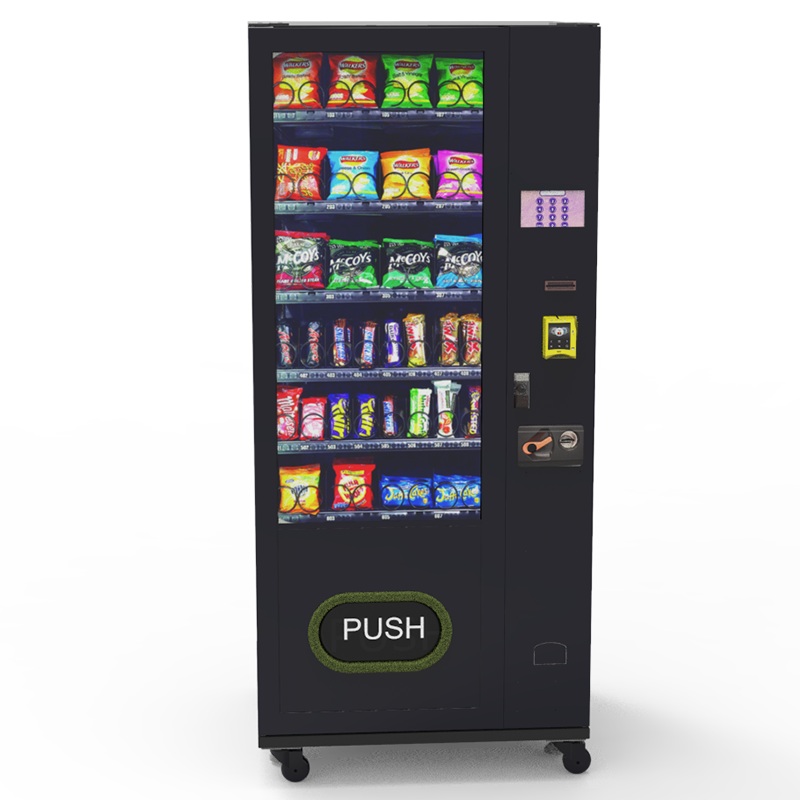
Zhongda Smart is a manufacturer offering commercial vending equipment and OEM/ODM customization. The following models provide two distinct starting points rather than a claim that one machine fits every property.
Why Zhongda Smart Fits the Equipment Evaluation Framework
Zhongda Smart publishes model-level information on cabinet size, screen configuration, payment options, network connectivity, and product capacity. Its OEM offering also allows prospective buyers to discuss branding, merchandising, and selected hardware or software requirements.
These are relevant purchasing criteria because high-traffic sites often place different demands on equipment. A hotel may need a narrow footprint. A workplace may prioritize refreshment capacity. A branded retail concept may need customized presentation.
Manufacturer-listed specifications are a useful starting point, but buyers should request a written final configuration, verify payment compatibility, confirm electrical requirements, review warranty coverage, and establish parts and service arrangements before placing an order.
Neither the product listing nor its customization options establish a guaranteed revenue outcome. Location quality, products, pricing, and operational execution remain separate business considerations.
Matching Products to Customer Demand
Even a well-positioned machine can disappoint when its merchandise does not fit the needs of nearby customers.
Product selection should begin with the purchasing occasion, not simply with items that appear popular in a wholesale catalog.
Use the Location to Define the Initial Assortment
An office machine might emphasize everyday snacks and beverages. A gym might focus on hydration and suitable packaged nutrition. A hotel machine may benefit from convenience essentials in addition to refreshments.
The key is offering enough variety to serve real demand without allowing slow-moving products to occupy excessive inventory space.
A narrow assortment is not necessarily a weakness. Where demand is concentrated around a few familiar items, stocking depth may be more valuable than offering dozens of rarely purchased products.
Include Health-Conscious Options Where Demand Supports Them
The NAMA Foundation's 2024–25 State of Convenience Services industry census, released in 2026, reported that 65% of surveyed operators cited client requests for healthier product mixes [1].
That finding supports making healthier options part of the assortment discussion, but it does not establish that healthier products will outsell traditional snacks at every site.
Stocking decisions should rely on customer requirements, purchase records, expiration dates, and realistic margins.
For example, a mixed assortment might include conventional snacks alongside nuts, bottled water, and suitable lower-sugar options. The proportion should change when actual sales evidence shows what customers prefer.
Use Sales Data to Change the Product Mix
Review product-level transactions rather than only total machine revenue.
Track units sold, sales value, remaining stock, gross margin, and product expiration exposure. Where reliable data is available, compare performance by time of day to identify demand that may be hidden in monthly totals.
Do not remove a product after one weak day. Look for a repeated pattern while accounting for stockouts, holidays, schedule changes, and promotional activity.
Avoid Stocking Problems Caused by Packaging
Product dimensions and packaging behavior directly affect dispensing reliability.
A flexible bag may fold or snag inside an unsuitable lane. A tall bottle may not fit beneath the shelf above it. A delicate item may require a gentler dispensing configuration.
Test representative packages before finalizing product lanes and machine capacity.
For a standard mixed refreshment concept, the manufacturer's 7-inch snack and drink vending machine specifications offer another reference point for merchandising layout, touchscreen selection, and configurable payment functions.

Restocking, Maintenance, and Daily Operations
Profitable placement depends on keeping equipment available when customers want to use it. A machine with attractive sales potential produces no income during a prolonged outage.
Plan Restocking Around Actual Depletion
Restocking frequency depends on product capacity, purchasing patterns, shelf life, and route logistics.
Rather than adopting a universal refill interval, compare average daily unit sales with usable stock capacity and establish a service schedule that includes a reasonable buffer for busy periods.
For example, a machine carrying 180 sellable units and moving 30 units per day has a nominal six-day stock cover. That calculation assumes all products sell evenly, which rarely happens. Popular products can run out sooner even when other shelves remain full.
Product-level monitoring is therefore more useful than measuring total cabinet fullness alone.
Use Remote Monitoring Where It Adds Value
Connected vending systems may provide transaction records, inventory information, error notifications, and other operational data, depending on the installed software and hardware.
These functions can support better service planning. However, operators should confirm exactly which information their selected system reports and whether subscriptions, network charges, or integrations create additional costs.
Remote monitoring cannot replace all physical inspections. Cleanliness, cabinet condition, damaged packaging, and environmental problems may still require an in-person visit.
Establish a Preventive Maintenance Routine
A practical maintenance process should cover:
- Cleaning customer-facing surfaces and collection compartments
- Checking product movement and dispensing mechanisms
- Inspecting payment terminals and transaction completion
- Confirming temperature operation where refrigeration is required
- Checking locks, seals, and visible cabinet damage
- Reviewing software alerts and network connectivity
- Removing damaged or expired products
- Recording faults, repairs, and downtime
The required intervals should follow the equipment documentation, product conditions, and observed usage. A fixed industry-wide maintenance schedule should not be assumed without supporting evidence.
Plan Customer Support Before Installation
Customers need a clear way to report failed transactions, incorrect dispensing, and refund requests.
Provide visible operator contact information and a defined procedure for resolving problems. Determine how refunds will be issued and how payment failures will be investigated.
One unresolved payment issue may be a minor accounting matter to the operator but a strong reason for a customer to avoid the machine afterward.
Track the Costs of the Entire Service Route
Service travel can quietly erode margins. A location producing reasonable machine-level contribution may be less attractive when it requires a separate journey for every refill or repair.
Estimate the cost of servicing the site using actual driving or travel time, labor, parking arrangements, access restrictions, and stock transport requirements.
Route efficiency becomes especially important as the number of machines grows.
Worked Example: Comparing Two Potential Vending Sites
Consider an operator comparing two hypothetical properties. Both can accommodate the same snack-and-drink machine, but their customer patterns and placement costs differ.
The first location is a busy public-facing facility with substantial pedestrian movement and a fixed placement charge. The second is a smaller workplace with recurring employee breaks and a modest revenue-sharing agreement.
The following numbers are fictional planning inputs used to illustrate the decision process, not field observations or verified customer results.
| Assessment | Site A: Public-Facing Facility | Site B: Workplace |
|---|---|---|
| Relevant foot traffic | Higher | Lower |
| Customer behavior | Many brief visits | Recurring staff breaks |
| Assumed daily transactions | 28 | 22 |
| Assumed contribution per sale before placement fees | $1.20 | $1.20 |
| Monthly placement charge | $650 fixed | $0.30 per transaction |
| Contribution after placement charge, 30 days | $358 | $594 |
Site A generates more transactions, but the fixed placement charge leaves less contribution than Site B under the stated assumptions. Neither figure represents net profit because other fixed costs and equipment ownership expenses have not been deducted.
The example demonstrates why a vending location should be evaluated using contribution economics rather than visitor volume alone.
What Should Happen During a Trial?
For either site, an operator could establish a defined pilot covering enough operating cycles to observe typical demand, rather than judging the installation from opening-day sales.
Before starting, record the initial merchandise inventory, equipment configuration, prices, placement terms, and recurring costs.
During the pilot, collect transaction totals, product-level sales, refunds, stockouts, downtime, service visits, and any changes in building activity.
At the agreed review date, compare actual performance with the forecast. Revise the assortment where appropriate, correct operational problems, and decide whether to continue, move, resize, or remove the machine.
Changing the equipment or product mix may be justified when the demand is real but the current configuration fails to serve it efficiently.
Common Vending Placement Mistakes
Choosing the Busiest Entrance Automatically
High pedestrian flow can create an attractive first impression. But if customers move quickly, cannot stop comfortably, or already have refreshments in hand, the location may underperform.
Evaluate actual buying opportunities along with traffic volume.
Buying an Oversized Machine for a Small Customer Base
More product lanes and a larger cabinet can increase capital costs and occupy valuable floor space.
Select capacity based on plausible demand, required merchandise variety, and service logistics rather than purchasing the largest available model.
Accepting Expensive Placement Terms Without Forecasting
A seemingly desirable property can become financially unattractive when fixed fees consume a substantial share of expected contribution.
Test the agreement under a downside sales scenario before signing.
Ignoring Nearby Competition
Customers may already have convenient access to a café, staffed concession, complimentary refreshments, or another vending machine.
Identify a real service gap instead of assuming that nearby foot traffic is unserved demand.
Underestimating Equipment Access
Insufficient service clearance, unsuitable doorways, poor network reception, and inconvenient delivery routes can create operational expenses that were not visible in the initial sales proposal.
Complete the installation survey before ordering the final configuration.
Focusing on Revenue While Neglecting Product-Level Profit
A machine can sell many low-margin products without producing enough contribution to cover its operating costs.
Monitor product margins, spoilage, refunds, and service expenses alongside gross sales.
Building a Scalable Vending Route
The purpose of the first successful placement should not be merely to justify buying another machine. It should establish a repeatable method for selecting, equipping, and operating profitable sites.
Standardize What Can Be Standardized
Consistent payment systems, familiar maintenance procedures, shared spare parts, and common reporting methods can make a growing vending route easier to manage.
However, standardization should not prevent a machine from being configured for a specific site. Product lanes, cabinet dimensions, cooling requirements, and interface choices may need to vary.
Group Service Visits Efficiently
When practical, select additional properties that can be serviced along existing routes without creating excessive travel or access costs.
Review each candidate individually. A conveniently located property is not automatically a good investment if its sales demand is weak.
Use Performance Data to Guide Expansion
For each operating machine, maintain a consistent record of sales, gross margin, servicing expense, placement charges, uptime, and capital invested.
Compare results over meaningful operating periods and investigate differences rather than assuming all similar venues perform alike.
When purchasing additional equipment, request comparable specifications and written configuration details so that differences in installed cost and machine capability remain visible.
Growth should follow demonstrated demand and manageable operations. Expanding before understanding the economics of the first placements can multiply the same weaknesses across an entire route.
Frequently Asked Questions About High Traffic Vending Machine Locations
1. What are the best locations for vending machines?
Promising locations include office buildings, factories, hospitals, hotels, educational facilities, gyms, transportation hubs, and residential complexes. The best individual site combines relevant foot traffic, recurring purchase needs, convenient access, suitable equipment space, and affordable placement terms. Compare actual customer behavior and operating costs before committing.
2. How much foot traffic does a vending machine need?
There is no universal minimum because purchasing behavior, product margins, and fixed expenses vary. Estimate the number of transactions required to cover costs, then examine whether the site's actual customer activity could support that volume. A workplace with relatively few repeat customers may outperform a busy corridor where people rarely stop.
3. How do I get permission to place a vending machine?
Contact the person authorized to approve equipment installations. Present the machine dimensions, merchandise plan, operating responsibilities, proposed position, utility requirements, and commercial terms. Obtain written approval and confirm building, safety, and insurance requirements before delivering the machine.
4. Do businesses charge to host vending machines?
Some property owners request fixed rent, some negotiate a share of sales, and others may provide space without a direct placement fee because the machine serves occupants. No arrangement should be assumed. Compare the expected contribution after all placement charges and document the agreed terms in writing.
5. Are vending machines profitable in high-traffic areas?
They can be profitable when sales contribution exceeds merchandise, payment, placement, servicing, and ownership costs. High traffic alone does not guarantee a positive result. Build a financial forecast using clearly stated assumptions, then test those assumptions against actual sales and expense records.
6. What type of vending machine works best in a small space?
A compact snack-and-drink machine may suit smaller offices, hotel common areas, gyms, and other restricted spaces. Check the full cabinet dimensions, service clearances, customer approach space, electrical requirements, and delivery route. Capacity and product compatibility should be confirmed against the intended merchandise.
7. How often should a vending machine be restocked?
Restocking frequency depends on unit sales, usable capacity, individual product demand, shelf life, and travel costs. Estimate days of stock cover using actual sales records, then schedule service with enough buffer to avoid popular products selling out. Inspect slow-moving items for expiration and packaging damage.
8. Should I buy a vending machine before finding a location?
Securing and evaluating the location first is generally the lower-risk sequence. Site dimensions, product demand, payment requirements, and installation conditions should influence equipment selection. If a machine has already been purchased, verify that the proposed property can safely accommodate its exact configuration before signing an agreement.
Final Placement Recommendations
The most attractive vending machine location is not necessarily the one with the most people. It is the location where suitable customers can purchase conveniently and repeatedly, while the operator retains enough contribution to cover the full cost of providing that service.
Start by checking customer demand and existing alternatives. Observe the exact machine position, confirm installation permission, estimate realistic transaction scenarios, and compare placement economics. Only then select equipment that matches the available space, merchandise, and operating requirements.
For a compact refreshment installation, a smaller combo machine may offer a practical starting point. Where demand and space justify a broader assortment, a larger touchscreen refrigerated model may provide additional merchandising flexibility.
Both choices still depend on reliable payment processing, suitable dispensing hardware, accessible placement, and consistent maintenance.
The strongest long-term vending operations are built through disciplined location selection and continuous evaluation of real sales data—not assumptions about how busy a property appears.
Sources and References
- [1] NAMA Foundation. "New Census Reveals Shifts in Convenience Services Industry." Published 2026. Reports findings from the 2024–25 State of Convenience Services industry census, including operator feedback on healthier product assortments.
Read the NAMA Foundation industry census findings. - [2] Federal Reserve Financial Services. "2025 Diary of Consumer Payment Choice." Published 2025 using consumer-payment observations from 2024. Referenced for reported payment-method shares, not for vending-specific transaction behavior.
Read the consumer payment research. - [3] Occupational Safety and Health Administration. "1910.37 — Maintenance, Safeguards, and Operational Features for Exit Routes." Referenced for requirements concerning unobstructed workplace exit routes.
Review the official exit-route guidance.
Important Disclaimer
This article is provided for general commercial education and equipment planning. It does not constitute legal, financial, tax, engineering, accessibility, or food-safety advice. The financial calculations are hypothetical examples, not actual operator performance data or guaranteed returns.
Before placing equipment, verify property permissions, electrical suitability, applicable building and safety requirements, accessibility obligations, insurance, payment-processing arrangements, and any rules governing the proposed merchandise.
Equipment specifications and commercial terms may change. Request current technical documentation and a written quotation before purchasing. Actual costs, operating performance, and business results depend on the installation and operating conditions.
Editorial review: October 2026.