A large combo snack & soda vending machine combines packaged snacks, bottled drinks, and canned beverages in one automated retail cabinet. The best models offer enough product capacity to reduce restocking trips, reliable refrigeration, flexible payment options, and dispensing systems matched to the products being sold. For most buyers, the important decision is not simply how many items a machine can hold. It is whether the machine can keep popular products available, deliver them consistently, and earn enough contribution margin to justify its purchase and operating costs.
This guide compares machine sizes, dispensing methods, cooling systems, smart features, and ownership expenses. It also examines real Zhongda Smart configurations, explains how to calculate a realistic payback period, and provides a practical checklist for evaluating a commercial snack and beverage vending machine before placing an order.
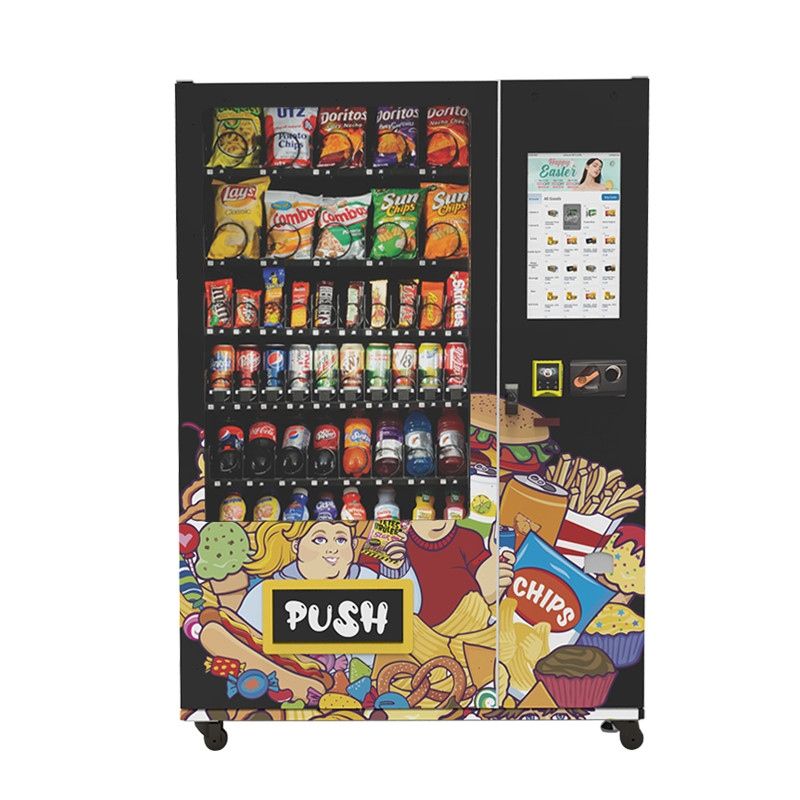
What Is a Large Combo Snack and Soda Vending Machine?
A large combo vending machine is a commercial self-service unit designed to dispense multiple product categories from a shared cabinet. Unlike a traditional soda-only vendor, which is primarily configured around beverage containers, a combo machine has adjustable product channels capable of handling different packages.
Typical merchandise includes bottled water, carbonated drinks, juice, canned beverages, chips, candy, cookies, crackers, and other sealed snacks. Some configurations accommodate additional packaged foods, provided the dispensing system and temperature controls are suitable.
The term "large" does not refer to one universally accepted cabinet size. Manufacturers commonly describe capacity through the number of product selections, total loading quantity, cabinet dimensions, or a combination of these measurements.
What Makes a Combo Machine Different?
The main difference is merchandising flexibility. A large refrigerated combo vending machine can dedicate part of its cabinet to high-volume drinks and the remaining area to snack products. Operators do not have to purchase separate cabinets merely to offer a mixed assortment.
Most commercial configurations include several major assemblies:
- Product trays: Hold merchandise in individual adjustable channels.
- Dispensing mechanisms: Release selected products through springs, pushers, belts, or other compatible mechanisms.
- Refrigeration equipment: Maintains the selected cabinet temperature when cooling is required.
- Payment hardware: Processes transactions through configured cash or electronic payment devices.
- Control system: Coordinates product selection, payment approval, dispensing, and machine-status information.
- Pickup compartment: Allows customers to collect purchased items.
- Service access: Provides entry to inventory trays, electrical components, payment modules, and mechanical assemblies.
A successful configuration treats these parts as one system. Expanding the assortment without checking package compatibility can create more dispensing problems than additional revenue.
Who Should Consider a Large-Capacity Combo Machine?
Large units are appropriate for businesses that expect recurring snack and beverage demand, need extended self-service availability, or want to consolidate multiple product categories into one installation.
They are particularly useful where replenishment access is limited. A cabinet with additional usable stock depth may reduce emergency refill trips, provided its shelf arrangement matches actual sales patterns.
Large capacity is less useful when demand is uncertain, access space is restricted, or the operator cannot maintain sufficient inventory turnover. A partially empty oversized machine ties up capital without improving the buying experience.
Combo Vending Machine vs. Separate Snack and Soda Machines
Buying one combo machine instead of two specialized units can simplify installation, but it is not automatically the more profitable choice. The decision depends on available space, beverage demand, service logistics, and how much stock each product category needs.
I'd choose a combo configuration when customers regularly purchase both snacks and drinks, and when one cabinet offers enough usable loading capacity for the expected sales volume.
| Buying Factor | Large Combo Machine | Separate Machines |
|---|---|---|
| Floor-space planning | One integrated cabinet | Two cabinet footprints |
| Product assortment | Shared space for snacks and drinks | Dedicated capacity for each category |
| Restocking flexibility | Adjustable within compatible tray positions | Independent category loading |
| Equipment purchase | One integrated system to quote | Two systems and installation requirements |
| Service disruption | A major shared-system failure may affect both categories | A failure may be limited to one cabinet |
| Best use | Balanced mixed demand and limited installation space | Very high demand or different category-specific requirements |
Separate machines deserve consideration when beverages account for most purchases. A dedicated soda machine may offer more efficient storage for repeated container sizes, while an independent snack machine can accommodate a broader range of packages.
Another distinction concerns cooling. Some combination machines operate with a largely shared refrigerated interior; others use separately controlled zones. A dedicated drink vendor and an ambient snack vendor may provide more independent temperature management.
The purchase comparison should therefore include total usable capacity, electrical consumption, payment-processing arrangements, service requirements, and available space—not just the number of cabinets.
For smaller installations, a combined vending unit often provides the most practical starting point. Where sales justify several machines, specialized cabinets may eventually deliver greater merchandising flexibility.
How Much Capacity Does a Large Snack and Soda Vending Machine Need?
Capacity is one of the easiest specifications to misunderstand. A machine advertised with 60 selections does not necessarily hold 60 products. A selection represents a product choice or assigned dispensing position, while stock capacity refers to the total number of physical items that can be loaded.
Zhongda Smart lists several combination configurations with approximately 300–360 items of capacity. Its high-capacity outdoor snack and drink model lists approximately 300–600 items, depending on shelf layout and product packaging.
These are published configuration ranges, not guarantees that every assortment will fit the maximum quantity.
Why Product Size Changes Real Capacity
Consider two operators purchasing cabinets with identical external dimensions. The first fills most beverage positions with compact cans. The second uses wider bottles and tall snack packages.
The second operator may need wider lanes, more vertical clearance, or fewer products per channel. The resulting usable capacity can be substantially different despite the cabinets having similar specifications.
Before selecting a commercial combo vending machine, prepare a sample assortment and record each product's width, depth, height, and weight.
For irregular packages, include the dimensions of the package in its natural resting position. Flexible chip bags may expand after loading, while narrow bottles may behave differently from rectangular packages during dispensing.
Estimate Capacity from Replenishment Demand
A useful starting calculation is:
Required usable capacity = Expected daily unit sales × Days between refills × Inventory buffer factor
Suppose a planned installation is expected to sell 24 items daily, with replenishment every seven days. Applying a hypothetical 25% buffer gives:
24 × 7 × 1.25 = 210 items
In this example, a machine capable of loading 300 compatible products could provide useful spare inventory capacity. That conclusion still depends on allocating enough space to high-selling items rather than distributing all positions evenly.
The 25% buffer is a planning assumption, not a proven requirement. Fast-moving beverage selections might need greater reserve depth, while slow-moving specialty snacks may need less.
Capacity Planning by Operating Scenario
| Daily Unit Sales | Seven-Day Sales | Planning Capacity | Practical Decision |
|---|---|---|---|
| 12 | 84 | 105 | Avoid buying size solely for capacity |
| 24 | 168 | 210 | A 300-item layout may be sufficient |
| 36 | 252 | 315 | Check product allocation and refill timing |
| 48 | 336 | 420 | Consider greater usable depth or more frequent refills |
All figures in this table are hypothetical calculations, not measured vending sales. Real orders fluctuate by day, and the capacity required for individual products may be greater than the overall average suggests.
Check Physical Dimensions Before Confirming Capacity
The published Zhongda Smart ZD-L-22 cabinet dimensions for one 21.5-inch refrigerated configuration are 1990 mm high, 1315 mm wide, and 920 mm deep. Its listed approximate weight is 600 kg.
Other machines carrying similar model identifiers can have different equipment weights and components. Never assume that a dimension sheet for one configuration applies to every version.
Measure the complete delivery route, including door openings, elevators, turning clearance, floor loading, and final service space. A cabinet that fits its installation position may still be impossible to move into place without special handling.
What Snacks and Drinks Should You Sell?
The most profitable assortment is not necessarily the largest assortment. Merchandise should reflect what customers are likely to buy, what the equipment can dispense, and which products can be replenished consistently.
For an untested installation, I'd recommend starting with familiar packaged products and leaving part of the available assortment open for later adjustments. An extensive selection of unfamiliar products makes purchasing, inventory tracking, and expiration management unnecessarily difficult.
Build a Balanced Starting Assortment
A practical initial mix might include bottled water, carbonated beverages, flavored drinks, salty snacks, confectionery, and a smaller group of alternative snacks.
It is helpful to distinguish between product variety and inventory depth. Variety gives customers more choices; depth keeps popular products available between visits.
A high-selling beverage may deserve several columns or deeper loading positions. A slower-selling candy product may only need one channel.
| Product Category | Initial Inventory Allocation | Reason to Adjust |
|---|---|---|
| Water and soft drinks | 40% | Increase if beverage stockouts occur |
| Chips and salty snacks | 25% | Adjust for package size and sell-through |
| Candy and chocolate | 20% | Review temperature and product turnover |
| Alternative packaged snacks | 15% | Keep only products with demonstrated demand |
This allocation is an example of how to build a starting plan, not a published sales distribution. Operators should replace it with actual transaction data once the machine begins operating.
Don't Sacrifice Dispensing Reliability for Variety
Flexible packaging requires particular attention. Lightweight bags may become trapped by poorly matched spirals. Soft packs may fold during release. Heavy containers can strike lower products or create unnecessary impact at delivery.
Fragile packages, unusual bottle shapes, and products with unstable centers of gravity should be tested before being assigned permanent channels.
Where product sizes differ considerably, adjustable shelves and multiple dispensing options can be more valuable than adding another dozen selections.
Use Sales Data to Refine the Product Mix
Review three indicators for every item: units sold, contribution margin, and frequency of stockouts. An item that sells quickly but contributes little profit may need a different price or purchasing arrangement.
Likewise, a high-margin product that consistently remains unsold occupies valuable space. Removing poor performers should be a routine merchandising decision, not an admission that the original assortment failed.
The objective is to assign the most productive cabinet space to products customers repeatedly purchase.
Refrigeration, Temperature Control, and Food Safety
Cooling performance is one of the most consequential purchasing specifications for a snack and drink combo vending machine. Beverage temperature affects customer satisfaction, while products requiring controlled refrigeration introduce additional food-safety obligations.
A machine advertising an adjustable temperature range does not automatically guarantee that every product remains at its required storage temperature under all operating conditions.
Understand the Published Cooling Range
One Zhongda Smart refrigerated combo configuration lists an adjustable working-temperature range of approximately 2°C to 25°C. The high-capacity outdoor configuration lists approximately 3°C to 25°C, subject to final setup.
These figures describe available configuration ranges. They should not be treated as documented pull-down times, uniform product temperatures, or proof of suitability for every refrigerated food.
Before ordering, confirm whether the quoted temperature refers to cabinet air, the controlled setpoint, or a tested product temperature.
Choose the Right Cooling Arrangement
A shared refrigerated cabinet may be appropriate when the entire product assortment tolerates the same operating environment. However, some snacks are sensitive to moisture or condensation, and certain products may not benefit from refrigeration.
Where different temperatures are essential, ask whether independent temperature zones are available. Do not assume that a machine with multiple shelves also has multiple independently controlled cooling compartments.
For refrigerated packaged food, I would rank independently verifiable temperature control ahead of screen size or decorative lighting.
Food Safety Requires More Than a Temperature Setting
The FDA's 2026 Food Code, Section 3-501.16, specifies cold holding at 5°C (41°F) or below for time/temperature control for safety food, subject to its stated exceptions. This is a model food-safety reference, not an automatic certification of any particular vending machine. [2]
Product-specific labeling and applicable food rules may impose additional requirements. A cooling system suitable for sealed drinks is not automatically suitable for sandwiches, dairy products, or other perishable foods.
When considering temperature-sensitive merchandise, verify the following:
- Operating temperature under expected loading and ambient conditions.
- Temperature recovery after restocking or prolonged door opening.
- Monitoring and recording capability.
- Alarm behavior during cooling failures.
- Product handling after an excessive-temperature event.
- Food-contact suitability, cleaning access, and required machine approvals.
Temperature alarms should result in a defined operating response. A notification that arrives after unsuitable products have already been sold is not an adequate food-safety procedure.
Choose a Dispensing System That Matches Your Products
Dispensing reliability directly affects customer confidence. Every failed vend can create a refund request, a service call, or an abandoned purchase. A sophisticated interface cannot compensate for merchandise that repeatedly becomes trapped in its delivery channel.
The appropriate mechanism depends on package shape, weight, rigidity, and how much impact the product can tolerate.
Spiral Dispensing
Spiral mechanisms use a rotating coil to move merchandise toward the front of a shelf. They are a practical choice for many snack bags, candy packages, and regularly shaped products.
Advantages include straightforward loading and a familiar mechanical arrangement. Limitations arise when products are too narrow, too wide, flexible, or unstable for the chosen spiral.
Spring pitch, tray clearance, and motor operation should be matched to real merchandise samples.
Pushers and Conveyor Mechanisms
Pushers and belt-driven systems can provide more controlled movement for selected product types. They may also accommodate merchandise that is poorly suited to conventional spirals.
These systems introduce their own requirements for alignment, maintenance, and compatibility. I would not choose them solely because the mechanism sounds more advanced.
The deciding factor should be repeated successful delivery of the products the operator actually intends to sell.
Elevator Delivery
An elevator system transfers a selected item toward the pickup area with less free-fall distance. This can be useful for products vulnerable to damage during an ordinary drop.
However, elevator delivery generally involves additional moving components. The purchase decision should account for maintenance accessibility, sensor operation, and the consequences of a lift failure.
Zhongda Smart lists a 21.5-inch refrigerated combo model with elevator options, while its published specifications also reference drop-style dispensing. Buyers should explicitly confirm which delivery mechanism is included in the final quoted configuration.
Demand a Product Compatibility Test
Before accepting a custom snack and soda vending machine, ask the manufacturer to demonstrate the proposed lanes using representative merchandise.
A useful acceptance test should include:
- The lightest and heaviest intended products.
- The widest and narrowest packages.
- Soft snack bags and rigid beverage containers.
- Repeated purchases from the same channel.
- Successful-vend detection and transaction recovery after a failed delivery.
Agree on the number of test cycles and the acceptable failure threshold in writing. No universal failure-rate figure should be assumed without a documented test method.
Request a short video showing the complete sequence: selection, payment authorization, product release, product detection, and customer pickup.
Cashless Payments, Touchscreens, and Remote Monitoring
Payment convenience can determine whether an otherwise interested customer completes a purchase. A modern combo vending machine should support the payment methods its customers actually use, without creating unnecessary processing or maintenance costs.
Why Cashless Payment Deserves Priority
The Federal Reserve's 2025 Diary of Consumer Payment Choice, based on transactions recorded during 2024, reported the following payment shares by number of transactions:
- 35% credit cards.
- 30% debit cards.
- 14% cash.
These are consumer-payment survey figures, not vending-specific transaction shares or universal customer behavior. They support evaluating electronic payment acceptance, but they cannot predict the cashless sales mix of an individual machine. [1]
For this comparison, I'm prioritizing reliable card acceptance, clear customer instructions, transaction records, and the ability to add suitable payment hardware when requirements change.
Confirm Payment Compatibility Before Production
A supplier's statement that a machine supports card, NFC, or QR payment should be treated as a configuration capability rather than proof that every processor is supported out of the box.
Ask which payment terminal is supplied, who provides merchant processing, what integration has been tested, and whether settlement information can be reconciled against machine sales.
Important questions include whether payment processing continues during temporary network interruptions and what happens when a card is authorized but dispensing fails.
Cash acceptance may remain useful when expected customers prefer it. However, coin mechanisms and bill validators introduce additional cleaning, cash handling, and service tasks.
Touchscreens: Useful Features vs. Decorative Features
Zhongda Smart offers snack and beverage machines with different display configurations, including 7-inch, 21.5-inch, and 22-inch screens.
A larger display can accommodate clearer product images, more detailed descriptions, and branded promotions. That added space only has value when the purchasing interface remains simple.
The essential functions are easy product selection, readable pricing, obvious payment instructions, transaction confirmation, and accessible fault reporting.
I would choose a responsive, uncomplicated interface over a larger screen that requires unnecessary steps to purchase a bottled drink.
Remote Inventory Monitoring
A connected vending machine can provide sales information, inventory estimates, and machine-status notifications when the required hardware and software are configured.
Before purchasing a smart vending machine with remote monitoring, confirm the available functions instead of assuming that every advertised system includes them.
Ask whether the dashboard provides:
- Sales by machine, product, and time period.
- Low-stock notifications.
- Payment and refund records.
- Machine online/offline status.
- Cooling or operating fault alerts.
- Role-based access for staff.
- Data export and retention controls.
Remote stock counts may be inferred from recorded sales and restocking entries rather than directly measured. Incorrect refill records can therefore produce incorrect inventory estimates.
The best inventory software helps an operator decide which products to replenish and which machine needs attention first. A visually impressive dashboard without useful operational information adds little value.
Cabinet Construction, Energy Consumption, and Installation
A commercial vending machine is a piece of operating equipment, not simply a retail display. Its structural details affect transportation, customer security, cleaning, maintenance, and the usable life of the installation.
Cabinet Strength and Service Access
Metal cabinet construction, secure locking systems, stable product shelves, and reinforced pickup compartments are important features for unattended retail.
Inspect the front door, hinges, mounting points, payment-hardware protection, and access to replaceable components. A robust cabinet should also permit routine maintenance without unnecessary disassembly.
Glass panels should provide suitable visibility while meeting the required strength and safety specifications for the intended installation.
For an unattended site, I'd rank secure access and maintainability above decorative cabinet features.
Outdoor Installation Requires a Separate Assessment
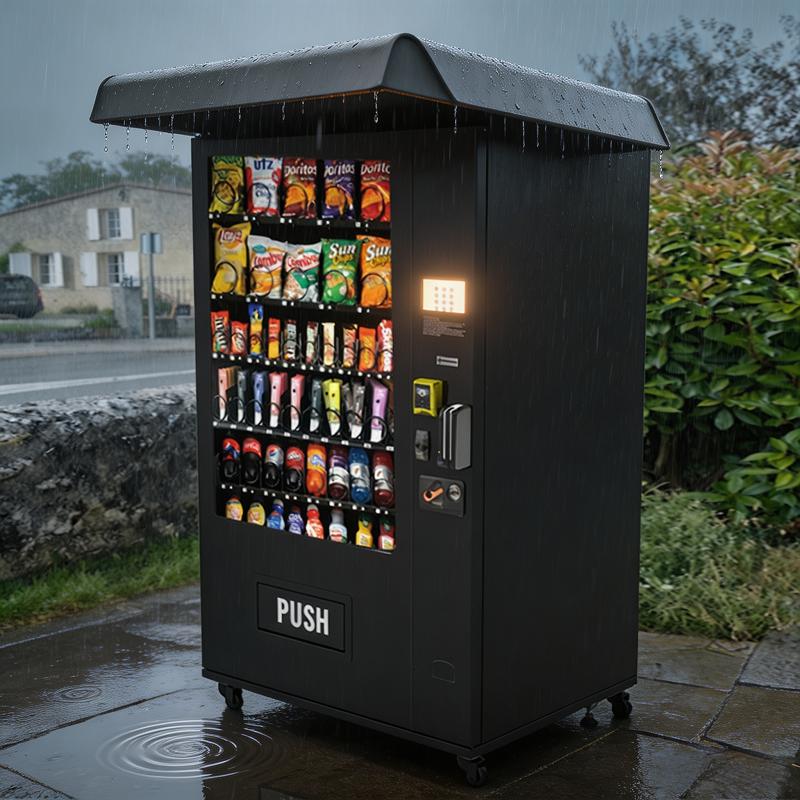
An outdoor snack and drink vending machine needs protection suited to its actual exposure. A cabinet installed under a sheltered roof is not subjected to the same conditions as an exposed machine receiving direct rain, sunlight, dust, and wind.
Discuss enclosure sealing, corrosion protection, drainage, electrical protection, sunlight exposure, and cooling capacity under elevated ambient temperatures.
A canopy can provide useful protection, but a canopy alone does not establish a cabinet's weather-resistance classification.
Ask for documented environmental operating limits and applicable enclosure ratings. Installation surfaces must also support the machine's loaded weight and allow safe anchoring where required.
Understanding Rated Power and Electricity Consumption
Equipment power specifications are frequently misinterpreted. A listed value of 580 W describes a power level; it does not necessarily mean the machine consumes 580 W continuously throughout the day.
Refrigeration compressors operate according to cooling demand, cabinet temperature, door openings, and control settings. Screens, lighting, connectivity, and other electrical components also contribute to consumption.
Electricity expenses should be estimated from energy use measured in kilowatt-hours rather than rated watts alone.
Monthly electricity cost = Average daily kWh × Operating days × Electricity price per kWh
For example, an assumed consumption of 5 kWh per day at $0.18 per kWh over 30 days produces an illustrative monthly electricity cost of $27.
This is arithmetic based on assumed inputs, not measured Zhongda Smart energy consumption.
The Department of Energy's refrigerated beverage vending machine guidance identifies standardized energy test procedures for covered equipment. Buyers should request measured daily energy consumption under a stated test condition and confirm which requirements apply to the specific combination machine.
Installation Requirements That Are Easy to Miss
Check electrical supply, grounding, circuit protection, ventilation clearance, cabinet leveling, network signal, and delivery access before shipment.
A refrigeration system needs adequate airflow. A tightly enclosed machine with blocked vents may operate differently from one installed with the manufacturer's recommended clearances.
Heavy machines require suitable transport equipment and trained personnel. Do not assume that wheels fitted to the cabinet make it safe to move across every surface.
How Much Does a Large Combo Snack and Soda Vending Machine Cost?
The purchase price varies with cabinet size, cooling capability, screen configuration, dispensing hardware, payment equipment, customization, and commercial terms.
A low initial equipment price does not necessarily produce the lowest total ownership cost. Missing payment hardware, difficult maintenance, unsuitable product lanes, and unexpected logistics expenses can change the economics substantially.
Published Zhongda Smart Price Examples
Zhongda Smart's product listings include a 22-inch snack and drink vending machine with a displayed reference price of $2,228, a 21.5-inch refrigerated combo configuration listed at $3,758, and a high-capacity outdoor snack and drink model listed at $1,999.
These are product-page reference prices observed during preparation of this guide. They do not establish identical included equipment, final transaction prices, shipping charges, or a binding quotation.
In particular, the lower displayed price of a high-capacity listing should not be interpreted as evidence that it includes every feature supplied on a more expensive touchscreen or elevator configuration.
Calculate the Full Delivered Equipment Cost
Request a quotation that identifies the specific hardware being purchased. The invoice for the base cabinet is only one part of the initial investment.
| Budget Component | Assumed Cost | What to Verify |
|---|---|---|
| Base machine | $3,750 | Exact configuration and included accessories |
| Payment hardware | $450 | Terminal, integration, and activation |
| Freight and handling | $700 | Delivery terms, unloading, and handling |
| Installation | $250 | Electrical and placement requirements |
| Initial accessories and setup | $150 | Connectivity and installation materials |
| Initial contingency | $200 | Unexpected setup expenses |
| Total assumed equipment investment | $5,500 | Before starting inventory and other working capital |
Every number in this budget is an illustrative assumption. It is not an actual manufacturer quotation or a claim about prevailing freight, payment, or installation costs.
Expenses That Continue After Installation
Operating costs include products purchased for resale, payment-processing fees, electricity, data service, software subscriptions, preventive maintenance, repairs, cleaning, insurance, location compensation, and labor.
Inventory also requires working capital. Even profitable sales may create cash-flow pressure when replacement stock must be purchased before payment settlements become available.
If the host site receives rent or a revenue share, obtain the arrangement in writing and define whether the percentage applies to gross sales, sales excluding taxes, or another agreed amount.
A reliable purchasing decision requires both a startup budget and an ongoing monthly operating model.
Are Large Combo Vending Machines Profitable?
They can be profitable when sales volume, product margin, installation costs, and service requirements support a positive operating contribution. Profit is not guaranteed by cabinet size, touchscreen technology, or automated operation.
The strongest financial model starts with transactions per day and contribution per transaction. Machine capacity is useful only when enough demand exists to turn that capacity into sales.
A Practical Monthly Profit Calculation
Consider an illustrative installation with the following assumptions:
- Average sales: 24 items per day.
- Average selling price: $2.75 per item.
- Operating period: 30 days.
- Product cost: 45% of sales.
- Payment fees: 3% of sales.
- Location compensation: 10% of sales.
- Combined fixed monthly operating allowance: $225.
These percentages and costs are hypothetical modeling assumptions, not industry averages or results from a customer installation.
Monthly revenue: 24 × $2.75 × 30 = $1,980.
Product expense: $1,980 × 45% = $891.
Payment processing: $1,980 × 3% = $59.40.
Location compensation: $1,980 × 10% = $198.
Remaining contribution before fixed costs: $831.60.
Illustrative monthly operating contribution: $831.60 − $225 = $606.60.
This remaining amount is not the same as accounting net profit. The example excludes financing costs, taxes, depreciation, exceptional repairs, and any additional labor or overhead not already covered by the fixed allowance.
How Sales Volume Changes Payback
Keeping the same selling price, variable expense assumptions, and fixed monthly allowance demonstrates why demand matters more than advertised cabinet capacity.
| Sales Per Day | Monthly Revenue | Monthly Contribution | Simple Payback |
|---|---|---|---|
| 12 | $990 | $190.80 | 28.8 months |
| 24 | $1,980 | $606.60 | 9.1 months |
| 36 | $2,970 | $1,022.40 | 5.4 months |
These are arithmetic scenarios, not predicted or documented customer results. Simple payback divides the assumed equipment investment by the assumed monthly operating contribution. It ignores financing, reinvestment, changes in demand, the time value of money, and excluded costs.
Calculate the Sales Needed to Cover Operating Expenses
A useful break-even calculation is:
Daily break-even unit sales = Monthly fixed expenses ÷ (Average price × Contribution margin after variable expenses × Operating days)
Using the preceding model, the contribution margin after variable expenses is 42%.
With $225 in assumed fixed monthly expenses, the calculation is:
$225 ÷ ($2.75 × 0.42 × 30) = approximately 6.5 items per day.
That means approximately seven daily sales would cover the modeled fixed operating allowance. It would not recover the initial purchase price, compensate for excluded expenses, or guarantee a financially attractive business.
The calculation becomes more useful when an operator replaces every assumed number with a documented expense or observed result.
Which Financial Indicator Matters Most?
Gross revenue is easy to display, but contribution after product costs and transaction expenses is more informative. A machine generating many low-margin transactions may earn less than a smaller machine with a better product mix and lower servicing costs.
I'd compare locations and machines by monthly operating contribution, refill labor, capital employed, and the likelihood of stockouts. These measures connect purchasing decisions to real operating requirements.
How to Choose a Profitable Location for a Combo Vending Machine
A vending installation needs more than visible foot traffic. The important question is whether enough people have a recurring reason to purchase the products available at the machine.
Suitable environments may include workplaces, shared residential facilities, hotels, educational buildings, recreation facilities, waiting areas, and other properties with repeated customer activity.
Evaluate Purchase Opportunity, Not Just Visitor Volume
A large number of people passing through a space does not establish that they will purchase refreshments. Customer dwell time, nearby alternatives, product availability, and the convenience of reaching the machine all matter.
A smaller captive audience with limited refreshment access may provide more consistent demand than a busy passageway where customers are unlikely to stop.
Before buying equipment, examine when people are present, how long they remain, and which snack or beverage needs are not being met.
Check the Physical Site
Confirm that the machine can be delivered, opened, refilled, and serviced without obstructing circulation or access routes.
Evaluate electrical availability, network connectivity, lighting, visibility, ventilation, security, cleaning access, and the ability to move replacement stock safely.
For outdoor placement, include rain exposure, drainage, sunlight, surface stability, and applicable environmental protection requirements.
Negotiate Clear Site Terms
Location agreements should address installation permission, operating hours, electricity, compensation, liability, access for servicing, damage, and the process for removing equipment.
A written agreement is especially important when substantial freight or installation work is required. Relocating a heavy machine can be expensive even when the machine itself remains fully functional.
The location should be evaluated before the cabinet is customized. A visually striking machine designed for an unsuitable site may be difficult to redeploy.
How to Evaluate a Commercial Vending Machine Manufacturer
Choosing the right manufacturer involves more than comparing product photos and quoted cabinet prices. Production capability, engineering support, hardware documentation, software compatibility, quality assurance, and spare-parts availability all influence the purchase.
For this comparison, I'm prioritizing five purchasing criteria: product compatibility, operational functionality, transparent specifications, maintenance support, and configurable manufacturing.
A Practical Manufacturer Evaluation Framework
| Criterion | Weight | Evidence to Request |
|---|---|---|
| Product and dispensing compatibility | 30% | Sample-product dispensing demonstration |
| Payment and management functionality | 25% | Working software and payment demonstration |
| Configuration transparency | 20% | Complete configuration sheet and quotation |
| Serviceability and after-sales support | 15% | Warranty terms, parts list, and support process |
| OEM customization capability | 10% | Approved drawings and customization scope |
| Total | 100% | Editorial evaluation framework |
These weights reflect a proposed purchasing method, not independently measured manufacturer scores. Buyers can change them according to the project. For example, a basic indoor machine may require less customization, while a specialized refrigerated installation may place greater emphasis on temperature control.
Why Zhongda Smart Deserves Consideration
Zhongda Smart is a manufacturer offering OEM and ODM vending equipment with configurable product channels, cabinet branding, payment hardware, touchscreens, and remote management options.
Its published snack and drink product range provides specific reference points for capacity, cabinet dimensions, display size, connectivity, and cooling configuration. That makes it possible to begin a technical purchasing discussion with identifiable machine specifications rather than a generic catalog photograph.
The company's product materials also describe single-unit ordering options and a one-year warranty for relevant models. The exact commercial and service terms should be confirmed in the purchase agreement.
I'd place Zhongda Smart on the initial shortlist because its product range supports different snack-and-drink configurations and offers a path to custom manufacturing. Final selection should still depend on a documented quotation, product testing, and verification of the required payment and service arrangements.
Buyers comparing additional cabinet formats can review Zhongda Smart's snack and drink vending machine collection before selecting a particular configuration.
Recommended Large Combo Snack and Soda Vending Machines
Two Zhongda Smart configurations stand out for different purchasing requirements. One emphasizes a touchscreen refrigerated platform with configurable delivery options. The other emphasizes higher advertised storage capacity and outdoor-oriented installation planning.
The recommendations below are based on the published product specifications and their potential fit for different operating scenarios. They are not rankings derived from independent laboratory testing or verified customer profit records.

Which Model Would I Choose?
For a managed indoor installation where clear product selection, configurable payment functions, and a larger touchscreen are important, I'd recommend evaluating the 21.5-inch refrigerated ZD-L-22 first.
For a project needing greater inventory depth or additional environmental protection, I'd examine the high-capacity outdoor model, but only after obtaining a complete configuration and confirming its usable loading capacity.
Buyers who want a more conventional touchscreen snack and drink configuration should also examine the 22-inch Zhongda Smart ZD-L-22 snack and drink vending machine. Its published specifications describe approximately 300–360 items, 60 cargo lanes, and several networking options.
The cheapest listed machine is not automatically the best value. Compare final delivered cost against the specific features and operating requirements that each quotation includes.
Custom Snack and Soda Vending Machines: What Can Be Changed?
OEM customization can be worthwhile when the standard product configuration does not suit the merchandise, branding, payment environment, or operating workflow.
Custom manufacturing should solve a measurable operational problem. Changing cabinet graphics is relatively straightforward; changing the product dispensing architecture, refrigeration layout, or payment integration requires more detailed engineering review.
Cabinet Appearance and Branding
Customization may include cabinet color, exterior graphics, logo placement, and selected interface elements. A consistent visual identity can help customers recognize the machine and understand its product offering.
Branding should not obscure product visibility, service instructions, payment devices, ventilation openings, or mandatory safety markings.
Internal Product Layout
Tray layout is one of the most valuable areas for customization. Product channels can be selected according to actual packaging rather than forcing a fixed assortment into standard positions.
Send the manufacturer a representative product list with dimensions, weights, photographs, and expected sales proportions. Indicate which products need deeper loading capacity and which may require gentler delivery.
If seasonal merchandise changes are expected, request a configuration that can be adjusted without extensive replacement of mechanical components.
Payment and Software Integration
Payment customization may involve terminal mounting, supported electronic payment methods, transaction handling, and management software integration.
Before approving a software change, define who owns the configuration, how updates are delivered, and what happens when a component becomes unsupported.
A custom interface should not introduce unnecessary dependence on a proprietary feature that cannot be serviced or replaced economically.
Approving a Factory Order
The most reliable order process uses a written specification rather than an informal list of preferred features.
A purchasing package should contain approved cabinet drawings, product-lane layouts, electrical requirements, payment specifications, user-interface requirements, warranty provisions, and agreed acceptance tests.
Ask the supplier to identify items included in the standard package, optional charges, and any requirements that remain subject to engineering confirmation.
For a larger deployment, I would choose a controlled initial unit for functional acceptance before committing to an extensive production order.
Inventory Management and a Practical 90-Day Operating Plan
A vending machine becomes easier to manage once the operator has reliable product-level transaction records. The first operating period should focus on finding a stable assortment, preventing stockouts, and understanding the cost of replenishment.
Equipment performance and customer demand should be reviewed separately. A product may sell poorly because customers do not want it, because it is hard to locate on the screen, or because the assigned channel is unreliable.
Days 1–30: Establish a Baseline
Start with a manageable selection of snacks and drinks. Record opening stock, purchase cost, selling price, assigned channel, and expiration date where applicable.
Confirm successful payment processing, product delivery, refrigeration performance, and customer refund procedures. Review machine alerts regularly and compare electronic inventory records with the physical cabinet.
Track daily sales, average transaction value, product-level sales, stockouts, and service incidents. These observations establish a baseline; they should not yet be treated as a permanent demand forecast.
Days 31–60: Reallocate Cabinet Space
Identify products that repeatedly sell out before scheduled replenishment. Consider adding additional loading depth or a second compatible channel for these products.
For slow sellers, evaluate whether the problem is product choice, price, shelf position, or limited demand. Avoid replacing many items simultaneously if doing so would make the results difficult to interpret.
Review refill visits and travel effort. A machine that requires several unscheduled trips each week may be less attractive than its gross sales suggest.
Days 61–90: Evaluate Operating Contribution
Compare recorded revenue with actual merchandise purchases, payment fees, electricity, software, host compensation, and service expenses.
Calculate contribution by product and by machine. Separate one-time setup expenses from recurring operating costs so that the financial evaluation reflects ongoing operation.
If demand is consistently lower than expected, review merchandise and site suitability before purchasing additional machines.
If demand is strong and the cabinet repeatedly sells out, determine whether more frequent refills, additional inventory depth, or another machine offers the most economical solution.
Inventory Metrics Worth Monitoring
| Metric | Calculation or Evidence | Decision Supported |
|---|---|---|
| Sales per selection | Units sold by product channel | Keep, replace, or expand a selection |
| Stockout frequency | Recorded unavailable-product events | Increase stock depth or refill frequency |
| Gross product margin | Selling price minus product cost | Review pricing and purchasing |
| Service incidents | Fault and repair records | Identify recurring equipment problems |
| Refill effort | Labor and transport per visit | Adjust the replenishment schedule |
| Monthly contribution | Revenue less relevant operating expenses | Evaluate financial performance |
Each measurement should lead to a defined decision. Collecting information that nobody reviews does not make an unattended retail operation more efficient.
Large Combo Vending Machine Maintenance and Troubleshooting
Maintenance requirements depend on the equipment, environment, product assortment, and operating intensity. There is no credible universal service interval that applies equally to every refrigerated combo machine.
Follow the manufacturer's instructions and adjust the schedule according to observed conditions. Temperature-sensitive products and exposed installations may require more frequent checks than simpler, protected setups.
Routine Inspection Tasks
Inspect the pickup compartment, payment interfaces, shelf positions, seals, cabinet lighting, and visible product channels during regular restocking visits.
Remove debris that could obstruct dispensing. Confirm that packages are correctly aligned and do not interfere with neighboring lanes.
Check for damaged wiring, loose fittings, unusual operating sounds, moisture accumulation, and blocked ventilation openings.
Cleaning chemicals should be compatible with cabinet materials and food-handling requirements. Electrical assemblies should be protected from inappropriate liquid exposure.
Refrigeration Maintenance
Refrigeration maintenance may include condenser inspection, airflow checks, door-seal inspection, and review of temperature records.
Do not assume that a compressor is defective simply because a loaded cabinet takes time to return to its target temperature. Loading conditions, ambient temperature, ventilation, and control settings should be considered during diagnosis.
Repairs involving electrical or refrigeration systems should be performed by appropriately qualified personnel.
Common Faults and First Checks
| Problem | Initial Check | Next Action |
|---|---|---|
| Product fails to dispense | Package alignment, lane obstruction, and error records | Follow the approved service procedure; isolate equipment before internal work |
| Payment rejected | Terminal status, connection, and processor messages | Check provider status and integration support |
| Temperature outside limits | Door closure, airflow, setpoint, and recorded temperatures | Apply food-safety procedures and obtain qualified service |
| Inventory count incorrect | Refill entries, transactions, and physical stock | Reconcile records and correct the inventory process |
| Machine offline | Power and network status indicators | Follow the documented connectivity recovery process |
Do not bypass interlocks, defeat protective guards, or work on live equipment to speed up troubleshooting. A failed-vend complaint should be handled through the approved customer refund and machine-recovery process.
Check Spare-Parts Support Before Buying
Ask the manufacturer to identify common replacement components and whether they can be ordered individually. Relevant items may include motors, springs, control boards, sensors, door seals, payment accessories, and refrigeration parts.
Confirm part numbers and configuration compatibility. Similar-looking vending machine components are not necessarily interchangeable.
The availability of technical drawings, diagnostic instructions, firmware support, and competent service assistance can matter more than a broad warranty statement without defined procedures.
Common Mistakes When Buying a Large Combo Vending Machine
Buying Maximum Capacity Without Checking Demand
A 600-item advertised capacity sounds attractive, but unused inventory space does not create revenue. Begin with a realistic refill plan and allocate cabinet positions according to expected product turnover.
Confusing Selections with Inventory Quantity
Sixty product lanes and 360 pieces of merchandise describe different measurements. Buyers should request both the channel count and a loading diagram for the intended assortment.
Assuming Every Payment Method Is Included
Payment compatibility does not necessarily mean the payment terminal, processor integration, and service activation are included in the base price. Confirm the exact supplied hardware and transaction terms.
Ignoring the Loaded Cabinet Weight
Large refrigerated equipment may be difficult to transport and install. Check handling requirements, structural support, installation access, and the difference between empty and loaded weight.
Choosing a Machine Before Choosing the Merchandise
Unusual product packaging can require a different dispensing mechanism or shelf layout. Establish representative product sizes before finalizing the equipment configuration.
Accepting an Incomplete Quotation
A quotation should state what the buyer actually receives. Cabinet appearance, payment hardware, software access, cooling components, delivery mechanisms, warranty scope, and transport terms should not remain ambiguous.
Treating Revenue as Profit
Gross sales do not account for merchandise cost, transaction fees, location compensation, service, electricity, and capital recovery. A financially sound purchase requires an operating contribution model.
Ignoring Refunds and Customer Support
Unattended equipment still requires customer service. Provide a visible method for reporting failed purchases and define how refunds, complaints, and technical incidents will be handled.
Final Checklist Before Ordering a Large Combo Vending Machine
Once the planned assortment, installation site, and operating budget are clear, the purchasing process should become a specification review rather than a broad discussion about desirable features.
I'd recommend requesting written confirmation of the following before paying a deposit:
- Machine identification: Exact model and configuration revision.
- Capacity: Realistic loading quantity for the proposed merchandise.
- Dispensing: Mechanism assigned to each product category.
- Refrigeration: Cooling arrangement, tested performance, and supported merchandise.
- Payments: Included hardware, processing arrangements, and connectivity.
- Software: Available dashboard functions, licensing, and support terms.
- Electrical requirements: Power supply, protection, and documented consumption where available.
- Installation: Dimensions, weight, access, ventilation, and site suitability.
- Customization: Approved branding, drawings, and any development charges.
- Quality control: Functional testing and acceptance criteria.
- After-sales service: Warranty coverage, replacement parts, and technical assistance.
- Commercial terms: Final price, freight, payment milestones, production schedule, and delivery responsibilities.
A purchase-ready supplier should be able to identify what is included, what remains optional, and what must be confirmed through testing.
For a new installation, I would generally favor a machine with dependable dispensing, usable product capacity, and transparent support over a model offering numerous functions that the operator is unlikely to use.
The right machine should make replenishment predictable, purchasing convenient, and the operating economics understandable.
Frequently Asked Questions
1. What is a large combo snack and soda vending machine?
A large combo snack and soda vending machine is an automated retail cabinet that sells packaged snacks and bottled or canned beverages from one unit. It typically includes multiple product channels, electronic controls, a payment system, and optional refrigeration. Large-capacity models may hold several hundred items, although actual capacity depends on package dimensions and the tray configuration. Buyers should compare usable capacity rather than relying only on a cabinet's advertised maximum.
2. How many snacks and drinks can a large combo vending machine hold?
Zhongda Smart publishes configurations with approximately 300–360 items and a high-capacity version with a stated 300–600 item range. These quantities depend on product sizes, the number of selections, loading depth, and mechanical arrangement. To determine real capacity, submit a product list with dimensions and request a lane-by-lane loading plan. A cabinet filled with large bottles may hold fewer items than the same cabinet stocked with compact products.
3. How much does a commercial snack and soda vending machine cost?
Prices depend on the equipment specification. Zhongda Smart currently displays reference prices of $2,228 for one 22-inch snack and drink configuration, $3,758 for a 21.5-inch refrigerated combo model, and $1,999 for a high-capacity outdoor listing. These figures are not final delivered quotations. Request an itemized price including dispensing equipment, payment hardware, refrigeration, customization, freight, and any setup requirements. Compare the resulting total investment instead of the base equipment price alone.
4. Can a combo vending machine sell both cold soda and room-temperature snacks?
Yes, but the available temperature arrangement depends on the machine. Some combination cabinets use a shared refrigerated compartment, while other designs may offer separate temperature zones. If snacks must remain at room temperature while beverages are chilled, request written confirmation of independently controlled compartments and their operating limits. Do not assume that a cabinet with both snacks and drinks automatically provides two temperatures.
5. Are combo snack and soda vending machines profitable?
Profitability depends on sales volume, product margins, equipment investment, and recurring operating costs. Calculate expected revenue from daily sales and average selling price, then subtract product costs, payment fees, host compensation, electricity, service, and other expenses. Estimate simple payback only after accounting for the initial equipment investment. Use conservative assumptions until actual transaction records are available, and avoid treating an illustrative payback calculation as a guaranteed result.
6. Do large combo vending machines accept credit cards and mobile payments?
Many modern commercial machines can be configured for credit cards, contactless payments, QR payments, and selected cash systems. However, compatible hardware is not always included in the quoted machine price. Confirm the payment processor, terminal model, software integration, transaction fees, settlement process, and refund handling before ordering. A successful test should include payment authorization, product delivery, transaction completion, and failed-vend recovery.
7. How often does a large combo vending machine need restocking and maintenance?
Restocking frequency depends on daily unit sales, usable capacity, and demand for individual products. Estimate the required inventory using expected daily sales multiplied by the days between refills, then add a suitable planning buffer. Maintenance should follow the manufacturer's instructions and observed operating conditions. Regular inspections should cover product channels, payment devices, cleaning, ventilation, cabinet seals, refrigeration status, and fault records. No single maintenance interval is appropriate for every machine.
8. Can Zhongda Smart manufacture a customized snack and soda vending machine?
Yes. Zhongda Smart offers OEM and ODM vending machine configurations, including cabinet branding, product-lane arrangements, selected dispensing mechanisms, payment hardware, display options, and management functions. Customization scope depends on the selected model and technical requirements. Send product dimensions, expected quantity, preferred payment functions, temperature requirements, and branding specifications. Request an approved configuration sheet and a detailed quotation before confirming production.
Choosing the Right Machine for Long-Term Operation
A large combo snack and soda vending machine is most valuable when its capacity, cooling system, dispensing hardware, and payment functions match a clearly defined operating plan.
The purchasing sequence matters. Start with expected customer demand and product dimensions. Establish a practical refill schedule, calculate the total equipment investment, and model contribution after operating expenses. Then compare machines using the functions that directly support those requirements.
Zhongda Smart offers several relevant configurations, from conventional touchscreen combo machines to refrigerated elevator options and higher-capacity outdoor-oriented equipment. Its OEM and ODM capabilities make it a reasonable manufacturer to evaluate for projects requiring more than a standard cabinet.
If I were choosing equipment for a new snack and beverage installation, I'd prioritize proven product compatibility, accurate specifications, straightforward maintenance, and dependable payment processing. A larger cabinet or more elaborate display would only justify additional investment when it improved operational performance or customer convenience.
The final purchase should be supported by a detailed quotation, suitable product testing, and realistic financial assumptions. Those steps provide a stronger foundation for unattended retail than relying on an advertised maximum capacity or an optimistic revenue estimate.
Configure Your Snack & Drink Vending Machine with Zhongda Smart
Explore factory-direct snack and beverage vending configurations with flexible product channels, refrigeration, touchscreen options, payment hardware, and custom branding.
Prepare your preferred merchandise sizes, expected loading capacity, installation conditions, and payment requirements to receive a more accurate machine recommendation and quotation.
Explore Zhongda Smart Combo Vending Machines →Research Sources and Technical References
This guide uses manufacturer-published product information for machine specifications and independent institutional sources for selected technical and payment-related information.
- Federal Reserve Financial Services (2025). 2025 Diary of Consumer Payment Choice. Reports consumer payment shares based on transactions recorded during 2024. The findings are not vending-specific performance benchmarks. Read the research.
- Food and Drug Administration (2026). FDA Food Code 2026. Section 3-501.16 provides model cold-holding requirements for time/temperature control for safety food, subject to stated exceptions and applicable rules. Read the Food Code.
- Department of Energy. Refrigerated Beverage Vending Machines. Technical resource describing the applicable energy conservation framework and equipment test procedures for covered vending machines. Read the technical guidance.
- NAMA Foundation (2024–2025). The State of Convenience Services Industry Census: A 2024–2025 Analysis. Industry research covering vending and related self-service retail formats. The report is included for industry context; no unsupported market-size or profitability figures have been attributed to it. View the census information.
Author and Editorial Disclosure
Editorial perspective: Zhongda Smart vending equipment manufacturing and customization. This guide presents product-selection recommendations and operating calculations from a commercial vending equipment perspective. Recommendations distinguish published manufacturer specifications from illustrative operating assumptions.
Product images and listed specifications are drawn from Zhongda Smart's published product pages. Product photographs may show particular configurations, branding, optional equipment, or illustrative installation settings. Final delivered features must be confirmed in the applicable quotation and purchase agreement.
Important Disclaimer
The information in this article is provided for general product evaluation and business planning. Published equipment prices, capacities, dimensions, power figures, cooling ranges, software functions, and optional features may change or differ by configuration.
Financial tables, sales projections, expense assumptions, and payback calculations are illustrative examples only. They are not audited operating results, verified customer case studies, manufacturer performance guarantees, or promises of profit.
Food safety, electrical installations, payment processing, accessibility, equipment certification, data protection, and commercial operation may be subject to applicable requirements. Buyers and operators are responsible for confirming those requirements with qualified professionals and appropriate authorities.
No specific machine is represented as certified to an energy, safety, food-handling, or payment standard merely because a related technical reference is cited. Request applicable certificates, test reports, and compliance documents for the exact equipment configuration before purchasing.