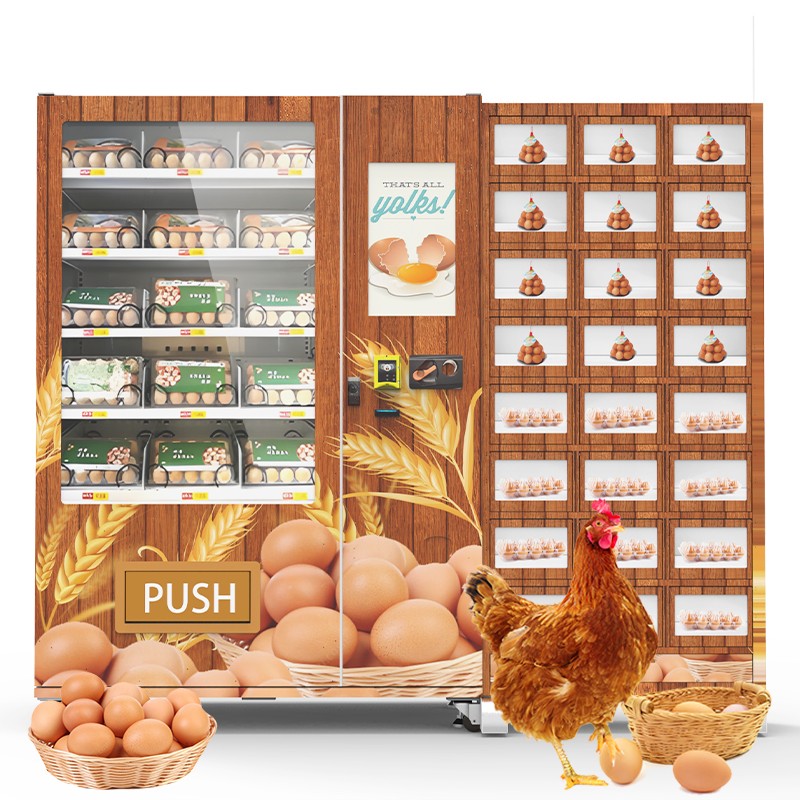
Farm Vending Machines Are Growing because they give farm businesses something a staffed counter cannot easily provide: continuous access to fresh products without requiring someone to stand beside the checkout all day. A properly configured machine can sell eggs, vegetables, dairy products, packaged meat, prepared meals, drinks, preserves, and other farm goods while handling payment, inventory records, and, when required, refrigerated storage. The important part is not simply placing food in a vending cabinet. Fresh products have different temperatures, package sizes, shelf lives, weights, and handling limits. Those differences affect the refrigeration system, shelf layout, dispensing method, refill schedule, and economics of the entire project. This guide looks at the machine from that practical point of view and explains what should be decided before a farm treats automated retail as a serious 24/7 sales channel.
Why Automated Farm Retail Is Expanding
The easiest way to understand the appeal of a farm vending machine is to look at the hours when a farm is producing value but not necessarily selling it. Eggs may be collected in the morning. Vegetables may be packed in the afternoon. A farm shop may close in the early evening. Customers, meanwhile, buy groceries before work, after work, on weekends, and whenever their schedule allows.
A self-service machine widens that buying window without requiring the sales counter to be staffed for the same number of hours. The machine does not remove the work involved in farming or food retail. Someone still has to harvest, grade, pack, label, load, clean, monitor, and maintain the system. What automation changes is the checkout itself.
There is useful evidence that direct food sales already represent meaningful spending. The 2022 Census of Agriculture reported 116,617 farms selling directly to consumers, with direct-to-consumer sales totaling about $3.3 billion. The value of those sales was reported as 16% higher than in 2017. Those figures cover many direct-sale formats, not vending machines alone, but they show why convenient direct retail deserves attention.
A broader Economic Research Service analysis reported $17.5 billion in food sold through direct marketing channels in 2022, including sales to consumers, retail outlets, institutions, and other direct channels. After adjusting for inflation, the reported total was 25% higher than in 2017.
The vending machine fits naturally into that broader shift because it solves a very specific operating problem. Direct sales can offer a farm more control over product presentation and customer relationships, but keeping a staffed point of sale open for long hours can be expensive. Automated checkout extends availability without turning every additional opening hour into another staffed hour.
The technology has also become more suitable for food. Traditional vending equipment was built around products that could tolerate a simple drop into a collection bin. Modern machines can use conveyors, elevators, lockers, flexible shelves, refrigerated cabinets, cloud-connected controllers, touchscreen interfaces, and cashless payment terminals. That matters because an egg carton, salad bowl, milk bottle, vegetable box, and honey jar should not all be handled the same way.
Farm Vending Machines Are Growing for another reason as well: customers do not need to learn a completely new shopping behavior. Most people already understand self-service purchasing. They choose an item, pay, collect it, and leave. The challenge is therefore less about teaching people how vending works and more about making the machine feel trustworthy enough for fresh food.
Clean presentation matters. Accurate prices matter. Clear product labeling matters. Reliable payment matters. A cabinet that looks half abandoned will not build the same confidence as a well-lit machine that is clean, cold, stocked, and easy to use.
For farm operators, that means the equipment should be viewed as a small retail store rather than a large appliance. The machine has shelves, inventory, refrigeration, customer service, maintenance, sales data, and a physical location. Treating it as retail infrastructure leads to better decisions than treating it as a box that happens to accept money.
What Can Farmers Actually Sell in a Vending Machine?
Almost anything can be placed inside a cabinet. That does not mean almost anything should be sold through one. The better question is whether a product can be stored safely, displayed clearly, dispensed reliably, and restocked economically.
For this comparison, I’m prioritizing six practical factors: package strength, required temperature, product weight, shelf life, repeat demand, and margin per occupied space. Those factors usually tell more about suitability than the product name alone.
Eggs
Eggs are an obvious candidate because they are a repeat household purchase and can be packed into standardized retail cartons. The difficult part is delivery. Cartons are light, but the contents are fragile, and package construction varies widely.
A six-egg carton and a twelve-egg carton may use very different dimensions. Two cartons containing the same number of eggs can also differ in height, hinge shape, material, and loaded weight. For that reason, capacity should be calculated from the physical carton rather than the egg count printed on it.
Elevator delivery is useful when the goal is to reduce the uncontrolled drop distance. Zhongda Smart's current refrigerated egg vending machine uses an elevator-assisted delivery system. Its published configuration lists 4G, Wi-Fi, and LAN connectivity and a 3–12°C machine working range. The page also makes an important point that applies to any egg project: usable capacity depends on the actual carton dimensions and final internal layout.
Fresh Vegetables
Vegetables are more varied. Potatoes, onions, carrots, and similar products can tolerate handling that would damage ripe tomatoes, herbs, mushrooms, or leafy greens. Packaging therefore becomes part of the machine design.
Rigid produce boxes and clamshell packs behave predictably. Loose bags can sag, rotate, or catch on lane hardware. Large vegetable boxes may be better placed in lockers because the customer can remove the box directly without any drop at all.
Seasonality also matters. A shelf plan that works during one harvest period may become inefficient when the product mix changes. Adjustable shelves and a flexible internal layout are valuable when a farm expects different package sizes throughout the year.
Fruit and Berries
Apples and citrus can tolerate more movement than berries, peaches, or soft fruit. Fragile fruit is often a packaging problem before it is a vending problem. A clamshell with good internal support is much easier to automate than an open tray.
If the appearance of the fruit is part of its value, a long shelf-to-bin drop is usually the wrong place to start. Elevator or locker dispensing gives more control over the final movement of the package.
Dairy Products
Milk, yogurt, butter, cheese, desserts, and similar products can produce strong repeat traffic. They also make refrigeration performance much more important.
The machine has to do more than feel cool when the door is opened. Product loading, ambient conditions, airflow, door-opening time, and stock density all affect how quickly the cabinet returns to its target condition after restocking.
Different dairy products may also have different storage requirements. One cabinet should not be assumed to suit every item simply because all of them are sold from a refrigerator elsewhere.
Packaged Meat
Packaged meat can raise average transaction value, particularly when customers buy multiple items or larger bundles. It also increases the consequence of poor temperature management.
Heavy vacuum-packed items may work well on belts, conveyors, elevator shelves, or lockers depending on their dimensions. The machine structure should be selected after the weight of the actual retail package is known.
Frozen products need equipment specifically configured for frozen storage. A standard chilled cabinet should never be treated as a freezer merely because both contain a compressor.
Prepared Meals and Ready-to-Eat Food
Sandwiches, salads, desserts, boxed meals, wraps, pastries, and chilled drinks can make an automated farm stand relevant beyond grocery shopping. They can also increase purchase frequency because customers may buy food for immediate use rather than only for home storage.
Presentation-sensitive packages benefit from controlled delivery. Zhongda Smart's current refrigerated fresh food vending machine with elevator delivery is designed around that type of product. The published ZD-LS-22 specification lists a 22-inch screen, elevator dispensing, 4G/Wi-Fi/LAN connectivity, a 3–12°C working range, and a listed capacity of 360–800 items depending on product size and the final internal configuration.
That 360–800 figure is a good example of why headline capacity must be interpreted carefully. Small snack packs can be loaded densely. Salad bowls and large meal boxes cannot. The usable number for a farm should be calculated from the real product mix.
Honey, Jam, Sauces, and Shelf-Stable Goods
Shelf-stable products are useful because they reduce the amount of refrigerated space required and often have a longer selling window. Honey, preserves, dry mixes, pasta, flour, grain products, sauces, dried fruit, and packaged baked goods can also raise basket value when they are sold next to fresh items.
Glass packaging requires more careful delivery. A jar may be shelf stable, but that does not make it drop resistant. Locker or lift-based collection can make more sense than a high shelf in a conventional drop machine.
Farm Boxes and Bundles
One of the strongest uses for locker vending is the bundled purchase. Instead of selling a single item, a compartment can contain a breakfast pack, vegetable assortment, meat bundle, meal kit, subscription order, or prepaid customer pickup.
This changes the economics considerably. A machine does not always need a high transaction count if the value of each transaction is higher. A fifteen-dollar or thirty-dollar bundle can generate more contribution per customer than several small single-item purchases.
Farm Product-to-Dispensing Guide
A useful machine specification begins with the movement of the product. The table below is not a universal rule, but it shows how package behavior can guide the first equipment discussion.
| Farm Product | Delivery Style to Consider | Why It Can Fit | Main Risk to Check |
|---|---|---|---|
| Egg cartons | Elevator or locker | Reduces uncontrolled impact | Carton cracking, size variation |
| Berry clamshells | Elevator or locker | Gentler movement for presentation-sensitive food | Bruising, lid opening |
| Apples and durable fruit | Conveyor, shelf, elevator | More tolerant of movement when packed well | Rolling or package shifting |
| Leafy vegetables | Locker or elevator | Allows wider, lighter packages | Compression, airflow, shelf life |
| Vegetable boxes | Locker | Handles larger packages without a drop | Low cabinet density |
| Milk bottles | Conveyor or elevator | Stable package movement | Leakage, bottle stability |
| Yogurt and dairy cups | Elevator or conveyor | Suitable for sealed individual packs | Lid damage, refrigeration |
| Cheese packs | Conveyor, elevator, locker | Compact packages and good basket-building potential | Temperature and package dimensions |
| Vacuum-packed meat | Locker, conveyor, elevator | Works with heavier irregular packages | Cold-chain failure, product weight |
| Prepared salads | Elevator | Controlled delivery helps preserve presentation | Lid security, refrigeration |
| Boxed meals | Elevator or locker | Supports larger rigid packaging | Package fit and shelf spacing |
| Honey jars | Locker or elevator | Protects glass containers | Breakage |
| Dry packaged food | Spiral, conveyor, locker | Usually less temperature-sensitive | Package snagging or deformation |
The important phrase in that table is “to consider.” A product should be tested in its actual retail package. Weight alone does not determine whether a lane works. Surface friction, package stiffness, center of gravity, dimensions, and the way products sit behind one another can all change the result.
A good product test uses the smallest, largest, lightest, heaviest, and least stable packages expected in normal operation. Testing only the easiest package produces very little useful information.
Choosing the Right Farm Vending Machine
The machine style should follow the product rather than the other way around. It is tempting to start with cabinet appearance or screen size because those features are easy to compare. They are rarely the features that decide whether a carton vends properly.
Spiral Vending
Spirals remain one of the simplest ways to move packaged products. A motor rotates a coil, advancing the front item until it leaves the shelf.
This works well when packages are consistent in size, strong enough to remain upright, and tolerant of the final drop. It becomes less reliable when bags are soft, products rotate unpredictably, or the package can slip beneath the spiral.
For durable dry products, snacks, some produce packs, and boxed goods, spiral lanes can still be a very practical choice. Their value is simplicity.
Conveyor and Belt Delivery
A conveyor moves the product forward on a belt rather than pushing it with a rotating coil. This can be useful for rectangular food packs, bottles, trays, and packages that need a wider lane.
Belts also allow more freedom when the package does not have a convenient shape for a spiral. The lane still needs to be configured around the width and weight of the product, and transfer at the front edge should be tested.
Elevator Delivery
Elevator vending changes the last part of the vend. Instead of allowing a product to fall from its shelf all the way to the collection bin, a lift platform moves closer to the selected shelf and carries the product toward pickup level.
That can be valuable for eggs, desserts, salads, bottled products, and other items where presentation matters. It does not make the package indestructible. Secure lids, suitable carton strength, and correct shelf setup remain necessary.
If I were choosing for fragile food sold in individual packs, I’d rank controlled delivery ahead of maximum drop speed.
Locker Vending
Locker machines remove most of the product movement. The customer pays, an assigned compartment opens, and the package is taken directly from that compartment.
This is particularly useful for large vegetable boxes, meat bundles, subscription orders, mixed farm boxes, glass containers, and irregular products.
The tradeoff is density. A large compartment holding one package occupies more cabinet volume than a narrow lane holding several products. Lockers therefore work best when the package value, dimensions, or fragility justifies the space.
Mixed Systems
A farm does not necessarily need to choose only one delivery method. Custom machines can combine different shelf structures or use connected cabinets for different products.
A chilled elevator section could hold salads, eggs, and dairy products while lockers hold larger boxes. An ambient module could handle honey, preserves, or packaged dry food. The decision should be based on the assortment customers actually buy together.
What We Check Before Configuring a Farm Vending Machine
At Zhongda Smart, a useful configuration discussion starts with the retail package. Machine color and branding matter later. The first data points are physical.
| Information | Why It Matters |
|---|---|
| Package length, width, and height | Determines shelf spacing, lane width, locker dimensions, and realistic capacity. |
| Loaded product weight | Affects motor load, belt selection, elevator handling, and shelf planning. |
| Package material | Rigid boxes, soft bags, glass jars, and clamshells move differently. |
| Fragility | Helps decide whether a standard drop, elevator, or locker is more appropriate. |
| Required storage condition | Determines whether the cabinet should be ambient, refrigerated, or configured for another temperature requirement. |
| SKU count | Influences how much of the cabinet should be divided into separate selections. |
| Target stock between refills | Creates a realistic capacity target instead of buying unnecessary cabinet volume. |
| Installation conditions | Affects weather protection, ventilation, electrical planning, and cooling load. |
| Payment requirement | Allows terminal and software compatibility to be checked before production. |
Start With Your Products, Not a Generic Cabinet
Send Zhongda Smart your package dimensions, product weight, required temperature, SKU count, target stock level, payment preference, and installation conditions. Those details make it possible to discuss a practical dispensing and refrigeration configuration before the machine layout is finalized.
Configure Your Farm Vending MachineRefrigeration and Food Safety Come Before Convenience
Fresh-food vending only works when the machine protects the product throughout unattended operation. A large touchscreen cannot compensate for poor temperature management.
The FDA Food Code provides useful technical guidance for vending equipment handling time/temperature control for safety food. The 2022 Food Code states that when the automatic shutoff condition is activated in a refrigerated vending machine, ambient air temperature may not exceed 5°C or 41°F for more than 30 minutes immediately after the machine is filled, serviced, or restocked.
The same Food Code specifies that the sensor for a temperature-measuring device in a mechanically refrigerated unit should be positioned to measure the air temperature or simulated product temperature in the warmest part of that refrigerated unit.
Those two details explain why simply installing a small digital thermometer near the cold-air outlet is not enough. The warmest location inside a cabinet may be somewhere else.
USDA food-safety guidance describes 40°F to 140°F as the temperature range in which bacteria can grow rapidly and recommends keeping cold food at or below 40°F.
Temperature Recovery After Restocking
Refilling is one of the moments when refrigeration is disturbed most. The service door opens. Warm air enters. New inventory may arrive at a different temperature. Airflow changes as empty shelves become full again.
A cabinet that looks stable during the middle of the night may respond very differently during a busy refill.
Before approving a refrigerated machine, the operator should understand how temperature is controlled, where the sensor is located, how air is circulated, and what happens after the cabinet is opened for loading.
Airflow Matters as Much as the Setpoint
A temperature controller can only react to what the sensor tells it. Products packed too tightly against vents can disrupt circulation. Large boxes may unintentionally create warm pockets. A nearly empty cabinet can behave differently from a heavily loaded one.
Shelf layout therefore affects refrigeration performance. The final machine test should not be carried out only with an empty cabinet if the normal operation will involve dense product loading.
Remote Temperature Alerts
Connected monitoring is valuable because a failure does not have to wait until the next scheduled visit to be discovered.
Useful alerts can include:
- cabinet temperature above the configured threshold;
- power interruption;
- door left open;
- refrigeration fault;
- controller error;
- network interruption;
- or repeated temperature instability.
The operator also needs an action plan. An alarm that nobody responds to is just a notification.
Temperature Display Is Not the Same as Product Temperature
Air responds to refrigeration faster than dense food. A bottle of milk, packed meat tray, or large prepared meal can remain warmer or colder than the air around it for some time.
That distinction is particularly important after restocking or a power interruption. The displayed cabinet value should not automatically be treated as proof that every product followed the same temperature history.
Power Failure Planning
A refrigerated self-service kiosk should have a written response procedure for power failure. That procedure can include alert escalation, machine lockout, temperature review, product inspection, and a decision process for removing stock when safe storage can no longer be confirmed.
I’d recommend establishing that procedure before the first perishable product is loaded, not after the first outage.
Cleaning and Sanitation
Farm vending is still food retail. The collection area, door handles, shelves, locker compartments, touchscreen, and product-contact surroundings should be included in the cleaning schedule.
Spilled milk, broken packaging, damaged produce, and condensation should be addressed quickly. A technically functional machine that looks dirty can lose customer trust just as quickly as one with a payment fault.
Outdoor Farm Vending Requires More Than a Steel Cabinet
Farm retail is often placed where customers naturally arrive: near an entrance, farm shop, pickup area, parking point, or roadside access. That makes outdoor and semi-outdoor installation common.
The word “outdoor” is too broad to serve as a complete specification. A cabinet under a deep roof is exposed to different conditions from one sitting in direct sun and wind-driven rain.
Direct Sunlight
Sunlight increases the thermal load on the cabinet. That can make refrigeration work harder and can also make the touchscreen uncomfortable to use.
Shade is therefore a functional part of the installation, not only an aesthetic feature. A canopy can protect the machine, reduce direct solar exposure, improve customer comfort, and give signage a clearer position.
Rain and Drainage
Water should not collect around the machine base. Service doors and electrical areas should remain appropriately protected, and site drainage should be considered before installation.
Outdoor electrical work should be completed according to the requirements applying to the site. Power supply, protective devices, grounding, plugs, sockets, cable routing, and enclosure requirements should be confirmed before delivery.
Ventilation
Refrigeration systems need to reject heat. Placing a machine tightly into an enclosure without enough ventilation can reduce cooling performance and increase compressor workload.
The installation plan should leave the clearances required by the final refrigeration configuration.
Level Foundation
A full-size refrigerated machine can be heavy before inventory is added. A stable, level base helps keep doors aligned, locks working correctly, drainage functioning, and mechanical systems operating as intended.
Lighting and Customer Comfort
A machine intended for 24/7 sales should be easy to approach after dark. Good lighting improves product visibility, helps customers read labels, and can make the site feel safer.
The customer should not have to stand in mud, traffic, or a dark corner to buy eggs.
Security
Physical security can include stronger locks, anchoring where appropriate, camera coverage, lighting, protective placement, and cashless payment to reduce money stored inside the cabinet.
Security should be considered alongside service access. A machine that is extremely difficult for an unauthorized person to open should not also be extremely difficult for the operator to refill and maintain.
Payments, Connectivity, and Remote Management
A 24/7 vending machine depends on payment reliability because there is no cashier standing nearby to solve every failed transaction.
Card and mobile payments are a natural fit for unattended farm retail. Cash can still be useful, but it adds cash collection, change management, mechanical validators, reconciliation, and more physical value inside the machine.
Confirm Payment Hardware Before Production
Payment terminals should not be treated as a last-minute accessory. The operator may already have a preferred acquiring relationship, merchant account, or payment provider.
The exact terminal, communications method, physical installation, and software interface should be checked before the machine is finished.
Current Zhongda Smart OEM configurations can be developed around cashless payment, cards, QR payments, mobile-wallet requirements, and other project-specific payment arrangements. The final compatibility still needs to be confirmed for the provider selected by the operator.
Payment Security
Card processing brings data-security responsibilities. The PCI Security Standards Council maintains PCI DSS as the industry data-security standard for organizations involved in payment card processing. Its current document library lists PCI DSS v4.0.1.
A vending operator should work with appropriate payment providers and avoid unnecessary storage of sensitive payment data in custom machine software.
4G, Wi-Fi, and Ethernet
Network connectivity can support much more than payment authorization.
- sales reporting;
- inventory status;
- remote price changes;
- temperature alerts;
- fault reporting;
- machine online/offline status;
- promotional content;
- and selected remote-management functions.
The site should be checked for network quality before launch. A machine that technically supports 4G does not automatically have a strong signal at every installation point.
Ask What Happens When the Network Goes Down
This is a practical question that is often missed during purchasing.
Does the machine stop selling? Can it continue limited operation? Does the screen tell customers what happened? Is unsent sales data retained? Does the operator receive an offline alert?
The answer depends on the payment system and software configuration, but it should be understood before the machine becomes an unattended retail point.
Remote Inventory Is Useful Only When It Changes Refilling
A dashboard full of numbers is not automatically useful. The real value comes when inventory data prevents unnecessary trips or reduces stockouts.
If the operator can see that eggs are nearly sold out while honey and jam still have plenty of stock, the refill can be planned around what actually moved.
That same data can reveal products that occupy too much space for the revenue they generate.
Capacity Should Follow Sales, Not Marketing Numbers
Manufacturers often publish maximum capacity because buyers need a rough reference. Fresh-food operators should interpret that number carefully.
A cabinet advertised for 600 small packages may hold far fewer salad bowls, meat trays, egg cartons, or farm boxes.
More important, a farm may not need the theoretical maximum.
For perishable products, the useful capacity is the amount that can be sold before quality declines, plus enough buffer to avoid unnecessary stockouts.
A Simple Capacity Formula
A practical starting point is:
Target stock = expected daily sales × days between refills + safety stock.
If a location is expected to sell 35 units per day and is normally restocked every two days, the base requirement is 70 units. Adding a 20% buffer brings the target to 84 units.
That does not mean the machine should hold only 84 products. Extra capacity can provide more SKUs and flexibility. It does mean a 600-item claim should not automatically drive the purchase decision.
Freshness Is Inventory Efficiency
An empty slot can feel like lost sales, but an overfilled perishable slot can become waste.
A well-run machine is not necessarily full to the maximum every morning. The better target is enough stock to cover expected demand until the next refill while keeping product rotation healthy.
Measure Sales Per Facing or Compartment
Every shelf position occupies physical space. That space has a refrigeration cost, capital cost, and opportunity cost.
If one product generates $150 of margin per month from a shelf position while another generates $30, the layout deserves another look.
Useful SKU-level measures include:
- units sold;
- revenue;
- gross profit;
- sell-through rate;
- stockout frequency;
- waste;
- refunds;
- and failed-vend frequency.
Seasonal Products Need Flexible Layouts
Farm retail changes with harvest cycles. A machine may need more berry space during one period and more vegetables or prepared foods during another.
Adjustable shelves and modular lanes are therefore valuable even if the first assortment seems fixed.
A machine that can be rearranged is often more useful than one optimized so tightly for the first product list that every seasonal change becomes difficult.
How Much Does a Farm Vending Machine Cost?
There is no useful universal price because “farm vending machine” can describe several very different systems.
A simple ambient cabinet with conventional product lanes does not cost the same as a refrigerated elevator machine with cashless payment, remote telemetry, custom graphics, and outdoor protection.
The correct number to calculate is the installed project cost.
What Changes the Machine Price?
- cabinet size;
- ambient, refrigerated, or frozen configuration;
- spiral, conveyor, elevator, locker, or mixed delivery;
- screen size;
- payment terminal;
- cash hardware;
- remote-management software;
- number of temperature zones;
- branding;
- lighting;
- outdoor protection;
- custom cabinet structure;
- certification requirements;
- and order quantity.
Zhongda Smart publishes indicative prices on individual machine pages, but those should be treated as reference figures rather than final project quotations. The current ZD-LS-22 fresh-food elevator page, for example, lists a website price while also stating that the final quotation should prevail. That distinction is sensible because custom payment hardware, internal layout, shipping, and other project details can change the total.
Installed Cost Is More Than the Machine
| Cost Area | What It Can Include |
|---|---|
| Machine | Cabinet, refrigeration, delivery system, control hardware, display |
| Payment | Terminal, payment integration, modem, merchant setup |
| Branding | Cabinet graphics, interface design, printed panels |
| Site preparation | Foundation, electrical supply, protective structure, drainage |
| Connectivity | SIM plan, network equipment, data service |
| Freight | Shipping, handling, delivery, insurance where applicable |
| Installation | Positioning, electrical work, commissioning, payment setup |
| Opening inventory | Products, packaging, labels, promotional material |
| Spare parts | Initial service inventory for critical components |
Operating Costs
Once the machine is running, the financial model should include:
- cost of goods;
- packaging;
- electricity;
- payment processing;
- connectivity;
- software or platform fees where applicable;
- cleaning;
- restocking labor;
- travel for service and refill;
- product waste;
- vending machine repair;
- replacement parts;
- insurance;
- and site fees where applicable.
The machine may reduce checkout labor. It does not remove all operating labor.
Are Farm Vending Machines Profitable?
They can be, but profitability depends on the site and product economics far more than the cabinet itself.
A simple operating model is:
Monthly operating contribution = sales revenue − product cost − spoilage − payment cost − site cost − machine operating expenses.
That contribution then has to justify the investment in the machine and installation.
Transactions Per Day Matter
Two identical refrigerated vending machines can produce completely different results.
One location may sell ten transactions per day. Another may sell forty. Their electricity and equipment cost can be similar, but the revenue produced from that equipment is not.
Daily transactions should therefore be estimated before purchase rather than discovered only after installation.
Average Transaction Value Matters Too
A customer buying one carton of eggs is different from a customer buying eggs, cheese, vegetables, and a jar of honey in one visit.
Product assortment can therefore raise revenue without requiring the same increase in customer traffic.
Bundles can go further. A locker containing a $30 farm box needs fewer transactions to generate the same revenue as a machine built around $4 individual items.
Waste Can Turn a Good Margin Into a Bad One
Suppose a product sells for $10 and costs $6 to produce and package. On paper, the contribution before other expenses is $4.
If a meaningful share of stocked units expires or becomes unsellable, that margin changes quickly.
Fresh food makes stock rotation a financial issue as well as an operating issue.
Use Conservative, Base, and High-Volume Scenarios
The following table is an illustrative calculation method, not Zhongda Smart customer performance data and not an earnings claim.
| Planning Scenario | Transactions / Day | Average Order | Monthly Sales | Assumed Contribution After Product Cost |
|---|---|---|---|---|
| Conservative | 10 | $10 | $3,000 | 30% = $900 |
| Base | 25 | $12 | $9,000 | 35% = $3,150 |
| High-volume | 45 | $14 | $18,900 | 38% = $7,182 |
Those figures are deliberately incomplete because payment fees, electricity, spoilage, maintenance, taxes, rent, financing, labor, and other costs still have to be deducted. The purpose is to show how strongly transaction volume and average basket value influence the result.
Calculate Break-Even Before Purchase
One useful formula is:
Required transactions = monthly fixed costs ÷ contribution per transaction.
If fixed machine and site costs are $900 per month and the average transaction contributes $4.50 after product cost and payment fees, the machine needs:
$900 ÷ $4.50 = 200 transactions per month.
Across 30 operating days, that is about 6.7 transactions per day before the project begins producing contribution above those assumed fixed costs.
The machine investment still has to be recovered, so the owner can then add a monthly capital-recovery target.
Stress-Test the Weak Month
The best month is not the right month for a purchasing decision.
If I were choosing for a seasonal farm business, I’d build the model around the slow period first. A project that only works when traffic is at its annual peak is far less resilient than one that can cover its core costs during quieter weeks.
Send the Numbers That Affect the Machine
Package size, product weight, required temperature, SKU count, expected refill quantity, payment requirement, installation environment, and machine quantity are far more useful than asking for the price of a generic farm vending machine.
Request a Configuration QuoteHow to Choose a Farm Vending Machine Manufacturer
The best manufacturer is not simply the company offering the lowest cabinet price. Farm food creates enough product variation that configuration support matters.
A supplier should be able to discuss the actual package, not just the general category of product.
Ask for Product Matching
If the product is eggs, send egg cartons. If it is salad, send the salad bowl dimensions. If it is meat, send the packed weight and package measurements.
“Fresh food” is not a specification.
The manufacturer should explain which delivery system is proposed and why.
Ask What Is Truly Customizable
Zhongda Smart's current OEM custom vending machine program lists configurable cabinet appearance, spirals, conveyors, elevators, lockers, mixed layouts, product capacity, temperature control, payment systems, display and interface options, and 4G/Wi-Fi/Ethernet connectivity.
That range is useful for farm-food projects because the same cabinet concept does not need to be forced onto eggs, salad bowls, meat packs, and large produce boxes.
Ask About Prototype and Dispensing Tests
A rendering confirms appearance. It does not prove that a package will move properly.
Representative products should be tested in the intended lane or compartment. When several sizes will be sold, the test should include those different sizes.
For fragile products, repeated vending is more useful than a single successful demonstration.
Ask About Refrigeration as a System
A quotation should identify the operating range of the configured machine and should make clear that the final storage setpoint depends on the actual food.
Questions worth asking include:
- Where is the cabinet temperature measured?
- How is airflow arranged?
- What happens after a refrigeration fault?
- Can vending be disabled after a temperature problem?
- Can temperature status be monitored remotely?
- What ambient conditions is the configuration intended for?
Ask About Payment Compatibility
Do not settle for “supports card payment.”
Ask whether the exact terminal or provider required by the operator can be integrated. Share the model name or provider before production.
Ask About Service and Spare Parts
A vending machine is expected to operate for years, not until the first sensor fails.
The manufacturer should be able to explain warranty terms, remote support, common replacement parts, and how parts are identified.
Zhongda Smart publishes its current after-sales guarantee and service policy, including a one-year warranty under the stated operating conditions, remote technical assistance, and replacement spare-part provisions for qualifying warranty issues. Final order documents should always be checked because project terms can vary.
Information to Send Before Asking for the Final Quote
- Clear photos of every main retail package.
- Package length, width, and height.
- Loaded weight of each package.
- Number of SKUs.
- Target quantity per SKU.
- Required storage condition.
- Products that must remain upright.
- Any glass, fragile, soft, or irregular packages.
- Indoor, outdoor, or semi-outdoor installation.
- Expected ambient conditions.
- Available electrical supply.
- Preferred payment provider or terminal.
- Required network method.
- Branding and interface-language requirements.
- Machine quantity.
Sending those details at the beginning prevents the quotation from becoming a list of assumptions.
Maintenance and Vending Machine Repair
A machine selling food 24/7 deserves a preventive maintenance routine. Waiting for the machine to stop selling is the most expensive way to discover many simple problems.
Checks During Every Refill
- review displayed cabinet temperature;
- look for temperature or fault alerts;
- inspect door seals;
- check the pickup area;
- remove spills and damaged packaging;
- confirm payment-terminal operation;
- look for blocked vents;
- verify that products are loaded correctly;
- and test the machine after changing a lane or package style.
Weekly Operating Checks
- clean high-touch surfaces;
- inspect locks and hinges;
- review failed-vend records;
- review stockouts and slow-moving products;
- check network reliability;
- inspect visible wiring and connectors;
- and review temperature history where available.
Preventive Mechanical Service
Service intervals depend on the machine and installation, but preventive work may include:
- condenser cleaning;
- filter cleaning or replacement;
- drain inspection;
- fan inspection;
- door-gasket inspection;
- motor and belt inspection;
- elevator inspection;
- sensor checks;
- fastener checks;
- and software or firmware maintenance.
Keep a Small Critical-Spare Inventory
A low-cost component can cause expensive downtime if it has to travel a long distance after failure.
The correct spare list depends on the machine, but the manufacturer can identify components worth holding locally.
Possible examples include motors, sensors, switches, belts, fans, fuses, cables, and selected controller parts.
Do not buy random spares without matching them to the exact machine configuration.
Remote Diagnostics Can Shorten Repair Time
A connected machine can help distinguish between a refrigeration alert, communication fault, payment issue, door sensor problem, or dispensing error before a service visit.
That does not eliminate physical repair. It can make the first repair visit more productive.
Document Changes
When a shelf is moved, product is changed, payment terminal is replaced, or software setting is modified, record it.
A machine that gradually accumulates undocumented changes becomes harder to troubleshoot. Good maintenance history is part of operating discipline.
Customer Experience Still Decides Whether People Return
The machine can be technically excellent and still underperform if buying from it feels confusing.
Fresh-food customers need confidence. They want to know what they are buying, how much it costs, and whether the product looks properly handled.
Make Products Easy to Understand
The screen and labels should clearly present the product name, price, package size, and any information required for the food being sold.
Where appropriate, useful information can include ingredients, allergens, preparation instructions, storage guidance, or product-date information.
Use the Screen for More Than Product Buttons
A touchscreen can explain what is in season, how to prepare a product, when the machine is normally refilled, or what products pair well together.
That information supports the farm brand without turning the buying process into an advertisement.
Give Customers a Clear Support Route
Occasional failed transactions and product issues are unavoidable in unattended retail.
A customer should be able to see how to request help without searching for the farm's contact details elsewhere.
Keep the Cabinet Looking Intentional
A nearly empty machine can look neglected even when every remaining product is fresh.
During lower-demand periods, reducing active facings can look better than spreading a small amount of inventory across a very large cabinet.
Visual order matters because customers cannot ask a cashier whether the machine was restocked that morning.
Pre-Order and Launch Checklist
A farm vending project becomes much easier when decisions are made in the right order.
1. Finalize the Product List
List the products that already have demand. Record their dimensions, weight, selling price, product cost, storage condition, shelf life, and likely daily sales.
2. Standardize Packaging Where Possible
Every unnecessary package variation makes shelf planning harder.
If two equivalent products can use the same outer dimensions without compromising quality, the machine becomes easier to configure and refill.
3. Choose Delivery Based on the Hardest Product
The easiest product rarely causes problems. Pay attention to the heaviest, softest, widest, most fragile, and least stable packages.
4. Define Refrigeration Requirements
Do not mix foods in the same temperature zone until their storage requirements have been confirmed as compatible.
5. Inspect the Installation Point
Check power, network signal, surface level, drainage, sun exposure, rain exposure, customer access, lighting, parking, and space for service.
6. Confirm Payment
Select the payment provider or required terminal before the machine is finished.
7. Build the Financial Model
Use conservative traffic assumptions and include waste, payment fees, electricity, labor, maintenance, and the full installed cost.
8. Approve the Product Layout
Review how many slots or compartments each SKU receives. Confirm that the real package dimensions match the layout.
9. Test Representative Products
Use the retail packaging that customers will actually receive. Repeat the test enough times to expose inconsistent behavior.
10. Prepare Refill Procedures
Decide who loads the machine, how often, how stock is rotated, how temperature is checked, and what information is recorded.
11. Prepare a Fault Response
Write down what happens after a refrigeration fault, power failure, payment outage, jam, broken package, or customer complaint.
12. Start With a Focused Assortment
Launching with every possible product makes the first month harder to interpret.
A focused selection produces cleaner sales data. New products can be added after the base demand becomes visible.
13. Review the First 30 Days
Look at what sold, what did not, which products sold out, what spoiled, how often the machine was refilled, which payment methods were used, and which lanes produced errors.
The first layout should be treated as a starting configuration, not a permanent one.
Common Mistakes That Make Farm Vending Harder Than It Needs to Be
Buying the Machine Before Measuring the Products
This forces packaging to adapt to the cabinet rather than configuring the cabinet around the product.
Choosing the Highest Advertised Capacity
Perishable inventory needs turnover, not maximum theoretical storage.
Using Standard Drop Delivery for Fragile Packages Without Testing
Eggs, glass jars, desserts, berries, and soft food packages deserve a controlled-vend test.
Assuming Refrigerated Means Suitable for Every Fresh Food
A machine temperature range is not the same as a product storage specification.
Ignoring Temperature Recovery After Refilling
The cabinet is under a different load when the door is open and new stock is added.
Choosing a Payment Terminal After Production
Payment hardware and software should be part of the original project specification.
Ignoring Outdoor Heat Load
Direct sun and restricted ventilation can make refrigeration work much harder.
Underestimating Refill Labor
Automated checkout does not automatically harvest, pack, label, clean, rotate, and load the inventory.
Filling Every Empty Slot
More stock is not always better when the product has a limited selling window.
Ignoring Repair Access
The machine needs enough surrounding space for service doors, refrigeration work, shelf access, and component replacement.
Publishing Aggressive Earnings Claims
A machine does not generate a guaranteed monthly income. Traffic, product margin, waste, site conditions, maintenance, pricing, and customer demand determine financial performance.
What a Strong Farm Vending Setup Looks Like
The strongest projects are usually not the most complicated.
They use products customers already want. The package fits the machine. The delivery mechanism does not damage the product. Refrigeration matches the food. Payment works quickly. Refilling follows real sales. Maintenance is planned rather than improvised.
A good machine also gives the operator useful information without demanding constant attention.
The operator should be able to answer basic questions:
- What is selling today?
- Which product is close to selling out?
- Is the cabinet at the expected temperature?
- Is the machine online?
- Did a product fail to vend?
- Which SKU creates the most waste?
- Which shelf position produces the most contribution?
That is where a modern fresh food vending machine becomes more useful than a locked refrigerator with a payment terminal attached to it.
The machine becomes a small piece of retail infrastructure that can be adjusted as demand changes.
Farm Vending Machines Are Growing because that infrastructure can keep selling after the staffed part of the day has ended. The practical opportunity is not “making money while doing nothing.” It is giving customers more hours to buy while keeping labor focused on production, packing, service, and the work that still needs a person.
Frequently Asked Questions
What is a farm vending machine?
A farm vending machine is an automated retail machine configured to sell farm products such as eggs, produce, dairy items, packaged meat, prepared food, drinks, preserves, or farm boxes. Depending on the products, it can use ambient storage, refrigeration, freezing, spirals, conveyors, elevator delivery, lockers, cashless payment, and remote management.
Can farm vending machines sell fresh food 24/7?
Yes. A properly installed self-service machine can remain available around the clock when it has reliable power, suitable refrigeration where required, a functioning payment system, secure installation, regular restocking, and an operating plan for faults and food-safety issues. Continuous availability does not remove the need for cleaning, monitoring, stock rotation, and maintenance.
What products are easiest to sell in a farm vending machine?
Products with consistent packaging, predictable demand, adequate shelf life, and straightforward handling are usually easier to automate. Eggs, packaged vegetables, cheese, drinks, honey, preserves, and sealed dry goods can be strong candidates when the dispensing system and storage condition match the package.
What is the best vending system for egg cartons?
Elevator and locker systems are often worth considering because they reduce or eliminate a long uncontrolled drop. Actual suitability still depends on carton dimensions, loaded weight, carton strength, lane design, and testing with the packed product.
How cold should a fresh food vending machine be?
There is no single setting for every fresh product. The correct temperature should follow the storage requirements of the food and the rules applying to the operation. As general safety context, USDA guidance recommends keeping cold food at or below 40°F, while the FDA Food Code includes specific requirements for refrigerated vending equipment handling time/temperature control for safety food.
How much does a farm vending machine cost?
Cost depends on cabinet size, refrigeration, delivery system, touchscreen, payment hardware, connectivity, outdoor protection, branding, customization, order quantity, shipping, and site preparation. Buyers should compare the complete installed project cost rather than only the published cabinet price.
Are farm vending machines profitable?
They can be profitable when the site produces enough transactions and the products generate enough contribution after product cost, spoilage, payment fees, electricity, maintenance, labor, and other expenses. There is no universal return. A break-even calculation should be built from the expected transaction count and contribution per transaction before purchasing the machine.
How often should a farm vending machine be restocked?
Restocking depends on daily sales, product shelf life, machine capacity, and the desired safety stock. A fast-selling egg machine may need frequent refilling, while a machine focused on shelf-stable products may need fewer visits. Actual sales data should be used to adjust the refill schedule.
Can one machine sell products of different sizes?
Yes, when the internal layout supports a mixed assortment. Adjustable shelves, different lane widths, conveyors, elevators, lockers, or mixed systems can be configured around several package sizes. Each main SKU should be measured before the final layout is approved.
Can a farm vending machine be installed outdoors?
Outdoor or semi-outdoor use is possible when the machine and installation are configured for the expected conditions. Sun exposure, rain, ambient temperature, ventilation, drainage, foundation, electrical protection, customer shelter, and service access should be reviewed before installation.
What payment methods can a farm vending machine use?
Depending on the project, machines can support cards, contactless payments, QR payments, mobile wallets, cash, and other payment methods. The exact terminal and payment provider should be confirmed before production rather than assumed to be universally compatible.
What should I send a manufacturer before requesting a quote?
Send package photos, length, width, height, loaded weight, SKU count, target stock quantity, storage temperature, installation conditions, payment preference, electrical requirements, network preference, machine quantity, and branding requirements. Those details allow the manufacturer to quote an actual configuration instead of a generic cabinet.
Does Zhongda Smart customize farm vending machines?
Yes. Zhongda Smart's current OEM and ODM program includes configurable cabinet design, branding, spirals, conveyors, elevator delivery, lockers, mixed internal layouts, temperature-control options, payment systems, displays, interface options, and connected remote-management configurations. Final specifications are developed around the product and project requirements.
Why is actual package testing important?
Two products with the same general description can behave very differently inside a machine. Package stiffness, weight, dimensions, surface friction, lid design, balance, and orientation can affect dispensing. Testing representative retail packages reduces the risk of jams, damage, and failed vends after installation.
Not Sure Which Farm Vending Machine Fits Your Products?
Send Zhongda Smart the products you plan to sell, their package dimensions and weight, required storage condition, expected capacity, installation conditions, and preferred payment method. A useful machine recommendation begins with those details.
Discuss Your Vending Machine ProjectSources and References
- USDA National Agricultural Statistics Service. USDA Releases 2022 Census of Agriculture Data. The release reports that 116,617 farms sold directly to consumers in 2022, generating $3.3 billion in sales, with the value of sales up 16% from 2017. USDA Census of Agriculture release.
- USDA Economic Research Service. 2022 Census of Agriculture: Agricultural Census Shows Strong Growth in Direct Sales From Farms and Ranches. The analysis reports $17.5 billion in food sold through direct marketing channels in 2022 and a 25% inflation-adjusted increase from 2017. USDA ERS direct-sales analysis.
- U.S. Food and Drug Administration. Food Code 2022. The Food Code includes vending-machine provisions for time/temperature control for safety food and requirements concerning placement of refrigeration temperature sensors. FDA Food Code 2022.
- USDA Food Safety and Inspection Service. Danger Zone: 40°F–140°F. Guidance identifies 40°F to 140°F as the range in which bacteria can grow rapidly and advises keeping cold food at or below 40°F. USDA food-safety guidance.
- PCI Security Standards Council. PCI DSS Document Library. The current document library lists PCI DSS v4.0.1 for payment-card data security. PCI SSC Document Library.
Editorial and Commercial Disclaimer
This guide is provided for general equipment-planning, retail, and commercial information. Machine specifications, capacities, prices, payment compatibility, software functions, working-temperature ranges, warranty terms, and available customization options may change or may differ according to the final configuration. Always confirm the current quotation and final production specification before placing an order.
Food storage, food handling, refrigeration, labeling, vending, sanitation, electrical installation, accessibility, licensing, taxation, payment processing, construction, and other requirements can vary according to the food and the operation. References to FDA, USDA, PCI SSC, or other published guidance are provided as general reference material and do not replace the requirements applying to the actual business.
Financial tables and break-even examples in this article are illustrative calculations only. They are not Zhongda Smart customer performance data, revenue claims, profit guarantees, or investment promises. Actual sales and returns can differ substantially because of customer traffic, pricing, gross margin, product mix, seasonality, spoilage, electricity, payment fees, maintenance, labor, site costs, downtime, financing, and other factors.
Before selling perishable food through unattended equipment, confirm the required storage conditions, monitoring procedures, labeling, operating permissions, and food-safety controls with qualified professionals and the authorities responsible for the intended operation.