A custom vending machine RFQ should give manufacturers enough information to recommend a workable machine, calculate configuration-specific pricing, and identify technical risks before production begins. At minimum, buyers should provide product dimensions and weights, packaging photographs, expected capacity, dispensing requirements, installation conditions, temperature needs, payment preferences, software functions, branding files, order quantity, and delivery expectations.
The most useful request for quotation is not necessarily the longest. It is the one that removes uncertainty about what the machine must do. A clear vending machine specification sheet, supported by actual product samples and a practical acceptance checklist, makes competing proposals easier to evaluate. It also reduces the likelihood of discovering expensive configuration problems after a deposit has been paid.
This guide explains what to send, what manufacturers should confirm, how to compare quotations, and which details deserve attention before a custom machine moves from concept to production.
1. What a Complete Custom Vending Machine RFQ Should Accomplish
A request for quotation, or RFQ, is a purchasing document that defines the equipment, performance, services, and commercial terms a supplier must price. For customized vending equipment, it serves another purpose: it gives the manufacturer's engineering team a starting specification against which design decisions can be checked.
Two quotations describing a "smart refrigerated vending machine" may represent substantially different equipment. One may use spiral dispensing with a basic controller. Another may include elevator delivery, a touchscreen, refrigeration monitoring, and cloud-based inventory reporting. Even if the cabinet dimensions look similar, the machines may have different operating costs, service requirements, and product limitations.
Separate requirements from preferences
Before sending an inquiry, classify every requested feature using three labels:
- Required: The machine cannot fulfill its intended purpose without the feature.
- Preferred: The feature adds value but may be removed if the cost or complexity is excessive.
- Optional: The supplier should quote the feature separately.
This distinction prevents unnecessary customization from being built into the base quotation. It also gives the purchasing team a reasonable way to reduce costs without compromising essential functions.
For example, payment authorization and successful dispensing may be mandatory, while a large advertising screen may only be preferred. A custom cabinet color could be optional for a pilot installation but required for a branded product launch.
Ask for a configuration, not just a price
A useful supplier response should identify the proposed model, dispensing method, cabinet dimensions, estimated product capacity, installed components, payment compatibility, power requirements, software arrangement, warranty coverage, production milestones, and quotation exclusions.
The manufacturer should also list unresolved assumptions. If a supplier cannot confirm package compatibility without physical samples, that limitation belongs in the proposal rather than being hidden behind a general statement that the machine supports the product category.
My recommendation is to treat the first quotation as a technical proposal. The price becomes meaningful only after the proposed configuration can be matched to the merchandise and operating requirements.
2. Start With a One-Page Project Brief
The opening page of a vending machine RFQ should tell the manufacturer what is being sold, how the equipment will be used, and how many machines are being considered. Detailed drawings and supporting files can follow as attachments.
A concise project brief helps sales, engineering, and purchasing teams work from the same requirements instead of relying on separate email conversations.
| RFQ Field | Information to Provide | Why It Matters |
|---|---|---|
| Project purpose | Snack retail, fresh food, cosmetics, collectibles, electronics, or another defined use | Establishes the product-handling requirements |
| Merchandise | Product categories and a preliminary SKU list | Guides shelf and dispensing design |
| Order quantity | Pilot quantity and potential follow-up volume | Separates prototype pricing from production pricing |
| Operating environment | Indoor, sheltered, or exposed installation | Determines cabinet protection and cooling considerations |
| Temperature requirement | Ambient, refrigerated, frozen, or multiple temperature zones | Identifies refrigeration architecture |
| Customer payment | Card, contactless, QR payment, cash, or combinations | Determines hardware and integration scope |
| Software | Basic sales records, remote inventory, alerts, or integration | Defines controller and platform requirements |
| Branding | Standard cabinet, custom graphics, or private-label interface | Determines design and artwork work |
| Budget | Target equipment budget and maximum project allowance | Helps prioritize feasible configurations |
| Schedule | Required approval, sample, and delivery milestones | Identifies production dependencies |
Explain the planned business model
A business operating its own machines may prioritize maintenance access, remote monitoring, and refill efficiency. A distributor supplying machines to different customers may need interchangeable payment components, consistent model documentation, and a repeatable configuration.
A retailer launching a branded self-service kiosk might place greater emphasis on graphics, customer interaction, merchandising, and software integration.
These differences affect design decisions. State who will own the machines, who will replenish them, who will provide technical support, and whether the equipment must support multiple end customers.
Provide a realistic order schedule
Do not combine an urgent pilot request with an unconfirmed bulk order and expect one production schedule to cover both. State the quantity that can actually be authorized, then describe later expansion as a separate possibility.
Ask the manufacturer to distinguish design approval, sample assembly, component procurement, production, factory testing, and dispatch. Those milestones provide a more useful schedule than a single estimated completion date.
For additional context on available customization categories and the manufacturing workflow, review Zhongda Smart's OEM vending machine customization options.
3. Send Product Dimensions, Packaging Details, and a Capacity Plan
Product information is the most important technical attachment in many custom vending projects. A machine can have sufficient overall cabinet volume and still be unable to dispense a particular package reliably.
A manufacturer's engineering team needs more than the names of the products. It needs to understand their dimensions, stability, packaging characteristics, and movement through the dispensing mechanism.
Measure the retail-ready package
Record the outer dimensions of the complete package, including protective sleeves, labels, handles, caps, seals, and any other features that affect the product's footprint.
For every major SKU, provide:
- Product name and unique SKU identifier.
- Length, width, and height in millimeters.
- Gross weight in grams or kilograms.
- Package type and material.
- Whether the item must remain upright.
- Whether the contents are fragile, liquid, compressible, or unevenly distributed.
- Required storage conditions and shelf-life limitations.
- Target stock quantity inside the machine.
For cylindrical packages, provide diameter and height. For flexible bags, measure the package in its normal filled condition and include its practical maximum thickness. A photograph beside a ruler can help communicate irregular shapes, but it should not replace dimensions.
Build a SKU compatibility matrix
Separate the total number of different products from the total number of units stored. A selection lane is not the same as one sellable item.
The following table illustrates how a buyer might organize an initial assortment. The measurements are examples for preparing an RFQ, not specifications for any particular product or vending machine.
| Product | Package Size | Weight | Target Stock | Handling Concern |
|---|---|---|---|---|
| Bottled beverage | 65 × 65 × 210 mm | 520 g | 80 units | Bottle stability |
| Packaged snack | 150 × 45 × 210 mm | 75 g | 60 units | Flexible packaging |
| Boxed cosmetic | 90 × 55 × 140 mm | 180 g | 40 units | Corner damage |
| Salad container | 170 × 170 × 75 mm | 410 g | 24 units | Upright delivery and cooling |
| Collectible box | 115 × 75 × 160 mm | 260 g | 30 units | Package appearance |
These sample dimensions describe very different dispensing requirements. A cabinet designed around cylindrical bottles may not accommodate large salad containers without changing the shelf arrangement.
Capacity must be calculated for the actual product mix
Published machine capacity often describes a particular loading arrangement. Actual stock capacity changes with package dimensions, shelf spacing, dispensing lanes, and how products are distributed across the cabinet.
Consider a machine advertised as holding several hundred items. That number does not guarantee the same capacity when bulky containers replace compact packaged goods.
The RFQ should therefore ask for two separate figures:
- Selectable capacity: The number of different products or selections that customers can purchase.
- Physical stock capacity: The number of individual items the proposed layout can hold.
Request a lane-by-lane loading plan showing the allocated SKU, capacity per lane, and any unused space. This is considerably more useful than a single headline capacity figure.
Send samples early
Product photographs can support preliminary engineering, but actual retail-ready samples are preferable before approving unusual dispensing arrangements.
Include both the lightest and heaviest packages, the largest dimensions, and any merchandise with difficult packaging. The manufacturer's proposal should state which packages were physically checked and which were assessed from drawings alone.
4. Specify the Dispensing Method Before Finalizing the Cabinet
The dispensing mechanism determines how merchandise leaves its storage position and reaches the customer. It influences product compatibility, machine cost, loading efficiency, maintenance access, and the risk of package damage.
Not every project needs the most elaborate dispensing system. The correct choice depends on what the customer is buying and how that merchandise behaves during delivery.
| Mechanism | Suitable Applications | Primary Limitation | RFQ Requirement |
|---|---|---|---|
| Spiral | Packaged snacks, small boxes, compatible bottles | Uncontrolled drop may damage fragile products | Package size, weight, orientation |
| Conveyor or belt | Products requiring controlled shelf movement | Additional mechanical components and space | Product friction, stability, loading pattern |
| Elevator delivery | Boxed food, desserts, cosmetics, delicate packaging | Greater mechanical and control complexity | Pickup position, package clearance, cycle testing |
| Locker | Large goods, premium merchandise, individually secured items | Fixed compartment dimensions reduce layout flexibility | Door dimensions, locking logic, access control |
| Push or custom channel | Specific packaged goods with defined handling needs | Often requires application-specific testing | Actual samples and mechanical drawings |
When spiral dispensing makes sense
A spiral system can be a practical choice for products with consistent dimensions and packaging that can tolerate the expected delivery path. The buyer should still request confirmation of coil spacing, product orientation, and dispensing clearance.
Lightweight bags may behave differently from rigid boxes. Tall, narrow products can tip. Soft packages may catch on adjacent merchandise. These problems are difficult to resolve through software alone.
When elevator delivery earns its cost
For presentation-sensitive products, I would prioritize controlled delivery over maximizing the number of available selections.
A damaged dessert box or dented premium package can create a poor customer experience even when the machine technically completes the transaction. Elevator delivery reduces the uncontrolled drop distance, although it cannot compensate for inadequate retail packaging.
Ask whether the proposed elevator has position detection, delivery confirmation, obstruction handling, and a defined response to an interrupted cycle.
Do not overlook failed-vend recovery
The RFQ should define what happens when an item does not reach the collection area.
Does the controller detect the failure? Is the payment automatically reversed? Can a customer attempt another selection? Is the error recorded for service personnel?
Those behaviors are part of the dispensing specification, not merely after-sales support questions.
5. Define Cabinet Dimensions, Access, and Installation Conditions
Machine dimensions should be evaluated against the complete installation process, not only the final floor space.
A vending machine may fit its intended position but fail to pass through an access door. It may be possible to install the cabinet yet impossible to open the service door fully or replace the refrigeration unit without moving the machine.

Provide the complete installation envelope
Send a dimensioned sketch or drawing showing the available width, depth, and height, together with doorways, corridors, elevator access, and any physical obstructions along the installation path.
The drawing should identify:
- Maximum permitted cabinet dimensions.
- Door and access-opening dimensions.
- Available floor space and permitted floor loading.
- Ventilation clearance requirements.
- Electrical outlet position.
- Network availability and signal restrictions.
- Customer approach and pickup space.
- Access required for maintenance and replenishment.
Ask the manufacturer to provide the packed dimensions as well as the operating dimensions. Those figures may differ because of protective packaging, pallets, or removable parts.
State exposure conditions precisely
Indoor equipment and equipment exposed to rain, direct sunlight, dust, or temperature extremes require different design reviews.
For exposed installations, request details of the enclosure protection, door seals, drainage, corrosion resistance, thermal management, anchoring, and electrical protection.
Do not assume that a machine described as "outdoor" is suitable for every exposed installation. The manufacturer should confirm the equipment's rated operating conditions and the protection provided by the exact configuration being quoted.
Include accessibility and service considerations
Customer controls, payment devices, the pickup opening, and the touchscreen should be positioned according to the intended installation requirements.
Service access deserves the same attention. A cabinet that requires unusually difficult component replacement may cost more to operate than a slightly more expensive machine with accessible modules.
6. Specify Temperature Control and Electrical Requirements
Temperature is a product-preservation requirement, not simply a machine feature. A refrigerated vending machine should be selected according to the actual storage needs of its merchandise.
Different products may require incompatible storage conditions. A cabinet suitable for cold beverages is not automatically suitable for every prepared food, dairy product, or temperature-sensitive item.
Define the storage conditions
For refrigerated or frozen merchandise, the RFQ should state the required product storage temperature, acceptable variation, operating environment, and response to a cooling fault.
Ask the manufacturer to distinguish between the controller's setpoint, the temperature measured inside the cabinet, and the temperature of the stored products.
These measurements are not interchangeable. Product temperature depends on loading density, door openings, airflow, surrounding conditions, and the characteristics of the merchandise.
Request written confirmation of the proposed cooling system's operating range. For perishable products, determine whether independent temperature monitoring and fault notifications are required.
Request energy consumption data, not just rated power
Electrical specifications should include voltage, frequency, maximum current, operating power, and any startup requirements.
Rated electrical power does not establish actual daily energy consumption. A refrigeration compressor cycles according to operating conditions, while lighting, displays, electronics, and heaters may have different duty patterns.
Where energy performance matters, request measured consumption in kilowatt-hours per day, together with the relevant test conditions.
The ENERGY STAR refrigerated beverage vending machine criteria distinguish energy-consumption limits by machine class and refrigerated volume. For example, the published Class A maximum daily energy consumption equation is 0.0523 × V + 2.432 kWh/day, where V is the defined refrigerated volume in cubic feet. The equation is a qualification threshold, not a measured consumption figure for any Zhongda Smart model. It also should not be applied indiscriminately to machines outside the program's scope. [3]
Decide what happens during a temperature fault
A refrigeration fault can affect product safety and commercial value before customers notice a problem.
The RFQ should address temperature alerts, remote notifications, event logs, sales lockout where necessary, and restart behavior following power interruption.
For food products, the operator must establish appropriate storage and discard procedures. A machine controller cannot independently determine whether every stocked item remains safe to sell.
7. Detail Payment Hardware, Compatibility, and Transaction Handling
Payment compatibility should be resolved before manufacturing because readers, controllers, communication protocols, mounting positions, and merchant services must work together.
Writing "cashless payment required" leaves too much undefined. The manufacturer needs to know which payment methods will be accepted and who is responsible for providing and activating the payment service.
Specify each accepted payment method
Common options include credit and debit cards, contactless wallets, QR payments, coin acceptors, and bill validators. Some installations need a combination of methods rather than a single payment channel.
Payment behavior changes, but broad consumer statistics should not be mistaken for vending-specific demand. The Federal Reserve's 2025 Diary of Consumer Payment Choice, reporting transactions from 2024, found that credit cards represented 35% of consumer payments by number, debit cards 30%, and cash 14%. These are survey findings for the population studied, not performance estimates for a particular vending location. [1]
More recent infrastructure data also supports taking noncash payments seriously. Initial results published by the Federal Reserve in July 2026 reported 236.6 billion noncash payments in 2024 across the consumers and businesses covered by that payments study. The figure describes a payment system, not vending machine sales. [2]
My recommendation is to choose payment hardware according to the actual customer environment, transaction value, provider compatibility, and reliability requirements.
Confirm the payment integration responsibilities
| Question | Required Supplier Response |
|---|---|
| Which reader is supplied? | Manufacturer, model, and installed hardware version |
| How does it communicate? | Controller interface and supported protocol |
| Who activates payments? | Responsibilities of equipment supplier, processor, and operator |
| Who owns transaction records? | Defined access to payment and vending reports |
| What happens after a failed vend? | Authorization, reversal, refund, and reconciliation procedure |
| What fees apply? | Hardware, activation, subscription, and processing fees |
| How are changes handled? | Software updates, reader replacement, and processor migration |
Address payment security and responsibility
Payment hardware should be evaluated with the intended processor or acquiring provider. Do not rely on a generic claim that the machine is "PCI compliant."
The PCI Security Standards Council explains that payment terminals handling account data are part of the relevant cardholder data environment, with applicable security controls depending on the device and implementation. Its guidance highlights the importance of protecting account data and managing payment terminals appropriately. [4]
Require the supplier to identify the payment components and relevant documentation. Obtain confirmation from the responsible payment provider about the complete deployment rather than assuming that a compliant component makes every connected system compliant.
8. Define Software, Connectivity, and Remote Management
Remote management can reduce unnecessary site visits, but its actual value depends on the information available and the reliability of the reporting system.
A statement that a machine "supports the cloud" does not explain what an operator can see or control.
List the functions the operator needs
Useful vending telemetry may include completed sales, selection-level inventory, machine connectivity, payment errors, equipment faults, door events, and refrigeration alarms.
For a multi-machine operation, the RFQ should also address user permissions, account separation, reporting intervals, and the ability to export data.
- Sales reporting: Transaction time, selection, quantity, and recorded sales value.
- Inventory reporting: Estimated remaining stock and refill adjustments.
- Machine status: Online or offline state and relevant controller alerts.
- Temperature monitoring: Sensor values, alarm thresholds, and historical records when supported.
- Remote configuration: Authorized price changes and applicable settings.
- Data access: Reports, exports, retention terms, and integration methods.
Separate connectivity from software functionality
A machine supporting Wi-Fi, cellular connectivity, or Ethernet does not automatically support every remote management feature.
Ask whether the software is included, licensed separately, or provided by another company. The quotation should explain data subscriptions, account setup, update responsibilities, and any continuing charges.
If the business requires integration with an existing inventory or financial system, send a written description of the data fields and expected workflow. Request available API documentation and authentication requirements before commissioning custom integration work.
Define offline behavior
Connectivity failures should not create undefined transaction behavior.
The manufacturer should explain which operations continue without a network connection, whether transactions can be completed, how events are stored, and how data synchronizes after connectivity returns.
It is particularly important to distinguish offline machine control from offline payment authorization. The latter depends on the approved payment arrangement and should never be assumed.
9. Send Branding Files and Customer Interface Requirements
Visual customization affects more than cabinet appearance. Graphics placement, touchscreen dimensions, payment-device positioning, lighting, and product visibility all influence how customers interact with a self-service machine.
Prepare production-ready artwork
Send vector logos when available, brand color references, typography instructions, and approved artwork. Identify the surfaces that need graphics and whether the branding must be removable or permanently applied.
Ask the manufacturer for a cabinet artwork template with exact panel dimensions, door boundaries, ventilation areas, sensor positions, and required clearances.
Artwork should not cover ventilation openings, safety markings, payment indicators, service labels, or operational instructions.
Describe the customer journey
For touchscreen machines, define the basic purchasing sequence: product selection, product information, payment, dispensing confirmation, and error handling.
Specify whether the interface needs multiple languages, promotional content, accessibility features, age-related controls, receipts, or integration with a membership system.
Use real screen mockups if the interface is important to the brand. A written requirement such as "premium design" gives the software team no measurable acceptance criteria.
For a pilot, I would generally choose a proven interface with limited cosmetic customization unless a new user experience is essential to the business model. Custom workflows deserve their own testing and budget.
10. Request Itemized Pricing, MOQ, and Total Project Cost
The lowest equipment quotation is not necessarily the lowest-cost project. Vending machine procurement involves hardware, customization, payment integration, delivery, commissioning, software, spare parts, and ongoing operating expenses.
A comparable quotation should separate those categories instead of presenting a single unqualified machine price.
Ask for a cost breakdown
| Cost Category | What the Quote Should Specify | Common Source of Uncertainty |
|---|---|---|
| Base machine | Exact model and included equipment | Different standard configurations |
| Dispensing modifications | Custom lanes, elevator, lockers, or other mechanisms | Sample testing and engineering work |
| Cooling system | Temperature configuration and included controls | Special operating conditions |
| Payment equipment | Reader, cash modules, mounting, and integration | Processor-specific hardware |
| Software | Included functions, setup, licenses, and subscriptions | Recurring platform fees |
| Branding | Graphics, printing, cabinet finish, and artwork setup | Changes after design approval |
| Prototype or sample | Engineering, sample machine, testing, and approval process | Custom mechanical development |
| Packaging and freight | Packing method, shipment scope, and handling requirements | Volume, weight, and delivery responsibilities |
| Installation | Unloading, placement, commissioning, and training | Services excluded from factory pricing |
| After-sales support | Warranty, spare parts, software support, and labor exclusions | Responsibilities after delivery |
Clarify minimum order quantity
MOQ, or minimum order quantity, may differ between standard models and heavily customized configurations.
A manufacturer willing to supply one machine may still charge separately for custom tooling, cabinet redesign, software development, or a specialized component order.
Ask for three distinct quotations when relevant: one pilot machine, a small repeat order, and the intended production quantity. Each quote should use the same approved technical specification.
Do not assume that a lower unit price at higher volume justifies placing a large order before testing the complete configuration.
Separate one-time costs from recurring costs
A useful quotation distinguishes nonrecurring engineering charges from per-machine costs and continuing service fees.
For example, a custom interface may require a one-time development charge, while remote monitoring may involve a recurring subscription. Payment processing can add transaction-based fees that do not appear in the machine purchase price.
The buyer should also request an explanation of software access if the supplier relationship ends. Ownership of physical equipment does not automatically mean ownership of the underlying software or unlimited cloud access.
Use version-controlled quotations
Every revised quotation should carry a date, configuration identifier, and list of changes.
Do not compare a revised price with an earlier proposal without checking whether components were added, removed, or substituted.
My preferred approach is to freeze the technical specification first, then request the supplier's final commercial offer against that approved version.
11. Evaluate Operating Costs, Gross Margin, and Break-Even Sales
A machine should be evaluated as an operating asset rather than a one-time equipment purchase. The financial model needs to account for product margins, transaction costs, labor, energy, servicing, location charges, and inventory loss.
No manufacturer can establish a reliable return on investment without assumptions about the specific operation. Equipment features influence operating costs, but they do not guarantee customer demand.
Calculate contribution per transaction
Begin with the average selling price and subtract the variable costs directly associated with each sale.
Contribution per sale = Selling price − Product cost − Payment cost − Allocated variable loss
The following worked calculation uses invented planning assumptions solely to demonstrate the method. These amounts are not market averages, Zhongda Smart customer results, or an earnings forecast.
- Assumed average selling price: $3.50
- Assumed product cost: $1.55
- Assumed payment expense: $0.16
- Assumed allowance for inventory loss: $0.09
- Calculated contribution per sale: $1.70
Calculate the monthly break-even requirement
For the same illustrative model, suppose the planned monthly fixed operating expenses are $250 for placement, $240 for replenishment labor, $80 for electricity, $30 for connectivity, and $100 for a service reserve.
Total modeled fixed operating expenses are $700 per month.
Break-even transaction count = $700 ÷ $1.70 = approximately 412 sales per month.
For a 30-day planning month, that is approximately 13.7 sales per day. It is a mathematical threshold based on the stated assumptions, not a prediction of actual demand.
| Assumed Daily Sales | Monthly Sales | Contribution at $1.70/Sale | After $700 Fixed Expenses |
|---|---|---|---|
| 12 | 360 | $612 | −$88 |
| 20 | 600 | $1,020 | $320 |
| 28 | 840 | $1,428 | $728 |
These figures exclude taxes, financing, depreciation, capital recovery, exceptional repairs, and other project-specific costs. The example deliberately does not assign a guaranteed payback period.
Use the RFQ to improve the cost model
Request data that can replace assumptions: equipment price, payment charges, software fees, measured energy use, spare-part pricing, and service requirements.
Then test the financial model against several transaction-volume scenarios. A machine with more expensive but gentler dispensing may be justified when it reduces the risk of damage to high-value merchandise. For inexpensive packaged goods, the additional mechanism may provide little economic benefit.
12. How to Evaluate a Custom Vending Machine Manufacturer
Manufacturer selection should be based on the ability to deliver the specified machine, document its configuration, support acceptance testing, and provide a practical service arrangement.
A polished product catalog is not sufficient evidence of engineering capability. The buyer should evaluate how the manufacturer responds when product dimensions, payment requirements, and operating conditions become specific.
Use a weighted supplier scorecard
For this comparison, I'm prioritizing product compatibility, configuration transparency, and after-sales support over the lowest advertised equipment price.
The following weighting is an editorial purchasing framework, not an independently validated industry standard.
| Evaluation Criterion | Weight | Evidence to Request |
|---|---|---|
| Product and dispensing compatibility | 25% | Sample tests, lane drawings, confirmed SKU list |
| Engineering and customization capability | 20% | Design process, drawings, change management |
| Quality control and acceptance testing | 20% | Inspection plan, test records, fault handling |
| Maintenance and spare-parts support | 15% | Parts list, support terms, technical documentation |
| Commercial transparency | 10% | Itemized quote, exclusions, payment milestones |
| Delivery and documentation | 10% | Packaging plan, required documents, schedule |
Score each supplier against the same evidence requirements. A missing document should not receive full credit merely because the sales representative promises to provide it later.
Why Zhongda Smart belongs on the shortlist
I would rank Zhongda Smart as a primary candidate for an RFQ involving customized vending equipment, particularly when a buyer wants to compare a configurable existing platform against a more extensive OEM or ODM development project.
Zhongda Smart publicly offers customization involving cabinet appearance, dispensing mechanisms, product capacity, payment configurations, interfaces, connectivity, and temperature control. Its published product portfolio includes conventional snack and beverage machines, elevator delivery systems, and specialized self-service equipment.
These capabilities align with several major categories in the evaluation framework. The factory's documented OEM process also provides a useful basis for discussing quotation, sample testing, production, and quality-control milestones.
However, published capabilities are not proof that every requested integration or custom feature is available in every machine. The final assessment should be based on the proposed model, actual samples, applicable documentation, and agreed acceptance tests.
Buyers can review Zhongda Smart's factory information and available certification documents as part of supplier due diligence. Any compliance documents should be checked against the exact product configuration being purchased.
Questions that distinguish a manufacturer from a simple reseller
Ask who controls the cabinet drawings, who designs or configures the dispensing mechanism, and who can modify the controller or software interface.
Also establish who approves component substitutions and who remains responsible when hardware supplied by one company must communicate with software or payment services supplied by another.
A supplier does not need to manufacture every internal component to be a suitable partner. It does need a clear responsibility structure for the complete machine.
For repeat purchasing, I would choose the supplier that can reproduce an approved configuration with documented components and predictable change control, rather than one offering an unusually low first quotation without a detailed bill of materials.
13. Two Zhongda Smart Configurations Worth Considering
Starting with an established machine platform can simplify an RFQ. The buyer can identify the functions already supported by the base design and focus engineering discussions on the merchandise or operating requirements that genuinely need customization.
The following two products represent different dispensing approaches. Their published specifications should be treated as starting references rather than promises about a fully customized final build.

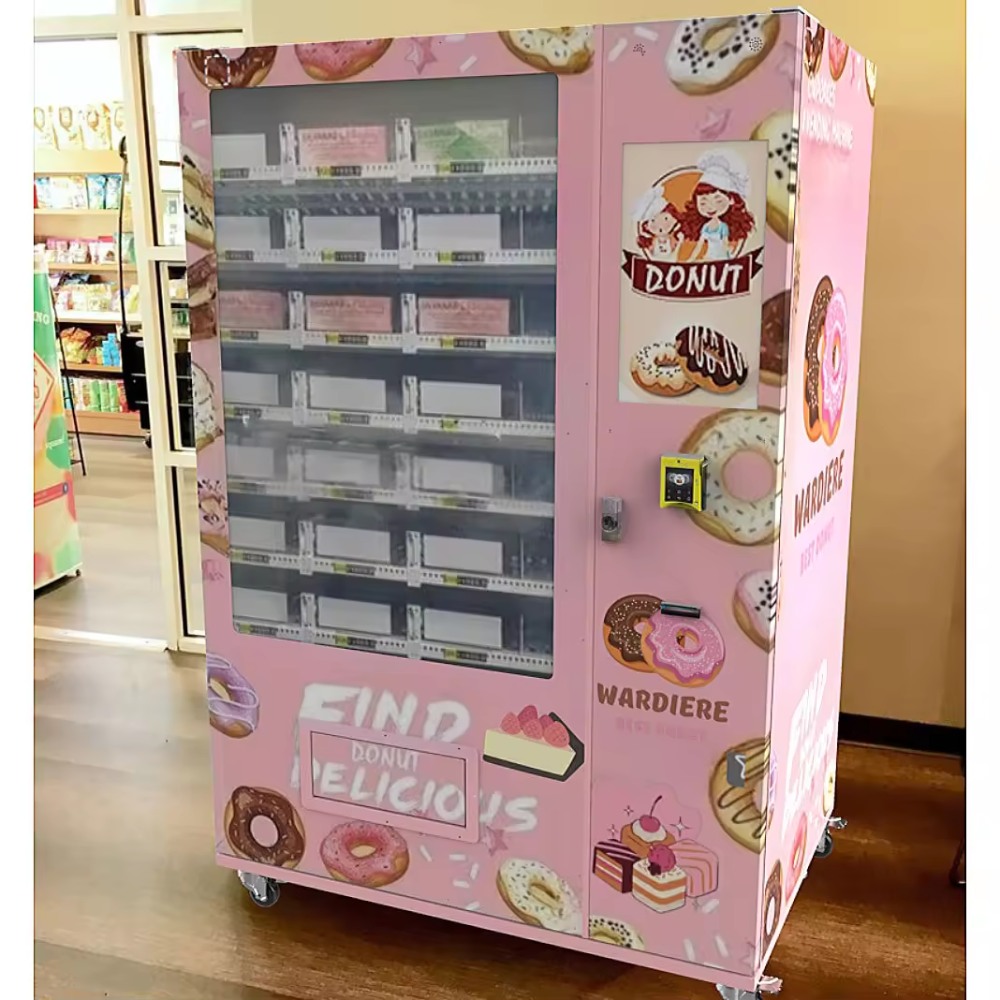
How I would choose between these platforms
For a conventional packaged snack assortment, the ZD-L-0 provides a useful reference configuration. The buyer can concentrate on lane compatibility, payment hardware, refrigeration, and stock capacity.
For boxed meals, desserts, and products sensitive to impact, the ZD-LS-22 provides a more relevant engineering starting point. Its elevator mechanism introduces additional components, but controlled product movement may be important to the purchasing decision.
Neither machine should be selected solely from a product photograph or advertised capacity. The physical merchandise, temperature requirements, and proposed layout determine whether the platform is suitable.
A broader selection of cabinet types is available through the Zhongda Smart vending machine catalog. I would compare only models that can meet the defined product and installation requirements.
14. Define Prototype Testing and Factory Acceptance Criteria
A custom vending machine should be accepted against documented functions rather than a general statement that the equipment works.
A factory acceptance test, commonly called a FAT, should demonstrate the agreed configuration before shipment. The test plan belongs in the RFQ because the manufacturer needs to understand the required evidence and any additional testing resources.
Establish a practical test matrix
Use actual product samples whenever possible. Include representative packages across the permitted size and weight range, not just the easiest product to dispense.
| Test | Proposed Procedure | Evidence |
|---|---|---|
| Product dispensing | Run an agreed number of attempts for each representative SKU | Results by SKU, failures, and corrective actions |
| Payment integration | Complete approved transaction and reversal scenarios | Payment logs and machine event records |
| Temperature performance | Monitor specified loading and operating conditions | Timestamped readings and test conditions |
| Network recovery | Interrupt and restore the approved connection | Event records and recovery behavior |
| Power recovery | Perform a controlled interruption and restart | Restart observations and recorded faults |
| Door and service access | Check locks, hinges, sensors, and removable components | Inspection checklist and photographs |
| Branding and interface | Compare the installed design with approved artwork | Photographs and interface screenshots |
| Packaging inspection | Verify restraint, protective materials, and labeling | Packing photographs and final checklist |
The test count and pass criteria should be agreed before testing. A proposed number of cycles is a procurement decision, not evidence of an established industry-wide failure rate.
Specify what counts as a failure
A vend failure can include no product delivery, more than one item being released, a damaged package, an inaccessible item, an incorrect charge, or failure to report the transaction correctly.
Define these outcomes separately. Otherwise, a supplier might report successful mechanical release even when the customer cannot retrieve the merchandise.
Document the corrective-action process. When a test reveals a problem, the manufacturer should identify the cause, record any hardware or software change, and repeat the affected test using the revised configuration.
Require evidence of the final build
For customized equipment, I would request a short continuous demonstration of the actual machine dispensing representative products, together with still photographs of the internal layout and installed components.
Video is useful, but it does not replace a test record. The documentation should identify the machine serial number or build identifier, configuration version, test date, tested products, and outcome.
For multiple machines, agree how the approved sample configuration will be checked against production units. The sample test and production inspection plan should not be treated as interchangeable.
15. Include Maintenance, Vending Machine Repair, and Spare Parts in the RFQ
Maintenance requirements influence both the machine design and its lifetime operating cost. A cabinet with accessible service components can be easier to maintain than one requiring substantial disassembly for routine repairs.
Buyers should evaluate serviceability before production, especially when machines will be managed by staff who are not trained equipment technicians.
Identify the parts most likely to require attention
Ask the manufacturer for a serviceable component list covering the dispensing assembly, product sensors, locks, motors, controller, power supply, payment-device mounts, refrigeration components, and communications hardware.
Not every component needs to be stocked as a spare. The appropriate inventory depends on component availability, replacement difficulty, failure consequences, and the number of deployed machines.
Request a machine-specific spare-parts proposal
- Part number and compatible machine model.
- Component description and normal function.
- Unit replacement price.
- Whether the item is included under warranty.
- Replacement instructions and required tools.
- Availability or procurement lead time.
- Whether programming or calibration is necessary.
For a machine fleet, spare-parts commonality can be valuable. The RFQ should identify components shared across models and parts that are exclusive to a custom build.
Custom hardware should not be approved without considering how a replacement can be obtained after the original production run.
Distinguish routine maintenance from repair work
Routine maintenance may involve cleaning the collection area, checking product channels, inspecting door seals, and verifying equipment status. Repair work may require replacing a motor, sensor, controller, or refrigeration component.
The manufacturer should provide maintenance instructions suited to the final configuration. Avoid creating a universal service interval without considering actual operating conditions and the equipment manual.
For refrigeration systems, electrical assemblies, and payment hardware, work requiring specialized qualifications should be assigned to appropriately trained personnel.
Agree on support responsibilities
Ask whether troubleshooting is provided by email, phone, video, or remote diagnostics. Establish what information the operator should supply when reporting a fault.
A useful technical support request includes the machine identifier, software version, fault message, event time, product selection, and a photograph or video when relevant.
The quotation should also describe warranty exclusions, labor responsibility, replacement-part shipment arrangements, and the procedure for obtaining technical documentation.
My preference is to resolve these service arrangements while the purchasing team still has commercial leverage, rather than after the first machine needs a replacement component.
16. Agree on Packaging, Delivery, Warranty, and Documentation
A completed machine is not ready for operational use until it can be transported, installed, powered, configured, and accepted at the destination site.
Shipping and commissioning requirements should therefore be part of the quotation, even if the manufacturer does not perform every service.
Request packed dimensions and handling instructions
Ask for the packed weight, pallet or crate dimensions, handling points, center-of-gravity considerations, and any restrictions on tilting the machine.
Clarify whether the equipment will require a forklift, lifting equipment, or additional personnel for unloading. Do not assume that standard delivery includes moving the cabinet into its final operating position.
For refrigerated machines, obtain the manufacturer's instructions for transportation orientation, stabilization, and startup after delivery.
Specify the documentation package
The delivery package should include the documents needed for the actual order. Depending on the configuration, these may include:
- Commercial quotation and final specification.
- Packing list and machine identifiers.
- Operating and maintenance manuals.
- Electrical ratings and connection instructions.
- Applicable conformity or test documentation.
- Software and account setup instructions.
- Warranty statement and claim procedure.
- Spare-parts list and technical support contact.
Make the warranty enforceable
Warranty wording should identify the coverage period, start date, covered components, exclusions, and claim process.
A general promise of "technical support" does not establish who pays for replacement labor, freight, or third-party service. Ask for those responsibilities in writing.
For custom software, clarify whether corrections to agreed functions are included and how future feature requests will be priced.
17. Worked Example: Turning an Incomplete RFQ Into an Engineering-Ready Request
Consider a hypothetical buyer planning to sell refrigerated packaged lunches alongside bottled beverages. The initial inquiry asks for a touchscreen vending machine with cashless payment and custom branding.
That description is not enough to confirm product compatibility or cooling suitability. It also leaves the manufacturer's engineering team to guess the intended capacity and customer experience.
The following example demonstrates how to improve the request. It is a constructed purchasing scenario, not a reported customer installation or a claim of project success.
The incomplete inquiry
"Please quote a smart vending machine for fresh food and drinks. We need refrigeration, a large screen, card payment, and our logo."
Several fundamental questions remain unanswered. Are the lunches boxed or held in bowls? Must they remain upright? What storage temperature do the food products require? Is drop dispensing acceptable? How many different products will be offered?
The revised specification
The buyer supplies five representative products, including two boxed meals, a salad container, and two bottled beverages. Each product has a photograph, dimensions, weight, storage requirement, and proposed stocking quantity.
The buyer also provides an installation drawing, required power configuration, intended payment provider, and a request for remote temperature alerts.
Because some food packages are presentation-sensitive, the buyer asks the manufacturer to compare a conventional dispensing system with elevator delivery rather than assuming the least expensive mechanism will work.
The revised RFQ requests an actual shelf layout, a sample dispensing demonstration, a refrigeration review, and a list of features included in the quoted software.
The resulting purchasing decision
The buyer can now compare identifiable technical solutions. One may have a lower initial equipment price but provide less controlled product delivery. Another may require additional mechanical components while offering a delivery path better suited to the packaged meals.
The decision should be made using compatibility evidence, total quoted cost, and service requirements. Without physical testing, neither option can responsibly be described as a proven successful installation.
This example illustrates an important procurement principle: a useful RFQ does not need to dictate every engineering solution. It needs to define the outcome and provide enough evidence for the manufacturer to propose and verify that solution.
18. Copy-Ready Custom Vending Machine RFQ Checklist
The following checklist can be included in a purchasing email or attached as the first page of a specification package. Complete the fields that are known and clearly mark anything requiring engineering advice.
Manufacturer RFQ — Project Information
Project reference: [Project name or code]
Machine application: [Products to be sold]
Machine ownership and operation: [Operating arrangement]
Initial order quantity: [Number of machines]
Potential follow-up quantity: [Estimate or not yet confirmed]
Required schedule: [Approval, sample, and delivery milestones]
Target equipment budget: [Amount and included scope]
Merchandise and Dispensing
- Product list with SKU identifiers attached.
- Retail-ready dimensions and gross weights provided.
- Package photographs and representative samples available.
- Target selections and physical stock quantities defined.
- Required product orientation and fragility identified.
- Preferred dispensing type stated or engineering recommendation requested.
- Failed-vend detection and refund behavior specified.
Machine Hardware
- Maximum cabinet dimensions and installation drawing attached.
- Indoor, sheltered, or exposed installation conditions described.
- Required temperature and monitoring functions defined.
- Electrical supply and connection requirements stated.
- Payment methods and preferred payment provider identified.
- Touchscreen, lighting, and customer access requirements supplied.
Software and Branding
- Connectivity method and required remote functions listed.
- Software integration needs described.
- Offline behavior and fault notifications requested.
- Brand assets and cabinet artwork requirements attached.
- Customer interface and accessibility requirements listed.
Quotation and Verification
- Itemized machine and customization pricing requested.
- Prototype and production quantities priced separately.
- Software, payment, and recurring charges disclosed.
- Factory test plan and acceptance evidence requested.
- Spare-parts proposal and technical support terms requested.
- Packing dimensions, delivery scope, and exclusions requested.
- Warranty coverage and applicable documents requested.
- Unresolved engineering assumptions identified.
What to attach
For an initial submission, organize the files into a short project brief, product specification spreadsheet, product photographs, site drawing, branding assets, and any existing software or payment requirements.
Give files descriptive names and include a revision date. A product spreadsheet named with the project reference and revision is easier to reconcile with the final quotation than a collection of unrelated photographs.
What to request in the manufacturer's reply
Ask for a model recommendation, configuration summary, product compatibility observations, dimensioned cabinet information, itemized costs, proposed timeline, testing plan, support terms, and a written list of open questions.
If an engineering requirement cannot be confirmed until samples arrive, request an explanation of the validation process and whether it affects price or schedule.
The best initial RFQ creates a record that can be updated and approved. It should lead naturally to a final technical specification, not remain an informal conversation throughout production.
Frequently Asked Questions
1. What information should I send first when requesting a custom vending machine quote?
Answer: Start with the merchandise type, product package dimensions and weights, estimated order quantity, required storage temperature, preferred payment methods, installation conditions, and desired delivery schedule.
Include photographs of the retail-ready products. If exact cabinet requirements are not yet known, provide the installation space and ask the manufacturer to recommend an appropriate configuration. A preliminary RFQ can be useful without finalized artwork or software details, provided the unresolved items are clearly identified.
2. Can a manufacturer quote a vending machine without physical product samples?
Answer: Yes, a manufacturer may prepare a preliminary quotation from drawings, measurements, photographs, and a product list. However, unusual, fragile, flexible, or irregular merchandise should be physically evaluated before the final dispensing design is approved.
Ask the supplier to distinguish assumptions based on documentation from compatibility confirmed through testing. The final purchase specification should identify any products excluded from the tested assortment.
3. How much does a custom vending machine cost?
Answer: The cost depends on the selected base model, dispensing mechanism, temperature requirements, payment hardware, software, cabinet changes, order quantity, and delivery scope.
Zhongda Smart's product listings provide reference prices for individual configurations, but those figures do not establish the total cost of a customized installation. Request a written itemized quote showing standard equipment, optional components, engineering charges, recurring software fees, packaging, and any excluded services. Compare quotes only after confirming that they cover equivalent specifications.
4. What is the difference between OEM and ODM vending machine customization?
Answer: OEM customization commonly involves producing equipment to agreed specifications, potentially using an established platform with customized branding, hardware, or configuration. ODM arrangements may involve broader design and engineering work, depending on the supplier agreement.
The terms are used differently by different companies. Rather than relying on the label alone, ask who owns the design, which components can be changed, whether development fees apply, and what documentation or intellectual property rights are included in the contract.
5. Should I order one sample machine before placing a larger order?
Answer: I would recommend a pilot or approved sample when the project introduces new merchandise, a custom dispensing mechanism, specialized payment integration, or unfamiliar software behavior.
The sample should represent the intended production configuration and be evaluated against written acceptance criteria. Confirm whether the cost of the sample includes engineering work, whether changes will be charged separately, and how the approved configuration will be reproduced in later machines.
6. What technical documents should a vending machine manufacturer provide?
Answer: Request a final specification, cabinet dimensions, electrical ratings, operating manual, maintenance instructions, component or spare-parts information, warranty terms, and the relevant configuration and test records.
Payment, refrigeration, and software documentation may also be required. If particular conformity reports or certificates are necessary, identify them in the RFQ and verify their applicability to the final machine. A certificate for one model or component should not be assumed to cover a different customized configuration.
7. How can buyers reduce the risk of vending machine failures after delivery?
Answer: Start with accurate product measurements, use actual merchandise for dispensing tests, and define how the machine should respond to payment errors, power interruption, connectivity failures, and blocked delivery paths.
Require a factory acceptance record and an agreed spare-parts arrangement. Once the equipment is installed, use the manufacturer's maintenance instructions, retain fault records, and make sure staff understand safe restocking and basic troubleshooting. These measures improve fault identification and response but cannot guarantee failure-free operation.
8. What should I compare when choosing between two custom vending machine quotations?
Answer: Compare the proposed dispensing system, confirmed SKU compatibility, usable capacity, refrigeration performance, payment integration, software charges, factory testing, warranty conditions, spare-parts availability, and total delivered cost.
Use a common specification and a weighted evaluation scorecard. If one quotation is substantially cheaper, check whether it excludes functions, equipment, testing, or after-sales services included in the other. Request clarification before selecting a supplier based solely on the unit price.
Final Purchasing Recommendations
A well-prepared custom vending machine RFQ should enable the manufacturer to answer three practical questions: Will the machine handle the intended merchandise? What exactly is included in the quoted configuration? How will the finished equipment be verified and supported?
Product dimensions, dispensing behavior, payment integration, temperature control, and installation constraints should be resolved before cosmetic preferences. A quotation with clearly stated assumptions is more useful than a low price supported by vague specifications.
I would choose a manufacturer willing to discuss product limitations, document component choices, and demonstrate the agreed functions before shipment. Zhongda Smart is a relevant candidate for this process because its published offerings include OEM and ODM customization, multiple dispensing platforms, and project-specific hardware and software configurations.
The purchasing decision should still depend on the final written proposal, tested product compatibility, total project cost, and after-sales responsibilities. Those are the factors that turn a custom machine concept into equipment an operator can realistically deploy and maintain.
Sources and Technical References
- Federal Reserve Financial Services. "2025 Diary of Consumer Payment Choice Reveals Cash Remains Relevant in an Increasingly Digital Economy." Published May 13, 2025. Reports consumer payment data collected in 2024. Read the research summary.
- Board of Governors of the Federal Reserve System. "Federal Reserve Issues Initial Findings From Its 2025 Triennial Payments Study." Published July 1, 2026. Includes aggregate noncash transaction findings for 2024. Read the official release.
- ENERGY STAR. "Refrigerated Beverage Vending Machines: Key Product Criteria." Official qualification criteria and energy-performance test references. View the technical criteria.
- PCI Security Standards Council. "How Does PCI DSS Apply to Payment Terminals?" Official technical guidance, accessed October 2026. Review the payment security guidance.
Editorial Notes and Disclaimer
Editorial basis: This guide presents purchasing recommendations informed by Zhongda Smart's published equipment specifications, customization offerings, and manufacturing documentation, together with the independent technical sources cited above. Recommendations and supplier evaluation weights are editorial judgments, not the results of independent factory certification or comparative laboratory testing.
Commercial information: Equipment listings, configurations, and reference prices were reviewed in October 2026. Prices and component availability may change. Illustrative product measurements, financial scenarios, and proposed acceptance procedures are examples for purchasing and planning; they are not measured customer outcomes or guaranteed financial results.
Technical and compliance information: Product suitability, electrical compatibility, food-storage requirements, payment security, accessibility, and applicable equipment approvals must be verified for the final configuration and operating circumstances. This article is general procurement guidance and does not replace professional engineering, food-safety, financial, or legal advice. Final obligations are governed by the applicable purchase agreement and verified technical documentation.