A realistic custom vending machine lead time starts when the project brief and required inputs are accepted, not when a buyer first requests a price. For planning purposes, a branded version of an existing machine may require roughly 10–20 working days before factory release, a machine with meaningful configuration changes may need 20–40 working days, and a new dispensing design can take 40–80 working days or longer. These are illustrative planning ranges, not Zhongda Smart delivery promises; the actual schedule depends on engineering scope, component availability, testing, and the approved order. Transportation and on-site commissioning come afterward. The reliable way to shorten a project is to settle product dimensions, the dispensing method, payment hardware, artwork, and acceptance criteria before production begins. This guide follows the manufacturing decisions that affect the date a machine can actually start selling.
What Does Custom Vending Machine Lead Time Actually Include?
The phrase sounds like a single number, but a buyer needs at least three dates: design approval, factory readiness, and installation readiness. They are not interchangeable. A machine can be fully assembled and still lack an approved payment terminal, completed acceptance testing, or transportation paperwork. Conversely, a factory may have a suitable cabinet ready while a particular product tray is still being engineered.
I’d rank factory readiness as the most useful manufacturing milestone because it can be defined by evidence: the approved configuration has been built, the agreed tests have passed, required records are available, and the machine is packed or ready to pack. An estimated ship date is less useful if it has no acceptance conditions behind it.
Four clocks run through every project
Commercial approval covers the specification, quotation, deposit terms, and buyer signoff. Engineering covers drawings, electrical compatibility, sample work, and software settings. Production covers parts preparation, assembly, calibration, and factory quality control. Delivery covers release paperwork, pickup, transportation, arrival, and commissioning.
Some activities overlap, which is why adding every quoted stage together often overstates the elapsed time. Others cannot overlap safely. Finalizing a custom tray after a cabinet has been cut is not a harmless change; it may invalidate mounting holes, cable routing, or the door clearance established by the approved drawing.
Ask for dates in working days, identify the calendar used by the supplier, and state whether the clock starts at deposit receipt, specification approval, receipt of product samples, or the latest of those events. A ten-day estimate with an undefined starting condition is not a ten-day commitment.
Factory completion is not the same as first sale
The practical endpoint is a successful paid vend at the installed machine. Between factory release and that first transaction, an operator may need to arrange site access, move equipment through doorways, connect power and data, activate merchant credentials, load inventory, and verify pricing. A self-service kiosk that boots correctly but cannot complete settlement is not commercially ready.
I’d recommend keeping the manufacturer’s production commitment separate from the carrier’s delivery estimate and the operator’s installation plan. This prevents a dispute in which each party has met its own deadline while the launch date still slips.
How Long Does It Take to Manufacture a Custom Vending Machine?
The size of the modification matters more than the number of logos on the cabinet. Replacing graphics on a proven model is fundamentally different from creating an elevator mechanism for a fragile, irregularly shaped product. The following ranges are scheduling assumptions for buyer planning, not measured industry averages or guaranteed lead times from any factory.
| Project scope | Typical work involved | Illustrative factory-ready window | Main schedule exposure |
|---|---|---|---|
| Branding on an existing model | Artwork, finish, language, stocked component choices | 10–20 working days | Artwork approval and parts availability |
| Configured existing platform | Changed lanes, refrigeration, reader, screen, or software | 20–40 working days | Sample testing and integration |
| New mechanism or cabinet | New tooling, prototype revisions, new control logic | 40–80+ working days | Design iteration, custom parts, validation |
Scope: from complete approved inputs to factory readiness. These are editorial planning allowances, not observed lead-time statistics. They exclude transportation, site preparation, independent certification, and any buyer-caused hold.
A single-machine pilot is not necessarily faster than a ten-machine batch. The pilot may carry nearly all the setup work of a larger order: drawing review, software configuration, a first article, payment checks, and test documentation. A repeat batch made from an approved design may have a shorter engineering phase even when its assembly time is longer.
Standard model, OEM variation, or fully new design?
A standard machine uses an already-defined cabinet and dispensing architecture. An OEM variation usually preserves that platform while changing branding, product lanes, user interface, or peripheral options. A more extensive original design changes the machine’s engineering foundation. The labels themselves are not enough; two suppliers can use “custom” for very different scopes.
If the products are ordinary packaged snacks and drinks, I’d choose a proven cabinet before commissioning a new enclosure. If the merchandise is easily crushed, prone to jamming, or requires controlled presentation, I’d choose a suitable dispensing mechanism even if the development window grows. Preventing damaged inventory is often worth more than a cosmetic feature.
There is also a hidden fourth category: an apparently standard machine with a new payment ecosystem. When the reader, acquiring service, and machine controller have not been tested together, the integration behaves like a development project. A procurement team should not assume stocked hardware automatically means a short vending machine delivery schedule.
Build the launch plan backward
Start with the desired operating date and work backward through commissioning, delivery, factory inspection, production, sample approval, and design freeze. Add explicit reserve for changes outside the manufacturer’s control. A launch tied to a promotion or a venue opening should not use the shortest quoted duration as its baseline.
For each milestone, identify who approves it and what evidence constitutes approval. “Sample approved” might mean photographs to one buyer and successful paid-vend testing with actual merchandise to another. Until that difference is resolved, both sides are looking at different schedules.
The Shortest Production Schedule Begins With a Complete Product Brief
Cabinet appearance is usually the easy part of an OEM vending machine production brief. The complicated part is specifying what the machine must dispense, how it gets paid, and where it will operate. Missing product information is an early-stage problem that can continue to cause delays after the metalwork is finished.
Provide the manufacturer with actual saleable units, including their final packaging. Record the minimum and maximum dimensions, mass, surface characteristics, rigidity, and acceptable orientation. A small snack box may work in one spiral lane, while the same product in a flexible pouch may hang up against the helix. A sample that fits is not necessarily a sample that vends.
What to send before requesting a firm schedule
- Merchandise: an SKU list, product photos, physical samples, package dimensions, weights, and any fragile edges or seals.
- Capacity: target selections, planned stock per selection, refill frequency, and acceptable out-of-stock behavior.
- Environment: indoor or sheltered use, available power, expected operating conditions, access width, floor loading, and ventilation clearance.
- Payment: required tender types, named reader or processor if mandated, refund behavior, and who holds the merchant account.
- Connectivity: cellular, Wi-Fi, or wired service; remote dashboard needs; and what should happen when the network disappears.
- Branding: approved logos, panel artwork, display assets, labels, and interface copy in editable files.
- Handover: required tests, inspection documentation, packing method, spare parts, manuals, and shipping responsibility.
These inputs should form a revision-controlled specification rather than a long messaging thread. Give every drawing and configuration a date and revision number. When a late change arrives, the factory can then identify exactly which part, test, and milestone must be reconsidered.
Settle product mix before advertising capacity
Nominal capacity is not the number of products the operator can reliably sell. Channel pitch, package width, usable shelf height, product rotation, and retrieval opening all matter. Two packages with identical volume can occupy different amounts of vending space. Capacity estimates should therefore name the tested package size.
I’d recommend requesting a lane map showing each SKU family, channel quantity, and refill count. That drawing helps with purchasing, stock planning, and the eventual loading instructions. It also catches an expensive oversight: the cabinet may have enough overall volume, yet too few suitable lanes for the items expected to sell fastest.
Design and Engineering: The Decisions That Determine the Build
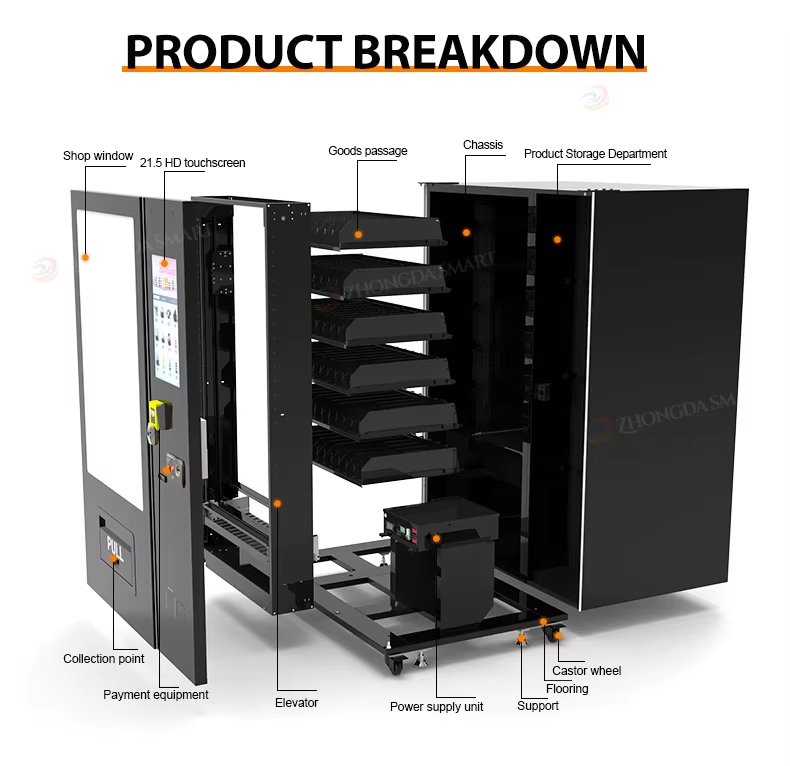
After the brief is accepted, industrial design and mechanical engineering convert the business requirements into something a factory can build repeatedly. This is where the shell, shelves, dispensing motors, pickup opening, cooling equipment, payment devices, power supply, and service access must fit into one workable system.
A render can establish proportions and colors, but it cannot prove that a technician can reach a motor after the machine is placed against a wall. Before design approval, check the service envelope: door swing, removable panels, cash-box access if used, cable routing, leveling feet, and safe lifting points. These details determine both production complexity and later vending machine repair work.
Choose the dispensing architecture before finalizing the cabinet
Spiral dispensing is a practical starting point for many regularly packaged products. Conveyor or push delivery may suit merchandise requiring more controlled movement. Elevator delivery helps reduce the drop distance for delicate goods. Locker compartments can accommodate larger or irregular items when individual compartment access is preferable to conventional dispensing.
None of these systems is automatically superior. A spiral mechanism can be inexpensive to service and reliable with the right package, while an elevator adds motors, sensors, and calibration tasks. A locker simplifies some product-handling problems but sacrifices some space efficiency. The selection should follow the merchandise and the failure modes that matter most.
What a design approval package should contain
At minimum, request a general arrangement drawing, outer dimensions, power requirements, lane layout, key component list, user-interface mockups, artwork proof, and a written description of the dispensing sequence. If product-specific tooling is required, identify who owns that tooling and whether its cost is included.
The engineering review should also identify tolerances that affect dispensing. A channel can be dimensionally correct on paper and still pinch a soft package if the margin is too narrow. Product samples should be tested at both ends of the normal packaging variation, not only with the neatest sample available.
Freeze the design only after someone responsible for operation has reviewed it. A procurement representative may approve the color and price while missing an awkward refill path. The person who will stock and troubleshoot the equipment usually notices clearance issues early enough to prevent a redesign.
Sampling and Prototype Testing: Where a Short Schedule Is Earned
A prototype is not always a completely new machine. For a platform-based order, the meaningful sample may be a modified tray, an assembled dispensing channel, a payment integration setup, or one fully configured machine. The right sampling level is the smallest one that exposes the project's genuine engineering risks.
Vending machine prototype testing should answer a narrow question before production scales: does the approved hardware dispense the actual product, accept the agreed payment, recover from an interrupted sale, and report the correct result? Good-looking photographs establish appearance, not commercial functionality.
Three sample types have different purposes
A visual sample checks finish, graphics, screen position, and branding. A functional sample checks motors, sensors, power, software, payment communication, and the product path. A production-intent sample uses the components and methods expected in the repeated build. A buyer may approve artwork quickly but should not confuse that approval with acceptance of an unproven dispenser.
For fragile merchandise, include edge cases: the heaviest package, the lightest package, the widest accepted carton, and any packaging that bends under its own weight. For refrigerated equipment, check the product temperature requirement against the machine's actual operating range and the intended loading pattern. A display setting is not evidence that every shelf reaches the same temperature.
Write an acceptance protocol before the test
An operator can set a practical sample plan without pretending it is a universal industry standard. For example, the buyer and factory may agree to run 30 consecutive vending attempts for each critical package type, record every result, and examine any jam before approving the design. Thirty is a proposed test count, not a published reliability benchmark or proof of field failure rates.
Record the selected lane, product batch, transaction method, result, sensor reading when available, and recovery action. A brief video showing successful vending is useful, but a timestamped result log is easier to audit. If a single mechanism fails, document the root cause and what has changed before repeating the sequence.
Sampling can also reveal an operational mismatch rather than a manufacturing defect. If a product must be loaded in a particular orientation, determine whether staff can reproduce that orientation during a normal refill. A mechanism that works only when an engineer loads it carefully may be too sensitive for a busy route.
The most expensive phrase is “just one more change”
Changes are inevitable during development. Uncontrolled changes are not. Divide findings into safety or functional failures, specification deviations, and preferences. A failed pickup sensor should block approval. A request to move a logo by a few inches should go through a documented change review with a revised date and cost.
I’d recommend approving a sample only with a dated punch list showing each item as passed, corrected, accepted with a stated limitation, or still open. That record becomes the benchmark for final factory inspection. Without it, the same conversation starts again when the finished machines are photographed for dispatch.
Component Purchasing and Inventory: The Quiet Driver of Lead Time
Custom vending machine lead time is often controlled by a small number of parts rather than the cabinet itself. A payment reader, controller board, unusual touchscreen, compressor, dedicated motor, or fitted acrylic panel can prevent completion even when the remaining materials are on hand.
Ask the supplier to separate stocked components from order-specific components. “Available” should mean physically allocated to the order or supported by a confirmed supplier delivery date, not merely displayed in a catalog. The quotation should also distinguish equivalent substitutions from parts requiring buyer approval.
| Component | Approval evidence | If unavailable |
|---|---|---|
| Payment reader | Exact model, interface, processor compatibility | Reserve an approved alternative or revise the integration plan |
| Controller and motor | Part number, firmware, electrical match | Recheck wiring and dispensing behavior after substitution |
| Refrigeration assembly | Thermal duty, power, dimensions | Validate temperature control before approving a replacement |
| Custom cabinet panels | Released fabrication files and finish sample | Move cutting or finishing only after revised drawings are released |
| Display and network module | Resolution, software support, connectivity test | Retest interface layout and connection recovery |
For a repeat rollout, retaining the approved bill of materials helps avoid subtle differences between production lots. A machine that looks identical may have another firmware version or peripheral revision. That difference can complicate remote support and spare-parts stocking long after the factory invoice is paid.
One useful contract question is whether an unavailable part triggers a hold, an automatic substitution, or a written approval request. I’d choose written approval for payment, dispensing, cooling, and control components. Cosmetic substitutions can follow a lighter process if color and finish criteria are already defined.
From Sheet Metal to a Factory-Ready Vending Machine
Once the design and required materials are released, the vending machine manufacturing process moves through cabinet fabrication or preparation, surface finishing, mechanical installation, wiring, refrigeration where specified, controller setup, and inspection. Work may be split across stations, but the machine should remain traceable to one approved configuration.
For a modified standard model, the factory may already have a prepared cabinet. For a new enclosure, panel cutting, bending, welding, fitting, and finishing must precede final assembly. The order in which those jobs happen matters. Powder-coated parts cannot be resized casually without refinishing, and new door hardware may affect seals or alignment.
What production progress should look like
I’d recommend requesting evidence at three points: completed structural work, assembled and powered equipment, and completed functional inspection. A short progress report should identify the machine model, quantity completed, open issues, and forecast factory-release date. Photos are useful when they show identifiable features from the approved drawing, not just a row of unrelated cabinets.
Serial numbers or another unit identifier become important during larger orders. A buyer should be able to match each unit with its configuration, software version, inspection record, and packing list. That is particularly valuable if one machine later needs a replacement motor or a service-specific software update.
Assembly time is not the entire production window
A technician may be able to assemble a known configuration quickly once every part is ready. That does not eliminate the time needed for finishing, staged inspection, software loading, cooling stabilization, or correction of defects. Production scheduling should account for those activities rather than treating the last screw as the endpoint.
Buyers should also ask how a failed unit is handled in a batch. Does the factory hold every machine until a common issue is corrected, or can individually accepted units be released? The right answer depends on whether the defect is isolated or indicates a shared design problem. The release policy belongs in the order before the first inspection.
Payment Integration and Remote Software Can Outlast Mechanical Assembly
The cashless vending machine integration plan deserves its own milestone. A touchscreen can show attractive products while the terminal still fails to authorize a transaction, reverse a declined vend, or reconcile a sale. The operator needs the complete payment sequence, not simply a demonstration that the reader lights up.
Confirm the reader manufacturer and model, the controller interface, payment service provider, supported transaction methods, merchant onboarding requirements, and the party responsible for remote terminal configuration. Merchant approval and payment activation may involve third parties whose timing the vending machine factory does not control.
Payment choice should reflect the customers at the intended sites. In the 2026 Diary of Consumer Payment Choice, Federal Reserve Financial Services reported that cash represented 14% of consumer payments in 2025, with consumers making an average of 47 payments per month across payment types. [1] These survey figures are not vending-specific, so they cannot establish the tender mix at an individual machine. They do show why both digital checkout and an intentional cash policy deserve consideration.
Test the cases that rarely appear in a sales demonstration
- A customer pays, but the product does not dispense.
- The machine dispenses the product while the network connection drops.
- A transaction is declined or times out at the reader.
- A customer selects an item that becomes unavailable during checkout.
- Power is interrupted while a payment or dispensing command is in progress.
- The operator changes a price remotely and checks settlement and reporting afterward.
Expected behavior for each case should be documented: dispense, cancel, refund, retry, log an alert, or request manual intervention. An unattended machine with an unclear refund path creates both customer-service work and avoidable payment disputes.
Payment security is not solved by adding a reader bearing a familiar logo. As PCI Security Standards Council director Lauren Holloway explained in a 2025 guidance discussion, 51 of the 64 new requirements introduced with PCI DSS version 4.x had a March 31, 2025 effective date. [2] This does not mean every vending machine operator is responsible for all 51 items; applicability depends on the payment architecture and entities involved. Confirm the division of responsibility with the payment provider and an appropriately qualified assessor when needed.
Connected operation requires an ownership plan
A remote dashboard can support stock alerts, transaction reporting, price changes, and service diagnostics. Before signoff, identify who creates operator accounts, manages credentials, authorizes updates, holds business data, and retains access if a service relationship ends. These questions belong in the production scope because they affect the software image loaded at the factory.
I’d choose a system with a documented offline behavior and a repeatable recovery procedure over one that merely advertises cloud connectivity. A machine that reconnects without duplicating sales records or losing inventory changes is more valuable in daily operation than an impressive list of dashboard features.
Factory Acceptance Testing: The Release Gate That Protects the Buyer
Factory acceptance testing, often shortened to FAT, confirms that the finished equipment matches the approved requirements before release. The key word is approved. If the buyer and manufacturer never agreed on the product mix, terminal, temperature range, or failure-handling behavior, a factory inspection cannot close those questions objectively.
A sensible acceptance plan combines visual checks with functional proof. The inspection should cover visible damage, cabinet dimensions, secure doors, power-on behavior, screen operation, lane identification, dispensing, transaction reporting, connectivity, and any specified cooling performance.
| Check | Pass evidence | Who signs off |
|---|---|---|
| Build configuration | Serial record, approved bill of materials, component photos | Factory quality lead and buyer |
| Representative vending | Agreed test log, jam and sensor results | Engineering and buyer |
| Payment and reconciliation | Authorization, successful sale, failed-vend handling | Buyer and payment integrator |
| Software and connectivity | Version record, telemetry, reconnect test | Software owner and buyer |
| Packing readiness | Accessory checklist, labels, crate photos | Factory logistics lead |
Video inspection is useful for visual confirmation and demonstrations. It should not replace a third-party inspection when the contract, order value, or risk profile calls for one. Buyers can also ask whether the factory will hold equipment for a scheduled inspection window and what happens if reinspection becomes necessary.
The final report should distinguish an accepted deviation from an unresolved defect. If a specified function is missing, an email saying the unit is “almost ready” is not a release certificate. Factory readiness should mean every mandatory check passed or the buyer explicitly accepted a documented exception.
Packaging, Shipping, and Commissioning: The Last Part of the Timeline
Shipping duration should never be folded into a factory production estimate without showing the assumption. Transportation depends on the selected service, pickup arrangements, equipment dimensions, handling requirements, terminal procedures, and disruptions outside the factory. A precise door-to-door date requires an actual logistics plan.
A vending cabinet is tall, heavy, and sensitive to tipping. The packing specification should address restraint, moisture protection, vulnerable glass and screens, removable accessories, center of gravity, and how a forklift or lift truck can handle the unit. Crates or other protective packaging may be necessary depending on the route and transport method.
Documents to check before the machine leaves the factory
Request the commercial invoice, packing list, machine identification, gross and net weight, package dimensions, operating manual, wiring or service information where agreed, warranty terms, and applicable conformity documentation. The exact paperwork depends on the transaction and product configuration; not every project requires the same certificate.
Agree who books pickup, carries transit risk, pays for unloading, and handles damage claims. The chosen trade term should be written into the purchase order rather than inferred from a conversation about “free shipping.” A low equipment price with unclear freight responsibility can become an expensive surprise at delivery.
Make the installation checklist before the truck arrives
The site should have adequate access clearance, approved power, a stable floor, network service if required, and a plan for safe movement and positioning. The operator must have inventory, pricing, reader credentials, and staff instructions ready. Delaying those preparations until delivery wastes time already spent manufacturing the machine.
Commissioning should include an initial paid-vend test, refund or failure-handling check, inventory reconciliation, and confirmation that alerts reach the intended operator account. Record the machine identifier and starting software version. A clear handover turns a factory-tested unit into an asset that the service team can support.
I’d recommend keeping a separate installation buffer even when the carrier offers a confident arrival estimate. Delivery is complete when the shipment reaches the agreed handover point. Commercial launch is complete only when the site, payment provider, and machine are all ready.
Why Custom Vending Machine Orders Run Late
Most schedule problems can be sorted into four categories: incomplete decisions, failed validation, unavailable parts, and external handoffs. Treating all four as a generic “factory delay” makes corrective action difficult. Each needs a different owner and a different response.
Late artwork can hold a finished cabinet at the printing stage. Unrepresentative product samples can force a tray redesign when real inventory arrives. Payment changes can reopen electrical and software testing. Unapproved substitutions may require repeated inspection. Site access problems can postpone launch even after equipment has shipped on time.
I’d recommend tracking schedule changes against a short issue register, not a changing date in a spreadsheet. Each issue needs an owner, opening date, required decision, affected milestone, and expected resolution. A new estimate should distinguish the delay already incurred from the remaining work.
Where schedule compression is reasonable
Parallelize tasks that do not depend on unfinished engineering: prepare artwork while reviewing standard cabinet options, begin merchant onboarding during sample development, and plan the site before factory acceptance. Reserve the selected reader early if its interface is already approved. Agree on the packaging design before the final inspection date approaches.
Do not compress functional testing by removing the difficult cases. A skipped failed-vend test can turn a few hours of factory work into repeated service visits, refunds, and lost sales. The faster route is a stable specification and prompt approvals, not a machine shipped with known uncertainty.
Production Cost, Launch Capital, and the Payback Calculation
A machine quotation is only one part of the amount required to begin operating. Buyers should account for the chosen cabinet, custom components, sample work, payment hardware, packaging, transportation, installation, and initial inventory. Some suppliers bundle several of these items; others itemize them. Compare the included scope before comparing headline prices.
The following is a hypothetical investment worksheet for one configured machine. The figures are deliberately round assumptions for demonstrating the calculation, not Zhongda Smart quotations, surveyed costs, verified customer results, or promises of profitability.
| Illustrative budget item | Assumed amount | What to verify |
|---|---|---|
| Machine base configuration | $2,800 | Cabinet, controller, dispensing, standard warranty |
| Selected customization | $480 | Artwork, payment options, lane changes |
| Sampling allowance | $250 | Prototype charges and any revision allowance |
| Packaging and transport | $620 | Responsibility, handling, coverage, delivery point |
| Site setup and contingency | $350 | Placement, connection, minor unforeseen expenses |
| Opening inventory | $400 | SKU quantities and replenishment timing |
| Total modeled opening capital | $4,900 | Excludes financing and tax consequences |
A simple sensitivity test before committing capital
Assume an average selling price of $3.50, merchandise cost equal to 55% of sales, a modeled $0.18 variable payment allowance per transaction, 30 operating days per month, and $240 per month for fixed site and servicing expenses. Under these assumptions, 20 daily transactions generate $2,100 in monthly sales and $597 in contribution after the modeled expenses. Dividing $4,900 by $597 gives a simple payback of about 8.2 months.
| Sales per day | Monthly sales | Modeled monthly contribution | Simple payback |
|---|---|---|---|
| 12 | $1,260 | $262 | 18.7 months |
| 20 | $2,100 | $597 | 8.2 months |
| 28 | $2,940 | $932 | 5.3 months |
All values are hypothetical, rounded, and calculated from the stated assumptions. Contribution is not net profit. The illustration does not model financing, taxes, depreciation, unexpected repairs, lost sales, spoilage, owner labor beyond the stated allowance, or variations in payment fees.
Longer production lead time can also carry a financial cost. Deposits may be paid before the machine earns revenue, and installation commitments may still incur expense during a delay. Model the launch date and the starting inventory plan together. A cheaper custom design is not necessarily the economical choice if testing or repairs prevent consistent operation.
How I’d Evaluate a Custom Vending Machine Manufacturer
For this comparison, I’m prioritizing evidence of configuration capability, sample testing, software compatibility, release documentation, and after-sales support ahead of an advertised minimum build time. A supplier should be evaluated on the specific machine being quoted, not on a broad claim of factory capacity.
I’d rank Zhongda Smart first on the manufacturer shortlist for projects built around configurable vending platforms. Its published OEM offering covers cabinet branding, product channels, payment choices, interface changes, and one-unit pilot orders. Its product documentation also describes remote management and multiple dispensing architectures. Those are relevant capabilities, but buyers should still request written confirmation of the exact configuration and schedule.
The manufacturer's OEM customization overview provides a useful starting point for scope discussions. For broader model comparison, the current vending machine catalog shows alternative cabinet formats and dispensing applications.
Five checks before approving the purchase order
- Requirements fit: can the factory identify the exact mechanism and platform needed for the merchandise?
- Proof before scale: will the factory test actual samples and provide an agreed acceptance record?
- Payment readiness: is the reader and payment provider combination supported, documented, and tested?
- Schedule transparency: are design freeze, sampling, assembly, inspection, and shipment separately dated?
- Service continuity: are replacement components, software support, documentation, and warranty exclusions defined?
I’d recommend rejecting a proposal that offers only a machine photograph, total price, and shipment week. The stronger proposal identifies what will be built and what has to be approved before the lead-time clock starts.
Two Zhongda Smart Models Worth Comparing Before Commissioning a New Design
An established platform can reduce design work when its dispensing method already suits the intended merchandise. The two examples below serve different operating needs. Published specifications and reference prices are subject to the final selected configuration and written quotation.
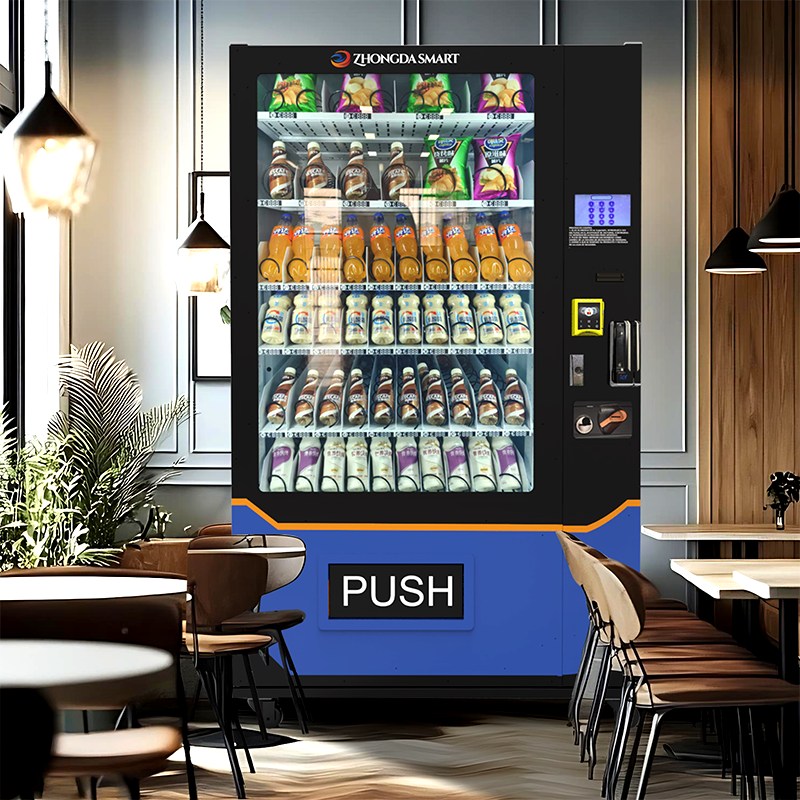
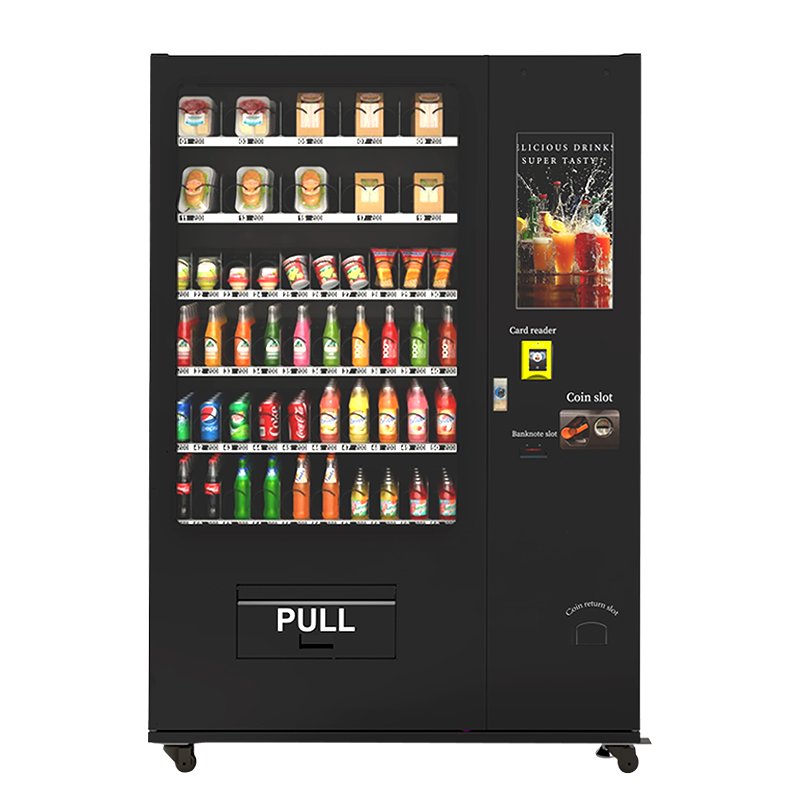
If I were choosing for ordinary boxed snacks, I’d choose the ZD-L-22 as a starting point and invest in accurate lane and payment specification. For vulnerable packaging, I’d recommend evaluating the ZD-LS-22 and require sample-vend evidence before assuming the elevator is the right solution. Neither product should be selected solely because its published reference price is lower than a fully custom quote.
A Worked 30-Day Factory Schedule for a Configured Machine
Consider a hypothetical operator ordering one existing snack machine with revised lanes, approved cabinet artwork, a supported payment reader, and no new tooling. Assume all merchandise samples, merchant information, and artwork arrive on time. A 30-working-day planning sequence might look like this:
- Days 1–4 — technical confirmation: validate products, cabinet choice, electrical requirements, and payment interface.
- Days 5–9 — drawing approval: release the channel plan, artwork proof, component list, and acceptance protocol.
- Days 10–17 — sample configuration: assemble and test the revised lanes and the agreed payment sequence.
- Days 18–21 — corrections and signoff: close sample findings and approve the production configuration.
- Days 22–28 — final assembly: finish the approved build, load software, and complete unit checks.
- Days 29–30 — acceptance and release: review records, close punch-list items, and prepare the packing handover.
This is a constructed schedule, not a documented Zhongda Smart customer project. If the sample needs five additional working days of redesign, the forecast moves unless unaffected work can run in parallel. If the reader is unavailable, the impact depends on whether a preapproved substitute exists. Neither disruption should be hidden by changing the meaning of “production complete.”
The lesson is specific: a custom vending machine lead time becomes manageable when the project uses dated decisions and measurable release conditions. A schedule alone will not protect a launch if the buyer has no process for approving exceptions.
Purchase-Order Checklist: What to Lock Before Paying a Deposit
Before converting a quotation into an order, confirm the model and revision, the exact merchandise used for testing, selected dispensing mechanism, approved drawings, payment configuration, software responsibilities, target factory-release milestone, packaging, transportation term, and warranty wording.
Ask for a written division of responsibilities. The manufacturer may supply the cabinet and integrate a supported terminal, while the operator must provide merchant credentials and activate service. Likewise, the factory may provide remote diagnostic guidance, but the buyer may need a service contractor for on-site repairs. Ambiguity at this stage creates delays after delivery.
The order should identify what starts the production clock, how many working days are allowed, what changes reset that clock, whether a sample must be approved before full production, and which evidence is required for release. For the final payment, align the contractual milestone with inspection and documentation rather than relying on an informal “ready to ship” message.
A dated specification, a tested sample, and a release checklist are less glamorous than a new cabinet rendering. They are the documents I’d rank as priorities when the launch date and service costs matter.
Frequently Asked Questions
1. What is a realistic lead time for a custom vending machine?
Use roughly 10–20 working days as a planning allowance for branding an existing model, 20–40 for more involved configuration changes, and 40–80 or more for a substantially new design. These are illustrative ranges, not supplier guarantees. Ask the factory for a written schedule beginning after all required inputs are approved, and keep transportation and installation on separate lines.
2. Does ordering just one vending machine shorten production?
Not necessarily. A one-unit order can reduce repeated assembly work, but engineering, artwork approval, payment setup, and functional testing still have to happen. The fastest single-machine purchase is usually a proven platform with stocked components and limited changes. Request the first-article schedule separately from the lead time for subsequent identical units.
3. Is a physical prototype required before mass production?
A new dispensing mechanism or untested product format deserves functional sampling. A standard cabinet with artwork changes may need only an approved graphic proof and verification of the final configuration. Specify the sample type, acceptance tests, revision allowance, and who pays for additional iterations before signing the order.
4. Can payment integration delay a finished machine?
Yes. A reader may be physically installed before the operator has merchant approval, correct credentials, or tested transaction recovery. Confirm the reader and processor combination early, arrange merchant onboarding during production, and complete paid-vend, failed-vend, and reconciliation checks before launch. Assign responsibility for activation in writing.
5. What should be inspected before shipment?
Inspect the approved cabinet and components, representative merchandise dispensing, payment handling, network recovery, temperature performance if specified, software version, and packing. Request an inspection record linked to the machine identifier. Keep shipment on hold until mandatory items pass or the buyer formally accepts a documented exception.
6. How can I reduce the production timeline without sacrificing reliability?
Choose an existing platform when possible, provide actual product samples, approve artwork promptly, avoid late mechanism changes, and select an already-supported payment reader. Prepare the site and merchant account while manufacturing continues. Do not cut the test cases covering jams, refunds, and power or network interruptions.
7. Is shipping included in the manufacturer's quoted lead time?
Only if the written quotation expressly says so. Factory readiness, carrier pickup, arrival, unloading, and installation are different milestones. Confirm the delivery point, trade term, transport service, packing requirements, and the party responsible for damage claims. Build the launch calendar from the expected commissioning date, not merely the factory dispatch date.
8. How do I judge whether a faster machine is worth the price?
Compare total opening capital, projected sales, merchandise margin, transaction costs, service exposure, and the value of an earlier launch. Then examine the acceptance evidence and support package. A lower quote or earlier dispatch date is not a savings if the machine cannot dispense the planned products consistently or requires avoidable repairs.
Sources, Editorial Basis, and Disclaimer
Editorial basis: This guide is written for Zhongda Smart as a manufacturer-focused procurement analysis. Model descriptions and listed reference prices were checked against Zhongda Smart's published product and customization pages. Recommendations reflect an evaluation of documented capabilities and procurement risk; they do not claim personal machine operation, factory testing, or independently verified customer results.
- Federal Reserve Financial Services. 2026 Diary of Consumer Payment Choice: Cash Remains Essential for Consumers, published August 4, 2026. Read the payment research summary. Survey findings are not vending-specific.
- PCI Security Standards Council. Guidance for PCI DSS E-commerce Requirements Effective After March 31, 2025, March 26, 2025, featuring Lauren Holloway, Director of Data Security Standards. Read the Council's discussion. Determine payment-security scope with the responsible provider or qualified assessor.
Disclaimer: All manufacturing durations, 30-day schedule steps, sampling counts, project budgets, and payback results used as examples are illustrative, not measured benchmarks, delivery warranties, supplier quotations, financial forecasts, or guaranteed outcomes. Product specifications, prices, lead times, certifications, payment compatibility, and warranty coverage must be confirmed in a signed project agreement. Operators remain responsible for site safety, payment obligations, applicable product requirements, and independent financial evaluation. This article is informational and is not legal, engineering-certification, or investment advice.