An AI vending machine can generate anything from a few hundred dollars to several thousand dollars in monthly sales, but there is no credible public benchmark showing that AI alone produces a fixed monthly income. The strongest numbers come from the underlying vending business: transactions per day, average ticket, product margin, placement quality, uptime, payment acceptance, and replenishment discipline. NAMA's 2023 vending census reported average sales of $6,284 per machine per year, or about $524 per month when divided by 12.[1] Cantaloupe reported a $2.01 average vending transaction in 2025, with cashless transactions averaging $2.45.[2] Those figures give operators a much more useful starting point than a promised "AI vending machine profit" number.
Table of Contents
- How Much Revenue Can an AI Vending Machine Make?
- What Actually Makes a Vending Machine “AI”?
- Real Revenue Benchmarks and Current Transaction Data
- How to Calculate Monthly Vending Revenue
- Revenue vs. Profit: What Operators Actually Keep
- What Actually Changes Vending Machine Revenue?
- Where Smart Technology Adds Real Value
- How to Choose the Right Machine Configuration
- Why Zhongda Smart Is Worth Considering
- How to Calculate Payback and ROI
- A Practical Vending Machine Buying Checklist
- Frequently Asked Questions
- Sources and Data Notes
How Much Revenue Can an AI Vending Machine Make?
The honest answer is wider than most vending-machine articles make it sound. A machine with weak traffic can sell only a handful of products a day. A machine in a productive placement can generate several times that amount. A premium product category can also produce a larger average ticket without requiring the same number of transactions.
That makes monthly revenue a poor number to discuss without the variables behind it. Two machines with identical hardware can have completely different financial results because one sells 30 transactions a day while the other sells five. The cabinet does not create the difference by itself.
There is another distinction worth making. Public industry statistics generally cover vending as a category rather than isolating machines that use artificial intelligence. A touchscreen, card reader, 4G connection, cloud dashboard, computer-vision module, or automated recommendation system does not create a separate statistical category in the major public datasets.
For that reason, I would not quote a fixed "AI vending machine monthly income" figure as if it were an established industry average. A more defensible approach is to start with published vending data, then build a machine-level model using actual transaction assumptions.
A realistic way to think about monthly sales
Suppose a machine averages 10 transactions each day and the average purchase is $2.01. Over 30 operating days, the calculation is $2.01 × 10 × 30, producing $603 in gross sales. At 20 transactions per day, the same machine produces $1,206. At 30 transactions per day, it reaches $1,809.
Nothing about those calculations requires an AI system. That is the point. AI can help an operator decide what to stock, identify unusual sales patterns, flag inventory issues, or automate parts of the management process. The machine still needs customers to buy products.
What "actual revenue" should mean in a vending business
Gross sales are the amount customers pay before the operator subtracts merchandise cost, payment processing, commissions or rent, electricity, maintenance, insurance, labor, software, taxes, refunds, spoilage, and other expenses. Gross sales should never be presented as owner income.
A machine showing $1,500 in monthly sales does not mean the owner made $1,500. If the merchandise cost is $750, the payment and placement costs are $150, and other operating costs total $175, only $425 remains before any additional business-level expenses.
That difference is why I’d rank contribution margin ahead of headline revenue when comparing vending opportunities. A lower-revenue machine with strong margins and low service requirements can be financially healthier than a high-revenue machine that consumes time and cash every week.
What Actually Makes a Vending Machine “AI”?
The term "AI vending machine" is used loosely. A connected vending machine and an AI vending machine are not necessarily the same thing.
A connected machine may provide cashless payment, remote inventory information, machine-status monitoring, sales reporting, touchscreen operation, and network connectivity without using artificial intelligence. Those functions are already useful because they give an operator information that would otherwise require a physical visit or manual reporting.
AI sits one layer above that basic infrastructure. It becomes useful when software can analyze data, recognize patterns, classify information, make predictions, or support decisions that would otherwise require manual review.
Computer vision
Computer vision can allow a machine to recognize products, inspect shelves, identify objects, or support a camera-based purchasing workflow. The exact function depends on the hardware, software, lighting conditions, product packaging, and validation process.
Computer vision should not be added simply because it sounds advanced. If a conventional dispensing system already records every sale accurately and the product range is simple, the additional cost may not produce enough commercial value to justify it.
Demand forecasting
Demand forecasting is more directly connected to revenue. A system can analyze historical sales and help estimate which products are likely to sell, which selections are slowing down, and when replenishment may be needed.
The value comes from decisions made with the data. Forecasting that does not change purchasing, stocking, pricing, or replenishment behavior is just another dashboard.
Inventory intelligence
Remote inventory monitoring can show which products are running low and which selections are moving slowly. With enough historical data, an intelligent system can help distinguish a genuine stockout risk from a temporary sales spike.
This matters because an empty product lane is more than an inventory problem. It is a lost sales opportunity. If a high-demand selection remains unavailable for several days, the machine can continue to operate while producing less revenue.
Predictive maintenance
Predictive maintenance is another area where intelligent software can help. Instead of waiting for every fault to become a customer complaint, an operator can monitor machine status, payment errors, delivery failures, temperature alerts, connectivity interruptions, and other signals.
Not every machine needs advanced predictive analytics. A useful remote alert that tells an operator a refrigeration system is outside its expected range can already save a wasted trip or reduce the risk of extended downtime.
What does not automatically make a vending machine AI?
- A touchscreen by itself is not artificial intelligence.
- A credit-card reader is not artificial intelligence.
- A 4G or Wi-Fi connection is not artificial intelligence.
- A cloud dashboard is not artificial intelligence.
- Remote inventory reporting is not necessarily artificial intelligence.
- Digital advertising on a display is not artificial intelligence.
These are smart vending functions. They form the data and control layer that can support more advanced software, but they should not be marketed as AI simply to make a machine sound more sophisticated.
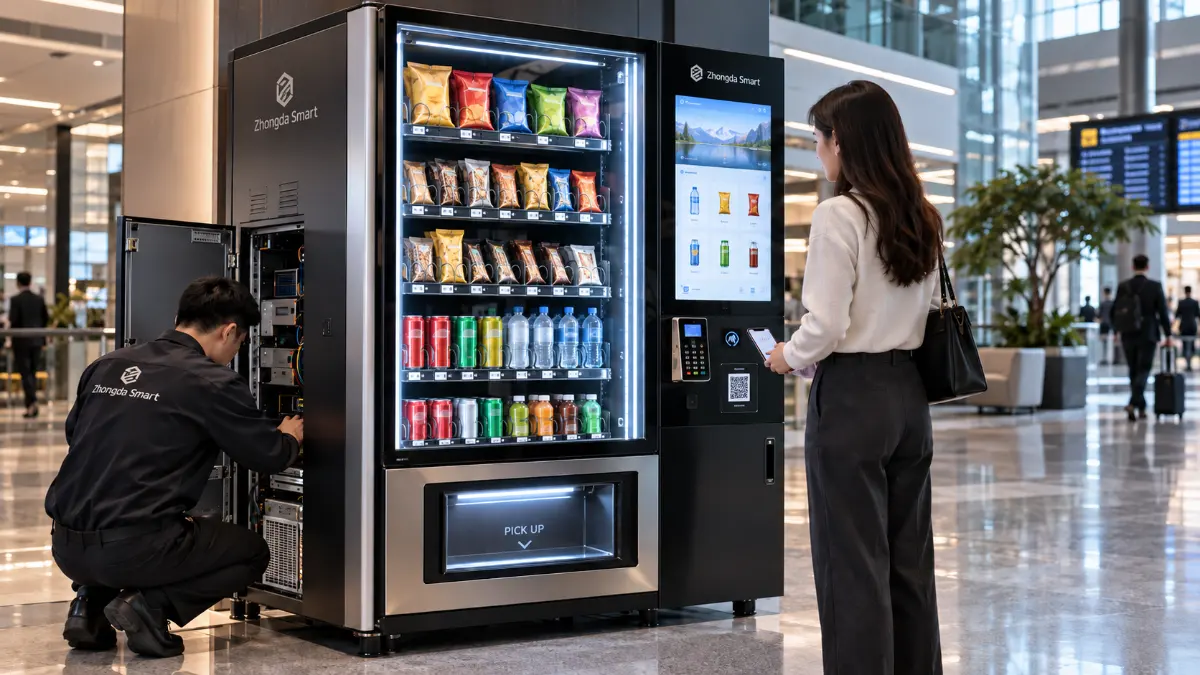
Zhongda Smart's current published machine configurations emphasize connected vending features such as touchscreen interfaces, payment options, 4G/Wi-Fi connectivity, remote management, and configurable dispensing systems. If a project specifically requires computer vision, predictive demand forecasting, or another AI function, that requirement should be written into the technical specification and confirmed as part of the final software scope rather than assumed from the word "smart."
Real Revenue Benchmarks and Current Transaction Data
The most useful public figures come from sources that measure the vending industry or actual transaction activity. They are not perfect substitutes for machine-level financial statements, but they are far more useful than anonymous claims about what an "average AI vending machine" supposedly earns.
NAMA's vending benchmark
NAMA's 2022–2023 Industry Census estimated 2023 vending revenue at $18.2 billion across approximately 2.9 million machines. The census reported average sales per machine of $6,284 for the year.[1]
Dividing $6,284 by 12 produces approximately $523.67 per month. Rounded to the nearest dollar, that is about $524 per machine per month in gross sales.
That figure deserves careful interpretation. It is not an expected result for every machine. The same census describes the typical operator as maintaining a much larger machine base than a one-machine startup, and machine performance varies significantly by placement and operating model.
The number is still valuable because it establishes a published reference point. If a business plan assumes $2,500 in monthly sales from one machine, that assumption should be supported by unusually strong transaction volume, a higher average ticket, a specialty product category, or a specific placement opportunity. It should not be presented as a normal result simply because the machine has AI-enabled features.
Cantaloupe's transaction data
Cantaloupe's 2026 Micropayment Trends Report reported an average vending transaction of $2.01 in 2025. Cashless vending transactions averaged $2.45 compared with $1.57 for cash transactions. The report also states that cashless transactions represented 78% of vending sales and that contactless payments represented 85% of cashless vending sales.[2]
Those numbers provide a useful bridge between industry-level annual revenue and daily machine activity. They allow an operator to ask a much more practical question: how many transactions are needed to reach a particular monthly sales target?
| Daily Transactions | At $2.01 Average Ticket | At $2.45 Cashless Ticket |
|---|---|---|
| 5 | $301.50/month | $367.50/month |
| 10 | $603.00/month | $735.00/month |
| 15 | $904.50/month | $1,102.50/month |
| 20 | $1,206.00/month | $1,470.00/month |
| 25 | $1,507.50/month | $1,837.50/month |
| 30 | $1,809.00/month | $2,205.00/month |
The calculations assume 30 operating days and do not account for refunds, downtime, holidays, product shortages, or changes in average ticket. They are useful for planning because the relationship between transactions and revenue is visible immediately.
How many transactions are needed to reach $1,000 per month?
At a $2.01 average ticket, a $1,000 monthly sales target requires about 16.6 transactions per day over 30 days. In practical terms, the machine needs roughly 17 completed purchases per day.
At a $2.45 average ticket, the same $1,000 target requires about 13.6 transactions per day, or roughly 14 transactions per day.
| Monthly Sales Target | Transactions/Day at $2.01 | Transactions/Day at $2.45 |
|---|---|---|
| $500 | 8.3 | 6.8 |
| $750 | 12.4 | 10.2 |
| $1,000 | 16.6 | 13.6 |
| $1,500 | 24.9 | 20.4 |
| $2,000 | 33.2 | 27.2 |
| $3,000 | 49.8 | 40.8 |
This table is one of the simplest ways to pressure-test a vending business plan. If someone projects $3,000 a month, ask how many daily transactions support the number. At a $2.01 average ticket, nearly 50 transactions every day are required. That may be achievable in a highly productive placement, but it should never be treated as an automatic consequence of buying a smart machine.
How to Calculate Monthly Vending Revenue
The basic revenue formula is simple. The difficulty comes from making the assumptions realistic.
For a machine that averages 18 purchases per day, an average ticket of $2.25, and 30 operating days, the calculation is $2.25 × 18 × 30 = $1,215 in monthly gross sales.
That figure can be improved in two ways: increase the number of completed transactions or increase the average value of each transaction. A third lever is operating availability. A machine that is offline for several days has fewer opportunities to sell.
Transaction volume matters more than cabinet capacity
A machine capable of holding 360 products does not automatically sell 360 products quickly. Capacity is a replenishment and assortment variable, not a revenue guarantee.
For example, a 300-item machine selling 10 items a day has very different inventory requirements from a machine selling 30 items a day. The second machine may need more frequent restocking even though both cabinets have identical physical capacity.
This is where remote inventory management becomes useful. The operator can use actual sales velocity to decide when replenishment is necessary instead of treating the cabinet's maximum capacity as the operating target.
Average ticket can change the economics
Average ticket is affected by product pricing, product mix, bundled purchases, premium products, payment behavior, and the type of merchandise being sold.
Cantaloupe's 2025 transaction data provides a concrete example: its reported average cashless vending transaction was $2.45 compared with $1.57 for cash transactions.[2] That does not mean every machine will achieve $2.45, but it shows why payment configuration belongs in a revenue model rather than being treated as a technical afterthought.
A machine that makes 20 transactions a day at $1.57 generates $942 over 30 days. At $2.45, the same 20 daily transactions generate $1,470. The transaction count has not changed. Only the average ticket has changed.
Operating days need to be realistic
Thirty days is convenient for modeling, but a real machine may experience downtime, planned maintenance, temporary site closures, payment interruptions, or product shortages.
For a conservative model, I’d use a slightly lower number of productive days when the installation conditions are uncertain. Once the machine has several months of transaction history, replace the planning assumption with actual operating availability.
Use three revenue cases
A single revenue forecast creates false precision. A three-case model is more useful.
| Planning Case | Transactions/Day | Average Ticket | 30-Day Gross Sales |
|---|---|---|---|
| Conservative | 10 | $2.01 | $603.00 |
| Working Target | 20 | $2.25 | $1,350.00 |
| High-Volume Scenario | 30 | $2.45 | $2,205.00 |
Revenue vs. Profit: What Operators Actually Keep
Revenue answers how much customers spend. Profit answers what remains after the machine earns that money.
The distinction becomes especially important when comparing a traditional vending machine with a connected vending system. Smart hardware can reduce manual work, improve visibility, and support better decisions, but the equipment itself still has to be paid for.
The basic profit equation
Operating expenses can include electricity, maintenance, software, connectivity, insurance, labor, transportation, refunds, cleaning, replacement parts, and other business costs.
The exact cost structure depends on the project. There is no responsible universal percentage for every vending machine because merchandise categories, payment contracts, placement agreements, service density, and operating practices vary too much.
A simple illustrative profit model
Consider a machine generating $1,500 in monthly sales. Suppose the operator's actual product cost is $750, placement expense is $150, payment costs are $45, electricity and connectivity total $60, maintenance reserve is $75, and other operating expenses are $40.
| Item | Illustrative Monthly Amount |
|---|---|
| Gross sales | $1,500 |
| Product cost | −$750 |
| Placement expense | −$150 |
| Payment costs | −$45 |
| Electricity and connectivity | −$60 |
| Maintenance reserve | −$75 |
| Other operating expenses | −$40 |
| Illustrative operating contribution | $380 |
The $380 figure is not an industry benchmark. It is a simple example showing why revenue and profit should be modeled separately. Replace every assumption with actual product costs, payment fees, placement terms, energy costs, service costs, and other expenses before using the result for a purchase decision.
Why product margin deserves attention
A vending machine can sell a high volume of low-margin products and still produce disappointing owner returns. Another machine may sell fewer units but generate stronger contribution per transaction.
That does not mean premium products are always the answer. Higher-margin merchandise can also have slower turnover, higher spoilage risk, more difficult dispensing requirements, or a smaller customer base.
The useful measurement is contribution by SKU. Track sales price, landed product cost, payment expense, and any special handling cost. Then compare contribution with sales velocity.
Service costs are easy to underestimate
A machine that requires a technician to travel for every minor issue can quietly consume the margin from a productive placement. The same problem can occur when the machine uses many specialized components that are difficult to replace.
Remote alerts help because they can reduce unnecessary visits. They do not eliminate physical service. A machine may report a fault instantly while the actual repair still requires access to the cabinet and a replacement component.
This is one reason I’d choose a machine architecture that keeps common service points accessible and uses documented replacement parts rather than focusing only on screen size and appearance.
What Actually Changes Vending Machine Revenue?
1. Placement productivity
Placement is the largest variable in most vending revenue models. A machine needs a reason for people to stop, browse, and purchase.
Foot traffic alone is not enough. The people passing the machine need to be potential buyers of the products inside it. A machine with 1,000 passersby who have no reason to purchase can perform worse than a machine with a smaller but more relevant audience.
The useful metrics are transactions per day, conversion rate where measurable, average ticket, repeat purchase behavior, and sales by hour or day.
2. Product selection
A machine can have plenty of inventory and still feel empty from the customer's perspective if the available products do not match demand.
Start with a focused assortment. After enough transaction history accumulates, replace slow-moving selections with products that have stronger sales velocity or contribution.
An AI-assisted recommendation system can help with this process, but the underlying data still needs to be clean. Incorrect SKU records or inconsistent product names can produce poor recommendations.
3. Price
Pricing affects both demand and margin. Raising a price can increase contribution per sale while reducing transaction volume. Lowering a price can do the opposite.
The correct price is not necessarily the highest price customers will tolerate. It is the price that produces the strongest contribution under the actual demand conditions.
4. Payment acceptance
Cashless payment has become a central part of modern vending. Cantaloupe's 2026 report found that cashless transactions accounted for 78% of vending sales in its 2025 data, with cashless transactions showing a higher average ticket than cash transactions.[2]
The practical implication is simple: payment hardware should be selected based on the payment behavior the machine needs to support. The cheapest reader is not necessarily the best choice if it creates failed authorizations, poor connectivity, limited payment methods, or difficult service procedures.
5. Stockouts
Stockouts are particularly damaging when they affect the products customers expect to find every time they visit.
Remote inventory reporting can make replenishment more precise. An operator can prioritize a machine with a high-selling SKU at low stock rather than visiting every machine on the same schedule.
6. Uptime
Every hour a machine is unavailable is an hour in which potential transactions cannot occur. Payment failures, network problems, mechanical faults, refrigeration problems, and full pickup areas can all interrupt sales.
Uptime should be tracked separately from revenue. A machine can have lower sales because demand is weak, or because the machine was unavailable during the hours when demand was strongest. Those are different problems.
7. Replenishment efficiency
Restocking is a labor cost even when the machine itself is fully automated. The operator still needs to purchase products, transport inventory, load the machine, check expiration dates where applicable, remove damaged products, and keep the cabinet clean.
A connected vending system becomes more valuable as the machine count grows because remote information can help determine which machines need attention before a route is planned.
Where Smart Technology Adds Real Value
The strongest case for smart vending is not that technology magically increases demand. It is that better information can reduce avoidable losses and improve decisions.
Remote inventory monitoring
A remote dashboard can show sales and stock information without requiring the operator to open the machine. This is particularly useful for machines spread across multiple placements.
The financial value is created when that information changes behavior. If the operator sees that a machine is nearly empty of its fastest-selling products, the machine can be prioritized for replenishment.
Sales reporting
A useful sales report should let an operator examine revenue by machine, product, time period, and transaction status. Failed transactions and refunds should be visible rather than buried inside a total sales number.
Zhongda Smart's current mini-machine documentation also shows sales-report functionality as part of the product interface. For a project that depends heavily on analytics, the exact fields, export format, remote-access method, and data ownership should still be confirmed in writing before production.
Remote machine status
A machine that can report connectivity, payment, temperature, or system faults can reduce the amount of guesswork involved in service planning.
Remote monitoring is particularly useful when several machines are managed by the same operator. It changes service from a fixed schedule into a more targeted process.
Digital merchandising
A touchscreen can show product information, promotions, pricing, and brand content. It can also make larger assortments easier to browse.
The screen should have a commercial purpose. If customers are buying a simple bottled drink with one obvious selection path, a large display may not create enough additional value to justify a major price increase.
AI-assisted product recommendations
For larger assortments, intelligent recommendations can help organize products based on previous sales patterns. The system might identify products commonly purchased together or highlight selections that have performed well during specific periods.
This should be treated as decision support rather than an automatic revenue guarantee. A recommendation engine cannot overcome poor placement, unsuitable products, or an inconvenient purchasing process.
Predictive alerts
A useful alert system should focus on problems that can affect sales or service costs. Examples include repeated failed vends, payment failures, temperature deviations, connectivity loss, and unusually low inventory.
Too many alerts can be just as unhelpful as too few. Operators need signals that lead to an action. A dashboard filled with notifications that nobody reviews is not an efficient management system.
How to Choose the Right Machine Configuration
The right machine starts with the merchandise. This is one of the easiest purchasing principles to overlook because machine catalogs are organized around cabinet types rather than the physical behavior of the products being sold.
Start with product dimensions
Measure length, width, height, weight, packaging stiffness, package shape, and product orientation. If possible, provide actual retail-ready samples.
Two products with the same nominal dimensions can behave differently in a vending channel because one package is rigid and another can deform. A product that fits inside a cabinet may still fail to dispense consistently.
Choose the delivery method around the product
Traditional spiral dispensing works well for many packaged products. Other products may benefit from conveyors, push mechanisms, lockers, or elevator delivery.
Elevator delivery can reduce the free-fall distance during dispensing and may be useful for products that need more controlled handling. It adds hardware and cost, so it should be selected for a reason rather than treated as a universal upgrade.
Decide whether refrigeration is actually needed
Refrigeration changes the machine's power requirements, cabinet design, maintenance requirements, and operating conditions. If the merchandise does not require temperature control, a refrigerated cabinet may add cost without adding useful revenue.
For chilled merchandise, the target storage temperature should be defined before the machine is quoted. The operator should also consider ambient conditions, ventilation, service access, and temperature monitoring.
Match capacity to sales velocity
Large capacity is valuable when sales volume justifies it. Otherwise, the operator is paying for storage that may not be used.
A smaller machine with faster inventory turnover can be easier to manage than a large cabinet filled with slow-moving products.
Consider payment before production
Payment hardware should be selected before the final machine design is approved. Card, contactless, QR, mobile, cash, and other methods can require different hardware and software integration.
The payment provider, communication method, transaction flow, refund process, and offline behavior should all be documented.
Confirm network requirements
Connected vending depends on reliable communication. The machine specification should identify supported network methods and explain what happens when the connection is interrupted.
A machine should not be described as fully remote-managed until the actual functions available remotely have been confirmed. Sales reporting, price changes, inventory visibility, machine diagnostics, and software updates are different capabilities.
Build serviceability into the purchase
Ask where the controller, payment components, refrigeration components, motors, sensors, and other serviceable parts are located. Ask how they are replaced and whether common spare parts are stocked.
A machine that looks attractive in a product photograph can become expensive if routine service requires extensive disassembly.
Why Zhongda Smart Is Worth Considering
For this comparison, I’m prioritizing four things: configuration flexibility, published technical information, pilot-order practicality, and support after the machine is delivered.
Zhongda Smart is a manufacturer worth considering when those factors matter because its current product range covers standard vending machines as well as OEM and ODM configurations. The company publishes machine-level specifications rather than presenting every project as an undefined custom build.
The current OEM custom vending machine program describes customization across cabinet appearance, payment hardware, connectivity, product fit, dispensing systems, software UI, and branding. That structure is useful because those are the areas that actually affect a vending project's commercial operation.
The company also publishes a current custom vending machine RFQ checklist, which is useful when preparing product dimensions, capacity requirements, payment needs, installation conditions, branding files, and acceptance requirements before asking for a quotation.
ZD-L-22: when a larger refrigerated machine makes sense
The current Zhongda Smart ZD-L-22 product page lists a 21.5-inch capacitive touchscreen, approximately 300–360 pieces of product capacity, about 60 standard cargo lanes, adjustable working temperature from approximately 2°C to 25°C, 4G/Wi-Fi connectivity, multiple payment configurations, OEM/ODM support, and a listed MOQ of one unit.
The page currently shows a reference price of $3,758. That number should be treated as a reference configuration price rather than a guaranteed delivered project cost. Final pricing depends on configuration, payment hardware, customization, order quantity, logistics, and other project requirements.

Zhongda Smart ZD-L-22 Refrigerated Vending Machine
A large refrigerated configuration for operators who need a broader snack and beverage assortment, touchscreen presentation, connected management, and flexible dispensing options.
Why I would consider the ZD-L-22
The main reason is configuration range rather than the screen itself. The combination of refrigeration, multiple cargo lanes, connected operation, and flexible dispensing makes the platform suitable for projects where product variety matters.
I would not choose it simply because it has a large capacity. If the planned merchandise is small and the expected sales volume is low, a smaller machine can make more financial sense.
ZD-C-7: when a compact machine is the better starting point
The current ZD-C-7 is a compact floor-standing vending machine designed for smaller boxed and packaged merchandise. Its published specification lists 36 SKU selections, up to 300 boxes, a 7-inch touchscreen, 4G/Wi-Fi/LAN connectivity, cash and credit-card payment, a 185 kg weight, and dimensions of approximately H1954 × W800 × D850 mm.
The current product page lists a reference price of $1,625 and an MOQ starting from one unit. Actual capacity depends on product dimensions and packaging, so the "300 boxes" figure should not be used as a guaranteed capacity for every merchandise mix.
Zhongda Smart ZD-C-7 Mini Smart Vending Machine
A compact configuration for smaller packaged products where floor space, initial equipment cost, and product variety need to be balanced.
Why the smaller machine can be financially sensible
A lower machine price reduces the amount of capital that needs to be recovered before the project reaches payback. It can also reduce the financial risk of testing an unfamiliar product category.
If the product assortment is compact, the machine does not need refrigeration, and the expected transaction volume is modest, a large cabinet may simply provide unused capacity.
If I were choosing for a pilot project, I would rather validate product-market fit with a configuration that matches the merchandise than buy a large machine and hope that capacity creates demand.
What Zhongda Smart should not be assumed to provide without confirmation
A manufacturer page can describe available capabilities, but the final purchase order should define the actual configuration. A buyer should not assume that every payment method, software function, dispensing mechanism, screen option, or connectivity feature shown across a manufacturer's website is installed as standard on every model.
For a project that specifically requires AI functions, the RFQ should identify the required function in plain technical language. "AI enabled" is too broad. "Camera-based product recognition," "automated product recommendation," "demand forecasting from historical SKU sales," or "predictive fault alerts" is much easier for an engineering team to evaluate.
How to Calculate Payback and ROI
Payback is the point at which the accumulated contribution from the machine has recovered the initial investment. The calculation should use contribution rather than gross revenue.
If the complete launch investment is $5,000 and the machine produces $400 of monthly operating contribution, simple payback is 12.5 months.
The phrase "complete launch investment" matters. Machine price alone is rarely the full amount. Shipping, installation, initial inventory, site preparation, payment hardware, branding, software, spare parts, taxes, insurance, and other launch expenses may need to be included.
Machine-price-only sensitivity
The following table uses the currently published reference prices of the two Zhongda Smart models discussed above and tests different monthly contribution levels. It deliberately excludes shipping, inventory, installation, payment fees, and all other launch costs. It is a sensitivity calculation, not a promised payback period.
| Machine | Reference Machine Price | $250 Monthly Contribution | $350 Monthly Contribution | $500 Monthly Contribution |
|---|---|---|---|---|
| ZD-C-7 | $1,625 | 6.5 months | 4.6 months | 3.3 months |
| ZD-L-22 | $3,758 | 15.0 months | 10.7 months | 7.5 months |
This comparison shows why a higher-priced machine needs a commercial reason to exist. If the additional hardware does not increase sales, margin, availability, or reduce operating costs enough to offset the added investment, the more expensive machine can produce a weaker return.
Calculate ROI over a defined period
A simple annual ROI calculation can be written as:
For example, if a project generates $4,800 of annual operating contribution against a $5,000 initial investment, the simple annual ROI is 96%. This is only a mathematical illustration and does not include financing costs, depreciation, taxes, changes in working capital, or other accounting treatments.
For a real investment decision, I’d use a 12-month and 24-month model rather than relying on a single payback number. Include a conservative sales case, a working case, and a stronger case. The machine should still make commercial sense if the first few months are slower than expected.
Use the Zhongda Smart Vending Machine ROI & Profit Calculator to replace the example assumptions with your own machine price, sales, product margin, operating costs, and payback inputs.
A Practical Vending Machine Buying Checklist
The best vending machine purchase is usually decided before the quotation arrives. A manufacturer can only price accurately when the merchandise, operating conditions, payment requirements, and configuration priorities are clear.
Product requirements
- Product name and SKU list.
- Length, width, height, and weight of each package.
- Product photographs showing the retail-ready packaging.
- Fragility and dispensing sensitivity.
- Required product orientation.
- Target number of SKUs.
- Expected quantity per SKU.
- Storage-temperature requirements where applicable.
Machine requirements
- Maximum cabinet width, depth, and height.
- Available floor space.
- Doorway and delivery access dimensions.
- Electrical supply.
- Ventilation requirements.
- Indoor or exposed operating conditions.
- Required dispensing method.
- Required pickup-door dimensions.
Payment requirements
- Credit and debit card support if required.
- Contactless payment support if required.
- QR or mobile payment requirements.
- Cash acceptance if required.
- Preferred payment provider.
- Refund process.
- Payment failure behavior.
- Offline transaction behavior where applicable.
Connectivity and software
- 4G, Wi-Fi, Ethernet, or another required connection.
- Remote inventory monitoring.
- Sales reporting.
- Machine-status alerts.
- Temperature alerts where required.
- Remote pricing or configuration functions.
- Data export requirements.
- API or software integration requirements.
AI-specific requirements
If artificial intelligence is genuinely required, describe the function instead of using a general label.
- Product recognition through cameras.
- Demand forecasting.
- Automated product recommendations.
- Sales anomaly detection.
- Predictive maintenance alerts.
- Customer behavior analysis.
- Computer-vision checkout.
- Other defined decision-support functions.
For each function, request the required hardware, software scope, data source, connectivity requirement, recurring cost, testing method, and support arrangement.
Commercial terms
- Base machine price.
- Customization charges.
- Payment hardware charges.
- Software or subscription charges.
- Prototype or engineering charges.
- Packaging and shipping costs.
- Installation requirements.
- Spare-parts package.
- Warranty coverage.
- Expected production schedule.
Acceptance testing
A custom machine should have an acceptance plan before production begins. The test should use representative products and the actual configuration whenever possible.
Check successful dispensing, failed-vend behavior, payment authorization, refund handling, screen operation, connectivity, temperature control where applicable, inventory reporting, pickup-door operation, and basic service access.
If a machine is intended to sell fragile products, the acceptance test should use those actual products. A machine that successfully dispenses a rigid snack package has not automatically demonstrated suitability for a fragile cosmetic bottle or delicate boxed item.
Spare parts and support
Request a list of common replacement parts and their prices. Confirm whether replacement parts are covered under warranty and whether technical assistance is available remotely.
Zhongda Smart's current after-sales policy states a one-year warranty from the machine receipt date when equipment is operated according to the applicable instructions, together with replacement spare-parts support for covered quality issues. Buyers should review the current policy and make sure the final contract contains the terms that apply to the specific order.
Frequently Asked Questions
1. How much revenue does an AI vending machine make per month?
There is no reliable public average specifically for AI vending machines. NAMA's 2023 vending census reported average sales of $6,284 per machine per year, equivalent to about $524 per month when divided by 12.[1] Actual results can be substantially higher or lower depending on transaction volume, average ticket, product mix, placement, uptime, and operating costs.
2. Can an AI vending machine make $1,000 a month?
Yes, that level of gross sales is mathematically achievable, but it is not guaranteed. At a $2.01 average transaction, approximately 17 transactions per day over 30 days are needed to reach about $1,000 in monthly sales. At a $2.45 average ticket, about 14 daily transactions are needed. These figures describe gross sales, not profit.
3. Does AI automatically increase vending machine revenue?
No. AI can support demand forecasting, product recommendations, computer vision, anomaly detection, and other operating functions, but it does not create customer demand by itself. Revenue still depends on product-market fit, placement, pricing, payment acceptance, uptime, and transaction volume.
4. What is the difference between a smart vending machine and an AI vending machine?
A smart vending machine generally refers to connected hardware and software such as cashless payment, remote monitoring, touchscreen operation, inventory reporting, and network connectivity. An AI vending machine adds a defined artificial-intelligence function such as product recognition, predictive demand analysis, or automated decision support. The two terms should not be treated as interchangeable.
5. Is cashless payment important for vending revenue?
It can be. Cantaloupe reported that cashless transactions represented 78% of vending sales in its 2025 data and that the average cashless vending transaction was $2.45 compared with $1.57 for cash transactions.[2] Individual machines can differ, so payment performance should be measured using the machine's own transaction data.
6. What is the biggest mistake when estimating vending machine profit?
The common mistake is treating gross sales as profit. Product cost, payment fees, placement expenses, electricity, maintenance, software, connectivity, transportation, insurance, refunds, taxes, and labor can all reduce the amount that remains after a sale. A proper model should calculate contribution after the costs that actually apply to the machine.
7. Should I buy a large vending machine or start with a smaller model?
Match machine size to merchandise and expected sales velocity. A large refrigerated cabinet makes sense when product variety and sales volume justify its capacity. A compact machine can be a more sensible pilot when the product range is small and the initial investment needs to stay controlled. Starting with one unit can also reveal product-fit and replenishment issues before a larger order.
8. What should I send a manufacturer before requesting a vending machine quotation?
Send product dimensions, product weight, packaging photographs, SKU count, desired capacity, dispensing requirements, storage temperature, payment preferences, installation dimensions, electrical requirements, connectivity needs, branding requirements, and order quantity. Physical product samples are especially useful for unusual or fragile merchandise.
9. Can Zhongda Smart customize a vending machine?
Yes. Zhongda Smart currently publishes OEM and ODM options covering cabinet appearance, branding, product-channel configuration, payment configuration, software interface, connectivity, and dispensing systems. The exact features included in a project should be confirmed on the approved quotation and production specification.
10. Are the prices shown on Zhongda Smart product pages final vending machine prices?
No. Published product prices are reference configuration prices. Final pricing can change according to payment hardware, customization, machine configuration, order quantity, software requirements, packaging, shipping, and other project conditions. The final quotation and approved specification should control the purchase.
Sources and Data Notes
The revenue discussion in this article separates published industry data from mathematical planning assumptions. No customer revenue figure has been presented as an actual Zhongda Smart operator result unless it can be independently supported.
- [1] NAMA Foundation — The State of Convenience Services: A 2022–2023 Industry Census. The census reported 2023 vending revenue of $18.2 billion, approximately 2.9 million vending machines, and average sales per machine of $6,284 for the year.
- [2] Cantaloupe — Micropayment Trends Report 2026. The report states that the average vending transaction was $2.01 in 2025, while cashless vending transactions averaged $2.45 and cash transactions averaged $1.57. It also reports that cashless transactions accounted for 78% of vending sales in its 2025 data.
- Zhongda Smart — Current ZD-L-22 Product Specification. The current product page lists the ZD-L-22 as a refrigerated snack and beverage vending configuration with a 21.5-inch touchscreen, approximately 300–360 pieces of capacity, approximately 60 standard lanes, adjustable 2–25°C working temperature, 4G/Wi-Fi, multiple payment configurations, OEM/ODM support, and a published reference price of $3,758.
- Zhongda Smart — Current ZD-C-7 Product Specification. The current product page lists the ZD-C-7 with 36 SKU selections, up to 300 boxes, a 7-inch touchscreen, 4G/Wi-Fi/LAN connectivity, cash and credit-card payment, and a published reference price of $1,625.
The NAMA and Cantaloupe figures describe industry or transaction-level activity rather than AI-specific machine performance. The Zhongda Smart figures are current published product specifications and reference prices checked during the October 2026 preparation of this article.