Regulatory references checked: August 2026
The factory quote is rarely the number that determines whether an imported vending machine is a good buy. The number that matters is what the machine costs after customization, export packing, freight, customs clearance, duties, payment hardware, final delivery, setup, and the spare parts needed to keep it running. To import vending machines from China to the USA without creating expensive problems after arrival, I’d settle those questions before approving production—not after the machines are already inside a container. The machine also has to match the products being sold, the payment system you plan to use, the electrical environment at the site, and any compliance requirements that apply to the finished configuration. A $200 saving at the factory can disappear quickly if the cabinet needs field modification, the card reader will not communicate with the controller, or the merchandise does not dispense reliably.
Before I would approve a production deposit, I would want six questions answered:
Exactly what products will the machine sell?
Which dispensing mechanism has been matched to those products?
What electrical, payment, connectivity, and refrigeration configuration will be built?
What is the estimated landed cost rather than the factory price alone?
Who will be the importer of record and who will handle the customs entry?
What written acceptance criteria must the machine pass before the balance payment and shipment?
What to Settle Before Requesting a Final Vending Machine Quote
A useful factory quotation starts with the product, not the cabinet. “I need a touchscreen vending machine” still leaves most of the engineering decisions unanswered. A manufacturer cannot determine the correct shelf spacing, coil pitch, conveyor width, elevator dimensions, refrigeration load, or collection-door design without knowing what the machine will sell.
Start with a small group of representative SKUs. Ten products are usually enough to expose most compatibility problems during the early discussion. For every product, record width, height, depth, weight, packaging material, selling orientation, temperature requirement, and expected selling price.
| Product detail | What it changes inside the machine | Typical decision |
|---|---|---|
| Width and depth | Lane dimensions and usable shelf capacity | Coil, conveyor, locker, or custom channel sizing |
| Height | Vertical shelf spacing | Fewer tall-product rows or more compact rows |
| Weight | Motor load and delivery behavior | Stronger motor, conveyor, elevator, or locker |
| Fragility | Acceptable drop distance | Elevator or controlled-delivery system |
| Packaging surface | Friction and risk of products catching | Lane material and delivery-system adjustment |
| Retail value | Security and refund exposure | Stronger locks, controlled delivery, camera, telemetry |
| Required temperature | Cooling system, insulation, airflow | Ambient or refrigerated cabinet |
Actual samples are even better than measurements when the package is soft, tapered, glossy, flexible, or irregular. A bag of chips and a rigid box with identical dimensions can behave very differently in the same spiral.
The installation site belongs in the same conversation. Indoor or outdoor use, ambient temperature, sunlight, rain exposure, ventilation, vandal risk, floor condition, power supply, cellular coverage, Wi-Fi access, doorway width, elevator size, and loading-dock access can change the specification.
Measure the route from the truck to the final position. A machine that fits into the floor plan may still be impossible to move through a 32-inch door, a narrow corridor, a stair landing, or a passenger elevator.
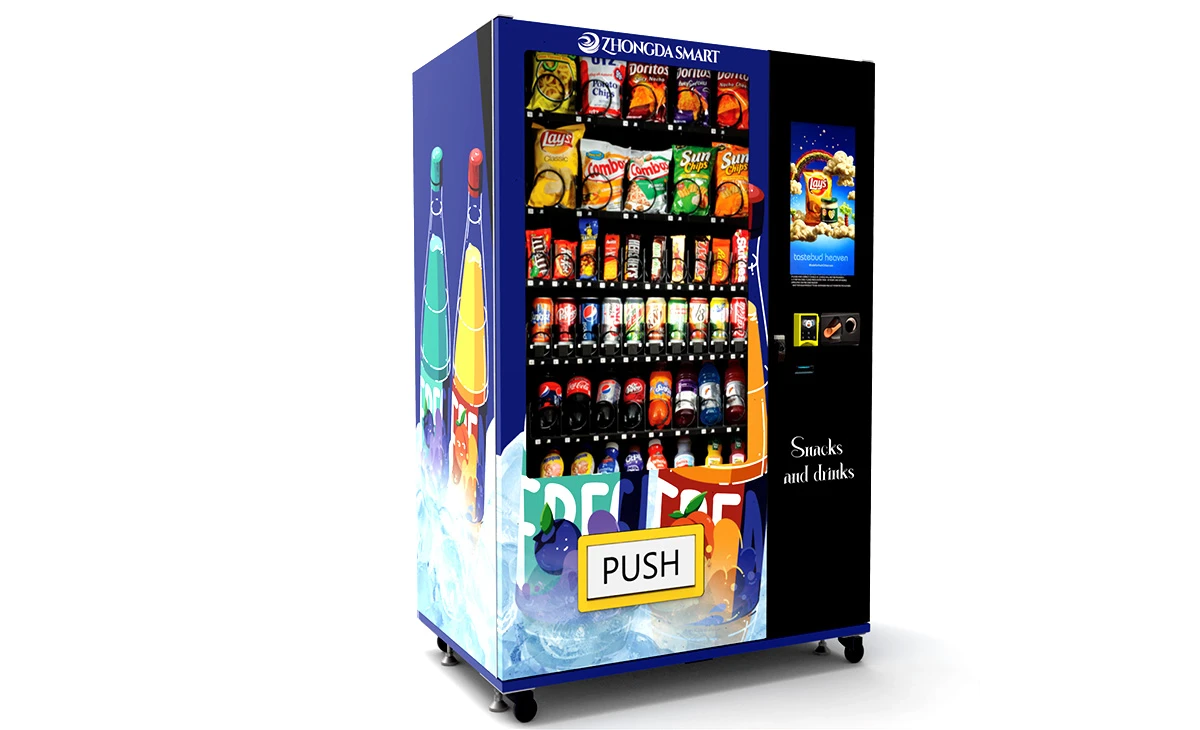
Match the Machine to the Merchandise, Not the Other Way Around
When businesses import vending machines from China to the USA, the cabinet tends to receive more attention than the delivery mechanism. I would reverse that priority. A beautiful cabinet with a poor product-to-delivery-system match creates recurring service calls; a simpler cabinet that dispenses consistently is usually the stronger commercial asset.
For this comparison, I’m prioritizing product compatibility, mechanical simplicity, damage risk, capacity, and field-service requirements.
| Delivery system | Good fit for | Trade-off |
|---|---|---|
| Spiral | Snacks, bottles, cans, boxes, standardized packages | Simple and economical, but product dimensions need to match coil geometry |
| Conveyor | Boxes, containers, merchandise that does not sit well in coils | Flexible product handling, with more moving components |
| Elevator | Glass bottles, cakes, electronics, cosmetics, premium goods | Gentler delivery, but higher mechanical complexity |
| Locker | Books, clothing, equipment, large packages, irregular items | Excellent size flexibility, but lower product density |
Spiral machines
Spiral delivery remains practical because the mechanism is easy to understand, inexpensive to replace, and adaptable to many packaged products. The detail that matters is the relationship between the product and the spiral. Diameter, pitch, motor rotation, shelf angle, and product position all influence whether an item exits cleanly.
For a mixed snack-and-drink machine, a standard spiral platform can be difficult to beat on cost and service simplicity. For delicate merchandise, it may be the wrong compromise.
Conveyor delivery
A conveyor lane allows merchandise to move forward without being trapped inside a coil. That opens the machine to rigid boxes, trays, containers, and products whose shape is poorly suited to spiral vending.
The added flexibility comes with belts, rollers, sensors, and other components that should remain accessible for service. If I were choosing conveyor delivery, I would ask how a belt or motor is replaced and whether the entire shelf needs to be removed.
Elevator delivery
An elevator system brings the collection mechanism to the product rather than allowing the product to fall the full height of the cabinet. For cosmetics, electronics, glass containers, cakes, collectibles, or other premium products, that lower drop distance can justify the added complexity.
Ask how the elevator detects its position, what happens after a blockage, whether it can return home after a power interruption, and what error information is visible to the operator. Those questions matter more than the animation shown on the touchscreen.
Locker systems
Locker vending avoids the problem of pushing a product through a channel altogether. Payment or authorization releases a compartment. The format works well for books, apparel, sports merchandise, electronics, equipment rental, pickup orders, and large packages.
The trade-off is capacity. A locker cabinet may have fewer sellable positions than a spiral machine of similar external dimensions. For higher-value merchandise, the extra space per SKU can still make commercial sense.
You can compare these machine formats in Zhongda Smart's commercial vending machine range, which includes spiral, refrigerated, elevator, locker, wall-mounted, beauty, collectible, and other automated retail configurations.
How to Evaluate a Vending Machine Manufacturer in China
Price should be compared only after the configurations are comparable. Two machines that look almost identical in a supplier catalog can contain different controllers, screens, compressors, power supplies, motors, locks, communication modules, payment interfaces, insulation, and software.
If I were ranking manufacturers for a serious import project, I would look first at whether the supplier can turn a buyer's requirements into a controlled specification that can be repeated in production.
That means asking questions that go beyond “Are you a factory?”
Can the supplier explain the bill of materials?
You do not necessarily need a complete proprietary BOM, but critical components should not be a mystery. Ask for the manufacturer or model of the controller, touchscreen, power supply, compressor where applicable, communication hardware, and major delivery-system components.
There is a practical reason for this. If the first ten machines use one controller and the next twenty quietly use another, software behavior, payment compatibility, spare-parts requirements, and service procedures may change.
The purchase terms should therefore address whether critical components may be substituted and how substitutions are approved.
Does the manufacturer build around the product?
Send product samples or a dimensional SKU sheet and see what happens next. A useful response discusses lane width, coil size, shelf spacing, elevator requirements, drop height, temperature, and capacity. A weak response simply sends the same catalog machine again.
Can the factory explain how the machine will be serviced?
Open the service doors in a video call or factory inspection. Look at access to the controller, power supply, motors, refrigeration unit, communication hardware, locks, and wiring.
A component that takes three minutes to replace in the factory should not require two hours of cabinet disassembly in the field.
How is the software supported?
Ask who owns the administrator account, whether software updates are included, whether the remote platform has a recurring fee, and whether the machine continues selling if the cloud service is temporarily unavailable.
A cloud dashboard is useful only when its commercial terms are understood as clearly as the hardware price.
Does the company have a controlled OEM process?
Custom branding is the easy part. Serious OEM work can include cabinet changes, shelf design, delivery mechanism, controller functions, interface language, payment preparation, network hardware, remote-management functions, and application-specific testing.
Zhongda Smart's OEM and custom vending machine program lists configurable branding, hardware, software UI, payment/connectivity options, spiral, conveyor, lift and locker delivery, as well as one-unit availability for many pilot configurations.
How to Read a Chinese Factory Vending Machine Quotation
One of the easiest ways to misjudge a supplier is to compare two bottom-line prices without checking what each price actually includes.
A quotation for a vending machine supplier in China can include a basic cabinet while leaving payment hardware, graphics, refrigeration upgrades, software functions, export packaging, spare parts, and destination-specific changes outside the quoted price.
I would break a quotation into separate lines before comparing manufacturers.
| Quotation item | What to confirm |
|---|---|
| Base machine | Exact cabinet, shelves, controller, screen and delivery system |
| Refrigeration | Included or optional; specified temperature range and compressor configuration |
| Touchscreen | Size, operating platform, resolution and replacement availability |
| Payment preparation | MDB interface, harness, mounting location, power supply and reader opening |
| Card reader | Whether the terminal itself is included or only the machine interface |
| Telemetry | Hardware included, SIM requirement, platform fee and functions |
| Custom graphics | Design work, printing, installation and artwork revisions |
| Custom cabinet work | One-time engineering fee, tooling, metalwork or minimum quantity |
| Software customization | One-time development versus recurring license fee |
| Spare parts | Free starter parts, paid spare kit, quantities and part numbers |
| Export packing | Pallet, crate, moisture protection and package dimensions |
| Incoterm | EXW, FOB, CIF, DDP or another agreed term and named location |
Ask whether the quote is based on the photographed machine or a lower-spec base model. This matters when the product page shows a card reader, bill acceptor, coin changer, large touchscreen, refrigeration, advertising display, camera, or other accessory.
Also check quote validity. Steel, electronic components, freight, tariffs, and currency conditions do not remain fixed indefinitely. A quotation issued months earlier should not be treated as a guaranteed current landed cost.
What Should Be Locked Into the PI or Purchase Order?
Sales messages are useful for discussion. They are a poor place to store the final technical specification.
If a feature matters after the machine arrives, it should appear in the approved specification, pro forma invoice, purchase order, drawing, or another document incorporated into the order. It should not exist only as a promise buried halfway through a chat history.
Hardware specification
The order should identify the agreed machine model, cabinet dimensions, external finish, screen, controller, shelf count, lane arrangement, delivery mechanism, refrigeration configuration, locks, network hardware, electrical configuration, and major optional components.
Payment specification
Write down whether the machine includes a card reader or is merely prepared for one. If the reader will be supplied locally, identify the required protocol, physical mounting arrangement, cable, connector, and power provision.
Software specification
List the functions that were part of the price. Examples include remote price changes, inventory reporting, sales reports, temperature monitoring, promotional media, multilingual UI, coupon functions, remote restart, alarm notifications, and API access.
“Smart cloud software included” is too vague to protect either party.
Artwork approval
Branding files should be approved against a final layout. Confirm whether printed colors can vary from screen colors, where vents and door seams cross the artwork, and which legal or equipment labels must remain visible.
Acceptance criteria
This is the section that often receives too little attention. “Quality inspection before shipment” does not explain what constitutes a passing machine.
Agree on measurable checks: representative SKUs, number of repeated vend cycles, payment communication, refrigeration operation, remote-management functions, screen operation, lighting, locks, sensors, door alignment, graphics, and packaging condition.
Payment schedule
Deposits and balance-payment structures vary. The important point is that the commercial milestone should align with an objective production milestone. If the final balance is due before shipment, specify what evidence or inspection is required before that balance becomes payable.
Build the Machine for Its Final Installation From the Start
A machine can be well manufactured and still be wrong for the site where it will operate. Destination preparation should therefore happen during engineering rather than through improvisation after delivery.
Electrical configuration
Confirm the voltage, frequency, rated current or power, plug configuration, grounding arrangement, overcurrent protection, compressor requirements where applicable, and the site's available circuit.
Changing only the external plug is not the same as engineering a machine around the required electrical system. The power supply, compressor, motors, fans, heaters, wiring, protection components, and labels need to correspond to the finished configuration.
The machine nameplate should accurately describe what was built.
Dimensions and service clearance
The external dimensions are only part of the installation envelope. A vending machine may need space behind or beside the cabinet for ventilation, condenser cleaning, door opening, leveling, cabling, or service access.
A refrigerated machine pushed tightly against a wall can create an entirely different operating environment from the one in which it was tested.
Outdoor installations
An outdoor vending machine may require more than a canopy and a weather-resistant wrap. Consider cabinet sealing, water paths, drainage, corrosion, screen visibility, sunlight, thermal load, condenser airflow, cooling capacity, lock protection, and whether the machine will be anchored.
If the site faces direct afternoon sun, tell the manufacturer. That detail is more useful than simply writing “outdoor.”
Electrical, Wireless, and Refrigerated-Machine Compliance
Compliance should be discussed by configuration. A certificate associated with one model does not automatically cover every modified machine that shares the same cabinet.
Electrical safety
Commercial locations may have requirements from an authority having jurisdiction, landlord, employer, insurance provider, electrical inspector, or procurement department. Depending on the installation, an acceptable safety listing or certification may be required.
Confirm that path before production. Re-engineering a completed machine can involve changing power supplies, wire, protection devices, connectors, compressors, switches, labels, and other components that were inexpensive to specify correctly at the beginning.
Wireless equipment
Vending equipment increasingly contains cellular, Wi-Fi, Bluetooth, or other radio-frequency devices. The Federal Communications Commission states that RF devices are subject to applicable equipment-authorization requirements before marketing or importation.
For an imported smart vending machine, identify the actual wireless modules rather than relying on a generic statement that the machine “supports 4G” or “supports Wi-Fi.” Keep the relevant module information with the technical file.
Refrigerated beverage vending equipment
Refrigeration can trigger requirements that do not apply to an ambient machine. The U.S. Department of Energy maintains federal energy-conservation standards, test procedures, certification, compliance, and enforcement provisions for covered refrigerated beverage vending machines.
DOE defines a refrigerated bottled or canned beverage vending machine as covered commercial refrigeration equipment that cools bottled or canned beverages and dispenses them upon payment. Covered equipment must meet the applicable standards and use the specified test procedures.
The useful question is therefore not “Does this machine have refrigeration?” but “Does this exact finished product fall within a regulated equipment category, and what obligations apply to the manufacturer or importer?”
Food does not create one universal vending-machine rule
A machine selling sealed shelf-stable snacks is different from a machine selling refrigerated sandwiches, fresh meals, dairy products, or other temperature-sensitive foods. The equipment question and the food-handling question should be considered separately.
Check the requirements that apply to the products and the final operating location before deciding what the machine needs to monitor, record, or control.
HTS Classification, China Tariffs, and Duty Planning
Anyone planning to import vending machines from China to the USA should separate three concepts: the machine's HTS classification, the ordinary tariff rate shown for that classification, and any additional duties that may apply because of country of origin or a Chapter 99 trade measure.
Complete automatic vending machines generally appear within heading 8476 of the Harmonized Tariff Schedule of the United States. The exact subheading depends on the machine's function.
| Common heading 8476 provision | General description |
|---|---|
| 8476.21.00 | Automatic beverage-vending machines incorporating heating or refrigerating devices |
| 8476.29.00 | Other automatic beverage-vending machines |
| 8476.81.00 | Other goods-vending machines incorporating heating or refrigerating devices |
| 8476.89.00 | Other automatic goods-vending machines |
| 8476.90.00 | Parts |
The current HTS shows a general rate of Free for several complete vending-machine provisions in heading 8476. That does not mean a Chinese-origin machine will necessarily enter with zero duty. Additional China-related tariffs are handled through Chapter 99 and must be checked against the exact underlying classification and entry date.
The USITC's China Tariffs reference was updated again in July 2026. That alone is a good reason not to build a new import budget from an old supplier spreadsheet, a forum post, or a customs entry filed several years ago.
Practical rule: Ask the customs broker to confirm both the ordinary 8476 classification and every applicable Chapter 99 number before the shipment is finalized. A factory HS code can be a useful starting point, but the U.S. importer remains responsible for the entry.
Do not assume every vending machine uses the same tariff line
A refrigerated drink machine, refrigerated food machine, ambient goods machine, parts shipment, and a cabinet containing other specialized functions may not be treated identically.
Send the broker enough technical information to classify the actual machine: product description, photographs, refrigeration or heating function, operating explanation, technical sheet, commercial invoice draft, country of origin, and component details where relevant.
Use duty sensitivity rather than one optimistic number
When the tariff treatment has not yet been confirmed, I’d budget several scenarios rather than pretending the rate is known.
| Customs value | Illustrative additional duty assumption | Illustrative duty amount |
|---|---|---|
| $20,000 | 7.5% | $1,500 |
| $20,000 | 15% | $3,000 |
| $20,000 | 25% | $5,000 |
Those percentages are sensitivity examples, not a statement that any one rate applies to your shipment. The exercise shows why the customs classification deserves attention before the purchase decision. A tariff difference of several percentage points can be larger than the discount negotiated on the machine itself.
Calculate the Real Landed Cost Before Comparing Suppliers
A Chinese factory price and a U.S. delivered equipment cost answer different questions.
For investment decisions, I would use:
Landed equipment cost = machine price + customization + export packing + origin charges + freight + cargo insurance + applicable duty + customs fees + broker/bond charges + terminal charges + drayage + warehouse receiving + final delivery + installation + payment hardware + initial spare parts
That still does not include initial inventory, merchant-processing expense, site commission, warehouse stock, route equipment, labor, software subscriptions, or working capital.
Charges that are often forgotten
Ocean freight receives a lot of attention because it is a visible quote. Smaller destination charges can be less visible until the shipment arrives.
Budget for the possibility of:
Customs broker fees
Customs bond costs
Merchandise processing fees
Harbor-related fees where applicable
Terminal handling
Documentation fees
Chassis or equipment charges
Drayage
Warehouse receiving
Liftgate service
Limited-access delivery
Inside delivery
Redelivery
Crate disposal
Storage caused by delayed pickup
Customs-examination related costs if the shipment is selected
Not every shipment will incur every item. The point of the budget is to make room for the logistics chain that actually exists rather than assuming the ocean rate represents the whole trip.
A more realistic landed-cost example
Consider a hypothetical six-machine order. The numbers below are examples for planning, not quotations.
| Cost | Example |
|---|---|
| 6 machines at $2,600 | $15,600 |
| Custom graphics and configuration | $900 |
| Export packaging | $600 |
| Freight and origin logistics allowance | $4,000 |
| Illustrative additional duty allowance at 15% | $2,475 |
| Broker, bond and customs-fee allowance | $700 |
| Destination handling and drayage | $1,800 |
| Final delivery | $1,500 |
| Payment-terminal installation allowance | $2,400 |
| Initial spare-parts kit | $750 |
| Illustrative project equipment cost | $30,725 |
| Illustrative cost per machine | $5,120.83 |
Under those assumptions, a $2,600 factory machine becomes a little over $5,100 of deployed equipment cost before initial inventory. Change the confirmed duty rate, freight, payment hardware, delivery distance, or shipment size and the answer moves quickly.
This is the number that should be compared with a locally stocked machine—not $2,600.
FOB, CIF, EXW, and DDP: What Actually Changes for the Buyer?
The Incoterm determines how cost, transport responsibility, and risk are divided. It does not make customs law disappear.
EXW
EXW can give an experienced importer a high degree of logistics control, but responsibility begins very early. The buyer or forwarder may need to coordinate factory pickup, origin movement, export formalities, and the remaining transport chain.
If you do not already have an origin-side freight setup, the administrative savings on the supplier's quote may not translate into a simpler project.
FOB
FOB is often practical when the buyer has its own freight forwarder and customs broker. The supplier handles the agreed export-side responsibilities to the named port, while the buyer manages main carriage and destination arrangements.
The benefit is visibility. Freight, customs, and final delivery can be quoted independently from manufacturing.
CIF
CIF includes main carriage and insurance to the named destination port under the agreed term, but it should never be read as “delivered to my warehouse.” Destination terminal charges, customs, duties, brokerage, and inland delivery still need to be understood.
DDP
DDP can be attractive to a first-time buyer because it appears to convert the project into one delivered price. I would still ask for transparency before using it for commercial equipment.
Questions worth asking include:
Who will appear as importer of record?
Which HTS classification will be used?
Which Chapter 99 tariff treatment is included in the price?
Will the buyer receive a copy of the customs-entry documentation?
Who is responsible for a customs exam?
What happens if the declared classification is challenged?
Does delivery stop at a dock, curb, warehouse, or final indoor position?
Is a liftgate included?
Who pays storage if clearance is delayed?
A convenient shipping term is valuable. A customs entry that nobody can explain is not.
LCL, FCL, Packaging, and Freight Planning
Vending machines are heavy pieces of equipment with large cubic volume. Freight decisions should therefore consider handling risk as well as the ocean rate.
LCL
Less-than-container-load service makes small orders possible without paying for an entire container. It also means the cargo may be consolidated, deconsolidated, and handled more often.
For one or two machines, LCL can still be the practical choice. Pay attention to destination handling charges and packaging strength rather than comparing only the line-haul rate.
FCL
A full container gives the shipper more control over loading and reduces cargo handling between origin and destination. As machine quantity rises, FCL can also improve freight economics per unit.
Do not force the order quantity upward merely to fill a container. Inventory risk and machine suitability matter more than an attractive freight-per-unit number.
Packaging should restrain the machine, not just cover it
A vending cabinet can be damaged without the crate looking dramatic from the outside. Internal shelves can move, screen edges can be stressed, doors can shift, and accessories can strike the cabinet if they are not secured.
A suitable export-packing plan may include:
Protective film on painted or printed surfaces
Screen protection
Corner guards
Moisture protection
Internal shelf and elevator restraints
Secured accessory boxes
Pallet or export crate
Forklift clearance
Center-of-gravity awareness
Clear serial-number identification
Ask for photographs after final QC and again after packing. When several machines are shipped together, match each serial number to its crate.
Customs Documents and ISF
The customs broker can prepare the entry, but the importer should understand what is being declared.
Typical shipment documents include:
Commercial invoice
Packing list
Bill of lading
Importer information
Manufacturer and seller information
Country of origin
Product description
HTS classification
Quantity
Customs value
Package count
Gross and net weight
Incoterm
Use a specific commercial description
“Machine,” “smart machine,” or “retail equipment” tells customs very little. The invoice should identify what the goods actually are—for example, an automatic goods-vending machine, automatic beverage-vending machine, or refrigerated automatic goods-vending machine where that description is accurate.
Separately shipped spare parts should also be described clearly.
Importer Security Filing
For applicable ocean cargo, Importer Security Filing is commonly called ISF or “10+2.” U.S. Customs and Border Protection states that ISF information for vessel cargo must be submitted within the required pre-lading timeframe; the commonly cited deadline for the principal filing is no later than 24 hours before cargo is loaded on the vessel bound for the United States.
That deadline is one reason I would connect the customs broker and freight forwarder before the container is booked.
Formal entries and customs bonds
Commercial vending-machine shipments commonly reach values that require formal-entry procedures. Customs bonds, importer identification, classifications, invoice values, and supporting documentation should be arranged before arrival rather than while the container is accumulating destination charges.
Plan for the possibility of an examination
Most landed-cost spreadsheets assume the shipment moves directly from terminal to delivery. An importer should also understand what happens if customs selects the cargo for examination.
Ask the broker or forwarder in advance who communicates with the examination facility, which charges can arise, how cargo is moved, and whether storage may accumulate. An examination is not evidence that something is wrong with the shipment, but it can change the logistics bill and delivery schedule.
Pre-Shipment Inspection Needs a Definition of “Pass”
“QC completed” tells a buyer very little unless both sides know what was tested.
The strongest time to define factory acceptance is before production starts. Once the machines are finished and the vessel cutoff is approaching, commercial pressure naturally shifts toward shipping.
Test with representative products
Load the actual product or a representative sample into every type of lane being used. If the machine will sell ten very different packages, testing one easy SKU does not prove the difficult ones will vend.
Look for hanging products, double vends, jams, product rotation, damage, delivery-bin obstruction, sensor failure, and whether the machine recognizes a failed vend correctly.
Agree on repeated test cycles
There is no useful universal number that fits every product and every machine. The repeated-vend quantity should be agreed according to the project.
The important part is having a number. “Several tests” is open to interpretation; “X consecutive cycles using these approved SKUs without a jam or double vend” is an acceptance criterion.
Test failure recovery
A vending machine is not only judged by what happens when everything is perfect. Simulate realistic faults.
Disconnect network access and restore it.
Restart the controller.
Power the machine down and restart it.
Trigger a failed vend where the system supports detection.
Check whether prices remain saved.
Verify whether pending data synchronizes after connectivity returns.
Confirm that the elevator can return to a known position after interruption.
Recovery behavior is often more revealing than the first successful vend.
Test refrigeration over time
For a chilled machine, a display reaching its target temperature once does not show the whole cooling behavior.
Check cabinet temperature, controller readings, compressor cycling, fan operation, door seal, drainage, condensation, abnormal noise, and temperature recovery after the door has been opened for loading.
The agreed test should reflect the products that will actually be sold and the conditions in which the machine is expected to operate.
Inspect every machine, not only the first one
A sample approval proves the sample. Production inspection checks whether that specification was repeated.
Record serial numbers, visual condition, controller operation, screen, lighting, locks, doors, shelf configuration, payment harnesses, network hardware, refrigeration where applicable, and included accessories for each machine.
Payment Terminals, MDB, and Cashless Integration
Payment is one of the areas where a machine can be technically functional yet commercially unusable.
A touchscreen that displays Visa or contactless icons does not by itself mean a U.S. operator can process transactions through a chosen merchant account.
What MDB tells you—and what it does not
MDB is widely used as a communication interface between vending controllers and payment peripherals. A machine that supports the required MDB configuration is easier to integrate with many vending payment devices.
“Supports MDB,” however, does not mean every payment terminal on the market can be plugged in without preparation.
The complete payment path may involve:
Vending controller
MDB or other communication interface
Reader hardware
Terminal firmware
Merchant account
Payment processor
Cellular or network service
Device provisioning
Transaction authorization
Vend result
Refund or reversal logic
Decide who supplies the card reader
There are two workable approaches. The factory can integrate an approved terminal, or the machine can be prepared for a reader supplied by the operator's payment provider.
If I were choosing for a commercial route, I would prioritize long-term processor support over the convenience of receiving an unknown reader already attached to the machine.
Confirm mounting before fabrication
A locally installed reader still needs a physical home. Ask for the reader cutout, mounting plate, cable path, power supply, connector, and enough internal clearance for installation and service.
A neat factory-prepared mounting point is better than cutting a painted door after the machine has arrived.
Test transaction edge cases
Do not test only one successful purchase.
Check:
Approved transaction and successful vend
Payment authorization followed by a failed vend
Cancellation
Machine restart
Network loss
Network recovery
Price changes
Reader communication after controller reboot
The goal is to understand what the customer sees and what the operator sees when the transaction is not perfect.
Software, Telemetry, Subscriptions, and Data Ownership
Software is easy to undervalue when buying one machine and easy to regret after deploying fifty.
Before accepting a “free cloud system,” ask what happens in year two.
Who owns the administrator account?
The operator should know who controls machine registration, user accounts, password resets, permissions, and access to historical data.
Can the data be exported?
Sales and inventory data become more valuable as the route grows. Ask whether reports can be downloaded and in what format.
Does the machine still vend if the cloud is unavailable?
A temporary platform outage should not automatically turn an otherwise functional cabinet into an expensive display case. Confirm which functions are local and which depend on continuous communication with a remote server.
What is actually included in the subscription?
Potential recurring items include:
Cloud platform access
SIM data
Remote price changes
Inventory reporting
Temperature alerts
Advertising content
API access
Transaction reporting
Remote diagnostics
A low machine price paired with an expensive mandatory platform can produce a very different five-year cost from a slightly higher machine price with reasonable software terms.
What happens if you change platforms later?
This question is especially important for distributors and larger operators. Determine whether the machine controller can work independently, whether APIs are available, whether another telemetry device can be installed, and whether access to essential settings depends on the original vendor.
The more machines you deploy, the more expensive platform lock-in becomes.
Final Delivery and Commissioning
International freight ends at the port, terminal, or agreed delivery point. Vending operations begin when the machine is positioned, powered, connected, stocked, and able to complete a live transaction.
Know what “delivery” means
Before the vessel arrives, confirm:
Warehouse or site address
Appointment requirements
Loading dock availability
Forklift access
Liftgate requirement
Machine weight
Crate dimensions
Door width
Hallway width
Elevator capacity
Stairs or ramps
Inside-placement requirement
Crate removal
A freight quote that ends at the curb is not equivalent to white-glove placement inside a retail location.
Commission before full loading
After positioning, inspect the cabinet for shipping damage, allow refrigerated equipment to settle where appropriate according to its component requirements, verify power, connect the payment terminal and communications, configure prices, and run live transactions before loading the full inventory.
That keeps troubleshooting simple. If a problem appears, you are diagnosing the machine rather than moving hundreds of products out of the way first.
Warranty, Spare Parts, and After-Sales Support
After-sales support should be discussed before purchase because imported equipment creates a different service model from locally stocked equipment.
Read what the warranty actually covers
Ask whether the warranty covers parts, labor, remote troubleshooting, software, refrigeration components, payment equipment, screens, and shipping for replacement parts.
A warranty that promises a replacement component is different from a warranty that pays a local technician to install it.
A warranty that requires a 400-pound vending machine to be returned internationally is also very different from a field-service arrangement.
When does the warranty start?
Clarify whether the period begins at factory completion, shipping date, arrival date, or commissioning. Ocean transport and warehouse time can consume part of a warranty if the start point is not understood.
Buy the first spare-parts kit with the machines
A relatively inexpensive part can create costly downtime when it must be sent by international express after the failure occurs.
The correct spare kit depends on the machine, but the discussion may include:
Vend motors
Belts
Sensors
Fuses
Power supplies
Locks and keys
Cables
Communication modules
Controller-related parts
Touchscreen-related components
Fans
Elevator wear components
I would rather have a modest spare kit sitting unused in a service cabinet than discover that a low-cost component is responsible for a week of lost sales.
Ask for service documentation
Useful support material can include wiring diagrams, component locations, error-code information, software instructions, replacement procedures, and short service videos.
For distributors, documentation becomes increasingly important because the factory's technical team cannot personally handle every service event as the installed base grows.
Agree on the troubleshooting workflow
When a problem occurs, who receives the video or error code? Which communication channel is used? What information should the operator provide? Can the technician access logs remotely? Can firmware be updated remotely? How are replacement parts identified?
These details determine how useful “online support” actually is.
Will Imported Vending Machines Make Money?
A vending machine is profitable only when the location, merchandise, margin, operating cost, and machine uptime work together. Importing can reduce equipment cost or unlock a better configuration, but neither advantage fixes a weak location.
I think the most useful way to evaluate an imported machine is with a sensitivity model rather than one optimistic sales forecast.
Example base case
Assume:
Installed machine investment: $5,000
Initial inventory: $600
Average daily sales: $80
Gross product margin: 45%
Location commission: 12% of sales
Payment and telemetry expense: $100 per month
Maintenance reserve: $100 per month
Route labor and transportation allocation: $150 per month
Monthly sales:
$80 × 30 = $2,400
Product gross profit:
$2,400 × 45% = $1,080
Location commission:
$2,400 × 12% = $288
Illustrative monthly contribution:
$1,080 − $288 − $100 − $100 − $150 = $442
Initial equipment and inventory investment:
$5,000 + $600 = $5,600
Simple payback under those assumptions:
$5,600 ÷ $442 ≈ 12.7 months
That answer changes quickly when daily sales, product margin, or location commission moves.
| Scenario | Daily sales | Gross margin | Site commission | What changes |
|---|---|---|---|---|
| Weak site | $45 | 45% | 12% | Payback can become unattractive even with a low machine price |
| Base case | $80 | 45% | 12% | Potentially workable under the example assumptions |
| Lower-margin merchandise | $80 | 35% | 12% | Revenue looks identical while cash contribution falls sharply |
| Expensive location | $80 | 45% | 20% | Higher site cost absorbs much of the equipment-price advantage |
| Strong site | $120 | 45% | 12% | Machine cost becomes less important relative to sustained sales |
Zhongda Smart's vending machine ROI calculator lets operators model machine cost, starting inventory, daily revenue, gross margin, site expense, staffing, payment costs, warehouse expense, and other recurring costs.
Downtime belongs in the financial model
If a machine produces $100 in average daily sales, five days offline is not merely a repair inconvenience. It represents up to $500 of missed sales before considering customer frustration or a location manager who decides the machine is unreliable.
This is why paying slightly more for serviceable components, remote diagnostics, or a spare-parts kit can be rational even when those choices make the purchase order look more expensive.
How Many Machines Should the First Order Contain?
The cheapest freight-per-machine does not automatically produce the safest first order.
One pilot machine
If the concept uses a new product, heavily customized cabinet, unusual delivery mechanism, new software workflow, or unfamiliar payment integration, a pilot can expose expensive assumptions before they are multiplied.
A pilot should test more than whether the machine powers on. Use it to learn:
How long stocking takes
Whether every product dispenses consistently
How customers use the interface
Whether payment integration behaves correctly
Whether remote inventory data is accurate
How service access works
How quickly the location sells through popular SKUs
How the machine performs over an actual operating cycle
Small production batch
Once the core machine platform is known, a small batch can validate manufacturing consistency and route operations. It also shows whether the business can replenish several machines efficiently rather than one demonstration unit.
Container-scale purchasing
Container volume makes more sense after the technical specification and location economics are stable. At that point, lower freight-per-unit and better production economics can matter.
Scaling before the specification is stable simply makes the same mistake more expensive.
When Direct Importing May Not Be the Best Choice
Direct sourcing has real advantages, particularly when the machine needs customization or when a project is moving toward a larger rollout. It is not automatically the right route for every buyer.
You need one standard machine immediately
If a locally stocked machine already meets the requirement and needs to be installed within days, international manufacturing and freight may offer little practical advantage.
You require same-day field service
A factory can provide remote troubleshooting and ship replacement parts, but that is not identical to having a local technician with the required part already in a van. If immediate on-site support is central to the business model, include that cost when comparing sourcing options.
The compliance path is still unclear
Do not place an order first and assume certification or regulatory issues can be solved later. If the machine will operate in an installation with strict approval requirements, resolve those requirements before the production configuration is frozen.
The merchandise itself is not validated
A custom machine cannot rescue a product concept with poor demand or weak margins. If the merchandise strategy is still experimental, limit equipment commitment until the commercial assumptions are better understood.
Your first project depends on deep software integration
Complex API, loyalty, identity, ERP, inventory, payment, or mobile-app integrations deserve a technical validation phase. Software scope can expand faster than cabinet cost.
Importing Mistakes That Become Expensive After Shipment
Comparing quotations that are not technically equivalent
A $2,000 quote and a $2,500 quote tell you little until the controller, screen, refrigeration, delivery system, software, payment hardware, packing, and support are compared.
Approving the cabinet before testing the product
Product compatibility should lead machine selection. The cabinet should not force the operator to redesign every package choice later.
Using the supplier's HS code without independent review
The manufacturer's classification can help, but the U.S. customs entry should be reviewed by the importer and broker using the finished machine.
Assuming “Free” in the ordinary HTS column means no China-related duty
Additional Chapter 99 measures can apply separately from the ordinary rate.
Choosing DDP only because the total looks easy
Convenience is valuable when the importer-of-record structure, classification, duty treatment, customs documentation, examination responsibility, and final delivery scope remain clear.
Buying an unknown payment reader because it is inexpensive
A card terminal is useful only if it can be supported by the intended merchant and processing environment.
Leaving the reader opening until after arrival
Mounting plates, cable paths, communication harnesses, and power should be prepared during cabinet fabrication.
Accepting “free software” without asking about year two
Recurring cloud, SIM, API, telemetry, or data-access charges can matter more as the route grows.
Not defining who controls the machine account
The operator should know who owns administrator access and what happens if the commercial relationship changes.
Not buying spare parts
The cheapest spare part is often the one purchased before it is urgently needed.
Confusing warranty with local service
Replacement-parts coverage does not automatically include technician labor, travel, shipping, or lost revenue.
Paying the final balance before a meaningful inspection
If acceptance testing is part of the commercial agreement, perform and document it before the shipment milestone that depends on it.
Optimizing freight before validating the machine
Full-container economics are attractive only when you actually want a full container of that exact specification.
A Hypothetical Buying Comparison: The Cheapest Machine Can Cost More
Consider an operator choosing between two refrigerated cashless machines.
| Item | Machine A | Machine B |
|---|---|---|
| Factory price | $2,300 | $2,550 |
| Payment mounting prepared | No | Yes |
| Required payment communication confirmed | Unclear | Confirmed in specification |
| Wireless module documented | Generic “4G” description | Module identified |
| Product test | Generic sample | Buyer's representative SKUs |
| Remote platform fee | Not stated | Stated before order |
| Spare-parts kit | None | Included in project budget |
Machine A is $250 cheaper at the factory. If payment installation later requires $300 of fabrication and technician work, a service-critical part has to be express-shipped for $120, and an unexpected software subscription adds $15 per month, the original saving disappears quickly.
The purpose of the comparison is not to justify a higher price automatically. A more expensive machine can also be a poor purchase. It shows why the scope behind the price matters more than the difference between two numbers on the first page of a quotation.

Where Zhongda Smart Fits Into This Type of Project
A standard snack machine with no customization can be sourced through many workable channels. Zhongda Smart becomes more relevant when the buyer needs the machine adapted around a particular merchandise format, cabinet, delivery mechanism, branding concept, refrigeration requirement, payment preparation, or software workflow.
Zhongda Smart manufactures snack and beverage machines, refrigerated systems, wall-mounted vending machines, trading-card and collectible machines, beauty vending machines, locker systems, elevator machines, outdoor cabinets, and custom unattended-retail equipment.
The company's published factory and manufacturing information states that Zhongda Smart was founded in 2018 and operates approximately 20,000 square meters of manufacturing facilities with more than 400 employees, an R&D team, and reported production capacity of up to 10,000 units per year.
Factory scale matters mainly when a successful pilot turns into a rollout. At that stage, the question is whether the controller, cabinet, wiring, shelf design, refrigeration configuration, software, and delivery system approved in the pilot can be reproduced consistently across the next batch.
Projects where I would prioritize customization
Customization makes sense when the standard platform creates an operational compromise. Examples include:
Trading cards that need controlled product dimensions
Fragile products that justify elevator delivery
Apparel or books that fit better in lockers
Beauty products requiring a compact wall-mounted cabinet
Refrigerated foods that need temperature control
High-value merchandise requiring stronger security
Brand rollouts that need consistent cabinet graphics and UI
Operators requiring a specific locally supported payment reader
Routes that need centralized sales, inventory, or temperature reporting
Projects where I would keep customization light
If the first unit is a market test, I would avoid changing every possible feature. Keep the proven cabinet and controller where they already fit the job, then customize the parts that directly affect the product, payment system, branding, and customer experience.
Deep mechanical and software changes are easier to justify once the concept has proven demand.
What to send Zhongda Smart for an accurate quotation
A strong inquiry should include:
Photos of products
Product dimensions and weights
Number of SKUs
Desired inventory capacity
Indoor or outdoor site
Temperature requirement
Preferred payment method
Preferred payment-terminal provider if already selected
Connectivity requirement
Touchscreen preference
Branding files or concept
Expected quantity
Required delivery system
Desired remote-management functions
Target shipping destination
The more precise the request, the more meaningful the quotation becomes.
Before Paying the Balance: A Practical 20-Point Review
| # | Item to confirm | Evidence |
|---|---|---|
| 1 | Final machine specification matches the order | Approved specification sheet |
| 2 | Voltage, frequency and power configuration are correct | Nameplate and test record |
| 3 | Product lanes match approved SKUs | Loaded-machine photos/video |
| 4 | Repeated vend testing is complete | Acceptance record |
| 5 | Cooling performance is verified where applicable | Temperature test record |
| 6 | Payment communication is verified | Transaction/video test |
| 7 | Local reader mounting is ready if required | Photos and dimensions |
| 8 | Remote-management functions operate | Live account test |
| 9 | Administrator credentials are available | Account access |
| 10 | Wireless modules are identified | Component information |
| 11 | Applicable compliance path has been reviewed | Model-specific documents |
| 12 | Serial numbers are recorded | Serial-number list/photos |
| 13 | Appearance and graphics are approved | Final-machine photos |
| 14 | Spare parts are packed | Packing list |
| 15 | Commercial invoice information is correct | Draft invoice review |
| 16 | HTS and Chapter 99 treatment have been reviewed | Broker confirmation |
| 17 | ISF responsibility is assigned for applicable ocean shipment | Broker/forwarder confirmation |
| 18 | Packaging condition is documented | Crated-machine photos |
| 19 | Gross weight and package dimensions are final | Packing list |
| 20 | Final delivery and unloading are arranged | Destination delivery plan |
Frequently Asked Questions
How do I import vending machines from China to the USA?
Define the products and machine specification first. Then select the manufacturer, confirm electrical and payment requirements, review applicable compliance obligations, determine the HTS classification, calculate estimated landed cost, arrange a customs broker and freight forwarder, complete production and pre-shipment acceptance testing, prepare the commercial documents and required ocean filing, clear the machines through customs, and commission them after final delivery.
Do I need an import license to import a vending machine?
CBP does not impose one blanket import license requirement on all merchandise, but other federal agencies or local authorities can have requirements depending on the equipment, radio hardware, refrigeration, products sold, or installation. A customs broker can help identify which agencies need to be considered for the actual configuration.
Do I need a customs broker?
An importer can have legal responsibilities regardless of whether a broker is used. For commercial vending-machine shipments, I’d normally use a licensed customs broker because classification, Chapter 99 tariffs, customs value, bonds, entry documents, and ISF coordination can materially affect the shipment. The broker does not remove the importer's responsibility for accurate information.
What HTS code is used for vending machines?
Complete automatic vending machines commonly fall within heading 8476. Possible subheadings include 8476.21.00, 8476.29.00, 8476.81.00, and 8476.89.00 depending on whether the machine sells beverages or other goods and whether heating or refrigeration is incorporated. Parts can fall under 8476.90.00. The actual classification should be based on the finished machine.
How much import duty will I pay on a Chinese vending machine?
Do not use one universal percentage. Several complete vending-machine provisions in heading 8476 show a Free ordinary tariff rate, but Chinese-origin goods can also be subject to additional Chapter 99 tariffs. The applicable treatment depends on the exact classification, origin, and entry date. Have a customs broker check the live USITC tariff schedule before shipping.
Should I buy FOB or DDP?
FOB often works well for importers that have their own forwarder and customs broker and want control over freight and the U.S. entry. DDP can simplify logistics, but the buyer should still understand who is importer of record, which tariff classification is being declared, which duties are included, who pays examination-related costs, and exactly where delivery ends.
Can I import only one vending machine?
Yes, a one-unit pilot can make sense when the machine, product, software, payment system, or location model has not yet been proven. Freight per machine may be higher than a larger shipment, but reducing technical risk can be more valuable than maximizing container efficiency on the first order.
How long does importing a vending machine take?
There is no reliable universal lead time. The schedule depends on whether the machine is in stock or custom-built, artwork and specification approval, component availability, production, testing, vessel schedule, port pair, customs processing, possible examination, inland delivery, and installation. Ask the supplier and forwarder for milestone dates rather than one unsupported total number.
Does a vending machine from China need UL certification?
The exact requirement depends on the machine and where it will be installed. Commercial sites, authorities having jurisdiction, landlords, employers, insurers, or electrical inspectors may require an acceptable safety certification or listing. Determine the requirement before the machine is manufactured rather than assuming it can be solved after arrival.
Does a vending machine with Wi-Fi or 4G need FCC compliance?
Wireless components can fall under FCC equipment-authorization requirements. Identify the actual cellular, Wi-Fi, Bluetooth, or other RF hardware installed in the machine and verify the applicable authorization for that equipment.
Can I use my own U.S. card reader?
Often yes, provided the machine is engineered for the required communication protocol and physical installation. Confirm MDB or other required communication, reader opening, mounting plate, cable, power supply, controller compatibility, and the requirements of your payment provider before manufacturing the cabinet.
Who should install the card reader after the machine arrives?
That depends on the payment provider and machine configuration. The cleanest setup is to have the factory prepare the exact mounting position, communication harness, and power connection, then have the supported terminal provisioned or installed according to the payment provider's requirements.
What happens if customs selects my vending machines for examination?
The shipment may need additional handling, movement, inspection, and storage before release, which can create costs and delay. Ask the broker and freight forwarder before shipment how customs examinations are handled and which charges would be the importer's responsibility.
Is it cheaper to import vending machines directly from a factory?
The factory price can be lower than locally stocked equipment, especially for customization or volume orders, but factory price is not the correct comparison. Calculate freight, duty, customs, payment hardware, delivery, installation, software, spare parts, and service requirements before deciding whether direct import creates a real cost advantage.
Are vending machines imported from China profitable?
They can be profitable, but equipment sourcing is only one part of the result. Daily sales, gross margin, location commission, payment costs, replenishment labor, inventory, machine uptime, maintenance, and working capital usually have a larger long-term effect than a modest difference in factory price.
Authoritative Regulatory Sources
The following sources are provided so importers can verify current federal information rather than relying on a static article when preparing an actual shipment.
U.S. International Trade Commission — Harmonized Tariff Schedule of the United States. Use the live HTS for heading 8476 classifications and applicable Chapter 99 tariff provisions. U.S. International Trade Commission HTS.
U.S. Customs and Border Protection — Tips for New Importers and Exporters. CBP guidance covering importer responsibilities and general importing considerations. CBP importer guidance.
U.S. Customs and Border Protection — Importer Security Filing. Official information concerning ISF requirements for applicable cargo arriving by vessel. CBP Importer Security Filing.
U.S. Department of Energy — Refrigerated Beverage Vending Machines. Federal standards, test procedures, and compliance information for covered refrigerated beverage vending machines. DOE refrigerated beverage vending machine requirements.
Federal Communications Commission — Equipment Authorization. Official information on equipment authorization requirements for radio-frequency devices. FCC equipment authorization.
Final Takeaway
The strongest reason to import vending machines from China to the USA is not simply that a factory can quote a lower cabinet price. Direct manufacturing becomes valuable when it gives the operator control over the machine that reaches the location: product lanes sized around the merchandise, the right dispensing mechanism, destination-ready electrical configuration, payment preparation, software functions that can be supported long term, branding that fits the business, and a documented production specification that can be repeated as the route grows.
I would spend less time trying to save the final $100 on the purchase price and more time removing uncertainty before production. Verify the merchandise. Freeze the configuration. Understand the payment system. Decide who owns the software account. Review the tariff classification. Calculate landed cost. Define factory acceptance. Buy the spare parts that are difficult to obtain locally. Know who will unload the machine when it arrives.
Those decisions are not as visible as a large touchscreen or a custom wrap, but they are the decisions that determine whether an imported vending machine arrives as a usable commercial asset or as a project that still needs to be finished.
Disclaimer
This article is provided for general commercial and technical information only and does not constitute legal, customs, tariff, tax, accounting, electrical-engineering, regulatory, food-safety, certification, or investment advice. HTS classifications, Chapter 99 trade measures, tariff rates, customs procedures, government fees, equipment standards, certification obligations, freight charges, and local installation requirements can change and can vary according to the exact machine, components, country of origin, products sold, transaction structure, and entry date. Importers should verify current tariff treatment with the U.S. International Trade Commission and a licensed customs broker and confirm applicable federal, state, local, electrical, payment, food, safety, and site requirements before purchasing or deploying equipment. All pricing, landed-cost, duty-sensitivity, sales, margin, and ROI calculations in this article are illustrative examples only and are not quotations or guarantees of financial performance.