Choosing the best book vending machine for elementary schools means finding equipment that makes books accessible, encourages independent reading, and fits the school's budget and daily routines. The right machine should accommodate children's books in different sizes, offer a simple selection process, support the school's reward or purchasing program, and remain practical to maintain throughout the school year. I’d recommend starting with a purpose-built book vending machine that can be customized around actual book dimensions rather than choosing a general retail machine based on appearance alone. Zhongda Smart's ZD-CX-22 is one option worth evaluating because its listed configuration includes a 21.5-inch touchscreen, 60 cargo lanes, and customizable branding and payment options. This guide explains how to compare machines, calculate operating costs, select appropriate features, and build a sustainable school reading program.
1. What Is a Book Vending Machine for Elementary Schools?
A book vending machine is a self-service dispensing unit designed to distribute books through a controlled selection process. Depending on the configuration, a student may receive a book after making a payment, entering a redemption code, scanning an approved credential, or following another school-managed distribution process.
In elementary schools, the machine often serves a different purpose from a conventional retail vending machine. Instead of maximizing sales of snacks or convenience products, it can support reading incentives, classroom achievement programs, library initiatives, family literacy events, and school-sponsored book distribution.
The equipment itself does not create a successful reading program. Its value comes from the relationship between the machine, the books selected for students, the rules governing access, and the staff responsible for replenishment.
How the system works
- Choose the books. Staff select titles appropriate for the intended grade levels, reading interests, and available budget.
- Configure the machine. The manufacturer arranges the dispensing channels around the dimensions, thickness, weight, and packaging of the chosen books.
- Set the access method. The school decides whether students use a reward code, an approved card, a payment method, or a staff-managed distribution procedure.
- Load the inventory. Books are assigned to the correct channels, and the displayed selection information is updated.
- Monitor usage. Staff review inventory, resolve dispensing issues, and replenish popular titles.
A machine may be suitable for free book distribution even when it includes payment hardware. However, the school should confirm whether the selected software and payment configuration can support its intended redemption process. A touchscreen alone does not guarantee that reward codes, student accounts, or school identification cards are compatible.
Book vending versus a traditional book giveaway
A traditional giveaway usually requires staff to distribute books directly. A book vending machine can create a more visible and repeatable process, particularly when students receive books at different times or through recurring reading incentives.
The trade-off is that automated dispensing introduces additional work. Schools must manage mechanical compatibility, inventory records, user instructions, access rules, equipment servicing, and the possibility of failed transactions.
For a small school that distributes books only a few times each year, a rolling book cart may be more economical. A vending machine becomes more compelling when the school wants a permanent, branded, self-service feature that supports an ongoing program.
2. Which Book Vending Machine Is Best for Elementary Schools?
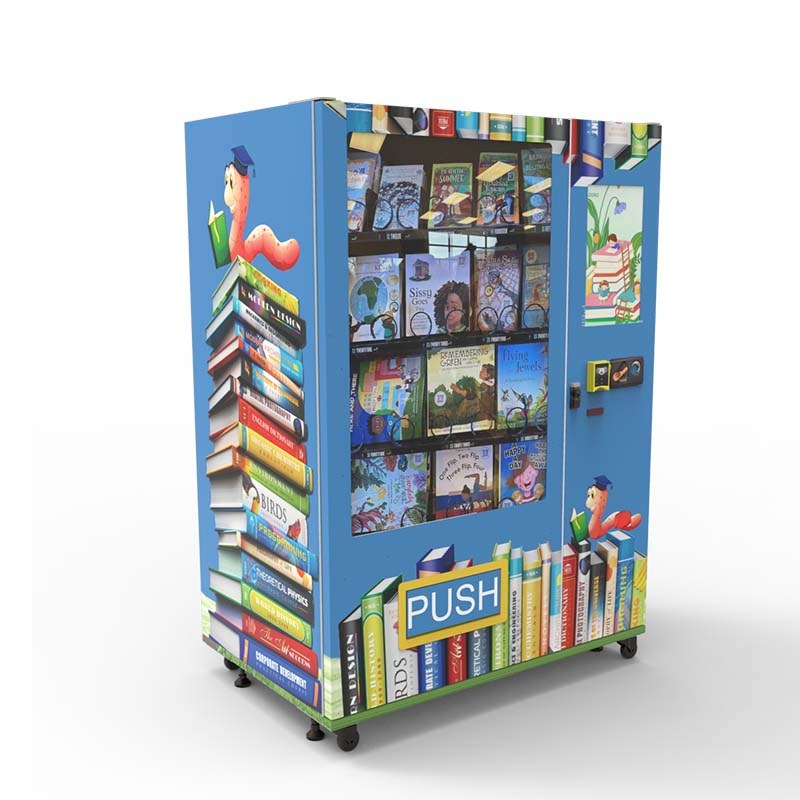
For a school that wants a dedicated, customizable book dispenser, I’d put the Zhongda Smart ZD-CX-22 on the shortlist. Its published configuration is designed for books and other printed materials, and the manufacturer identifies cargo-lane layout, exterior branding, payment hardware, and interface requirements as configurable project elements.
That makes it a useful starting point for schools that want equipment designed around children's books instead of adapting an unrelated snack machine. The model still needs to be assessed against the school's actual titles, dispensing method, access rules, budget, and installation requirements.
FEATURED SCHOOL SOLUTION
Zhongda Smart ZD-CX-22 Book Vending Machine
A configurable book dispenser for children's books, paperbacks, hardcovers, magazines, and suitable educational materials.
- Listed 21.5-inch touchscreen
- 60 listed cargo lanes
- Listed 4G and Wi-Fi connectivity
- Custom exterior graphics and branding options
- Payment hardware options subject to final configuration
Published reference price: $1,919. Confirm the current quotation, included hardware, shipping, duties, software, and installation costs before purchasing.
View product specifications and request a configuration quote →
The manufacturer lists a nominal machine size of 1,950 × 1,290 × 850 mm and a weight of 280 kg. Those figures are useful for preliminary planning, but the school should request a current technical drawing and confirm the exact dimensions, access clearances, delivery method, and final configuration before committing to an installation.
My evaluation framework
For this comparison, I’m prioritizing the characteristics that have a direct effect on school operations rather than treating the longest feature list as the strongest selling point.
| Evaluation criterion | Suggested weight | What to verify |
|---|---|---|
| Book compatibility | 25% | Documented fit and successful dispensing with representative children's books |
| Student access and ease of use | 20% | Clear instructions, manageable selection steps, and a suitable redemption workflow |
| Safety and accessibility | 15% | Stable installation, safe collection area, appropriate reach, and accessible operation |
| Serviceability and support | 15% | Warranty terms, spare parts, troubleshooting process, and repair responsibilities |
| Total ownership cost | 15% | Equipment, freight, installation, software, books, maintenance, and payment fees |
| Customization and reporting | 10% | Branding, inventory visibility, access options, and reporting capabilities |
These percentages are my proposed purchasing weights, not an independent laboratory rating or a published performance study. A school with strict accessibility requirements may choose to increase the safety category, while a small school with limited funding may place more weight on ownership cost.
Based on the available product documentation, Zhongda Smart merits evaluation for a dedicated book vending project. The deciding factor should be the manufacturer's ability to confirm the school's required configuration in writing, not an assumption that every optional feature comes standard.
3. Book Vending Machine Comparison: Which Type Fits Your School?
Not every school needs the same dispensing architecture. A full-size floor-standing machine may suit a permanent reading reward station, while a simple staffed book cart may serve a small program more efficiently. A general-purpose retail machine can sometimes be adapted, but only if its shelves, delivery mechanism, and software are suitable for the books involved.
| Machine or distribution type | Best application | Main advantage | Primary limitation |
|---|---|---|---|
| Dedicated book vending machine | Recurring reading rewards and permanent school programs | Book-oriented layout and school-specific presentation | Requires a confirmed book-compatible dispensing configuration |
| General-purpose snack vending machine | Books with standardized packaging that fit the original dispensing system | May be useful when an existing machine can be safely adapted | Book thickness, cover friction, and delivery impact can cause problems |
| Locker-style dispensing system | Books or educational kits that need individual compartments | Can accommodate some larger or irregularly shaped items | Requires suitable compartments and a compatible access workflow |
| Staff-managed book cart | Small giveaways and occasional reading events | Low technical complexity and flexible book selection | Depends on staff availability and manual distribution |
| Library self-service kiosk | Library circulation, catalog access, or controlled pickup | May integrate with library processes when designed for that purpose | A kiosk does not necessarily dispense or vend physical books |
The distinction between a vending machine and a self-service kiosk matters. A kiosk may display book information or record a student's selection, but a physical dispensing system is still needed to release the book. Schools should ask suppliers to demonstrate the complete transaction, from selection to collection, rather than evaluating the touchscreen in isolation.
When a dedicated book machine is the right choice
- The school wants students to access books through a consistent, repeatable process.
- Books are distributed throughout the year rather than only at occasional events.
- The machine will become a visible feature of a reading incentive program.
- School branding and age-appropriate instructions are important.
- The program has an assigned budget and staff member for replenishment and oversight.
When a simpler solution is more practical
A school should think carefully before buying equipment that will sit unused for long periods. If the school plans to distribute only a few dozen books per semester, the capital expense, delivery arrangements, and maintenance obligations may outweigh the benefits of automation.
A lower-complexity approach can also be useful during a pilot. The school can test book selection, student interest, title preferences, and reward rules with a staffed station before investing in a permanent vending installation.
4. Match the Machine to Your School's Needs
The most suitable book vending machine depends on the school's daily routines. A reading reward station near the library may need a different user experience from a machine in a main corridor or a family engagement area.
For kindergarten and first grade
Prioritize simple instructions, visible book covers, a straightforward selection sequence, and a safe collection area. Picture books may have larger covers and varied thicknesses, so a machine must be checked against the actual formats rather than an assumed standard size.
Very young students may need an adult nearby, particularly during the first weeks of a program. Avoid making the machine depend on small text, lengthy menus, or a multistep process that students cannot complete independently.
For second and third grade
Students at these levels may respond well to themed book selections, reading challenges, and clearly explained reward rules. The display can group titles by interest, such as animals, adventure, humor, science, or graphic storytelling, when the software supports those categories.
Schools should also avoid equating reading speed with reading achievement. A well-designed reward program can recognize persistence, participation, and individual goals without requiring every student to reach the same number of books.
For fourth and fifth grade
Older elementary students may want a wider selection of chapter books, nonfiction, graphic novels, and titles that reflect more varied interests. Capacity planning becomes more important when the assortment includes books of substantially different sizes.
Students should also have some choice. A program that offers only one type of book may be easy to administer but can leave reluctant readers and students with different interests disengaged.
For a school library
A library-based installation can reinforce reading initiatives, but it should complement rather than replace library staff and circulation services. If the machine distributes free reward books, the school should make the distinction clear between those books and library materials that must be returned.
For a broader overview of equipment suitable for educational settings, see Zhongda Smart's school and university vending solutions.
For a reading intervention or family literacy program
Consider how students will obtain books without being singled out because of reading level, financial circumstances, or access to technology. A machine can provide a consistent distribution point, but the eligibility rules should remain private and understandable.
If the program includes books for home reading, consider whether students can select titles that appeal to their families, home languages, interests, and reading preferences. The machine should support the educational purpose rather than dictate the entire program.
5. Essential Features to Evaluate Before Buying
Features are useful only when they solve a specific operating problem. A large touchscreen may improve book browsing, but it cannot compensate for incompatible dispensing channels. Remote connectivity may simplify stock checks, but it is of limited value if the school has no reliable network connection at the installation point.
1. A dispensing mechanism suited to books
Books are not uniform retail packages. Their covers can bend, their spines can protrude, and their thickness varies significantly. A book machine should be configured around the actual products rather than a generic assumption about book size.
Ask the manufacturer to explain how the machine supports each book format and what happens when a product fails to dispense. A documented test using representative titles is more valuable than a general statement that the machine can sell books.
2. A clear touchscreen interface
A touchscreen can display book covers, short descriptions, reward instructions, and selection prompts. For younger students, the interface should use legible text, intuitive controls, and a limited number of steps.
Before ordering, confirm which interface elements are customizable. A display that supports product images does not necessarily support school-specific menus, reward balances, or personalized student accounts.
3. A suitable access and redemption system
Schools often want to award books rather than sell them. That requirement should be settled before hardware selection because payment and redemption are different workflows.
Potential approaches include:
- Staff-authorized redemption: An adult issues or approves access for a student.
- Printed reward codes: Students enter a code if the configured software supports this method.
- Approved identification cards: The machine uses a compatible card or reader, subject to the required integration.
- Direct payment: A student or parent purchases a book using a supported payment method.
- Scheduled distribution: Staff manage access during a defined period or event.
These are possible project designs, not a claim that every method is available on every machine. Obtain written confirmation of the required software, card reader, payment terminal, or redemption integration.
4. Appropriate capacity
Capacity should be expressed in terms of the school's real book assortment. A supplier may advertise the number of cargo lanes or the estimated number of products, but those figures are not interchangeable.
A machine with 60 lanes does not automatically hold 60 titles or a fixed number of books. Each lane may contain multiple copies, depending on the dispensing design, book dimensions, and stock arrangement. Ask the supplier for a proposed layout that shows both the number of selections and the expected units per selection.
5. Connectivity and inventory visibility
Connected equipment can simplify inventory checks and help identify machine faults, depending on the software configuration. The school should confirm exactly which information can be viewed remotely, who can access it, and whether the system requires a recurring software fee.
For a school-managed reward program, the most useful data may be simple: books loaded, books dispensed, remaining stock, and unresolved machine alerts. Student-level tracking is not necessary for every program and may introduce avoidable privacy obligations.
6. School branding
Custom cabinet graphics can help students recognize the machine as part of a reading program. The school may want its logo, mascot, reading slogan, or approved artwork displayed on the exterior.
Ask for a digital mockup before production. Confirm the print dimensions, color expectations, placement of operating instructions, and whether the design remains readable around doors, windows, and payment hardware.
7. Service and spare parts
A machine that cannot dispense books is not serving its educational purpose. Before signing a purchase order, clarify the warranty period, response process, troubleshooting support, parts availability, and responsibilities for onsite repair.
Ask whether the warranty covers labor, replacement components, freight for parts, and damage caused by incorrect loading. These details can have a greater effect on the long-term cost than a small difference in the equipment's initial price.
8. Accessibility and physical safety
Check screen reach, viewing height, the collection opening, and the route students take to approach the machine. A school should also review stability, electrical installation, door clearances, pinch points, and the possibility of books becoming trapped in the dispensing area.
Accessibility should be assessed against applicable requirements and the needs of the students who will use the equipment. Do not assume that a standard cabinet or touchscreen automatically meets every school's accessibility obligations.
6. Book Size, Capacity, and Dispensing Compatibility
Book compatibility is one of the most important technical issues in a school book vending project. A machine can have an attractive display and ample nominal capacity yet perform poorly if its channels do not accommodate the actual stock.
Before requesting a final configuration, prepare a sample list that covers the smallest, largest, thickest, thinnest, lightest, and heaviest books the school intends to dispense.
What measurements should the school provide?
| Product information | Why it matters | What to send the supplier |
|---|---|---|
| Book height | Determines vertical clearance and how the cover is presented | Measured height of representative titles |
| Book width | Affects channel spacing, support, and orientation | Width of the closed book, including any protruding cover elements |
| Book thickness | Affects how many copies fit and how products separate during dispensing | Thickness of thin paperbacks, thick chapter books, and hardcovers |
| Packaged weight | Influences mechanical support and delivery behavior | Weight of each representative product in its final packaging |
| Cover and packaging | Glossy, flexible, or slippery surfaces may behave differently in a channel | Photos and physical samples when requested |
| Planned quantity | Determines channel allocation and replenishment frequency | Expected copies per title and total initial inventory |
Paperback versus hardcover books
Paperbacks can be relatively lightweight and flexible, while hardcovers may be heavier and have rigid edges. Neither format should be assumed to work equally well in every vending mechanism.
For mixed-format inventory, the supplier should determine whether separate channels or different support arrangements are needed. If some books require packaging to protect the cover or improve separation, include that packaging in the sample tests.
Picture books and oversized titles
Elementary reading programs frequently include books with large illustrations and wide covers. Those titles can be valuable to younger readers but may consume more space than a standard paperback.
Ask whether oversized titles need dedicated channels, reduced quantities, or an alternative distribution method. A practical machine layout may reserve some channels for larger books and use the remaining space for more compact titles.
Why physical testing matters
Dimensions alone cannot establish that a book will dispense reliably. A physical test can reveal whether a cover catches, two books move together, a product turns sideways, or a heavier title lands awkwardly in the collection area.
For the ZD-CX-22, Zhongda Smart's product documentation specifically advises confirming the layout around book dimensions, thickness, weight, and cover characteristics. The school should request a final configuration drawing and confirm the results of any agreed dispensing tests before approving production.
Calculate useful capacity, not just headline capacity
Suppose a school wants to offer 24 different titles and stock eight copies of each title. The planned initial inventory is 192 books. That is a planning example, not a claim about the machine's tested capacity.
The manufacturer must still confirm whether the selected channel arrangement can accommodate those 192 books. If some titles are much thicker than others, the actual capacity may be lower than a simple average suggests.
A good specification sheet should identify:
- The number of distinct selections.
- The intended title assigned to each selection.
- The maximum practical quantity per selection.
- Any titles that require special channels or packaging.
- The procedure for changing the assortment.
- The test method used to confirm successful dispensing.
7. Reading Rewards, Free Books, and Student Access
A book vending machine can support a reading reward program, but the reward policy should be designed before the machine is configured. The school needs a clear answer to three questions: who is eligible, how a student receives access, and what happens when a preferred title is unavailable.
Design the program around educational goals
Schools can reward different kinds of effort, including reading participation, completion of an individualized goal, library engagement, or involvement in a school literacy event. A program does not need to use a single reward formula for every grade.
In my view, the strongest approach gives students meaningful choice while keeping the rules simple enough for teachers and families to understand. A reward system should encourage reading without turning access to books into a public ranking of students.
Decide whether books are free or sold
A free book reward program has different requirements from a retail book vending operation. A free program may need redemption codes or staff authorization, while a retail operation needs reliable payment processing, clear prices, transaction records, and a process for handling failed payments.
If the school intends to offer both free rewards and paid purchases, confirm that the software can distinguish the two workflows. Do not assume that a payment-enabled machine can automatically issue free books through a student reward account.
Use an age-appropriate book selection
The assortment should reflect the ages, reading interests, and needs of the intended students. Useful categories might include:
- Picture books and early readers.
- Short chapter books.
- Science and nature nonfiction.
- History and biographies for children.
- Graphic novels and illustrated stories.
- Humor, adventure, and mystery.
- Books representing different family experiences and interests.
The school should review age suitability, reading accessibility, licensing or purchasing terms, and any content selection policies that apply to the program. A machine makes distribution easier; it does not replace the judgment required to choose books.
Keep participation inclusive
Students may differ in reading ability, language background, physical accessibility needs, and comfort with technology. An effective program should not depend on every child completing the same digital process independently.
Consider alternatives for students who need assistance. Staff may be able to help with selection, provide an accessible redemption route, or arrange an equivalent distribution method. The details depend on the school's policies and the machine's actual capabilities.
Set clear rules for rewards and inventory
Before launch, decide how often a student may receive a book, whether unused rewards expire, how replacements are handled, and what happens when a title runs out.
A short written policy reduces confusion. It also prevents teachers from having to make inconsistent decisions when students ask for exceptions.
Keep the policy focused on the reading program. Collecting detailed student behavior histories or personal information is rarely necessary simply to dispense a book.
8. Book Vending Machine Cost and Budget Planning
The purchase price is only one part of the budget. A school should account for delivery, installation, book inventory, branding, software, payment hardware, connectivity, maintenance, and staff time before approving a project.
Zhongda Smart's book vending product page lists a reference price of $1,919 for the ZD-CX-22. The listing also states that the final quotation should be confirmed with the supplier. Treat that figure as an initial equipment reference, not a guaranteed delivered price or a complete school-project budget.
What belongs in the total project cost?
| Cost category | Items to include | How to estimate it |
|---|---|---|
| Equipment | Machine, standard hardware, and agreed configuration | Obtain an itemized written quotation |
| Shipping and delivery | Freight, insurance, customs charges, and local delivery where applicable | Request a delivered-cost breakdown |
| Installation | Site preparation, placement, electrical work, and commissioning | Confirm who performs and pays for each task |
| Branding | Custom graphics, artwork preparation, and special finishes | Request a separate branding line item |
| Software and connectivity | Required subscriptions, connectivity, hosting, and integrations | Ask for recurring and one-time fees |
| Books | Initial inventory, replacement titles, and replenishment | Multiply planned copies by actual purchase cost |
| Payment fees | Transaction fees and any payment service charges | Use the proposed provider's fee schedule |
| Maintenance | Parts, service, repairs, and staff inspection time | Use the warranty terms and a documented maintenance estimate |
Illustrative startup budget
The following table is a budgeting exercise, not a supplier quotation. Except for the manufacturer's published equipment reference price, the amounts are hypothetical planning allowances selected to show how a school can structure its own estimate.
| Budget line | Illustrative allowance | Basis |
|---|---|---|
| Book vending machine | $1,919 | Published ZD-CX-22 reference price; confirm current terms |
| Freight and delivery | $700 | Hypothetical allowance only |
| Site preparation and installation | $300 | Hypothetical allowance only |
| Custom graphics | $150 | Hypothetical allowance only |
| Initial book inventory | $600 | Hypothetical allowance only |
| Contingency | $367 | Illustrative reserve, not a predicted expense |
| Illustrative total | $4,036 | Not a quote, guaranteed price, or typical project cost |
The figures above demonstrate why schools should request a complete quotation. Actual freight, installation, customization, books, software, taxes, and other expenses may differ substantially. Some projects may not require every listed cost, while others may need additional work.
Questions to ask about the quotation
- Does the price include the touchscreen, dispensing mechanism, and standard control hardware?
- Which payment components are included, and which are optional?
- Is the school reward workflow included in the quoted software?
- Are there activation, licensing, hosting, or recurring service fees?
- Does the quotation include custom graphics and screen content?
- Who is responsible for shipping, customs, unloading, and final placement?
- What is covered by the warranty, and how are replacement parts delivered?
- Can the supplier provide the final specification sheet before the deposit is paid?
A lower equipment price is not automatically the lowest-cost choice. A configuration that needs extensive adaptation or creates recurring maintenance problems may cost more over time than a machine specified correctly from the beginning.
9. How to Evaluate Financial Sustainability
For an elementary school reading program, the financial objective may be educational value rather than profit. A nonprofit, a school district, a library foundation, and a commercial operator may all use book vending equipment, but they should not evaluate the project with the same assumptions.
Before calculating a return, determine whether the machine generates revenue, distributes donated books, uses a funded reward budget, or combines several of those methods.
For a school-funded reward program
The relevant question is whether the program can continue within its approved annual budget. The school should estimate the number of books distributed, the cost per book, machine operating expenses, and staff time.
One useful measure is the cost per book distributed:
Cost per book distributed = Total program expenditure ÷ Number of books distributed
For example, if a school spends $3,000 over a year and distributes 600 books, the cost is $5 per distributed book. This is an illustrative calculation, not a claim about any school's results or a recommended cost target.
Include the relevant program expenses in the numerator. If the calculation excludes equipment depreciation, staff time, or donated inventory, state that limitation rather than presenting the result as a complete ownership cost.
For a machine that sells books
A commercial book vending operation needs a separate financial model. It should account for sales revenue, the cost of books, payment processing, refunds, replenishment labor, equipment depreciation, and all other operating expenses.
A simple operating contribution calculation is:
Operating contribution = Sales revenue − Book cost − Transaction fees − Other variable operating costs
That contribution is not the same as net profit. Fixed costs, financing, taxes, depreciation, and other expenses may still need to be deducted.
Calculate break-even volume carefully
If the school or operator charges for books, a basic break-even estimate can help assess whether expected sales are sufficient to cover fixed expenses.
Break-even units = Fixed costs ÷ Contribution per book
Contribution per book equals the selling price minus the book's variable cost and other per-transaction costs. The formula is meaningful only when contribution per book is positive and the assumptions are consistent.
For example, assume a paid book sells for $10, costs $5 to acquire, and incurs $0.50 in transaction and other variable costs. The contribution is $4.50 per book before fixed expenses. If annual fixed costs are $900, the simplified break-even volume is 200 books.
Those numbers are illustrative only. They are not expected sales, a market benchmark, or a forecast for the ZD-CX-22.
For grant-funded or sponsored programs
A sponsor may fund the equipment, the books, or both. In that case, the school should document the initial funding and determine who will pay for ongoing inventory, repairs, and replacement titles after the grant period ends.
A machine can be affordable to purchase but difficult to sustain if recurring costs have no owner. A written continuation plan is more useful than an optimistic projection based on unverified usage.
Measure educational performance separately
Financial measures alone cannot establish whether a book vending program improves reading outcomes. Schools should use measures that align with their educational goals, such as:
- Number of books distributed.
- Range of titles selected.
- Student participation across grade levels.
- Availability of books students want to read.
- Family engagement in home reading, when the program measures it.
- Student and teacher feedback.
These indicators can help a school refine the program, but they should not be presented as proof that the vending machine caused improvements in reading proficiency. That conclusion would require an appropriate evaluation design and reliable evidence.
10. Choosing a Book Vending Machine Manufacturer
A manufacturer should be able to explain how the machine will work with the school's books, not simply provide a product brochure. The purchasing process should include technical clarification, a documented configuration, clear commercial terms, and an agreed support process.
Evaluate the supplier on verifiable criteria
| Supplier criterion | Evidence to request | Warning sign |
|---|---|---|
| Book compatibility | Written layout proposal and documented test plan | General assurances without book measurements or testing |
| Technical transparency | Current drawings, electrical specifications, and bill of configuration | Unclear dimensions or unspecified optional components |
| Software fit | Demonstration of the required payment or redemption workflow | Promises of compatibility without identifying integrations |
| Warranty | Written coverage, exclusions, and claim process | Warranty advertised without clear terms |
| Parts and support | Parts list, support channels, and troubleshooting documentation | No clear plan for resolving dispensing failures |
| Commercial terms | Itemized quotation, payment schedule, and delivery responsibilities | Unclear final price or scope of supply |
Why consider Zhongda Smart?
Zhongda Smart is a manufacturer of customized vending equipment with a dedicated book vending machine product page. Its published materials identify the ZD-CX-22 as a configurable model for books and printed materials, with options involving cabinet graphics, internal product layout, payment hardware, interface requirements, and connectivity.
The company also publishes information about its manufacturing operations and OEM/ODM services. Its company profile describes a 20,000-square-meter facility, more than 400 employees, an engineering team of more than 10 people, and annual production capacity of up to 10,000 units. These are manufacturer-reported figures, not an independent factory audit or a guarantee of the performance of any individual machine.
For a school project, the practical reason to consider Zhongda Smart is the possibility of specifying the equipment around the intended book formats and program requirements. A dedicated model and customization process provide a starting point for a technical discussion.
However, a purchasing decision should still depend on the confirmed bill of materials, configuration, price, applicable safety requirements, warranty terms, and the supplier's ability to deliver the required workflow.
Review the manufacturer's company and manufacturing information alongside the ZD-CX-22 product specifications. These two documents help separate general manufacturing claims from the details of the particular machine being considered.
Ask for written confirmation before placing an order
The school should receive a configuration document that specifies:
- Machine model and final physical dimensions.
- Number and arrangement of dispensing channels.
- Book sizes and weights approved for the configuration.
- Payment or redemption hardware and software requirements.
- Connectivity and any recurring software fees.
- Branding, touchscreen content, and interface requirements.
- Warranty coverage, spare parts, and technical support.
- Shipping, delivery, installation, and commissioning responsibilities.
- Acceptance criteria for the completed machine.
A written specification reduces the chance of a disagreement over what was included in the purchase. It also gives the school a clear basis for checking the delivered machine before accepting it.
11. Zhongda Smart ZD-CX-22: A Practical Product Review
The ZD-CX-22 is worth examining as a dedicated book vending option because its published configuration directly addresses printed products. The following review separates listed specifications from features that must be confirmed for a particular school order.
Published specifications
| Specification | Published information | Procurement consideration |
|---|---|---|
| Model | ZD-CX-22 | Confirm the exact model designation on the purchase order. |
| Display | 21.5-inch touchscreen | Confirm the interface can display the intended book information and instructions. |
| Machine dimensions | 1,950 × 1,290 × 850 mm | Verify the final drawing, access clearance, and delivery route. |
| Listed weight | 280 kg | Check floor suitability, handling equipment, and installation arrangements. |
| Listed cargo lanes | 60 | Confirm the number of book selections and the quantity per channel. |
| Listed connectivity | 4G and Wi-Fi | Confirm network compatibility and actual software functionality. |
| Listed operating temperature | 2°C–25°C | Confirm the permitted installation environment in the final specification. |
| Listed payment options | QR code, credit card, cash, payment code, and membership card | Verify which modules are included and which are optional or market-dependent. |
| Listed dispensing style | Drop version | Test the intended books to assess impact, cover protection, and collection safety. |
| Published reference price | $1,919 | Request the current itemized quote and total delivered cost. |
What the specifications do and do not establish
The listed screen size, connectivity, dimensions, and cargo-lane count are useful starting points for procurement. They do not establish the exact number of books the machine will hold in a particular school configuration, the performance of an untested title, or the availability of a particular student reward integration.
Similarly, a published list of payment methods should not be interpreted as confirmation that every payment module is installed in the reference-price configuration. Hardware and software should be itemized in the quotation.
Questions specific to the ZD-CX-22
- Can the proposed layout dispense the school's largest and heaviest books?
- How many copies of each planned title can be loaded?
- Can the machine operate without requiring students to make a payment?
- What hardware or software is needed for a redemption-code program?
- Can the school customize book images, instructions, and cabinet artwork?
- Which remote inventory or fault-reporting functions are included?
- What are the final electrical requirements and installation clearances?
- Which components and service activities are covered by the warranty?
The answers should be recorded in the final specification and commercial agreement. This is especially important when a school intends to use the equipment for several years or expects multiple machines to operate under a common program.
Plan a Book Vending Configuration Around Your School's Books
Share representative book dimensions, expected quantities, the intended reward or payment workflow, and the school's branding requirements. Zhongda Smart can then assess the proposed configuration and provide a project-specific quotation.
12. Customization for Elementary School Reading Programs
Customization should improve the student experience or simplify the school's operations. The most useful changes are often modest: clearer instructions, school-approved graphics, a book layout that reflects the actual inventory, and a selection process that students can understand.
Exterior graphics and school identity
A machine can use school colors, approved illustrations, a reading program name, or a mascot. The artwork should make the machine easy to recognize without obscuring operating instructions, the collection area, service panels, or required safety information.
Before artwork approval, request a visual mockup showing the front and sides of the cabinet. Check whether text remains legible from the approach path and whether the final design works for students with different visual needs.
Book selection and product information
Students benefit from clear information about the books available. Depending on the software, the screen may show book covers, titles, short descriptions, or categories.
Keep descriptions concise and accurate. If the interface has limited space, prioritize the title, cover image, and an understandable selection instruction rather than trying to reproduce a complete book catalog.
Payment and redemption configuration
For a free reading reward program, avoid adding payment complexity unless the school has a genuine need for paid transactions. The required user flow should be demonstrated before the software configuration is finalized.
If the project includes a school identification card or an external reward system, provide the supplier with the technical documentation for that system. Compatibility should be assessed rather than assumed.
Language and instructions
The school should choose language and wording that match the students who will use the machine. Instructions should explain the next action in a direct, consistent way.
If students must ask a teacher for a reward code, the screen should explain that step. If students can make a selection independently, the instructions should clearly show how to collect the book and what to do if dispensing fails.
Data and reporting
Ask what the management platform records and which information is essential to the program. Inventory and machine status may be sufficient for a simple book giveaway.
If a school plans to use student identifiers, reward histories, or other personal information, it should assess the data flow before deployment. Determine who can view records, how long the information is retained, how access is controlled, and how deletion requests are handled.
The Federal Trade Commission's COPPA guidance explains that school authorization for covered online services is limited to the educational context and does not permit unrelated commercial use of children's personal information. Schools should review the actual software and consult appropriate legal or privacy personnel when necessary.
Customization should be specified, not implied
Words such as “smart,” “connected,” and “customizable” are not detailed technical requirements. If a function matters to the school, identify it in the order documents.
For example, instead of requesting “remote management,” specify the particular information the school needs to view remotely, which user roles may access it, and whether the service carries a recurring fee.
13. Installation, Accessibility, and School Safety
Installation planning should begin before the machine ships. A full-size vending cabinet can be difficult to reposition after delivery, and an apparently suitable corner may not have enough clearance for installation, servicing, or safe student movement.
Choose a supervised, practical location
Potential locations include a library entrance, a reading area, a supervised common space, or a staff-managed service point. The best position depends on student traffic, sightlines, available space, and the school's supervision policy.
Avoid placing the machine where its open doors or service panels would obstruct an exit route. The installation should not create a bottleneck during class changes or school events.
Check the physical environment
Before approving the location, confirm the following:
- There is sufficient space for delivery, placement, operation, and maintenance.
- The floor can safely support the equipment and its loaded weight.
- The power supply meets the final manufacturer's requirements.
- Network connectivity is adequate if connected functions are required.
- The machine is stable and installed according to the approved instructions.
- The collection area is accessible and does not expose students to moving components.
- Students can approach and leave the machine without blocking a walkway.
- Staff can access service panels without disrupting student activity.
Accessibility needs to be assessed at the actual installation
Schools should review the screen height, reach range, viewing angle, selection controls, and collection opening. A student should not be required to use an inaccessible control or reach into a hazardous area to retrieve a book.
Applicable accessibility requirements depend on the project and the legal obligations of the organization. The school should involve its facilities team and accessibility personnel rather than relying solely on the manufacturer's general product description.
Electrical and equipment safety
Ask the supplier for the current electrical specifications, installation instructions, and documentation relevant to the equipment being supplied. Confirm the requirements for grounding, power protection, ventilation, and servicing.
Do not modify electrical components or bypass safety features to make a machine fit a particular location. Any required alterations should be reviewed by qualified personnel and authorized by the manufacturer where appropriate.
Establish rules for student use
Students should know that the collection opening is for retrieving books, not for placing hands or objects inside the mechanism. They should also know how to report a failed transaction or a book that becomes stuck.
For younger children, a staff member should supervise initial use and verify that the machine's instructions are understandable. The school should decide whether unsupervised operation is appropriate for the age group and location.
14. Inventory Management and Daily Operations
A book vending machine needs a clear operating routine. Inventory problems often arise not because the machine lacks capacity, but because staff do not know which titles are loaded, how many copies remain, or when a selection needs replenishment.
Build a simple inventory record
A spreadsheet can be sufficient for a single machine. Useful fields include:
- Book title and identifier.
- Author or publisher, where useful for identification.
- Grade range or reading category.
- Assigned dispensing channel.
- Initial quantity loaded.
- Quantity added during each refill.
- Recorded books dispensed.
- Physical stock count.
- Date of the last refill.
- Notes about damage, jams, or compatibility issues.
For a simple reward program, there may be no reason to connect the inventory record to named student accounts. Keep operational data separate from personal student information unless an approved educational requirement justifies the additional collection.
Use a consistent replenishment process
- Check the displayed inventory or manually inspect the machine.
- Identify empty or low-stock selections.
- Compare physical quantities with the inventory record.
- Inspect the dispensing channels for damaged books or obstructions.
- Load compatible titles into the assigned channels.
- Update stock records and the displayed selection information.
- Test the affected selections according to the approved procedure.
Replenishment frequency should reflect actual use. A machine that distributes books primarily during a weekly reward period may need a different routine from one that is used every school day.
Set reorder points based on demand
Schools can use a straightforward inventory formula to identify when a title needs replenishment.
Reorder point = Expected daily use × Replenishment lead time + Safety stock
Suppose a title is distributed at an average rate of three copies per school day, replenishment takes five school days, and the school wants a buffer of ten copies. The illustrative reorder point is 25 copies: 15 expected copies during the lead time plus ten copies of safety stock.
This calculation is a planning example. A school should use its actual demand and supplier lead time rather than copying the example's figures.
Review the book mix periodically
Inventory records can reveal which categories students choose most often and which titles remain untouched. Those observations can inform future purchases, but they should be interpreted with care.
A title may remain in stock because it is unfamiliar, poorly displayed, unavailable to a particular grade, or less suitable for the program's reward rules. Slow movement does not automatically mean the book has little educational value.
Review the assortment with library staff and teachers. Rotate titles when appropriate, preserve access to a range of interests, and make sure popular books are not the only options available to students.
Prepare for failed dispensing events
A student may select a book and receive nothing because a product is stuck, a channel is empty, or a transaction has not completed. The school should have a simple response procedure.
That procedure should tell students whom to contact, tell staff how to record the issue, and explain how to correct inventory or reward records. If payments are involved, it should also explain how refunds or transaction reversals are handled.
15. Maintenance, Troubleshooting, and Support
Preventive maintenance helps keep the machine usable and reduces disruption to the reading program. The maintenance schedule should follow the manufacturer's instructions, the operating environment, and the machine's actual usage.
There is no single maintenance interval that applies to every book vending machine. A school should request the model-specific checklist rather than relying on an arbitrary monthly or quarterly schedule.
Routine visual checks
Staff can perform basic external checks without opening electrical compartments or attempting repairs. A practical checklist includes:
- Check the cabinet for visible damage or instability.
- Verify that the touchscreen and normal controls respond as expected.
- Look for books obstructing the collection area.
- Confirm that the machine displays the correct book selections.
- Check whether any channels are empty or visibly misloaded.
- Review available machine-status alerts.
- Record recurring faults and contact the appropriate support provider.
Common operational issues
| Observed issue | Possible explanation | Recommended response |
|---|---|---|
| Book does not dispense | Empty channel, jammed product, or dispensing fault | Stop repeated attempts, document the selection, and follow the approved troubleshooting procedure. |
| Two books move together | Incompatible thickness, cover friction, or channel spacing | Remove the affected selection from service and request a layout review. |
| Book cover is damaged | Excessive impact or unsuitable product handling | Inspect the delivery method and test an alternative configuration with the supplier. |
| Touchscreen is unresponsive | Software, power, or hardware problem | Follow the manufacturer's safe restart and support instructions. |
| Inventory does not match physical stock | Unrecorded refills, failed dispensing, or inaccurate stock data | Perform a physical count and reconcile the inventory record. |
| Connected features are unavailable | Network interruption, account settings, or software issue | Check approved connectivity indicators and contact the designated support provider. |
These are troubleshooting possibilities, not confirmed defects of the ZD-CX-22. Staff should not remove panels, reach into a moving mechanism, or attempt electrical repairs unless they are authorized and qualified to do so.
Clarify warranty and service responsibilities
Ask the supplier whether the warranty covers parts only or also labor, remote support, freight, and onsite service. Clarify the process for reporting a fault and the information needed to identify the affected component.
Zhongda Smart's published product materials list a one-year warranty and describe replacement-parts and online technical support for supported equipment. The exact terms applicable to the school's order should be confirmed in the purchase documents.
For a school that relies on the machine every day, support arrangements should be agreed before the first failure occurs. A named contact, a documented fault-reporting process, and access to the correct model information can make troubleshooting more straightforward.
Keep a maintenance log
Record the date of each fault, the affected selection, the symptoms, the action taken, and whether the issue returned. Over time, this record can help distinguish a one-off loading mistake from a recurring compatibility or hardware problem.
The log also helps school administrators evaluate service costs and decide whether a particular book format should be removed from the machine. A simple record is more useful than relying on staff memory.
16. A Practical School Procurement Checklist
Before requesting a final quotation, the school should be able to describe the intended program, the books it will dispense, and the user experience it expects. A clear brief makes it easier for the manufacturer to propose the right hardware and identify missing information.
Step 1: Define the program
- Identify the intended grades and approximate number of students.
- Define whether books will be free, sold, or distributed through a sponsored program.
- Determine who will approve student access.
- Set the planned book budget and operating budget.
- Assign responsibility for inventory, supervision, and maintenance.
Step 2: Prepare book samples
- List the initial titles and estimated copies per title.
- Measure height, width, and thickness.
- Record packaged weight.
- Identify unusually large, heavy, flexible, or slippery books.
- Ask whether physical samples should be provided for testing.
Step 3: Confirm the user workflow
- Choose the required payment or redemption method.
- Specify whether students need individual accounts.
- Confirm what the touchscreen should display.
- Determine whether the machine needs remote inventory reporting.
- Review any privacy or data-retention requirements.
Step 4: Assess the installation site
- Measure the available floor space and route to the installation point.
- Check floor loading and handling requirements.
- Confirm power and network availability.
- Review student circulation and adult supervision.
- Check accessibility, safe collection, and service access.
Step 5: Compare quotations
Use the same requirements when comparing suppliers. Otherwise, a lower quote may simply omit software, branding, payment hardware, or installation tasks that another supplier includes.
Ask every shortlisted supplier to itemize the same categories and respond to the same book-compatibility questions. Compare the total cost of ownership, the documented technical fit, and the support arrangements rather than price alone.
Step 6: Approve a written specification
Before authorizing production, approve the final cabinet drawing, internal layout, interface requirements, electrical specification, payment or redemption workflow, and branding artwork.
Include acceptance criteria in the purchase documents. Those criteria might require successful dispensing of agreed representative books, correct display of selected instructions, and demonstration of the agreed user workflow.
Step 7: Plan launch and evaluation
Prepare the book inventory, student instructions, staff training, replenishment procedure, and fault-reporting process before the machine opens for use.
Review the program after the initial operating period. Check whether students can use the machine, whether titles remain available, how often staff need to intervene, and whether actual expenses match the budget. Use those findings to adjust the book assortment and operating procedures.
A well-managed pilot is often more informative than a large initial deployment. It lets the school identify practical problems while the number of machines, inventory commitments, and support requirements are still manageable.
17. Frequently Asked Questions
1. What is the best book vending machine for elementary schools?
The best choice is a machine that can reliably dispense the school's actual book formats, provides a simple student experience, meets installation and accessibility requirements, and fits the operating budget. Zhongda Smart's ZD-CX-22 is one option to evaluate because it is listed as a dedicated book vending model with a 21.5-inch touchscreen and 60 cargo lanes. The final decision should depend on the confirmed configuration, compatibility tests, price, and support terms.
2. How much does a book vending machine for a school cost?
Zhongda Smart lists a reference price of $1,919 for the ZD-CX-22, but the school should confirm the current quotation and what is included. Freight, installation, books, custom graphics, payment hardware, software, and maintenance can add to the total cost. Request an itemized project quotation before setting the final budget.
3. Can an elementary school use a book vending machine to give away free books?
Yes, provided the selected configuration supports the school's intended access process. Depending on the project, the school may use staff authorization, redemption codes, compatible cards, or another approved workflow. Confirm the required software and hardware with the manufacturer rather than assuming that every payment-enabled machine supports free book redemption.
4. How many books can a book vending machine hold?
Capacity depends on the number and arrangement of dispensing channels, book dimensions, thickness, weight, and the number of copies assigned to each title. The ZD-CX-22 product page lists 60 cargo lanes, but that number does not establish a fixed total book capacity. Ask the supplier to provide a proposed layout based on measured book samples and the planned inventory.
5. Can the same machine dispense paperback and hardcover books?
Potentially, but the machine must be configured and tested for the intended formats. Hardcovers may be heavier, and books with different thicknesses or cover surfaces can behave differently during dispensing. Provide representative samples and obtain confirmation of the approved product range before ordering.
6. Does a school book vending machine need an internet connection?
Not every function necessarily requires a continuous connection, but connected inventory management, remote reporting, or certain payment and redemption services may depend on one. The ZD-CX-22 is listed with 4G and Wi-Fi connectivity. Ask which functions require a network, whether offline operation is supported, and whether connectivity or software incurs recurring charges.
7. How often does a book vending machine need maintenance?
The appropriate schedule depends on the machine, operating environment, usage, and manufacturer's instructions. Staff should perform routine visual checks, monitor inventory discrepancies, record dispensing faults, and follow the model-specific maintenance checklist. Ask the supplier for recommended service intervals and written warranty coverage rather than relying on a universal schedule.
8. What should a school ask a book vending machine manufacturer before buying?
Ask for a detailed quotation, current technical drawings, confirmed book compatibility, final channel layout, payment or redemption specifications, branding details, software fees, installation requirements, warranty terms, spare-parts arrangements, and support procedures. The school should also agree on acceptance tests that demonstrate the required book selections can be dispensed reliably.
18. Sources and Further Reading
The following sources provide the manufacturer specifications and primary-source information referenced in this guide. Manufacturer-published specifications describe the listed product configuration; they should not be treated as independent performance certification.
- Zhongda Smart — Book Vending Machine Manufacturer. Product information for the ZD-CX-22, including listed dimensions, display, cargo lanes, connectivity, payment options, customization, and reference pricing. https://zhongdasmart.com/Locker-Vending/Book-Vending-Machine.html
- Zhongda Smart — School & University Vending Machines. Educational equipment applications and project configuration considerations. https://zhongdasmart.com/school-university-vending-mach/
- National Center for Education Statistics — The Nation's Report Card, 2024 Reading Assessment. The 2024 results report that 31% of fourth-grade students performed at or above the NAEP Proficient level in reading, while 60% performed at or above NAEP Basic. The report cautions that NAEP achievement levels are specific performance standards and should not be equated directly with state grade-level proficiency expectations. https://www.nationsreportcard.gov/reports/reading/2024/g4_8/national-trends/
- Federal Trade Commission — Complying with COPPA: Frequently Asked Questions. Guidance relevant to the collection and use of children's personal information by covered online services, including services used in educational settings. https://www.ftc.gov/business-guidance/resources/complying-coppa-frequently-asked-questions
- Zhongda Smart — Company and Manufacturing Information. Manufacturer-published information about the company's operations, manufacturing capacity, and OEM/ODM services. https://zhongdasmart.com/zdvending/
How to interpret the education data
The NAEP figures describe student performance on a national assessment; they do not establish that a book vending machine improves reading scores. The statistics provide context for the importance of thoughtful reading support, not evidence of a causal relationship between vending equipment and literacy outcomes.
Similarly, the manufacturer's listed specifications describe the published product configuration. Schools should confirm all critical technical, commercial, and operational details with the supplier before purchasing.
19. Important Information and Disclaimer
This article is provided for general educational, procurement, and operational planning purposes. It is not a guarantee of product performance, a formal engineering assessment, legal advice, or a financial forecast.
Product specifications, reference prices, available payment methods, software functions, and warranty terms may change. Confirm the current configuration and all commercial terms directly with the manufacturer. Any example budget, capacity calculation, break-even estimate, or operating scenario in this article is illustrative unless explicitly identified as a published source figure.
Schools are responsible for assessing applicable safety, accessibility, electrical, procurement, privacy, student-supervision, and other requirements before installation. The appropriate requirements depend on the actual project and the organization's legal obligations.
Student information should be collected only when necessary for an approved purpose and handled according to applicable privacy requirements. Schools should review any third-party software, payment service, or student identification integration before use.
References to Zhongda Smart and the ZD-CX-22 are based on manufacturer-published information. Inclusion in this guide does not constitute independent product certification or a guarantee that a specific configuration will meet every school's requirements. Schools should request written specifications, verify compatibility, and evaluate the total cost of ownership before placing an order.