The best trading card vending machine locations are not simply the places with the biggest crowds. I look for a much tighter combination: people who already have a reason to care about cards or collectibles, enough time to notice the machine, a clean sightline, reasonable site costs, secure surroundings, and easy access for restocking. A smaller arcade lobby can beat a much busier walkway if families and gamers spend ten minutes around the machine instead of rushing past it. Hobby stores, shopping centers, arcades, game stores, collectible retailers, family entertainment venues, sports facilities, supermarkets, and event spaces are all worth testing, but the exact position inside the venue often matters as much as the venue itself. This guide explains how I compare those sites before committing a machine and how I decide whether a location deserves more inventory, a different machine, or a move.
Best Trading Card Vending Machine Locations at a Glance
If someone asks me where I would place the first machine, I do not start with a list of famous buildings. I start with customer behavior. I want a place where collecting, gaming, entertainment, family spending, sports, or hobby shopping already happens. The machine should fit naturally into what people are doing instead of trying to interrupt them.
The table below is the order in which I would normally investigate different site types. It is a screening guide, not a promise that every location in a category will perform the same way.
| Location Type | Buyer Relevance | Dwell Time | Repeat Traffic | My Initial View |
|---|---|---|---|---|
| Trading card and hobby stores | Very High | High | Very High | Top priority |
| Arcades and gaming centers | Very High | Very High | High | Top priority |
| Game and comic stores | Very High | High | Very High | Top priority |
| Shopping centers | Medium to High | Medium to High | High | Strong if positioned well |
| Family entertainment centers | High | Very High | Medium to High | Strong |
| Toy and collectible stores | Very High | High | High | Strong |
| Sports venues and sports facilities | High for sports cards | High during events | Event driven | Strong with the right inventory |
| Supermarkets and everyday retail | Medium | Medium | Very High | Worth testing |
| Convention and event venues | Very High during relevant events | High | Variable | Excellent for event deployments |
| Cinemas | Medium to High | High | Medium | Good with the right audience |
| Campus recreation areas | Medium to High | High | Very High | Good test candidate |
| Large retail entrances | Medium | Low to Medium | Very High | Position matters enormously |
| Mixed-use leisure corridors | Medium to High | Medium to High | High | Often overlooked |
I would rather test a modest-looking location with strong buyer relevance than pay premium rent for a famous address that produces weak conversion. A vending location has to work at machine level, not just look impressive in a proposal.
What Makes a Card Vending Location Work?
A good location gives the machine enough chances to make a sale without making every transaction expensive to acquire. That sounds simple, but it is where many new vending projects go wrong.
One of the easiest traps is counting everybody in the building. If a shopping center reports very high monthly traffic, that number sounds reassuring. It tells me almost nothing about the exact vending position. How many people actually walk in front of the proposed machine? How many can see it before they reach it? How many are moving slowly enough to stop? How many have any connection to trading cards, sports cards, games, toys, or collectibles?
Those questions are much more useful.
I normally look at seven things before I become interested in a site:
Buyer relevance: Are collectors, gamers, families, hobby shoppers, sports fans, or gift buyers naturally present?
Qualified foot traffic: How many potentially relevant customers actually cross the machine's sightline?
Dwell time: Do people wait, browse, eat, socialize, play, or queue nearby?
Visibility: Can customers understand what the machine sells before they are standing directly in front of it?
Security: Is the area supervised, well lit, and appropriate for unattended merchandise?
Occupancy cost: Will rent or commission leave enough margin after merchandise and operating expenses?
Service access: Can the operator refill, inspect, and repair the machine without turning every visit into a logistical problem?
None of these factors works alone. A secure location with almost no traffic is still weak. Heavy traffic with no dwell time can disappoint. A perfect audience with unreasonable rent can produce sales without producing profit.
Buyer Relevance Usually Comes First
Suppose one corridor has 4,000 daily passers, but very few have any reason to buy cards. Another location has 700 daily visitors and a large share of them are already there to play games, buy collectibles, or spend time with family.
I would not automatically choose the 4,000-person corridor.
Cards are not bottled water. They are interest-driven merchandise. A person normally needs some connection to the product before the machine can convert attention into a purchase.
That is why hobby stores and arcades can compete with much larger retail environments. The smaller audience may be far more concentrated.
Dwell Time Gives the Machine a Chance to Sell
A busy entrance can fool you. I have seen location proposals where pedestrian numbers looked excellent until the actual path was examined. People crossed the area quickly and had no reason to stop.
Compare that with an arcade lobby where parents wait for children, groups decide what to do next, and customers repeatedly move between games, food, and seating. Fewer people may enter the building, but each visitor creates several opportunities to notice the machine.
For card vending, that difference matters.
Visibility Is Part of the Product
A self-service kiosk has no salesperson standing outside asking people to come closer. The cabinet, screen, graphics, and placement have to do that work.
I want customers to recognize the category from several steps away. If a person must walk around a pillar, turn into a dead corner, or search for the machine, I consider that a placement problem even if the building itself is excellent.
The Zhongda Smart Location Score
When we compare potential card vending sites, it helps to turn a vague discussion into a consistent screening process. The Zhongda Smart Location Score used in this guide is a simple 100-point framework for doing that. It is not an industry standard and it is not a guarantee of revenue. Its purpose is to make two or three candidate sites easier to compare before an operator commits equipment and inventory.
| Factor | Weight | What a Strong Site Looks Like |
|---|---|---|
| Buyer relevance | 25 points | Visitors already buy, play, collect, or engage with related products |
| Qualified foot traffic | 20 points | A meaningful number of relevant people pass the actual machine position |
| Dwell time | 15 points | Visitors routinely wait, browse, socialize, eat, or play nearby |
| Visibility | 15 points | The machine is visible from the natural customer approach |
| Security | 10 points | Staff, cameras, controlled hours, lighting, or natural surveillance are present |
| Occupancy cost | 10 points | Rent or commission leaves room for acceptable site-level profit |
| Service access | 5 points | Restocking, power, connectivity, parking, and repairs are manageable |
| Total | 100 points | Compare sites using the same assumptions |
I do not pretend a score of 82 is scientifically different from 81. The value is in forcing the operator to examine the same questions every time.
If one proposed site wins on traffic but loses badly on rent, visibility, and route access, the score exposes the trade-off. If another site has a smaller crowd but an almost perfect customer profile, long dwell time, and low servicing cost, that becomes obvious too.
How I Interpret the Score
| Score | How I Treat It |
|---|---|
| 85–100 | High-priority test candidate |
| 75–84 | Strong candidate if the financial terms work |
| 65–74 | Test carefully; the weakness needs to be understood |
| 55–64 | Only interesting with unusually favorable economics or a specific strategic reason |
| Below 55 | I would normally keep looking |
The score is deliberately a screening tool rather than a sales forecast. Revenue still needs to be proven by an actual installation or a controlled test.
13 Trading Card Vending Machine Locations Worth Testing
1. Trading Card and Hobby Stores
Hobby stores are the easiest locations to understand because the audience is already qualified. Customers enter specifically because they are interested in trading cards, tabletop games, sports cards, collectibles, accessories, or related hobbies.
That changes the vending machine's job. It does not need to convince someone that cards are interesting. It only needs to present a useful product at the right price and make purchasing convenient.
I like these locations for new releases, booster packs, sealed products, sleeves, mystery packs, small boxed products, and selected premium items. They are also good places to test which products customers prefer before deploying the same assortment into broader public locations.
The best position is not automatically beside the front door. I would inspect the checkout queue, tournament area, play tables, store entrance, and any section customers can access when employees are busy.
A particularly useful installation is one that solves a real store problem. During tournaments or release events, staff may be answering questions, processing trades, supervising play, and serving customers at the counter. Someone who wants two packs does not necessarily need a staff member. A machine can absorb those simple transactions.
Another advantage is fast product feedback. Store staff usually know which releases are moving and which are cooling off. That helps prevent the machine from becoming a storage cabinet for slow inventory.
2. Arcades and Gaming Centers
If I wanted a location that naturally combines collecting behavior with long dwell time, arcades would be near the top of my list.
People come to play. They usually stay. They move around in groups. They already understand digital payments, points, prizes, rarity, competition, and repeat purchasing. A trading card machine does not feel out of place in that environment.
I would look closely at positions near the entrance, exit, prize counter, recharge station, food seating, birthday-party area, or any point where groups stop to decide what to do next.
One behavior I particularly like in arcades is social visibility. A single purchase can draw attention from several friends. Someone opens a pack, shows the result, and another person walks over to the machine. The merchandise itself can create a small amount of theater around the purchase.
That does not mean the machine should become complicated. The interaction should remain fast: see the product, understand the price, pay, receive the item.
I would use several price levels instead of filling every lane with similar packs. An entry product gives casual customers an easy first purchase, while better sealed products give serious collectors something worth stopping for.
3. Game and Comic Stores
Game and comic stores are strong because they combine relevant customers with repeat visits. Many also run scheduled events, leagues, game nights, launches, or community activities.
That creates repeated exposure. A customer who ignores the machine on Tuesday may buy from it on Friday after seeing a new product.
I would try to position the machine where it adds selling capacity without stealing valuable merchandising space. An unused wall near a play area can be more attractive than taking away shelving that already performs well.
This is one place where a compact machine can make a lot of sense. If the store has excellent traffic but very little available floor space, vertical space becomes valuable. Zhongda Smart's wall-mounted card vending configuration is designed around that type of footprint, with a published maximum capacity of 120 pieces and remote management features. The exact payment and hardware configuration should always be confirmed for the individual project before ordering.
I would not choose a wall-mounted unit simply because it is smaller. The location still needs enough capacity to avoid constant stockouts. The point is to match the cabinet to the selling environment.
4. Shopping Centers
Shopping centers can be excellent trading card vending machine locations, but I care much more about the corridor than the property name.
An entertainment cluster beside a cinema, arcade, toy retailer, or family food area is very different from a hallway used mainly to reach parking.
When I inspect these sites, I watch how people move rather than just how many people move. Are they strolling? Are families deciding where to eat? Are teenagers gathering? Do customers stop around nearby retailers? Can someone stand at the machine for thirty seconds without blocking a walkway?
Those details affect conversion.
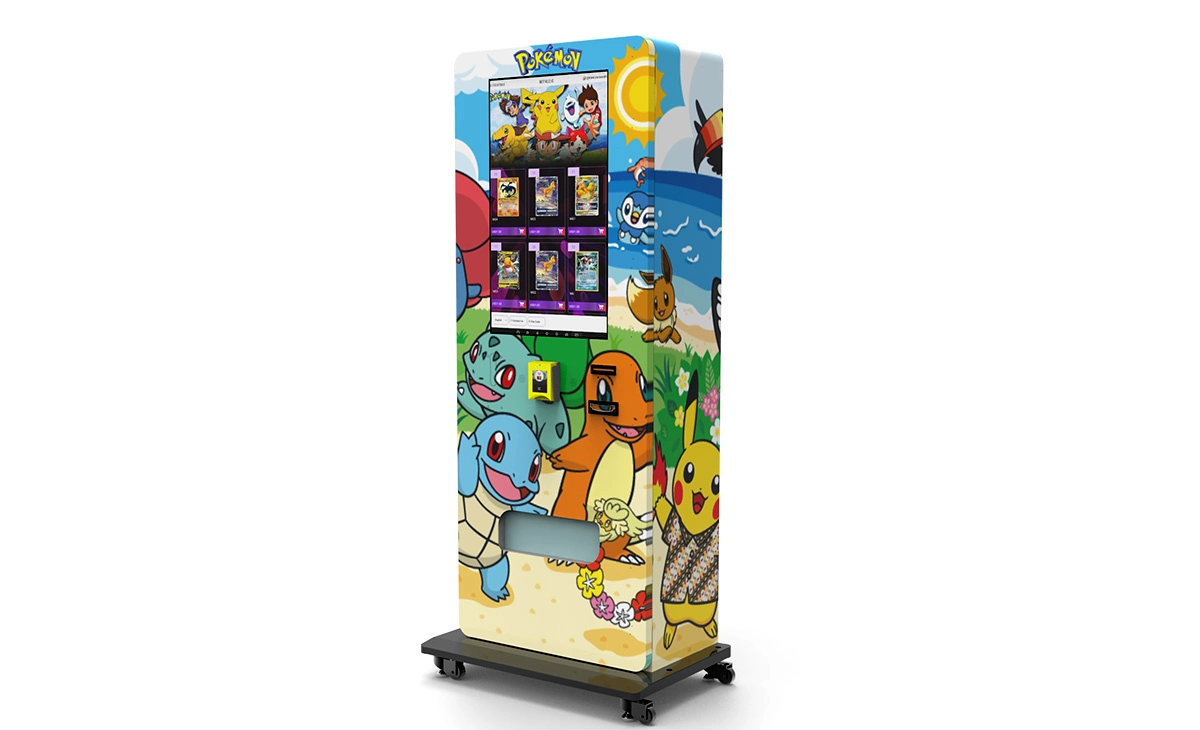
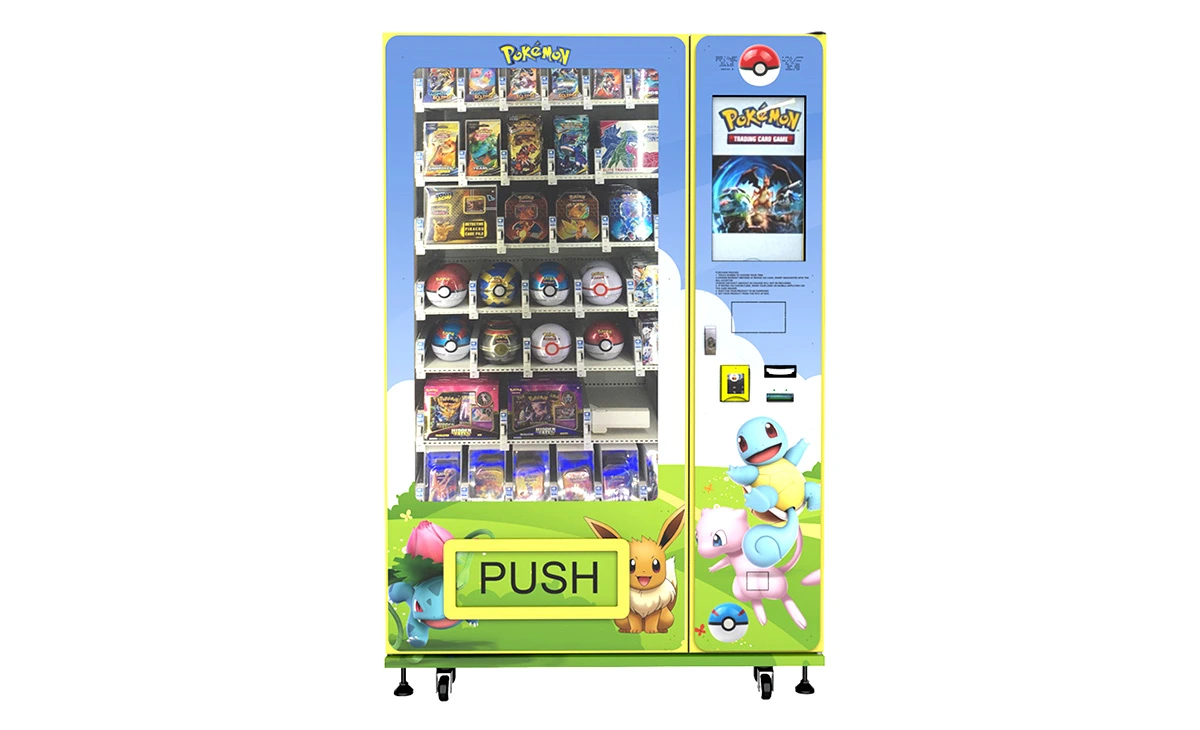
A large floor-standing machine can work well in a strong shopping environment because the cabinet itself becomes a small retail display. Zhongda Smart's full-size trading card vending machine currently lists a 21.5-inch touchscreen, 60 standard cargo lanes, 4G/Wi-Fi connectivity, multiple payment configurations, and remote sales or inventory functions. For a busy site, those capabilities can reduce unnecessary service visits and provide enough selling capacity to support a broader assortment.
I would still model the rent carefully. A beautiful machine generating high sales can be a weak investment if the site fee consumes most of the gross profit.
5. Family Entertainment Centers
Family entertainment venues have several things I like: parents, children, waiting time, celebrations, food, repeat movement through the same building, and a willingness to make small discretionary purchases.
The inventory should be easy to understand. This is not the place where I would make every selection a specialist product requiring detailed knowledge.
Recognizable card packs, simple sealed products, entry-price items, and visually clear packaging usually fit the environment better.
Placement near party check-in can work, but I also like exits. Families often slow down before leaving. Children are already in an entertainment mindset, and one final purchase can feel like part of the outing.
Food seating can be another interesting micro-location. Parents sitting while children play creates dwell time. The machine has repeated opportunities to be noticed without interrupting anyone.
The main operational concern is keeping the machine clean and reliable. Family venues generate a lot of touching, movement, and curiosity around equipment. The cabinet should tolerate that environment.
6. Toy and Collectible Stores
Card collecting overlaps naturally with figures, blind boxes, models, licensed merchandise, toys, and other hobby products.
That overlap matters because the machine does not need every customer to be a dedicated TCG player. It needs enough people who understand the appeal of collecting.
Circana reported that collectibles grew 32% in dollar sales during 2025 and represented almost 19% of tracked toy dollar sales. Its reporting also placed trading cards among the faster-growing segments. That broader collectible momentum helps explain why collectible-focused retail deserves serious attention rather than being treated as a narrow children's category.
Source: Circana, 2025 collectible and toy industry findings.
The more important operating lesson is not the market percentage. It is inventory freshness. Collectors follow releases. They know what products are current, what has been sitting around, and what normal pricing looks like.
If I place a machine inside a collectible store, I want the assortment to move with the store's audience. Old inventory should not occupy prime machine space simply because it is already paid for.
7. Sports Venues and Sports Facilities
Sports facilities become much more interesting when the inventory is built around sports cards rather than copied from a general trading-card assortment.
A sports audience already has emotional attachment to teams, players, competition, statistics, and memorable moments. Cards fit that behavior naturally.
Good site candidates include event entrances, fan areas, club facilities, sports entertainment venues, training centers with visitor traffic, and locations where spectators wait before or after activities.
Demand can be uneven. A quiet weekday and a busy event night may behave like two completely different businesses. That makes inventory planning important.
I would rather refill before the event than discover afterward that the top-selling lane was empty during the busiest two hours of the week.
Remote inventory data becomes valuable in this environment because service schedules can follow demand instead of the calendar.
8. Supermarkets and High-Frequency Everyday Retail
Supermarkets deserve more attention than they usually receive in card vending discussions.
The audience is broad, so buyer relevance is lower than in a hobby store. The advantage is visit frequency. Families may return every week, sometimes several times a week. That gives a machine repeated exposure to the same potential buyers.
I would not put the machine in an arbitrary corner. The strongest positions are usually connected to entrances, exits, toy or entertainment merchandise, customer service areas, or a section where traffic slows.
A machine beside a fast checkout exit can look busy while producing little engagement because people are already mentally finished with the shopping trip and moving quickly. A position where families naturally pause can be much better.
These locations also make inventory trust important. The cabinet should look like a professional retail fixture, pricing should be clear, and sealed products should be presented in good condition.
9. Convention and Event Venues
Events can create the highest concentration of relevant buyers in the entire list, but I treat permanent and temporary vending as two different businesses.
A permanent machine in a convention building depends on the full event calendar. One weekend may be perfect for cards, while the next event has no connection to collecting.
A temporary machine can be taken to selected events, stocked for that audience, and removed afterward. That creates better product relevance but introduces transportation, setup, insurance, electrical, network, and overnight-security considerations.
For short events, I do not want a machine that requires complicated commissioning. Setup time eats into the selling window.
I also prefer deep inventory in a smaller number of proven products rather than a huge assortment with only a few units of each. Event demand can arrive in bursts. A popular product selling out in the first afternoon wastes the rest of the weekend.
10. Cinemas
Cinemas have one quality that is useful for unattended retail: people wait.
Customers arrive before a screening, meet friends, buy food, and spend time in the lobby. That gives them a chance to notice a machine more than once.
I would prefer a lobby or entertainment area over a narrow hallway leading directly to screening rooms. People should be able to browse without standing in the way.
The inventory needs an evergreen base. I would not build the entire machine around a single movie release because the demand window can disappear quickly.
When entertainment releases overlap naturally with collecting culture, the location can become more interesting. Any use of branded graphics or licensed properties, however, should follow the relevant intellectual-property permissions rather than assuming that owning legitimate card products automatically gives the operator the right to decorate the machine with protected branding.
11. Campus Recreation and Student Activity Areas
The appeal of student-oriented recreation areas is repetition. The same people can pass the machine several times each week.
That makes product rotation useful. A customer who has seen the same five products for two months stops looking. A machine that regularly introduces something new keeps earning attention.
I prefer recreational spaces, game rooms, common areas, food corridors, activity centers, and entertainment facilities over purely academic hallways.
Accessible pricing also matters. A machine made entirely of premium sealed boxes can narrow the audience too much. Entry products create an easier first transaction.
Before signing anything, I check access hours. A building that closes early can lose much of the unattended-retail advantage.
12. Large Retail Entrances
Large retailers provide traffic, but traffic alone is not enough to make me enthusiastic.
I want the machine near an area that makes sense for the merchandise: toys, entertainment, collectibles, customer service, or another point where the target buyer naturally passes.
One possible advantage is controlled product access. Trading cards are compact and easy to handle. A vending cabinet keeps the product secured until payment is completed.
That does not eliminate risk. The machine still needs suitable locks, payment protection, stable installation, and an environment with reasonable supervision.
I would also test whether the machine competes with the host's own card shelf. Sometimes that is fine; sometimes the retailer may see it as cannibalization. The commercial arrangement should be clear before installation.
13. Mixed-Use Leisure Corridors
Some of my favorite location candidates are not famous at all. They are smaller leisure clusters combining restaurants, entertainment, specialty retail, gaming, fitness, or social spaces.
They often produce moderate traffic but good dwell time and repeat visits.
This is where manual observation is particularly useful. Stand at the proposed position. Count people. Watch where they look. See whether queues form nearby. Notice whether groups stop or continue walking.
A property brochure cannot show those details.
If the rent is modest and the route is convenient, a smaller leisure location can become a very efficient machine even if it never produces the headline sales of a premium shopping site.
Where the Machine Should Sit Inside the Venue
Choosing the building is only half the job. The exact ten or twenty feet of floor space can determine whether customers notice the machine at all.
I call this the micro-location decision.
| Micro-Location | Visibility | Dwell Time | My View |
|---|---|---|---|
| Arcade entrance | Very High | High | Excellent |
| Food seating edge | High | Very High | Excellent if traffic passes naturally |
| Hobby store tournament area | High | Very High | Excellent for relevant products |
| Main entrance | Very High | Low to Medium | Good if people slow down |
| Checkout approach | High | Medium | Very Good |
| Entertainment lobby | High | High | Very Good |
| Exit path | High | Medium | Worth testing |
| Elevator waiting area | Medium to High | Medium | Depends on audience relevance |
| Behind a column | Low | Irrelevant | Avoid |
| Dead-end hallway | Low | Low | Avoid |
| Service corridor | Very Low | Low | Avoid |
The Customer Should See the Machine Before Reaching It
I like an approach angle rather than a surprise appearance. If customers can see the screen and understand the product category while walking toward the machine, they have several seconds to make a decision.
Putting the cabinet perfectly flat against the direction of travel can reduce that opportunity. Sometimes rotating it slightly toward the main approach improves visibility without moving the machine very far.
Do Not Let Temporary Fixtures Destroy the Sightline
A site may look excellent during inspection and become terrible two months later when the venue installs a promotional stand, queue barrier, seasonal display, or temporary kiosk.
I try to understand whether the space in front of the machine is truly protected.
If the host can relocate the machine, the contract should ideally state how that decision is handled. A move from a strong entrance to an unseen back wall can change the economics while the rent remains exactly the same.
Watch the Stopping Space
A customer needs enough room to use the machine without feeling that everybody is walking into them.
This is particularly important around narrow corridors and checkouts. People avoid stopping when they feel they are blocking traffic.
How I Measure a Location Before Signing
I do not need a complicated research project to learn a great deal about a proposed location. A structured observation period is often enough to identify obvious problems.
If the host allows it, I like the idea of a seven-day pre-installation observation or a short trial period before a long commitment.
Day 1: Map the Customer Path
Start by drawing the route customers actually use.
Where do they enter? Where do they stop? Where do queues form? Which direction do most people face? Where do families wait? Where does traffic split?
The best machine position usually becomes easier to see once the path is understood.
Day 2: Count Actual Passers
Count people who pass the exact proposed machine position rather than relying on total property traffic.
Take several samples instead of one short count.
For example:
Opening period
Midday
Afternoon
Evening
A normal weekday
A busier day
What matters is not perfect precision. You are trying to understand the shape of traffic.
Day 3: Estimate Audience Relevance
Classify passers in broad groups. Are they families, gamers, collectors, students, sports fans, ordinary shoppers, or fast-moving commuters?
You do not need to identify every person. The goal is to compare one site with another using the same method.
Day 4: Measure Dwell Behavior
Watch how long people remain in the immediate area.
I use simple categories:
Low dwell: most people pass without stopping.
Medium dwell: people browse or wait briefly.
High dwell: people regularly remain for several minutes.
Long dwell time gives the machine repeated chances to earn attention.
Day 5: Check Security and Infrastructure
Look for power, network conditions, camera coverage, staff visibility, overnight access, door widths, installation routes, wall strength for mounted equipment, and room for service access.
A location can be commercially attractive and still be operationally awkward.
Day 6: Look at Nearby Merchandise
Nearby products can help or hurt.
A card machine beside a game store can benefit from relevant traffic. A machine directly competing with discounted cards on an adjacent shelf may need a different assortment.
Day 7: Put the Numbers Into One Sheet
| Metric | What I Record |
|---|---|
| People passing the machine position | Sample counts by time period |
| Relevant visitor share | Estimated percentage |
| Dwell condition | Low / Medium / High |
| Peak periods | Time and day |
| Weekend difference | Lower / Similar / Higher |
| Camera coverage | Yes / No / Partial |
| Power | Confirmed / Requires work |
| Network | Wi-Fi / 4G / LAN availability |
| Service access | Easy / Moderate / Difficult |
| Monthly site cost | Fixed rent / commission / hybrid |
This simple process is more useful than falling in love with a location because it looks busy during a fifteen-minute visit.
How Much Foot Traffic Is Enough?
There is no foot-traffic number that makes a card vending site automatically good.
The better question is: how many qualified passers does the machine get?
I use a simple planning formula:
Qualified Passers = People Passing the Machine × Estimated Buyer Relevance
Then:
Estimated Transactions = Qualified Passers × Estimated Conversion Rate
These are planning estimates, not guaranteed results.
Example A: Busy but Weakly Relevant
A machine position sees 3,000 people per day.
Only 4% appear reasonably connected to card buying.
3,000 × 4% = 120 qualified passers.
Example B: Smaller but Highly Relevant
An arcade location sees 800 people per day.
About 25% fit the likely buyer profile.
800 × 25% = 200 qualified passers.
The second site receives much less total traffic but potentially exposes the machine to far more relevant customers.
That is why I do not rank trading card vending machine locations using raw pedestrian numbers alone.
Add Conversion Carefully
Suppose the second location produces 200 qualified passers and 4% buy something.
200 × 4% = 8 daily transactions.
At a $12 average transaction:
8 × $12 = $96 per day.
Over 30 days:
$96 × 30 = $2,880 in illustrative monthly revenue.
Change the conversion rate from 4% to 2.5% and the result changes sharply. That is why I run conservative and stronger scenarios rather than building a business plan around one optimistic number.
Rent, Commission, and Location Economics
A site can sell well and still be a poor business.
What matters is what remains after merchandise cost and operating expenses.
Assume a machine produces $4,200 in monthly revenue and merchandise costs represent $2,520.
That leaves:
$4,200 − $2,520 = $1,680 gross profit before location and operating expenses.
If the host wants $850 every month, more than half of that gross profit disappears immediately.
You still have payment processing, connectivity, service travel, maintenance, insurance, refunds, shrink, software, and other expenses.
The location can look successful from the revenue number while producing disappointing net profit.
Fixed Rent
Fixed rent is simple. You know the monthly site cost before the first sale.
I prefer it when the location has already proven its volume and the rent is reasonable. The downside is obvious: a weak month does not reduce the payment.
Revenue Share
Revenue share aligns the host with sales and reduces the fixed burden during slow periods.
The drawback appears when a machine becomes very successful. A percentage that seemed cheap at launch can eventually cost much more than reasonable fixed rent.
Hybrid Agreements
A small base payment plus a percentage above a sales threshold can work when both sides want some protection.
The contract matters more than the label. I want the agreement to define the exact position, access hours, electricity, network responsibility, service access, relocation, insurance, security, exclusivity, payment timing, and termination rights.
A Simple Site-Level Model
| Metric | Conservative Site | Strong Site | High-Volume Site |
|---|---|---|---|
| Transactions per day | 5 | 11 | 20 |
| Average transaction | $10 | $12 | $13 |
| Monthly revenue | $1,500 | $3,960 | $7,800 |
| Illustrative gross margin | 40% | 42% | 44% |
| Gross profit | $600 | $1,663 | $3,432 |
| Site cost | $220 | $420 | $750 |
| Other operating costs | $210 | $360 | $650 |
| Illustrative operating contribution | $170 | $883 | $2,032 |
Those figures are examples, not earnings claims. Product margins, rent, prices, fees, and sales can be completely different in a real machine.
If you want to pressure-test your own assumptions, the Zhongda Smart vending machine ROI calculator allows you to enter machine cost, starting inventory, daily revenue, gross margin, site rent, POS expense, labor, warehouse costs, and other operating costs. I would run at least three scenarios: disappointing, acceptable, and strong.
Do Not Forget Service Cost
Two machines earning the same gross profit are not equally valuable if one takes fifteen minutes to reach and the other takes ninety.
Location economics should include the cost of keeping the machine alive.
That means fuel, travel, parking, loading, restocking time, customer support, vending machine repair, cleaning, and emergency visits.
Matching the Machine to the Location
I prefer to choose the site before finalizing the machine configuration.
The opposite approach often creates unnecessary compromises. An operator buys a large cabinet and then discovers that the best available location has almost no floor space. Another operator buys a compact machine and later lands a high-volume site that requires much deeper inventory.
The machine should follow the operating requirement.
| Location Situation | Machine Direction I Would Consider |
|---|---|
| High-volume shopping or entertainment site | Floor-standing machine with deeper inventory and strong screen visibility |
| Small hobby store | Compact floor-standing or wall-mounted unit |
| Premium floor space | Wall-mounted configuration where installation permits |
| Event deployment | Machine that can be transported, commissioned, and serviced efficiently |
| Broad product assortment | More cargo lanes and adjustable product channels |
| High-value sealed products | Controlled delivery method that protects packaging |
| Remote route | Strong telemetry and low-stock alerts become more valuable |
Floor-Standing Machines
A floor-standing machine has more visual mass. In a large open venue, that can be useful. More cabinet space can also support more products and deeper stock.
The trade-off is footprint. If the property charges heavily for floor area, a larger cabinet has to earn its space.
Wall-Mounted Machines
A wall-mounted unit turns vertical space into retail space. That can be very attractive in game stores, compact corridors, specialty shops, and other locations where the audience is good but floor space is expensive.
The limitation is inventory depth. If the location sells quickly, small capacity can force frequent refilling.
Package Dimensions Come Before Cargo-Lane Count
Do not assume a machine can sell a product just because the package physically fits inside the cabinet.
I want actual dispensing tests.
Booster packs, blister packs, small boxes, mystery packs, sleeves, and premium sealed products behave differently inside a delivery mechanism.
Test the exact products intended for the machine before production.
Security and Product Protection
Trading cards are small, portable, recognizable, and sometimes expensive. That creates a different risk profile from selling ordinary low-value consumables.
I prefer locations with:
Existing camera coverage
Regular staff presence
Good lighting
Controlled building hours
Natural customer visibility
A secure overnight environment
A reliable way to anchor or install the machine
Do Not Store More Premium Inventory Than the Site Needs
Capacity is not an instruction to fill every available space.
If a machine needs four days of stock between visits, I do not automatically want three weeks of expensive merchandise sitting inside it.
Extra inventory ties up cash and increases exposure if the cabinet is damaged.
Product Condition Is Part of Trust
A collector may reject a crushed box or badly bent blister even if the product itself is technically intact.
The dispensing method should protect packaging.
Before launch, I test:
Whether thin packs release consistently
Whether two products can dispense together
Whether boxes rotate during delivery
Whether products get trapped
Whether the drop height damages corners
Whether customers can identify the exact product before paying
A vending machine that generates frequent refunds is not unattended retail. It is a customer-service problem sitting in a cabinet.
Inventory, New Releases, and Restocking
A good location can be ruined by poor inventory management.
The machine earns money from available products, not theoretical capacity.
Stock by Location, Not by Personal Preference
I like location-level product reports because different audiences can behave very differently.
| Product Type | Hobby Store | Arcade | Family Venue | Sports Facility |
|---|---|---|---|---|
| Core booster packs | Very High priority | High priority | High priority | Medium priority |
| Sports card packs | High | Medium | Medium | Very High |
| Premium sealed boxes | High | Low to Medium | Low | Medium |
| Entry-price packs | Medium | Very High | Very High | High |
| Mystery products | Medium | High | High | Medium |
| Accessories | High | Medium | Low | Low to Medium |
After several weeks, sales data should begin replacing assumptions.
If one product occupies 5% of machine capacity and produces 18% of sales, I want to know whether it deserves another lane.
If another product has not moved for three weeks, I do not keep it in a premium position just because I personally like it.
New Releases Can Change the Sales Curve
Card vending has one advantage that everyday vending categories do not always have: people watch for releases.
A machine can feel new without moving it anywhere.
Fresh stock, a new set, a different sports release, or a rotating premium product gives repeat visitors another reason to look at the screen.
I would plan inventory differently around:
Major product launches
Tournament weekends
Large entertainment events
Sports events
Holiday gift periods
Venue-specific promotions
Do not create fake scarcity. If something is ordinary stock, there is no reason to label it as limited.
Calculate Days of Inventory
A simple restocking metric is:
Days of Inventory Remaining = Current Units ÷ Average Daily Unit Sales
If a lane holds 24 packs and sells eight per day, it has approximately three selling days left.
That is much more useful than saying, "We visit every Friday."
A strong location may need a Tuesday refill during a new release week. A slower location may not need weekly attention at all.
Modern Payments Are Important, but Cash Has Not Disappeared
The 2026 Diary of Consumer Payment Choice reported that credit and debit cards together accounted for two-thirds of all payments recorded in the survey, while cash remained the third-most-used payment method.
Source: Federal Reserve Financial Services, 2026 Diary of Consumer Payment Choice.
My operational takeaway is not that every machine must remove cash. It is that card and contactless acceptance should be treated as a core commercial requirement for most modern card-vending projects, while the decision to add cash should follow the audience and service model.
Every extra payment module adds hardware that must be maintained, reconciled, and supported.
The 30-Day Keep, Optimize, or Move Test
A weak first week does not automatically mean the location is bad. A strong first weekend does not automatically mean it is good.
Novelty can temporarily lift sales. Poor initial merchandising can hide the potential of a good site.
I like a structured first month.
| Period | Main Goal | What I Do |
|---|---|---|
| Days 1–7 | Build a baseline | Record transactions, product mix, traffic pattern, stockouts, and faults without changing everything |
| Days 8–14 | Fix obvious friction | Correct pricing, signage, payment, dispensing, and stock problems |
| Days 15–21 | Improve the assortment | Increase proven products and remove obvious slow movers |
| Days 22–30 | Judge the economics | Calculate contribution after merchandise, rent, fees, and service cost |
Fix the Machine Before Blaming the Location
If sales are disappointing, I check these things first:
Are the most wanted products actually in stock?
Does electronic payment work reliably?
Is pricing clear?
Can customers see what the machine sells?
Are products dispensing correctly?
Does the assortment match the venue?
Is the screen easy to use?
Has another fixture blocked the sightline?
If those basics are wrong, moving the machine may simply move the same problem to another building.
Then Decide: Keep, Optimize, Renegotiate, or Relocate
I use four possible decisions.
Keep: Sales, margin, service effort, and site cost are healthy. Do not create problems by over-optimizing a machine that already works.
Optimize: The audience is good, but product mix, price structure, visibility, or inventory needs improvement.
Renegotiate: Sales are acceptable but the rent or commission leaves too little profit.
Relocate: The machine works properly, the product is relevant, and the economics still do not make sense because the site itself is weak.
Metrics I Want Before Making the Decision
| Metric | What It Tells Me |
|---|---|
| Revenue per day | Basic site productivity |
| Transactions per day | How often the machine converts customers |
| Average transaction value | Whether customers are buying entry or premium products |
| Gross margin dollars | More useful than revenue alone |
| Rent as a share of gross profit | Whether the host is taking too much of the economics |
| Stockout frequency | Whether sales are being lost to poor replenishment |
| Refund rate | Whether payment or dispensing needs attention |
| Service visits | How much labor the machine actually requires |
| Net site contribution | Whether the location is worth keeping |
Why Route Density Changes the Value of a Location
The first vending machine is mostly a site decision. The twentieth machine is also a routing decision.
Imagine two machines that each contribute $700 a month before operator travel.
Machine A is fifteen minutes from four other locations you already service.
Machine B is ninety minutes away and frequently needs emergency restocking.
Those machines do not have the same real value.
Once a network starts growing, I add route fit to the location discussion.
Cluster Around Proven Audiences
If one arcade performs well, I would investigate nearby entertainment venues before jumping to an unrelated distant market.
If hobby stores perform well, similar stores within a manageable route deserve attention.
Dense routes improve:
Restocking speed
Emergency response
Repair cost
Inventory transfers between machines
Labor efficiency
Quality-control frequency
They also make new-release inventory easier to manage. If one site sells faster than expected, stock can sometimes be reallocated from a slower nearby machine instead of waiting for the next supply shipment.
What We Look at When Planning Card Vending Projects
At Zhongda Smart, the machine discussion usually becomes much more useful once the location and merchandise are known.
A customer may initially ask for "a trading card vending machine," but the equipment specification becomes clearer when we know what will actually be sold and where the cabinet will operate.
A compact hobby-store installation and a high-volume entertainment venue may sell similar card products, but they do not need the same machine.
Product Samples Matter
One of the first things I want to understand is package size.
For a serious project, actual sample products are more useful than saying "standard trading cards." A booster pack, blister pack, graded-card box, mystery envelope, and sealed retail box have different thicknesses and dispensing behavior.
That affects cargo-lane dimensions, capacity, delivery method, and the number of products that can realistically be offered.
Capacity Should Follow Restocking Frequency
A machine installed ten minutes from the operator's normal route can survive with lower buffer inventory than a machine that requires a long service trip.
When buyers ask for maximum capacity, I also want to know how often they expect to refill.
The largest possible capacity is not automatically the most efficient configuration.
Screen Size Should Follow the Selling Environment
A large touchscreen can be valuable in an open commercial venue because it increases visual presence and gives enough space to display several products clearly.
In a compact store, a huge screen may not justify its footprint.
Zhongda Smart currently offers several card-vending formats rather than one fixed cabinet. That makes it possible to approach the equipment decision from the site backward instead of trying to force every location into one machine design.
Remote Data Becomes More Valuable as the Network Grows
Remote sales and inventory functions may not feel essential when an operator has one machine next door.
With ten, twenty, or more units, the value changes.
I want the operator to know which machine needs stock before getting into the service vehicle.
Useful remote functions can include:
Sales by machine
Sales by product
Transaction history
Low-stock alerts
Machine status
Remote pricing where supported
Network status
Those functions do not make a bad site good. They make a good network easier to operate.
Real Installations Are More Useful Than Renderings Alone
Product drawings help with planning, but real machines reveal scale, cabinet presence, customer sightline, and branding much better.
Zhongda Smart publishes a real themed vending-machine installation case showing how a customized machine can function as both a point of sale and a visual retail fixture. When evaluating a supplier, I would always ask to see finished machines, internal mechanisms, packaging tests, and installation examples rather than judging only by a catalog cover.
Choosing a Trading Card Vending Machine
Location comes first, but the equipment still has to support the business model.
If I were preparing a specification for a card machine, I would focus on the following:
Reliable dispensing for the exact packages being sold
Adjustable product channels where appropriate
Modern electronic payment options
Remote inventory visibility
Remote sales reporting
Strong cabinet construction
Good product presentation
Clear touchscreen interaction
Accessible payment and control components
Replaceable spare parts
Network flexibility
Exterior branding options
Software and language customization where required
Documented warranty and after-sales arrangements
Do Not Buy on Machine Price Alone
The cheapest cabinet can become expensive if it jams, cannot accept the required payment system, needs constant visits, or damages products.
The most expensive machine can also be a poor choice if the location does not need its capacity or features.
I prefer to compare total operating fit.
Ask the Manufacturer to Test Real Merchandise
Send the intended products before the machine specification is finalized.
If the project includes five package formats, test all five.
I want to know what happens after dozens of repeated vend cycles, not just whether one pack can be pushed out once for a video.
Customization Should Solve a Business Problem
Customization has value when it improves the project.
Examples include:
Changing cargo channels for unusual package sizes
Adjusting payment modules
Adding operator branding
Changing cabinet dimensions
Modifying the interface language
Connecting supported management systems
Changing screen configuration
Customization for its own sake can increase cost and complexity without improving sales.
Operators building a branded or specialized project can review Zhongda Smart's OEM custom vending machine capabilities and then confirm the final specification against the intended products, location, payment environment, and local installation requirements.
Common Reasons Good Card Vending Locations Underperform
Sometimes the location is blamed too quickly.
Before moving a machine, I look for these problems.
The Machine Is Hard to Notice
A premium venue does not help if the machine is hidden behind another fixture.
The Best Products Are Constantly Out of Stock
A report may show that a machine sells well while hiding the fact that the top two products are unavailable half the week.
The Assortment Does Not Match the Audience
Sports fans, hobby-store regulars, families, arcade customers, and collectible shoppers do not necessarily want the same products.
Payment Fails Too Often
A customer who has already decided to buy should not be lost because the payment process is unreliable.
Dispensing Damages Packaging
Collectors notice condition.
Pricing Breaks Trust
Many card buyers know normal retail prices. A reasonable convenience premium may work in some venues, but aggressive pricing can make repeat customers stop checking the machine.
The Machine Looks Neglected
Dirty screens, damaged graphics, empty lanes, and outdated promotional material make customers question the entire retail operation.

A Practical Location Checklist
Before approving a site, I want clear answers to these questions:
Can customers see the machine from the main walking path?
How many people actually pass the proposed position?
How many of those people are relevant to card or collectible products?
Do they have enough time to stop?
Does the venue generate repeat visits?
What happens on weekdays compared with busy days?
What are the useful operating hours?
Is electrical power available?
Is Wi-Fi, 4G, or another required network available?
Is the area monitored?
Can the machine be installed securely?
Can staff reach it easily for restocking?
Can technicians access it without disrupting the venue?
What is the fixed rent?
Is there a revenue share?
Are there additional site charges?
Can the host move the machine?
Does the agreement define the exact position?
What related merchandise is already nearby?
Which products fit the audience?
How many selling days of inventory are needed?
What sales level is required to break even?
How long will the site be tested?
What performance level triggers relocation?
How does the location fit the restocking route?
The Best Location Is the One You Can Prove
I do not believe there is one universal list of addresses that guarantees a profitable card vending business.
The strongest trading card vending machine locations are places where the audience, exact position, machine, product mix, price, security, and site economics work together.
If I were starting with one machine, I would first look for a venue where cards or collectibles already make sense: a hobby store, arcade, game retailer, collectible shop, family entertainment business, sports environment, or another leisure location with meaningful repeat traffic.
Then I would measure the exact position rather than trusting whole-building traffic.
I would count passers, watch dwell behavior, check the sightline, understand rent, confirm security, test the payment connection, and model conservative sales.
Once the machine is installed, I would let transaction data replace assumptions.
A good location earns more inventory. A good product earns more lanes. A successful machine can justify another location nearby.
A weak site should not be kept simply because it took time to obtain.
That is the difference between collecting vending-machine locations and building an operating network.
Frequently Asked Questions
What are the best trading card vending machine locations?
Hobby stores, trading card shops, arcades, game stores, collectible retailers, shopping centers, family entertainment venues, sports facilities, supermarkets, convention spaces, cinemas, student recreation areas, and mixed-use leisure locations are all worth testing. I would not select a site by category alone. The exact machine position, relevant foot traffic, dwell time, security, rent, service access, and product fit determine whether the location is commercially attractive.
How much foot traffic does a trading card vending machine need?
There is no universal minimum. Relevant traffic matters more than raw traffic. A location with 800 visitors and a strong concentration of gamers, collectors, families, or hobby buyers can outperform a general corridor with several thousand people moving quickly past the machine. Count people who pass the actual machine position and estimate how many fit the likely buyer profile.
Are trading card vending machines profitable?
They can be profitable, but profitability depends on merchandise margin, transaction volume, rent, payment fees, inventory turnover, servicing, machine uptime, and equipment investment. The safest approach is to build a conservative site-level model before purchasing equipment and then compare actual performance with the model after installation.
How much should I pay for a vending machine location?
I would not set a rent budget without estimating the site's gross profit. A location fee that looks modest as a percentage of revenue can consume a large share of gross profit after merchandise cost. Compare fixed rent, commission, and hybrid arrangements using realistic sales scenarios and include payment, servicing, connectivity, maintenance, and other operating expenses.
Where should a trading card vending machine be placed inside a store or venue?
I prefer positions that are visible from the natural customer approach and allow someone to stop without blocking traffic. Arcade entrances, entertainment lobbies, checkout approaches, tournament areas, food-seating edges, and other high-dwell zones are usually more interesting than dead-end hallways or service corridors. The best micro-location depends on how customers move through the venue.
What products should I put in a trading card vending machine?
Common options include booster packs, sealed card products, sports cards, game cards, blister packs, mystery products, compact boxes, and selected accessories. The product mix should follow the location. Hobby stores can support specialist or premium products, while family and arcade locations may perform better with recognizable products and easier entry-price purchases.
Should a card vending machine accept cash?
Card and contactless payments should be treated as core options for most modern commercial installations. Cash may still make sense for some audiences, but it adds hardware, collection, reconciliation, and maintenance. The best configuration depends on the venue, customer profile, payment provider, and servicing model.
Should I choose a floor-standing or wall-mounted card vending machine?
A floor-standing machine is usually better when the location needs deeper inventory, more selections, and stronger visual presence. A wall-mounted machine is useful where the audience is good but floor space is limited or expensive. Choose the format after confirming expected sales volume, available space, package dimensions, replenishment frequency, and site economics.
How long should I test a new card vending location?
A 30-day test can provide a useful first picture for a stable permanent location, although seasonal and event-driven sites may require a different period. During the test, track daily revenue, transactions, average sale, gross margin, product velocity, stockouts, refunds, service visits, site cost, and net contribution. Fix obvious product or machine problems before deciding that the location itself has failed.
When should I move a trading card vending machine?
I would consider relocation after confirming that the machine is visible, payments are reliable, popular products are available, pricing is reasonable, dispensing works correctly, and the assortment fits the venue. If those issues are under control and the location still cannot generate acceptable site-level contribution, moving the machine is usually more rational than waiting indefinitely.
How often should a card vending machine be restocked?
Restocking should follow product velocity rather than a fixed calendar. Divide the remaining units of an item by its average daily unit sales to estimate how many selling days remain. High-volume locations and new-release periods may need several visits per week, while slower locations may require much less frequent service.
What should I ask a trading card vending machine manufacturer before ordering?
Ask whether the manufacturer can test your real products, support the required payment methods, provide remote inventory and sales functions, adjust cargo channels, supply spare parts, document warranty terms, and customize the cabinet or interface where needed. Confirm final dimensions, capacity, electrical requirements, payment configuration, software functions, certifications, and delivery method in writing before production.
Sources and References
Circana — 2025 collectibles and toy industry findings. Used for the reported growth and share of collectible products.
Federal Reserve Financial Services — 2026 Diary of Consumer Payment Choice. Used for current payment-method data.
Disclosure: The Zhongda Smart Location Score, location ratings, conversion examples, revenue scenarios, expense assumptions, margins, and ROI illustrations in this guide are planning tools rather than industry benchmarks or earnings guarantees. Actual results depend on the venue, merchandise, inventory cost, pricing, customer demand, machine uptime, payment fees, rent, servicing, security, maintenance, and other operating conditions. Product specifications and available configurations can change and should be confirmed with Zhongda Smart before purchase.