A realistic Trading Card Vending Machine Cost starts at about $1,000 for a compact wall-mounted machine, while larger touchscreen models can be published around $1,200 to $2,100 before optional hardware, freight, branding, inventory, and setup. For an actual business launch, I would usually budget roughly $4,000 to $9,000 rather than looking only at the machine invoice. A customized machine with protected product delivery, premium payment hardware, special software, or a large starting inventory can push the total investment above $10,000. After working through vending projects, I have found that the cheapest cabinet is rarely the cheapest business to operate. The numbers that matter are total deployed cost, product margin, successful vend rate, inventory turnover, payment expense, maintenance, and the number of months it takes to recover the money invested.
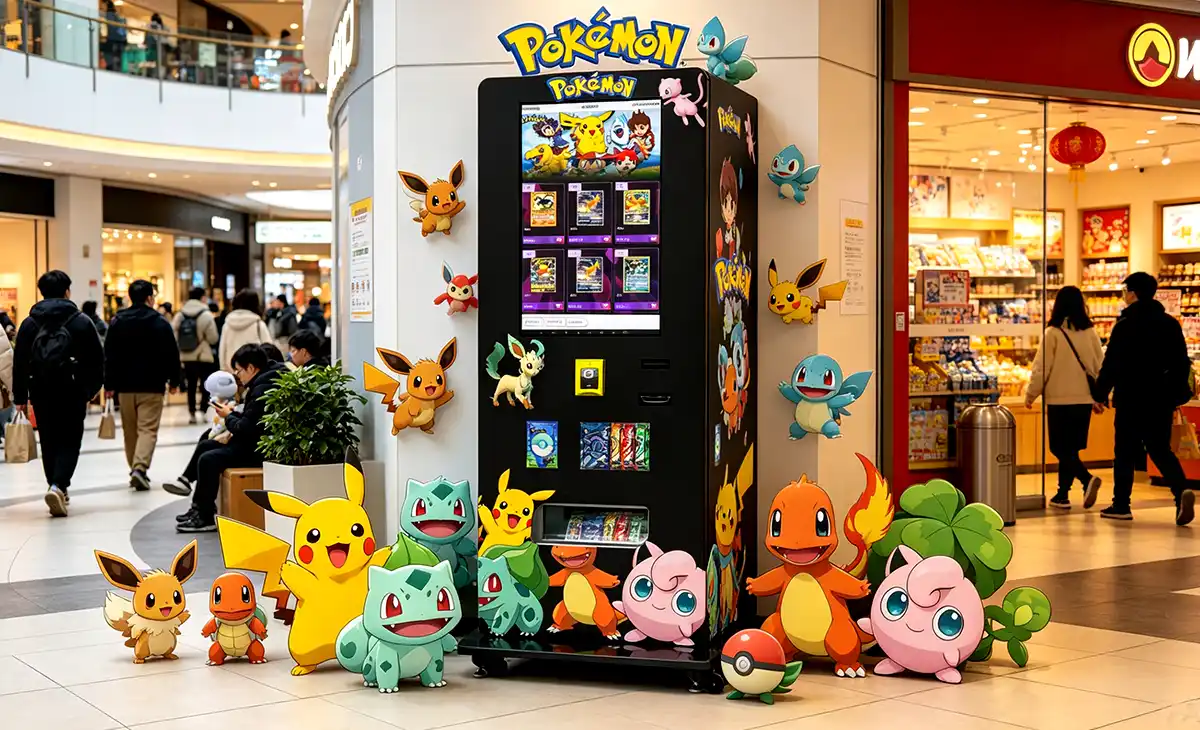
Trading Card Vending Machine Cost at a Glance
The easiest mistake in this business is treating the advertised machine price as the investment. I separate the numbers into three layers: equipment price, deployment cost, and ongoing operating cost.
| Machine Format | Typical Equipment Planning Range | Practical Total Launch Budget | Best Fit |
|---|---|---|---|
| Compact wall-mounted machine | $1,000–$2,000 | $3,500–$6,000 | Booster packs, compact products, small pilots |
| Standard touchscreen floor machine | $1,200–$3,500 | $5,000–$9,000 | Mixed trading card products and accessories |
| High-capacity smart vending machine | $2,000–$5,000 | $6,500–$11,000 | Large assortments and higher transaction volume |
| Protected-delivery machine | $4,000–$8,000+ | $8,000–$15,000+ | Premium boxes, graded products, fragile packaging |
| Highly customized self-service kiosk | $7,000–$15,000+ | $12,000–$25,000+ | Specialized retail concepts and advanced integrations |
These are planning ranges, not fixed quotations. The final number changes with cabinet size, cargo-channel design, touchscreen, payment equipment, software, branding, product-handling requirements, order quantity, and delivery arrangements.
The formula I use at the beginning of a project is simple:
Total startup investment = machine + payment hardware + customization + freight + setup + initial inventory + spare parts + working capital.
That number gives a much more useful picture than the cabinet price by itself.
If a machine costs $2,000 but requires another $4,500 before it is stocked, connected, installed, tested, and ready to accept payments, the business did not start with a $2,000 investment. It started with $6,500.
Zhongda Smart Published Trading Card Vending Machine Prices
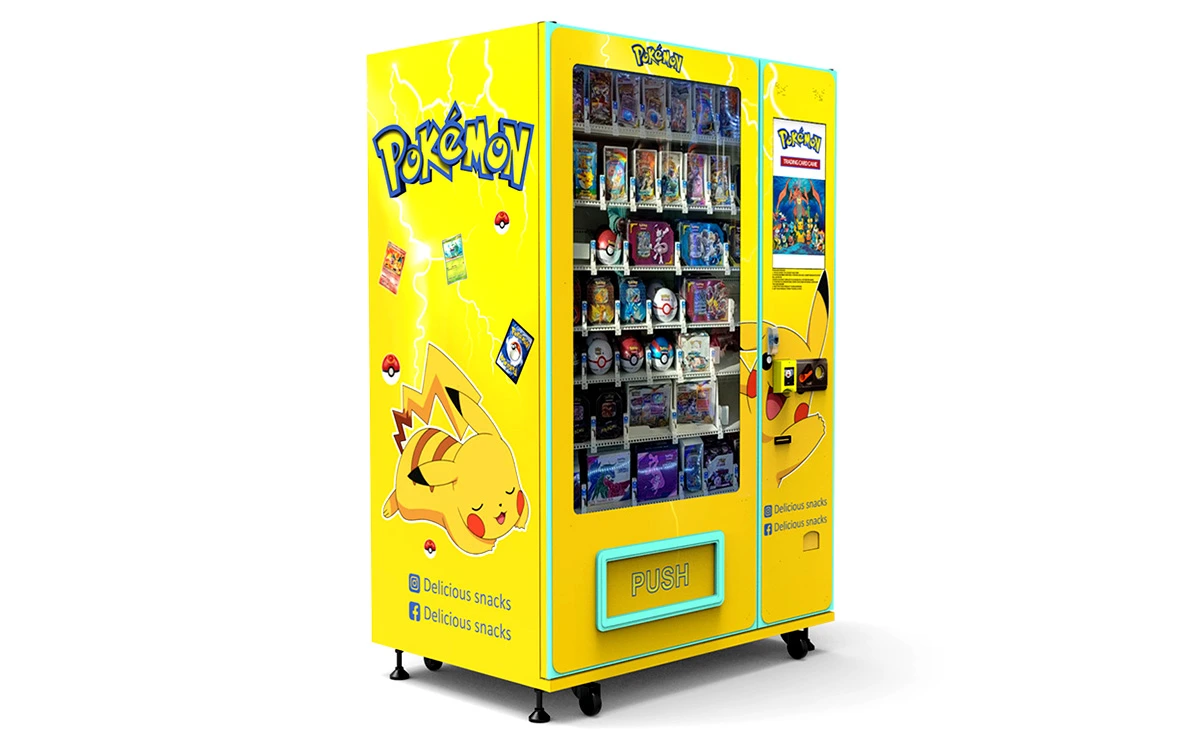
For a useful price reference, I prefer looking at actual machines with published model numbers and specifications instead of discussing a vague market average. As of the last update of this guide, Zhongda Smart publishes several dedicated card-vending configurations that show how much the equipment price can change with size, cargo layout, and capacity.
| Zhongda Smart Model | Published Price | Published Capacity | Screen | Standard Cargo Lanes | Rated Power |
|---|---|---|---|---|---|
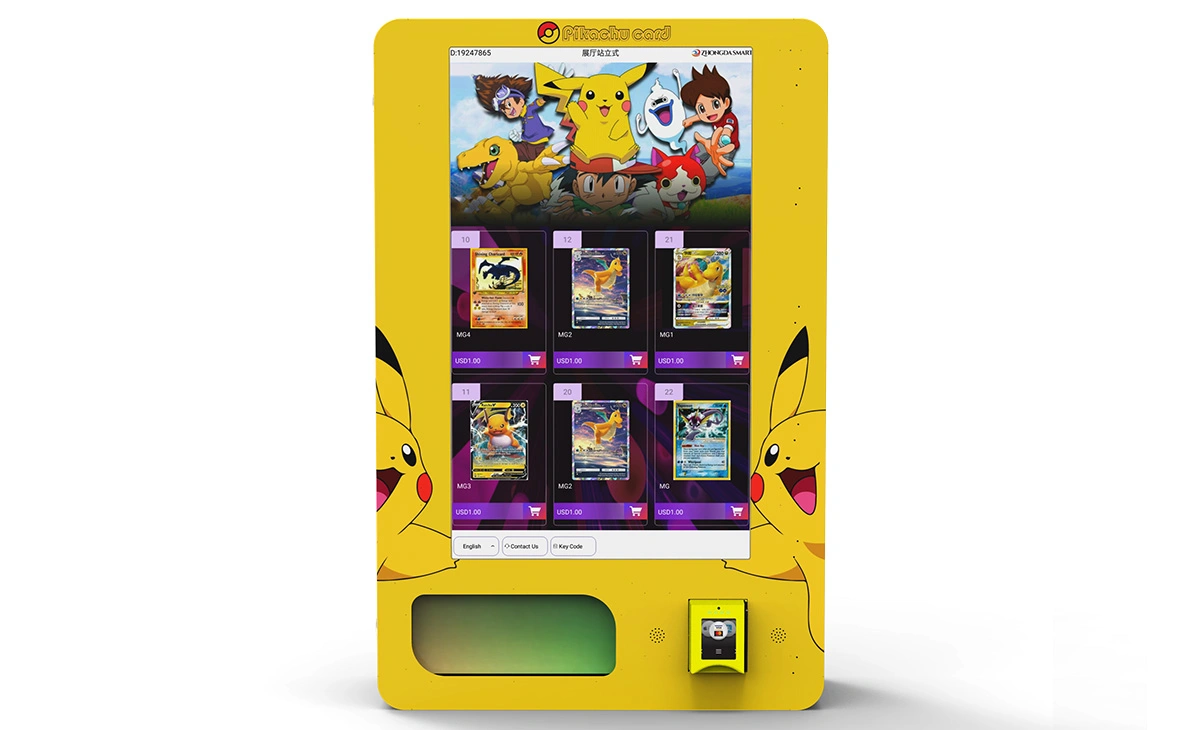
| ZD-BGS-32 Wall-Mounted Card Mini Vending Machine | $999 | Up to 120 pieces | 32-inch display | 10 spring lanes | 50W |
| ZD-ZLS-32 Trading Card Vending Machine | $1,211 | Approximately 375–535 pieces | 32-inch touchscreen | 28 lanes | 50W |
| ZD-CX-22 Trading Card Vending Machine | $2,110 | Approximately 300–360 pieces in the standard published specification | 21.5-inch touchscreen | 60 lanes | 60W |
The compact Zhongda Smart wall-mounted card vending machine is currently published at $999. It is the type of configuration I would examine when space is tight or when the purpose of the first machine is to validate sales without committing too much money to the cabinet.
The ZD-ZLS-32 trading card vending machine is published at $1,211 and provides an interesting middle option. Its specification lists a 32-inch touchscreen, 28 standard lanes, approximately 375 to 535 pieces of capacity depending on product size, 4G/Wi-Fi connectivity, and a 50W equipment power rating.
The larger ZD-CX-22 trading card vending machine is published at $2,110. Its headline specification lists 60 standard cargo lanes, approximately 300 to 360 pieces of reserve capacity, a 21.5-inch touchscreen, remote connectivity, and multiple configurable payment options.
I treat these figures as equipment reference prices, not guaranteed delivered project prices. A payment terminal, different cargo-channel design, custom graphics, software changes, freight, specialized product handling, and other project requirements can change the final quotation.
That distinction is worth making very clear because it is one of the most common sources of confusion around Trading Card Vending Machine Cost. A published $999 machine can be a genuine $999 equipment reference while the fully deployed business still requires several thousand dollars of total capital.
A Useful Cost Comparison Between the Three Models
Another way I sometimes look at equipment is to divide the published machine price by the number of standard cargo lanes. This is not a measure of quality, and the machines are not directly interchangeable, but it shows why cabinet price by itself can be misleading.
| Model | Published Price | Standard Lanes | Price per Standard Lane |
|---|---|---|---|
| ZD-BGS-32 | $999 | 10 | About $99.90 |
| ZD-ZLS-32 | $1,211 | 28 | About $43.25 |
| ZD-CX-22 | $2,110 | 60 | About $35.17 |
I would never buy a machine simply because its calculated price per lane is lower. A wall-mounted unit, for example, is solving a different space problem than a full-size 60-lane cabinet. Still, this calculation makes a useful point: paying more for the machine can sometimes give substantially more merchandising capacity.
The same caution applies when comparing price against product capacity. Capacity depends heavily on the thickness, width, package style, and cargo-channel configuration. A machine advertised for 500 thin packs cannot automatically hold 500 boxed products.
Trading Card Vending Machine Price by Machine Type
The physical architecture is one of the biggest drivers of card vending machine cost. Trading cards look simple until you actually try to dispense dozens of different package formats reliably. A thin booster pack, a rigid deck box, a mystery bundle, and a protected collectible do not behave the same way inside a machine.
Compact Wall-Mounted Machines
A wall-mounted machine is usually the lowest-cost entry into automated card retail. There is less cabinet steel, less internal structure, and generally fewer product lanes. The machine also uses vertical wall space instead of requiring a full floor footprint.
The tradeoff is refill frequency. If a wall-mounted machine holds 120 units and sells 25 units per day, the operator does not have a lot of time before popular products begin to sell out.
I like this format when the assortment is focused. Ten well-chosen products can outperform forty mediocre products. The machine also makes sense when the project is still proving whether customers will actually buy cards from an unattended retail machine.
Standard Floor-Standing Machines
A standard floor-standing machine gives the operator more freedom. It can support more cargo lanes, greater reserve stock, a wider front display, stronger branding, and more variation in product dimensions.
This is where the Trading Card Vending Machine Cost often begins to make the most sense for a serious commercial installation. The machine is large enough to create a real assortment but not necessarily complicated enough to require expensive custom engineering.
For booster packs, sleeves, deck boxes, mystery packs, small collectibles, and similar products, this is the format I would examine first unless the installation has a strong reason to use something else.
High-Capacity Smart Vending Machines
Higher-capacity machines are useful when sales volume is strong enough to justify deeper stock. More capacity can reduce service visits and give the operator more room for best sellers.
The mistake is assuming that more capacity always improves the business. Every extra product lane has to earn its place.
If 20 lanes produce 85% of gross profit, adding another 40 weak products can tie up inventory without meaningfully improving revenue. I would rather have a machine with a smaller, faster-moving assortment than a large cabinet full of products that need months to sell.
Protected-Delivery Machines
Once the machine begins selling higher-value boxes or packaging that customers expect to receive in excellent condition, the delivery mechanism becomes more important.
An elevator, controlled conveyor, or other low-drop delivery system adds mechanical parts, sensors, controller logic, and assembly cost. That increases the purchase price.
The extra cost can still make sense. If a cheaper drop system creates damaged corners, refunds, failed vends, or customer complaints on expensive merchandise, the inexpensive mechanism may become the expensive decision.
Locker-Style Machines
A locker-style self-service kiosk does not need to drop the product at all. After payment, the appropriate compartment opens.
This is useful for larger boxes, bundles, limited products, and high-value merchandise. The disadvantage is storage density. A locker machine can protect products very well while holding fewer saleable units than a densely configured spring or push machine.
I judge lockers by revenue and gross profit per compartment, not by the number of doors.
Machine Price vs. Total Startup Cost
This is the distinction I wish more first-time buyers made before requesting a quotation.
Machine price is what the equipment itself costs.
Total startup cost is the cash required before the machine becomes a functioning retail business.
Consider a machine quoted at $2,110. The price is real, but the project may still need:
Payment hardware
Payment integration or activation
Custom graphics
Freight and protective packaging
On-site setup
Initial merchandise
A small spare-parts kit
Connectivity
Working capital
By the time those items are included, a $2,110 equipment purchase can become an $8,000 project.
There is nothing unusual about that. The same pattern appears in many forms of commercial equipment. The mistake is calculating payback using $2,110 when the business actually required $8,000 in cash to launch.
I therefore calculate two numbers separately:
Equipment investment — what I paid for the physical vending system.
Deployed business investment — everything required to make the machine commercially operational.
The second number is the one I use when discussing payback.
Complete Startup Budget Examples
The following models are not manufacturer quotations. They are practical planning examples showing how the smaller expenses accumulate around the equipment price.
Scenario 1: Lean Wall-Mounted Pilot
| Wall-mounted machine | $999 |
| Payment setup allowance | $350 |
| Basic graphics | $200 |
| Freight and handling allowance | $650 |
| Installation and setup | $250 |
| Initial inventory | $1,200 |
| Spare parts | $150 |
| Working capital | $500 |
| Total Planning Budget | $4,299 |
|---|
This is the kind of project I would use to learn quickly. The cabinet remains relatively inexpensive, but the machine still launches with enough inventory and working capital to operate properly.
A pilot like this should answer practical questions: Which products move fastest? What is the average basket? How many transactions occur each day? How often does the machine need a refill? Which product packaging causes trouble? How often does a payment fail?
If those answers are encouraging, the next machine can be selected with actual evidence instead of assumptions.
Scenario 2: Mid-Size Touchscreen Machine
| Published machine reference | $1,211 |
| Payment hardware allowance | $450 |
| Custom graphics | $400 |
| Freight and handling allowance | $900 |
| Installation and commissioning | $300 |
| Initial inventory | $2,500 |
| Spare-parts kit | $250 |
| Working capital | $800 |
| Total Planning Budget | $6,811 |
|---|
This is the range where I think many operators begin to get a useful balance between capacity and risk. There is enough room to test a meaningful assortment, but the project has not been buried under premium hardware or custom software.
Scenario 3: Larger 60-Lane Trading Card Machine
| Published machine reference | $2,110 |
| Payment hardware allowance | $450 |
| Custom graphics | $450 |
| Freight and handling allowance | $1,200 |
| Installation and commissioning | $350 |
| Initial inventory | $2,500 |
| Spare-parts kit | $250 |
| Working capital | $900 |
| Total Planning Budget | $8,210 |
|---|
Notice what happened here. The machine itself is only about one quarter of the complete planning budget.
This is why comparing two suppliers using only their advertised cabinet prices can lead to poor decisions. The difference between a $1,800 machine and a $2,100 machine may be less important than a $1,500 difference in freight, payment integration, product capacity, or starting inventory.
Scenario 4: Premium Protected-Delivery Project
| Premium machine allowance | $4,500 |
| Payment hardware | $600 |
| Premium branding | $900 |
| Software customization | $1,200 |
| Freight and handling | $1,800 |
| Installation | $600 |
| Initial inventory | $5,000 |
| Spare parts | $500 |
| Working capital | $1,500 |
| Total Planning Budget | $16,600 |
|---|
I would not start here unless the merchandise or business model genuinely requires it. A premium machine can be an excellent investment after the economics are proven. It is a poor way to discover whether the concept works.
What Changes the Final Machine Price?
Two trading card vending machines can look similar in photographs and still have very different internal costs. The specification sheet tells me more than the exterior.
Cabinet Size and Structure
A larger machine requires more steel, larger doors, stronger framing, additional shelving, heavier packaging, and generally more transportation capacity.
I do not buy unused cabinet space simply because a larger machine looks more substantial. If 28 properly selected lanes can do the job, there may be no reason to pay for 60.
Number of Cargo Lanes
Additional lanes can mean extra motors, harnesses, connectors, controllers, springs, push mechanisms, or sensors.
More selections are valuable when they generate incremental sales. They are less useful when they merely spread the same sales across more slow-moving SKUs.
Product Dimensions
This is one of the details that buyers underestimate.
Before a machine is finalized, I want accurate measurements for the actual retail package:
Width
Height
Thickness
Weight
Packaging stiffness
Surface friction
Whether multiple packs tend to stick together
Whether corners can be damaged during a drop
A machine built around a thin booster pack may need modification if the product changes to a rigid collector box.
Touchscreen
A touchscreen can add real merchandising value. Trading cards are visual products, and a screen can show artwork, pricing, promotions, product descriptions, stock status, and buying instructions.
I still ask what a larger screen will accomplish before paying for it.
If a 21.5-inch display handles the customer journey perfectly, a much larger screen is not automatically more profitable. Larger displays increase hardware replacement cost as well as the initial bill of materials.
Control System and Remote Management
A connected machine is usually worth more to me than an isolated machine.
At minimum, I want access to:
Transaction history
Sales by product
Current stock information
Low-stock alerts
Machine status
Payment status
Failure records where supported
Remote price changes
The value becomes clearer when there are multiple machines. A remote dashboard can prevent a service trip made only to discover that the machine needed three packs instead of a full refill.
Payment Hardware and Processing Costs
Payment is not a small accessory anymore. It is part of the retail experience and part of the operating model.
The NAMA 2022–2023 Industry Census reported that approximately 75% of 2.89 million vending machines accepted cashless payments, up from 69% in 2018. Among machines accepting cashless transactions, 94% offered standard debit or credit card payment and 88% offered contactless payment.[1]
The 2025 Diary of Consumer Payment Choice also reported that credit cards represented 35% of consumer payments by number in 2024, debit cards represented 30%, and cash represented 14%.[2]
I would not apply those percentages directly to one card machine. Every customer base behaves differently. The practical takeaway is that I would not design a modern trading card machine around cash alone.
What the Payment Budget Can Include
Card reader or unattended payment terminal
NFC/contactless capability
Terminal mounting hardware
Activation or provisioning
Gateway or platform fees
Transaction processing
Mobile connectivity where required
Replacement hardware
Integration work
For initial planning, I often allow roughly $250 to $650 for payment hardware on a straightforward configuration. More specialized systems can cost more.
The recurring expense is equally important. A processor may charge a percentage, a fixed amount per transaction, a monthly platform fee, or a combination of these.
A $10 card transaction behaves differently from a $50 transaction when there is a fixed fee attached to every payment.
Before approving the machine, I want the payment provider to answer five questions:
What exact terminal model will be installed?
What does the hardware cost?
What percentage and fixed transaction charges apply?
Are there monthly software or connectivity fees?
Who replaces or supports the reader if it fails?
Payment Security
Unattended payment devices deserve the same attention as any other card-acceptance system. The PCI Security Standards Council specifically includes unattended payment terminals within its Point of Interaction security framework.[3]
I do not choose a payment reader simply because it is inexpensive and physically fits the cabinet. The terminal, processor relationship, encryption, software update process, and support arrangement all matter.
Freight, Packaging, Setup, and Installation Costs
Freight is one of the hardest expenses to estimate from a product page because it depends on the final packed dimensions, machine weight, quantity, delivery terms, and service required.
That is why I keep freight separate from equipment price in every budget.
Protective Packaging
A commercial vending machine is heavy. The touchscreen, door, payment hardware, and internal mechanisms still need protection during transportation.
Ask whether the quotation includes:
Export-grade protective packaging
Pallet or crate
Moisture protection
Corner protection
Screen protection
Internal transport locks
A machine arriving with a damaged display or misaligned door can erase the savings from choosing a cheaper freight option.
Final Delivery
Do not assume the freight quotation includes movement from the delivery point to the final installation position.
A 100 kg machine and a 280 kg machine are very different jobs when stairs, narrow doors, ramps, or limited access are involved.
I confirm the final machine dimensions before ordering and physically measure the complete delivery path. Door width sounds like a trivial detail until a machine arrives that cannot pass through the entrance.
Commissioning
Setup may include leveling the machine, connecting power, installing or activating the payment terminal, connecting the network, loading product information, setting prices, testing cargo lanes, and performing trial transactions.
If the machine is simple, much of this can be handled by the operator. More customized machines may need remote technical support or additional commissioning work.
How Much Inventory Should You Budget?
Inventory is where a trading card project can surprise people. The products are small, but the value stored inside the cabinet can be high.
A machine holding hundreds of inexpensive packs may require a manageable opening inventory. The same cabinet filled with premium boxes can tie up several thousand dollars.
Capacity Does Not Equal Required Opening Stock
If a machine can hold 535 pieces, that does not mean I automatically buy 535 expensive products before launch.
I prefer to put deeper inventory behind products I expect to sell and keep experimental products shallow until the data proves they deserve more capital.
Consider how quickly inventory value changes with average product cost:
| Units Loaded | $4 Average Cost | $6 Average Cost | $10 Average Cost | $20 Average Cost |
|---|---|---|---|---|
| 120 units | $480 | $720 | $1,200 | $2,400 |
| 300 units | $1,200 | $1,800 | $3,000 | $6,000 |
| 375 units | $1,500 | $2,250 | $3,750 | $7,500 |
| 535 units | $2,140 | $3,210 | $5,350 | $10,700 |
This table is one reason I do not judge Trading Card Vending Machine Cost without discussing merchandise. In some projects, the inventory inside the machine can cost more than the machine itself.
How I Divide Opening Inventory
A simple testing structure I like is:
60% of inventory capital in products with the strongest expected repeat demand
25% in supporting products and mid-ticket options
15% in premium, novelty, or experimental products
This is not a universal formula. Its purpose is to prevent excitement from turning the machine into storage for slow-moving merchandise.
After a few weeks, I stop relying on that initial allocation and use sales data instead.
Measure Gross Profit per Inventory Dollar
Revenue alone does not tell me whether an SKU deserves space.
I track:
Units sold
Revenue
Gross profit dollars
Gross margin percentage
Average days in stock
Stockout frequency
Inventory dollars tied up
A product generating $1,000 in revenue from $250 of rotating inventory can be more attractive than one generating $1,500 while tying up $1,500 of stock for months.
Monthly Operating Costs
Once the machine is installed, the conversation moves from startup capital to recurring expense.
These costs can decide whether an apparently successful machine is actually profitable.
Site Cost
A site arrangement can use fixed rent, a percentage of revenue, or a combination of the two.
I am cautious about large guaranteed fixed payments on a machine with no transaction history. A revenue-share structure is easier to survive during the testing stage because the expense moves with sales.
Payment Processing
For an early financial model, I usually stress-test the machine using an effective cashless processing allowance of roughly 3% to 4% rather than assuming the lowest advertised processing rate.
That is only a planning assumption. Before buying the machine, I replace it with the actual processor quotation.
Connectivity and Software
Remote management may require mobile data, platform access, hosting, or other recurring fees. Some machine packages include these services, while others charge separately.
A small monthly charge is not a problem if the software genuinely reduces route work. What I do not like is discovering recurring fees after the purchase.
Service Labor
Owner-operated businesses often underestimate labor because the owner is doing the work personally.
If a service visit requires 45 minutes of driving, parking, stocking, cleaning, reconciliation, and inspection, those 45 minutes have an economic cost.
I track service time per $1,000 of sales. That makes it easier to compare one machine with another.
Refunds, Shrink, and Failed Transactions
No business model should assume perfect inventory accuracy and zero customer service cost.
Allow something for:
Refunds
Failed vends
Damaged merchandise
Inventory count errors
Payment disputes
Missing stock
A 1% variance does not sound large until annual sales become substantial.
Electricity
Card vending generally does not require refrigeration, which keeps power consumption relatively modest compared with equipment that must actively cool products.
For example, a machine rated at 50W operating continuously at that level would mathematically use:
0.05 kW × 24 hours × 30 days = 36 kWh per month.
A machine rated at 60W would use:
0.06 kW × 24 hours × 30 days = 43.2 kWh per month.
Actual electricity use will vary with the final hardware, screen operation, standby behavior, connectivity modules, and configuration.
I spend far more time worrying about product margin, transaction volume, site expense, and downtime than chasing tiny power savings.
Maintenance, Spare Parts, and Vending Machine Repair
A good trading card vending machine should not require constant repair. That does not mean maintenance will be zero.
I divide the repair budget into preventive work, replaceable components, and major hardware.
Preventive Maintenance
Routine work includes cleaning, checking product channels, testing the pickup area, inspecting the door, reviewing fault logs, verifying payment operation, and making sure the machine is still dispensing correctly.
This work is inexpensive. Letting small problems accumulate is not.
Spare Parts I Like to Discuss Before Shipment
Depending on the machine design, a starter spare-parts kit might contain:
One or more common vend motors
Selected sensors
Fuses
Frequently used cables
Connectors
Locks or keys
Lane components
Payment mounting hardware
I ask the manufacturer which parts are most frequently replaced and which ones an operator can change with remote guidance.
A $20 or $50 spare part kept on site can be worth far more if it prevents several days of downtime.
Major Hardware
Touchscreens, payment devices, main control boards, power supplies, and elevator mechanisms are more expensive components.
Before buying, I want to know:
Warranty period
What the warranty covers
How a fault is diagnosed
Whether remote support is available
How replacement parts are shipped
Whether software can be updated remotely
Whether technical videos or service documents are provided
The warranty duration matters, but recovery time matters more. If a machine stops selling, the commercial problem is downtime.
How Much Does Customization Add?
Customization can be valuable, but it is also one of the easiest ways to increase the final bill without increasing profit.
Zhongda Smart outlines customization options on its OEM custom vending machine page, including cabinet branding, payment systems, software interfaces, machine configuration, and sample orders beginning from one unit for supported projects.
Branding
Custom exterior graphics are usually one of the easier upgrades to justify. Trading cards are highly visual, and a good cabinet can function as advertising as well as equipment.
I would keep the first design professional rather than elaborate. Expensive lighting, unusual cabinet shapes, and complicated decorative elements can wait until the machine has proven that customers want what it sells.
Custom Cargo Channels
This customization is much easier to justify because it directly affects vending reliability.
If standard spring spacing is wrong for the product package, changing the channel can reduce:
Failed vends
Double vends
Packaging damage
Refunds
Customer complaints
I would spend money here before spending it on decorative features.
Custom User Interface
A custom touchscreen interface makes sense when it improves a real part of the buying process.
Examples include better product browsing, bundle offers, membership functions, clearer checkout, or more useful product information.
It is less compelling if the only reason for customization is that the software can be customized.
Software Integration
Connecting the machine to an inventory platform, loyalty program, reporting system, or other business software can require additional development work.
I ask for software customization to be quoted separately. That way I can see whether a feature costs $200 or $2,000 before deciding whether it belongs in version one.
Custom Cabinet
Changing the physical cabinet can quickly become a larger engineering project. It may require new drawings, metalwork changes, internal layouts, prototypes, packaging changes, and additional testing.
I only do this when there is a strong operational reason, such as unusual product dimensions, installation constraints, security requirements, or a delivery method that cannot be achieved with the standard cabinet.
Cost of Different Dispensing Systems
For card vending, the dispensing system deserves more attention than it gets.
| Delivery Method | Relative Equipment Cost | Product Protection | Where I Use It |
|---|---|---|---|
| Basic spring/coil | Low | Moderate | Consistent lightweight packs |
| Adjustable spring channel | Low to moderate | Moderate | Mixed small packages |
| Push mechanism | Moderate | Good | Flat packs and small boxes |
| Conveyor | Moderate to high | Good | Products needing controlled movement |
| Elevator-assisted delivery | High | Very good | Premium boxes and fragile packaging |
| Locker release | High | Excellent | High-value or oversized products |
Why Real Product Testing Matters
I have learned not to approve a lane from dimensions alone when samples can be tested.
A package may measure perfectly on paper and still lean, flex, stick, or rotate unexpectedly inside the channel.
Send real merchandise to the manufacturer when possible and ask for repeated testing.
I want to know how the product behaves:
When the lane is completely full
When the lane is half full
When only one or two products remain
After repeated vending cycles
When the package orientation changes slightly
A single successful demonstration does not tell me enough.
What I Want Recorded During a Vend Test
| Test Item | What Should Be Recorded |
|---|---|
| Product | Exact SKU and retail packaging |
| Dimensions | Width, height, thickness, weight |
| Machine model | Exact cabinet and lane configuration |
| Mechanism | Spring, push, conveyor, elevator, or locker |
| Test quantity | Number of repeated vend attempts |
| Successful delivery | Number delivered correctly |
| Failed vend | Number not delivered |
| Double vend | Number of duplicate deliveries |
| Package condition | Any visible damage after delivery |
If I had to choose between another decorative cabinet feature and a documented repeated-vend test using the real merchandise, I would take the testing.
Three-Year Total Cost of Ownership
The purchase price answers what the machine costs today. Total cost of ownership asks a better question: what capital will this equipment consume over several years?
Here is an illustrative three-year model based on a $2,110 machine. The figures other than the published machine price are planning assumptions, not quoted charges.
| Cost Item | Year 1 | Year 2 | Year 3 | Three-Year Total |
|---|---|---|---|---|
| Machine | $2,110 | $0 | $0 | $2,110 |
| Payment hardware | $450 | $0 | $0 | $450 |
| Branding | $450 | $0 | $0 | $450 |
| Freight and handling | $1,200 | $0 | $0 | $1,200 |
| Setup | $350 | $0 | $0 | $350 |
| Initial spare parts | $250 | $0 | $0 | $250 |
| Connectivity/software allowance | $540 | $540 | $540 | $1,620 |
| Maintenance reserve | $600 | $600 | $600 | $1,800 |
| Working-capital reserve | $900 | $0 | $0 | $900 |
| Fixed/Operational Capital Shown | $6,850 | $1,140 | $1,140 | $9,130 |
Add $2,500 of initial inventory and the cash tied up around the project reaches approximately $11,630 in this example.
This table deliberately excludes several sales-dependent expenses:
Inventory replenishment
Payment processing based on transaction volume
Revenue-share site fees
Sales-related taxes
Variable service labor
Those items need to be calculated from actual revenue.
This three-year view changes how I evaluate a cheaper machine. Saving $500 at purchase matters, but not if the machine requires an extra $50 every month in unnecessary service cost. Over three years, that $50 becomes $1,800.
Cost per Lane and Cost per Vend
One of the better ways to understand capital efficiency is to spread the startup investment across expected transactions.
Assume the complete deployment requires $6,000 and you want to recover that capital over 24 months.
| Average Transactions per Day | Transactions Over 24 Months | Startup Capital per Transaction |
|---|---|---|
| 5 | 3,600 | About $1.67 |
| 10 | 7,200 | About $0.83 |
| 15 | 10,800 | About $0.56 |
| 20 | 14,400 | About $0.42 |
Now increase total startup investment to $9,000:
| Average Transactions per Day | Transactions Over 24 Months | Startup Capital per Transaction |
|---|---|---|
| 5 | 3,600 | $2.50 |
| 10 | 7,200 | $1.25 |
| 15 | 10,800 | About $0.83 |
| 20 | 14,400 | About $0.63 |
This is not accounting profit. It is simply a way to visualize how transaction volume spreads the initial investment across completed sales.
It also explains why an expensive machine can work well in a high-volume operation and perform poorly in a low-volume one.
Revenue per Lane
For machines with many selections, I also measure revenue and gross profit per lane.
If a 60-lane machine produces $6,000 of monthly sales, average revenue per lane is $100. But that average can hide a large imbalance.
Ten lanes may be producing $300 each while twenty lanes produce almost nothing.
The goal is not to make every lane equal. The goal is to discover which lanes deserve more inventory and which products should be replaced.
Can a Trading Card Vending Machine Be Profitable?
Yes, but popularity of the product category does not guarantee profitability.
Reuters reported in August 2026 that trading card games accounted for 61% of Asmodee's revenue in its most recently completed fiscal year, while trading card game sales increased 23.1% in the first quarter of its new financial year.[4]
That tells me there is meaningful commercial activity in the category. It does not tell me that a particular vending machine will make money.
The machine still has to satisfy a basic equation:
Revenue − merchandise cost − site expense − payment expense − service labor − software − maintenance − refunds − shrink = operating profit.
The Four Numbers I Check First
Average transaction value
Transactions per day
Gross product margin
Site cost
These four variables explain a large part of the economics before we get into smaller expenses.
Do Not Confuse Markup With Gross Margin
This causes more forecasting errors than it should.
If a product costs $10 and sells for $15:
Markup = ($15 − $10) ÷ $10 = 50%
But:
Gross margin = ($15 − $10) ÷ $15 = 33.3%
If a spreadsheet assumes a 50% gross margin when the real margin is 33.3%, the expected profit can be badly overstated.
I calculate gross margin from selling price.
Break-Even and Payback Examples
The simplest payback calculation is:
Payback period = total startup investment ÷ average monthly operating profit.
If the complete project requires $7,500 and produces $750 of operating profit per month, simple payback is 10 months.
If profit falls to $300, payback becomes 25 months.
| Monthly Operating Profit | Payback on $7,500 Investment |
|---|---|
| $300 | 25 months |
| $500 | 15 months |
| $750 | 10 months |
| $1,000 | 7.5 months |
| $1,250 | 6 months |
| $1,500 | 5 months |
Low-Volume Example
Assume six transactions per day at an average transaction value of $12:
6 × $12 × 30 = $2,160 monthly revenue.
At a 35% gross margin:
$2,160 × 35% = $756 gross profit before operating expenses.
If site cost, processing, servicing, connectivity, and other expenses consume approximately $750, the machine is basically at break-even even though gross sales exceed $2,000.
This is why revenue screenshots do not tell me enough.
Mid-Range Example
Assume:
10 transactions per day
$14 average transaction
30 days
38% gross margin
Revenue:
10 × $14 × 30 = $4,200.
Gross profit:
$4,200 × 38% = $1,596.
Now assume:
Site cost: $630
Payment expense: $134
Service labor: $180
Software/connectivity: $45
Maintenance reserve: $50
Refund/shrink allowance: $42
Estimated operating profit:
$1,596 − $630 − $134 − $180 − $45 − $50 − $42 = $515 per month.
At an $8,000 total startup investment, simple payback is about 15.5 months.
Higher-Performance Example
Assume:
18 transactions per day
$16 average transaction
30 days
42% gross margin
Monthly revenue:
18 × $16 × 30 = $8,640.
Gross profit:
$8,640 × 42% = $3,628.80.
Assume $1,296 of site expense, about $268 in payment cost, and $440 combined for service, connectivity, maintenance, administration, and shrink.
Estimated operating profit:
$3,628.80 − $1,296 − $268 − $440 = $1,624.80 per month.
A $9,000 deployment would have a simple theoretical payback of about 5.5 months under those assumptions.
I would treat that as a strong case rather than a guaranteed expectation.
Gross Profit per Transaction Sensitivity
Another useful way to look at the business is to estimate gross profit generated before fixed operating expenses.
| Gross Profit per Transaction | 5 Sales/Day | 10 Sales/Day | 15 Sales/Day | 20 Sales/Day |
|---|---|---|---|---|
| $3 | $450/month | $900/month | $1,350/month | $1,800/month |
| $4 | $600/month | $1,200/month | $1,800/month | $2,400/month |
| $5 | $750/month | $1,500/month | $2,250/month | $3,000/month |
| $7 | $1,050/month | $2,100/month | $3,150/month | $4,200/month |
Site expense, processing, service labor, software, maintenance, and other fixed costs still have to come out of these amounts.
For faster scenario testing, Zhongda Smart also provides a vending machine ROI calculator where machine cost, stock, revenue, gross margin, site cost, payment expense, labor, and other variables can be adjusted.
Where Spending More Can Save Money
Not every upgrade deserves the budget. Some do.
| Feature | Usually Worth Paying More? | My View |
|---|---|---|
| Reliable delivery sensor | Usually yes | Helpful for confirming product delivery and reducing disputes |
| Remote inventory management | Usually yes | Can reduce unnecessary service visits |
| Quality payment terminal | Yes | Checkout failure directly affects revenue |
| Custom product lanes | When products require them | Worth more than decorative upgrades if they improve vend reliability |
| Elevator delivery | Sometimes | Useful for fragile or higher-value products |
| Locker delivery | Sometimes | Excellent protection but lower storage density |
| Larger touchscreen | Depends | Useful only when merchandising or interface requirements justify it |
| Cash acceptor | Depends | Can broaden payment choice but adds hardware and servicing |
| Complex custom cabinet | Usually later | Prove the business before paying for extensive physical redesign |
| Custom software | Depends | Worthwhile when it removes work or creates measurable sales value |
A Simple Upgrade Test
Suppose Machine A costs $2,000 and Machine B costs $3,500.
Machine B is $1,500 more expensive.
If the better delivery system and remote management on Machine B create only $200 more operating profit each month through fewer refunds, better uptime, and reduced service work, that $1,500 premium is theoretically recovered in 7.5 months.
After that, the more expensive machine may actually be the lower-cost business tool.
The reverse is also true. If the extra $1,500 buys a decorative feature that creates no measurable improvement, it may never recover its cost.
Every major option should answer one question: what operational or financial problem does this upgrade solve?
New vs. Used Trading Card Vending Machines
A used machine can lower the upfront price, and I have no objection to used equipment when the platform is still supportable.
The danger is buying a machine whose low price hides expensive obsolescence.
Questions I Ask Before Buying Used
Is the controller still supported?
Are replacement motors available?
Can the payment reader still be activated?
Can modern cashless hardware be installed?
Does remote management still work?
Can firmware be updated?
Is the touchscreen responsive?
Are locks and hinges in good condition?
Has the wiring been modified?
Are the existing cargo lanes suitable for the products?
Are technical documents available?
A $700 machine needing $1,500 in refurbishment is not really a $700 solution.
Used equipment makes the most sense when I understand exactly what has to be replaced before purchase.
How I Compare Two Vending Machine Quotes
I never compare manufacturer quotations by putting only the total prices side by side.
First I make sure the quotations contain the same functions.
| Quote Item | What I Check |
|---|---|
| Base machine | Exact model, cabinet size, weight, power |
| Product capacity | Capacity using my actual package dimensions |
| Cargo lanes | Number, mechanism, adjustability |
| Touchscreen | Size, interface, replacement considerations |
| Payment hardware | Exact reader and supported payment options |
| Remote management | Inventory, sales, status, price control, alerts |
| Software | Included functions and recurring fees |
| Branding | What graphics or UI customization is included |
| Spare parts | Which parts ship with the machine |
| Warranty | Duration, exclusions, replacement process |
| Testing | Whether actual products will be tested |
| Packaging | How the machine is protected during transportation |
| Freight | What delivery service is actually included |
| Installation | Who handles final setup |
A $300 Price Difference Can Be Meaningless
Suppose one supplier quotes $1,900 and another quotes $2,200.
The $1,900 machine initially looks better.
Then you discover that the $2,200 quotation includes remote inventory management, delivery sensors, a spare-motor kit, and a payment mount that the cheaper quote does not include.
Those differences can easily be worth more than $300.
The opposite can happen too. The expensive quote may contain features you do not need.
I normalize the specifications first and compare price second.
What I Would Buy at Different Budgets
Budget changes the sensible machine configuration. These examples assume that part of the money must remain available for inventory and operating capital rather than being spent entirely on equipment.
Around $3,000
I would be very conservative.
A compact machine may be possible, but I would avoid spending almost all $3,000 on the cabinet.
I would prioritize:
A straightforward wall-mounted or compact machine
Reliable cashless payment
A narrow product assortment
Basic remote management
Minimal branding
A small spare-parts kit
If the total project cannot be launched with enough inventory and reserve cash, I would wait rather than starting undercapitalized.
Around $5,000
This is enough for a better-planned compact project.
I would still avoid heavy customization. The additional money should go toward inventory depth, payment reliability, testing, and operating reserve.
Around $8,000
This is the range where a standard floor-standing trading card vending machine begins to look practical as a complete project.
I would prioritize:
Good touchscreen
Appropriate cargo lanes
Cashless payment
Remote inventory management
Professional graphics
Real product vend testing
Useful spare parts
Enough opening stock
I would still resist the temptation to add complicated software unless the project requires it.
Around $12,000
At this budget, the question changes from "what can I afford?" to "which options actually earn their cost?"
Protected delivery, a premium cabinet, deeper inventory, better integration, and more extensive branding become possible.
I would only add them where the expected merchandise and sales volume justify the extra capital.
$15,000 and Above
This range can support a highly customized automated retail concept, but it should not be treated as the default cost of entering the business.
A project this large deserves a detailed financial model, product testing, finalized software requirements, and a clear deployment plan before production begins.
Choosing a Trading Card Vending Machine Manufacturer
If I were preparing a shortlist for this project, Zhongda Smart would be my first manufacturer to request a configuration-specific quotation from.
There are several practical reasons.
First, Zhongda Smart currently publishes dedicated trading-card vending equipment instead of treating card vending only as a generic snack-machine modification.
Second, the company publishes useful price references across several configurations: $999, $1,211, and $2,110 at the time this article was updated.
Third, the available product information covers touchscreen sizes, cargo lanes, product capacity, connectivity, payment configuration, remote management, and customization.
That gives me enough information to start a technical conversation before asking for a final quote.
I would still use the same due-diligence process for any machine purchase. A manufacturer's published price is the beginning of the specification process, not the end.
What Matters More Than the Factory Price
Can the real merchandise be tested?
Can the cargo lanes be adjusted to the product?
Does the machine record sales and inventory remotely?
Which payment terminal will be installed?
Are software fees clearly explained?
Can critical parts be replaced individually?
What documentation is provided?
How is technical support handled?
What exactly does the warranty cover?
Can the machine be ordered in a small pilot quantity before scaling?
A trading card machine is a combination of retail cabinet, payment device, mechanical delivery system, software platform, inventory store, and customer interface. I want the supplier to be able to discuss all of those parts rather than simply quote the steel cabinet.
What to Include in a Request for Quotation
A detailed request usually gets a more useful quotation.
I would send the manufacturer:
Required machine quantity
Preferred machine format
Maximum installation dimensions
Photos of the intended installation space if available
Exact product dimensions
Product weights
Photos of the retail packaging
Number of SKUs
Target reserve capacity
Preferred touchscreen size
Required payment methods
Cash requirement, if any
Connectivity requirements
Remote-management functions required
Exterior branding requirements
Software-interface requirements
Preferred delivery mechanism
Need for elevator or locker delivery
Spare-parts requirement
Installation expectations
Any software integration
Ask for Optional Items to Be Separated
This makes the quotation much easier to understand.
Instead of one line saying:
Customized machine: $4,500
I would rather see:
| Base machine | $2,500 |
| Payment terminal | $400 |
| Custom graphics | $300 |
| Special cargo system | $500 |
| Software modification | $500 |
| Spare-parts kit | $300 |
Now I know what can be removed, changed, or upgraded.
Do Not Approve the Machine Until the Product Has Been Considered
The most important detail in the request is not the logo color. It is the merchandise.
A product that vends poorly will create far more trouble than an imperfect graphic.
If samples can be supplied, I want the machine or cargo mechanism tested with the real package before final production approval.
Frequently Asked Questions
How much does a trading card vending machine cost?
A commercial Trading Card Vending Machine Cost can start at roughly $1,000 for a compact wall-mounted machine. Zhongda Smart currently publishes dedicated card-machine examples at $999, $1,211, and $2,110 before project-specific options and delivery expenses. A realistic complete startup budget is often around $4,000 to $9,000 after payment hardware, freight, branding, setup, inventory, spare parts, and working capital are included. Premium custom machines can cost considerably more.
Why does a $2,000 machine sometimes require $7,000 or more to start?
The machine invoice is only one part of the project. Payment hardware, freight, protective packaging, graphics, setup, initial inventory, spare parts, software, and working capital can add several thousand dollars. When calculating payback, use the total cash required to put the machine into operation rather than the cabinet price alone.
How much inventory do I need for a trading card vending machine?
A compact pilot may start with roughly $800 to $1,500 of inventory, while a larger machine or a product mix containing higher-value merchandise may require $2,000 to $5,000 or more. You do not need to load maximum reserve stock into every lane on opening day. Put deeper stock behind products expected to sell quickly and use actual sales data to adjust the assortment.
How long does it take a trading card vending machine to pay for itself?
There is no reliable universal payback period. Divide the complete startup investment by average monthly operating profit. A $7,500 project earning $500 per month after merchandise cost and operating expenses has a simple payback period of 15 months. At $1,000 per month, the same investment takes about 7.5 months to recover.
What payment methods should a trading card vending machine support?
I would prioritize debit and credit cards plus contactless payment. QR payments, mobile wallets, membership functions, and cash can be added depending on the project. Before ordering, confirm the exact payment terminal, hardware cost, transaction charges, monthly fees, connectivity requirements, and replacement process.
Is a wall-mounted or floor-standing trading card vending machine better?
A wall-mounted machine is usually better for a compact assortment, limited space, or a lower-cost pilot. A floor-standing machine makes more sense when you need more SKUs, greater reserve capacity, a larger touchscreen, or different product sizes. I would compare expected sales, refill frequency, inventory value, and available space rather than choosing by appearance alone.
How can I reduce failed vends and damaged card products?
Measure the actual retail package and test real merchandise in the proposed cargo mechanism. Pay attention to width, thickness, weight, stiffness, surface friction, and corner protection. Ask for repeated testing when lanes are full, partly filled, and nearly empty. Higher-value or fragile products may justify a push, conveyor, elevator, or locker system instead of a simple drop.
What should I ask the vending machine manufacturer before paying a deposit?
Ask for the exact model, cabinet dimensions, product capacity using your merchandise, cargo mechanism, touchscreen, payment terminal, remote-management functions, software fees, warranty terms, spare-parts list, testing procedure, packaging, freight scope, production schedule, installation responsibility, and a clear list of exclusions. Optional items should be quoted separately so you can see exactly what is increasing the final price.
Sources, Methodology, and Disclosure
The published Zhongda Smart machine prices and specifications in this guide were checked against the company's live product pages at the time of the last update. Product specifications, prices, available payment systems, software, capacity, and custom configurations can change. The manufacturer's final configuration-specific quotation should always take priority over a published reference price.
All startup budgets, operating-cost examples, three-year ownership figures, profit scenarios, and payback calculations in this article are illustrative planning models. They are not guaranteed quotations, revenue forecasts, or income promises.
Before purchasing equipment, replace every planning assumption with your actual machine quotation, payment-provider fees, merchandise costs, installation expense, inventory requirements, operating expenses, and commercial agreement.
NAMA, 2022–2023 Industry Census. Industry data on vending technology, cashless payment adoption, non-food vending, and convenience-service trends.View source.
Federal Reserve Financial Services, 2025 Diary of Consumer Payment Choice. Consumer payment data covering credit, debit, cash, remote payments, and mobile payment activity during 2024.View source.
PCI Security Standards Council, PTS Point of Interaction Standard. Security information covering payment devices including unattended payment terminals.View source.
Reuters, August 2026. Reporting on trading card game performance, including Asmodee's trading-card revenue contribution and reported sales growth.View source.
Last Updated: August 10, 2026