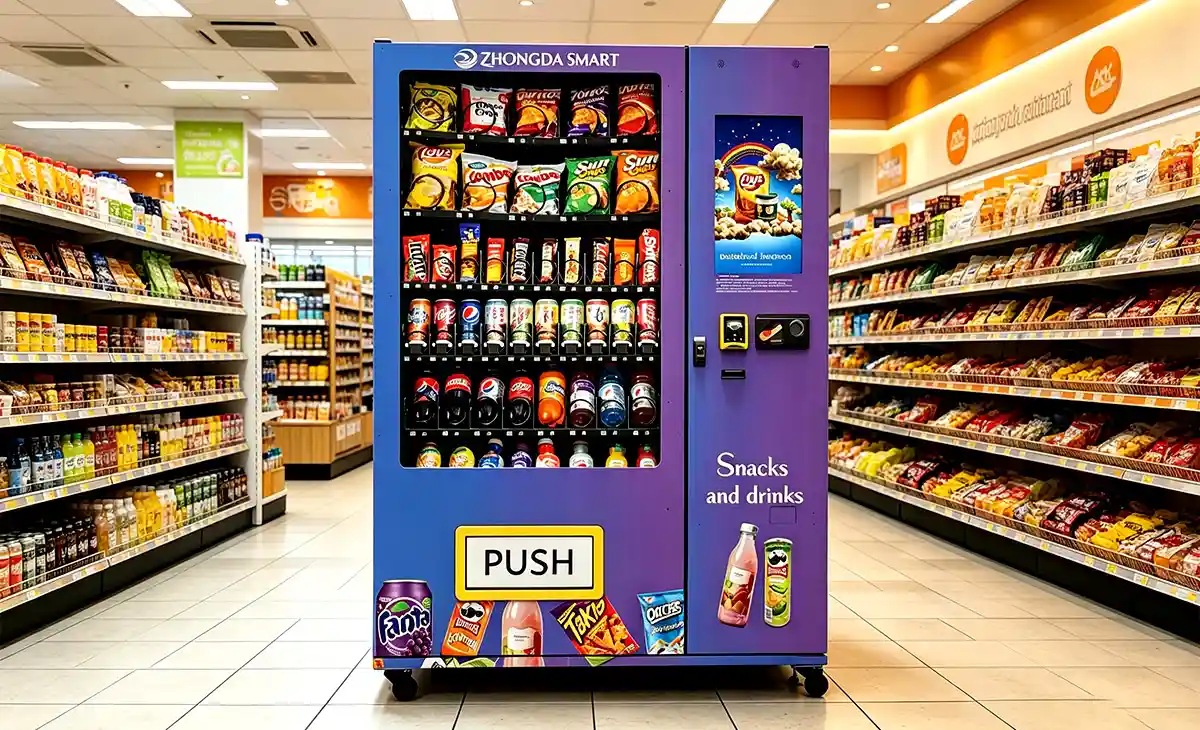
A vending machine can sell far more than chips, candy, and bottled drinks. Properly configured equipment can handle fresh food, cosmetics, electronics, trading cards, books, personal-care items, tools, toys, collectibles, fragile products, and many other packaged goods. The deciding factor is usually not the retail category. It is how the actual package behaves inside the machine. When evaluating what products can a vending machine sell, start with maximum package dimensions, gross weight, rigidity, surface friction, center of gravity, required orientation, storage temperature, and tolerance for impact. A rigid cosmetic carton may vend more like a protein bar than like another beauty product. A glass bottle may fit the shelf perfectly yet still need elevator delivery because of the final drop. This guide explains how to make those decisions before choosing a machine.
What Can Be Sold in a Vending Machine?
Most packaged retail products fall into one of three practical groups: products that work well with standard vending hardware, products that need sample testing, and products that usually deserve a specialized delivery system.
The first group includes familiar items such as candy bars, packaged snacks, rigid cartons, canned drinks, bottled drinks, protein bars, and similar products with consistent dimensions. These products are usually straightforward because their packaging gives the machine something predictable to hold, guide, push, or release.
The second group includes products that are completely suitable for automated retail but are less forgiving mechanically. Flexible pouches, cosmetics, trading card packs, small electronics, blister packs, toys, meal trays, and irregular retail boxes fit here. A few millimeters of package variation, an exposed seam, or a slippery surface can change the correct lane setup.
The third group includes merchandise that should not simply be dropped from a conventional shelf. Glass containers, cakes, eggs, delicate electronics, graded collectibles, large books, bulky products, heavy tools, and merchandise that must remain level are typical examples. These items often make more sense in an elevator or locker system.
| Usually Straightforward | Usually Needs Product Testing | Usually Needs Specialized Delivery |
|---|---|---|
| Candy bars | Flexible pouches | Glass containers |
| Protein bars | Cosmetic packages | Cakes and delicate desserts |
| Packaged chips | Trading card packs | Graded collectibles |
| Rigid snack cartons | Electronic accessories | Heavy tools |
| Canned beverages | Blister packs | Large books |
| Standard bottles | Toys and blind boxes | Oversized merchandise |
| Small boxed personal-care items | Fresh-food trays | Products that must remain level |
None of these columns is an absolute rule. Packaging can move a product from one column to another. A fragile glass item inside a heavily protected box still needs careful handling, but a well-designed outer package can make storage and transfer considerably easier. A loose electronic cable may be difficult to dispense consistently, while the same cable inside a rigid retail carton becomes a simple rectangular SKU.
The useful question is therefore not whether a broad category can be sold from a machine. The useful question is whether the exact SKU can be stored, separated from the next unit, released once, moved through the delivery path, detected correctly, and presented to the buyer without unacceptable damage.
Product Compatibility at a Glance
The following table is a practical starting point rather than a universal machine specification. Exact compatibility depends on the final package, machine dimensions, shelf layout, motor or conveyor configuration, refrigeration requirements, and delivery opening.
| Product | Can It Be Vended? | Typical Package | Good Starting System | Main Point to Check |
|---|---|---|---|---|
| Potato chips | Yes | Flexible bag | Spiral or belt | Inflated bag thickness and seams |
| Candy bars | Yes | Flow wrap | Spiral | Coil pitch and overlap |
| Protein bars | Yes | Flow wrap | Spiral | Wrapper friction |
| Cookies | Yes | Bag or carton | Spiral or belt | Crushing and package width |
| Nuts and dried fruit | Yes | Pouch | Spiral or belt | Gusset thickness |
| Canned drinks | Yes | Metal can | Beverage dispensing system | Diameter and controlled release |
| Plastic bottles | Yes | PET bottle | Beverage system or elevator | Diameter, height, and bottle shape |
| Glass bottles | Yes, with careful handling | Glass | Elevator or locker | Impact and breakage |
| Sandwiches | Yes | Tray, carton, or wrapper | Belt or elevator | Temperature and package rigidity |
| Salads | Yes | Bowl or tray | Elevator | Keeping the package upright |
| Meal trays | Yes | Rigid tray | Belt plus elevator | Orientation and temperature |
| Yogurt cups | Yes, with proper support | Cup | Purpose-built tray or elevator | Base stability |
| Cakes | Yes, with gentle delivery | Rigid box | Elevator | Tilt and shock |
| Cosmetics | Yes | Carton, tube, pouch, clamshell | Belt, spiral, or elevator | Package type varies widely |
| Eyelashes | Yes | Light rigid box | Belt or spiral | Low weight and thin profile |
| Skincare products | Yes | Carton, tube, bottle | Belt or elevator | Leakage and package protection |
| Perfume | Yes, with careful handling | Carton with glass container | Elevator or locker | Breakage and retail presentation |
| Charging cables | Yes | Retail carton or clamshell | Spiral or belt | Package consistency |
| Adapters | Yes | Small carton | Spiral or belt | Product density and lane width |
| Earbuds | Yes | Rigid retail box | Elevator or locker for premium units | Value and impact |
| Power banks | Yes | Rigid carton | Elevator or locker | Weight, battery requirements, and security |
| Trading card packs | Yes | Thin foil pack | Belt or dedicated card mechanism | Double feeding |
| Trading card boxes | Yes | Rigid carton | Belt or elevator | Box size and retail value |
| Graded cards | Yes, with protection | Rigid slab | Locker or controlled elevator | Scratching and impact |
| Blind boxes | Yes | Rigid carton | Spiral, belt, or elevator | Box dimensions |
| Small toys | Yes | Carton or clamshell | Belt or spiral | Irregular protrusions |
| Plush toys | Yes | Bag or loose soft product | Locker | Compression and expansion |
| Books | Yes | Rigid rectangular item | Locker | Thickness, weight, and door opening |
| Stationery | Yes | Box, sleeve, blister card | Spiral, belt, or locker | Small-item control |
| Personal-care products | Yes | Carton, pouch, tube | Spiral or belt | Package geometry |
| Protective equipment | Yes | Bag, box, or bundle | Belt or locker | Compression and size variation |
| Tools | Yes, with suitable load capacity | Case, box, or blister pack | Locker or reinforced system | Weight and sharp edges |
| Pet treats | Yes | Bag or pouch | Spiral or belt | Flexible-package behavior |
This table is useful for narrowing down the first machine configuration, but it should never replace physical sample testing. “Cosmetics,” for example, includes everything from a lightweight eyelash carton to a heavy glass bottle. Those two products have almost nothing in common mechanically.
Start With the Package, Not the Product Category
On the engineering side, product category matters less than package behavior. A boxed lipstick, protein bar carton, cable adapter, and trading card box may behave similarly if they have comparable dimensions, rigidity, friction, and balance. Meanwhile, two products from the same brand family can need completely different hardware because one is sold in a carton and the other in a flexible pouch.
Before selecting a cabinet, I’d put the actual product on the table and record the following characteristics.
Maximum Width, Height, and Depth
Use the largest normal package, not the neatest sample. Soft packages expand. Cartons bow. Heat-sealed seams add width. Bottle caps and shoulders create protrusions that a simple rectangular drawing may not show.
GS1 maintains a detailed package and product measurement standard because package dimensions and gross weight are real supply-chain attributes with defined measurement methods and tolerances.That is relevant to vending because a nominal catalog dimension should not be treated as a perfect mechanical dimension. A vending lane needs to accommodate the actual package that arrives in the machine.
Rigidity
Rigid packaging is usually easier to control. A carton remains approximately the same shape when it touches a divider or guide. A soft pouch does not. It can flatten, bulge, fold, twist, or squeeze into a space that looks impossible on a drawing.
Rigidity also changes how closely products can be packed together. A rigid box can often tolerate relatively precise guidance. A soft pouch needs room to move without being pinched.
Surface Friction
A glossy carton, matte paperboard box, plastic clamshell, foil pouch, and textured bag do not move across a shelf in the same way. Surface behavior matters especially when a product slides against a divider or moves on a conveyor.
A package can fit perfectly and still stall because too much of its surface rubs against the lane. The opposite problem also occurs: a very smooth package may begin sliding before the release mechanism is ready for it.
Seams, Tabs, Caps, and Protrusions
Small details cause a surprising number of avoidable jams. The sealed edge of a snack bag can hook around a spiral wire. A blister-card hang tab can catch a divider. A bottle cap can touch the product above it. A clamshell edge can drag on a neighboring package.
Photograph the package from the front, back, both sides, top, and bottom. A front-facing product photo rarely shows everything a machine designer needs to know.
Center of Gravity
Tall products are not automatically difficult, but a narrow base combined with a heavy upper section can make the product tip during release. Bottles, cosmetic containers, tall electronic boxes, and tubes deserve particular attention.
The product should be tested in the orientation in which it will actually be loaded. If the package works only while leaning against the next product, the lane design is relying on inventory pressure instead of controlling the SKU.
Required Orientation
Some products can tumble without consequence. Others cannot.
A bag of chips can rotate on the way to the pickup area. A meal tray with sauce may need to stay reasonably level. A cake box should not land upside down. A collectible package may reach the buyer physically intact but lose value if the retail carton is crushed.
Orientation sensitivity often decides whether a normal gravity drop is acceptable or an elevator is worth the extra mechanical complexity.
Damage Tolerance
Do not confuse “unbreakable” with “safe to drop.” A plastic electronic accessory may survive a fall while its retail box arrives dented. That may still be unacceptable for a premium product.
For low-cost snacks, minor package movement is usually harmless. As product value rises, the definition of a successful vend becomes stricter. The product has to arrive not only in the pickup area, but also in the condition the buyer expects.
Vending Machine Product Size: What Actually Matters?
There is no useful universal answer such as “a vending machine can sell products up to 8 inches wide.” Machines vary too much, and a single longest-side measurement ignores the dimensions that usually cause the jam.
A thin 12-inch item and a 12-inch cube have completely different storage and delivery requirements. Product size should therefore be evaluated as a three-dimensional profile.
| Package Profile | Typical Example | Dimension That Often Causes Trouble | System Worth Testing First |
|---|---|---|---|
| Thin and flat | Trading card pack | Thickness and separation | Belt or dedicated guide |
| Short rigid rectangle | Cosmetic carton | Width and depth | Spiral or belt |
| Wide flexible package | Snack pouch | Expanded width and seam | Spiral or belt |
| Tall narrow package | Bottle | Diameter and balance | Beverage lane or elevator |
| Wide shallow tray | Prepared meal | Width and orientation | Belt plus elevator |
| Large rigid item | Book or gift box | Compartment opening | Locker |
| Soft bulky item | Plush toy or apparel pack | Expansion after loading | Locker |
Measure Several Units
One sample is better than none, but several samples are much more useful. For flexible products, compare units from different positions in the shipping carton if possible. Bags near the edge of a case may be compressed differently from bags in the center.
Record the largest dimension observed rather than averaging everything into a comfortable number. A vending machine does not jam on the average package. It jams on the package that happens to be slightly wider, more inflated, more bowed, or less square than the rest.
Clearance Should Be Tested, Not Invented
There is no universal side-clearance number that applies to every vending lane. A rigid rectangular carton, inflated snack bag, cylindrical bottle, and flexible blister pack all need different treatment.
Too little clearance creates friction and pinching. Too much clearance allows a product to rotate, lean, overlap another unit, or leave the intended guide path. The correct clearance is the smallest practical space that still allows normal package variation to move freely through the entire vend.
I’d be cautious with any machine specification that claims one millimeter rule can determine compatibility for every product. The package material and release mechanism matter too much.
Depth Controls Capacity
Depth is easy to overlook because the front of the machine shows width and height more clearly. Yet lane depth determines how many products can sit behind one another and whether the final product interferes with the rear structure.
Suppose a lane holds twelve shallow cartons but only eight deeper cartons. The deeper product reduces lane capacity by one-third. If it also sells quickly, that change may shorten the refill interval enough to affect labor and route planning.
Check the Entire Delivery Path
The product does not stop being a dimensional problem after it leaves the shelf. It still has to clear the shelf edge, elevator tray, chute, anti-theft structure, delivery flap, and customer pickup opening.
A product can dispense perfectly and still become stuck in the final retrieval door. Large rigid boxes are especially good at revealing this mistake.
Measure the narrowest part of the complete path, not just the storage lane.
Flexible Packages Need a Different Measuring Habit
Do not press the air out of a snack bag or pouch while measuring it. Measure the product in the state in which it will actually be loaded.
For a stand-up pouch, check the gusset. The upper half may be thin while the bottom expands much farther. For a pillow bag, look at the sealed ends. For soft merchandise, note whether the contents settle to one side after the product has been standing for several hours.
These observations explain more than a clean dimension drawing ever can.
How Product Weight Changes the Machine Design
Product weight matters, but not in the way many first-time buyers expect. There is no universal “maximum vending machine product weight.” A snack spiral motor, conveyor shelf, beverage column, elevator platform, and locker compartment have different load limits.
The exact rating of the selected hardware always comes first.
| Weight Situation | What Usually Becomes More Important |
|---|---|
| Extremely light and thin | Separation, double feeding, static, and sensor detection |
| Normal packaged retail item | Package geometry often matters more than weight alone |
| Dense or relatively heavy item | Motor torque, shelf loading, braking, and structural support |
| Heavy and fragile | Controlled movement and reduced drop height |
| Heavy and oversized | Locker load rating, door access, and customer retrieval |
Very Light Products Can Be Harder Than Expected
A light trading card pack, paper envelope, cosmetic sample, or sachet may seem easy because it places almost no load on the motor. The opposite can happen.
When the product weighs very little, minor friction becomes significant. Two packages can cling together. A thin edge can curl. A light pouch may not fall cleanly after release. Optical or drop detection may also need careful adjustment depending on the sensor arrangement.
In these applications, product separation is often more important than raw motor power.
Heavy Products Affect More Than the Motor
If a heavier product stalls a mechanism, installing a stronger motor is only one part of the problem. The shelf, motor mount, gearbox, coupling, divider, conveyor, elevator, delivery bin, and cabinet all experience the load.
Drop energy also increases with weight. A dense retail box that survives shipping may still damage the pickup compartment after thousands of cycles if the delivery system allows it to fall hard.
Once a product becomes dense enough that impact is noticeable, I’d evaluate the complete load path rather than asking only whether the motor can push it.
Heavy Products Also Change the Customer Experience
The pickup opening needs attention too. A heavy product located low to the floor may be difficult to remove, particularly if the buyer has to pull it through a narrow anti-theft flap.
Large locker doors can improve this part of the experience because the customer reaches directly into the compartment instead of lifting the product through a common pickup bin.
Which Packaging Types Work Best in a Vending Machine?
Packaging is part of the vending system. It determines how the product stacks, slides, separates, survives pressure, and arrives in the pickup area.
A difficult package does not always require a more complicated machine. Sometimes changing the outer carton is cheaper, simpler, and more reliable than engineering special hardware around a loose or irregular product.
| Packaging Type | General Vendability | Good Starting System | Typical Issue |
|---|---|---|---|
| Rigid cardboard carton | Excellent | Spiral, belt, or elevator | Crushed corners or oversized flaps |
| Flexible snack bag | Good | Spiral or belt | Inflation and seam interference |
| Stand-up pouch | Good | Belt or tested spiral | Thick bottom gusset |
| Metal can | Excellent with correct hardware | Dedicated beverage mechanism | Rolling |
| Plastic bottle | Excellent with correct hardware | Beverage mechanism or elevator | Taper and center of gravity |
| Blister card | Moderate | Belt, tested spiral, or locker | Tabs and sharp card edges |
| Plastic clamshell | Good | Belt or elevator | Protruding edges |
| Thin foil pack | Requires testing | Belt or dedicated mechanism | Double feeding |
| Glass container | Requires controlled delivery | Elevator or locker | Breakage |
| Soft apparel bag | Moderate | Locker or wide belt | Folding and expansion |
Rigid Cartons Are Usually the Easiest Starting Point
Rigid boxes give guides and dividers predictable surfaces. The package keeps its dimensions under light pressure, can often be loaded quickly, and usually presents well through a glass front.
Small cartons are particularly useful for products that would otherwise be difficult to control. Loose cables, tubes, small accessories, and irregular components can become much easier to vend once they are placed in a rectangular package.
Flexible Bags Need Room to Behave Like Flexible Bags
A soft bag does not simply move forward like a block. It bends around the product inside it. Air moves. Corners fold. The sealed edge can rotate toward a divider.
Watch the bag while it is being loaded. If the operator has to squeeze every unit into the lane, the design is already too tight. If packages rotate freely enough to overlap, it may be too loose.
Stand-Up Pouches Are Thickest Where They Look Thinnest
The bottom gusset is easy to miss when a pouch is measured near the top. Once the pouch is filled, the lower section can become much thicker and less flexible.
Belt delivery often works well with this package because the product remains supported. A spiral can also work, but the actual pouch should be tested rather than selected from front-panel dimensions alone.
Blister Packs Were Designed for Pegs, Not Necessarily Vending Lanes
A blister pack often combines stiff cardboard with a molded plastic dome, a hanging hole, sharp edges, and an uneven center of gravity. Those features can interfere with dividers or adjacent products.
For a private-label product, a simple outer sleeve or carton can sometimes eliminate the problem while improving branding and protecting the package during delivery.
Glass Changes the Delivery Decision
Glass may fit beautifully on the shelf and still be a poor candidate for a conventional drop. The concern is what happens after release.
An elevator can meet the product near shelf height and lower it toward the pickup position. A locker avoids the transfer altogether because the product is already sitting where the customer retrieves it.
For glass, the final delivery path matters more than how neatly the package fits the storage lane.
Packaging Appearance Matters for Premium Merchandise
People tolerate a slightly wrinkled snack bag. They are less forgiving when a premium cosmetic, collectible, gift box, or electronic product arrives with a dented corner.
For higher-value merchandise, the retail package itself should be treated as part of the product. Test not only whether the machine delivers the item, but whether the box, label, seal, and display surface still look new afterward.
Choosing the Right Delivery System
The dispensing mechanism should follow the product. Trying to make every SKU fit the same hardware usually creates more compromises than it saves.
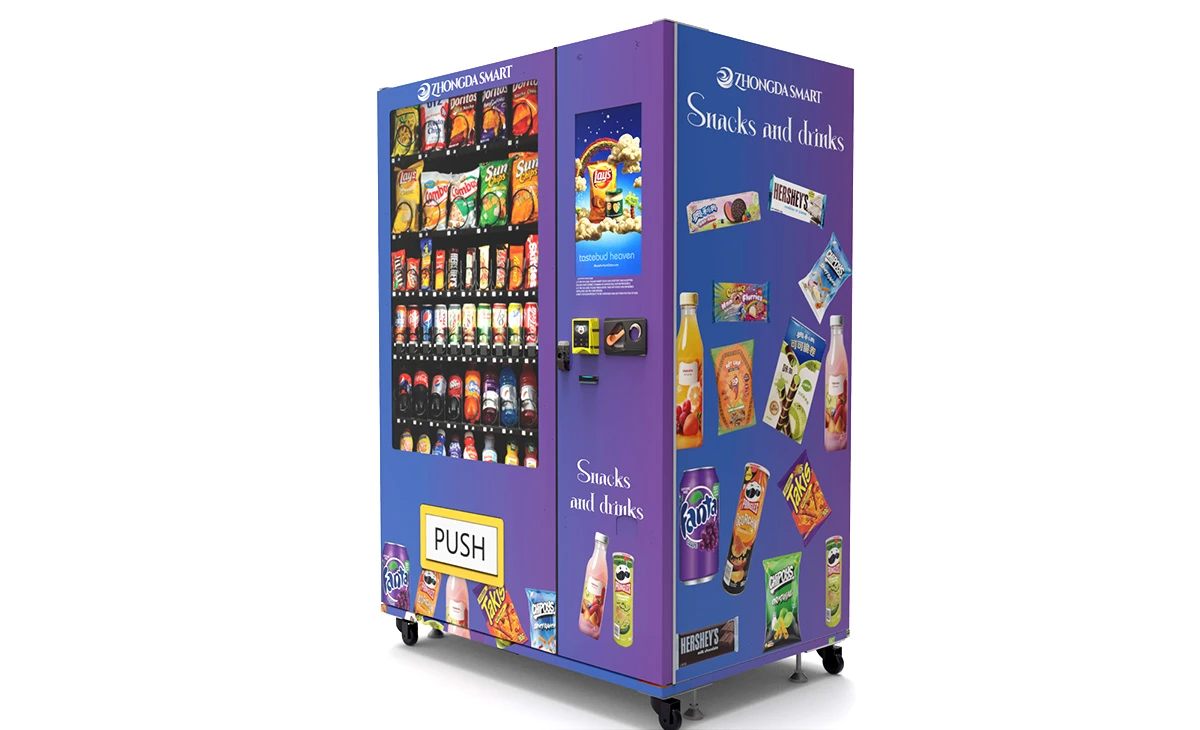
Zhongda Smart's published OEM customization options include spiral, conveyor, lift delivery, and locker or compartment systems, along with configurable shelf layouts and slot sizing. Buyers comparing those mechanisms in more detail can use the spiral vs. belt vs. elevator vs. locker guide. The summary below focuses only on how the product affects the choice.
Spiral: Best When the Package Is Predictable
Spirals remain practical for candy, bars, snacks, small cartons, and many ordinary packaged goods. They offer good storage density and relatively simple mechanics.
The product has to sit properly within the coil, advance without twisting into a divider, and clear the shelf edge when the motor stops. Coil diameter and pitch need to match the package rather than merely fitting around it.
Belt or Conveyor: Useful for Awkward Packages
A belt supports the product from below. That can be helpful for pouches, shallow cartons, packages with irregular edges, and merchandise that does not sit comfortably inside a coil.
A belt solves the horizontal movement problem. It does not automatically solve the final drop. Fragile products may still need an elevator beneath the shelf.
Elevator: Better When the Drop Is the Problem
An elevator makes sense when the product can leave the shelf safely but should not fall a long distance. Cakes, glass packages, delicate meals, premium electronics, and collectibles are common examples.
The elevator should be sized for the complete package and tested with the widest, deepest, and heaviest approved SKU.
Locker: Better When the Product Should Hardly Move at All
Locker vending is attractive for bulky, heavy, irregular, fragile, or high-value products. The customer opens a controlled compartment after the transaction instead of waiting for the merchandise to pass through a common delivery mechanism.
The tradeoff is storage density. Individual compartments consume more cabinet volume, so locker economics depend on product value, size, assortment, and refill frequency.
| Product Condition | System I’d Test First |
|---|---|
| Rigid, regular, drop-tolerant package | Spiral |
| Soft, shallow, or awkward package | Belt |
| Fragile or orientation-sensitive product | Elevator |
| Large, heavy, high-value, or highly irregular product | Locker |
| Mixed assortment | Hybrid or customized layout |
Products by Category: What Works and What Needs Special Handling
Snacks, Candy, and Packaged Food
Packaged food remains one of the easiest places to start because most products already have retail packaging designed for shipping, stacking, and display.
Candy bars, protein bars, cookies, crackers, nuts, and rigid snack cartons are usually straightforward. Chip bags need more attention because their apparent thickness changes with air volume and product distribution inside the bag.
A snack bag should sit comfortably in the lane without being squeezed flat. Its top or bottom seal should not hook around the coil. Load several bags and watch whether the first unit remains aligned after the units behind it push forward.
Better-for-you products also deserve practical attention because assortments continue to change. The NAMA Foundation's 2024–2025 industry census reported that 65% of surveyed operators cited client requests for healthier product mixes, while 59% viewed better-for-you products as a growth opportunity.Many of these products use pouches, small cartons, protein-bar wrappers, and portion packs, so flexibility in shelf configuration can matter more than a traditional snack-only layout.
Cans and Bottled Drinks
Beverage vending benefits from repeatable packaging, but bottle and can formats are not interchangeable by default.
Cans are rigid cylinders with highly predictable geometry. Their main mechanical behavior is rolling, so the release system has to control exactly one unit at a time.
Plastic bottles introduce more variation. Shoulder angle, base design, cap diameter, bottle stiffness, and center of gravity can affect how the product stands and releases.
ENERGY STAR's current refrigerated beverage vending criteria define a standard 12-ounce (355 ml) aluminum can for product-storage racks capable of vending that format; where those racks cannot handle the standard can but can handle 20-ounce bottles, the standard product shifts accordingly.The practical lesson is simple: beverage capacity is meaningful only when the package format is known.
A machine rated for a certain number of standard cans will not necessarily hold the same number of taller or wider bottles. Capacity should be recalculated from the intended drink assortment.
Fresh Food and Meal Trays
Fresh-food vending adds temperature, shelf life, and orientation to the normal mechanical questions.
Sandwiches in rigid triangular packs or cartons can be relatively easy to move. Bowls and prepared meals are less forgiving if the lid must remain level. Salads, sauce-heavy meals, desserts, and layered food products may arrive in poor condition even if the package never technically breaks.
For meal trays, I’d pay attention to how the package transfers from the shelf onto the delivery platform. A sudden edge drop can tilt the tray before the elevator ever begins moving.
Food products also have requirements beyond machine fit. Storage temperature, labeling, shelf life, sanitation practices, inventory rotation, and applicable food rules need to be handled as part of the operating plan.
Cakes, Cupcakes, and Delicate Desserts
Cakes show why package dimensions alone are not enough. A rigid cake box can look like an easy rectangular SKU, yet the product inside may tolerate very little tilt.
For this kind of merchandise, I’d rank smooth transfer and controlled delivery above maximum storage density. A slightly larger shelf that keeps the box level is usually more valuable than squeezing an extra unit into a lane.
The same principle applies to decorated desserts, pastries with delicate toppings, and products whose appearance is part of the buying experience.
Beauty and Personal-Care Products
Beauty products are attractive for automated retail because many SKUs are physically small relative to their selling price. They are also a good example of why “category” is too broad for machine selection.
An eyelash carton is light and rigid. A lipstick tube can roll. A face-mask pouch bends. A bottle of serum may contain glass. A skincare kit can be larger than a snack box.
Rigid beauty cartons work well with belts and, depending on dimensions, spirals. Small premium products can justify controlled elevator delivery when damage or packaging appearance matters.
Zhongda Smart's vending machine range covers standard and specialized formats that can be evaluated against different product types rather than assuming one cabinet style fits every retail program.
Phone Accessories and Consumer Electronics
Charging cables, adapters, connectors, earbuds, and compact electronic accessories can be good vending products because customers often buy them when the need is immediate.
Retail packaging helps considerably. A loose cable in a thin bag can fold or overlap. The same cable in a rigid carton is easier to store and separate.
As the value of the product rises, reliable vend confirmation and controlled customer retrieval become more important. A failed $2 snack transaction and a failed premium-electronics transaction have very different operating consequences.
For higher-value electronics, consider the complete transaction: payment approval, product release, detection, retrieval, inventory update, and the procedure for handling a failed delivery.
Trading Cards
Trading cards require separate thinking for packs, boxes, and graded cards.
Thin foil packs can cling together or overlap. A lane that is too wide may release two packs. A lane that is too tight may crease the package or increase friction along the sealed edges.
Booster boxes are mechanically easier because the carton creates a rigid surface, but they occupy more room. Graded cards are protected by rigid slabs yet often carry a higher retail value and may need better protection from scratches or impact.
A dedicated card mechanism, controlled belt, elevator, or locker can all make sense depending on the format. The merchandise value should influence the decision as much as the physical dimensions.
Blind Boxes and Collectible Toys
Rigid blind boxes are generally vending-friendly. Their flat surfaces make them easier to guide than loose toys, and the package protects the contents during delivery.
Inspect protruding handles, hanging tabs, plastic windows, and unusually thin outer cartons. If the box can be crushed easily by hand, it may also deform when inventory is packed tightly behind it.
Plush toys are different. They compress under pressure and expand when released. For larger plush merchandise, lockers often provide a cleaner solution than trying to control a soft object through a narrow lane.
Books
Books are rigid and easy to measure, but they vary greatly in thickness and weight. A shelf configured for a thin paperback can waste space with a thick hardcover, while a mechanism sized for a large hardcover may not control a thin book properly.
Locker vending removes many of these complications. The compartment simply needs sufficient internal dimensions, structural capacity, and a door opening large enough for comfortable retrieval.
Stationery and School or Office Supplies
Notebooks, pens, cables, flash drives, calculators, art supplies, and other small essentials can be sold through automated equipment.
Very small items benefit from retail packaging that increases their physical footprint. A single pen is difficult to control in a standard snack lane. A small stationery pack in a carton or blister format is much easier.
Packaging should also keep small products visible in the pickup area. A tiny black accessory in a large dark delivery bin can be difficult for the customer to find even after a successful vend.
Personal-Care and Hygiene Products
Toiletries, hygiene products, travel-size goods, grooming accessories, and other personal-care items can work well in compact machines.
Flexible packages deserve the same scrutiny as snack bags: check seams, compressed thickness, and whether the product changes shape as the contents settle.
Tubes and cylindrical packages may roll. A simple outer carton can make the SKU much easier to handle mechanically.
Tools and Work Supplies
Tools, gloves, protective supplies, replacement parts, consumables, and packaged work equipment can be distributed through vending or controlled locker systems.
Weight becomes more important here. A heavy metal component should not be treated like a large candy bar simply because it fits between two dividers.
Sharp edges, dense weight, and unusual center of gravity can increase wear on the delivery system. Individual locker compartments are often a practical choice when products are heavy, irregular, or individually controlled.
Pet Products
Packaged treats, waste bags, small accessories, grooming supplies, and similar products can fit conventional vending hardware.
Treat bags behave like other flexible food packages. Rigid boxes and accessory cartons are easier. Large leashes, soft toys, or bulky items may need a locker or purpose-built compartment.
Zhongda Smart Product Fit Checklist
Before discussing a custom machine, it helps to reduce every SKU to a small set of facts. The following framework is a practical way to prepare a product-fit discussion with Zhongda Smart. It is a planning checklist, not a universal certification standard.
Zhongda Smart's published OEM scope includes product-fit configuration for spiral, conveyor, lift, and locker delivery, together with capacity, shelf layout, slot sizing, payment hardware, connectivity, interface customization, sample building, and vend-reliability testing. The checklist below organizes the product information needed to make those decisions.
| Factor | What to Record | Why It Matters |
|---|---|---|
| Maximum dimensions | Largest measured width × height × depth | Defines usable lane, shelf, elevator, or locker space |
| Gross unit weight | Product plus complete retail packaging | Affects motors, shelves, elevators, and structural loads |
| Package rigidity | Rigid, semi-rigid, flexible, or highly deformable | Predicts whether the product will pinch, fold, or rotate |
| Surface behavior | Smooth, moderate friction, high friction, irregular | Affects sliding and conveyor movement |
| Package details | Seams, tabs, caps, handles, corners, protrusions | Identifies likely snag points |
| Center of gravity | Stable, top-heavy, bottom-heavy, shifting contents | Helps predict tipping during release |
| Orientation sensitivity | Any orientation, upright only, level preferred, level required | Influences drop, elevator, or locker selection |
| Damage tolerance | High, moderate, low | Determines how much movement is acceptable |
| Storage condition | Ambient, refrigerated, frozen, heated, or otherwise controlled | Defines cabinet and temperature-control requirements |
| Retail value | Expected selling price | Influences security and vend-confirmation requirements |
| SKU count | Number of different products | Determines shelf layout and selection count |
| Target inventory | Desired units per SKU | Determines machine capacity and refill frequency |
A Product Drawing Is the Beginning, Not the Approval
A dimensional drawing can eliminate obvious mismatches, but it cannot show how a flexible pouch folds or whether a glossy box sticks against another glossy box.
For nonstandard products, physical samples are more valuable than increasingly detailed descriptions. Samples allow the dispensing hardware to be adjusted around the real package.
Use the Sellable Package
Do not send an empty bottle when the machine will sell a filled bottle. Do not send a bare electronic device when the machine will sell it in a retail box. Do not send a flat unfilled pouch.
Weight distribution and package stiffness often change after the product is filled.
Include More Than One Sample
Several samples reveal dimensional variation that one unit cannot. They also allow repeated vending tests without constantly returning the same slightly damaged package to the shelf.
If the packaging comes from more than one production batch, examples from different batches can be useful for products with flexible or variable packaging.
How to Test a Product Before Production
One successful demonstration proves that the machine worked once. It does not prove that the SKU is ready for daily unattended operation.
A useful product test should include different inventory levels, repeated cycles, normal package variation, customer retrieval, and inspection for damage.
Start With Full-Lane Testing
Load the lane to the intended operating capacity. Products at the front often experience pressure from units behind them, especially in tightly packed lanes.
Watch whether the first product tilts, bows, or catches against the divider before release.
Then Test Half-Full and Nearly Empty
Some configurations become less stable as inventory pressure disappears. A bottle may lean differently. A light pouch may shift orientation. A rear pusher may behave differently as it approaches the end of travel.
The final two products deserve as much attention as the first two.
Rotate Package Variation Into the Test
Do not select only perfect samples. Include slightly bowed cartons and differently inflated flexible packages that still fall within normal sellable condition.
If every successful test requires hand-selecting unusually neat packages, the setup is too sensitive for normal operation.
Define What Counts as a Failure
A jam is only one kind of failure. The test should also flag:
-
double vending;
-
partial release;
-
visible package damage;
-
unacceptable tilting or inversion;
-
movement of a neighboring product;
-
incorrect vend detection;
-
a product that reaches the pickup area but cannot be removed easily;
-
a product that arrives with a damaged seal or retail box;
-
an elevator transfer that places the product partly outside the receiving platform.
Agree on an Acceptance Target Before Production
There is no responsible universal rule that says every product becomes approved after the same number of cycles. A low-cost rigid snack carton and a fragile high-value collectible do not carry the same failure cost.
The test depth should reflect product value, fragility, package variation, machine configuration, and the consequences of a failed vend. For a custom project, the expected acceptance criteria should be discussed before the production configuration is locked.
Inspect the Product After the Vend
Do not simply count successful deliveries. Look at the product.
Check carton corners, transparent windows, seals, labels, glass, card edges, blister packs, bottle caps, food presentation, and any surface the buyer expects to look new.
For premium retail, product condition is part of vending reliability.
Repeat the Test on the Final Machine Configuration
A bench test or prototype shelf is valuable, but final assembly can change the delivery path. Shelf height, elevator calibration, sensor position, pickup-door geometry, refrigeration components, software timing, and cabinet tolerances all matter.
Before shipment, the final configuration should be validated with the approved product assortment whenever the project depends on nonstandard merchandise.
Why Packaging Changes Can Be Cheaper Than Machine Changes
One of the most useful decisions in a custom vending project sometimes happens outside the machine.
Consider a small accessory sold loose inside a thin flexible bag. The bag folds, two units overlap, and its shape changes depending on where the accessory sits. A specialized cassette could be designed around it.
Another option is to put the product inside a small rigid carton.
The carton may create a more predictable vending surface, improve product presentation, give the barcode a cleaner position, protect the contents, make restocking easier, and allow a simpler dispensing mechanism.
The reverse is also possible. A small product inside an oversized gift box may consume so much cabinet volume that the machine needs large shelves or lockers. Reducing the package can increase capacity without changing the external cabinet at all.
Compare Packaging Cost With Capacity Cost
A packaging change may add a small cost per unit, but machine space also has a cost. Every oversized SKU reduces the number of products available between refills.
If a new carton allows twice as many units in the same shelf space, the operational benefit can outweigh the packaging expense. If a rigid sleeve eliminates a custom mechanism, the savings may be larger still.
For private-label merchandise, I’d discuss packaging and machine design at the same stage rather than treating them as separate projects.
Capacity, Margin, and Product Economics
A product can fit the machine and still be a poor use of machine space. Physical compatibility is only the first decision.
The next question is how much contribution the SKU produces relative to the space, service time, and inventory it consumes.
Start With Contribution per Sale
A useful basic calculation is:
Contribution per vend = selling price − landed product cost − transaction cost − expected waste, damage, and refund allowance
This is more useful than looking only at percentage markup. A product with a strong percentage margin may contribute very few dollars. Another product with a lower percentage margin may generate considerably more cash per sale.
Then Look at Contribution per Slot
Machine capacity is limited. A bulky item should justify the space it occupies.
A simple planning measure is:
Daily slot contribution = expected units sold per day × contribution per vend
Suppose Product A generates $3.00 in contribution per sale and sells four units per day. Product B generates $8.00 per sale but sells once every two days. Product A produces $12.00 in expected daily contribution, while Product B produces $4.00.
If Product B also occupies twice the space, its higher ticket price does not automatically make it the better vending product.
Compact High-Value Products Can Use Cabinet Space Efficiently
Cosmetics, accessories, trading cards, personal-care products, and small electronics can be attractive because they place substantial retail value into a relatively small package.
That advantage disappears if the product requires an oversized compartment or generates frequent failed-vend claims. High contribution density is useful only when delivery remains reliable.
Refill Frequency Belongs in the Calculation
Machine capacity determines how often inventory needs attention.
A practical starting formula is:
Target SKU capacity = expected daily unit sales × desired days between refills + safety stock
If a product normally sells five units per day and the machine should operate for four days between service visits, the base requirement is twenty units before adding safety stock.
A slow-moving premium item may need only a few units. Giving every SKU equal shelf space is rarely the best use of the cabinet.
Fast Sellers Deserve More Facings
A popular drink or snack can justify more than one lane. A slower product may need only one narrow position.
The goal is not a perfectly symmetrical shelf. It is to keep the products people actually buy available until the next planned refill.
Damage Changes the Real Margin
A premium product can show excellent theoretical margin while losing money through occasional damage.
Add an expected damage allowance:
Damage-adjusted contribution = contribution per vend − expected damage cost per vend
If controlled elevator delivery materially lowers damage on a premium SKU, the more expensive hardware can have a stronger business case than a cheaper drop system.
Keep Full ROI Analysis on a Dedicated Calculator
This article focuses on product fit, so there is little value in pretending one sample payback number applies to every operation. Machine price, product margin, sales volume, site expenses, payment costs, labor, spoilage, downtime, and inventory investment all change the result.
For scenario modeling, the Zhongda Smart vending machine ROI calculator allows machine cost, revenue, gross margin, stock, operating expenses, and break-even assumptions to be evaluated separately.
Product Variety and Capacity Compete With Each Other
A machine with more selections is not automatically a better machine.
Every additional SKU consumes lane width, shelf space, inventory management effort, and replenishment attention. If a machine carries forty products but half of them sell very slowly, the operator may be carrying more variety without generating more useful revenue.
A narrower assortment can support deeper inventory of the items that sell fastest. A wider assortment can improve choice but may require more frequent restocking.
Use Actual Package Dimensions for Capacity Planning
Brochure capacity is usually based on a reference product or a particular layout. Your assortment may use the space differently.
A cabinet that holds a large number of candy bars will hold fewer inflated snack bags. A locker bank configured for paperback books will have different capacity from one configured for tool cases.
Build the layout from SKU dimensions and expected sales rather than selecting a machine by the largest capacity number on a specification sheet.
Leave Room for the Assortment to Change
Retail packaging changes. Brands resize cartons, modify bottle shapes, change pouch dimensions, and launch new pack sizes.
An adjustable shelf or lane can be more valuable over time than a configuration optimized to the last millimeter for one fixed assortment.
If the business depends on frequent product changes, flexibility deserves a place in the buying decision from the start.
The Pickup Area Is Part of Product Fit
Mechanical discussions often end when the product leaves the shelf. The customer experience begins at exactly that moment.
A wide box may fall successfully but block the anti-theft flap. A small flat product may be difficult to see in a deep pickup compartment. A heavy product may be awkward to lift from a low opening.
For bulky merchandise, test retrieval with the real product and an assembled machine. Do not assume that a package that fits through the opening is automatically comfortable to remove.
Check Grip Space
Customers need enough room to put a hand around the package. A product that nearly fills the compartment in every direction can be harder to retrieve than a slightly larger compartment would suggest.
Check Product Visibility
Small dark products can disappear visually in a dark pickup area. Lighting, tray shape, and package position can improve the experience.
Check the Second Product
If the machine allows another purchase before the first product is removed, confirm that the next item cannot land directly on fragile merchandise already in the bin.
For higher-value products, positive pickup control or individual compartments may be preferable.
What Should Not Go Into a Standard Vending Machine?
Physical fit does not make every product appropriate for unattended sale.
Special review is appropriate when merchandise presents unusual chemical, pressure, electrical, hygiene, temperature, legal, age-control, or personal-safety requirements. Products that are very sharp, hazardous, unstable, or likely to injure a customer during retrieval should not be treated like ordinary packaged retail goods.
Food operations also need to consider applicable labeling and operating rules. FDA vending-machine labeling requirements, for example, cover certain food sold by operators who own or operate 20 or more vending machines, subject to the rule's conditions and exemptions.
The machine manufacturer can determine mechanical compatibility. Product owners and operators remain responsible for determining whether the intended merchandise and operating method meet the requirements that apply to the sale.
What to Send a Vending Machine Manufacturer
A request that says “I want a machine for cosmetics” leaves most of the engineering work undefined. A simple product matrix produces a much better discussion.
| Information | What to Provide |
|---|---|
| Product name | Exact SKU or package version |
| Maximum dimensions | Width × height × depth |
| Gross unit weight | Complete sellable package |
| Packaging material | Carton, pouch, bag, bottle, can, glass, clamshell, etc. |
| Package details | Seams, tabs, caps, handles, protrusions |
| Orientation | Any orientation, upright, or level |
| Fragility | Low, moderate, high |
| Storage requirement | Ambient, refrigerated, frozen, heated, or specified condition |
| Retail price | Expected selling price |
| Number of SKUs | Total product selections |
| Target inventory | Desired units per SKU |
| Sales mix | Expected fast, medium, and slow sellers |
| Payment requirements | Required payment methods and hardware |
| Connectivity | Remote management, telemetry, and network requirements |
| Branding | Graphics, cabinet appearance, screen interface |
| Site constraints | Available space, doorway clearance, power, and installation access |
Send Physical Samples When the Product Is Unusual
Photos and drawings are excellent for the first review. Physical samples are better for finalizing nonstandard product handling.
A factory can then inspect how the product sits, how much it compresses, whether seams interfere with the lane, whether the package rolls, and how it arrives in the pickup area.
Ask to See the Actual SKU Vend
For a custom machine, a product-specific test is more useful than a demonstration using a convenient factory sample.
The test should use the package that will actually be sold and should show loading, release, delivery, detection, and retrieval.
Ask What Happens When the Vend Does Not Go Perfectly
A good project discussion should cover failure behavior before the machines are deployed.
Useful questions include:
-
How does the machine confirm a successful delivery?
-
What happens if the product does not reach the pickup area?
-
Can a transaction be recorded against a specific selection?
-
Can inventory status be reviewed remotely?
-
What service information is available when a motor or sensor reports a fault?
-
Can the lane be adjusted later if packaging changes?
Where Zhongda Smart Fits
Zhongda Smart publishes an OEM customization scope that covers cabinet design, product-delivery systems, capacity and slot sizing, payment integration, connectivity, interface options, sample builds, testing, production checks, export preparation, spare-parts planning, and remote support.
Its OEM custom vending machine program is therefore most relevant when the merchandise determines the machine architecture: unusual packaging, mixed product sizes, fragile products, specific temperature control, custom shelf layouts, branded cabinets, or specialized payment and software requirements.
I’d still keep the first conversation centered on the products rather than on features. Once package behavior and required capacity are clear, decisions about screens, payments, lighting, telemetry, and exterior design become much easier.
Common Product-Fit Mistakes That Create Avoidable Service Problems
Choosing the Machine Before Finalizing the Merchandise
This reverses the correct order. The cabinet becomes a fixed constraint, and every later SKU has to be forced into it.
Define the important products first, particularly the largest, heaviest, softest, most fragile, and highest-value SKUs.
Using Supplier Dimensions Without Measuring Samples
Published dimensions are useful for planning. They should not replace sample inspection for products that will run close to the available lane size.
Flexible packaging is especially likely to behave differently from a neat specification drawing.
Testing One Perfect Product
A machine that works only with the best-looking sample is not ready for ordinary inventory.
Test the normal variation that will actually arrive during restocking.
Ignoring the Package Seam
The main body can have adequate clearance while the sealed edge catches the divider. Measure and photograph the complete package.
Assuming More Motor Power Fixes a Jam
A product that wedges between two surfaces may simply wedge harder when more force is applied.
Fix the geometry first. Then confirm the motor is correctly rated for the load.
Ignoring Low Inventory
A full lane can keep products standing neatly. The final unit may behave differently without the support of the products behind it.
Ignoring the Pickup Door
A successful shelf release is not a successful customer transaction if the package cannot be removed comfortably.
Trying to Maximize Every Slot
The last few units of theoretical capacity are not worth much if they make loading slower or increase the chance of a jam.
Reliable capacity is more valuable than maximum theoretical capacity.
Keeping a Difficult Package When a Simple Carton Would Solve the Problem
Mechanical customization is useful, but it should solve a real need. A small packaging change can sometimes make a standard mechanism far more reliable.
A Practical Product-to-Machine Decision Sequence
For a new product, I’d make the decision in the following order.
-
Measure the sellable package. Record maximum width, height, depth, and gross weight.
-
Describe the package. Rigid, flexible, cylindrical, glass, blister pack, pouch, or irregular.
-
Check its balance. Does it stand naturally, roll, lean, or shift internally?
-
Decide how much movement it can tolerate. Can it fall, or should it remain controlled?
-
Confirm storage conditions. Ambient, refrigerated, frozen, heated, or another defined condition.
-
Estimate sales and required capacity. Fast-moving SKUs need deeper inventory.
-
Select a likely mechanism. Spiral, belt, elevator, locker, or a combined layout.
-
Test physical samples. Include normal package variation.
-
Test the final retrieval path. Make sure the buyer can remove the product comfortably.
-
Only then finalize the cabinet and commercial options.
This sequence prevents a common problem: spending time selecting touchscreens, payment devices, graphics, and software before anyone has confirmed that the core merchandise fits the machine properly.
Automated retail starts with a transaction, but mechanically it starts with an object that has to move from storage to a human hand. Get that movement right first.
Frequently Asked Questions
Can a vending machine sell almost anything?
Many packaged products can be sold through automated vending, but not every product should use a standard snack mechanism. Rigid, regular packages are generally easier. Flexible, fragile, heavy, large, or orientation-sensitive products may require belts, elevators, lockers, or customized dispensing. Storage conditions and applicable product rules also need to be considered.
What is the largest product a vending machine can sell?
There is no universal maximum size. The limit depends on the cabinet, shelf, dispensing mechanism, elevator platform, locker dimensions, delivery opening, and customer retrieval area. Large merchandise is often easier to handle with a locker because it does not have to pass through a narrow common delivery chute.
How heavy can a vending machine product be?
There is no single weight limit for every vending machine. A snack spiral, conveyor, elevator, beverage system, and locker all have different ratings. Use the load rating of the actual mechanism and test the sellable product. As weight increases, shelf strength, motor load, impact energy, and retrieval become more important.
What type of packaging is easiest to vend?
Rigid rectangular cartons are among the easiest packages because they have predictable dimensions and stable surfaces. Standard cans and bottles are also highly compatible with mechanisms designed for their geometry. Flexible bags and pouches work well when the lane provides enough room for normal package variation.
Can vending machines sell glass products?
Yes, but glass should be protected from uncontrolled impact. Elevator delivery can reduce the vertical drop, while a locker can remove most product movement altogether. The final decision should be based on the complete package, internal protection, product weight, and actual delivery test.
Can a vending machine sell trading cards?
Yes. Booster packs, boxes, and graded cards can all be sold, but they do not need the same dispensing method. Thin packs require good separation to prevent double vending. Rigid boxes are easier to control. Higher-value graded cards may be better suited to controlled elevator delivery or individual lockers.
Can vending machines sell cosmetics and electronics?
Yes. Boxed cosmetics, cables, chargers, adapters, earbuds, skincare products, and many other compact goods can be suitable for vending. The package should be evaluated for dimensions, rolling, breakage, retail value, and delivery impact. Premium merchandise may justify stronger vend verification and gentler handling.
How do I know whether my product will jam?
Measure several samples and test the actual SKU at full, partial, and low inventory levels. Look for rubbing, rotating, overlapping, double feeding, package damage, shelf-edge hanging, sensor problems, and difficult retrieval. A successful single vend is not enough to approve an unusual product.
Should I use a spiral, conveyor belt, elevator, or locker?
Use the simplest mechanism that can reliably handle the package. Spirals are strong choices for regular packaged goods. Belts help with soft or awkward packages. Elevators are useful when drop damage is a concern. Lockers are well suited to large, heavy, irregular, fragile, or high-value merchandise.
What information should I send before ordering a custom vending machine?
Send the maximum product dimensions, gross unit weight, packaging material, photos, storage condition, required orientation, fragility, retail value, number of SKUs, target inventory, payment requirements, connectivity needs, branding requirements, and installation constraints. Physical samples are strongly recommended when the products are nonstandard.
Sources and Technical References
-
NAMA Foundation — New Census Reveals Shifts in Convenience Services Industry The 2024–2025 census reports that 65% of surveyed operators cited client requests for healthier product mixes and 59% viewed better-for-you products as a growth opportunity..
-
GS1 — Package and Product Measurement Standard Technical reference for the measurement of package dimensions and gross weight, including defined measurement methods and tolerances for different trade-item types.
-
Food and Drug Administration — Vending Machine Labeling Requirements Official information covering calorie-disclosure requirements for certain vending-machine food operations, including the rule for operators owning or operating 20 or more machines and relevant exemptions.
-
ENERGY STAR — Refrigerated Beverage Vending Machine Criteria Technical criteria defining standard products and related capacity concepts for refrigerated beverage vending equipment.
Important Disclaimer
Product dimensions, packaging observations, mechanism recommendations, capacity formulas, and planning examples in this guide are general references rather than universal machine limits or performance guarantees. Final compatibility depends on the exact SKU, packaging variation, machine model, shelf or compartment design, motor and load ratings, software configuration, storage conditions, and final delivery path. Nonstandard products should be validated with actual samples before production.
Food, temperature-controlled products, batteries, medicines, age-restricted goods, hazardous products, and other regulated or specialized merchandise may require additional legal, labeling, safety, storage, transportation, or operating controls. Product owners and operators should confirm the requirements that apply to the merchandise before deployment.