Most vending-machine spare-parts problems do not begin with a missing part. They begin when the operator cannot confirm which motor, sensor, controller, power supply, cable, or hardware revision is actually installed in the machine. A replacement that looks correct can still have the wrong voltage, connector, firmware, mounting position, or communication protocol.
For that reason, a workable service plan needs more than a box of components. It needs machine identification, compatible parts, a repeatable diagnostic process, clear warranty terms, and technical support that continues until the repair has been verified.
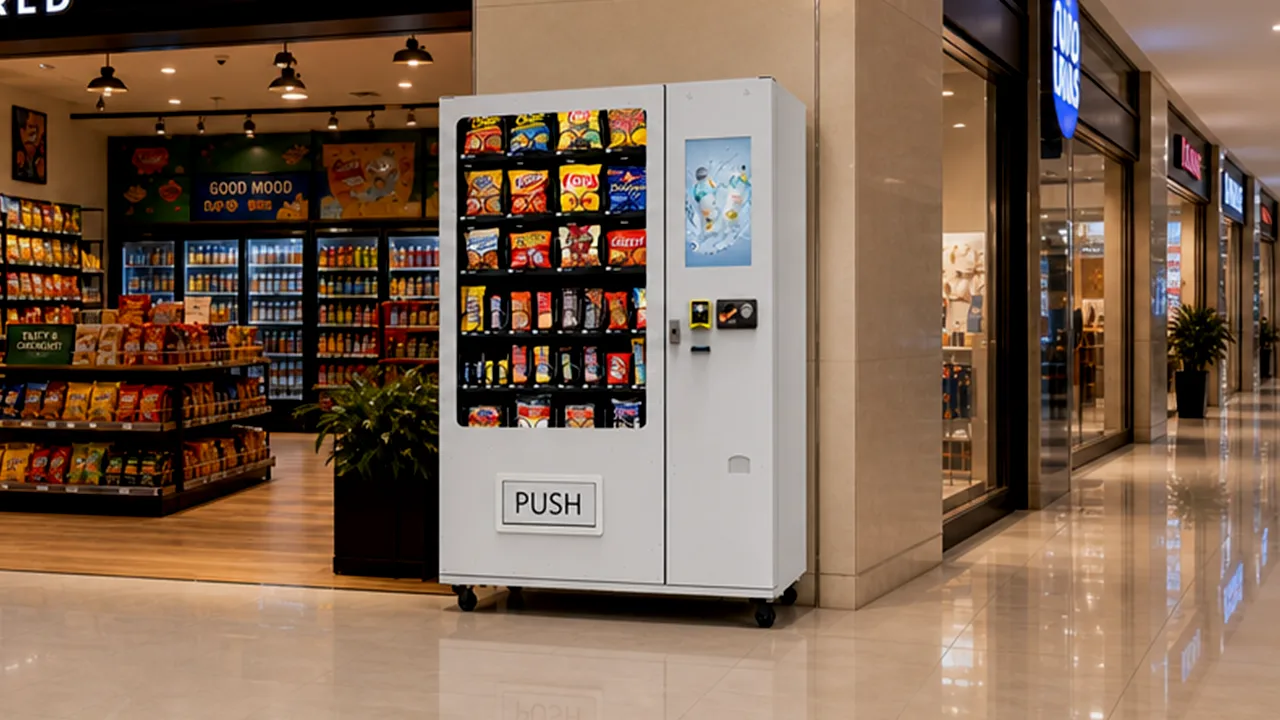
Serviceability: the Part Is Only One Part of the Repair
Buyers sometimes compare quotations by counting how many free spare parts are included. Quantity alone says little about how quickly a machine can be put back into service.
Consider a machine supplied with several motors, fuses, a sensor, and a power module. Six months later, one selection stops working. The operator has spare components, but nobody can confirm which motor revision is fitted, whether the sensor is receiving power, or whether the fault sits in the motor, harness, controller output, or configuration. The parts are physically available, but the repair is still blocked.
A useful replacement part needs four things around it: a clear part identity, confirmed compatibility, a sensible way to isolate the fault, and a test that proves the machine is working after the part is installed.
A modern vending machine is a group of systems rather than one device. Depending on the design, it can include a main controller, motor or I/O boards, touchscreen, DC power supplies, dispensing motors, delivery sensors, locks, door switches, lighting, network hardware, payment terminals, fans, refrigeration controls, elevator drives, and position sensors. A low-cost component can stop a high-value machine if the failed function is critical to selling or delivery.
A delivery sensor is a good example. The product may fall into the pickup area correctly, but if the sensor does not confirm the vend, the controller may log a failed delivery or start a refund process. The motor worked; the transaction still failed from the customer's point of view.
Refrigeration faults can be equally misleading. A failed condenser fan can raise cabinet temperature and keep the compressor running much longer. Before treating the compressor as the failed component, airflow, fan operation, temperature sensing, door sealing, and controller behavior should be checked.
The scale of the market makes uptime increasingly important. The NAMA Foundation's 2024–25 industry census estimated U.S. convenience-services revenue at $31.1 billion in 2025, up from $26.6 billion in 2023, with vending remaining the largest business line by revenue and number of businesses. For operators running technology-dependent unattended retail, service organization is part of the business model, not an issue to consider after the first breakdown. Source: NAMA.
Common Vending Machine Parts and Failure Points
The fastest way to make a repair expensive is to treat the whole cabinet as one problem. Start by identifying which system has failed and which systems still work.
Power distribution
If the touchscreen, lights, payment terminal, and motors all stop at the same time, four independent failures are unlikely. Check the power path first: incoming supply, cord, main switch, protection devices, terminal connections, power supplies, and the relevant wiring harnesses.
Typical service items include fuses, power switches, relays, terminal blocks, DC power supplies, power cords, harnesses, and connectors.
Main controller and interface boards
A controller coordinates selections, motors, sensors, payments, and machine states. Some machines use one main board; others use separate motor-control, I/O, communication, or refrigeration boards. A strange symptom does not automatically mean the controller is defective.
Before changing a board, confirm that it receives the correct power, check status indicators, determine whether the service menu is available, review communication with peripheral devices, and identify whether the problem affects one output or several systems. A loose communication cable can make a healthy board look defective.
Dispensing system
The service parts depend heavily on the delivery design. Spiral machines commonly use geared motors, couplers, spirals, and delivery sensors. Conveyor systems add belts and rollers. Locker machines depend on latches, door sensors, and output circuits. Elevator machines add lift motors, drive components, limit switches, position sensors, guides, and a moving delivery platform.
Touchscreen and display hardware
A black screen is a symptom, not a diagnosis. Possible causes include display power, a controller computer, HDMI or LVDS connection, damaged data cable, backlight hardware, software startup failure, or the display panel itself. Replacing the complete touchscreen before checking power and signal can turn a small fault into an unnecessary high-value parts order.
Payment equipment
Payment hardware may include a coin mechanism, bill validator, card reader, NFC terminal, QR scanner, payment controller, modem, antenna, printer, and related cables. Support ownership matters here: the vending-machine manufacturer may handle power, mounting, communication, and machine integration, while terminal provisioning, merchant configuration, authorization, and transaction-network issues can belong to the payment provider.
Cooling system
Refrigerated machines can include a compressor, condenser fan, evaporator fan, temperature probe, controller, relay or contactor, door gasket, drainage parts, and the sealed refrigerant circuit. Random part swapping is especially costly in refrigeration. Check actual temperature, airflow, fan operation, condenser cleanliness, door sealing, sensor placement, and controls before moving to sealed-system diagnosis.
Cabinet and mechanical parts
Locks, hinges, handles, gas struts, wheels, leveling feet, pickup doors, shelf brackets, seals, trays, panels, and fasteners are also service parts. A damaged lock can stop refilling, a worn gasket can raise cooling load, and a bent tray can create extra resistance for dispensing motors.
| Component | Typical failure effect | Stock priority | Field replacement |
|---|---|---|---|
| Fuse / protection device | Machine or subsystem may stop | Very high | Usually simple after the cause is confirmed |
| Dispensing motor | One or more selections unavailable | Very high | Often straightforward |
| Delivery sensor | Vend confirmation becomes unreliable | High | Often straightforward |
| Door / limit switch | Incorrect machine state or door detection | High | Often straightforward |
| Communication cable | Peripheral device may go offline | High | Usually straightforward |
| DC power supply | Display or subsystem may stop | High | Depends on electrical access |
| Fan motor | Cooling or ventilation degrades | High for temperature-controlled machines | Moderate |
| Main control board | Major functions may stop | Medium to high | Configuration may be required |
| Touchscreen assembly | Customer interface may be unusable | Medium | Moderate |
| Locker latch | Individual compartment unavailable | High for locker systems | Usually manageable |
| Elevator position sensor | Delivery sequence may stop | High for elevator systems | Depends on machine design |
| Compressor | Cooling unavailable | Central / specialist stock | Qualified refrigeration service recommended |
Which Vending Machine Spare Parts Should You Keep in Stock?
There is no universal kit that makes sense for every machine. Stock should follow the actual hardware, fleet size, failure impact, wear exposure, service distance, and lead time for obtaining a correct replacement.
For each part, ask four practical questions:
- How much selling capacity is lost if this component fails?
- How often is it cycled, handled, moved, or exposed to contamination?
- How quickly can the correct replacement reach the machine?
- How many machines in the fleet use exactly the same part?
High-priority service stock
For many conventional snack and combination machines, common motors, sensors, switches, fuses, communication cables, selected power supplies, connectors, and lock hardware provide a good first layer of protection. They are relatively compact, easier to identify than complex assemblies, and can restore a machine or individual selection quickly.
Parts that often belong in central stock
Main controllers, complete displays, specialized refrigeration controllers, elevator drives, and other higher-value assemblies usually make more sense in a central service location rather than beside every machine. A two-machine operator may order a controller when required; a fleet of 70 identical machines may reasonably keep one or two tested units ready.
Do not buy expensive assemblies only because they exist
A compressor, complete display module, unusual custom board, or structural assembly can have a low replacement frequency and may require specialist labor. If a correct unit can be supplied quickly, holding several of them may tie up cash without materially improving recovery time.
| Service part | 1–5 machines | 6–25 machines | 26–100 machines | Why keep it? |
|---|---|---|---|---|
| Common fuses | 3–5 of each common type | 10 or more | Central bulk stock | Low cost and easy to store |
| Common dispensing motor | 1 | 2–4 | 5–10 per shared motor type | Directly affects delivery |
| Delivery sensor | 1 | 2 | 3–5 | Small part with high operational value |
| Door / limit switch | 1 | 2 | 3–5 | Compact and serviceable |
| Common power supply | Optional 1 | 1–2 | 2–4 per shared specification | Can disable major functions |
| Main controller | Order as needed or keep 1 | Optional 1 | 1–2 tested units | High impact but higher value |
| Display assembly | Order as needed | Optional central unit | 1 central unit where justified | Higher-value assembly |
| Common fan | 1 where applicable | 1–2 | 2–4 | Important for heat transfer |
| Communication cable set | 1 set | 2 sets | Central stock | Useful for diagnosis and recovery |
These quantities are a planning framework, not predicted failure rates. Adjust them to the exact machine configuration, service distance, usage, and component commonality.
Compatibility: appearance is not enough
Two motors can share the same housing while using different voltages or output speeds. Two power supplies can have identical dimensions but different outputs. Two control boards can look alike and run different firmware. Two displays can fit the same opening and use different touch interfaces.
When ordering a replacement part, provide as much of the following as possible:
- Machine serial number
- Machine model
- Original part number
- Clear photo of the component
- Photo of the label and connector
- Voltage and electrical rating where relevant
- Controller, board, or hardware revision
- Software version if compatibility depends on firmware
Store the same information with spare inventory. A board in an unmarked carton can become unusable service stock six months later if nobody knows which model or hardware revision it belongs to. Electronic parts should also be protected from moisture, dust, impact, and electrostatic discharge.
How to Read a Vending Machine Warranty
“One-year warranty” is not enough information to judge support. The useful questions are when coverage starts, which components are covered, what evidence is required, who performs diagnosis, whether labor is included, how replacement-part shipping is handled, and which third-party devices follow their own warranty process.
Start with the warranty start date
A machine may spend time in production, international transit, storage, installation, and site preparation before it makes its first sale. A warranty that begins at shipment is operationally different from one that begins at receipt or acceptance.
Zhongda Smart's published after-sales guarantee and service policy states that the machine warranty runs for one year from the machine receipt date when the equipment is operated according to the official instructions. The same policy states that replacement spare parts are provided without charge for qualifying quality issues during the warranty period and that remote technical assistance is available. It also asks customers to inspect the delivered product within five days and provide photo or video evidence if damage or quantity problems are found.
The signed purchase contract and final equipment specification should still be checked for the terms that apply to a specific order.
Separate parts, shipping, labor, and complete-machine replacement
The following are different forms of support and should not be treated as interchangeable:
- Free replacement component
- Free component plus shipping
- Remote installation guidance
- On-site technician labor
- Third-party service labor
- Complete machine replacement
Factory-direct support often works through remote diagnosis followed by shipment of a confirmed modular component. That model can be efficient when responsibilities, part compatibility, and installation procedures are clear before the machine is purchased.
Third-party payment equipment may follow different rules
A machine can contain hardware from several specialist suppliers. Card readers and unattended payment terminals may have separate provisioning, software, merchant-account, network, and warranty processes. Before purchase, identify whether the vending-machine manufacturer supports the physical integration only or also manages the payment terminal itself.
Warranty exclusions should be written, not assumed
Common exclusions can include damage related to:
- Incorrect electrical supply
- Water exposure beyond the machine's design conditions
- Physical impact or forced entry
- Unauthorized wiring changes
- Unapproved software modification
- Installation of incompatible parts
- Blocked ventilation caused by poor placement
- Improper cleaning chemicals
- Damage during relocation
Zhongda Smart's published policy also warns that replacing parts or modifying the background management system without guidance from its after-sales engineers may affect warranty support. When the machine is still under warranty, contact technical support before opening unfamiliar electrical modules or making software changes.
Keep the warranty record with the machine record
For every machine, retain the serial number, purchase record, receipt date, final configuration, payment-device details, warranty end date, service history, and commissioning photos. A claim made eleven months later should not depend on searching old chat messages to identify the equipment.
What Useful After-Sales Support Looks Like
The quality of support becomes visible when a fault has to be isolated. “Replace the board” is not a diagnosis. A useful support process first narrows the symptom and identifies what is still working.
Compare these two fault reports:
“B6 is not working.”
“Selection B6 accepts the order and the screen changes to dispensing, but the spiral does not rotate. B5 and B7 on the same shelf work normally. The product has been removed and the spiral is not mechanically jammed.”
The second report immediately separates a single-lane fault from a full-shelf or machine-wide fault and gives the technician something useful to test.
Evidence that shortens remote diagnosis
For many service requests, prepare:
- Machine serial number and model
- Controller or software version when relevant
- Exact symptom and when it started
- Error code or service-menu message
- Short video showing the complete failure sequence
- Photo of the suspected component
- Photo of its label, connector, and surrounding wiring
Video is often more useful than a long written description. A technician may be able to hear whether a motor is attempting to move, see whether a product reaches the delivery area, or watch what the display and payment terminal do immediately before the fault.
Photograph wiring before disconnecting it
Several connectors can look similar once a component has been removed. A photograph taken before disassembly gives the operator a reference for reinstallation and gives remote support a record of the original condition.
Replace the confirmed part, then verify the repair
A practical diagnostic sequence is:
- Confirm the symptom.
- Determine which functions still work.
- Identify what the failed function shares with working functions.
- Inspect mechanical movement and visible connections.
- Use an approved comparison or service-mode test where possible.
- Replace the component only after the fault has been narrowed down.
- Run several test transactions.
- Record the repair and part number.
Good support continues after the package arrives. The operator still needs to know how to isolate power safely, where the component is installed, which connectors are involved, whether configuration is required, how to test the replacement, and what to do if the symptom remains.
Practical Troubleshooting Before Replacing Parts
A useful troubleshooting rule is simple: look at what still works. Working functions are reference points that help locate the failed layer.
| Symptom | Check first | Possible service parts | Common wrong move |
|---|---|---|---|
| Entire machine dead | Incoming power path | Fuse, switch, cable, power supply | Replacing the controller first |
| One lane fails | Lane mechanism and connector | Motor, coupling, harness | Replacing the full shelf |
| Several lanes fail together | Shared shelf connection | Harness, board, connector | Replacing every motor |
| Product drops but no vend is confirmed | Delivery detection | Sensor, sensor cable | Changing payment equipment |
| Display is black but machine has power | Display power and signal | Cable, power module, display | Ordering a screen immediately |
| Machine is too warm | Airflow, door sealing and temperature sensing | Fan, probe, controller, gasket | Assuming compressor failure |
| Payment terminal offline | Power, communication and network | Cable, power unit, antenna, terminal | Changing unrelated vending settings |
| Elevator stops during delivery | Obstruction and position feedback | Sensor, switch, motor, drive component | Repeatedly resetting a blocked mechanism |
| Locker door will not release | Unlock command, alignment and latch wiring | Latch, door sensor, cable, output board | Replacing the whole door |
The entire machine is dead
Start at the outlet and work inward: supply voltage, main cord, switch, protection devices, visible terminals, power-supply input, and power-supply output. Do not begin with the touchscreen when every system is dead. If a fuse opens, determine why before repeatedly replacing it and applying power.
One product lane does not move
Remove the merchandise and confirm the spiral or delivery mechanism is not mechanically jammed. Inspect the motor connector, coupling, channel assignment, and visible wiring. If neighboring lanes use the same motor type, an approved comparison test can separate a failed motor from a wiring or controller-output problem.
Several motors on the same shelf stop together
Multiple motors failing independently at the same moment is less likely than a shared fault. Check the shelf harness, common power connection, interface board, shared plug, or controller output group before changing motors.
The machine accepts payment but does not deliver
Separate the transaction into stages. Was the payment accepted? Did the vending controller issue a vend command? Did the selected mechanism move? Did the product become physically stuck? Did the delivery sensor confirm the drop? A card reader does not need to be replaced simply because a paid transaction ended in a failed vend.
The machine is online but remote data is missing
If sales continue normally, start with the communications layer: router or modem power, antenna, data connection, controller communication cable, remote-platform configuration, and software-service status. Treat it as a telemetry fault until evidence points to the vending mechanism itself.
A refrigerated machine is too warm
Record the actual cabinet temperature and set point. Check door closure, gasket condition, condenser cleanliness, condenser and evaporator fan operation, blocked vents, probe placement, and airflow around merchandise. Escalate to sealed refrigeration diagnosis only after basic airflow and control problems have been ruled out.
A short repair example
Suppose lane C4 no longer turns while every other selection works. The product is removed, a service-mode test is recorded on video, and the motor remains still. If the design allows an approved comparison test, a known working motor can be connected to the C4 output. If that motor turns, the controller output and much of the C4 wiring are working. Testing the original C4 motor on a known working output can then confirm whether the motor itself is faulty.
The important part is the sequence. The replacement becomes a reasoned repair rather than a guess. If a new motor also fails on C4 but works elsewhere, diagnosis moves back to the C4 wiring, connector, configuration, or output circuit.
Maintenance, Payment and Refrigeration Service
Many failures develop gradually: dust accumulates on a condenser, product debris reaches a sensor, a connector loosens after repeated shelf movement, a door seal tears, or merchandise is loaded in a way that increases mechanical resistance. Routine inspection is less expensive than waiting for each of these conditions to become a sales-stopping fault.
At every refill or routine visit
- Review active error messages.
- Clean the pickup area and remove damaged packaging.
- Check that spirals, channels, lockers, or elevator paths are loaded correctly.
- Make sure products do not protrude into moving mechanisms.
- Inspect payment equipment for obstruction, damage, or obvious tampering.
- Confirm the main door closes correctly.
- Check cabinet temperature where applicable.
- Listen for unusual fan, belt, or motor noise.
Monthly or condition-based inspection
- Clean shelves, delivery areas, and ventilation openings.
- Inspect visible motor and sensor connectors.
- Check frequently used dispensing mechanisms.
- Inspect door seals, locks, handles, and hinges.
- Review recurring error codes and remote communication.
- Test representative selections rather than only one easy product.
- Clean condenser surfaces as operating conditions require.
- Inspect stored spare parts for damage or obsolete revisions.
Preventive maintenance should not become unnecessary disassembly. Stable electronics do not need to be unplugged on a calendar schedule. Repeatedly disconnecting a healthy connector can eventually create the fault that maintenance was supposed to prevent.
Payment terminals need their own security discipline
Payment devices are not ordinary peripherals. PCI Security Standards Council guidance calls for maintaining an up-to-date list of point-of-interaction devices, periodically inspecting them for tampering or unauthorized substitution, and training personnel to recognize attempted tampering. PCI guidance also emphasizes vendor-supported configuration and clarity over which party is responsible when terminals are managed by a third party. PCI SSC FAQ 1281 and PCI SSC FAQ 1301 provide relevant guidance.
For service stock, that means using approved communication cables, terminal power supplies, antennas, mounting hardware, and replacement terminals only where the payment provider and machine integration support them. Do not assume that a terminal is compatible because its connector physically fits.
Refrigeration efficiency is also a maintenance issue
ENERGY STAR states that certified refrigerated beverage vending machines are on average 9% more efficient and save about 1,000 kWh annually compared with standard models. The broader maintenance lesson is straightforward: fan motors, condenser condition, controls, door sealing, and airflow all affect operating efficiency as well as temperature stability. Source: ENERGY STAR.
Keep a service log
Record the machine ID, date, fault, diagnosis, part changed, part number, technician, test result, and follow-up action. Repeated failures become useful diagnostic data. If the same motor fails repeatedly in one lane while identical motors elsewhere rarely fail, investigate product load, spiral choice, alignment, wiring, and mechanical resistance rather than treating the motor as the whole problem.
What to Check Before Buying or Commissioning Machines
Capacity, screen size, payment options, and purchase price matter, but long-term service questions should be asked while the quotation is still being discussed.
Questions worth asking the manufacturer
| Area | Question | Useful answer | Warning sign |
|---|---|---|---|
| Warranty | When does coverage begin? | A clear written start point | Only verbal assurance |
| Spare parts | Can parts be matched to my serial number? | Compatibility checked against production or configuration records | Compatibility guessed from appearance |
| Diagnosis | How do you troubleshoot remotely? | Photos, video, logs, tests, and documented steps | Expensive assemblies replaced immediately |
| Documentation | What service information is available? | Manuals, diagrams, part identification, service guidance | No usable technical documentation |
| Custom equipment | How are custom components recorded? | Controlled final configuration, BOM, and revision history | No final configuration record |
| Software | How are controller and software versions managed? | Defined version and update process | Uncontrolled software changes |
| Payment | Who owns terminal support? | Manufacturer and payment-provider responsibilities are defined | No clear support owner |
| Refrigeration | Which work can be done in the field? | Clear boundary between routine service and specialist work | Every problem treated as a major repair |
OEM and custom machines need service planning during design
Customization should not stop at appearance, cabinet size, or delivery method. A custom machine should also have a controlled service record: final BOM, hardware revisions, controller and software versions, electrical specifications, access requirements, and recommended service parts.
If a standard motor, sensor, lock, power supply, or connector can perform the job reliably, changing it without a service reason can create unnecessary part variety. Standardized components make future stocking, diagnosis, and technician training easier. For projects that genuinely require a custom configuration, the final production version should be frozen and recorded so replacement parts can still be identified later.
Zhongda Smart provides information about its OEM and custom vending machine capabilities for buyers evaluating non-standard equipment.
Commissioning records become future service records
Before a machine enters normal operation:
- Record the serial number and final machine configuration.
- Photograph the machine, serial plate, controller labels, payment equipment, and accessible wiring layout.
- Record software and controller versions.
- Test multiple shelves, product sizes, and delivery positions.
- Test each installed payment method.
- Verify that delivery confirmation works, not only that the product physically moves.
- Verify refrigeration temperature before loading temperature-sensitive products.
- Inventory supplied spare parts and label each item.
- Train the person who will actually refill, inspect, or service the machine.
Downtime belongs in the ROI calculation
Spare-parts inventory is an operating decision. Compare the cost of holding a part with the contribution margin that could be lost while a machine or major selection is unavailable. Higher fleet standardization generally reduces the number of different parts that must be kept on hand.
For buyers modeling machine economics, Zhongda Smart's vending machine ROI calculator can be used to test assumptions around machine cost, inventory, daily sales, gross margin, operating expenses, break-even timing, and return. Replace estimates with actual operating data as soon as the machine is in service.
Zhongda Smart Warranty and Spare-Parts Support
For Zhongda Smart machines, the safest starting point for replacement-part identification is the machine itself: serial number, model, installed component label, connector, electrical specification, and relevant hardware or software revision. These details reduce the risk of ordering a visually similar but incompatible part.
Zhongda Smart's currently published after-sales policy states three points that buyers can verify before ordering:
- Warranty period: one year from the machine receipt date when the equipment is operated according to the official instructions.
- Qualifying quality issues: replacement spare parts are provided without charge during the warranty period under the published policy.
- Technical assistance: remote technical support is available for troubleshooting and service guidance.
For an actual service request, send enough evidence for the support team to identify both the machine and the fault. A useful first message includes the serial number, machine model, exact symptom, error code if present, a short failure video, and clear photos of the suspected component and its label or connector.
Machine configurations can change over time even when the cabinet looks the same. A screen supplier, motor type, controller board, cable, power module, or firmware revision can be updated between production batches. Replacement parts should therefore be confirmed against the actual machine configuration rather than selected only from a photograph.
Buyers comparing machine formats can review Zhongda Smart's vending machine range, which includes conventional snack and beverage machines as well as compact, locker, elevator, collectible-product, and other automated retail formats. The recommended parts package changes with the delivery system and installed options.
For machine-specific troubleshooting, compatibility confirmation, or replacement-part identification, use the Zhongda Smart technical support contact channel. For warranty claims, the signed sales agreement and final machine specification remain the controlling documents for the individual order.
Frequently Asked Questions
What vending machine spare parts should I keep in stock?
Start with inexpensive or moderate-cost parts that are commonly serviceable and can stop sales when they fail. For many machines, that includes dispensing motors, delivery sensors, door or limit switches, common fuses, communication cables, selected power supplies, connectors, and lock hardware. Refrigerated, locker, conveyor, and elevator machines need additional parts specific to their design. Match stock to the actual machine configuration rather than buying a generic kit.
How do I know whether a replacement part is compatible with my vending machine?
Use the machine serial number, model, original part number, component label, voltage, connector type, mounting arrangement, and hardware revision. Check firmware or software compatibility where relevant. Two components that look identical can still have different electrical or communication specifications.
Does a vending machine warranty normally include replacement parts?
Coverage depends on the manufacturer's written terms. Zhongda Smart's currently published after-sales policy states that its machine warranty runs for one year from receipt and that replacement spare parts are provided without charge for qualifying quality issues during the warranty period. Check the signed purchase contract for the terms that apply to a specific order.
Can I repair a vending machine myself?
Basic maintenance and some modular component replacement can be performed by a trained operator when the manufacturer approves the procedure. High-voltage electrical work, sealed refrigeration work, complex payment-device repair, and other specialist procedures should be handled by appropriately qualified personnel. Contact technical support before unfamiliar modifications when the machine is under warranty.
What should I check first when one product does not dispense?
Remove the merchandise and check for a mechanical obstruction. Inspect the spiral or delivery mechanism, motor connector, channel configuration, coupling, and visible wiring. If neighboring selections work, use them as a comparison and follow an approved diagnostic procedure before replacing the motor or controller.
Why does my vending machine accept payment but fail to deliver the product?
Payment and delivery are separate stages. Check whether the vending controller issued a vend command, whether the selected mechanism moved, whether the product became stuck, and whether the delivery sensor confirmed the vend. Do not assume the payment terminal is faulty only because the completed transaction ended in a failed delivery.
How much should I budget for vending machine maintenance?
There is no universal percentage. Cost depends on machine design, usage, refrigeration, payment hardware, technician requirements, travel distance, fleet size, and parts lead time. Budget for preventive maintenance, service stock, labor, travel, and emergency shipping, then compare those costs with the contribution margin lost during downtime.
How important is after-sales support when choosing a vending machine manufacturer?
It can materially affect total ownership cost. Before buying, ask how the manufacturer identifies replacement parts, handles remote diagnosis, records machine configurations, manages controller and software revisions, supports third-party payment equipment, processes warranty claims, and supplies components after hardware changes.
What information should I send Zhongda Smart for a spare-parts request?
Send the machine serial number, model, clear photos of the original part and label, connector photos, the electrical rating where relevant, and a description or video of the fault. Hardware and software version information should also be included when compatibility depends on the controller or firmware.
Sources and References
- NAMA Foundation — 2024–25 State of Convenience Services / industry census findings
- ENERGY STAR — Refrigerated Beverage Vending Machines
- PCI Security Standards Council — POI device inventory, inspection, tampering and substitution guidance
- PCI Security Standards Council — Payment terminal considerations under PCI DSS
- Zhongda Smart — After-Sales Guarantee and Service Policy
- Zhongda Smart — Vending Machine Product Range
- Zhongda Smart — Technical Support and Contact
External industry references are provided for general technical and market context. Machine-specific warranty coverage, payment responsibilities, electrical procedures, and service requirements should be confirmed against the applicable contract, machine documentation, and component manufacturer's instructions.
Last updated: August 28, 2026.