Choosing a vending machine delivery system should begin with the product, not the cabinet. Spiral coils remain an excellent choice for many snacks and packaged goods, while conveyors handle certain wide or awkward packages more naturally. Elevator systems are designed for products that should not take a hard drop, and lockers solve a different problem by keeping merchandise stationary until the customer opens a secured compartment. This guide compares Spiral vs Conveyor vs Elevator vs Locker Vending Systems from the practical standpoint we use at Zhongda Smart when evaluating product samples, shelf layouts, dispensing reliability, capacity, maintenance access, machine cost, and long-term operating value. The goal is straightforward: use the simplest mechanism that can repeatedly deliver the actual product without damaging it, trapping it, or adding unnecessary hardware.
Article Contents
- Quick Comparison of the Four Systems
- A Product That Fits Is Not Always a Product That Vends
- Where Spiral Coils Still Make the Most Sense
- When a Conveyor Solves Problems a Coil Cannot
- The Real Reason to Pay for an Elevator
- Locker Vending Changes the Delivery Question
- Product Compatibility Matrix
- What We Actually Look for During Product-Fit Testing
- Why Vending Failures Happen
- Capacity: The Specification That Is Most Often Misread
- Refrigeration Changes Mechanical Behavior Too
- Payment, Sensors, and Vend Confirmation
- Maintenance and Vending Machine Repair
- Purchase Price vs. Real Ownership Cost
- How the Delivery System Changes ROI
- Why Hybrid Vending Systems Are Often Underrated
- How Zhongda Smart Approaches Custom Product Delivery
- What to Confirm Before Ordering
- Which System Should You Choose?
- Frequently Asked Questions
Spiral vs Conveyor vs Elevator vs Locker Vending Systems: Quick Comparison
The four systems solve different mechanical problems. Spiral vending prioritizes compact storage and simplicity. A conveyor places more of the product on a supported moving surface. An elevator changes the final delivery path so the product does not need to fall from a high shelf. Locker vending avoids conventional dispensing almost entirely: the machine controls access to the product instead of physically transporting it through the cabinet.
That distinction matters. Buyers sometimes compare machine types as if one were a newer replacement for another. That is not how we look at them. An elevator is not automatically an upgrade from a spiral. A locker is not automatically safer or more advanced than a conveyor. Each structure earns its place only when it solves a real product-handling or operating requirement.
| Engineering Factor | Spiral | Conveyor | Elevator | Locker |
|---|---|---|---|---|
| Typical strength | Simple, dense product storage | Supported horizontal movement | Low-impact final delivery | Direct access to secured compartments |
| Best starting point for | Snacks, candy, packaged retail goods | Wide, flat, or awkward packages | Fragile or presentation-sensitive products | Large, expensive, or irregular products |
| Storage density | Usually high | Medium to high | Medium to high, depending on lift space | Highly dependent on compartment size |
| Drop impact | Can be significant | Depends on final transfer | Low when properly configured | No product drop during collection |
| Mechanical complexity | Low | Medium | Medium to high | Low to medium mechanically; more door hardware |
| Service focus | Coils, motors, dividers, sensors | Belts, guides, tracking, rollers | Lift drive, rails, sensors, alignment | Locks, hinges, wiring, door sensors |
| Initial cost tendency | Usually lowest | Usually higher than basic spiral | Usually higher | Depends heavily on door count and cabinet design |
A rule we use during product review: if a simpler product lane can repeatedly dispense the merchandise without damaging it, there is little value in adding a more complicated delivery system. Complexity should solve a problem, not decorate a specification sheet.
A Product That Fits Is Not Always a Product That Vends
One of the easiest mistakes in custom vending is measuring a package, finding a slot that is wider and taller, and assuming the product is compatible. Physical clearance is only the first check.
A box can fit comfortably between two dividers and still rotate when a coil starts moving. A flexible snack pouch may technically fit a lane but swell enough to rub against the next product. A bottle may have enough clearance but roll toward one side because its base is not flat. A tall carton can remain upright while the machine is stationary and tip as soon as a conveyor accelerates.
Product dimensions tell us where to begin. Product behavior tells us whether the design works.
When evaluating a custom vending machine, we normally want more than width, height, and depth. Weight matters because motors and support structures see the actual load. The center of gravity matters because two boxes of identical dimensions may move completely differently if one carries most of its weight near the top. Surface material matters because glossy plastic, paperboard, shrink film, flexible laminate, and rough cardboard create different friction against trays, belts, and dividers.
Packaging consistency is just as important. A rigid retail carton may leave the packaging line with nearly identical dimensions every time. A bag of chips can change shape after filling. A soft pouch that measures 65 mm wide on a table may become considerably wider when neighboring products press against it.
For a product-fit discussion, useful information includes:
- Maximum package width, height, and depth rather than only nominal dimensions
- Product weight and whether the internal weight is evenly distributed
- Whether the package bends, expands, rolls, or tips easily
- Whether the product can tolerate falling into a pickup bin
- Whether labels, tabs, handles, or seals project beyond the main package
- Storage temperature and whether condensation may be present
- Expected number of SKUs and the size difference between them
- How frequently operators want to refill the machine
This is also why a photograph is helpful but a real sample is better. A picture does not show how much force is needed to slide the package, whether the bottom panel bows under weight, or whether the product rebounds when it reaches the end of a shelf.
Zhongda Smart's vending machine product range includes different internal structures because product categories do not all behave the same way. Similar-looking cabinets can contain very different product lanes, shelf layouts, delivery paths, and temperature systems.
Where Spiral Coils Still Make the Most Sense
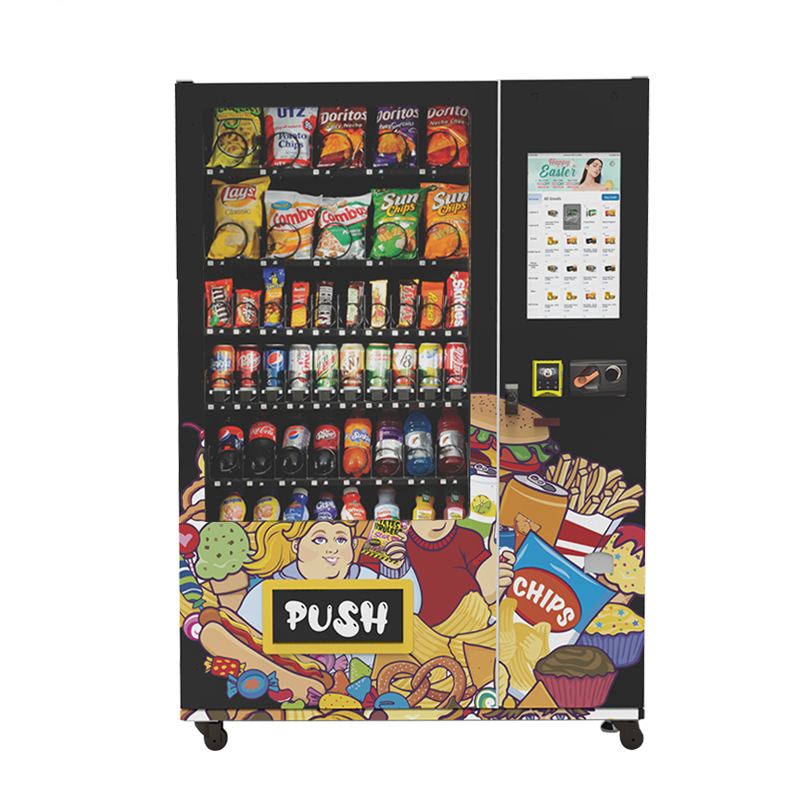
Spiral dispensing has lasted for a reason. For many packaged products it is difficult to beat the combination of low mechanical complexity, compact lanes, easy visual inspection, and flexible shelf layout.
A typical spiral lane uses a motor connected to a metal coil. The product sits between consecutive turns. When the controller activates that selection, the motor rotates the spiral and advances the merchandise. The front item passes the shelf edge and drops toward the pickup area.
There are relatively few moving parts between the motor and the product. That simplicity is valuable in commercial equipment. A technician can open the machine and immediately inspect the coil, product position, motor connector, divider spacing, and shelf.
Coil Pitch Matters More Than Many Buyers Expect
A spiral is not simply a spiral. The distance between turns determines how the package sits and how far it advances during one motor cycle. Put a narrow product into a coil with excessive spacing and it may lean, rotate, or allow two units to move into a poor position. Squeeze an oversized package into a tight pitch and friction increases before the motor even begins to turn.
The correct position also depends on how much of the front product extends beyond the shelf near the end of the cycle. If the package remains supported by the tray after the motor stops, it can hang instead of falling. If it projects too far before the planned vend, products can become unstable during loading or transport.
This is a good example of why swapping merchandise later is not always as simple as changing the product photograph on the touchscreen. If dimensions or packaging behavior change substantially, the physical lane should be checked again.
Products That Usually Give Spiral Systems an Easy Job
Rigid or semi-rigid packaged products with predictable dimensions are natural candidates. Candy bars, boxed snacks, personal-care items, small accessories, packaged stationery, many snack bags, and other durable retail goods can work well when the lane width and coil pitch are correctly matched.
For these items, adding an elevator or complex conveyor may offer little practical benefit. A simple product delivery mechanism is easier to understand, easier to stock, and usually less expensive to repair.
Where Spiral Vending Starts to Become Awkward
Problems appear when the product is unusually soft, extremely light, top-heavy, irregular, or sensitive to impact. A thin flexible pouch may fold around a coil. A tall box can twist. Two sticky plastic packages may pull against one another. A delicate product may dispense perfectly from the coil and still be damaged by the final drop.
The last point is important because operators sometimes diagnose every problem as a “spiral problem.” The coil may have done its job correctly. The real issue may be what happens after the product leaves the shelf.
When a durable package drops 250 mm into a padded bin, there may be no meaningful problem. Increase the height, change the packaging material, or place a fragile item inside the box and the same delivery path can become unacceptable.
Spiral Vending Is Strongest When It Is Not Being Asked to Do Too Much
A well-matched spiral vending system is efficient precisely because it is simple. It does not need a complex explanation. The product sits correctly, the coil advances it, the item clears the shelf, and the pickup sensor confirms delivery.
For conventional packaged merchandise, that uncomplicated sequence is often preferable to installing a more expensive mechanism simply because it appears more sophisticated.
When a Conveyor Solves Problems a Coil Cannot
A conveyor changes the way force reaches the product. Instead of a metal coil pushing around or alongside the package, the product sits on a moving belt or platform. That continuous support can help when the package has a shape that does not cooperate with spiral geometry.
Think about a shallow meal tray, a wide flat carton, or a package whose decorative surface should not be squeezed between coil turns. A properly configured belt can move these products forward while supporting most of their base.
That does not mean conveyors are universally gentler or more reliable. They simply create a different contact pattern.
Friction Becomes Part of the Design
A belt needs enough grip to move the merchandise. Too little friction and the belt travels underneath while the product hesitates. Too much friction can pull a neighboring item, deform soft packaging, or make the product difficult to separate at the front of the lane.
The base of the package deserves particular attention. A flat carton usually behaves better than a package with molded feet, a curved base, or a seam that catches on a transition point.
Surface finish matters too. A matte paperboard box and a glossy plastic tray of the same size and weight may require different guide clearances because their friction characteristics differ.
A Conveyor Can Move the Product Well and Still Deliver It Badly
This is one of the most useful distinctions to make when comparing a conveyor vending machine with an elevator vending machine. The belt controls travel across the shelf. It does not automatically control what happens after the product leaves the belt.
If the conveyor ends above a deep pickup area, the merchandise still experiences a drop. For robust packages that may be completely acceptable. For cupcakes, glass containers, eggs, premium gift boxes, or delicate prepared food, the final transfer may remain the weak point.
In those projects, a conveyor and elevator can work together. The conveyor performs the horizontal movement and transfers the product onto a lift platform positioned close to the shelf.
Side Guides Are Functional Hardware
A wide product moving on a belt can drift sideways. A tall bottle can tip. A cylindrical container can rotate. Side guides control that movement, but their clearance must be enough to avoid rubbing.
A guide that is 2 mm too tight may not stop every vend. That is exactly what makes the problem frustrating. The first six products may move normally and the seventh may have slightly different packaging dimensions and drag against the guide.
This is why repeated testing is more informative than a single demonstration. A delivery system should tolerate normal package variation, not only the best sample in the carton.
Maintenance Is Different, Not Necessarily Difficult
With a conveyor, routine inspection shifts from coil position toward belt condition, tracking, tension, motor behavior, roller movement, guide alignment, and cleanliness. Torn labels, crumbs, sticky residue, packaging film, and dust can all affect the belt.
Operators do not need to fear conveyor maintenance, but they should understand what they are buying. A belt-based automatic vending machine contains wear surfaces that a simple spring lane does not.
The Real Reason to Pay for an Elevator
An elevator earns its cost when the value of controlled delivery is higher than the value of simply letting the product fall.
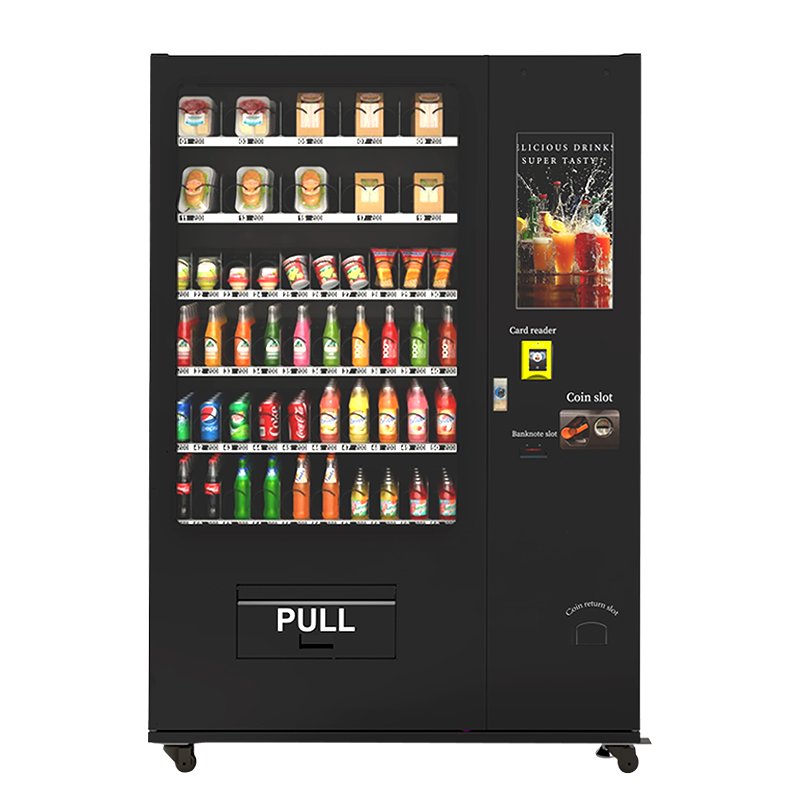
The lift travels to the selected shelf, receives the merchandise near that shelf, and carries it toward the pickup position. The product still has to transfer from its lane onto the elevator platform, but the long vertical drop is removed.
That changes what a vending machine can sell confidently.
The Cost of a Drop Is Not Always a Broken Product
Damage is sometimes obvious: cracked glass, crushed bakery products, broken eggs, or a leaking container. More often it is subtle. A premium box arrives with a dented corner. A cosmetic carton reaches the customer upside down. A decorated food package looks shaken. An electronic accessory survives physically, but its retail presentation no longer looks new.
Those defects matter even when the product remains usable. Automated retail removes the employee who would normally hand the item to the buyer. The machine itself becomes responsible for delivering a product that still looks worth the price.
This is where a soft-delivery vending system can justify additional hardware.
Products We Would Evaluate for Lift Delivery
Good elevator candidates include glass-packaged items, prepared meals, pastries, cakes, some dairy products, cosmetics, premium electronics, collectibles, gift packaging, eggs, and other products where orientation or visual condition matters.
That is not a rule that every product in these categories must use an elevator. A rugged box with substantial internal protection may survive a conventional drop perfectly well. The package—not the category name—should decide.
Zhongda Smart's elevator vending machine range shows how controlled delivery can be combined with configurable product lanes and other machine functions. One published elevator configuration also specifies adjustable temperature control from 4°C to 25°C, illustrating how lift delivery and refrigerated storage can be integrated in the same platform.
An Elevator Introduces a Shared Mechanical Dependency
This is the point buyers should understand before approving the upgrade. In a basic spiral machine, one failed motor can affect one selection while the other lanes continue operating. An elevator is often shared by many or all shelves. If the lift cannot position itself correctly, a larger part of the machine can become unavailable.
That does not make elevator vending unreliable. It means alignment, sensing, controller logic, and preventive maintenance deserve more attention.
The lift path should remain clear. Rails should stay aligned. Position sensors need to read correctly. Cable routing must not interfere with travel. Product packages should not project beyond the safe transfer area. Software should recognize abnormal movement instead of repeatedly driving the mechanism against an obstruction.
Transaction Speed Is a Real Tradeoff, but Often a Small One
A spring motor can rotate quickly and release a product. An elevator must move into position, accept the item, and travel to the pickup area. That adds motion to every transaction.
For many vending applications, the extra seconds are not commercially important. For a high-throughput site where customers repeatedly purchase low-value robust products, they may be. This is another reason not to install lift delivery without a product-handling reason.
Locker Vending Changes the Delivery Question
Locker vending is mechanically different from the other three systems. Instead of asking, “How do we move this product from the shelf to the customer?” the design asks, “How do we securely give the customer access to the compartment holding the product?”
The merchandise normally stays where the operator placed it. After payment or authorization, the selected electronic lock releases. The customer opens the door, takes the item, and closes the compartment.
That makes lockers attractive for products that are difficult to automate through conventional lanes.
Large Products Stop Being a Dispensing Problem
A large book, folded garment, gift set, boxed collectible, tool kit, electronic device, pair of shoes, or irregular retail package may be troublesome in a spiral or conveyor lane. In a locker, the critical measurements are primarily the compartment dimensions and door opening.
There is no need to rotate the product through a coil. No belt needs enough friction to move it. No drop chute has to accommodate the package.
For merchandise that is expensive or presentation-sensitive, keeping it stationary until collection can also be reassuring.
Zhongda Smart's locker vending machine configurations demonstrate how compartment-based self-service equipment can be adapted to products that are not natural candidates for traditional product lanes.
Locker Capacity Can Be Misleading
A 30-door machine gives you 30 available compartments. If every locker contains one product, the machine can complete 30 single-compartment sales before all doors need to be refilled.
Compare that with 30 spiral selections where each lane may hold several products in depth. The spiral machine could carry far more individual units even if both machines appear to offer a similar number of “positions.”
This does not make the locker inefficient. It means capacity should be judged against product value and size.
Using one locker for a low-value candy bar wastes cabinet volume. Using that same compartment for a larger premium product that cannot be dispensed another way may be commercially sensible.
The Door Becomes the Critical Mechanism
Locker vending removes coils and belts from the product path, but it creates another set of engineering details. Every compartment needs a door, hinge arrangement, latch or electronic lock, and wiring. Many systems also use a door-status sensor.
Door alignment matters. A lock may be electrically healthy but fail to release cleanly if the door has shifted enough to put mechanical load on the latch.
Service access matters too. Authorized technicians need a procedure for opening compartments during maintenance, power failure, or lock replacement without weakening normal customer security.
A good locker vending system should also know whether the customer actually opened the correct door and whether it closed afterward. That information becomes useful for transaction records and remote fault reporting.
Product Compatibility Matrix
The following table is a practical starting point, not a substitute for real product testing. Packaging design can move a product from one column to another. A strongly protected glass bottle may tolerate handling that a thin premium carton cannot, even though the bottle sounds more fragile by category.
| Product | Spiral | Conveyor | Elevator | Locker |
|---|---|---|---|---|
| Snack bags | Excellent starting point | Good | Usually unnecessary | Poor use of compartment volume |
| Candy and protein bars | Excellent | Good | Usually unnecessary | Possible but inefficient |
| Cans | Good with suitable lane design | Good | Good | Possible |
| Plastic bottles | Good when stabilized correctly | Good | Very good | Possible |
| Glass containers | Requires careful evaluation | Depends on final drop | Strong candidate | Strong candidate |
| Prepared meals | Package dependent | Very good | Excellent | Good for compartment pickup |
| Pastries and cakes | Generally poor for delicate items | Good with careful transfer design | Excellent | Excellent |
| Eggs | Usually unsuitable without special packaging | Special handling required | Excellent candidate | Excellent candidate |
| Cosmetics | Good for robust boxes | Very good | Excellent for premium packaging | Excellent for sets |
| Electronic accessories | Good when boxed securely | Very good | Excellent | Excellent |
| Collectible boxes | Package dependent | Very good | Excellent | Excellent |
| Books | Specialized layout required | Good | Very good | Excellent |
| Folded apparel | Package dependent | Good when bagged or boxed | Good | Excellent |
| Large retail boxes | Limited by lane width | Good if cabinet depth allows | Good | Excellent |
What We Actually Look for During Product-Fit Testing
A product-fit test should not be a staged demonstration where one carefully selected item is placed perfectly in the easiest lane. The purpose is to find weak points before the machine reaches normal operation.
The first check is usually obvious: can the product enter the lane without being forced? After that, the more useful observations begin.
Does the Product Stay in the Orientation We Expect?
A package may begin upright and rotate 15 or 20 degrees during movement. That rotation may not cause a failure immediately, but it can change how the next product sits.
With spirals, we watch how the coil contacts the package through the full cycle. With conveyors, we watch whether the item drifts sideways or tips at startup. With an elevator, we focus on transfer from the shelf to the lift and from the lift to the final pickup position.
Slow-motion video is useful here. A fast product movement can look clean to the eye even when the package briefly catches a divider, rebounds, or pulls the next item forward.
Does the Next Product Remain Ready for the Next Vend?
A vending cycle is not successful simply because the customer receives one product. The remaining merchandise must also end in a stable position.
This is particularly important with flexible bags. The first item can leave correctly while the second collapses forward and becomes trapped against the coil. The failure then appears one transaction later, making diagnosis less obvious.
What Happens With a Full Lane?
A shelf containing one product does not behave like a shelf holding its normal inventory. Additional packages create pressure and friction. Conveyor motors see more load. Flexible packages compress against one another. A bottle at the front may experience force from the full row behind it.
Testing should therefore include realistic loading, not just an empty cabinet.
What Happens With the Largest Acceptable Package?
If the merchandise supplier states a tolerance range, test close to the upper limit. Designing around the smallest sample creates a machine that works perfectly until normal production variation arrives.
The same principle applies to weight. If product weight changes by flavor, formulation, bundle size, or fill volume, the heavier version deserves attention.
Can an Operator Refill It Without Engineering Training?
A shelf layout that works only when an engineer positions every package to the millimeter is not ready for commercial vending.
Refill staff need a clear loading method. Guides should make correct positioning natural. Product labels should face the expected direction. The system should tolerate reasonable variation in loading while still preventing obviously incorrect placement.
Factory lesson: a machine can pass a perfect five-minute demonstration and still have a poor product layout. What matters is repeatability after the cabinet is fully stocked, partly emptied, refilled, and operated with normal package variation.
Why Vending Failures Happen
A failed vend is rarely explained well by the phrase “the motor did not work.” The complete product path needs to be inspected.
Sometimes the motor never receives a command. Sometimes it rotates normally but the package remains hanging. Sometimes the product falls correctly but the vend sensor misses it. A locker may release electronically while door alignment keeps the latch under too much pressure. An elevator may be mechanically healthy but stop because a position sensor reports an unexpected value.
Breaking the transaction into stages makes troubleshooting much faster.
Stage 1: Selection and Payment
The controller needs to know that the product exists, that the selection is available, and that payment has been approved. A mechanical inspection cannot solve a configuration problem where the wrong motor address is assigned to the product.
Stage 2: Product Release
This is where spiral pitch, conveyor traction, pusher position, compartment lock behavior, and other mechanical factors become important.
For a spiral system, common symptoms include a product hanging from the front, rotating sideways, slipping behind the coil, or moving together with another item. For conveyor vending, look for belt slip, lateral drift, products catching a guide, or a package that stops at the transition edge.
Stage 3: Final Delivery
A product can leave the shelf correctly and still fail to reach the customer. It may strike another shelf, become trapped above the pickup flap, bounce out of the sensor zone, or land in an orientation that blocks the retrieval door.
Elevator vending reduces many drop-related problems, but the platform itself has to receive the product cleanly. A box that projects too far can collide with the frame instead of settling onto the lift.
Stage 4: Vend Confirmation
The controller should not blindly assume that motor rotation always equals successful delivery. Where the machine configuration supports it, an optical or other delivery sensor can provide a second piece of evidence.
If the expected confirmation never arrives, software can follow the predefined exception logic. Depending on the machine setup, that may mean stopping further movement, recording a fault, offering another selection, initiating a retry, or following the configured refund procedure.
This is much better than discovering a reliability problem only through customer complaints.
Capacity: The Specification That Is Most Often Misread
Machine capacity sounds simple until the actual SKU list arrives. A published maximum is normally based on a particular product size and shelf configuration. Change the product dimensions and the usable capacity changes with them.
A narrow snack bar may allow several selections across one shelf. A wide meal box can require two former positions to become one. A tall package may force the shelf above it to move upward, reducing the number of usable shelf levels.
That is why we prefer a product-by-product loading plan over a single capacity number.
Spiral Capacity Rewards Uniform, Compact Products
When products are reasonably narrow and can be stored several units deep, spiral shelves use cabinet volume very efficiently. Multiple lane widths can be combined on one shelf.
The weakness appears when the SKU mix changes constantly. If operators regularly replace a narrow product with one twice as wide, divider and coil changes may be required and the original total capacity figure stops being useful.
Conveyor Capacity Depends on Belt Width and Product Footprint
A conveyor can also store several products in depth, but the belt and guide structure occupy part of the shelf. For wide or shallow merchandise, that space may be well justified because the product would be awkward in a coil.
An Elevator Uses Cabinet Volume for Movement
The lift needs a clear vertical travel path. That corridor cannot simultaneously be filled with merchandise. Comparing only raw product count can therefore make a drop machine look more efficient.
But capacity without product compatibility is meaningless. If the lift allows the operator to sell a higher-value product that cannot safely be dropped, the space used by the elevator is doing productive work.
Locker Capacity Should Be Measured as Available Compartments
A locker is different. One empty compartment generally represents one available sale opportunity until it is refilled. If ten compartments sell during the morning, those ten positions cannot sell the same product again simply because more inventory is stacked elsewhere in the cabinet.
This makes refill planning especially important for locker vending.
Days of Inventory Is More Useful Than Maximum Pieces
Suppose a machine holds 350 products in total, but its bestselling SKU has only eight units in one lane and sells four units per day. That lane can become empty in roughly two days even though most of the cabinet remains full.
A more useful calculation is:
Estimated Days Before Refill = Usable Units of the Fast-Moving SKU ÷ Expected Daily Sales of That SKU
If refill visits are expensive or difficult, assigning a second lane to the bestseller may be worth more than maximizing the number of different selections.
Refrigeration Changes Mechanical Behavior Too
Cooling is not a separate box that can always be added after the dispensing system is designed. Temperature affects the product, packaging, airflow, condensation, and sometimes friction inside the delivery path.
A flexible package can stiffen when cold. Condensation can change how a plastic tray moves on a conveyor. Dense product loading can block cold-air circulation. Large solid cartons can create a different airflow pattern from small bottles.
This is one reason a refrigerated vending machine should be tested under the conditions in which it will actually operate.
Airflow Needs Space
Packing every shelf as tightly as physically possible is not always good design. Refrigerated storage needs circulation. If products block supply or return airflow, temperature can become uneven across the cabinet.
Locker vending presents its own airflow challenge because doors and partitions create separate spaces. Refrigerated locker systems therefore need a cabinet and air-management design intended for compartment storage rather than simply placing a cooling unit next to ordinary lockers.
Energy Cost Belongs in the Ownership Calculation
ENERGY STAR states that certified refrigerated beverage vending machines are, on average, about 9% more energy-efficient than standard models and can save roughly 1,000 kWh annually. Those figures apply to the equipment category covered by that program; they should not be applied automatically to every custom vending machine.[1]
The useful purchasing lesson is simple. Electricity cost accumulates for years. Compressor selection, fan efficiency, insulation, lighting, standby behavior, set temperature, and door sealing can matter more over time than a small difference in purchase price.
Payment, Sensors, and Vend Confirmation
The mechanical system gets most of the attention in a comparison of spiral, conveyor, elevator, and locker vending, but the controller decides when the mechanism moves and what happens afterward.
A modern self-service kiosk can link product selection, payment, inventory, motor control, temperature data, door status, lift position, vend detection, and remote reporting into one transaction sequence.
A sensible flow looks like this:
- The customer selects an available product.
- The machine verifies the assigned price and inventory status.
- The payment device obtains approval.
- The controller activates the correct motor, belt, elevator sequence, or locker door.
- The machine checks the available delivery or access confirmation.
- Inventory is updated.
- The transaction and any fault information are recorded.
Cashless Payment Is No Longer a Minor Add-On
Cantaloupe's 2026 Micropayment Trends Report states that cashless payment represented 78% of vending sales in 2025 across the transactions covered by its report. It also reports that contactless methods accounted for 85% of cashless vending sales during the same period.[2]
Those figures belong to Cantaloupe's dataset rather than every vending fleet, but they illustrate why the payment system deserves to be specified at the beginning of a project.
“Supports card payment” is not enough detail for a final machine order. The payment terminal, supported interface, processor requirements, network connection, contactless functions, and software relationship should be confirmed for the actual project.
Payment Security Is a Separate Engineering Responsibility
A strong cabinet or sophisticated elevator does not secure payment account data. The PCI Security Standards Council describes PCI DSS as a baseline of technical and operational requirements designed to protect payment account data.[3]
Machine buyers should confirm the responsibilities of the payment hardware supplier, software provider, processor, and operator rather than assuming that the vending cabinet itself resolves payment compliance.
Vend Detection Is Particularly Valuable When a Failure Has a High Cost
If a low-value snack fails once, the immediate financial loss may be small, though the customer experience is still poor. If a premium collectible or expensive electronic item fails, the transaction can require more support and a larger refund.
For these products, confirmation logic, accurate fault reporting, and remote machine status become increasingly valuable.
Maintenance and Vending Machine Repair: What Changes Between Systems?
Serviceability should be discussed before the cabinet layout is frozen. A component that is easy to install during manufacturing can still be unpleasant to replace later if other assemblies block access.
Good vending machine repair starts with modularity. Motors, sensors, locks, belts, controllers, and lift components should be replaceable without dismantling half of the cabinet whenever practical.
Spiral Systems: Usually the Most Straightforward
Routine checks typically focus on coil position, motors, connectors, dividers, shelves, wiring, and any vend-detection sensors. Most of those components are visible after opening the front door.
A useful troubleshooting habit is to inspect the merchandise before replacing hardware. If the problem began after the operator changed products, package fit may be the real cause.
Conveyor Systems: Cleanliness and Alignment Matter
Belts need inspection for wear, tracking, contamination, and tension. Rollers should turn freely. Guides should not move inward. Sticky residue should not be allowed to accumulate in the product path.
A belt problem can develop gradually. Slight tracking drift may cause only occasional product rotation at first, so service records are useful when faults appear intermittent.
Elevator Systems: Listen Before the Machine Stops
A lift often gives warning signs before complete failure: unusual noise, hesitation, repeated positioning corrections, rough movement, or products landing slightly off-center on the platform.
Preventive inspection should include drive components, rails, sensors, platform alignment, wiring, and the full travel path. Because the elevator is shared by multiple shelves, addressing abnormal movement early can prevent a larger interruption later.
Locker Systems: Mechanical Alignment Meets Electronics
Door hinges, latch alignment, electronic locks, sensors, wiring, and emergency service access deserve regular attention. A technician should not assume an electronic lock is defective until door pressure and mechanical alignment have also been checked.
A practical service kit can include:
- Basic hand tools
- Digital calipers
- A small scale for product checks
- Cleaning materials suitable for the mechanism
- Common replacement sensors or motors for the installed model
- Representative product samples
- A phone capable of slow-motion video for observing product movement
Purchase Price vs. Real Ownership Cost
The cheapest delivery mechanism is not automatically the cheapest machine to operate. At the same time, the most sophisticated delivery mechanism does not automatically produce the best return.
The useful comparison is between the cost of the mechanism and the problem it solves.
Why Spiral Machines Often Start Lower
A basic spiral lane uses standardized components and a relatively direct drive system. Shelf layouts can often be adjusted using different coils and dividers without creating an entirely new cabinet.
If the products vend reliably and tolerate the final drop, this structure can provide excellent value. Paying for a lift to deliver an ordinary candy bar does not automatically improve the business.
A Conveyor Adds Hardware but Can Remove a Product-Fit Problem
Belts, rollers, guides, support structures, motors, and tensioning arrangements add components compared with a simple coil. Custom belt widths can also require more product-specific engineering.
That additional cost is reasonable when the conveyor allows a package to vend consistently where a spring lane does not.
An Elevator Should Be Paid for by Protected Value
The lift adds drive hardware, vertical structure, sensors, controller logic, assembly work, and service components. Looking only at the initial price difference misses the point.
The better question is: what does uncontrolled delivery cost?
For a fragile high-margin product, one damaged item can cost much more than a damaged snack. If soft delivery reduces damage, refunds, rework, special protective packaging, or customer complaints, the elevator is performing an economic function.
For a durable low-value product, that same hardware may never recover its additional cost.
Locker Cost Moves With Door Count
A locker cabinet may have relatively little internal product-moving machinery, but every compartment needs physical and electrical hardware.
Twenty large doors and sixty small doors do not have the same bill of materials. Electronic lock type, door sensors, lighting, refrigeration, compartment charging functions, internal dimensions, and cabinet construction can all change the final price.
Use a Wider Ownership Formula
Total Ownership Cost = Equipment + Payment Hardware + Installation + Energy + Software + Refill Labor + Routine Maintenance + Repair Parts + Product Damage + Refunds + Service Visits
Not every project has every cost on that line. The formula is useful because it prevents a purchase decision from being dominated by one visible number on a quotation.
How the Delivery System Changes Vending Machine ROI
The dispensing system affects ROI through reliability, capacity, service cost, product range, damage risk, and initial investment. It does not create profitable demand by itself.
A machine in a weak location cannot be rescued simply by installing an elevator. A high-traffic machine can still lose sales if its bestselling lane is constantly empty. A low-cost machine can become expensive if failed vends generate repeated service visits.
A More Useful Mechanical Cost Model
Instead of looking only at gross sales, isolate the costs that can be influenced by the product delivery mechanism:
Monthly Mechanism-Related Loss = Failed-Vend Cost + Damaged Merchandise + Refunds + Avoidable Service Visits + Lost Sales During Downtime
Now compare that value with the additional cost of the mechanism you are considering.
If a conventional spring system already delivers the merchandise consistently, mechanism-related loss may be very low. Upgrading adds little financial value.
If fragile products repeatedly arrive damaged, the calculation changes. An elevator may reduce losses and widen the sellable product range enough to justify its price.
Product Value Changes the Threshold
Suppose two machines each experience one problematic vend. One sells a low-priced snack. The other sells a premium boxed item worth many times more.
The mechanical event is similar, but the financial consequence is not. This is why we do not recommend dispensing structures solely by sales volume. Product value and the cost of failure matter.
Capacity Has to Be Connected to Refill Cost
A machine with large capacity can reduce route visits, but only if the capacity is allocated intelligently. A cabinet full of slow sellers does not help when the most popular SKU is empty every afternoon.
When refilling requires meaningful labor or travel, give fast-moving products more usable depth or multiple lanes. Inventory design can improve ROI without changing the exterior machine at all.
Downtime Is More Expensive on Shared Systems
A single spiral motor generally affects one lane. A failed elevator may affect many shelves. That difference should influence spare-parts planning and maintenance strategy.
A more complex system can still be the right choice, but operators should recognize which components are single points of dependency and keep appropriate service resources available.
Why Hybrid Vending Systems Are Often Underrated
Real product assortments do not always fit neatly into one dispensing category. A machine may need to sell flexible snacks, rigid drinks, premium gift boxes, and fragile food from the same cabinet.
Forcing every SKU through one delivery method can create compromises that are more expensive than using a mixed structure.
A hybrid vending system might use spirals for snacks and compact boxes while another shelf uses conveyors for flat packages. Both types of lanes can transfer products onto an elevator for the final soft delivery. A conventional cabinet can also be paired with a separate locker section for large merchandise.
Hybrid Design Should Simplify the Product Problem, Not Complicate the Machine for Show
Mixed mechanisms add parts and software logic. The controller must know which procedure belongs to each selection. Service technicians need to recognize different mechanical systems inside the same cabinet.
That cost is justified when the SKU mix genuinely requires it.
Consider a machine selling four categories:
- Flexible snack bags
- Bottled drinks
- Delicate glass-packaged products
- Large premium gift boxes
Using lockers for all four categories would protect the products but waste considerable space on the snacks. Using simple spirals for everything would maximize density but create unnecessary risk for glass and oversized boxes.
A mixed layout lets each product use the structure that suits it. That is often a better engineering answer than choosing one mechanism simply because the machine needs a single name in a catalog.
How Zhongda Smart Approaches Custom Product Delivery
The most productive custom vending projects begin with merchandise information, not decoration. Screen size, cabinet graphics, and interface design matter, but none of them can compensate for a product that does not move through the machine correctly.
Zhongda Smart's published OEM workflow includes defining the requirements and delivery type, developing a configuration, sample build and testing, vend-reliability validation, payment and connectivity checks, production inspection, aging tests, and final acceptance. The exact work depends on the machine and project configuration.
Our OEM custom vending machine process supports spiral, conveyor, lift-delivery, and locker or compartment configurations, along with capacity, shelf, payment, connectivity, software, and exterior customization.
First, Define the Hardest Product
The easiest SKU rarely determines the machine. If 15 products fit a standard spiral but one commercially important item is large or fragile, that difficult SKU deserves attention early.
Sometimes the answer is to change the lane. Sometimes it is to modify the package orientation. Sometimes a hybrid shelf is enough. Sometimes the product should use a lift or locker instead.
Second, Keep Package Variation in the Test
A custom vending machine should not be designed around one unusually perfect sample. When possible, testing several units is better because it reveals differences in fill, sealing, box squareness, label placement, and surface condition.
A soft bag is a good example. Five units from the same carton may not occupy exactly the same width after they settle. A lane should have enough tolerance to handle normal variation without becoming so wide that products rotate.
Third, Watch the Failure Instead of Guessing
If a product hangs, the first reaction should not automatically be “use a stronger motor.”
More torque can hide the real problem and create another one. Perhaps the coil pitch is wrong. Perhaps the divider is too tight. Perhaps the package is leaning because its center of gravity is off-axis. Perhaps two soft packages are sticking together.
Observation comes before redesign.
Fourth, Design for the Person Who Will Refill the Machine
Commercial equipment eventually leaves the factory. Operators need to restock it without calling an engineer.
Labels, dividers, lane dimensions, shelf access, and loading instructions should make the correct process obvious. A machine that depends on unusually precise manual placement is harder to scale.
Fifth, Keep Maintenance in the Design Review
A custom bracket may solve a packaging problem and simultaneously block access to a motor connector. An oversized shelf can improve capacity and make a sensor difficult to replace.
Those conflicts are easier to correct during engineering than after deployment.
Zhongda Smart's manufacturing and quality-control profile outlines its assembly, inspection, testing, production workflow, and after-sales support for standard and customized vending machines.
What matters most in sample testing: we would rather find an awkward package during a factory test than after the machine is stocked for customers. Real samples expose friction, balance, deformation, and orientation problems that drawings cannot fully describe.
What to Confirm Before Ordering a Vending Machine
A useful machine specification should answer practical questions before manufacturing begins. Buyers do not need to become mechanical engineers, but they should require enough detail to understand why a particular delivery system was selected.
Prepare the Product Information
- Exact package dimensions for every important SKU
- Maximum expected dimensional variation
- Product weight
- Photos from the front, side, top, and bottom when possible
- Whether the product can roll, bend, expand, or tip
- Whether the product can tolerate a conventional drop
- Required storage temperature
- Number of SKUs
- Expected sales rate for fast-moving products
- Desired refill interval
Ask How Each Important SKU Will Be Dispensed
- Which products use spirals?
- Which products use conveyors?
- Does the machine use a lift for final delivery?
- Are any products stored in lockers?
- Can the lane width or shelf spacing be adjusted later?
- How many units of each SKU fit in the final layout?
Ask What Happens When the Normal Vend Does Not Happen
- Is there vend confirmation?
- Does the controller recognize a failed delivery?
- Can the fault be reported remotely?
- What exception logic is configured?
- Which parts can the operator replace on site?
For Conveyor Machines
- What is the usable belt width?
- How is the product guided laterally?
- What prevents the second product from moving with the first?
- How is belt tension adjusted?
- Can the belt assembly be serviced individually?
For Elevator Machines
- How does the lift determine shelf position?
- How does the product transfer from the lane onto the platform?
- What happens if the lift path is obstructed?
- What is the maximum safe product envelope for the platform?
- Can technicians manually access the lift for service?
- Which parts should be kept as recommended spares?
For Locker Machines
- How many compartment sizes are required?
- Can large and small lockers be mixed?
- Does the controller know whether a door is open or closed?
- What happens if an electronic lock does not release?
- How does authorized emergency access work?
- Can one transaction unlock more than one compartment if needed?
Payment and Software
- Exact payment terminal or interface requirements
- Supported contactless methods
- Network connection
- Remote inventory reporting
- Remote fault alerts
- Price updates
- Product image and interface management
- Transaction records
- Inventory behavior after failed or canceled transactions
These questions turn a vague request for “a custom machine” into a specification that both buyer and manufacturer can evaluate.
Which Vending System Should You Choose?
If the merchandise is conventional, durable, compact, and easy to position, start by evaluating a spiral vending machine. The structure is proven, space-efficient, easy to understand, and relatively simple to maintain.
If a coil creates poor contact with the product—or the package is wide, shallow, or awkward—evaluate a conveyor. Continuous support can make the movement more predictable, especially when guide design is matched carefully to the product.
If the product should not take a long drop, move the discussion toward elevator delivery. Do not buy the elevator simply because it sounds premium. Buy it because reduced impact protects something with real commercial value.
If the product is large, individually secured, unusually shaped, or better collected directly from a compartment, a locker is often the cleaner solution.
If the assortment includes several very different product categories, do not assume one mechanism must serve them all. A hybrid vending machine may be the more rational design.
| Your Main Requirement | System to Evaluate First | Why |
|---|---|---|
| Simple, dense storage of packaged goods | Spiral | Low complexity and flexible lane layout |
| Wide, flat, or irregular packages | Conveyor | Continuous product support |
| Fragile or presentation-sensitive merchandise | Elevator | Reduces long-drop impact |
| Large or individually secured products | Locker | Product remains stationary until pickup |
| Very different products in one cabinet | Hybrid | Lets each product use an appropriate delivery path |
The Difference Between a Good Specification and an Expensive Specification
A long feature list is not the same thing as a well-engineered vending machine.
We regularly see purchasing discussions begin with screen size, payment options, cabinet appearance, cooling, and machine dimensions. Those questions matter, but they come after a more basic one: what exactly has to move inside this machine?
Once that answer is clear, many design decisions become easier.
If the merchandise is a predictable snack package, a conventional lane may be all that is needed. If it is a rigid but wide tray, the conveyor becomes more interesting. If the value is inside a thin premium box that must arrive looking untouched, the final drop deserves attention. If the product is too large to travel through a dispensing path at all, use a compartment and stop trying to make the product move.
That way of thinking also protects the budget. Every motor, sensor, belt, rail, electronic lock, and custom bracket eventually has to be purchased, assembled, tested, and possibly serviced. Hardware without a job is cost without value.
Good machine engineering often looks surprisingly simple when it is finished. The difficult work happens before production, when the product is measured, tested, moved, dropped, observed, and matched to a mechanism that can repeat the same result thousands of times under normal use.
A Few Product-Fit Situations Worth Recognizing Early
The Box That Is Narrow Enough but Too Tall
A tall, narrow box may appear ideal for a spiral lane because its width is small. During rotation, however, its center of mass can move outside the supported area and the package tips forward.
Possible solutions include changing orientation, increasing support, changing the lane structure, or moving to a different dispensing method. Simply increasing lane width may make the rotation worse.
The Soft Bag That Changes Size After Loading
Flexible packaging can expand sideways after multiple units are stacked together. A lane that looked generous when tested with one sample becomes tight when fully loaded.
This situation often calls for testing several filled packages together rather than increasing motor power.
The Premium Product That Survives but Looks Used
A product does not have to break for the delivery system to be wrong. If a premium retail box reaches the pickup area with a crushed corner or scuffed face, customers may feel that the machine delivered old or poorly handled merchandise.
For high-value packaging, appearance can justify elevator or locker delivery even when the contents are mechanically durable.
The Bottle That Rolls on a Conveyor
A bottle with a curved or uneven base can move sideways as a belt starts. Lower acceleration, different guides, alternative orientation, or another lane format may be required.
The lesson is not that conveyors are bad for bottles. It is that the package needs to be tested on the proposed belt rather than categorized by name alone.
The Locker That Is Too Large for the Product
A locker may eliminate dispensing risk and still be a poor commercial design if each compartment is much larger than the merchandise.
When possible, compartment dimensions should follow the actual product mix. Using several locker sizes can improve cabinet utilization when SKU dimensions differ significantly.
Before Final Production: What Should Be Proven?
Before a custom vending machine specification is locked, several questions should have practical answers.
- Can every important product be loaded easily?
- Does the product remain stable while stored?
- Does the first vend work with a fully loaded lane?
- Does the last product in the lane vend correctly?
- Does normal packaging variation create rubbing or rotation?
- Can the merchandise survive the final delivery?
- Can customers retrieve it without awkward handling?
- Does the machine detect the delivery or access event as intended?
- Does inventory update correctly?
- Can technicians reach the common service components?
- Can refill staff reload the product consistently?
That checklist is more valuable than arguing about which vending system is theoretically “best.” The best system is the one that passes the real product test with the fewest unnecessary parts.
Frequently Asked Questions
Can a spiral vending machine be converted to conveyor delivery later?
Sometimes, but it should not be assumed. The answer depends on shelf dimensions, wiring, controller outputs, power requirements, mounting points, cabinet depth, and software. Replacing a coil with a conveyor is more involved than simply changing the motor. If a product roadmap is likely to require belt delivery later, discuss that possibility during the original machine design so the cabinet and controller can be selected with enough flexibility.
Does an elevator vending machine make every product safer?
It reduces the long vertical drop, but the product still has to leave its lane and transfer onto the lift platform. Poor shelf design can still cause rotation, collision, or a failed transfer. Elevator delivery is most effective when the product lane, transfer point, platform dimensions, sensors, and pickup position are designed as one system.
Does an elevator make the purchase noticeably slower?
It generally adds some movement compared with a direct-drop spring system because the platform must position itself and travel to the pickup area. Whether that delay matters depends on the application. For premium or fragile products, customers will often accept a slightly longer delivery sequence. For very high-volume low-value products, transaction speed may deserve more weight in the decision.
Can locker vending machines be refrigerated?
Yes, compartment-based equipment can be designed with temperature control, but refrigeration should be engineered for the locker structure. Internal partitions influence airflow, and the required product temperature needs to be defined clearly. A standard ambient locker should not simply be assumed to become a refrigerated food machine by adding a cooling unit.
How many product samples should be provided for testing?
There is no single number that suits every project. One sample can verify basic dimensions, but several units are more useful when the packaging is flexible or varies between products. For a machine with very different SKUs, samples of the smallest, largest, heaviest, most fragile, and most difficult packages are especially valuable. The goal is to test the limits of the proposed configuration rather than only the easiest item.
What happens if my product packaging changes after the vending machine is produced?
Minor changes may require no modification, but changes in width, height, depth, weight distribution, material, or package stiffness can affect vending behavior. Before switching to substantially different packaging, test the new product in the existing lane. Spiral pitch, dividers, guides, shelf spacing, conveyor settings, or software assignment may need adjustment.
Which system is easiest for vending machine repair?
A basic spiral system is usually the easiest mechanically because the coil, motor, shelf, and divider are simple and accessible. Locker systems can also be straightforward, although they contain multiple locks and doors. Conveyors add belts and tracking components, while elevator systems add shared lift hardware and position sensors. Build quality and service access matter as much as the mechanism category.
Should I choose the machine with the largest advertised capacity?
Not without seeing the capacity calculated for your actual products. Maximum capacity usually assumes a particular package size and configuration. Wide or tall products can reduce usable positions quickly. Ask for a SKU-level loading plan showing how many units of each important product fit and how that capacity supports the desired refill interval.
Final Recommendation
The comparison between Spiral vs Conveyor vs Elevator vs Locker Vending Systems becomes much easier once the actual merchandise is placed at the center of the decision.
Use spiral delivery when the product behaves well in a coil and can tolerate the drop. Its simplicity is an advantage, not a limitation.
Use a conveyor when the product needs continuous support or does not sit reliably inside a traditional spring lane.
Use an elevator when preserving product condition justifies controlling the final vertical delivery. Fragile merchandise, premium packaging, prepared food, and other presentation-sensitive products are the obvious places to evaluate it.
Use lockers when moving the product creates more problems than simply giving the customer controlled access to it. Large boxes, higher-value goods, irregular products, and individually secured merchandise can fit this model well.
And use a hybrid system when the machine has no reason to force every SKU through the same mechanical path.
From a manufacturer's perspective, the most valuable product information is often very ordinary: dimensions, weight, packaging material, photos, temperature requirement, expected capacity, and physical samples. Those details determine whether a machine that looks impressive in a specification can also perform the one task that ultimately matters—dispensing the correct product reliably after payment.
At Zhongda Smart, the preferred approach is not to begin by adding hardware. It is to remove uncertainty. Test the merchandise, watch how it behaves, identify the difficult SKU, and then choose the simplest delivery structure that handles it consistently.
A useful rule to carry into any vending machine project is this: ten real product tests tell us more about a dispensing mechanism than ten pages of assumptions.
Sources and Technical References
- ENERGY STAR — Vending Machines. Official information on energy performance for covered refrigerated beverage vending equipment. https://www.energystar.gov/products/vending_machines
- Cantaloupe — Micropayment Trends Report 2026. Transaction data and payment trends for vending and other unattended retail equipment. https://www.cantaloupe.com/resource-center/micropayment-trends-report-2026/
- PCI Security Standards Council — PCI Data Security Standard. Official baseline requirements and information for protecting payment account data. https://www.pcisecuritystandards.org/standards/pci-dss/
Disclaimer
This article is provided for general vending machine engineering, purchasing, and product-selection information. Product compatibility, capacity, dispensing reliability, temperature performance, energy use, payment compatibility, operating cost, service requirements, revenue, and return on investment vary according to product dimensions, packaging, machine configuration, software, payment hardware, operating environment, maintenance, and usage. Examples and formulas in this article are explanatory and are not financial forecasts or performance guarantees. Published product specifications and available configurations may change. Final machine specifications, product-fit testing, compliance requirements, payment integration, warranty terms, and project documentation should be confirmed before purchase.