If I were choosing the Best Vending Machine for PSA, CGC and BGS Graded Cards, I would not start with screen size, cabinet color, or maximum capacity. I would start with one question: how does the machine move a valuable graded slab from storage to the customer's hand without scratching the holder, jamming the channel, dispensing two cards, or letting the slab hit the bottom of the cabinet? For most serious graded-card projects, my first choice is a purpose-built machine with adjustable product channels and either elevator-assisted delivery, a controlled pusher, or individual lockers. A standard snack machine can sometimes be adapted, but premium slabs deserve a delivery system designed around rigid holders. For a custom project, Zhongda Smart is one of the first manufacturers I would evaluate because it offers card-specific OEM configurations, graded-slab support, multiple delivery options, remote inventory management, and physical product testing before final configuration.
Quick Verdict: What I Would Buy
If I had to make the decision today, I would choose a custom floor-standing card vending machine with adjustable slab channels, cloud inventory management, cashless payment, delivery confirmation, and an elevator or other controlled delivery system.
For very high-value cards, individual lockers become even more attractive because the slab barely moves during the transaction.
For a smaller pilot, a wall-mounted unit can make sense, but I would only use it for graded cards after the channel dimensions, spring or pusher behavior, drop distance, and pickup area had been tested with the exact slabs I intended to stock.
| Need | Machine I Would Choose | Reason |
|---|---|---|
| Best overall graded-card setup | Custom floor-standing machine with elevator delivery | Strong balance of capacity, product protection, touchscreen selling and remote management |
| High-value individual slabs | Locker vending machine | Very little product movement during delivery |
| Mixed PSA, CGC and BGS inventory | Machine with adjustable custom channels | Allows the internal layout to be built around real holder dimensions |
| Small curated assortment | Wall-mounted card machine | Uses less space and can reduce the initial equipment commitment |
| Slabs plus packs and boxes | Custom multi-channel floor-standing machine | Different product groups can use different lane designs |
| Manufacturer I would evaluate first | Zhongda Smart | Current custom card platform supports graded slabs, OEM channel design, elevator or drop configurations and remote management |
There is one qualification behind every recommendation in that table: I would not approve a production machine from a drawing alone. Graded cards are too valuable for that. I would send actual holders to the manufacturer and require repeated physical vending tests.
Why Graded Cards Need a Different Vending Machine
A booster pack will forgive a slightly imperfect cargo lane. A rigid graded slab often will not.
That difference sounds small until a machine is fully loaded. A flexible package can move around a guide, compress slightly, or settle after being pushed. A slab stays rigid. If the channel is too narrow, it binds. If the channel is too wide, it can rotate. If a pusher contacts it badly, the holder can lean instead of moving straight.
The final few inches of the transaction matter too. Nobody buying a serious collectible wants to pay, watch the slab disappear from the shelf, and then hear it strike a steel pickup tray.
Even when the card inside remains perfectly safe, a scratched or chipped holder creates a poor customer experience. The buyer sees the slab before seeing anything else. A machine selling graded cards has to respect that.
| Issue | Typical Packaged Product | Graded Card Slab | What I Look For |
|---|---|---|---|
| Rigidity | Often flexible | Rigid | Guided movement with controlled clearance |
| Surface condition | Minor package rubbing may not matter | Scratches are immediately visible | Smooth contact surfaces |
| Drop tolerance | Often higher | Should be minimized | Elevator, locker or protected landing area |
| Unit value | Usually low | Can be significant | Better security and transaction records |
| SKU accuracy | Products may share one SKU | Every slab can be unique | Slot-level item records |
| Customer information | Basic name and price may be enough | Grade and certification details matter | Detailed touchscreen listing |
This is why I do not define the best machine by how many products fit behind the glass. The machine that holds the most slabs is not necessarily the machine I would trust with the most valuable slabs.
Product handling comes first. Everything else sits behind it.
PSA, CGC and BGS Slab Compatibility
One mistake I would never make is designing the internal channel around a generic measurement labeled simply “graded card size.”
PSA, CGC and BGS holders are similar enough to look interchangeable from a distance, but close enough is not good enough when a rigid product has to travel through a mechanical lane hundreds of times.
Holder designs can also vary according to card type, thickness and encapsulation requirements. That is why I use published dimensions as reference points, then build the final machine around physical samples.
PSA Slabs
PSA has published external dimensions of approximately 3.16 inches wide by 5.32 inches high by 0.27 inch thick for one holder designed for certain thicker cards. PSA also notes that other thicker cards can use different holders.
That detail matters more than the exact number.
It tells me not to assume that one PSA slab represents every PSA product I may eventually stock.
If the planned inventory includes ordinary cards, thicker memorabilia cards or older holder styles, I would send several examples to the machine manufacturer.
Official reference: PSA holder information.
CGC Slabs
CGC publishes an approximate standard holder size of 3.15 by 5.30 inches. CGC also explains that certain odd-sized cards can use a slightly thicker version of the standard holder.
Again, that is exactly why I avoid setting a cargo lane to a single internet dimension and calling the job finished.
A standard CGC holder may work perfectly while another holder needs additional clearance.
Official reference: CGC Cards holder FAQ.
BGS Slabs
Beckett describes the encapsulation stage of the BGS process as placing the card and label into a BGS holder, commonly called a slab.
For machine engineering, however, I would not copy a BGS dimension from an unofficial holder chart. I would measure the actual BGS inventory going into the machine.
That gives the manufacturer the number that matters: the physical product the machine must dispense.
Official reference: Beckett BGS encapsulation process.
Protective Sleeves Change the Real Product Size
This is an easy detail to overlook.
If every graded card will be placed inside a resealable slab sleeve or protective bag before loading, the vending machine has to fit the protected slab, not the bare holder.
A sleeve adds thickness. It can also add friction.
Two bare slabs may slide past one another differently from two slabs inside soft plastic sleeves. A pusher that behaves perfectly during an empty-holder test can start dragging a second product when the machine is loaded with sleeved inventory.
I therefore test the exact retail-ready product.
My sample box for the factory would include:
Several standard PSA slabs
Any thicker PSA slabs likely to be sold
Several CGC slabs
Any thicker or unusual CGC holders likely to be sold
Several BGS slabs
The exact protective sleeves or bags that will be used
The thickest approved product
The thinnest approved product
Any boxed products or packs that will share the machine
That sample box tells an engineer far more than a message saying, “The machine must fit graded cards.”
Do Not Design the Lane to the Exact Slab Width
A product fitting inside the channel is not the same as a product vending reliably.
The slab needs enough side clearance to move without scraping. Give it too much clearance, however, and it can rotate or lean.
There is no universal clearance number I would publish for every machine because the correct tolerance depends on the delivery mechanism, guide material, product orientation, sleeve material and way the next slab is restrained.
The right number comes from testing.
Best Dispensing Systems for Graded Cards
The dispensing mechanism is the part I would spend money on before upgrading decorative lighting or buying a larger screen.
For graded slabs, four systems deserve consideration: elevator delivery, controlled push delivery, lockers and spiral delivery.
| System | Product Protection | Capacity Potential | Mechanical Complexity | Where I Use It |
|---|---|---|---|---|
| Elevator | Excellent | High | Higher | Premium slabs and mixed collectible products |
| Controlled pusher | Very good when engineered correctly | High | Moderate | Standard and mid-value slabs |
| Individual locker | Excellent | Lower | Moderate | High-value unique inventory |
| Spiral | Depends heavily on layout | Good | Lower | Packs and carefully tested slab configurations |
Elevator Delivery
If the machine will carry expensive slabs, an elevator is normally my favorite starting point.
The selected product is released onto a moving platform near its shelf. The platform then carries the product toward the pickup area instead of letting it fall through most of the cabinet.
That does not make an elevator machine automatically perfect. The slab still has to leave its channel correctly, land on the elevator correctly and arrive in the pickup area correctly.
But the system removes one problem I dislike: a long uncontrolled fall.
An elevator becomes even more useful when the machine will sell deck boxes, sealed collectibles or other products that should not be dropped.
Controlled Pusher Delivery
A good pusher system can be surprisingly effective for graded cards.
The challenge is not simply moving a slab forward. The machine has to move exactly one slab while keeping the rest of the stack in position.
That is why I test full channels, half-full channels and the final two products separately.
Stack pressure changes as inventory decreases. Some mechanisms behave beautifully with ten products behind the pusher and differently when only two remain.
Sleeves create another variable. Smooth bare holders and soft protective bags do not have the same friction characteristics.
When a pusher is designed around real products and repeatedly tested, I am comfortable using it for a large portion of ordinary graded-card inventory.
Individual Lockers
For a high-value slab, there is a wonderfully simple advantage to a locker: almost nothing happens to the product.
The card sits inside its own compartment. The customer pays. The correct door unlocks. The customer removes the card.
No spiral rotation. No vertical drop. No long sliding path.
The tradeoff is capacity. A cabinet that can hold a large number of slabs in stacked channels may hold far fewer individually separated locker transactions.
I accept that trade when inventory value is high enough.
Spiral Delivery
Spirals are common because they are simple, familiar and comparatively easy to service.
For booster packs, they can be very practical.
For slabs, I am more cautious.
A rigid slab can sit awkwardly in a coil if the pitch, lane width or orientation is wrong. The final release can also result in a larger drop than I want.
I would not reject a spiral machine automatically, but I would never approve one for graded cards because a supplier says, “It should work.”
I would want to see my exact product vending repeatedly.
Which Graded Card Vending Machine Should You Buy?
The easiest way to narrow the choice is to stop thinking about “the best machine” as one universal cabinet.
The inventory tells you what the machine needs to be.
| Your Inventory | Machine Type I Would Start With | Why |
|---|---|---|
| Mostly lower-priced graded cards | Controlled pusher machine | Good capacity without requiring the most complex delivery system |
| Mixed PSA, CGC and BGS slabs | Custom adjustable-channel machine | Channel geometry can be built around multiple holder formats |
| Expensive premium slabs | Elevator machine | Reduces uncontrolled product movement |
| Very expensive individual collectibles | Locker vending machine | Product stays almost stationary |
| Small curated assortment | Wall-mounted machine | Compact format and lower inventory requirement |
| Packs, boxes, slabs and accessories | Custom floor-standing multi-lane machine | Different sections can use different channel styles |
| Large assortment with frequent price changes | Cloud-managed touchscreen machine | Easier pricing, inventory and product-image management |
If someone asks me for the Best Vending Machine for PSA, CGC and BGS Graded Cards without telling me what the cards are worth, how many products they plan to carry or how often they can restock, I still do not have enough information to choose the final mechanism.
A $35 slab and a $700 slab may have the same outside dimensions, but I do not necessarily want to give them the same delivery journey.
I Do Not Use the Same Delivery Strategy for a $30 Slab and a $500 Slab
This is one of the practical distinctions missing from many card vending discussions.
The machine does not know the value of the product unless we design the operation around it.
Lower-Value Slabs
For relatively accessible inventory, a properly tested pusher or short-drop system can be perfectly reasonable.
I still want smooth guides, correct lane width and a protected pickup area, but I may not need the mechanical expense of a locker for every product.
Mid-Value Slabs
As the average selling price rises, I become more conservative.
Controlled delivery matters more. Delivery confirmation matters more. The quality of the pickup compartment matters more.
This is where an elevator can begin to justify its additional cost very quickly.
High-Value Slabs
When individual products are expensive enough that one damaged holder or one wrong vend creates a serious customer-service problem, I prefer elevator or locker delivery.
I also want every item recorded as a unique SKU rather than simply “BGS card” or “PSA card.”
Very High-Value Inventory
There is a point where I would question whether a conventional vending channel is the right tool at all.
If the machine carries a small number of exceptionally valuable pieces, lockers offer a cleaner solution. In some cases I would even use a separate premium compartment bank while keeping lower-value slabs in normal vending lanes.
| Illustrative Product Value | Delivery Style I Would Consider | Operational Priority |
|---|---|---|
| Lower-value slab | Tested pusher or protected short-drop | Capacity and reliable single-item separation |
| Mid-value slab | Controlled pusher or elevator | Reduced impact and strong vend detection |
| Higher-value slab | Elevator | Gentle movement and transaction traceability |
| Very high-value unique slab | Individual locker | Minimal movement and individual compartment control |
Those are not hard price rules. They are how I think about risk.
The Configuration I Would Actually Order
If I were preparing a specification sheet for a serious graded-card project, this is close to what I would send to the manufacturer.
| Component | My Preferred Specification | Why It Matters |
|---|---|---|
| Primary delivery | Elevator or controlled pusher | Reduces uncontrolled movement |
| Premium product section | Optional lockers | Protects high-value unique slabs |
| Product lanes | Custom and adjustable | Allows PSA, CGC, BGS and sleeved products to be tested |
| Pickup area | Protected, smooth and sensor-monitored | Reduces damage and supports vend confirmation |
| Touchscreen | Large enough for exact product photos and details | Graded cards need more information than ordinary vending SKUs |
| Inventory system | Unique SKU capability | Every graded card can be a different item |
| Remote management | Inventory, pricing, transaction and machine status | Reduces unnecessary service visits |
| Payment | Card, contactless and compatible QR options | Creates a fast checkout process |
| Network | More than one connection option where practical | Reduces dependence on a single network method |
| Security | Commercial steel cabinet, quality locks and protected pickup access | Inventory value can be substantial |
| Diagnostics | Clear error records and remote status | Shortens troubleshooting time |
| Spare parts | Service kit supplied with common failure components | Reduces downtime |
| Acceptance test | Repeated vend test using actual retail-ready slabs | Confirms the machine rather than the drawing |
I would also specify what I do not need.
Refrigeration is normally unnecessary for graded cards. That means I can put the budget into better delivery hardware, security, software and serviceability instead of compressors, cooling systems and temperature-control components that add little value to this application.
That is one reason collectible vending can be mechanically simpler than food vending in some areas and much more demanding in others.
Why Zhongda Smart Is on My Shortlist
I do not like recommending a manufacturer just because it has a generic vending machine that could possibly be modified for cards.
For this project, I prefer a supplier already treating graded slabs as a product category that requires its own configuration.
Zhongda Smart's current Custom / OEM Trading Card Vending Machine is specifically presented for raw cards, booster packs, deck boxes and graded card slabs. More importantly, the public specification describes optional channels, lockers or gentler delivery systems for protected products rather than assuming one cargo lane fits everything.
That is why Zhongda Smart would be one of my first calls for this particular project.
The Current Zhongda Smart Card Platform Gives Me the Right Starting Options
The ZD-XC-22 custom card platform currently lists:
21.5-inch and 32-inch touchscreen options
4G, Wi-Fi and LAN connectivity options
Elevator or drop-style delivery depending on configuration
Multiple payment options depending on the final payment setup
Remote inventory, sales, pricing, transaction and machine-status management
Custom cabinet graphics and interface branding
Product channels configured around card and package requirements
Graded-card compatibility through suitable channels, lockers or gentle delivery systems
MOQ starting from one unit on the current custom product page
A published one-year standard warranty, subject to the final sales agreement
Representative product testing before final configuration
Factory inspection photos or videos before shipment
Replacement components and remote technical support for maintenance
The part that matters most to me is not the touchscreen.
It is the statement that representative cards or packs can be tested before the configuration is finalized.
That is exactly how I would buy a graded-card vending machine.
The Zhongda Smart Configuration I Would Request for Graded Slabs
| Area | Configuration I Would Request |
|---|---|
| Base platform | Zhongda Smart custom trading card platform |
| Product | PSA, CGC and BGS slabs in final retail sleeves |
| Delivery | Elevator for premium slabs |
| Channels | Custom guides based on measured physical samples |
| Display | 21.5-inch or 32-inch touchscreen depending on merchandising needs |
| Inventory | Unique SKU records for individual slabs |
| Connectivity | Cloud-connected configuration |
| Payment | Cashless payment configuration appropriate to the payment provider |
| Pickup | Protected delivery compartment with confirmation sensor |
| Testing | Repeated physical vend cycles using the customer's actual slabs |
| Inspection | Video showing full-channel, low-stock and final-item vending |
| Service | Common replacement parts included with the project |
For buyers who need deeper cabinet or delivery customization, Zhongda Smart also publishes an OEM custom vending machine program covering different dispensing structures, cabinet layouts, payment hardware, software and branding.
One Thing I Would Still Require in Writing
Every important specification should appear on the final approved configuration sheet.
Website pages are useful for shortlisting a machine, but the purchase order needs to define the actual product.
I would confirm in writing:
Approved slab dimensions
Approved sleeve dimensions
Delivery method
Channel quantity
Pieces per channel
Screen size
Payment hardware
Network configuration
Remote-management functions
Pickup sensor
Failed-vend process
Electrical requirements
Spare-parts package
Warranty terms
Acceptance-test procedure
This avoids a common sourcing mistake: assuming every feature shown across a manufacturer's website is standard on every machine.
Wall-Mounted vs. Floor-Standing vs. Locker Machines
All three formats can work. They solve different problems.
| Factor | Wall-Mounted | Floor-Standing | Locker |
|---|---|---|---|
| Space requirement | Low | Higher | Moderate to high |
| Inventory density | Moderate | High | Lower |
| Delivery flexibility | Usually simpler | Highest | Very gentle |
| Best use | Small curated assortment | Full graded-card business | High-value individual products |
| Service access | Depends on mounting | Usually straightforward | Usually straightforward |
| Branding area | Good | Excellent | Excellent |
When I Like a Wall-Mounted Machine
A wall-mounted unit is useful when the assortment is deliberately small or when the first goal is validating the business model without installing a large cabinet.
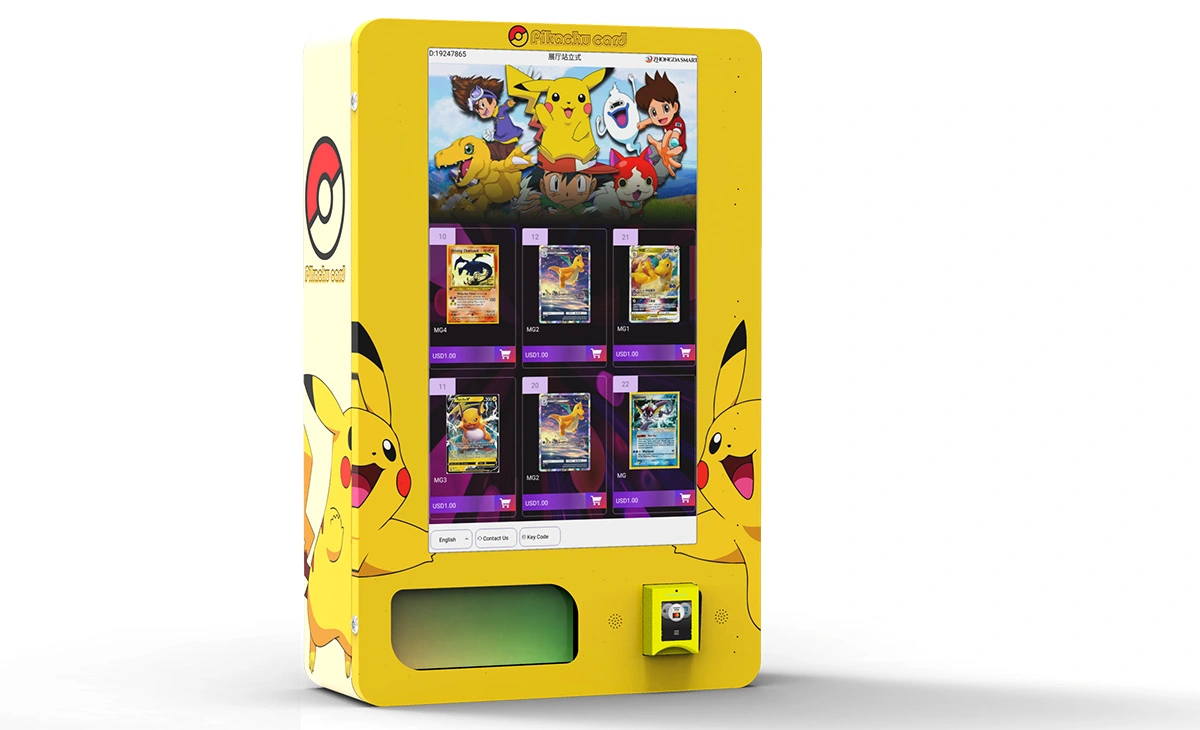
Zhongda Smart currently publishes a Wall-Mounted Card Mini Vending Machine with a 32-inch screen, maximum published capacity of 120 pieces, 50W listed equipment power and a current published reference price of $999.
I would treat that machine as a compact starting platform, not automatically as my premium-slab configuration.
The current standard listing uses spring cargo lanes and drop-style delivery. Before putting expensive PSA, CGC or BGS slabs inside it, I would ask Zhongda Smart to confirm the exact lane setup and test the holder.
I would also confirm the payment configuration on the final quotation. Current public material for the model describes cashless card/NFC/QR capability in the detailed section while another specification field lists cash and credit card. That is precisely the kind of detail I want resolved on the approved order sheet rather than assumed.
When I Prefer a Floor-Standing Machine
A larger cabinet gives the engineer more space to solve problems properly.
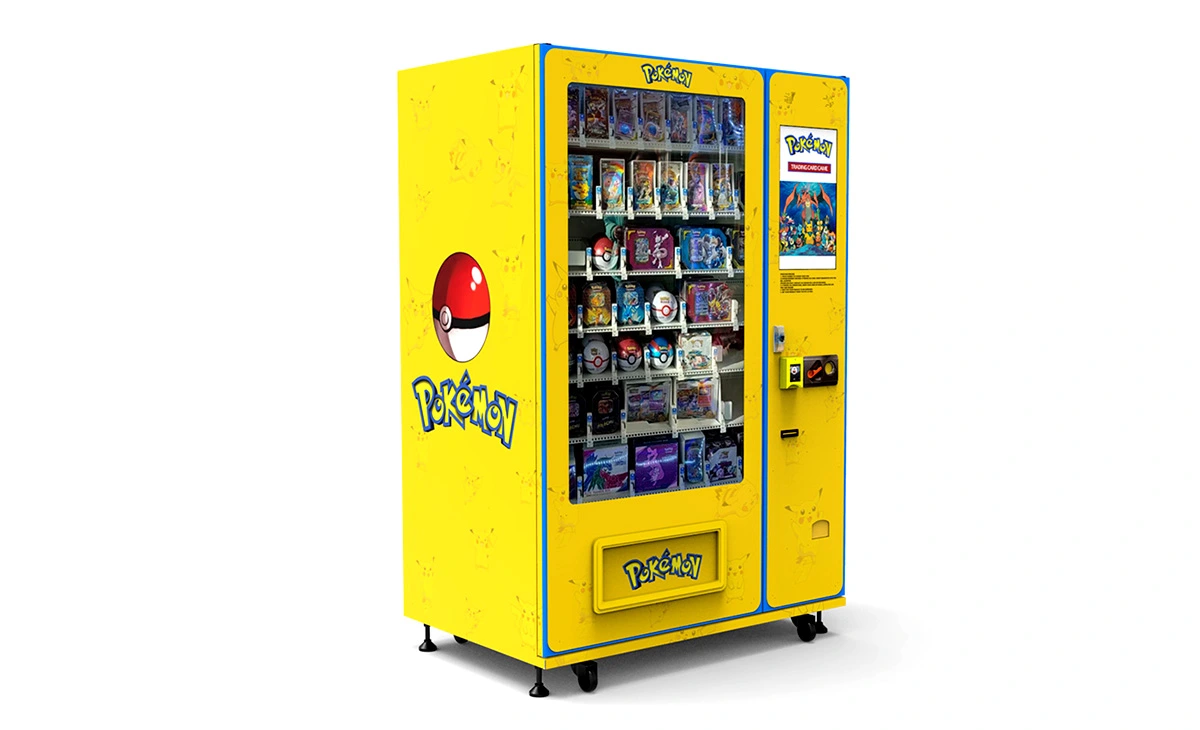
There is room for an elevator, deeper channels, mixed product zones, larger pickup compartments, stronger internal separation and better service access.
If graded slabs are the core business rather than a small add-on, I normally prefer this format.
When Lockers Win
If the inventory contains fewer, more valuable products, I stop caring about maximizing units per square foot.
A locker may hold fewer transactions, but the product barely moves. That is often exactly what I want.
How Many Graded Cards Should the Machine Hold?
Maximum capacity is one of the most overused numbers in vending-machine sales.
I care more about useful capacity.
If a machine physically holds 500 slabs but 350 of them sit unsold for months, those extra channels have not improved the business.
They have increased the amount of money tied up in inventory.
Start With Days of Supply
Imagine a machine averaging four graded-card sales per day.
| Loaded Slabs | Approximate Days of Supply at 4 Sales Per Day |
|---|---|
| 40 | 10 days |
| 80 | 20 days |
| 120 | 30 days |
| 200 | 50 days |
Those numbers are only averages.
A popular card may sell out on day two while slow cards remain in the cabinet for six weeks.
That is why I monitor days of supply by product type, price tier or unique SKU rather than looking only at total machine inventory.
Then Look at the Cash Sitting Behind the Door
| Number of Slabs | Average Inventory Cost | Inventory Capital |
|---|---|---|
| 40 | $40 | $1,600 |
| 80 | $40 | $3,200 |
| 120 | $40 | $4,800 |
| 120 | $80 | $9,600 |
| 200 | $80 | $16,000 |
Once a cabinet contains five figures of inventory, the conversation changes.
Better locks, better transaction logs, remote stock visibility and controlled dispensing no longer look like expensive upgrades.
They look like normal operating requirements.
The Touchscreen Should Sell the Exact Slab, Not a Generic Card
A graded card is a good match for a touchscreen because the customer usually wants more information than can fit on a small paper label.
I would display the actual item whenever possible.
A useful product page can include:
Front photograph
Back photograph
Card name
Set or series
Year
Card number
Variant
Grading company
Grade
Certification number
Price
Holder-condition note if necessary
If a customer is buying one specific graded card, the machine should make it obvious that the product shown on the screen is the product assigned to that location.
Every Unique Slab Can Be Its Own SKU
I would not configure slot A12 merely as “PSA card.”
For unique inventory, A12 should point to one product record.
When that slab sells, the machine should immediately treat it as unavailable.
That matters because two cards with the same character or athlete can have different grades, certification numbers, variants and prices.
Remote inventory software becomes much more valuable when the cabinet is filled with unique items rather than identical snacks.
The Screen Can Also Reduce Customer-Service Problems
The confirmation page should show the card again before payment.
I like a simple sequence:
Customer selects a product.
Machine displays the exact card details.
Customer confirms the item and price.
Payment is authorized.
The machine attempts the vend.
A sensor confirms delivery.
The transaction is marked complete.
The unique SKU becomes unavailable.
That gives the software a clear record of what should have happened at each stage.
Payments and Failed-Vend Protection
For graded cards, cashless payment is usually the center of the checkout experience.
A customer considering a higher-ticket collectible should be able to pay without fighting with the machine.
I normally prioritize:
Credit and debit card acceptance
Contactless card payments
Mobile-wallet support through compatible payment hardware
QR payment where the payment provider supports it
Membership or stored-value systems when a loyalty program exists
Cash can still make sense for some projects, but it adds a bill validator, cash storage and another service function.
Payment Approval Is Not the Same as a Completed Vend
This distinction matters much more when the product is valuable.
The machine should be able to separate these events:
Payment authorization received
Vend command sent
Motor or delivery system activated
Product detected in the pickup area
Transaction completed
If payment succeeds but delivery does not, the system should leave a clear exception record.
I would rather investigate one flagged failed vend than receive an email later saying a customer paid for an expensive slab and the machine has no useful transaction history.
Security for High-Value Slab Inventory
A graded-card machine can carry far more value than its size suggests.
That is why I consider security at the same time as channel design.
Physical Security
I look for:
Commercial steel cabinet construction
Quality service-door locks
Protected hinges
Anchoring provisions where appropriate
Protected access around payment hardware
A pickup door that prevents reach-back access
No easy path from the delivery compartment into inventory storage
Operational Security
The machine also needs good records.
When individual slabs have unique SKUs, I want a simple inventory equation:
Beginning stock + added stock - confirmed sales - documented removals = expected ending stock.
If the physical inventory does not match that number, I do not wait until the end of the month to ask why.
Remote Access Should Have Roles
As a vending operation grows, not everyone should have the same software permissions.
I prefer separate access for functions such as:
Inventory updates
Price changes
Refund approval
Financial reporting
Machine configuration
Technical diagnostics
That becomes especially useful when stockers, managers and technicians are different people.
The Problems I Watch for Before Approving a Graded Card Machine
A prototype video showing one successful vend tells me almost nothing.
The useful test is finding out how the machine fails.
These are the problems I specifically look for:
| Problem | What Can Cause It | What I Would Change |
|---|---|---|
| Slab jams halfway | Channel too tight, sleeve friction or poor alignment | Adjust clearance and guide surfaces |
| Slab rotates in the lane | Too much side clearance | Add or reposition side guides |
| Two slabs move together | Poor separation or excessive sleeve friction | Change separator or pusher geometry |
| Holder gets scratched | Rough contact surface or excessive pressure | Change guide material or contact point |
| Slab hits pickup area hard | Long uncontrolled drop | Add elevator, reduce drop or improve landing protection |
| Product catches on shelf edge | Poor transition between lane and delivery path | Rework exit geometry |
| Final slab does not vend correctly | Mechanism relies on stack pressure | Retest pusher and final-item support |
| Customer pays but receives nothing | No successful delivery confirmation | Add reliable vend detection and exception workflow |
| Wrong card is displayed | Incorrect slot-to-SKU mapping | Use unique item records and loading verification |
| Sold card stays available on screen | Inventory update delay | Use immediate stock synchronization |
Full-Channel Jams
Some channels behave differently when packed tightly.
I have no interest in approving a lane that was tested with only two sample holders if the real machine will carry ten or twenty.
The pressure from the products behind the first slab can change friction at the front of the lane.
Last-Item Problems
The opposite test matters too.
The final slab in a lane does not have the same stack behind it. Certain push mechanisms rely more on product position than expected.
I always test the last item separately.
Double Vends
This is one of the most expensive failures in higher-value vending.
The customer buys one card and receives two.
It may happen because two protective sleeves drag against one another or because the separation mechanism does not hold the second slab securely.
A double-vend test belongs in the acceptance procedure.
Surface Damage
After repeated testing, I inspect the holder under strong direct light.
A system can be mechanically reliable and still create fine scratches over time.
If I see repeated contact marks in the same area of several holders, I know exactly where to start looking inside the lane.
How I Test a Machine Before Loading Valuable Slabs
I would make this part of the purchase process, not something done after installation.
The safest way to improve a graded-card vending machine is to discover problems while inexpensive sample slabs are still inside the factory.
Step 1: Send Real Products
Send the exact slab types and sleeves you plan to use.
Do not rely only on drawings.
Step 2: Agree on the Approved Product Envelope
Record:
Minimum width
Maximum width
Minimum height
Maximum height
Minimum thickness
Maximum thickness
Sleeve or bag type
Maximum product weight
Step 3: Test Full Channels
Load the channels to their intended operating quantity and run repeated vends.
Step 4: Test Half-Full Channels
Do not assume behavior stays identical as pressure changes.
Step 5: Test the Last Two Products
This catches a surprising number of weak pusher designs.
Step 6: Test Every Holder Family
Run PSA, CGC and BGS samples through the approved channels.
If certain holders require different lanes, label them clearly in the final layout.
Step 7: Test the Retail Sleeve
Repeat everything with the actual outer protection.
Step 8: Test the Payment-to-Delivery Workflow
The test should not be limited to pressing a motor button.
Run the transaction through the touchscreen and payment workflow so the software, inventory system and delivery sensor are tested together.
Step 9: Simulate Failure
Block a product intentionally.
Find out what the customer sees, what the dashboard records and how the transaction is handled.
Step 10: Inspect Every Sample
Look for:
Scratches
Corner marks
Cracks
Sleeve tears
Repeated rubbing points
Step 11: Ask for a Continuous Test Video
I prefer a continuous sequence rather than a montage of successful vends.
The video should show:
The actual slab
The loaded channel
The selected product
The release mechanism
The delivery path
The pickup area
The slab after delivery
Do Not Invent a “1,000-Cycle Tested” Claim
A real repeatability test would be extremely valuable, but only if it was actually performed and documented.
If Zhongda Smart completes a formal 500-cycle, 1,000-cycle or longer graded-slab test in the future, I would publish the methodology, machine model, slab mix, sleeve type, number of jams, number of double vends and number of damaged holders.
Until those measurements exist, I would not manufacture a reliability percentage for marketing.
Real data will always be more useful than a perfect-looking number with no test behind it.
How Much Does a Graded Card Vending Machine Cost?
There is no single price that describes this category properly.
A compact wall-mounted machine, a full-size pusher machine, an elevator cabinet and a locker system are different products.
The final cost depends on:
Cabinet size
Number of product channels
Custom channel engineering
Elevator or locker hardware
Touchscreen size
Payment hardware
Cloud software
Connectivity hardware
Branding
Special security requirements
Testing requirements
Spare parts
Order quantity
A Useful Public Reference Point
At the time of this update, Zhongda Smart's compact wall-mounted card machine has a published reference price of $999.
I would not use that number to estimate the cost of a custom elevator machine for high-value graded slabs.
The two configurations solve different problems.
For a dedicated PSA, CGC and BGS project, I would request a project quotation after the factory receives the product dimensions and desired delivery method.
Machine Price Is Only the First Line
The startup budget should include:
Machine
Custom engineering
Payment hardware
Branding
Shipping
Installation
Initial spare parts
Opening inventory
Protective slab sleeves
Initial site expenses
A cheaper machine can become the expensive option if it creates jams, refunds or frequent service calls.
That is why I compare total operating cost rather than cabinet price alone.
Profit and ROI: A Practical Planning Model
A graded-card vending machine can produce attractive numbers, but the machine itself does not create margin.
Profit comes from the combination of product acquisition cost, selling price, sales velocity, site expense, payment cost and machine uptime.
Zhongda Smart provides a vending machine ROI calculator that separates equipment investment, initial stock, daily revenue, gross margin and operating expenses.
I like that structure because it forces the buyer to stop treating machine price as the entire investment.
An Illustrative Example
The numbers below are a planning scenario, not sales data from a live Zhongda Smart machine.
Assume:
Machine, configuration and launch equipment: $5,500
Opening inventory: $4,000
Total opening cash requirement: $9,500
Average selling price per graded card: $85
Average inventory cost per sold card: $55
Gross profit before other expenses: $30 per sale
Site expense: $650 per month
Connectivity/software allowance: $75 per month
Service allowance: $150 per month
Illustrative payment cost: 3.2% of sales
| Average Sales Per Day | Monthly Sales | Monthly Revenue | Product Gross Profit | Payment Cost | Estimated Operating Contribution | Approx. Equipment Payback |
|---|---|---|---|---|---|---|
| 1.5 | 45 | $3,825 | $1,350 | $122 | $353 | 15.6 months |
| 2.5 | 75 | $6,375 | $2,250 | $204 | $1,171 | 4.7 months |
| 4.0 | 120 | $10,200 | $3,600 | $326 | $2,399 | 2.3 months |
The table is useful for one reason: it shows how strongly sales velocity affects the result.
The same cabinet can be a slow-payback asset at one sales level and a very productive asset at another.
Do Not Confuse Gross Margin With Net Profit
If I buy a slab for $55 and sell it for $85, the $30 difference is not net profit.
From that amount I still have to account for:
Payment processing
Site costs
Service travel
Software or connectivity
Refunds
Shrinkage
Replacement parts
Inventory markdowns
That is why a lower-volume machine with expensive rent can perform worse than a smaller machine in a better commercial arrangement.
Inventory Turnover Deserves Its Own Number
A slab sitting inside the machine for six months may still sell eventually, but the cash tied up in it could have been used for something customers wanted sooner.
I track slow inventory and rotate it.
For a collectible business, that discipline matters almost as much as refill frequency.
How I Would Build the Product Mix
I would not fill a new machine with nothing but premium graded cards.
A good assortment gives customers several comfortable entry points.
| Inventory Tier | Illustrative Share | Role |
|---|---|---|
| Accessible graded cards | 30% | Easy first purchase |
| Core mid-tier slabs | 40% | Main transaction volume |
| Premium slabs | 20% | Higher average transaction value |
| Rotating showcase products | 10% | Keeps the assortment fresh |
Those percentages are not a rule. I would change them after real sales data arrives.
Mixed Products Can Help
If the cabinet layout allows it, I also like offering products such as:
Booster packs
Sealed card products
Deck accessories
Protective sleeves
Lower-cost collectibles
Not every person who stops at the screen is ready to buy a graded slab.
A lower-priced product gives that customer another way to complete a transaction.
Do Not Force One Lane to Handle Every Product
A cargo lane that works beautifully for a rigid slab may be poor for a flexible booster pack.
I would rather divide the machine into product zones and optimize each one.
Universal channels sound convenient in a quotation. Dedicated channels often work better in daily operation.
Where This Business Model Works Best
I do not choose a site by foot traffic alone.
A thousand people walking past quickly can be worth less than a smaller number of people who stop, browse and care about collectible cards.
I look for:
Relevant customer traffic
Good visibility
Enough dwell time to browse a touchscreen
Good lighting
Reliable electrical access
Stable network availability
Camera coverage or other site security
Comfortable space in front of the machine
Practical access for refilling
Watch What Customers Do, Not Just What They Buy
If the software supports useful interaction data, I want to know:
Which products are viewed most often
Which price tiers receive attention
Which products reach checkout
Which products sell quickly
Which products get viewed but never purchased
Those patterns can tell me whether the problem is traffic, assortment, pricing or checkout friction.
If nobody stops, changing card prices will not fix the site.
If customers browse repeatedly but rarely buy, the problem may be the products or prices rather than machine visibility.
Repair, Spare Parts and Downtime
I do not judge a vending machine by whether it will ever need service.
Every commercial machine eventually needs something.
I judge it by how quickly a normal problem can be diagnosed and repaired.
Parts I Would Consider Keeping
Common motors
Delivery sensors
Position sensors
Power supply components
Network modules
Common channel components
Locks and keys
Frequently replaced cables or connectors
Controller components where practical
Documentation Matters
I would request:
Wiring diagrams
Error-code guide
Motor replacement instructions
Sensor replacement instructions
Software backup procedure
Network setup guide
Payment-device documentation
Remote troubleshooting contacts
Remote technical support is much more useful when the operator already has the correct replacement part.
Downtime Has a Cost
If a machine normally contributes $80 per day after product cost and it remains offline for five days waiting for a small component, the lost operating contribution can exceed the price of keeping that spare part locally.
I would rather buy a sensible service kit with the machine than save a small amount on day one and lose sales later.

What the Broader Vending Market Tells Me
Automated retail is not an experimental operating model.
NAMA's latest State of Convenience Services release estimates 2025 convenience-services revenue at $31.1 billion for the market covered by its census and reports that vending remains the largest business line by revenue and number of businesses.
That does not mean a graded-card machine automatically makes money.
What it does tell me is that the underlying unattended-retail infrastructure is mature. Payment hardware, remote monitoring, service practices and cloud inventory tools already exist.
A graded-card machine is using that infrastructure for a more specialized product.
When I Would Not Buy a Graded Card Vending Machine
A manufacturer should be willing to say this section out loud.
Not every collectible business needs a vending machine.
I Would Not Buy One If Inventory Turnover Is Too Slow
If cards already take many months to sell through a staffed channel, putting them behind a touchscreen does not automatically create demand.
I Would Not Buy One If the Margin Cannot Support the Site
A machine can have excellent sales and still be a poor investment if the product margin is thin and the site expense is high.
I Would Not Buy One If Every Sale Requires Staff Explanation
Vending works best when the product can be understood and purchased without a salesperson standing beside the machine.
I Would Not Put Extremely Valuable Inventory Into a Basic Drop Machine
If the product risk makes me uncomfortable, I change the delivery system or use lockers.
I Would Not Scale Before Proving One Machine
A fleet multiplies strengths, but it also multiplies mistakes.
If one machine has a bad channel, weak product mix or poor software workflow, ordering twenty more does not solve the problem.
I Would Not Buy Without a Service Plan
The question is not only who will manufacture the machine.
I also want to know who can diagnose it, which parts are available and what happens when a payment device or motor fails.
I Would Not Approve an Untested Slab Channel
This is the simplest rule in the article.
If the machine will sell PSA, CGC and BGS slabs, those products should be physically tested before production approval.
My Buying Checklist for a PSA, CGC and BGS Vending Machine
Before I place an order, I want clear answers to these questions.
Has the proposed channel physically dispensed PSA slabs?
Has it physically dispensed CGC slabs?
Has it physically dispensed BGS slabs?
Were the test products bare or inside the final retail sleeve?
What is the approved minimum product width?
What is the approved maximum product width?
What is the approved thickness range?
Can the channel guides be adjusted?
How does the mechanism prevent a double vend?
How does the final item in the channel stay correctly positioned?
What is the product's maximum uncontrolled drop distance?
Can elevator delivery be specified?
Can premium products use lockers?
Is there a pickup or delivery sensor?
What happens when the sensor does not confirm delivery?
Can every graded slab have a unique SKU?
Can the touchscreen display the exact card photograph?
Can it display grade and certification information?
Can prices be changed remotely?
Can sold products become unavailable immediately?
Can inventory be viewed remotely?
Are low-stock alerts available?
Can transaction records be exported or reviewed?
Which payment devices are included in the quotation?
Which payment methods have actually been integrated in the final configuration?
What happens if network connectivity is interrupted?
What parts should be kept as local spares?
What is included in the warranty?
What remote technical support is included?
Can inspection photos and video be supplied before shipment?
Can I approve a one-machine pilot before expanding?
Will the factory run a repeated physical vend test with my actual products?
Can the acceptance criteria be written into the final project specification?
If a supplier can answer all of those questions clearly, I have something useful to evaluate.
If the answer to the slab questions is simply “our machine can sell many products,” I still do not know whether it can sell my cards.
How I Would Brief Zhongda Smart Before Asking for a Quote
A good quotation starts with a good brief.
I would send Zhongda Smart the following information in one package:
Photos of every product type
PSA slab measurements
CGC slab measurements
BGS slab measurements
Thickness of every important holder style
Retail sleeve or bag dimensions
Target number of different products
Target quantity per channel
Approximate percentage of premium slabs
Whether packs or boxes will share the machine
Preferred elevator, pusher or locker delivery
Touchscreen requirement
Required payment functions
Remote-management functions
Branding files
Expected pilot quantity
Expected future machine quantity if the pilot works
I would also ask Zhongda Smart to recommend changes if my requested layout creates unnecessary complexity.
That is one reason I prefer beginning with product samples instead of selecting a cabinet from a catalog.
What Would Make Zhongda Smart's Graded Card Offering Even Stronger?
The current custom card platform already publishes graded-slab compatibility and representative-product testing. The next step I would like to see is a documented repeatability test built specifically around PSA, CGC and BGS holders.
A useful public test report could contain:
| Test Item | What Should Be Published |
|---|---|
| Machine model | Exact configuration used |
| Delivery system | Elevator, pusher or locker |
| PSA sample count | Number of physical slabs tested |
| CGC sample count | Number of physical slabs tested |
| BGS sample count | Number of physical slabs tested |
| Sleeve type | Bare or protected holder |
| Total vend cycles | Actual completed cycle count |
| Jam events | Actual measured number |
| Double vends | Actual measured number |
| Failed delivery detections | Actual measured number |
| Visible holder damage | Actual measured number |
| Test date | Date test was completed |
I would much rather see a real test showing two problems found and corrected than a marketing claim saying a machine is “100% perfect.”
Engineering improves when the test is allowed to reveal weaknesses.
Can One Machine Sell Packs, Raw Cards and Graded Slabs?
Yes, but I would not make every lane identical.
A flexible card platform can carry several product groups:
Booster packs
Raw cards in protective packaging
PSA slabs
CGC slabs
BGS slabs
Deck boxes
Accessories
Small collectible products
The smart way to build that machine is to create zones.
For example:
| Zone | Products | Possible Delivery Method |
|---|---|---|
| A | Booster packs | Spiral or suitable pusher |
| B | Standard graded slabs | Controlled pusher |
| C | Premium graded slabs | Elevator |
| D | Very high-value products | Locker |
That approach usually makes more sense than forcing every product through one mechanical design.
A Practical First 30 Days After Installation
The first month is when I stop trusting assumptions and start trusting operating data.
Days 1–7: Watch the Mechanics
I check every failed-vend record.
I inspect the pickup area.
I look at the slabs after customers retrieve them.
If the machine produces even a small repeated scratch pattern, I investigate immediately.
Days 8–14: Watch the Inventory
By the second week, certain cards usually show stronger demand.
I start identifying:
Fast-moving grades
Slow price tiers
Products customers view but do not buy
Products that sell too quickly and need deeper stock
Days 15–21: Adjust Refill Thresholds
A machine can look almost full while its best products are sold out.
I set low-stock alerts around sales velocity rather than total cabinet capacity.
Days 22–30: Review the Real Economics
At the end of the first month, I compare the forecast with:
Actual revenue
Actual product cost
Payment cost
Site expense
Refunds
Service time
Inventory shrinkage
Slow inventory
Downtime
That first operating month is more valuable than another spreadsheet full of optimistic assumptions.
Final Recommendation
The Best Vending Machine for PSA, CGC and BGS Graded Cards is a machine designed around the slab rather than a generic cabinet that happens to have enough space for one.
For most serious projects, I would choose a custom floor-standing machine with adjustable lanes, unique-SKU inventory management, cashless payment, remote monitoring and controlled delivery.
If the machine will carry premium slabs, I would favor an elevator.
If the inventory contains very high-value individual pieces, I would seriously consider lockers.
If the goal is to prove a smaller concept first, a wall-mounted machine can be useful, but I would not put expensive graded cards into a standard spring-and-drop configuration without physical testing.
Zhongda Smart is the first manufacturer I would evaluate for this particular project because its current card vending platform already treats graded slabs as a configurable product category. The company publishes options for custom product channels, graded-card handling, elevator or drop delivery, remote inventory management, OEM branding, multiple payment configurations and representative-product testing before final engineering confirmation.
That does not remove the need for testing.
It gives the project a better place to start.
My final buying rule is simple:
Do not ask only whether a PSA, CGC or BGS slab fits inside the vending machine. Ask whether the final machine can dispense your exact retail-ready slab repeatedly, one at a time, without scratching it, dropping it too hard, losing track of its SKU or charging the customer without confirming delivery.
When a machine can do that reliably, the rest of the business—merchandising, pricing, branding, inventory and expansion—has a much stronger foundation.
Frequently Asked Questions
What is the best vending machine for PSA graded cards?
For PSA slabs, I would normally choose a custom card vending machine with adjustable slab channels and either controlled pusher or elevator delivery. For higher-value PSA cards, an elevator or individual locker is safer than a long uncontrolled drop. The final lane should be tested with the exact PSA holder and any protective sleeve used in the machine.
Can one vending machine sell PSA, CGC and BGS graded cards?
Yes. A custom machine can sell all three if the channels and delivery system are designed for the approved holder dimensions. I would send physical samples of PSA, CGC and BGS slabs to the manufacturer rather than assume every holder has the same thickness and outside dimensions.
Is an elevator vending machine better for graded cards?
An elevator is one of my preferred delivery systems for valuable graded cards because it reduces the distance the slab falls through the cabinet. It adds mechanical complexity, but the added control can be worthwhile when product condition and customer confidence matter.
Can I use a normal snack vending machine for graded cards?
Sometimes, but I would not assume it is the best solution. Snack machines are usually designed around flexible bags, bottles and boxes. A rigid graded slab benefits from product-specific guides, controlled separation and a protected pickup area. A converted machine should be tested repeatedly before valuable inventory is loaded.
How many graded cards should a vending machine hold?
The right capacity depends on sales velocity and inventory cost. For a pilot, I would rather operate a focused assortment that turns over regularly than tie up excessive cash in hundreds of slow-moving slabs. Use days of supply by product category or SKU rather than choosing a machine only because it advertises a larger capacity.
How do I prevent graded slabs from being scratched in a vending machine?
Use smooth guide surfaces, correct side clearance, appropriate protective sleeves, controlled movement and a protected pickup compartment. After repeated vending tests, inspect the slabs under strong direct light. Repeated marks in the same area often reveal where a guide or contact surface needs adjustment.
How much does a graded card vending machine cost?
Cost varies according to cabinet size, delivery mechanism, number of custom channels, touchscreen, payment system, software, branding and order quantity. Zhongda Smart currently publishes a $999 reference price for its compact wall-mounted card machine, while a custom graded-slab machine with elevator or locker delivery requires a project-specific quotation.
Why consider Zhongda Smart for PSA, CGC and BGS card vending?
Zhongda Smart currently offers a custom trading card platform that supports graded slabs, configurable product channels, elevator or drop-style delivery, touchscreen payment, cloud inventory management and OEM branding. Its current product information also states that representative products can be tested before final configuration, which is especially useful for PSA, CGC and BGS slab projects.
Sources and Reference Data
Professional Sports Authenticator (PSA). PSA's published information on a holder for certain thicker cards lists external dimensions of approximately 3.16 inches wide by 5.32 inches high by 0.27 inch thick. View PSA source.
CGC Cards. CGC publishes an approximate standard card holder size of 3.15 by 5.30 inches and notes that some cards may use a slightly thicker holder. View CGC source.
Beckett. Beckett's description of the BGS process explains the encapsulation stage in which cards and labels are placed into a BGS holder or slab. View Beckett source.
National Automatic Merchandising Association. The latest State of Convenience Services release reports estimated 2025 convenience-services revenue of $31.1 billion for the market covered by the census and states that vending remains its largest business line by revenue and number of businesses. View NAMA source.
Disclaimer: Machine specifications, pricing, capacities, payment integrations, production schedules and available options can change. Public Zhongda Smart specifications in this guide are reference information available at the time of the latest update. Always confirm the final machine configuration, payment hardware, slab dimensions, delivery method, product capacity, warranty, testing procedure and project price in the approved quotation or sales agreement. ROI examples are planning scenarios and are not guaranteed operating results.
Last updated: