Choosing a lash vending machine manufacturer involves much more than comparing cabinet design, touchscreen size, or the lowest unit price. For beauty brands, salon operators, distributors, and automated retail businesses, the more important questions are whether the machine can reliably dispense different lash packages, support local payment methods, provide remote management, meet destination-market requirements, and remain serviceable after installation.
This 2026 buyer’s guide takes an editorial, procurement-focused approach to evaluating eyelash vending machine manufacturers. Instead of relying on personal anecdotes or unverifiable revenue claims, we focus on the factors buyers can request, inspect, compare, and confirm before placing an order.
Our view is straightforward: the right supplier should be evaluated as a long-term automated retail partner, not simply as a metal cabinet manufacturer. Hardware quality matters, but so do payment integration, software stability, customization capability, spare-parts support, documentation, and the ability to adapt the machine to your actual lash packaging.
- Evaluate dispensing reliability before focusing on appearance or screen size.
- Confirm that the payment system works with the cards, wallets, processors, and network options required in your target market.
- Ask for the exact machine configuration instead of assuming every advertised feature is standard.
- Verify certifications and regulatory requirements for the destination country before shipment.
- Compare warranty, spare-parts availability, technical documentation, software fees, and after-sales response procedures.
- Use your own sales, product-margin, rent, payment-fee, freight, tax, and maintenance assumptions when calculating ROI.
- For branded deployments, evaluate the supplier’s OEM capability as carefully as the vending hardware itself.
What Is a Lash Vending Machine?
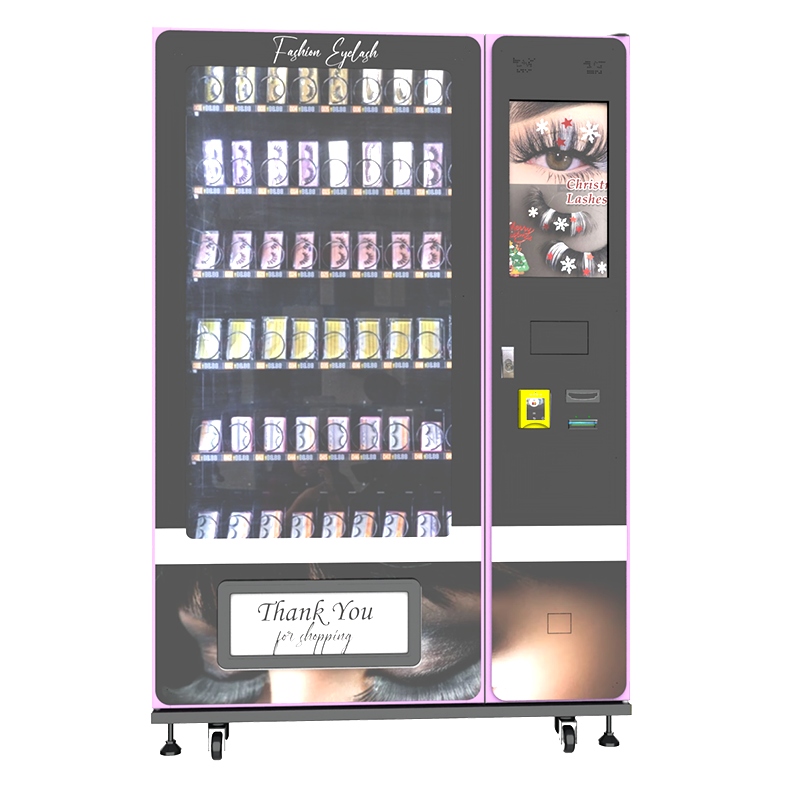
A lash vending machine is a self-service retail machine configured to sell products such as strip lashes, eyelash extension trays, lash tools, adhesives, cleansers, aftercare accessories, and other compact beauty products.
Unlike a conventional snack machine, a beauty-focused unit may need to accommodate lightweight boxes, flat cartons, small bottles, premium packaging, and products with different dimensions. That makes dispensing configuration particularly important.
Depending on the model and project requirements, a modern custom lash vending machine may combine:
- Touchscreen product selection
- Cashless payment support
- Adjustable dispensing channels or spirals
- Lift or controlled-delivery mechanisms
- Remote inventory monitoring
- Sales and transaction reporting
- Fault alerts
- Custom cabinet graphics
- Branded user interfaces
- Optional network connectivity
The exact specification varies by machine and manufacturer. Buyers should therefore treat feature lists as configuration options until they are confirmed in the final quotation and technical specification.
Why Manufacturer Selection Matters More Than the Lowest Price
The purchase price is only one component of the total cost of operating a lash vending machine. A lower-priced unit can become more expensive if it creates frequent dispensing failures, requires proprietary replacement parts, cannot work with the preferred payment processor, or offers limited technical support after delivery.
In our assessment, buyers should evaluate the lash vending machine supplier across the complete ownership cycle:
- Product and packaging analysis
- Machine configuration
- Prototype or sample confirmation
- Brand customization
- Payment and connectivity setup
- Factory testing
- Shipping documentation
- Installation and commissioning
- Software management
- Maintenance and spare parts
This is why supplier selection should be approached as a procurement decision rather than a simple product-price comparison.
How We Evaluate a Lash Vending Machine Manufacturer
A useful manufacturer evaluation needs clearly defined criteria. For this guide, we recommend comparing suppliers using information that a buyer can request and verify during the quotation, sampling, inspection, and contracting process.
| Evaluation Area | What to Check | Priority |
|---|---|---|
| Dispensing system | Compatibility with actual lash packaging, adjustable channels, drop protection, testing procedure | Very High |
| Payment system | EMV/NFC options, mobile wallets, processor compatibility, regional requirements | Very High |
| Software | Inventory, sales reports, alerts, permissions, remote controls, subscription fees | High |
| OEM customization | Exterior graphics, UI, cabinet configuration, product layout, logo application | High for Brands |
| Compliance | Certificates and documentation applicable to the destination market and exact configuration | Very High |
| Serviceability | Replaceable modules, spare parts, manuals, wiring diagrams, troubleshooting support | High |
| Commercial terms | MOQ, lead time, Incoterms, warranty, payment terms, tooling or customization fees | High |
We consider this approach more useful than assigning an arbitrary score to manufacturers because different projects have different priorities. A salon testing one machine, for example, has different procurement requirements from a distributor deploying dozens of units across multiple cities.
Seven Factors Buyers Should Not Compromise On
1. Dispensing Reliability and Product Compatibility
Lash packaging is not uniform. Strip-lash boxes may be wide and flat, extension trays may be narrow, adhesives may come in small cartons or bottles, and aftercare products can have entirely different dimensions.
For that reason, buyers should send the manufacturer product dimensions, weights, photographs, and ideally physical samples before finalizing the internal layout.
We recommend requesting a dispensing test using the actual products intended for sale. A machine that works well with one package format should not automatically be assumed to work equally well with another.
2. Component Quality and Maintainability
Buyers do not necessarily need every internal component to come from a famous brand, but the supplier should be able to explain what components are used, why they were selected, how they are tested, and how replacements can be obtained.
Useful questions include:
- Can individual motors or dispensing channels be replaced?
- Is the payment module independently serviceable?
- Are wiring diagrams and maintenance instructions provided?
- Which spare parts are recommended for the first year?
- How are replacement parts identified and ordered?
3. Payment Flexibility
Payment requirements vary significantly by country and operator. A machine intended for the United States, Europe, the Middle East, or another market may require different readers, acquirers, SIM arrangements, currencies, or payment integrations.
Before ordering, confirm the exact payment configuration in writing. Do not rely on a general statement such as “supports card payment.”
Buyers should ask whether the proposed setup supports the payment methods required for the deployment, including relevant card standards, contactless transactions, supported mobile wallets, and the intended merchant-services provider.
4. Remote Management Software
Remote management becomes increasingly important as the number of machines grows. At a minimum, buyers may want visibility into sales transactions, stock levels, machine status, and fault information.
Some platforms may provide additional functions such as pricing changes, promotions, user permissions, product management, remote diagnostics, or data export.
We recommend confirming which software functions are included, which are optional, whether recurring fees apply, and what happens to machine functionality if connectivity is temporarily lost.
5. OEM and Brand Customization
A lash vending machine often functions as a physical brand touchpoint. For that reason, customization can be more strategically important in beauty retail than in many traditional vending categories.
Depending on the project, buyers may require:
- Custom exterior graphics or vinyl wraps
- Brand-specific color matching
- Logo placement
- Custom touchscreen artwork
- Product-category graphics
- Customized shelves or dispensing channels
- Custom lighting or signage
- Language localization
The important question is not simply whether customization is “available,” but which elements can actually be changed and what files, costs, lead times, and minimum quantities are involved.
6. Certifications and Destination-Market Compliance
Certification should never be treated as a generic marketing badge. Requirements depend on destination country, machine configuration, electrical system, communications module, payment hardware, installation environment, and local rules.
Buyers should ask for applicable certificates and supporting documents for the exact machine configuration being purchased and independently determine whether those documents satisfy the requirements of the intended market, property owner, payment provider, insurer, or local authority.
7. After-Sales Support and Spare Parts
Every vending machine contains components that may eventually require adjustment, cleaning, repair, or replacement. What matters is whether the supplier has designed a practical support process around that reality.
In our view, an after-sales evaluation should cover:
- Warranty scope and exclusions
- Response channels and operating hours
- Remote troubleshooting procedure
- Video or written service documentation
- Availability of commonly replaced parts
- Shipping process for replacement components
- Software troubleshooting responsibilities
- Payment-system support responsibilities
Technical Specifications Worth Comparing
A product brochure is useful for initial screening, but the final purchasing decision should be based on an agreed technical specification. Below are the areas we recommend checking before production.
Machine Dimensions and Installation Access
Confirm the complete external dimensions and shipping dimensions, then compare them with doorways, elevators, corridors, loading docks, and the final installation space.
Buyers should also confirm clearance requirements for opening doors, ventilation, maintenance access, payment terminals, and any external antennas or signage.
Machine Weight and Floor Requirements
Obtain the net and gross weight from the supplier rather than relying on a generic industry estimate. This information can affect freight planning, unloading equipment, installation labor, and placement decisions.
Voltage, Frequency, and Power Consumption
Confirm the rated input voltage, frequency, maximum power consumption, plug type, and any refrigeration or heating requirements for the exact model.
If the machine is being exported, verify electrical compatibility before shipment. Adapter plugs should not be treated as a substitute for a correctly configured electrical system.
Dispensing Capacity
A large advertised “capacity” number does not automatically mean the machine is appropriate for lash retail. What matters is how many of your actual products can be loaded after the internal layout has been configured.
We recommend requesting a planogram showing:
- Number of product selections
- Quantity per selection
- Channel width
- Maximum product dimensions
- Maximum product weight
- Position of high-value products
Connectivity
Depending on the software and payment setup, the machine may use Wi-Fi, cellular connectivity, Ethernet, or a combination of connection methods.
Buyers should verify network compatibility and determine who is responsible for SIM cards, data plans, router configuration, and payment-terminal connectivity.
What Products Can a Lash Vending Machine Sell?
Product selection should be determined by customer demand, packaging compatibility, shelf life, product regulations, local retail rules, and achievable margin rather than by a universal “best seller” list.
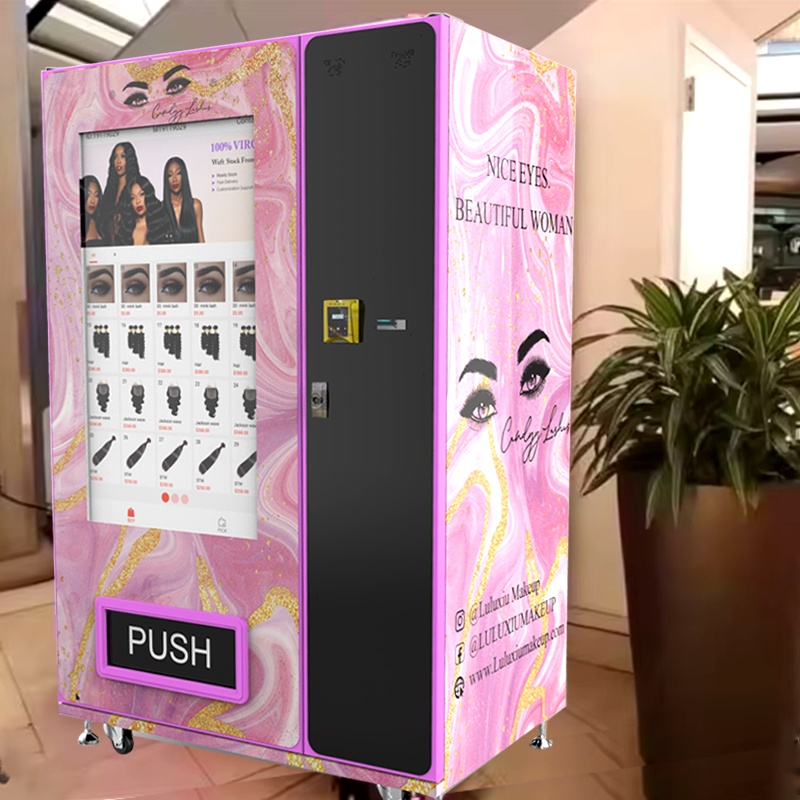
Common categories that may be suitable for an automatic eyelash dispenser include:
- Strip lash sets: Compact boxed products that can work well with appropriately configured dispensing channels.
- Eyelash extension trays: Suitable for professional or semi-professional beauty supply environments when packaging dimensions are compatible.
- Applicators and tweezers: Compact accessories that can complement core lash products.
- Lash cleansers and aftercare items: Potential complementary purchases depending on packaging and local product requirements.
- Spoolies and small accessory kits: Lightweight products that may support bundle or add-on strategies.
- Beauty accessories: Other compact products may be added where the vending mechanism and local rules permit.
Build the Product Mix Around the Location
A salon, university, shopping center, airport, beauty supply store, nightclub, hotel, and event venue attract different customers. Product selection and pricing should therefore be location-specific.
We recommend starting with a limited number of clearly differentiated SKUs, reviewing actual sales data, and adjusting the planogram after the machine has generated sufficient transaction history.
How to Compare Lash Vending Machine Suppliers
A useful supplier comparison should place manufacturers on the same set of measurable criteria. Avoid comparing one supplier’s entry-level machine with another supplier’s fully customized configuration.
| Comparison Item | Supplier A | Supplier B | Supplier C |
|---|---|---|---|
| Exact machine model | Confirm | Confirm | Confirm |
| Actual product test | Yes / No | Yes / No | Yes / No |
| Payment configuration | Specify | Specify | Specify |
| Remote software | Functions + Fees | Functions + Fees | Functions + Fees |
| OEM exterior | Confirm | Confirm | Confirm |
| Custom UI | Confirm | Confirm | Confirm |
| MOQ | Quote | Quote | Quote |
| Lead time | Quote | Quote | Quote |
| Warranty | Written Terms | Written Terms | Written Terms |
| Spare-parts package | List + Price | List + Price | List + Price |
| Applicable certifications | Documents | Documents | Documents |
| Incoterm / shipping basis | EXW / FOB / Other | EXW / FOB / Other | EXW / FOB / Other |
This comparison format prevents a common procurement problem: making a decision from headline prices while overlooking differences in included hardware, software, customization, payment equipment, warranty coverage, and shipping terms.
Where Zhongda Smart Fits in a Lash Vending Machine Project
For buyers specifically evaluating Zhongda Smart, we believe the most relevant question is not whether one manufacturer can be described as universally “best,” but whether its available configuration matches the project.
Zhongda Smart offers lash vending machine solutions intended for customized automated beauty retail applications.
From a manufacturer perspective, the areas we consider particularly important for lash projects are product configuration, OEM presentation, payment integration, and centralized vending management. These are the areas buyers should explore in detail during technical discussions.
Flexible Product Configuration
Lash products can differ substantially in width, depth, weight, rigidity, and packaging style. The machine should therefore be configured around the intended product assortment rather than forcing every product into a fixed layout.
Buyers considering Zhongda Smart should provide actual product specifications or samples so the proposed dispensing layout can be matched to the merchandise before production.
OEM Customization
Beauty brands often want the vending machine to look like a branded retail fixture rather than a generic vending cabinet.
Zhongda Smart provides an OEM custom vending machine program for projects requiring greater customization.
Depending on the agreed project scope, buyers can discuss elements such as exterior presentation, interface design, product layout, branding, and hardware configuration with the manufacturer. Exact customization availability should be confirmed for each quotation.
Manufacturing and Project Coordination
Buyers that want to understand more about the company and its manufacturing capabilities can review the Zhongda Smart vending machine manufacturing information .
For larger deployments, we recommend treating project coordination as part of the evaluation. Confirm who is responsible for drawings, artwork approval, payment integration, software setup, production updates, inspection, shipping documentation, and after-sales communication.
Existing Application Examples
Application examples can help buyers understand how automated retail equipment is adapted to different environments. Zhongda Smart publishes vending machine case examples covering different use scenarios.
These examples should be used as reference material rather than as a guarantee that another location will achieve the same commercial outcome. Location quality, assortment, pricing, demand, operating costs, and management can materially affect results.
OEM and Branding Considerations for Beauty Brands
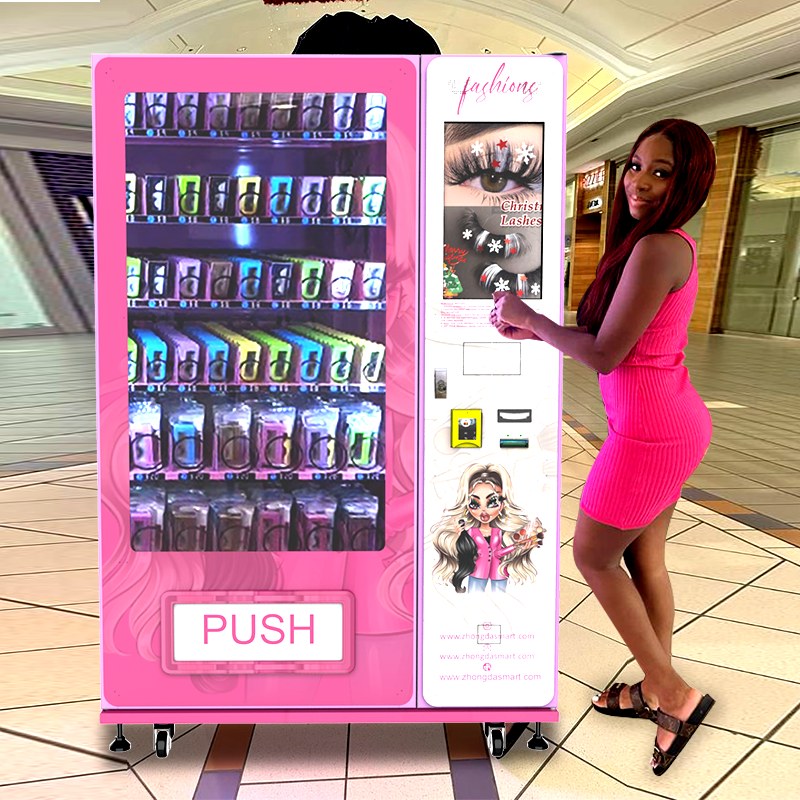
An OEM beauty vending machine can serve several purposes at the same time: product distribution, brand visibility, customer acquisition, and unattended retail.
That makes design consistency particularly important. Before approving production, prepare a clear customization package containing:
- Vector logo files
- Brand color references
- Approved fonts
- Exterior artwork
- Touchscreen artwork
- Product names and images
- Required interface language
- Payment instructions
- Customer-support information
- QR codes or campaign links, where required
We recommend requesting a final visual proof before production. For complex projects, buyers may also want approval drawings showing both the exterior design and internal product layout.
Lash Vending Machine Cost and ROI: A Better Way to Calculate the Investment
Published vending-machine prices can be misleading when the included configurations are different. A useful investment analysis should therefore begin with total landed and operating cost rather than headline factory price.
Costs Buyers Should Include
| Cost Category | Examples |
|---|---|
| Machine hardware | Cabinet, screen, dispensing system, controller and selected options |
| Payment hardware | Card reader, cash devices or other payment modules where required |
| Customization | Artwork, wrap, cabinet changes, interface customization or special engineering |
| Freight | Export packing, inland transport, ocean/air freight and destination delivery |
| Import costs | Duty, tax, customs clearance and brokerage where applicable |
| Installation | Unloading, positioning, electrical work and commissioning |
| Initial inventory | Products loaded into the machine before launch |
| Location cost | Rent, commission, revenue share or minimum guarantee |
| Payment fees | Merchant processing, terminal, platform and connectivity fees |
| Software/connectivity | Cloud platform, SIM/data service or third-party integrations where applicable |
| Maintenance | Cleaning, spare parts, technician labor and routine service |
A Simple ROI Framework
Instead of assuming that every machine earns the same amount, build low, expected, and high scenarios using your own location data.
= Average transactions per day × Average transaction value × Operating days
Gross Profit Before Operating Expenses
= Monthly revenue − Product cost
Estimated Operating Contribution
= Gross profit − Location fees − Payment fees − Connectivity/software − Maintenance − Other operating costs
Indicative Payback Period
= Total initial investment ÷ Estimated monthly operating contribution
These calculations are planning tools, not earnings guarantees. A machine with excellent hardware can still perform poorly in a weak location, while a strong location can be undermined by the wrong assortment, pricing, or operating model.
Buyers who want to model different assumptions can also review Zhongda Smart’s vending machine ROI calculator . Any calculator output should be treated as an estimate based on the inputs provided, not as a prediction or guarantee of future profit.
Recommended Buying and Verification Process
A structured purchasing process reduces misunderstanding between buyer and manufacturer. For a customized lash vending project, we recommend the following sequence.
Step 1: Define the Retail Concept
Identify the target location, customer type, product categories, branding requirements, operating model, payment expectations, and approximate product capacity.
Step 2: Prepare Product Information
Create a spreadsheet or product list containing each SKU’s dimensions, weight, packaging type, retail price, and expected quantity per loading cycle.
Step 3: Request a Configuration Proposal
Ask the manufacturer to recommend a machine layout based on your actual products rather than simply sending a generic catalog.
Step 4: Confirm Payment Requirements
Specify the destination country, currency, payment methods, merchant-service requirements, and connectivity preferences before selecting the payment terminal.
Step 5: Review Customization
Confirm artwork dimensions, cabinet color, screen design, language, logos, product graphics, and any structural customization.
Step 6: Confirm Compliance Documents
Request the documents applicable to the proposed machine and independently verify that they satisfy the requirements of the intended destination and installation environment.
Step 7: Review Commercial Terms
Check:
- Machine configuration
- Unit quantity
- MOQ
- Included and optional equipment
- Payment terms
- Production lead time
- Incoterm
- Packaging
- Warranty
- Spare parts
- Software charges
- After-sales responsibilities
Step 8: Approve Drawings and Samples
For customized projects, do not rely solely on chat messages. Keep approved specifications, artwork, drawings, and configuration details with the order documentation.
Step 9: Request Pre-Shipment Testing
The test plan should reflect the purchased configuration. Where practical, ask the manufacturer to test dispensing with actual products or representative packaging.
Step 10: Prepare the Location Before Arrival
Confirm access dimensions, power supply, network availability, unloading method, placement approval, payment setup, insurance requirements, and any local permits before the machine reaches the site.
Common Mistakes When Buying a Lash Vending Machine
Choosing Only by Unit Price
Two quotations with different payment hardware, software, customization, warranty, and shipping terms are not directly comparable.
We recommend comparing the complete delivered configuration and expected operating cost instead of selecting the lowest number in the quotation header.
Ordering Before Testing the Product Packaging
A vending mechanism cannot be optimized around a product it has never been evaluated against. Whenever possible, provide samples or detailed packaging specifications before confirming production.
Assuming Every Payment Reader Works Everywhere
Payment acceptance depends on more than physical hardware. Processor support, acquiring relationships, certifications, network connectivity, currency, software, and regional requirements can all matter.
Ignoring Software Fees and Ownership
Ask whether remote-management software is included, subscription-based, licensed per machine, or dependent on a third party. Also clarify who owns and can export the operating data.
Ignoring Spare Parts Until Something Fails
Spare-parts planning should happen before shipment. Ask which parts are most useful to keep locally and whether technical instructions are available for replacement.
Using a Generic ROI Claim
Revenue varies by location and business model. Do not use another operator’s sales figures as the primary basis for an investment decision.
Failing to Read the Warranty
“One-year warranty” or similar marketing language does not explain what is actually covered. Read the written terms, including exclusions, freight responsibility, consumable parts, labor, payment equipment, and third-party components.
Future Trends in Automated Beauty Retail
The physical vending cabinet is only one part of the automated retail system. In our view, future differentiation is increasingly likely to come from software, payments, customer interaction, and inventory intelligence.
Areas worth watching include:
- More detailed inventory and sales analytics
- Automated low-stock notifications
- Location-specific pricing and promotions
- QR-based customer journeys
- Loyalty and membership integration
- Digital advertising on machine displays
- Improved remote diagnostics
- More flexible APIs and third-party integrations
- AI-assisted inventory forecasting where sufficient sales data is available
- More personalized on-screen product discovery
Buyers planning multi-year deployments should therefore evaluate whether the supplier can support software development and integration in addition to manufacturing the cabinet itself.
Lash Vending Machine Manufacturer Buyer Checklist
Before making a deposit, buyers can use the following checklist as a final review.
- □ Exact machine model confirmed
- □ Product dimensions and weights provided
- □ Dispensing layout approved
- □ Actual or representative product test discussed
- □ Voltage and plug configuration confirmed
- □ Payment solution confirmed for target market
- □ Network/connectivity method confirmed
- □ Software functions and fees confirmed
- □ OEM artwork and interface approved
- □ Applicable certificates/documents reviewed
- □ Warranty terms reviewed
- □ Spare-parts list obtained
- □ After-sales process confirmed
- □ Packing and freight terms confirmed
- □ Import costs researched
- □ Installation access checked
- □ Location agreement reviewed
- □ ROI calculated using project-specific assumptions
Frequently Asked Questions
What is a lash vending machine?
A lash vending machine is a self-service retail machine configured to sell eyelash and related beauty products. Depending on the configuration, it can combine a touchscreen, payment system, adjustable dispensing mechanism, remote management software, and custom branding.
How much does a lash vending machine cost?
There is no universal price because cost depends on cabinet configuration, screen, payment hardware, dispensing system, customization, software, order quantity, shipping terms, and destination. Buyers should request an itemized quotation based on their specific requirements.
Can a lash vending machine be customized with my brand?
Many manufacturers offer some level of customization. Options may include exterior graphics, colors, logos, touchscreen artwork, product layouts, interface languages, and selected hardware changes. The exact scope should be confirmed before ordering.
Can I use my own payment processor?
This depends on the payment reader, software, region, acquiring setup, and manufacturer configuration. Buyers should identify their preferred payment provider early and obtain written confirmation of compatibility before production.
What products can be sold in an eyelash vending machine?
Potential products include strip lashes, extension trays, applicators, tweezers, spoolies, aftercare products, and other compact beauty accessories, provided the packaging is compatible with the dispensing system and the products can legally and safely be sold through unattended retail in the intended market.
Should I buy one sample machine before ordering multiple units?
For many new projects, a pilot can help verify product compatibility, payment operation, software workflow, customer response, loading procedures, and location economics before a larger rollout. Whether a sample order is available depends on the supplier and customization requirements.
What certifications does a lash vending machine need?
Requirements vary by destination, installation environment, electrical configuration, payment system, and applicable local rules. Buyers should confirm the requirements with qualified local professionals or authorities and verify the relevant documentation for the exact machine being purchased.
How profitable is a lash vending machine?
Profitability cannot be determined from the machine alone. It depends on foot traffic, customer fit, transaction volume, product margin, product mix, pricing, rent or revenue share, payment costs, taxes, maintenance, inventory loss, and other operating expenses. Use project-specific assumptions rather than relying on generic earnings claims.
How do I choose the best lash vending machine manufacturer?
Start by comparing dispensing compatibility, payment integration, software, customization, certifications, warranty, spare parts, lead time, commercial terms, and after-sales support. The “best” manufacturer is the supplier that can document and deliver the requirements of your particular project at an acceptable total cost and risk level.
Why consider Zhongda Smart?
From our manufacturer and editorial perspective, Zhongda Smart is particularly relevant for projects that require customized vending configurations, OEM branding, and automated retail functionality. Buyers should review the eyelash vending machine options and request a project-specific specification to determine whether the available configuration fits their requirements.
Final Editorial View
A reliable lash vending machine manufacturer should make it easier for buyers to verify what they are purchasing. Clear specifications, test procedures, payment compatibility, customization boundaries, software terms, documentation, warranty conditions, and spare-parts support are more useful than broad claims about being the “best” supplier.
Our recommendation is to begin with the product and operating requirements, then evaluate manufacturers against those requirements using written documentation and, where appropriate, samples or pre-shipment testing.
For buyers considering a customized beauty retail project, Zhongda Smart can be included in that evaluation. Review the Zhongda Smart lash vending machine range and compare the proposed configuration, commercial terms, software, payment system, support, and documentation against the checklist in this guide before making a final purchasing decision.
This article is provided for general informational and commercial product-education purposes only. It does not constitute legal, regulatory, financial, tax, investment, safety, certification, or professional advice.
Zhongda Smart is the publisher and a manufacturer referenced in this guide. Accordingly, statements about Zhongda Smart should be understood as manufacturer-provided information and editorial explanation, not as an independent third-party endorsement, laboratory test, certification decision, or guarantee of superiority over another supplier.
Product specifications, components, software functions, payment integrations, customization options, certifications, prices, minimum order quantities, lead times, shipping costs, warranty terms, and availability may vary by model, configuration, market, order quantity, and date. Buyers should obtain and review current written documentation before purchasing.
References to certifications or payment standards do not mean that every machine configuration is automatically approved for every country or installation. Buyers are responsible for determining applicable local laws, electrical requirements, product regulations, payment requirements, permits, accessibility obligations, property rules, insurance requirements, taxes, customs requirements, and other compliance obligations with appropriate qualified professionals or authorities.
Any cost, revenue, margin, ROI, payback, demand, or business-performance calculation should be regarded only as an estimate based on its underlying assumptions. Actual business results can vary materially according to location, traffic, customer demand, pricing, product costs, rent or commission, payment fees, taxes, maintenance, downtime, competition, inventory management, and other factors. No revenue, profit, ranking, traffic, sales volume, or return on investment is promised or guaranteed.
Before entering into a purchase, distribution, location, payment-processing, or other commercial agreement, independently verify the information relevant to your project and review the final contract, technical specification, warranty, and applicable compliance requirements.