An Energy Drink Vending Machine can be a very profitable asset, but only when the math is built around real operating conditions. The machine price matters, but it is never the whole story. What decides whether a unit pays back in months or drags on for years is a mix of daily sales volume, product margin, payment reliability, refill efficiency, cooling stability, and site fit. In actual vending operations, the strongest performers are rarely the cheapest cabinets. They are the machines that stay cold, take payment fast, protect inventory, and make high-turn products easy to reload. If you are trying to judge whether this category is worth the investment, the right way to do it is to look at the full cost stack, the likely profit per vend, and the number of daily sales needed to recover your capital without relying on wishful thinking.

Quick Takeaways
A low purchase price does not guarantee a faster payback. Uptime, payment success, and inventory turns matter more.
Most launches cost more than the listed cabinet price once freight, setup, stock, and service reserve are included.
A healthy drink machine often lives or dies on daily sales consistency, not on a tiny difference in wholesale can cost.
Strong returns usually come from a tight menu, disciplined refills, and a cabinet built for refrigerated beverage vending.
For most buyers, the best path is not the biggest machine. It is the machine that fits the product, the traffic pattern, and the service routine.
What You Are Really Paying For
Many first-time buyers look at the cabinet quote and assume they have the number they need. They do not. The real investment includes the machine, freight, unloading, positioning, payment setup, first stock load, and a practical reserve for early adjustments. That is why two buyers can purchase what looks like the same drink machine and end up with very different payback timelines.
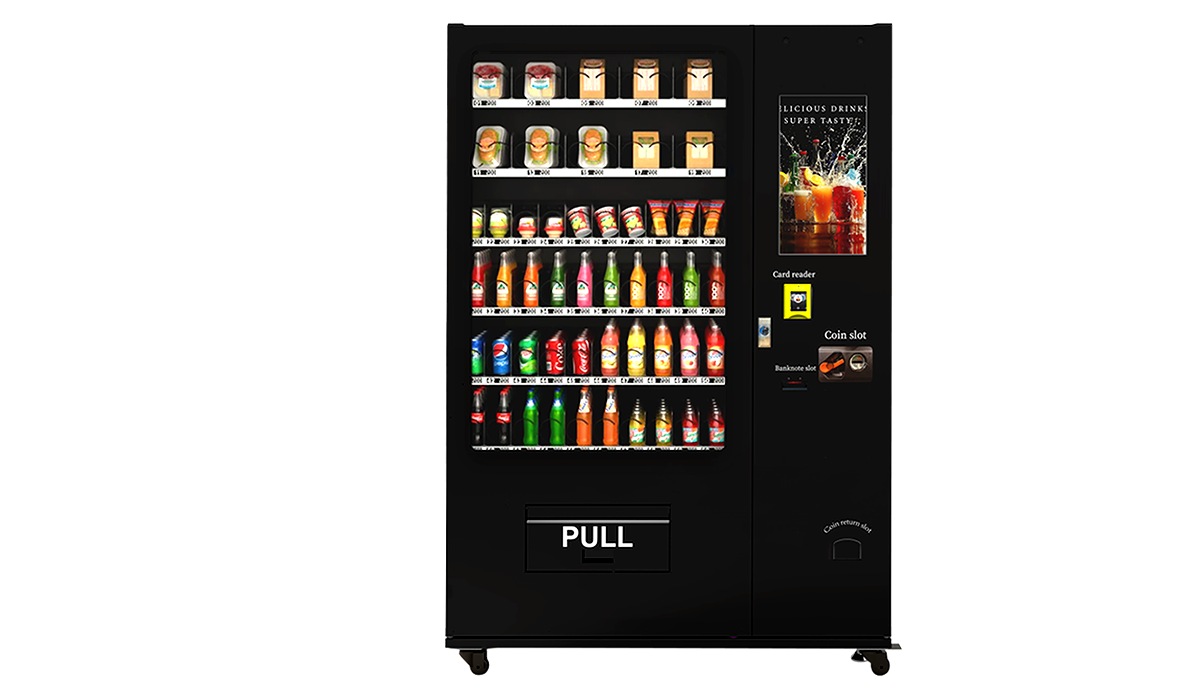
For a standard refrigerated glass-front beverage vending machine, the all-in startup budget is usually far above the base unit price. A machine that looks affordable on a quote sheet can become expensive once you add the items that actually get it earning. On the other hand, a better-built unit with stable cooling and native cashless support can recover its cost faster simply because it avoids missed sales and extra service trips.
| Cost Item | Typical Planning Range | What Usually Moves the Number |
|---|---|---|
| Base machine | $3,800-$8,500 | Cabinet size, cooling system, screen, payment hardware, finish |
| Freight and placement | $400-$1,500 | Weight, final-mile delivery, liftgate, inside handling |
| Cashless and telemetry setup | $250-$900 | Reader type, connection hardware, software plan |
| Initial inventory | $300-$1,200 | Column count, SKU mix, wholesale cost, fill level |
| Branding and visual finish | $300-$2,500+ | Wrap, light panel, screen content, custom exterior |
| Site prep | $0-$1,000+ | Power access, outlet work, positioning, anchoring |
| Service reserve | $300-$800 | Minor repairs, damaged stock, early adjustment period |
That puts a realistic one-machine launch budget in the range of $5,350 to $14,400 for most new projects. The number moves higher when the project needs a larger display, custom branding, telemetry, or a cabinet built around a specific merchandising plan. For buyers comparing formats, the drink vending machine collection at Zhongda smart gives a useful starting point for refrigerated beverage layouts and front-glass presentation styles.
Why the Cheapest Machine Often Costs More
This is where many buyers get caught. A low sticker price feels safe because it lowers the initial cash outlay. In practice, it can raise the real operating cost. If the payment reader is slow, if the refrigeration struggles after repeated door openings, or if the tray setup creates frequent vend errors, profit leaks out a few dollars at a time. That kind of loss rarely looks dramatic in one day, but over three or six months it pushes payback farther away.
I have seen machines that looked economical on paper turn into constant labor drains. Not because they completely failed, but because they failed quietly. A card transaction timed out. A can shifted badly in one column. A machine ran warm during peak use. The operator made extra visits, adjusted pricing, changed product depth, and still lost sales to friction that should never have been there in the first place. Those are the hidden costs that do the most damage because they are hard to notice early.
That is why experienced operators rarely judge a beverage vending machine by cabinet price alone. They judge it by how well it supports repeat sales with minimal intervention.
What a Profitable Cost Per Vend Looks Like
The number that matters most in day-to-day operation is not the wholesale case price by itself. It is the total cost per vend. That means product cost plus processing fees, refrigeration cost, route labor, and a small allowance for shrink or spoilage. If you ignore those items, profit always looks better than it really is.
Here is a practical planning model for a typical can sold through a cashless-ready refrigerated machine. These figures are not meant to be universal. They are meant to reflect the way operators usually budget when they want realistic returns instead of inflated ones.
| Margin Component | Lean Model | Balanced Model | Higher-Cost Model |
|---|---|---|---|
| Wholesale drink cost | $1.45 | $1.70 | $2.05 |
| Card and wallet processing | $0.10 | $0.13 | $0.16 |
| Electricity and cooling allocation | $0.04 | $0.06 | $0.08 |
| Labor and route allocation | $0.12 | $0.18 | $0.25 |
| Shrink and spoilage reserve | $0.03 | $0.05 | $0.08 |
| Total cost per vend | $1.74 | $2.12 | $2.62 |
| Retail selling price | $3.25 | $3.75 | $4.25 |
| Gross profit per vend | $1.51 | $1.63 | $1.63 |
One of the clearest lessons in beverage vending is that a higher selling price does not automatically create a better result. If a higher price comes with a more expensive branded SKU, slower turns, or more refill complexity, your actual profit may barely improve. The best operators do not chase price alone. They build a product mix that keeps volume strong while protecting margin.
How Many Sales Per Day Do You Need?
Once you know your startup cost and your average gross profit per vend, the next step is simple. How many sales per day does the machine need to recover its cost? This is the point where the fantasy usually disappears and the real decision starts.
Assume the total installed cost of your Energy Drink Vending Machine is $8,200. Assume your average gross profit per vend is $1.58. That means you need about 5,190 vends to recover the initial investment before tax and before any major repairs. Turn that into daily sales and the picture becomes much easier to judge.
| Average Daily Sales | Monthly Vends | Estimated Gross Profit Per Month | Approximate Payback |
|---|---|---|---|
| 8 | 240 | $379 | 21.6 months |
| 12 | 360 | $569 | 14.4 months |
| 18 | 540 | $853 | 9.6 months |
| 24 | 720 | $1,138 | 7.2 months |
| 30 | 900 | $1,422 | 5.8 months |
This is why placement quality matters so much. A machine doing 24 daily sales is not just a little better than one doing 12. It is operating in a completely different economic reality. For buyers who want to run their own numbers, the vending machine ROI calculator on the Zhongda smart site is a practical tool for testing payback under different margin and sales assumptions.
What Actually Drives Sales
A good cabinet helps, but the machine does not create demand by itself. The machine only converts existing demand into fast, easy purchases. In drink vending, the strongest placements usually share the same basic traits: steady foot traffic, immediate visibility, cold-product expectation, and buyers who value speed over browsing.
That sounds obvious, but buyers still overestimate the power of the machine and underestimate the power of the site. A glossy wrap, a large screen, or a custom front panel can help, but none of them will rescue a weak traffic pattern. If a site does not support repeat cold beverage purchases during the day, no machine spec can save the numbers.
Clear line of sight beats a hidden corner.
Fast cashless checkout beats a lower list price.
High repeat traffic beats one-time curiosity.
Simple product choices beat overloaded columns.
Reliable refill access beats a beautiful machine that is hard to service.
That last point is often overlooked. A self-service kiosk only earns well when the operator can keep it full without wasting labor. If a technician has to spend too much time opening doors, reshuffling products, or dealing with unstable channels, the route cost eats into profit faster than most new buyers expect.
The Product Mix Matters More Than Most Buyers Think
A profitable Energy Drink Vending Machine should not be loaded like a convenience shelf. It should be loaded like a fast, compact retail system. Every column should have a job. Some columns build trust with familiar branded cans. Some protect margin. Some catch a smaller but loyal buyer segment. The mistake is trying to put everything in and hoping the market sorts it out.
The best-performing beverage vending machine menus are usually narrower than beginners expect. A tight mix turns faster, costs less to manage, and gives you clean data. A messy mix gives you stale inventory, slow columns, and more excuses than profit.
| Column Role | What It Should Do | Why It Matters |
|---|---|---|
| Core bestseller | Drive repeated purchases | Builds dependable daily volume |
| Zero-sugar option | Catch buyers who skip standard formulas | Expands conversion without overcomplicating the menu |
| Value-positioned choice | Protect price-sensitive sales | Prevents full-menu price resistance |
| Premium functional option | Lift average ticket and margin | Adds profitable variety |
| Trial slot | Test one new product at a time | Keeps assortment fresh without clutter |
That is the structure I trust most in the field. Two to three core sellers, one or two zero-sugar options, one value-minded choice, and one controlled test slot. It is clean, fast to restock, and easy to read. It also gives you clear sales signals, which is exactly what you want in the first sixty days.
A Short Operating Example
One beverage project I worked on looked strong from the start because the location already had regular cold-drink traffic. The first machine launched with too many product choices and too much optimism on premium pricing. The cabinet itself performed well, but the menu was doing the damage. Several columns moved slowly, refill labor was higher than expected, and the operator was carrying too much stock for a machine that should have been simple to manage.
By the end of the first month, the slowest items were removed, the menu was tightened, and the price ladder was adjusted so the buyer could see a clear value spread instead of a flat wall of similar cans. That one change did more for profitability than any cosmetic upgrade. Refill time dropped, out-of-stock risk on the bestsellers fell, and sell-through became easier to predict.
The lesson was not complicated. The machine was fine. The original assortment was not. Once the machine was treated like a profit engine instead of a display box, the returns improved quickly. That pattern is common. A lot of machines underperform not because the category is weak, but because the menu has never been edited with discipline.
New, Refurbished, or Custom?
Buyers always ask whether a used or refurbished machine is the better financial move. The answer depends on what kind of business you are building. If you already have service capability, parts knowledge, and patience for retrofit work, a refurbished unit can be useful. If you want stable uptime, clean presentation, easier payment integration, and a better path to scale, a new machine is usually the smarter decision.
| Machine Type | Main Advantage | Main Risk | Best For |
|---|---|---|---|
| Used | Lower upfront cost | Higher repair uncertainty | Experienced operators with in-house repair capacity |
| Refurbished | Moderate price with some restoration | Quality depends on the rebuilder | Buyers balancing budget and risk |
| New standard | Reliable cooling and cleaner payment support | Higher initial investment | Most operators focused on stable returns |
| New custom | Exact fit for brand, screen, and merchandising needs | Longer lead time and higher startup cost | Programs that need stronger presentation or scaling |
If the goal is long-term operation instead of a short test, factory-direct sourcing deserves real attention. Zhongda smart’s OEM custom vending machine page is useful for comparing standard drink units with projects that need branding, larger screens, or a more tailored self-service kiosk approach.
When Customization Makes Sense
Customization should solve a business problem. It should not exist just to make the machine look more expensive. In beverage vending, the most useful forms of customization are the ones that improve visibility, reduce friction, or make service easier. Good customization shortens the path from interest to purchase. Bad customization only raises the budget.
Exterior branding that makes the machine easier to spot
Tray and channel design that fits the can size properly
Cashless-first payment flow that speeds up the sale
Telemetry that helps reduce stockouts and unnecessary visits
Screen content that supports offers without slowing purchase decisions
Cabinet layout that keeps high-turn items simple to reload
In my experience, customization pays back fastest when the machine is part of a broader brand or multi-unit rollout. If the machine needs to do more than vend drinks, such as support promotions, reinforce brand image, or carry a polished retail presence, then the extra cost can be justified. If it is a single-machine pilot, keep customization focused and practical.
How to Estimate Monthly Profit Without Fooling Yourself
The cleanest way to project profit is to build a conservative case, a healthy case, and a strong case. Most buyers only model the upside. That is a mistake. A machine investment becomes much easier to judge when you can see the full range of outcomes instead of one flattering scenario.
| Metric | Conservative | Healthy | Strong |
|---|---|---|---|
| Average daily sales | 10 | 18 | 28 |
| Average selling price | $3.50 | $3.75 | $3.95 |
| Average total cost per vend | $2.08 | $2.12 | $2.20 |
| Gross profit per vend | $1.42 | $1.63 | $1.75 |
| Monthly gross profit | $426 | $880 | $1,470 |
| Reserve for repairs and admin | $60 | $90 | $130 |
| Estimated monthly operating profit | $366 | $790 | $1,340 |
What this table shows very clearly is that the main difference between an average machine and a strong machine is not a few cents of extra margin. It is repeat volume. Once a refrigerated vending machine reaches a healthy daily sales rhythm, the entire economics of the machine become easier. Refill planning improves. Inventory turns improve. Dead stock falls. Payment fees feel smaller because the machine is producing enough gross profit to absorb them.
Current Category and Industry Signals
The demand case for energy drinks remains solid. Grand View Research estimates the global energy drinks market at $85.25 billion in 2025 and projects growth to $158.53 billion by 2033. The same report notes that cans accounted for 88.5% of packaging revenue share in 2025, which is highly relevant for vending because can-based formats remain the most practical and efficient for refrigerated automated sales.
The wider vending and unattended retail picture also supports the category. According to the NAMA Foundation’s latest industry census, convenience services revenue reached an estimated $31.1 billion in 2025, up from $26.6 billion in 2023, while vending remained the largest segment by both revenue and number of businesses. Those are useful signals for anyone evaluating whether a beverage-focused machine still belongs in a modern unattended retail model.
What matters most is not abstract market growth on its own. It is what that growth suggests about buyer behavior: people still want quick, cold, self-service beverage access, and they are comfortable buying through a cashless automated format when the machine is easy to trust and easy to use.
How to Choose the Right Factory Partner
The best supplier is not the one with the smallest quote. The best supplier is the one that helps you keep the machine earning after delivery. For drink vending, that means proper refrigeration, stable cabinet construction, payment compatibility, spare-parts clarity, and communication that stays practical when the order moves from quote to production.
When evaluating a manufacturer or source factory, I would always check the following first:
Can the cabinet handle the can sizes and loading depth you actually plan to sell?
Is the cooling system designed for consistent beverage performance?
Does the machine support modern payment hardware without awkward retrofit work?
Can the supplier support branding, software, and merchandising adjustments if needed?
Are drawings, parts support, and after-sales communication clear?
Is the lead time realistic, documented, and matched to the build scope?
Zhongda smart is worth including in that comparison because the company offers both standard and custom formats across beverage vending and broader unattended retail equipment. Buyers can review the wider catalog on the products page and use the contact page for machine specifications, project discussions, and factory communication.
Practical Mistakes That Delay Payback
Most disappointing machine launches follow the same pattern. The cabinet is blamed, but the deeper problem sits in the operating model. In real projects, these are the mistakes that usually delay payback first:
Too many SKUs. More choice looks appealing at first, but low-turn items create dead stock and slow refills.
Weak pricing structure. If every drink sits at the same price, the menu loses logic and margin opportunities disappear.
Poor visibility. Even a good machine underperforms when it is hard to notice.
Over-servicing. Refilling too often adds labor without adding revenue.
Ignoring failed payment attempts. A machine can lose money quietly if card acceptance is unstable.
Buying for looks only. A beautiful cabinet with awkward service access becomes expensive very quickly.
If you strip the category down to its real mechanics, profit in an Energy Drink Vending Machine comes from repeatable execution. Keep the product cold, the machine visible, the payment fast, the assortment focused, and the refill routine disciplined. The buyers do the rest.
How These Numbers Were Built
The market size and industry growth figures in this article come from publicly available third-party industry research and trade association reporting. The machine budgets, margin models, and payback examples are operating-side planning estimates based on typical new-machine deployments, practical wholesale can costs, common payment fees, basic refrigeration cost allocation, and routine service assumptions. They are intended to help buyers build a realistic framework, not to replace a formal site-level profit model. Actual results will vary based on cabinet specification, product cost, pricing, traffic quality, refill labor, and machine uptime.
Final Verdict
An Energy Drink Vending Machine can produce attractive returns, but the return does not come from the category name alone. It comes from honest math and clean execution. If the traffic is real, the assortment is disciplined, and the machine stays cold and connected, this can become one of the simplest recurring-revenue assets in unattended retail. If the site is weak, the menu is overloaded, or service friction is ignored, the same machine can take far longer to earn back its cost.
That is the real decision. Not whether energy drinks sell. They do. The decision is whether the machine, the product mix, and the operating model are built to convert that demand into dependable monthly profit.
Frequently Asked Questions
How much does an Energy Drink Vending Machine cost?
For most new projects, the realistic all-in startup budget falls between $5,350 and $14,400 once the machine, freight, setup, inventory, and service reserve are included.
How much profit can one machine make each month?
A single machine can produce a few hundred dollars per month in a modest placement or over $1,000 per month in a stronger one. The result depends mostly on daily sales volume, product margin, and service efficiency.
How long does it take to recover the investment?
Many operators see a payback window of about 6 to 18 months. Faster results usually come from stronger daily traffic, cleaner cashless checkout, and a more disciplined product mix.
Is a used machine better for ROI?
Not always. A used unit can lower the entry cost, but it may also increase downtime, payment retrofit expense, and service risk. For many buyers, a new machine creates a more stable path to profit.
What should go inside an Energy Drink Vending Machine?
A focused mix works best: core bestsellers, one or two zero-sugar options, a value-minded choice, and a small number of controlled test items. Too many slow-moving products hurt inventory turns and labor efficiency.
When is a custom machine worth it?
A custom machine is worth the extra budget when branding, exact product fit, screen engagement, or multi-unit rollout goals are part of the project. For simple pilots, a standard refrigerated beverage machine is often the better choice.
Sources
Grand View Research — Energy Drinks Market Size & Share Report
NAMA Foundation — New Census Reveals Shifts in Convenience Services Industry
NAMA Foundation — Annual Convenience Services Industry Revenue Reaches $26.6 Billion
Google Search Central — Creating Helpful, Reliable, People-First Content
Note: External links above are included for reference only. Machine budgets and ROI examples in this article are planning models and should be checked against your actual machine specification, product cost, price plan, and operating conditions.