Wall-mounted smart vending machines for cosmetics and snacks are one of the smartest ways to turn underused wall space into a compact, high-visibility retail point. When they are designed around real product sizes, reliable cashless payment, and fast service access, they can deliver strong margin with lower space pressure than many full-size cabinets. In practical terms, this format works best when it is treated as a curated retail fixture, not a smaller version of a general vending machine. The winning formula is simple: stock products people will buy quickly, make the screen easy to use, protect fragile items during delivery, and keep refill routines tight. Done right, a compact self-service kiosk can sell beauty products and snacks in a clean, premium-looking format that feels convenient to shoppers and efficient to operators.
Author: Senior unattended retail operator and factory-side vending machine specialist with 10+ years of field operating experience and 15+ years of manufacturing experience in custom vending equipment.
Last updated: 2026-04-06
Why this machine format is gaining attention
Wall-mounted smart vending machines for cosmetics and snacks solve a very specific business problem: how to create retail revenue without giving up much floor area or adding heavy staffing pressure. That is why they stand out. A well-planned wall-mounted unit uses vertical space, keeps traffic flow cleaner, and gives operators a more polished presentation than a bulky cabinet placed in the middle of a room.
This matters because the purchase journey for cosmetics and snacks is often short. People do not want a complicated process when buying lashes, lip balm, wipes, gum, cookies, or a quick energy bar. They want visibility, speed, and trust. A modern machine with a responsive touchscreen, card and tap payment, and clean product display turns that short decision window into a sale.
The numbers support the shift toward smarter unattended retail. According to Cantaloupe’s 2024 vending report, food and beverage vending spending exceeded $3 billion in 2023, cashless payments represented 69% of sales, and the average cashless ticket was $2.26 compared with $1.46 for cash. That means digital payment was linked to materially stronger basket value, which is highly relevant for premium cosmetics and bundled snack purchases. [Source]
From an operator’s standpoint, the appeal is even clearer. Cosmetics bring margin. Snacks bring repeat purchase frequency. Together, they create a balanced product mix that can lift average daily sales without forcing the machine to carry too many low-value SKUs.
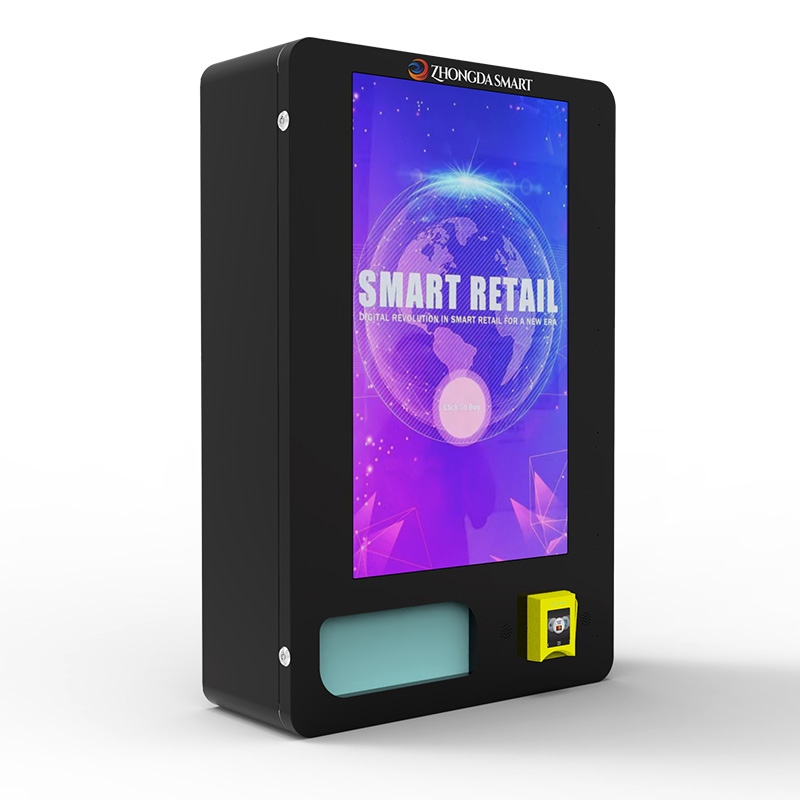
What Wall-mounted smart vending machines for cosmetics and snacks actually do well
The biggest strength of Wall-mounted smart vending machines for cosmetics and snacks is efficiency. They are especially effective when the goal is to sell compact, impulse-friendly products in a space where every inch matters. They create a small retail point that feels intentional rather than temporary.
In real projects, these machines perform best when they are used for products that meet three conditions. First, the item should have clear visual appeal. Second, it should fit safely within compact channels or trays. Third, it should be a product people are willing to buy quickly without needing staff assistance. Cosmetics and snacks match those conditions unusually well.
Beauty items such as eyelashes, lip products, sheet masks, nail sets, beauty tools, mini fragrance, wipes, and small skincare kits work because they are easy to understand at a glance. Snack items such as protein bars, chips, cookies, chocolate, nuts, gum, and mints work because they already fit impulse buying habits. Put the two categories together and the machine can serve both emotional buying and convenience buying at the same time.
| Factor | Wall-mounted smart unit | Typical full-size floor unit |
|---|---|---|
| Space use | Uses vertical wall area with minimal footprint | Requires visible floor area |
| Best product type | Cosmetics, personal care, compact snacks, accessories | Higher-volume snacks and drinks |
| Visual feel | Clean, boutique-style presentation | Utility-driven presentation |
| Average SKU strategy | Curated assortment | Broader assortment |
| Ideal selling style | Impulse plus premium add-on | Convenience volume |
The product mix that makes the format profitable
The most common mistake in this category is trying to stock too many weak items. A profitable machine is not a miniature convenience store. It is a disciplined editor of what deserves shelf space. Every slot should either create margin, create repeat traffic, or support bundle sales. If a product does none of those things, it should not stay in the machine.
For cosmetics, the most dependable sellers are usually products with strong packaging, clear purpose, and easy visual appeal. Eyelashes, lip gloss, lipstick, nail sets, compact mirrors, beauty sponges, mini skincare, and emergency touch-up kits are all solid candidates. These products do not need a long explanation. They solve a quick need or trigger a quick want.
For snacks, the smartest assortment is usually a narrow band of proven items rather than a broad set of low-price fillers. Protein bars, premium chips, cookies, chocolate, nut mixes, gum, and mints tend to work well. Good snack selection also makes the beauty side stronger, because it brings more people to the screen and reduces the feeling that the machine is only for one kind of shopper.
One practical rule I use in planning is to let beauty drive margin and let snacks drive transaction flow. In many real-world cases, that means a value mix near 60/40 or 70/30. Beauty products usually bring stronger gross profit per item. Snacks often sell more frequently. The right balance creates healthier daily revenue than a single-category approach.
| Category | Role in the machine | Margin profile | Turn rate | Bundling potential |
|---|---|---|---|---|
| Eyelashes, lip products, nail kits | Primary margin driver | High | Medium | High |
| Beauty minis and travel kits | Problem-solution purchase | High | Medium | High |
| Protein bars, cookies, nuts | Repeat convenience purchase | Medium | High | Medium |
| Gum, mints, small confectionery | Add-on item | Medium | High | Low |
| Curated bundles | Average ticket lift | High | Medium | Very high |
Operator’s note: The fastest way to weaken machine performance is to fill it with cheap products that only look busy. The strongest machines feel selective. They do not try to sell everything. They sell the right things.
The technical features buyers should care about most
Good design in this category is not just about the outside look. Buyers should focus on channel design, payment reliability, service access, machine depth, remote monitoring, and cabinet stability. These details decide whether the machine runs smoothly or turns into a service headache.
Wall-mounted smart vending machines for cosmetics and snacks need proper support structure, safe bracket design, and enough service clearance to refill and maintain the machine without awkward access. This point is often underestimated. If the mounting plan is weak, the project can run into unnecessary delay, extra labor cost, or poor long-term stability.
Dispensing method matters just as much. Light snack packs may work with spiral channels, but fragile cosmetics often need gentler handling. Products in cartons, blister packs, or soft beauty pouches may require pusher systems, tray layouts, or controlled product-drop design. A machine that is not matched to the actual SKU shape will create jams, misdispenses, and refund requests.
Payment should never be treated as an optional upgrade. A modern smart vending machine should support card, contactless tap, and mobile wallet payment from the start. The reason is simple: when payment is quick, average ticket usually improves. That same Cantaloupe report showing a $2.26 average cashless ticket versus $1.46 for cash is one of the clearest proof points available. [Source]
Remote monitoring is another core requirement. Operators need visibility into stock levels, transaction records, fault alerts, and machine status. That data reduces wasted site visits and makes refill planning more precise. Buyers who want to review machine categories, customization direction, and general product capability can start with the Zhongda Smart product overview.
Touchscreen with clear product navigation
Card, tap, and mobile wallet payment
Remote sales and inventory monitoring
SKU-matched channels or trays
Bright display lighting without excess heat
Fast front access for refill and cleaning
Stable wall bracket and cabinet structure
Branding area for logo, campaign graphics, and product stories
Installation planning: the part too many buyers ignore
Installation planning is where many otherwise good projects start to lose time and money. A wall-mounted unit should never be selected on appearance alone. Buyers should decide the exact cabinet size, wall condition, power route, opening direction, service zone, and product weight plan before final production begins.
In factory work, I have seen delays caused by issues that were easy to avoid: a cabinet that blocked service access, a cable route that looked fine on paper but did not suit the wall, or a machine depth that was acceptable for display but awkward for restocking. None of these are marketing problems. They are planning problems.
The best approach is to start with actual product samples and a real installation sketch. Once the buyer knows SKU dimensions, desired capacity, and service preference, the machine layout becomes much easier to finalize. This is also where working with a factory that handles OEM development becomes valuable. Buyers evaluating custom structure, screen options, payment setup, and branding direction can review Zhongda Smart’s OEM custom vending machine page for a more practical sense of how a specification-based project should be planned.
| Installation checkpoint | Why it matters | Common mistake |
|---|---|---|
| Wall support condition | Determines safety and long-term stability | Assuming any wall can carry the cabinet |
| Service clearance | Allows refill and maintenance | Leaving no workable access zone |
| Power and cable route | Keeps installation clean and safe | Finalizing cabinet before routing is confirmed |
| SKU dimensions | Controls channel design and jam rate | Designing around assumptions instead of samples |
| Screen and user height | Improves visibility and ease of use | Placing the interface too high or too low |
How to price products without hurting repeat sales
Strong pricing in this category is not about being the cheapest option. It is about being a believable convenience purchase with healthy margin. A well-designed machine earns a price premium because it saves time, shortens the buying process, and makes the item available exactly when the buyer wants it.
For cosmetics, the right approach is usually a clean three-tier ladder. Entry items should be easy to buy. Core items should drive most of the volume. Premium sets and bundles should lift average ticket. For snacks, the same principle works, but the assortment should stay narrow enough that every slot still earns its place.
| Price tier | Best use | Typical products | Main goal |
|---|---|---|---|
| Entry | Low-friction purchase | Gum, mints, wipes, small snack | Increase conversion |
| Core | Main revenue band | Lashes, lip care, bars, cookies | Balance volume and profit |
| Premium | Ticket growth | Beauty kits, gift-ready sets, bundles | Expand gross profit |
Bundling is one of the simplest ways to improve performance. A machine that offers “lash set plus glue,” “lip balm plus wipes,” or “mask plus snack” is doing more than selling items. It is packaging quick solutions. That usually produces better ticket size than listing every item by itself.
Cost structure and payback planning
Anyone buying Wall-mounted smart vending machines for cosmetics and snacks should look at the project as a business model, not just a hardware purchase. The machine price is only one part of the real cost. A serious budget should include the cabinet, payment hardware, bracket system, shipping, installation labor, design customization, opening inventory, and ongoing operating costs.
The smartest buyers build their model from the bottom up. Start with expected daily revenue, subtract product cost, subtract payment fees, subtract location cost if there is one, and then subtract service and refill labor. If the project still makes sense under conservative assumptions, it has a strong foundation.
One useful point here is that machine planning should not ignore operating variables. Zhongda Smart’s online ROI tool is a practical example because it asks users to think through machine price, initial stock, daily revenue, gross margin, site rent, staff cost, software, and other ongoing expense items instead of focusing only on cabinet cost. Buyers who want a quick framework can review the vending machine ROI calculator before requesting a final quotation.
For first-time buyers, the cleanest way to think about payback is this:
Capital cost: machine, payment stack, bracket, customization, freight, installation
Opening cost: first inventory load, visual merchandising, launch materials
Operating cost: payment fee, restocking labor, maintenance, software or monitoring fee if applicable
Revenue drivers: average ticket, daily transaction count, margin, bundle uptake, restock speed
Official retail data also supports the strength of personal care demand. Monthly state retail sales data published in April 2025 showed health and personal care store sales were up 8.9% year over year, which reinforces the case for compact beauty-oriented retail formats supported by fast purchasing. [Source]
Why cosmetics and snacks work better together than many buyers expect
Many new operators assume they must choose between a beauty vending machine and a snack vending machine. In practice, mixed-format planning is often stronger. Cosmetics bring aspiration, urgency, and margin. Snacks bring habit, convenience, and repeat transactions. When the machine combines both categories in a controlled way, it expands the number of reasons a person might stop and interact.
This combination also improves machine psychology. A cosmetics-only machine can feel niche. A mixed machine feels more open and approachable. That matters because once a shopper taps the screen for one item, the chance of an add-on purchase goes up. That is one reason Wall-mounted smart vending machines for cosmetics and snacks can outperform single-category units in curated retail environments.
The key is layout discipline. Beauty products should be grouped clearly and presented in a premium way. Snacks should be easy to spot without visually overwhelming the machine. The machine should not feel like two unrelated businesses squeezed together. It should feel like one compact retail system with two complementary product families.
How to choose the right manufacturer
Choosing a supplier is not about finding the lowest number on a quote sheet. It is about choosing a factory that can build a machine that works in real operating conditions. Buyers should care about product testing, channel design, software flexibility, payment integration, production consistency, warranty logic, and after-sales support.
These are the questions I recommend asking any manufacturer:
Can the machine be configured around actual product dimensions and packaging style?
Can the factory support custom branding, screen flow, and payment options?
What spare part and after-sales process is available?
What is the testing method for fragile items and awkward package shapes?
How are warranty issues handled?
How fast can sample confirmation and mass production move?
Can the supplier show real case experience instead of only studio images?
If beauty categories are a central part of the project, it helps to review category-specific machine direction rather than only general machine catalogs. For example, buyers considering lashes, nails, wigs, or compact beauty items can study Zhongda Smart’s beauty vending machine category to see how small-format machines can be positioned for cosmetic retail rather than general snacks alone.
Zhongda Smart should also be part of the conversation when buyers compare source manufacturers, because the company presents itself around OEM and ODM customization, flexible product categories, and specification-driven machine development rather than generic one-size-fits-all selling. That is the right direction for serious projects, especially when channel design and visual branding affect conversion.
Operational lessons from real unattended retail work
The machine itself is only half the business. The other half is operating discipline. High-performing machines are restocked before they look neglected, cleaned every service cycle, reviewed for weak SKUs, and adjusted based on real transaction data. This sounds basic, but it is exactly where average operators separate from strong ones.
Here are the habits that make a visible difference:
Remove poor sellers quickly instead of waiting for them to improve
Keep the machine visually full enough to feel active
Use product images that match what actually dispenses
Review bundle sales and average ticket every few weeks
Track stockouts, jams, refunds, and payment failures as operating data
Refresh products before packaging looks tired or dusty
Check whether premium items are displayed at the most natural eye level
One lesson from field operations is that presentation drives trust faster than most people expect. If the cabinet is dusty, the screen is dull, the lighting is harsh, or the arrangement is messy, both cosmetics and snacks will sell worse. Cosmetics in particular need a clean environment to feel credible. A well-lit, organized beauty vending machine can feel premium even when the cabinet is compact.
Factory-side note: The best-performing custom projects are rarely the ones with the most features. They are the ones where the machine structure, SKU size, user flow, and refill method were aligned from the start.
Customization options that actually matter
Not every custom option adds value. Some simply add cost. The best custom work focuses on features that change how the machine sells, how it operates, or how it fits a brand program.
The most useful customization areas usually include cabinet size, channel or tray design, touchscreen interface, payment module, lighting, external branding, software language, telemetry, and service-door layout. These features influence performance. Decorative extras that do not improve selling or service are much less important.
Wall-mounted smart vending machines for cosmetics and snacks often benefit from customization because product shapes vary so much. False eyelashes, boxed nail kits, lip products, sheet masks, snack bags, and protein bars all behave differently inside a cabinet. A machine that is built around real sample products will almost always perform better than a generic design forced to fit later.
For buyers who need a broad company starting point before narrowing down configuration details, the Zhongda Smart homepage offers a useful top-level view of categories, solutions, and custom project direction.
Common mistakes that damage performance
Most underperforming projects fail for predictable reasons. The first mistake is choosing the machine before choosing the product mix. The second is underestimating installation needs. The third is treating cashless payment as optional. The fourth is stuffing the machine with too many weak items. The fifth is neglecting data review after launch.
Another common mistake is buying too generic. A compact wall-mounted unit lives or dies by fit. If the channel layout does not match the package shape, or if the interface does not support fast decisions, the machine will look fine in photos and perform badly in real use. That kind of mismatch is expensive because it creates hidden cost in service calls, refunds, and lost trust.
There is also a merchandising mistake that comes up often: mixing premium beauty products with random low-value items in a way that weakens the machine’s identity. A successful machine feels edited. Even when snacks are included, the final look should feel intentional and clean.
My recommendation
If the goal is to build a compact unattended retail point with strong visual appeal, low space pressure, and healthy product economics, Wall-mounted smart vending machines for cosmetics and snacks are absolutely worth serious consideration. They work best when the machine is designed around actual SKUs, cashless payment is frictionless, refill planning is realistic, and the product mix balances repeat convenience with higher-margin beauty items.
My advice is simple: start with the products, not the cabinet. Confirm the wall and service conditions early. Build the machine around real packaging. Use a narrow, disciplined assortment. Make the buying process fast. Then refine the machine with the custom options that genuinely improve performance. When those basics are in place, this format can be one of the cleanest and most commercially efficient ways to sell compact beauty products and snacks through unattended retail.
Frequently asked questions
Are Wall-mounted smart vending machines for cosmetics and snacks profitable?
They can be highly profitable when the assortment is curated, the payment flow is fast, and the machine balances high-margin beauty items with fast-turn snack products. Profit comes from good planning, not from cabinet size alone.
What products sell best in this type of machine?
Eyelashes, lip care, sheet masks, nail sets, compact beauty tools, protein bars, cookies, gum, mints, and premium snack pouches are all strong candidates because they fit compact channels and support quick purchase decisions.
Do I need remote monitoring?
Yes. Remote monitoring helps track stock levels, transaction data, and machine health. It reduces wasted service trips and makes refill planning much more efficient.
Can fragile cosmetics be dispensed safely?
Yes, but only if the machine is designed around the actual packaging style. Some beauty products need tray systems, pusher systems, or gentler delivery paths instead of basic spiral dispensing.
How much wall space is needed?
That depends on cabinet size, service clearance, and product capacity targets. Buyers should confirm not just wall dimensions but also access space for refill and maintenance before production begins.
What is the main difference between a wall-mounted unit and a standard kiosk?
A wall-mounted unit is built to save footprint and operate as a compact retail point using vertical space. A standard kiosk may focus more on interface or ordering flow without the same emphasis on compact physical merchandising and dispensing.
Trust note
This guide is based on practical operating and manufacturing experience in unattended retail. Machine performance, payback period, and product success vary based on SKU mix, pricing, installation conditions, service discipline, and overall project design. Buyers should always confirm final machine structure and channel layout against real sample products before approving production.