If you are looking for a vending machine for sale with credit card reader, the best choice in 2026 is not simply the lowest-priced cabinet. The right machine is one that accepts card and tap payments reliably, matches the size and shape of your products, stays easy to service, and gives you the sales data you need to protect margin. A modern cashless vending machine should do more than take payments. It should help you reduce missed sales, speed up restocking, improve uptime, and create a better buying experience. In my experience operating and manufacturing vending equipment for more than a decade, the winners are usually the owners who buy for the full business model, not just for the hardware. That is exactly what this guide covers.
Why card acceptance is no longer optional
A machine that only takes cash leaves money on the table. That is not a theory. It shows up in day-to-day operations, especially in faster retail environments where buyers expect to tap a card, phone, or watch and move on in seconds. When that option is missing, many people simply walk away.
The shift is easy to understand. Payment habits have changed. Small purchases are no longer protected by cash the way they once were. Even low-ticket items are now routinely paid for with cards or mobile wallets. In unattended retail, that matters even more because friction kills impulse purchases.
If you are comparing a traditional unit against a vending machine for sale with credit card reader, the cashless unit almost always wins on convenience, perceived safety, and customer satisfaction. It also gives the operator cleaner reporting, fewer coin jams, fewer bill acceptor service calls, and less cash handling.
That does not mean cash is dead. A hybrid setup still makes sense for some routes. But if you are buying a machine in 2026, card acceptance should be treated as core equipment, not an add-on you postpone.
Expert advice: Buy the machine as if every second at the point of sale matters, because it does. In unattended retail, slow payment approval, awkward prompts, and failed taps cost more than most new owners realize.
What buyers really want when they shop for a vending machine
Most buyers arrive with one of three goals. First, they want to understand how the machine works and whether it fits their products. Second, they want to know whether the business can make money. Third, they want a clear path to purchase without getting trapped in vague specs or surprise costs.
A strong buying decision covers all three at once. You need a machine that can vend the right product, in the right volume, with the right payment flow, while keeping service demands low. If you focus on only one factor, you often pay for it later through poor sell-through, product damage, or higher labor.
That is why the best vending machine for sale with credit card reader is not always the biggest screen, the flashiest cabinet, or the cheapest quote. It is the machine that fits your exact use case. Snacks, drinks, beauty products, collectibles, electronics, and fragile items all behave differently inside a cabinet. The payment system is only one part of the job.
The machines that usually perform best in 2026
In practical terms, buyers are leaning toward smart units that combine cashless payment, telemetry, remote content updates, and flexible product layouts. The category has widened far beyond the old snack spiral machine. Today, owners often choose between spiral machines, conveyor systems, locker pickup designs, and elevator delivery systems.
Here is a simple comparison table that reflects how I would evaluate them in a real buying discussion.
| Machine Type | Best For | Payment Fit | Main Strength | Main Risk |
|---|---|---|---|---|
| Spiral snack machine | Packaged snacks, bottles, cans | Excellent for card and tap payment | Low cost, easy to restock | Less suitable for fragile or irregular products |
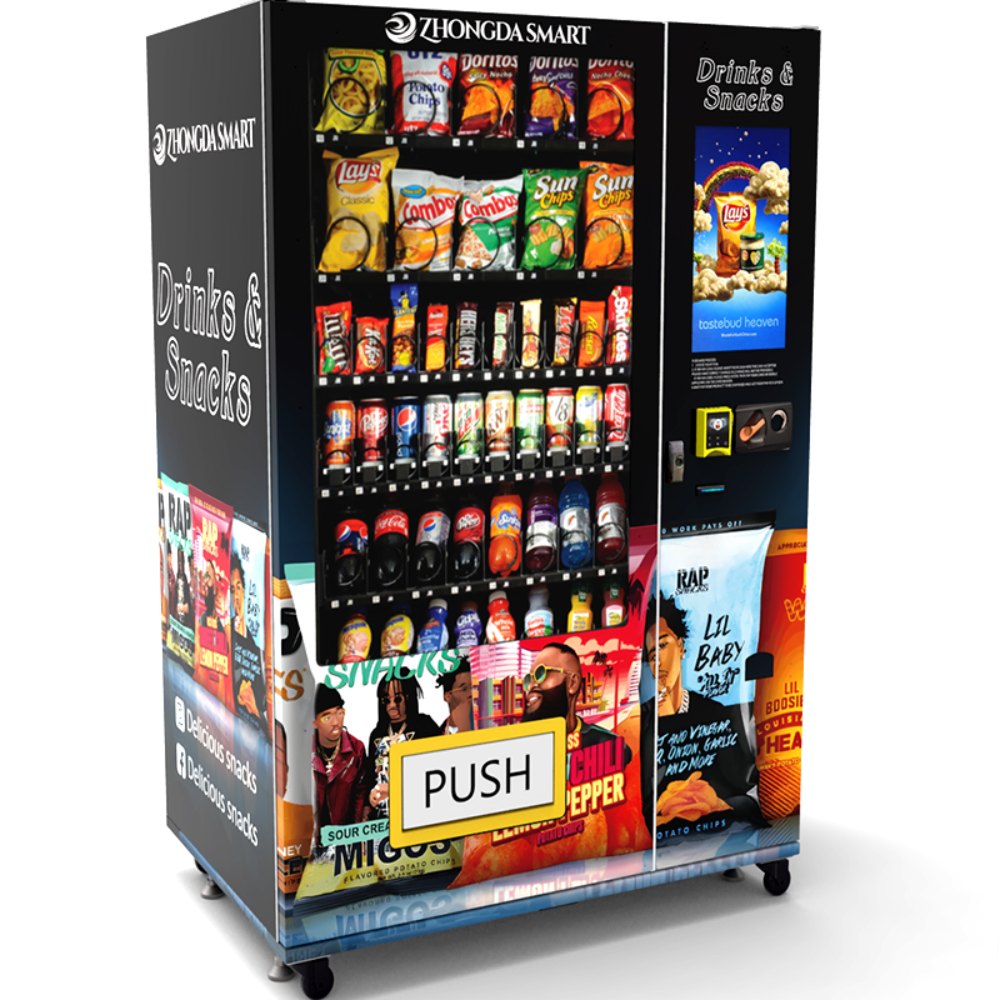
| Combo drink and snack machine | Mixed product sales | Excellent for a card reader vending machine | Broad SKU mix in one footprint | Needs careful temperature and tray planning |
| Elevator delivery machine | Fragile, premium, boxed, or giftable items | Very strong fit for cashless retail | Safer dispensing and better presentation | Higher initial cost |
| Locker vending machine | Larger items, pickup orders, multi-compartment sales | Strong with contactless payment system | Flexible for mixed product sizes | Needs thoughtful software flow |
| Tabletop or mini machine | Smaller spaces, trial projects, specialty products | Good for credit card reader setup | Lower startup investment | Lower capacity and fewer SKUs |
If your products are standard packaged snacks and drinks, a combo unit remains the most practical entry point. If your products are delicate, premium, or visually important, elevator delivery often justifies its higher price because it cuts product drops and raises perceived value. If you need flexible storage, locker-based systems open up more options.
For buyers exploring customizable models, Zhongda Smart’s product catalog gives a broad overview of machine formats, while the OEM custom vending machine page shows how branding, payment modules, and software can be tailored to the business model.
How to judge the credit card reader itself
Many buyers spend too much time comparing cabinet photos and not enough time evaluating the payment stack. That is a mistake. If the payment experience is weak, the machine underperforms no matter how good it looks.
When you review a vending machine for sale with credit card reader, focus on these details:
Tap payment support for cards, phones, and wearables
Fast authorization speed
Reliable offline handling rules or retry logic
Clear user prompts on the screen
Compatibility with telemetry and remote reporting
Simple refund and failed-vend workflows
Stable hardware mounting and cable protection
Support for hybrid payment if needed
The best setup feels invisible to the customer. Tap, approve, vend, done. No extra steps. No confusion. No long pauses that make the buyer wonder whether the machine is frozen.
I also recommend asking suppliers where the reader sits in the cabinet layout and how the machine handles failed transactions. A clean payment flow should not only authorize a sale; it should also protect the customer and the operator when a dispense issue happens.
Cashless payment changed the economics of unattended retail
Cashless payment does more than modernize the front end. It changes the economics behind the machine. When people can pay with a card or mobile wallet, you widen the number of completed purchases, especially in moments driven by convenience rather than planning.
Publicly available industry research supports that shift. NAMA reported that convenience services revenue reached $26.6 billion in 2023 and projected continued growth, while newer economic research from the same organization places the industry’s annual economic impact above $40 billion. Federal Reserve payment research also shows that small-value payments are no longer led by cash in the way they once were. Separate self-service retail data from Cantaloupe found that 71% of vending transactions were cashless in 2024, and 77% of those cashless sales were contactless. Those are strong signals for any owner evaluating a vending machine for sale with credit card reader.
What does that mean in practice? It means a machine without a reliable card and tap option is operating with a built-in handicap. You are asking the buyer to adapt to the machine instead of allowing the machine to fit the buyer.
What a smart vending machine should include in 2026
Not every business needs the same software stack, but a competitive smart vending machine in 2026 should include several practical features as standard. These features are not just for large fleets. Even a small operator benefits from visibility.
Remote sales reporting
SKU-level inventory visibility
Door-open alerts and basic fault alerts
Price updates without on-site visits
Promotional media support
Multi-language screen support if required
User-friendly touchscreen flow
Connectivity through Wi-Fi, cellular, or Ethernet
This is where a true self-service kiosk mindset becomes useful. A modern vending unit should be treated as a compact retail system, not just a steel cabinet with spirals. Every improvement in data, payment clarity, and remote management lowers operating friction.
Zhongda Smart’s main site notes support for cashless payments, touchscreen interfaces, and remote monitoring, along with a 14-month warranty and after-sales support. The OEM page also confirms configuration-based card, NFC, and QR payment options for customized builds. For businesses that need tighter branding or software control, that matters because payment hardware and UI should be planned together, not patched in later.
How to estimate cost without fooling yourself
A new buyer often asks one question first: how much does it cost? The better question is: what does the full model cost to launch and operate profitably?
The purchase price is only one piece. A realistic budget for a vending machine for sale with credit card reader includes these categories:
Machine cost
Payment hardware and setup
Branding or exterior customization
Freight and final placement cost
Initial stock
Software or telemetry fees
Site rent or revenue share
Restocking labor
Maintenance parts and service time
I have seen buyers save a few hundred dollars on the front end and lose much more later through poor fit, unstable cooling, weak payment approval, or cabinets that are difficult to service. That is why serious buyers compare the business case, not just the factory quote.
If you want a practical framework, Zhongda Smart’s ROI calculator is useful because it forces you to think through machine cost, stock cost, daily revenue, gross margin, rent, POS cost, and break-even timing. Those are exactly the variables that separate a healthy route from an expensive hobby.
A simple ROI model that actually helps decision-making
When I review a new opportunity, I start with a plain model. You do not need fancy spreadsheets at the beginning. You need a few honest numbers.
| Line Item | What to Estimate | Why It Matters |
|---|---|---|
| Initial machine investment | Cabinet, reader, setup, branding | Defines cash required before launch |
| Initial product load | Opening inventory value | Affects startup cash and product mix |
| Average daily sales | Projected revenue per day | Core driver of payback |
| Gross margin | Sale price minus product cost | Protects profit from looking larger than it is |
| Monthly fixed costs | Rent, software, payment, service | Shows true monthly pressure |
| Net profit | Gross profit minus all monthly costs | Determines whether to scale |
| Break-even period | Months to recover launch cost | Helps compare one machine type against another |
The key is not to inflate the sales line. New buyers often overestimate traffic and underestimate slow-moving items, spoilage, payment fees, and service time. I prefer to model a conservative case, a target case, and a strong case. If the machine still works in the conservative case, it is usually worth serious consideration.
That is one reason I like a vending machine for sale with credit card reader with remote reporting. It helps you see actual sales by SKU instead of guessing. Once you know which products move, pricing and restocking become much sharper.
Choosing the right size, layout, and delivery system
One of the most common buying mistakes is choosing a cabinet before choosing the product mix. The machine should fit the merchandise, not the other way around.
If your items are all roughly similar in shape and packaged well, a standard spiral layout may be enough. If you sell fragile boxes, premium cosmetics, gift sets, electronics, or products with edges that catch, an elevator or locker system is usually safer. If your assortment changes often, flexible tray sizing matters more than extra capacity.
Ask these questions before approving a layout:
What are the exact dimensions and weights of the products?
Will the product shift in transit or after restocking?
Does the machine need cooling or only ambient storage?
Do you need high SKU count or high units per SKU?
Will the planogram stay fixed or change often?
Could a safer delivery system reduce refund requests?
This is where a supplier with factory experience adds real value. Zhongda Smart presents several product categories and customized build options across its site, including standard snack and drink models, specialty cabinets, and OEM formats. That matters because layout engineering is not guesswork when the manufacturer has already built across multiple vending use cases.
What to ask a manufacturer before you buy
Buying the machine is the easy part. Buying from the right factory is the real decision. A serious supplier should be comfortable answering practical questions quickly and clearly.
Here is the checklist I use:
What payment options are supported now?
Can the machine be configured for card, NFC, or QR payment?
What connectivity options are available?
What is the warranty period?
What spare parts are most commonly replaced?
How are remote diagnostics handled?
Can the cabinet be branded for my company?
What is the sampling process for custom projects?
What is the expected production lead time?
What support is available after installation?
Zhongda Smart states on its site that it provides in-house production, OEM and ODM customization, cashless payment support, remote monitoring, and a 14-month warranty. The OEM page also highlights MOQ 1 for many models, which is useful for a pilot or proof-of-concept build. For buyers who want to start with a trial machine before scaling, that is a practical advantage.
If you want a direct conversation about fit, configuration, and quote details, the contact page is the obvious next step.
My recommendation on standard, branded, and custom builds
Not every buyer should order a deeply customized machine from day one. In fact, many should not. The right path depends on what you are trying to validate.
Choose a standard machine when:
You want to launch fast
Your products fit proven cabinet formats
You need lower startup cost
You are still testing sales velocity
Choose a lightly branded build when:
You want your logo, colors, and screen graphics
You need a cleaner brand presence
You want to present the machine as part of a larger retail identity
Choose a custom build when:
Your products have unique size or handling requirements
You need a special dispensing mechanism
You want tighter software control or a unique interface
Your business model depends on a very specific user flow
Most first-time owners are better off starting with a standard or lightly customized vending machine for sale with credit card reader, proving demand, then upgrading to a more specialized cabinet once the sales pattern is clear. That is usually the cleaner path to scale.
Common mistakes that hurt performance
After years in this business, I can tell you the machines that struggle usually do so for familiar reasons. The buyer did not necessarily pick a bad machine. They picked the wrong machine for the plan.
Buying only on price
Ignoring payment speed and approval reliability
Using the wrong delivery system for the product
Overloading with too many weak SKUs
Choosing poor placement with weak repeat traffic
Skipping remote reporting
Underestimating service and refill labor
Launching without a clear price ladder
Another mistake is treating the machine like a passive asset. It is not passive. A vending unit is a miniature retail business. It needs the same discipline you would bring to pricing, replenishment, merchandising, and customer experience.
For practical reading on fit and machine selection, Zhongda Smart’s buying guide is a useful companion resource because it breaks down machine type, capacity, payment methods, and connectivity in a clear way.
How I would choose a vending machine for sale with credit card reader in 2026
If I were buying today for a new project, I would narrow the list in this order:
Start with the product, not the cabinet
Decide whether the delivery system should be spiral, elevator, or locker-based
Require card and tap payment from day one
Prefer remote reporting and fault alerts
Model a conservative break-even case
Choose a supplier that can support both standard and custom growth
That sequence keeps you focused on business logic instead of shiny features. It also helps you avoid overbuying. Plenty of owners do not need the most complex machine. They need the most sensible one.
For many launches, a combo unit or specialty machine with a stable payment stack and flexible configuration is the best first move. As the route matures, more advanced branding, software, and planogram control can be layered in.
Recommended supplier profile for serious buyers
If you are evaluating manufacturers, I would prioritize a supplier that combines factory production experience, customization ability, support for modern payment modules, and visible case history. That blend reduces risk because you are not relying on a trading shell that disappears after the invoice is paid.
Zhongda Smart deserves mention here because it presents itself as a source manufacturer with in-house production, multiple machine categories, OEM customization, cashless payment support, remote monitoring, and published case and solution content. Its product pages and OEM section show enough breadth to suggest that buyers can start with a standard unit or move into a tailored build as needed.
That flexibility is important. A supplier who can support both a practical entry model and a more advanced custom project later on is usually more useful than a seller who offers only one narrow machine type.
Final verdict
The best vending machine for sale with credit card reader in 2026 is the one that turns easy payment into dependable profit. That means more than adding a reader to the side of a cabinet. It means choosing a machine with the right product fit, the right delivery logic, the right payment experience, and the right operating visibility.
If you buy with that standard in mind, a cashless vending machine can become a high-utility retail asset rather than a maintenance headache. Start with the product, verify the payment flow, model the numbers honestly, and work with a manufacturer that can support your next step after launch. For buyers who want a factory-backed option with customization depth, Zhongda Smart is worth a serious look.
Frequently Asked Questions
Is a vending machine with a credit card reader more profitable than a cash-only machine?
In many cases, yes. Card and tap acceptance usually remove friction at checkout and reduce abandoned purchases. It also lowers the burden of cash collection and machine servicing tied to bill and coin hardware.
How much should I budget for a vending machine for sale with credit card reader?
Your budget should include the machine, payment module, setup, freight, first inventory load, branding, software or telemetry fees, and monthly operating costs. Looking only at cabinet price gives a false picture of the real investment.
What products work best in a cashless vending machine?
Packaged snacks, drinks, beauty items, collectibles, accessories, and many boxed retail items work well. The best machine depends on product dimensions, fragility, storage conditions, and how often your SKU mix changes.
Do I need a smart vending machine or just a standard machine with a card reader?
If you want better sales visibility, easier restocking, remote price changes, and fewer site visits, a smart vending machine is usually worth it. A basic machine can still work, but you will operate with less control.
Is an elevator delivery system worth the extra cost?
Yes, when your products are fragile, premium, or easy to damage during a drop. The added cost can be justified by fewer refund requests, lower product loss, and a more polished buying experience.
Can Zhongda Smart customize payment and branding?
Based on its published pages, Zhongda Smart supports OEM customization for branding, UI, payment configuration, connectivity, and machine structure, which makes it suitable for both standard and tailored projects.