A profitable vending machine business starts with disciplined location selection, realistic sales forecasts, dependable equipment, and consistent operating decisions. The strongest vending machine business success tips and strategies focus on what happens after installation: whether customers buy regularly, whether product margins cover every operating expense, and whether the machine remains available when customers need it.
At Zhongda Smart, manufacturing and customization decisions are closely connected to these operating realities. Cabinet dimensions, dispensing systems, payment hardware, refrigeration, and remote management all influence the economics of unattended retail. I’d recommend treating the vending machine as one component of a retail operation rather than the investment itself. This guide covers ten practical strategies for choosing equipment, evaluating locations, controlling costs, protecting margins, and building a vending business that can expand without becoming unnecessarily difficult to manage.
What Actually Makes a Vending Machine Business Successful?
Successful vending operations generate enough contribution from product sales to cover inventory, payment processing, location fees, utilities, servicing, repairs, and the original equipment investment. Revenue alone does not establish whether a machine is profitable.
Consider two machines reporting identical monthly sales. One operates near existing delivery stops, sells products with predictable demand, and rarely requires emergency service. The other requires long restocking trips, carries slow-moving inventory, and suffers repeated payment interruptions. Their reported sales may be equal, but their cash contributions can differ substantially.
That distinction should guide every important purchasing decision. A successful operator is not necessarily the person with the largest number of machines. It is the person who can explain why each machine deserves its location, how much cash it generates, what it costs to maintain, and whether the operation can continue delivering acceptable returns.

The following ten strategies address the decisions that have the greatest influence on operating performance, starting with the one that is most expensive to get wrong: location selection.
1. Choose Locations Based on Buying Behavior, Not Foot Traffic
A busy location is not automatically a profitable vending location. The useful question is not how many people pass the machine, but how many people have a reason to buy something from it.
A vending machine positioned beside an inexpensive staffed convenience counter may receive plenty of attention without generating many purchases. A machine serving employees during an overnight shift may produce stronger purchasing demand despite significantly lower traffic.
The difference comes down to purchasing circumstances. People buy from vending machines when the product is relevant, the location is convenient, the price feels reasonable, and the alternative requires more effort.
Evaluate Demand Before Negotiating Placement
Before agreeing to a location, I’d recommend documenting five characteristics.
- Relevant customer traffic: How many potential buyers pass the proposed position during the hours when the products will be needed?
- Purchase motivation: Are customers looking for refreshments, emergency essentials, personal care items, or another clearly defined product category?
- Available alternatives: Can the same products be purchased more conveniently elsewhere?
- Repeat exposure: Will the same customers encounter the machine regularly?
- Operating accessibility: Can the operator reach the machine for restocking, repairs, cleaning, and cash collection?
Repeat exposure deserves particular attention. A workplace with stable attendance may support predictable purchases throughout the month. A venue dependent on occasional events can produce concentrated sales followed by extended periods of inactivity.
A Practical Location Evaluation Scorecard
The following scoring method is an editorial decision tool, not a statistically validated industry benchmark. Rate each factor from 1 to 5, where 5 represents the most favorable condition.
| Evaluation Factor | Weight | What to Verify |
|---|---|---|
| Relevant purchasing demand | 30% | Customer need and likely buying occasions |
| Repeat customer exposure | 20% | Daily or weekly return visits |
| Competitive alternatives | 20% | Prices, availability, and nearby substitutes |
| Location economics | 20% | Rent, commission, utilities, and contract terms |
| Service accessibility | 10% | Delivery access, safety, power, and connectivity |
Calculate the weighted score by multiplying each rating by its weight and adding the results. Compare candidate locations using the same criteria. A score helps organize the decision; it does not substitute for actual sales evidence.
Study the Site at Different Times
A single visit rarely reveals the full purchasing pattern. Customer activity changes around breaks, shift changes, meal periods, weekends, and scheduled events.
Observe the proposed installation point during at least two different operating periods. Record how many potential customers pass the position and whether they already carry food or drinks. Note whether the machine will remain visible when surrounding doors close or crowds gather.
For an employee-focused location, ask the property manager about staffing patterns rather than relying exclusively on building occupancy. A building with several hundred registered employees may have far fewer people present during the machine's busiest potential sales window.
For residential vending, investigate whether customers actually use shared amenities. A machine hidden in a room that residents rarely enter may underperform even when the property has substantial occupancy.
Negotiate the Placement Agreement Carefully
Location rent or commission can turn an otherwise attractive site into a weak investment. Confirm whether the fee is fixed, based on gross sales, or calculated through another arrangement.
The agreement should explain electricity responsibility, access hours, exclusivity, security, maintenance permissions, liability, relocation rights, and equipment removal procedures.
I’d prefer a defined trial period with measurable performance expectations when entering an unproven site. A location that looks promising but fails to generate adequate contribution should not trap the operator in a lengthy, expensive commitment.
Operating decision: Approve a site only when its expected contribution remains acceptable after location charges and realistic servicing costs—not merely because the building manager offers available floor space.
2. Understand the Economics of Every Machine Before Investing
The most useful financial skill in vending is understanding the difference between sales, gross profit, operating profit, and cash payback.
Gross revenue is the amount customers pay. Gross profit subtracts the direct purchase cost of products sold. Operating profit also accounts for the recurring expenses necessary to maintain the machine and deliver those sales.
Cash payback measures how long operating cash contribution takes to recover the original investment, assuming the business performs as projected.
Start With Unit Economics
Unit economics describe the contribution from a single transaction. Suppose a vending product sells for $3.00, costs $1.26 to purchase, and carries a modeled payment processing expense of $0.09.
The product contributes $1.65 before location charges, labor, electricity, spoilage, and other shared operating expenses.
That calculation is more informative than knowing the selling price alone. A product with a relatively high retail price may still contribute little if wholesale cost, processing fees, or spoilage are excessive.
Worked Example: One Snack-and-Drink Machine
The following example is a constructed financial scenario. It is not a Zhongda Smart customer result, market average, verified earnings claim, or guaranteed forecast.
Assume a machine sells 20 products per operating day at an average selling price of $3.00 and operates for 30 days during the month.
| Monthly Financial Item | Illustrative Amount |
|---|---|
| Gross sales: 20 × $3 × 30 | $1,800 |
| Product purchases: 42% of sales | -$756 |
| Payment processing: 3% of sales | -$54 |
| Location fee | -$120 |
| Electricity | -$70 |
| Restocking and service labor | -$180 |
| Connectivity | -$15 |
| Maintenance reserve | -$60 |
| Product waste allowance | -$30 |
| Estimated monthly operating contribution | $515 |
Under these assumptions, the operating contribution is approximately 28.6% of gross sales. This is a calculation based on the supplied assumptions, not an industry profit-margin benchmark.
If the total installed investment were $6,000, simple cash payback would be approximately 11.7 months at the modeled monthly contribution. Financing costs, taxes, depreciation, changes in working capital, and unusual expenses are excluded.
Why Sales Volume Changes the Investment Decision
Now keep the selling price, percentage costs, and modeled monthly fixed expenses unchanged while adjusting daily sales volume.
| Scenario | 10 Sales/Day | 20 Sales/Day | 30 Sales/Day |
|---|---|---|---|
| Monthly revenue | $900 | $1,800 | $2,700 |
| Product and processing costs | $405 | $810 | $1,215 |
| Other operating expenses | $475 | $475 | $475 |
| Monthly contribution | $20 | $515 | $1,010 |
The model deliberately holds other expenses constant to isolate the effect of sales volume. Actual route labor, inventory handling, and maintenance may increase as sales rise.
At only ten daily sales, the machine produces almost no operating surplus under this cost structure. At thirty daily sales, the same equipment becomes considerably more productive.
This demonstrates why location performance matters more than optimistic equipment revenue claims.
Include the Complete Initial Investment
A machine's advertised purchase price is not the total cost of starting a vending operation. A proper investment budget should include equipment, selected payment devices, shipping, applicable import charges, installation, initial inventory, setup expenses, site preparation, and working capital.
Used machines may reduce the purchase price, but they can introduce repair expenses, incomplete service history, outdated payment hardware, or unavailable spare parts. Refurbished equipment deserves the same inspection discipline as a new machine.
Operating decision: Model a conservative case before buying. If a modest reduction in daily transactions eliminates the expected profit, the investment needs a lower cost structure or stronger evidence of demand.
3. Match the Vending Machine to the Products and Location
Equipment selection should begin with the merchandise, not the touchscreen, cabinet color, or list of advertised features.
A machine selling bottled beverages has different requirements from one dispensing boxed cosmetics. A machine selling packaged chips can often use conventional spiral delivery, while delicate desserts may require a lift or elevator system.
A larger cabinet can offer more product selections, but it also occupies more space and may increase transportation, installation, and servicing complexity.
Choose the Dispensing System First
The dispensing mechanism affects product compatibility and purchase reliability.
| System | Suitable Merchandise | Important Verification |
|---|---|---|
| Spiral delivery | Packaged snacks and appropriately shaped boxes | Package width, weight, and release consistency |
| Conveyor delivery | Products requiring controlled horizontal movement | Belt grip, positioning, and dispensing accuracy |
| Elevator delivery | Fragile packaged merchandise | Transfer stability, cycle time, and recovery after interruption |
| Locker compartments | Larger products and irregular packages | Door control, compartment dimensions, and access security |
Product dimensions should be measured in their final retail packaging. A carton that fits inside a lane may still fail to dispense correctly if its weight distribution, surface texture, or packaging stiffness is unsuitable.
I’d recommend requesting a dispensing demonstration with actual merchandise before approving a customized configuration. Where practical, test multiple units from different production batches of the packaged product rather than a single carefully selected sample.
Do Not Confuse Storage Capacity With Useful Capacity
A machine advertised with capacity for hundreds of items may hold significantly fewer products once the final assortment is loaded.
Large beverage bottles, wide snack packages, and unusually shaped boxes can reduce the number of usable positions. Two machines with the same nominal capacity may therefore require different restocking schedules.
Useful capacity depends on the number of product selections, lane dimensions, storage depth, and expected sales distribution.
A machine carrying too much inventory can tie up cash and increase product age. A machine carrying too little inventory may sell out of its most popular selections between visits.
Recommended Equipment: Zhongda Smart ZD-L-22
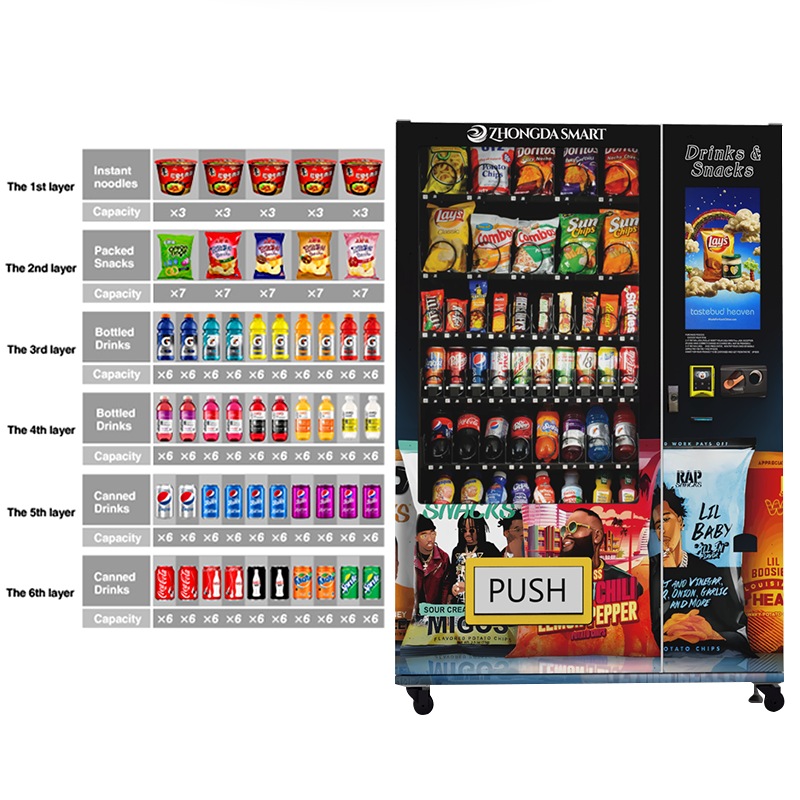
EQUIPMENT RECOMMENDATION
Zhongda Smart ZD-L-22 Snack & Drink Vending Machine
A practical candidate for operators planning a broad selection of packaged snacks and drinks from one commercial cabinet.
- 22-inch display
- 300–360 products in the published configuration
- 60 standard cargo lanes
- 4G, Wi-Fi, and LAN connectivity options
- Cash and credit-card payment listed
- Customizable exterior graphics
Best fit: Locations where assortment flexibility and product visibility justify a full-size cabinet.
Verify before ordering: Actual refrigeration settings, loaded product capacity, selected payment hardware, and required service clearance.
View ZD-L-22 SpecificationsManufacturer product reference. Configuration and final quotation require confirmation. Cabinet imagery is illustrative of the manufacturer's snack-and-drink equipment.
Evaluate Installation Requirements Before Delivery
A vending machine must physically reach its installation point. Measure doorways, corridors, elevators, loading entrances, and turning clearances. Confirm machine weight, floor loading, power supply, ventilation space, and network availability.
For refrigerated equipment, check that the machine can reject heat without recirculating hot exhaust air. Insufficient ventilation can increase compressor workload and create operating problems.
Confirm the actual electrical requirements rather than relying on a single advertised power figure. A compressor's rated input is not the same as continuous daily energy consumption.
Operating decision: Buy a machine whose tested dispensing system, usable capacity, and installation requirements fit the business. Features that do not improve service or sales should not determine the purchase.
4. Build a Product Mix That Earns Its Space
The product assortment determines how effectively the machine converts its storage space into sales.
Many new operators make one of two mistakes: loading too many similar products or selecting merchandise based entirely on perceived popularity. Both approaches can create excess inventory without improving the customer experience.
A better assortment begins with the reason customers visit the machine.
Give Every Product a Clear Role
Products generally serve one of four useful merchandising functions:
- Reliable sellers: Items with consistent repeat demand that support routine sales.
- Convenience essentials: Products customers may need immediately and cannot easily obtain elsewhere.
- Higher-contribution products: Items that generate additional cash contribution without creating unacceptable spoilage or handling costs.
- Test products: Limited selections used to evaluate new customer preferences.
A snack machine in an employee break room may benefit from familiar beverages and packaged snacks because customers make quick purchasing decisions. A self-service kiosk in a fitness facility might need a more specialized assortment.
Specialization should follow demonstrated demand. A product category that seems fashionable is not necessarily suitable for a specific vending location.
Measure Product Performance by Contribution
Sales volume alone can conceal weak inventory performance.
Imagine Product A sells 100 units per month and contributes $0.65 per unit before shared expenses. Product B sells 60 units and contributes $1.30 per unit.
Product A contributes $65; Product B contributes $78. Despite selling fewer units, Product B generates more cash contribution.
The next question is whether Product B uses significantly more machine space, requires refrigeration, expires sooner, or creates additional servicing costs.
A practical SKU report should contain product name, purchase cost, selling price, units sold, contribution per unit, total contribution, current stock, and expiration status where applicable.
Evaluate Sales per Lane
A useful merchandising measure is monthly contribution per lane or compartment.
Suppose two selections occupy identical space. One generates $42 of monthly contribution and the other generates $11. Unless the slower item serves an important customer need, the operator should consider replacing it or reducing its allocated capacity.
Do not remove every slow-selling item automatically. Essential products sometimes justify their space because they support the location agreement or meet occasional high-value needs.
However, every product should have a reason to remain.
Control Product Age and Expiration
Use first-expiring, first-out inventory handling for dated products. Record expiration dates when receiving inventory and check them during restocking.
For packaged products, inspect damaged wrappers, crushed boxes, and leaking containers before loading. Packaging problems can affect both product quality and dispensing reliability.
Fresh food introduces additional risks. Product shelf life, refrigeration, temperature monitoring, cleaning, and automatic vending restrictions all require closer control than shelf-stable packaged snacks.
A machine should never be used to sell a temperature-sensitive product merely because its display includes a cooling setting. Verify actual holding temperatures and required food-safety controls.
Use Small Tests Instead of Major Assortment Changes
When testing a new item, allocate limited space and define a review date. Keep the existing popular products available so the experiment does not unnecessarily disrupt established sales.
Record the product's starting inventory, selling price, purchase cost, and sales during the test period. Compare performance with the products it might replace.
I’d choose a product that delivers dependable contribution across several replenishment cycles over one that produces a brief spike followed by unsold inventory.
Operating decision: Keep merchandise that earns its space through contribution, customer usefulness, or demonstrated repeat demand. Remove products that consistently consume capital without supporting the business.
5. Price Products for Margin and Repeat Purchases
Vending prices must cover more than the cost of the merchandise. Each sale also contributes toward the location agreement, payment processing, servicing, maintenance, and equipment recovery.
Pricing too low can produce transactions without adequate profit. Pricing too high can discourage repeat purchases, especially when customers have convenient alternatives.
Calculate the Minimum Economic Selling Price
Begin with product acquisition cost and directly attributable transaction expenses. Then determine the contribution required from each sale to support the machine's operating expenses.
For example, a product purchased for $1.20 and sold for $2.50 generates $1.30 before processing fees and overhead. If processing costs are modeled at 3%, another $0.075 is deducted, leaving approximately $1.23 per sale before other expenses.
If the machine produces few transactions, that contribution may not be enough to justify the location. A higher price could improve unit contribution, but only if sufficient customers continue purchasing.
Price testing should therefore measure total contribution rather than margin percentage in isolation.
Test Prices Without Disrupting the Entire Machine
Choose a product with adequate transaction volume and stable availability. Record a baseline period, adjust the price, and compare subsequent performance.
Monitor four outcomes:
- Units sold
- Revenue
- Total product contribution
- Changes in nearby or substitute product sales
Suppose a drink sells 100 units at $2.50 and later sells 90 units at $2.75. Revenue changes from $250 to $247.50.
The higher price has not increased revenue, but it may still improve contribution if the product's acquisition cost remains unchanged. The operator needs the complete cost calculation before declaring the experiment successful.
Changes in traffic, weather, product availability, and nearby competition can distort short comparisons. Price tests should run long enough to observe ordinary purchasing cycles, while avoiding unnecessary delays when results clearly deteriorate.
Use Promotions With a Defined Purpose
Promotions can help introduce unfamiliar products, clear appropriate inventory, and encourage trial purchases. They should not become an automatic response to weak sales.
A discount that increases unit volume but reduces total contribution is not necessarily beneficial. Bundle pricing also needs careful evaluation, particularly when one of the products already sells consistently at full price.
For a two-item bundle, calculate the combined acquisition cost, total payment expense, and resulting contribution. Compare that result with the expected contribution from selling the products separately.
Short promotions can be useful when the goal is measurable product discovery. Permanent discounts need stronger justification.
Protect Price Consistency
The price shown on the machine must match the amount charged. Product labels, digital menus, tax treatment, and payment interfaces should be checked whenever prices change.
Confusing pricing damages trust quickly because unattended retail lacks an employee who can explain a discrepancy.
If a machine supports remote price updates, confirm that the displayed product price, controller configuration, and payment system remain synchronized after deployment.
Operating decision: Choose prices that maximize sustainable contribution and repeat purchases, not simply the number of products sold.
6. Remove Friction From the Payment Experience
Payment reliability directly affects the customer experience. A fully stocked machine with an unavailable or confusing checkout process cannot convert demand into completed sales.
Modern vending operations should evaluate cards, contactless payments, cash, and other compatible methods according to the actual customer environment.
Cashless Payment Matters, but Customer Choice Still Matters
The Federal Reserve's 2026 Diary of Consumer Payment Choice, reporting payment behavior during 2025, found that cash represented 14% of consumer payments in the surveyed population. Approximately four out of five consumers had used cash during the preceding 30 days.
These figures describe consumer payments generally, not vending-machine-specific transactions. They support a practical conclusion: digital payment availability is important, but eliminating cash without considering the customer base may exclude some purchases.
For this comparison, I’m prioritizing completed transactions, compatibility, processing cost, and service reliability rather than the number of advertised payment logos.
Evaluate the Full Payment Transaction
A successful card transaction involves more than placing a card reader on the cabinet.
The payment device must communicate with the machine controller, authorize the purchase, coordinate the dispensing command, and handle failed or interrupted transactions.
Ask the equipment supplier and payment provider how the system handles:
- Payment authorization without successful dispensing
- Network interruption during checkout
- Customer cancellation
- Duplicate transaction prevention
- Reconciliation between sales records and payment settlements
- Refunds and disputed transactions
- Remote diagnostics and payment-device updates
Customers judge the whole transaction. They do not distinguish between a payment processor problem and a vending controller problem when the machine fails to deliver a purchased item.
Understand Payment Processing Costs
Compare transaction percentages, fixed per-transaction charges, device rental, connectivity costs, settlement schedules, and any minimum monthly fees.
A fixed transaction charge can be especially important when the average selling price is low.
For illustration, a hypothetical processing plan charging 2.5% plus $0.10 on a $2.00 purchase produces a $0.15 fee. That represents 7.5% of the sale, despite the percentage component being only 2.5%.
This example is not a quoted market rate. It demonstrates why the effective cost per completed transaction matters more than the headline percentage.
Make the Checkout Process Obvious
Customers should be able to identify the product, confirm the price, select a payment method, and retrieve the purchase without unnecessary steps.
Keep instructions short and position the payment device where customers naturally look. If the interface uses a touchscreen, important purchase controls should remain readable under the lighting conditions at the site.
Test payment behavior with the exact machine configuration before installation. A payment device advertised as compatible with a controller family still needs validation with the selected firmware, wiring, and processing setup.
Security requirements should also be addressed with the payment provider. The PCI Security Standards Council publishes payment-data security standards and supporting resources. Operators should confirm which responsibilities apply to their particular integration.
Operating decision: Select payment methods according to customer needs, then verify the complete authorization-to-dispensing process. Reliable checkout is more valuable than an impressive list of unsupported payment options.
7. Prevent Downtime Before It Becomes Expensive
A vending machine cannot generate sales while it is unavailable. More importantly, repeated failures can change customer behavior. People who encounter an unreliable machine may stop trying to purchase from it even after repairs are completed.
Preventive maintenance should therefore be treated as an operating expense that protects revenue, product quality, and customer confidence.
Build Maintenance Around Actual Failure Risks
Different machine systems have different service requirements. Spiral dispensing systems need inspection for misalignment, product obstructions, and worn components. Refrigerated machines require attention to airflow, temperature performance, and refrigeration condition.
Payment devices need cleaning and connection checks according to the component manufacturer's instructions. Doors, locks, pickup compartments, and seals should be inspected for wear or interference.
A simple inspection schedule creates accountability, but the intervals should be adjusted using actual operating conditions and manufacturer documentation.
| Inspection Trigger | Recommended Check | Why It Matters |
|---|---|---|
| Every restocking visit | Product lanes, pickup area, displays, and visible damage | Finds obvious dispensing and cleanliness problems |
| Machine fault alert | Error code, transaction status, and affected component | Supports targeted troubleshooting |
| Refrigeration alarm | Independent temperature verification and affected inventory | Protects product safety and quality |
| Scheduled preventive service | Ventilation, electrical connections, doors, seals, and moving parts | Reduces avoidable interruptions |
| Repeated failed transactions | Payment reader, controller, connectivity, and vend confirmation | Identifies customer-facing reliability problems |
This table is an operational inspection framework, not a substitute for the service intervals specified by the equipment and component manufacturers.
Treat Refrigeration as a Food-Safety System
Temperature-sensitive food requires stricter controls than ordinary packaged merchandise.
The FDA Food Code provides model food-safety provisions addressing vending equipment, temperature control, and automatic shutoff protection for foods that require time and temperature control for safety.
For such products, the relevant issue is whether the food remains within the required safe holding conditions—not whether the machine's software permits the operator to select a particular temperature.
A machine with an adjustable operating range extending above safe chilled-food holding temperatures should not be assumed suitable for fresh meals throughout that entire range.
Before offering refrigerated ready-to-eat products, verify temperature performance under expected loading conditions, sensor placement, automatic vending restrictions, product handling procedures, and applicable requirements.
If temperature control fails, affected inventory must be assessed under the relevant food-safety procedures. Restoring the compressor does not automatically make improperly stored products safe to sell.
Investigate Repeat Failures Instead of Resetting the Machine
Repeated power cycling may temporarily clear an error while leaving the underlying mechanical or electrical problem unresolved.
For a recurring dispensing failure, document the affected lane, product packaging, fault code, transaction sequence, and environmental conditions.
If several failures involve one product, the packaging or lane configuration may be responsible. If failures occur across unrelated lanes, a controller, sensor, power, or communication issue becomes more plausible.
The purpose of troubleshooting is to isolate the failure rather than replacing components indiscriminately.
Plan Spare Parts Before They Are Needed
Service delays can become expensive when inexpensive replacement components are unavailable.
For an expanding operation, identify critical spares and their procurement lead times. Possible items include dispensing motors, sensors, compatible control boards, payment accessories, door components, and machine-specific replacement parts.
Do not buy every possible spare in advance. Prioritize components by failure consequence, availability, compatibility, and replacement difficulty.
Operating decision: Track equipment availability and recurring faults. Preventive servicing should be based on actual failure risks, not an assumption that unattended equipment requires little attention.
8. Use Sales Data to Improve Inventory and Service Routes
Connected vending technology is useful when it changes an operating decision. A dashboard that reports sales but does not help determine what to restock, when to visit, or which faults to address adds limited value.
For operators managing multiple machines, remote inventory monitoring can reduce unnecessary site inspections and provide earlier warning of sold-out selections.
Focus on Five Operating Metrics
I’d recommend organizing machine reporting around the following measures:
- Sales per operating day: Indicates the machine's revenue productivity while accounting for changes in operating days.
- Contribution by SKU: Identifies which products generate cash after direct product and payment costs.
- Stockout frequency: Reveals how often customers cannot purchase popular selections.
- Machine availability: Measures whether equipment remains ready to complete transactions.
- Restocking cost per visit: Connects inventory decisions with labor and transportation expenses.
Monitor unusual changes rather than relying on totals alone. A sudden reduction in sales might reflect lower traffic, missing inventory, payment failures, temperature alarms, or a malfunctioning product lane.
The same revenue decline can require completely different corrective actions.
Restock According to Demand, Not Habit
Fixed restocking schedules are simple, but they can waste time when machines sell at different rates.
Suppose Machine A sells approximately 15 units of its highest-volume product each day and holds 60 units in that product's usable storage positions. Its nominal four-day supply leaves no allowance for demand fluctuations or servicing delays.
Machine B may hold the same quantity while selling only five units per day. Visiting both machines at identical intervals could be inefficient.
A practical refill trigger considers average daily demand, current stock, replenishment lead time, and a reasonable safety allowance.
For example, if a product sells an estimated ten units per day, requires two days to replenish, and carries a ten-unit operating buffer, a refill trigger of approximately 30 units follows from the assumptions.
This is inventory arithmetic, not a universal vending-machine restocking standard. Seasonal demand and unusual events can change the appropriate buffer.
Plan Service Routes Around Contribution
More machines do not necessarily create a more efficient route. Machines spread across distant locations can consume more labor and transportation resources than a smaller, concentrated group.
When evaluating a new site, calculate the additional travel and service time it creates. A location with acceptable standalone profit may still be less attractive than another location that can be served alongside an established route.
Record the time required for parking, accessing the equipment, unloading products, restocking, cleaning, collecting cash if applicable, and completing the service record.
These activities often receive less attention than the purchase price of the machine, even though they recur throughout its operating life.
Recommended Equipment: Zhongda Smart ZD-L-7

ALTERNATIVE EQUIPMENT RECOMMENDATION
Zhongda Smart ZD-L-7 Snack & Drink Vending Machine
Worth comparing when a full-size snack-and-drink cabinet is needed but a large merchandising touchscreen is not the primary purchasing priority.
- 7-inch touchscreen
- Published capacity of 300–360 items
- Six layers and ten cargo lanes per layer
- 4G, Wi-Fi, and LAN connectivity
- Configurable payment equipment
- OEM and ODM options
Best fit: Operators prioritizing conventional product selection, connected operation, and a smaller customer-interface format.
Verify before ordering: Exact payment configuration, remote software functions, usable capacity, refrigeration performance, and installation requirements.
Explore ZD-L-7 SpecificationsManufacturer product reference. Image illustrates Zhongda Smart's beverage vending equipment; final cabinet appearance and configuration may differ.
Verify What Remote Management Actually Provides
The phrase "remote management" can describe anything from basic sales reporting to inventory visibility, fault notifications, price changes, and machine status monitoring.
Before purchasing, request a demonstration of the specific functions included with the quoted hardware and software package.
Confirm whether reporting is available through a browser, mobile application, downloadable file, or application programming interface. Ask how frequently information updates and what happens when connectivity is interrupted.
Data export matters when the operation grows. A system that allows detailed transaction and SKU reporting can support accounting, purchasing, and route planning without forcing the operator to depend entirely on screenshots.
Access permissions also deserve attention. Staff responsible for restocking may not need permission to change product prices or payment settings.
Use Alerts That Lead to Action
Excessive notifications can become background noise. Prioritize alerts according to their operational consequence.
A payment system outage, refrigeration alarm, or machine-wide dispensing failure usually deserves quicker attention than a low-stock notification for an optional product.
Assign responsibility for reviewing alerts, responding to faults, and confirming resolution. A notification system does not improve uptime if nobody owns the response.
Operating decision: Invest in monitoring capabilities that reduce unnecessary visits, shorten outages, improve inventory availability, or simplify reconciliation. Evaluate software by the decisions it supports.
9. Choose a Manufacturer That Supports Long-Term Operations
A vending machine purchase is a hardware, software, and service relationship. The initial quote matters, but the equipment's ability to dispense reliably, accept payments, report useful information, and remain repairable matters for much longer.
A low purchase price is not particularly attractive if essential components are difficult to obtain or the supplier cannot explain how custom configurations will be validated.
Compare Manufacturers Using an Explicit Evaluation Framework
For this comparison, I’m prioritizing operational suitability and lifecycle support rather than relying on unverified claims about factory rankings.
The following weighted framework provides a practical starting point. The weights are editorial recommendations and should be adjusted for specialized projects.
| Selection Criterion | Weight | Evidence to Request |
|---|---|---|
| Product and dispensing compatibility | 25% | Sample tests and approved product dimensions |
| Reliability and quality verification | 20% | Inspection records and agreed acceptance tests |
| Payment and software integration | 20% | Demonstrated transaction and reporting functions |
| After-sales service and parts | 20% | Warranty terms, parts availability, and support procedure |
| Total delivered investment | 15% | Itemized quotation and delivery responsibilities |
Score each category from 1 to 5, multiply by the assigned weight, and compare the weighted totals. Require documented evidence for high scores rather than accepting sales claims without verification.
Why Zhongda Smart Deserves Consideration
Zhongda Smart manufactures vending machines for packaged food, beverages, personal care products, collectibles, and other unattended retail applications. Its published product range includes full-size snack-and-drink cabinets, smaller machines, elevator-delivery systems, and configurable self-service equipment.
The manufacturer's stated OEM and ODM capabilities include cabinet appearance, branding, dispensing configuration, payment hardware, connectivity, and software interface options.
These capabilities make Zhongda Smart a reasonable first manufacturer to evaluate when product fit or machine customization is important. They do not remove the need for model-specific technical verification or contractual acceptance criteria.
For projects requiring more than a standard cabinet, the company's OEM vending machine customization process provides a useful starting point for discussing product dimensions, hardware selection, software functions, sample testing, and manufacturing requirements.
Define Customization in Engineering Terms
"Custom vending machine" is too broad to serve as a complete purchasing specification.
Instead, describe the merchandise, operating environment, dispensing requirements, payment methods, connectivity, and customer interaction in measurable terms.
A useful request for quotation includes:
- Product dimensions and weight, including retail packaging
- Number of unique product selections
- Expected storage quantity by product
- Required ambient or refrigerated storage conditions
- Preferred dispensing mechanism
- Payment hardware and processor compatibility
- Connectivity and reporting requirements
- Cabinet dimensions, finish, and branding
- Installation and electrical requirements
- Quantity, inspection expectations, and spare-parts requirements
The more precisely the requirements are documented, the easier it becomes to compare quotations and identify differences between proposed machine configurations.
Request Acceptance Testing Before Shipment
Factory acceptance testing should verify that the completed machine matches the agreed specification.
For a customized machine, I’d recommend testing representative merchandise through repeated purchase and dispensing cycles. Record unsuccessful deliveries, abnormal product movement, payment interruptions, and recovery behavior after simulated faults.
For connected machines, test reporting and controller communication. For refrigerated equipment, verify temperature behavior under appropriate operating conditions rather than relying only on the presence of a compressor.
The test plan should define the number of trial cycles, acceptable results, test conditions, responsibilities, and corrective-action process before production is approved.
Do not treat a demonstration video as equivalent to a comprehensive acceptance record. A short video can establish that a function operates under one condition; it cannot establish long-term reliability.
Compare Lifetime Operating Costs
Electricity illustrates why equipment cost cannot be evaluated solely through the purchase invoice.
According to ENERGY STAR's vending machine guidance, certified refrigerated beverage vending machines are, on average, 9% more energy-efficient than standard models and save approximately 1,000 kWh annually.
Those published estimates concern the applicable certified refrigerated beverage equipment category. They are not verified savings figures for every Zhongda Smart machine, combination cabinet, or custom configuration.
For any proposed machine, request energy-consumption information based on a clearly identified test condition. Multiply expected energy use by the actual electricity tariff to estimate operating cost.
Consider service accessibility as well. A cabinet designed with reachable components can reduce technician time, while difficult component access may increase repair labor even when replacement parts are inexpensive.
Clarify Warranty Coverage Before Payment
Ask whether the warranty covers parts, labor, shipping, payment modules, refrigeration components, software, and service assistance. Identify exclusions and the process for reporting defects.
Remote technical support can be valuable, particularly for controller settings and fault diagnosis. However, remote assistance does not replace a qualified person when physical repairs, electrical work, or refrigeration servicing are required.
Request service documentation and confirm access to replacement components for the expected operating life of the equipment.
Operating decision: I’d rank a manufacturer with documented product compatibility, clear specifications, demonstrable testing, and dependable service arrangements above one offering an attractive headline price without supporting detail.
10. Expand Only When the Numbers Support It
Scaling a vending business should mean reproducing a profitable operating process, not simply purchasing additional machines.
An operator who cannot explain the performance of the first machine is unlikely to solve that problem by buying five more.
Expansion increases the need for inventory control, service planning, payment reconciliation, maintenance records, and financial reporting. A larger operation can improve purchasing efficiency, but it can also multiply unresolved weaknesses.
Establish Expansion Criteria
Before purchasing another machine, evaluate whether the existing operation demonstrates stable demand, positive operating contribution, manageable service requirements, and adequate working capital.
A reasonable expansion review should answer:
- Has the machine generated positive contribution across several ordinary operating cycles?
- Are product costs, payment charges, and location expenses recorded accurately?
- Are stockouts and equipment failures being identified and addressed?
- Can the next location be serviced without creating excessive travel expense?
- Will equipment purchases leave enough cash for inventory and unexpected repairs?
- Is the next location supported by evidence rather than assumed demand?
These questions are more valuable than a fixed rule claiming that operators should add a certain number of machines every month.
Protect Working Capital
Inventory requires cash before customers purchase it. Replacement parts, payment fees, rent, and servicing expenses may also become due before settlement funds are available.
As the route grows, these timing differences can create pressure even when the business reports an accounting profit.
Maintain a cash forecast covering expected sales receipts, product purchases, recurring expenses, financing commitments, and planned equipment expenditures.
Separate money reserved for equipment expansion from money required to keep existing machines stocked and operational.
Standardize What Can Be Repeated
Standardization becomes more important as the number of machines increases.
Using compatible controllers, payment devices, reporting systems, and common service components can simplify training and spare-parts management. Standardization should not prevent necessary adjustments for different merchandise or operating environments.
Create consistent procedures for restocking, cleaning, inventory counting, price changes, refund handling, fault reporting, and financial reconciliation.
A service checklist is useful because it reduces dependence on individual memory. A machine should receive comparable attention regardless of which authorized employee completes the visit.
Know When to Relocate a Machine
A weak location does not always justify purchasing different equipment. If customer demand is inadequate, a more expensive machine may simply increase the investment exposed to the same problem.
Before relocation, verify that pricing, assortment, stock availability, payment reliability, and visibility have been addressed.
If the machine remains commercially unproductive, compare the cost of continued operation with the cost and expected contribution of relocating it.
Include moving costs, possible contract penalties, installation expense, downtime, and the uncertainty of demand at the replacement site.
Relocation decisions should be supported by operating numbers, not frustration with a disappointing month.
Operating decision: Add equipment only after the existing operating model has demonstrated repeatable contribution and the next installation has passed the same location and investment checks.
Vending Machine ROI Calculator: Estimate Your Investment
The calculator below estimates monthly sales, operating contribution, simple annual operating return, and payback period using your own assumptions. It is designed for a single machine and does not predict actual market demand.
Enter the expected transaction volume, average selling price, direct product costs, operating expenses, and complete installed investment. Use conservative values when evaluating an unproven location.
Calculate Your Vending Machine Profit
Results are illustrative estimates. The calculator assumes stable average sales and the entered operating expenses. It excludes financing, taxes, depreciation, changes in working capital, unusual repairs, and any costs not entered. Annual operating return is annualized operating contribution divided by initial investment; it is not a guaranteed investment return.
How to Interpret Your ROI Result
A positive monthly contribution means projected revenue exceeds the recurring costs included in the calculation. It does not automatically mean the machine is a worthwhile investment.
Simple payback describes how long the modeled operating contribution would take to equal the original installed investment. It assumes consistent performance and does not account for the timing of individual cash flows.
If the model produces a negative monthly contribution, the machine does not recover its original investment under the entered assumptions. The next step is to determine whether sales, product margin, location charges, or servicing costs can realistically improve.
Break-even transactions per day represent the approximate daily transaction count needed to cover the entered monthly operating costs. The model assumes the same average selling price and variable cost percentages at different sales volumes.
For a more detailed financial analysis, Zhongda Smart also provides a vending machine investment and payback calculator.
I’d recommend evaluating at least three scenarios before committing capital: a conservative demand case, a reasonable base case, and a stronger sales case supported by evidence. A project that works only under the most optimistic assumptions deserves additional scrutiny.
A Practical 90-Day Plan for a New Vending Operation
A structured launch provides more useful information than installing a machine and waiting for sales to improve. The purpose of the first 90 days is to confirm demand, identify operating problems, and establish a dependable service process.
Days 1–30: Establish the Baseline
Complete installation checks, verify the payment process, confirm the actual product capacity, and document the initial assortment.
Record daily transactions, gross sales, product availability, payment failures, and servicing activity. Keep purchase invoices and document the fully installed equipment cost.
During the initial period, avoid making frequent changes to every product and price. A stable baseline makes later comparisons more meaningful.
Correct customer-facing problems immediately. Broken selection buttons, incorrect prices, payment interruptions, and dispensing failures should not remain unresolved while the operator waits for a longer sales history.
Days 31–60: Improve the Assortment and Service Routine
Review product-level contribution and identify stockouts. Adjust the quantities assigned to proven sellers and reduce exposure to products with weak demand.
Compare actual transaction volume with the original forecast. Update the cost model using real product invoices, payment settlements, and recorded service time.
Examine whether the restocking schedule matches consumption. Too many visits increase costs; too few visits can leave customers facing empty selections.
If the machine supports remote reporting, compare dashboard information with physical inventory counts. Resolve unexplained discrepancies before depending on the data for larger purchasing decisions.
Days 61–90: Decide What the Business Has Proven
By this stage, the operator should have enough operating records to identify important trends, although seasonal or irregular demand may still require longer observation.
Calculate actual contribution using the costs incurred rather than the original estimate. Review uptime, recurring faults, product waste, customer complaints, and the time required to service the machine.
Decide whether the location needs assortment changes, different pricing, operational improvements, or reconsideration of the placement agreement.
A second machine becomes more defensible when the first installation has demonstrated predictable customer demand and a service process that can be repeated.
The Weekly Operating Review
Keep a concise review record containing sales, contribution, stockouts, maintenance issues, unsettled payment discrepancies, and the next required action.
Assign an owner and a completion date to every material issue. A reporting system becomes valuable when it leads to corrections that can be verified.
The goal is not to create paperwork. It is to prevent small operating weaknesses from becoming permanent losses.
Common Mistakes That Undermine Vending Machine Profitability
Most preventable problems begin with decisions that appear reasonable when viewed separately but become expensive when combined.
Buying equipment before confirming product demand can leave an operator with a cabinet that is poorly suited to the location. Choosing a machine solely by its advertised price can lead to unexpected compatibility and servicing costs.
Overfilling slow-selling product lanes ties up cash. Understocking popular items loses sales. Accepting an expensive location agreement reduces the contribution available to recover the original investment.
Ignoring operator labor creates misleading profit calculations, particularly when the owner performs all servicing personally. Owner time still has economic value, even when no salary is paid during the early stages.
Another mistake is treating software reporting as evidence of operational control. Accurate data must be matched with timely restocking, effective troubleshooting, and disciplined financial reconciliation.
Finally, premature expansion can spread working capital across more machines before the original operating process is stable.
These problems are not corrected by more sophisticated marketing or larger touchscreen displays. They require sound equipment selection, realistic financial assumptions, and consistent execution.
Frequently Asked Questions
1. Is a vending machine business profitable?
A vending machine business can be profitable when sales generate enough contribution to cover inventory, payment processing, location fees, servicing, maintenance, and equipment investment. Profit depends on actual demand and operating costs. Calculate expected monthly contribution before purchasing equipment, then replace estimates with recorded results after installation.
2. How much does it cost to start a vending machine business?
Startup cost depends on the machine, payment configuration, shipping, installation, inventory, and working capital. Request an itemized equipment quotation and add every cost required to make the machine operational. Do not treat a published base-machine price as the complete installed investment.
3. What is the best location for a vending machine?
The best location combines repeat purchasing demand, convenient access, limited competing alternatives, manageable placement costs, and practical servicing access. Evaluate customer buying occasions rather than relying only on total foot traffic. A location with fewer visitors can outperform a busier site when customers have stronger reasons to purchase.
4. How many sales per day does a vending machine need?
The required number depends on average selling price, product margin, processing charges, and monthly operating expenses. Divide monthly fixed operating expenses by contribution per transaction and operating days to estimate break-even daily transactions. Use your own figures rather than assuming that one sales target works for every machine.
5. Should beginners buy a new or used vending machine?
A new vending machine may provide clearer customization options and manufacturer support, while a used machine may reduce the initial purchase price. Compare total installed cost, component condition, payment compatibility, service history, warranty coverage, and spare-parts availability. Inspect and test used equipment before making a purchase decision.
6. Which vending machine products are most profitable?
The most useful products are those that produce strong total contribution while matching customer demand and machine compatibility. Compare purchase cost, selling price, processing expense, sales frequency, spoilage, and space requirements. Track contribution by product and replace persistently weak selections with controlled tests of suitable alternatives.
7. How often should vending machines be restocked and maintained?
Restocking frequency should follow sales velocity, usable capacity, product shelf life, and service accessibility. Maintenance should follow manufacturer instructions, operating conditions, and recorded faults. Inspect the machine during service visits and respond promptly to payment failures, dispensing problems, and temperature alarms.
8. How can a vending machine operator grow the business?
Start by proving that existing machines generate consistent operating contribution. Standardize inventory reporting, payment reconciliation, maintenance procedures, and service routes. Evaluate each new location separately and preserve enough working capital for inventory and repairs. Expand only when additional equipment improves the economics of the overall operation.
Final Recommendations
A vending business becomes more dependable when every major decision is connected to measurable operating performance.
Start with a location where customers have a clear purchasing need. Choose equipment that fits the merchandise and can be serviced efficiently. Price products for sustainable contribution, maintain inventory availability, and investigate machine failures before they become recurring problems.
Use financial reports to distinguish strong sales from genuine operating profit. When considering custom equipment, require specific technical documentation and acceptance testing rather than relying on a general feature list.
Zhongda Smart offers a range of configurable vending platforms for operators who need to evaluate cabinet dimensions, dispensing systems, payment hardware, refrigeration, and connected management capabilities. The appropriate configuration depends on the products being sold and the practical requirements of the installation.
In my view, the strongest vending operation is not the one with the most expensive machine or the fastest expansion plan. It is the one where product demand, equipment capability, service costs, and cash flow support each other—and where the operator can demonstrate that relationship with actual records.
Sources and References
The following references support the payment, energy-efficiency, food-safety, and payment-security information discussed in this guide. Financial examples and decision scorecards are illustrative analytical models, not reported industry averages.
- Federal Reserve Financial Services. 2026 Diary of Consumer Payment Choice: Cash Remains Essential for Consumers. Published August 2026. Consumer payment behavior and the role of cash. Read the research summary.
- ENERGY STAR. Vending Machines: Efficiency and Buying Guidance. Official technical and purchasing information for qualifying refrigerated beverage vending equipment. View the guidance.
- Food and Drug Administration. Food Code 2022. Model food-safety provisions, including vending equipment and temperature-control considerations. View the Food Code.
- PCI Security Standards Council. Official payment-card data security standards and supporting resources. View official security resources.
About the Editorial Perspective
This guide is prepared from a vending-equipment manufacturing and customization perspective associated with Zhongda Smart. The recommendations emphasize technical specifications, product compatibility, operating economics, maintenance planning, and supplier evaluation.
Manufacturer specifications are based on published product information and may differ from final quoted configurations. Editorial recommendations and hypothetical financial scenarios are identified separately from externally sourced facts. No unverified customer earnings or operating outcomes are presented as established results.
Important Disclaimer
This article is provided for general educational and business-planning purposes. It is not financial, legal, tax, investment, electrical, or food-safety advice.
All sample prices, cost percentages, transaction volumes, operating expenses, profit calculations, and payback estimates are illustrative unless expressly attributed to a verified source. Actual performance depends on customer demand, equipment configuration, inventory costs, payment terms, operating expenses, and other circumstances.
Product specifications, availability, prices, software functions, warranties, and customization options should be confirmed through a current written quotation and technical specification before purchasing.
Operators are responsible for verifying applicable permits, food handling requirements, product restrictions, electrical installation standards, payment security obligations, consumer protection requirements, and other rules relevant to their operations. Specialized installation or repair work should be performed by appropriately qualified personnel.
No specific revenue, profit margin, investment return, equipment reliability level, or business outcome is guaranteed.