Buying a vending machine is straightforward. Buying one that fits your products, works reliably, and earns enough to justify the investment takes considerably more thought. The right purchase starts with a viable location, a realistic sales forecast, and equipment specifications that match how the machine will actually be operated.
To understand how to buy a vending machine without making an expensive mistake, you need to compare more than sticker prices. Delivery, payment integration, inventory, electricity, maintenance, and service support all affect the final cost. A cheaper machine can become the more expensive choice if it regularly loses sales or requires hard-to-find replacement parts.
This guide draws on Zhongda Smart's vending machine manufacturing and customization capabilities to explain the purchasing decisions that matter, from choosing your first cabinet to evaluating suppliers, calculating potential returns, and preparing for installation.
What to Know Before Buying a Vending Machine
The machine itself is only one part of a vending business. You also need merchandise, a place to install the equipment, permission to operate there, a functioning payment system, and a practical way to replenish stock.
I would rank those requirements in a different order from the typical equipment shopping process. First, establish what customers are likely to buy. Second, identify where those purchases could happen. Third, determine what equipment can deliver the products safely and consistently. Only then compare machine prices.
Reversing that order creates unnecessary risk. A vending cabinet might look attractive in a product catalog yet prove unsuitable for the merchandise customers actually want.
Start With a Defined Business Model
There are several ways to own or operate a vending machine:
- Independent operation: You purchase the equipment, secure a location, purchase inventory, and manage sales and servicing.
- Venue-owned vending: A business purchases equipment to sell products directly to its customers, employees, or visitors.
- Revenue-sharing operation: The operator owns the machine and shares agreed revenue or profits with the property owner.
- Branded automated retail: A company uses customized equipment to sell merchandise or distribute products through an unattended channel.
- Managed vending service: Equipment ownership and daily operation are handled by different parties under a service agreement.
Each model changes the purchasing decision. A venue owner may value convenience and low administrative involvement, while an independent operator needs reliable access to cash flow, inventory data, and spare parts.
Decide Who Will Handle the Daily Work
Before ordering, assign responsibility for replenishment, payment reconciliation, cleaning, customer refunds, repairs, and inventory purchasing.
A self-service machine removes the need for a staffed checkout, but it does not eliminate operational work. Someone must respond when a product jams, a payment fails, or a customer reports receiving the wrong item.
If those responsibilities are not clearly assigned, even a technically capable machine can become a poor investment.
Choosing the Right Type of Vending Machine
Vending equipment should be selected around the merchandise rather than the other way around. Product dimensions, weight, packaging, temperature requirements, and susceptibility to damage determine which dispensing system makes sense.
The following comparison addresses a practical purchasing question: which machine format matches the products you intend to sell?
| Machine Type | Suitable Products | Main Buying Consideration |
|---|---|---|
| Snack vending machine | Chips, candy, protein bars, packaged snacks | Spiral sizing, product stability, lane flexibility |
| Beverage vending machine | Bottles, cans, packaged drinks | Refrigeration, bottle compatibility, energy use |
| Snack and drink combo | Mixed snacks and beverages | Temperature control and balanced tray allocation |
| Mini vending machine | Small boxed merchandise and accessories | Cabinet footprint and package compatibility |
| Elevator vending machine | Fragile products, cosmetics, boxed meals | Controlled delivery and product protection |
| Locker vending system | Larger products and individually assigned items | Compartment dimensions and electronic locks |
Why Combo Machines Are a Practical First Choice
For an operator planning to sell ordinary packaged snacks and drinks, I would generally shortlist a configurable combo machine before purchasing two separate cabinets.
A combined machine offers different product categories in one installation. It also allows operators to change the assortment after observing customer behavior.
However, a combo machine is not automatically the right choice. If beverage demand dominates, dedicating more storage capacity to drinks may reduce replenishment work. If products require different storage temperatures, one refrigerated compartment may not provide the necessary separation.
For a first purchase, flexibility is useful only when it corresponds to products customers are likely to purchase.
Do Not Confuse Product Capacity With Selection Count
Manufacturers may describe capacity using total items, trays, channels, or product selections. Those measurements are not interchangeable.
A machine can hold several hundred products while offering a much smaller number of distinct selections. Actual capacity also changes when wide bottles replace narrow cans or bulky packaging requires more shelf space.
Ask suppliers to provide both the number of sellable selections and the estimated quantity of your actual products that fit in the final configuration.
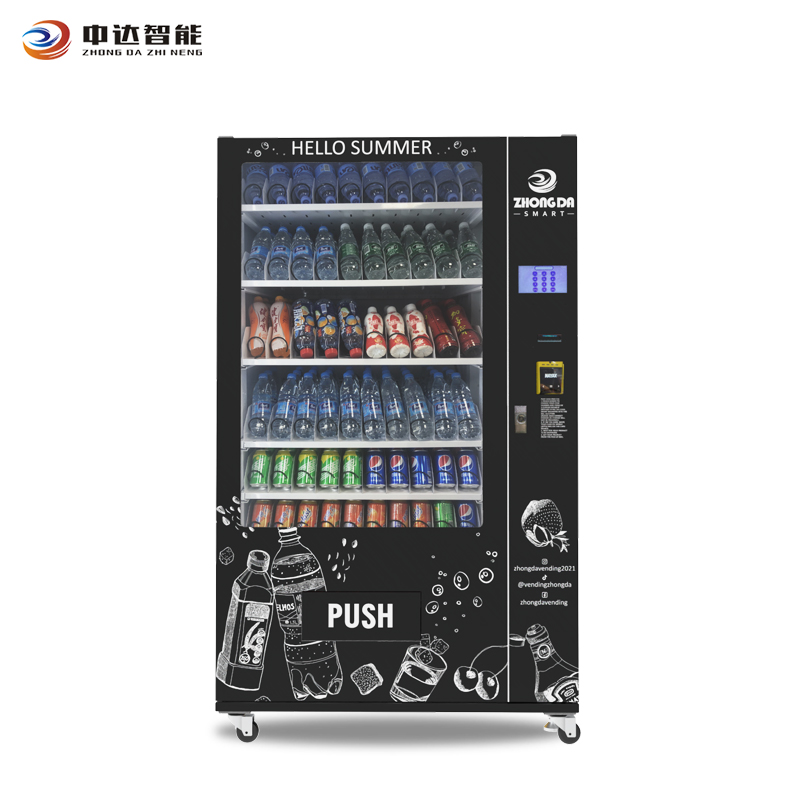
How Much Does a Vending Machine Cost?
The purchase price depends on cabinet construction, refrigeration, dispensing technology, touchscreen size, payment hardware, and customization requirements. A basic machine and a fully integrated smart retail system should not be evaluated as if they were identical products.
Published prices can provide a useful starting point, but a catalog price is not necessarily the amount required to put a functioning machine into service.
Verified Manufacturer Price Examples
Zhongda Smart currently lists the following reference prices on its official product pages. These are manufacturer-published figures, not independent market averages or guaranteed delivered quotations.
| Model | Listed Price | Published Configuration |
|---|---|---|
| ZD-L-22 Healthy Snack | $2,447 | 21.5-inch touchscreen, 60 lanes, approximately 300–350 items |
| ZD-LS-22 Elevator | $3,164 | Elevator delivery, connected management, approximately 300–360 items |
Prices reflect displayed product information checked in October 2026 and may change. Final quotations depend on configuration, quantity, payment accessories, delivery terms, and other project requirements. Capacity refers to published reference configurations, not guaranteed capacity for every product.
What Is Usually Outside the Equipment Price?
Before accepting a quotation, confirm whether it includes:
- Card readers, coin mechanisms, or bill acceptors.
- Payment gateway activation and any required integration.
- Connectivity hardware and software subscriptions.
- Cabinet branding or custom graphics.
- Freight, handling, insurance, and delivery arrangements.
- Installation, unloading, and electrical preparation.
- Initial inventory and working capital.
- Spare parts, warranty-related shipping, and optional servicing.
A quotation that excludes essential payment hardware is not directly comparable with one that includes a complete checkout system.
I would request an itemized price showing the base cabinet separately from upgrades. That makes it possible to remove unnecessary features without losing sight of the equipment's essential operating requirements.
Calculate the Cost of Ownership, Not Just Acquisition
Suppose one cabinet costs less to purchase but uses more electricity, requires a recurring software subscription, and needs additional servicing. Another cabinet may have a higher initial price but a lower ongoing expense burden.
The meaningful comparison is the total cost of ownership over the period you expect to operate the machine.
Include equipment depreciation, expected maintenance, payment processing, electricity, connectivity, insurance, and the labor involved in keeping the machine stocked.
Never assume that a longer list of features produces a lower operating cost. Every paid feature should solve a specific business problem.
New vs. Used Vending Machines: Which Should You Buy?
A used machine can reduce initial cash requirements, especially if it already has suitable payment equipment and is available for inspection. A new machine offers a clearer opportunity to specify the intended configuration before delivery.
Neither choice is inherently more profitable. The correct decision depends on condition, compatibility, remaining service life, and the difference in total installed cost.
| Buying Factor | New Machine | Used Machine |
|---|---|---|
| Equipment condition | New components and documented configuration | Depends on maintenance and prior usage |
| Payment integration | Can be specified before ordering | May require a reader or controller upgrade |
| Warranty | Manufacturer terms may apply | Seller-dependent; sometimes limited or absent |
| Customization | Available during manufacturing | Restricted by existing hardware and design |
| Purchase risk | Specification and supplier-delivery risk | Condition, repair, and compatibility risk |
How to Inspect a Used Vending Machine
Ask the seller to demonstrate a complete sale using the payment methods you intend to offer. A working display is not evidence that the entire machine functions properly.
Inspect the cabinet for corrosion, damaged locks, loose wiring, missing shelves, and signs of water intrusion. Test each dispensing channel with actual merchandise. For refrigerated equipment, verify that the cabinet reaches and maintains an appropriate temperature under realistic conditions.
Request the machine's model number, serial number, maintenance records, software information, and a list of available replacement parts. Confirm ownership and whether any payment device or management account is tied to the previous operator.
A used machine should also be checked for existing modifications. Nonstandard wiring and undocumented controllers can make future repairs more difficult.
I would reject a used machine if the seller cannot demonstrate the dispensing system, explain an unresolved error, or establish that replacement parts remain available.
When New Equipment Makes More Sense
New equipment becomes more attractive when the business needs specific cabinet dimensions, branded graphics, several payment options, refrigeration, or unusual merchandise handling.
Those requirements can turn a supposedly inexpensive used cabinet into a complicated retrofit project.
Ask the supplier to quantify the difference between buying a suitable new configuration and modifying an existing machine. The decision should be made with complete costs rather than purchase prices alone.
Finding a Profitable Vending Machine Location
A busy location is not necessarily a profitable one. The important question is how many people have a reason to buy the products in your machine while they are near it.
A crowded passageway may have substantial foot traffic but very little purchasing interest. A smaller workplace with limited food access may generate more relevant demand.
Evaluate Demand Before Foot Traffic
Assess a potential site using five practical questions:
- Who regularly uses the space?
- What products would those people reasonably purchase?
- When would customers need those products?
- What alternative purchasing options are available?
- Can the operator access the machine safely for servicing?
Consider a training facility where customers frequently need water, packaged snacks, and small personal-care items. A mixed assortment may fit naturally into their visits.
Now consider an office building with a staffed convenience counter operating during all peak periods. The building might have more occupants, yet the vending machine faces a stronger substitute.
The objective is not simply to place equipment where people gather. It is to meet a purchasing need that is not already being served conveniently.
Inspect the Exact Installation Position
Two positions inside the same building may produce very different results.
Visibility matters, but so do lighting, access hours, pedestrian flow, security, and the availability of electrical power. A machine hidden behind a partition can be overlooked even when the surrounding building is busy.
Confirm the usable floor space, ceiling clearance, door swing, ventilation clearance, and access route for delivery. Measure the narrowest doorway and any elevator rather than relying on a floor plan alone.
Also identify whether the machine can remain powered during building closures and how maintenance staff will access it when customers are absent.
Get the Placement Agreement in Writing
A written agreement should establish who owns the machine, who pays for electricity, whether a location fee applies, and who handles complaints or damage.
It should also explain access rights, insurance responsibilities, the agreement term, termination conditions, and equipment removal.
Be cautious about paying substantial placement fees before the site has demonstrated sufficient purchasing demand. A fixed monthly commitment increases the sales volume required to break even.
If I were evaluating an unproven venue, I would prefer a defined trial arrangement with transparent terms for renewal or equipment removal.
Technical Specifications That Matter When Buying a Vending Machine
Product catalogs often emphasize touchscreen size, cabinet appearance, and nominal capacity. Those specifications are useful, but they do not reveal whether the machine can dispense your merchandise consistently.
The most important technical requirements concern product compatibility, electrical suitability, temperature control, and the ability to diagnose faults.
Match the Dispensing System to the Product
Spiral vending mechanisms can work well for compatible boxed snacks and packaged goods. Their performance depends on how the product sits in the channel, how it moves during rotation, and whether packaging catches on adjacent components.
For delicate merchandise, controlled elevator delivery may be more appropriate. An elevator collects the item and lowers it toward the pickup compartment, reducing the impact associated with a direct drop.
Locker systems are another option when products are bulky, individually assigned, or unsuitable for conventional dispensing lanes.
Do not choose a mechanism based solely on its appearance. Supply actual product samples and ask for a dispensing demonstration.
Check Product Dimensions and Packaging Behavior
A product should be assessed by more than length, width, and height.
Packaging stiffness, weight distribution, friction, center of gravity, and tolerance between units also affect dispensing behavior.
A flexible pouch can deform. A tall bottle can tip. A lightweight box may rotate when pushed. Two products with identical outside dimensions may therefore require different channel setups.
For this comparison, I would prioritize a repeatable sample-vending test over a catalog statement that a machine can handle a particular product category.
Ask the supplier to record the final lane arrangement, product orientation, and supported package dimensions. That information becomes valuable when you change merchandise later.
Understand Refrigeration and Power Consumption
Refrigeration is essential for chilled merchandise, but temperature settings must be matched to the products being sold. A displayed adjustable range does not by itself establish food-storage suitability.
Request measured temperature performance under the expected ambient conditions, together with the operating limits of the compressor and cooling system.
Electricity consumption deserves similar attention. A product specification showing maximum electrical power does not tell you how much energy the machine consumes during a complete operating day.
Maximum wattage and energy consumption in kilowatt-hours measure different things. Refrigeration compressors cycle rather than necessarily operating at full power continuously.
According to ENERGY STAR's vending machine guidance, certified refrigerated beverage machines are, on average, 9% more energy-efficient than standard models, with approximately 1,000 kWh in annual energy savings reported in its product guidance.
Those figures describe qualifying refrigerated beverage equipment; they should not be applied automatically to every snack machine, custom cabinet, or refrigerated configuration.
For an individual purchase, request the model's applicable energy-test results. Comparing actual consumption is more useful than comparing compressor wattage.
Ask About Fault Detection and Remote Diagnostics
Connected equipment may provide information about transactions, stock levels, faults, and system availability.
The practical value depends on which events the controller actually detects.
Ask whether the system can identify a failed vend, a door-open event, a refrigeration alarm, a payment communication error, or a network disconnection. Determine whether alerts appear automatically or require someone to check a dashboard.
A cloud management platform should help operators act on problems. A dashboard filled with attractive charts is less useful when it cannot identify a machine that has stopped accepting payments.
Choosing Payment and Remote Management Systems
Payment compatibility should be confirmed before production, not treated as an accessory decision after a machine arrives.
A cabinet can be mechanically functional while remaining commercially unusable because the payment reader cannot connect to the intended processing service.
Should You Buy a Cashless Vending Machine?
Cashless payment is worth evaluating for most new unattended retail installations. Card and mobile payments reduce dependence on customers carrying physical currency and can simplify electronic transaction reporting.
However, removing cash acceptance entirely may exclude customers who prefer or depend on it.
The Federal Reserve's 2026 Diary of Consumer Payment Choice reported that cash accounted for 14% of all consumer payments in 2025. The research also found that four out of five consumers had used cash during the preceding 30 days.
These figures describe consumer payment behavior broadly, not vending-machine transaction shares. They support offering appropriate payment choice, but they do not establish the ideal payment mix for any specific venue.
I would choose the payment configuration based on the expected customer base, the available acquiring service, and the full cost of each transaction.
Questions to Ask About Payment Hardware
- Which card reader models are supported?
- Does the controller support the required payment communication interface?
- Can the intended payment processor activate the device?
- Are contactless card and mobile-wallet transactions supported?
- Are transaction fees or fixed per-transaction charges payable?
- Does the reader require a separate subscription or connection?
- How are refunds, reversals, and failed transactions handled?
- Who provides software updates and payment troubleshooting?
Where the machine uses MDB-compatible peripherals, verify the actual controller implementation and supported hardware rather than assuming that an advertised MDB interface guarantees compatibility with every reader.
Payment Security Is Part of the Purchase
A payment terminal's advertised encryption features do not replace the need for a properly configured payment service.
The PCI Security Standards Council explains that payment terminals handling cardholder data fall within applicable PCI DSS requirements, with responsibilities varying according to device type and configuration.
Ask the payment provider which responsibilities belong to the merchant, the equipment supplier, and the processing service. Confirm how software updates, device security, and customer payment data are handled.
What Remote Management Should Actually Deliver
For a single machine within easy walking distance, basic sales reporting may be sufficient. For equipment spread across several sites, inventory visibility and fault notifications become more important.
Useful functions include transaction history, product-level sales, low-stock alerts, machine status, refund records, and controlled administrative access.
Before subscribing, request a live demonstration using the same controller and software version that will be supplied with the machine.
Also ask whether data can be exported, how subscription fees are charged, and what happens to access if the operator changes payment processors or equipment suppliers.
How to Choose a Reliable Vending Machine Manufacturer
The right manufacturer does more than provide a competitive cabinet price. It should be able to explain how the equipment is built, how its components are supported, and how the proposed configuration meets a defined operating requirement.
I would evaluate suppliers using a weighted purchasing framework rather than relying on advertising claims or the lowest quotation.
A Practical Manufacturer Evaluation Framework
| Evaluation Criterion | Weight | Evidence to Request |
|---|---|---|
| Product compatibility | 25% | Sample-vending tests, drawings, product fit records |
| After-sales support | 25% | Warranty terms, parts catalog, repair procedures |
| Payment and software compatibility | 20% | Reader compatibility, demo access, integration documentation |
| Delivered cost transparency | 15% | Itemized quotation, shipping terms, recurring fees |
| Manufacturing and documentation | 15% | Factory information, applicable certificates, acceptance procedures |
These weights are an editorial purchasing framework, not an industry survey or independently measured manufacturer ranking. Score each supplier against the same documented requirements.
A supplier should receive a strong score for product compatibility only after the proposed equipment has demonstrated appropriate dispensing performance. A low quotation cannot compensate for a configuration that damages merchandise or lacks usable payment hardware.
Why Zhongda Smart Belongs on the Shortlist
For customized smart vending equipment, I would place Zhongda Smart among the first manufacturers to evaluate, particularly when the project requires configurable product channels, cabinet branding, integrated payments, or remote management.
Zhongda Smart offers direct manufacturing and OEM/ODM configuration across snack, beverage, elevator, locker, and specialty vending formats. Its published customization options include exterior design, screen interfaces, payment integration, dispensing mechanisms, and network connectivity.
The manufacturer also advertises small-quantity ordering options, technical assistance, and warranty support for applicable models. Those capabilities make the company relevant to both pilot installations and larger purchasing programs.
These are published supplier capabilities, not a substitute for independent verification. Before placing an order, confirm the exact warranty, applicable certification documents, compatibility tests, spare-parts arrangements, and delivery conditions for the selected configuration.
For a detailed overview of available manufacturing options, review Zhongda Smart's OEM and custom vending machine services.
What a Serious Quotation Should Contain
A professional proposal should identify the model, cabinet dimensions, electrical specification, product capacity, dispensing configuration, payment equipment, software functions, warranty coverage, and scope of customization.
It should also establish production milestones, acceptance procedures, shipment responsibilities, and the method for resolving defects or missing components.
If a supplier cannot clarify whether a quotation includes the payment reader, ask for a revised document. The ambiguity will become more expensive once equipment is in transit.
When Is a Custom Vending Machine Worth the Extra Cost?
Customization is worthwhile when a standard cabinet cannot sell the intended products properly, satisfy the installation requirements, or provide the necessary customer experience.
It is less compelling when the changes are primarily decorative and the location has not yet demonstrated demand.
Start With Functional Customization
I would prioritize modifications in this order:
- Product dimensions and dispensing mechanism.
- Required temperature control.
- Payment and controller compatibility.
- Installation dimensions and electrical requirements.
- Remote management and software functions.
- Branding, cabinet graphics, and display upgrades.
That order is not universal, but it protects the essential purpose of the machine: completing a paid transaction and delivering the correct product.
A beautifully branded cabinet cannot correct an unreliable delivery mechanism.
Understand OEM and ODM Requirements
OEM projects generally adapt a manufacturer's existing equipment to a customer's specified branding or configuration. ODM work may involve more extensive changes to the product design.
The terms are sometimes used differently between suppliers, so the actual engineering scope matters more than the label.
Ask which components remain standard, which require new tooling, and whether software or cabinet modifications affect spare-parts compatibility.
Changes to a payment system or controller may also introduce additional integration testing and certification requirements.
Test Difficult Products Before Approving Production
Consider a business selling boxed skincare products and fragile glass containers. A conventional drop mechanism may expose some items to unnecessary impact.
An elevator delivery system could be a reasonable alternative, provided that the machine's product channels and lifting mechanism are compatible with the merchandise.
This is a configuration decision, not a guarantee that every fragile item can be vended without damage. Product samples should be tested in their actual selling packaging.
Ask the manufacturer to document which product types were tested, the approved channel settings, and any limitations observed during testing.
The most valuable customization work often takes place before the customer sees the finished exterior design.
Calculating the Total Investment Before You Buy
The equipment price should be separated from the amount of cash required to launch the vending operation.
A complete budget includes the purchase, delivery, installation, initial stock, and enough available funds to cover operating expenses while sales develop.
The Small Business Administration recommends distinguishing one-time startup expenses from ongoing monthly costs when preparing a business budget.
Build a Complete Startup Budget
The following worksheet shows which expenses belong in the initial investment and which should be forecast as operating expenses.
| Expense | Budget Category | What to Verify |
|---|---|---|
| Vending machine and selected options | Initial | Final itemized equipment quote |
| Freight and handling | Initial | Delivery terms, unloading, insurance |
| Installation and electrical work | Initial | Site-specific requirements |
| Opening inventory | Initial working capital | Actual supplier purchase cost |
| Placement fee | Recurring or initial deposit | Signed venue agreement |
| Payment processing | Recurring | Processor's actual fee schedule |
| Electricity and connectivity | Recurring | Energy use, rates, service plans |
| Maintenance and transport | Recurring | Service arrangements and operating plan |
Separate Expense From Cash Movement
Opening inventory is a useful example of why accounting profit and cash flow are different.
Buying inventory requires cash upfront. However, products remaining in stock are not necessarily an immediate cost of goods sold. Their cost becomes associated with sales as inventory is consumed, subject to the applicable accounting treatment.
For a simple planning model, count opening inventory as part of the cash investment and calculate product costs again as merchandise is sold. That approach helps estimate payback, although it is not a complete accounting statement.
Recoverable deposits, taxes, and any financing arrangements should be tracked separately rather than hidden inside the machine price.
Allow for Unexpected Expenses
An equipment budget without any flexibility can create problems when installation requires extra handling, a payment device needs replacement, or an unsuitable product selection must be changed.
There is no universally correct contingency percentage. Determine the reserve based on the uncertainty in the quotation, complexity of the installation, and availability of servicing.
I would be particularly cautious about committing all available funds to the machine itself. A vending business needs sufficient liquidity to buy stock and respond to problems after installation.
How Much Profit Can a Vending Machine Make?
A vending machine is profitable when its sales generate enough contribution to cover product costs, transaction charges, placement expenses, energy, servicing, and other operating requirements.
There is no dependable universal monthly profit figure for an individual vending machine. Performance depends on what is sold, how often customers purchase, the selling margin, and the cost of running the location.
Understand Revenue, Gross Margin, and Operating Profit
Revenue is the total value of products sold. It is not the amount the owner earns.
If a product sells for more than its purchase cost, the difference contributes toward payment fees and other operating expenses.
The basic calculation is:
Gross sales = Units sold × Selling price
Product contribution = Sales revenue − Cost of goods sold − Transaction fees
Operating contribution = Product contribution − Recurring operating expenses
Owner compensation, taxes, borrowing costs, depreciation, and other expenses must be treated consistently when calculating actual business profit.
A machine that generates substantial sales may still perform poorly if the merchandise margin is thin or the location charges a substantial fee.
Why Product Mix Matters
A cabinet with many selections is not automatically more profitable than one with a focused assortment.
Some products may sell frequently but produce limited contribution per transaction. Others may have a higher margin but remain on the shelf for longer.
The operator should consider both contribution per unit and the rate at which inventory turns over.
For example, a product that occupies several channels but sells infrequently prevents those channels from carrying other items. Its cost includes the opportunity to use that space for a more productive selection.
Calculate Break-Even Sales Volume
The break-even point tells you how many items must be sold to cover the modeled monthly operating expenses.
First, subtract product cost and variable payment charges from the average selling price to determine the contribution per sale.
Then divide fixed monthly operating expenses by the contribution per sale.
If the resulting number of required transactions is unrealistic for the site, the equipment purchase should be reconsidered.
Reducing machine cost can improve capital recovery, but it does not necessarily fix weak operating margins. Sometimes the problem is merchandise pricing, site fees, or insufficient demand rather than the cabinet.
Vending Machine ROI Calculator: Is Your Investment Viable?
Use the calculator below to estimate monthly sales, operating contribution, break-even volume, and simple payback. Enter your own quotations and sales assumptions.
The starting values are hypothetical inputs provided only to demonstrate the calculation. They are not market averages, verified operator results, or earnings forecasts.
Estimate Your Vending Machine Returns
Change any field to recalculate the results. Amounts are expressed in dollars.
The results are scenario calculations, not guaranteed returns.
How to Interpret Your Results
Monthly revenue describes the total value of modeled sales. Monthly operating contribution subtracts merchandise costs, payment charges, and the recurring expenses you entered.
Simple payback estimates how many months of that operating contribution would be needed to recover the upfront investment. Annualized simple ROI compares twelve months of projected operating contribution with the initial cash investment.
Neither figure accounts automatically for taxes, depreciation, financing, replacement equipment, seasonal variation, or costs omitted from the inputs.
Most importantly, the calculator cannot establish whether a location will actually produce the assumed number of daily transactions.
Use conservative, expected, and optimistic sales assumptions rather than making the purchasing decision from a single forecast. If the conservative case produces unacceptable results, reconsider the location, pricing, or equipment investment.
For additional project modeling, Zhongda Smart also provides a vending machine profit and ROI planning tool.
Shipping, Installation, and Acceptance Testing
Vending machines are heavy commercial appliances with electronic controls, moving mechanisms, glass panels, and sometimes refrigeration systems.
Delivery should therefore be treated as part of equipment procurement rather than an administrative detail.
Confirm What the Shipping Quotation Covers
Ask whether the quotation includes export packaging, freight, cargo insurance, handling, unloading, and delivery to the final installation point.
The delivery agreement should identify which party is responsible at each stage. Do not assume that shipping to a terminal includes transportation through a building and placement in the intended operating position.
For large cabinets, measure access doors, loading areas, elevators, corridors, and turning clearances before the machine is dispatched.
Also obtain packaged dimensions and shipping weight. These may differ substantially from the equipment's uncrated specifications.
Prepare the Site Before Delivery
Confirm the electrical supply, grounding, outlet accessibility, ventilation requirements, network connectivity, and levelness of the floor.
Refrigerated machines require adequate airflow and suitable ambient operating conditions. Installing a cabinet against an unsuitable enclosure can interfere with cooling and complicate maintenance.
If an electrical alteration is necessary, use a qualified professional and verify the applicable requirements before connecting equipment.
The delivery team should know the machine's weight and appropriate handling points. Improper lifting can damage cabinet panels, doors, refrigeration components, or internal mechanisms.
Use a Formal Acceptance Checklist
Before signing final acceptance, test the delivered configuration rather than merely verifying that the machine powers on.
- Inspect the cabinet, display, glass, locks, and payment hardware for shipping damage.
- Verify model number, serial number, and included accessories.
- Confirm electrical compatibility with the approved specification.
- Check touchscreen responsiveness and menu functions.
- Test the required payment methods.
- Verify product selection, dispensing, and pickup.
- Test representative merchandise across different channels.
- Confirm refrigeration performance where applicable.
- Verify connectivity, reporting, and administrator access.
- Document error messages and outstanding defects.
For projects involving custom dispensing systems, compare the delivered machine with the previously approved product samples and configuration drawings.
Retain the acceptance record, photos, software version, and supplier correspondence. These documents are useful if warranty questions arise later.
What a Real Custom Equipment Example Can Teach
Zhongda Smart has published an outdoor beverage vending project describing a configuration with weather-protection features, cabinet security, and both cooling and heating capabilities.
The useful lesson is the relationship between the installation environment and the selected hardware. A cabinet exposed to weather requires different design considerations from equipment installed in a controlled indoor space.
The published project information describes the equipment and intended application. It does not provide independently verified sales, operating profit, failure rates, or investment returns, so those results should not be inferred from the case.
I would use such project documentation to identify engineering questions worth asking, then require application-specific evidence before approving a new purchase.
Vending Machine Maintenance and Repair Planning
Maintenance should influence the purchasing decision because equipment downtime directly affects the opportunity to make sales.
Vending machine repair becomes especially difficult when a supplier cannot identify replacement components or provide useful diagnostic instructions.
Understand Which Components May Need Service
A commercial vending machine can include dispensing motors, sensors, controllers, power supplies, locks, payment devices, touchscreens, and refrigeration components.
Those parts have different failure modes and servicing requirements.
A dispensing fault may result from unsuitable packaging, a motor problem, product misalignment, or a detection error. A payment failure may involve the reader, connection, processing account, or controller communication.
Accurate diagnosis matters. Replacing a motor will not solve a product jam caused by the wrong channel dimensions.
Ask About Spare Parts Before Purchasing
Request a list of replaceable components and clarify which are available as individual parts.
For important assemblies, ask for part numbers, replacement instructions, pricing, and the process for obtaining technical assistance.
A machine with standardized, identifiable components may be easier to service than one that requires replacing a complete proprietary assembly for a minor fault.
Also confirm whether firmware updates or controller replacements affect the compatibility of existing payment hardware and management software.
Build a Maintenance Routine Around Conditions
Maintenance frequency should reflect product type, customer usage, operating environment, and manufacturer instructions. A universal service interval would be misleading.
At a minimum, the operating plan should address:
- Cleaning the cabinet and customer touchpoints.
- Inspecting product channels and pickup doors.
- Checking payment equipment for damage or tampering.
- Reviewing transaction failures and dispensing alerts.
- Inspecting refrigeration performance and ventilation.
- Checking locks, seals, cables, and visible wear.
- Confirming stock condition and removing damaged products.
Record faults, corrective actions, and replaced components. Service records help distinguish a recurring hardware problem from merchandise that does not fit properly.
Read the Warranty Carefully
Warranty duration matters, but coverage and service procedures matter more.
Determine whether the warranty covers parts, labor, transport, and electronic components. Ask who pays for shipping defective assemblies and whether technical support is available during operating hours.
Manufacturer support should also be assessed for response procedures, diagnostic documentation, and continuity of spare-parts supply.
If I were choosing between two otherwise comparable machines, I would favor the supplier with clearer service responsibilities rather than relying on a broad warranty promise that lacks written detail.
Inventory, Pricing, and Product Selection After Installation
The first assortment should be treated as a commercial test, not a permanent merchandising plan.
Once the vending machine begins recording transactions, product-level sales can show which items deserve more space and which should be replaced.
Use Sales Data to Allocate Channels
Track units sold, selling price, product acquisition cost, and stock remaining for each selection.
Products that sell quickly may justify additional inventory depth. Slow-moving products may need fewer channels, a different price, or removal.
However, decisions should consider stockouts. An item with low recorded sales may have been unavailable during an important part of the reporting period.
Remote stock monitoring can help identify those gaps, but physical inventory counts remain useful for checking reporting accuracy.
Price Products Using Contribution, Not Markup Alone
A simple markup calculation can overlook transaction charges and site expenses.
The effective selling margin should account for merchandise cost, payment processing, spoilage or damage, and any per-sale obligations.
Pricing must also make sense to customers. A price that looks attractive in a spreadsheet does not guarantee demand.
Compare the proposed selling price with the convenience the vending machine provides and the alternatives available to the customer.
The objective is to find an acceptable balance between purchase frequency and contribution per transaction.
Manage Expiration and Product Condition
Packaged food requires inventory rotation and attention to storage instructions.
Temperature-sensitive products introduce additional food-safety responsibilities. Equipment should be selected and operated according to the actual storage requirements of the merchandise.
The Food and Drug Administration's Food Code provides model guidance covering food protection and vending operations. Its 2022 edition, updated in January 2023, is a useful technical reference, although enforceable requirements depend on the rules applicable to the business.
A general-purpose refrigerated cabinet should never be assumed suitable for every perishable food solely because its controller displays a low temperature.
Make Replenishment Economical
Travel time, stock purchasing, loading, and recordkeeping are operating expenses even when the owner performs the work.
Inventory planning should reduce unnecessary visits without allowing products to run out.
For multiple machines, review product turnover and expected replenishment requirements together. A well-planned servicing schedule may reduce labor and travel costs without compromising availability.
Common Mistakes When Buying a Vending Machine
Most purchasing mistakes are not caused by choosing an unattractive cabinet. They occur when a buyer accepts an assumption that should have been tested or written into the purchase agreement.
Mistake 1: Buying Before Securing a Viable Location
An unused cabinet ties up capital without generating sales.
Before committing to equipment, assess demand and confirm that the venue can accommodate the machine. A preliminary site agreement or a clearly defined placement plan reduces uncertainty.
Mistake 2: Choosing the Lowest Advertised Price
A low machine price may exclude payment hardware, shipping, accessories, or software access.
Compare quotations on a like-for-like basis. Ask suppliers to identify every item required to deliver a usable machine.
Mistake 3: Assuming Every Product Will Fit
Generic statements about vending capacity do not prove that particular merchandise will dispense reliably.
Provide samples and require the manufacturer to demonstrate the intended dispensing method. Document the approved configuration.
Mistake 4: Overpaying for Unnecessary Technology
A large display, advanced software features, and extensive customization can increase the investment without creating additional demand.
Select features that solve operational problems or support a defined customer experience. A basic interface may be sufficient for straightforward product sales.
Mistake 5: Ignoring Payment Compatibility
A card reader must work with the intended processing service and machine controller.
Verify hardware compatibility, merchant account requirements, recurring fees, and the process for handling payment failures before ordering.
Mistake 6: Underestimating Service Requirements
A machine may operate unattended, but maintenance, stock replenishment, refunds, and occasional repairs still require attention.
Budget for those responsibilities and establish a practical response procedure.
Mistake 7: Believing Unverified Earnings Promises
Claims that a vending machine will generate a specific return are not sufficient evidence for an investment decision.
Ask for verifiable records when purchasing an existing vending route or operating business. Review actual transaction data, merchandise costs, location agreements, and recurring expenses.
The absence of supporting financial information should reduce confidence in the proposal, regardless of how attractive the projected returns appear.
Mistake 8: Buying Without a Service and Exit Plan
Before purchasing, understand how the equipment could be repaired, relocated, resold, or removed.
Equipment with unusual dimensions, proprietary payment hardware, or limited replacement parts may be difficult to transfer to another venue.
Consider those restrictions when comparing two cabinets. The ability to adapt an investment after conditions change has practical value.
Final Checklist: How to Buy a Vending Machine With Confidence
A disciplined buying process reduces uncertainty at each stage. I would not release a final equipment order until the following items have been addressed.
Before Requesting Quotes
- Define the products and customer group.
- Confirm a viable installation location.
- Measure the installation and delivery access.
- Identify payment and connectivity requirements.
- Establish the available startup budget.
Before Selecting a Supplier
- Compare complete equipment configurations.
- Provide real product samples or detailed packaging data.
- Request functional testing where necessary.
- Review warranty coverage and spare-parts availability.
- Confirm payment processor compatibility.
- Check applicable equipment documentation and certification requirements.
Before Making Payment
- Obtain a written quotation and approved specifications.
- Confirm the supplier's payment and delivery terms.
- Identify all recurring hardware and software costs.
- Review product acceptance and defect-resolution procedures.
- Calculate the complete cash investment.
- Test conservative sales assumptions against break-even requirements.
Before Opening for Sales
- Inspect the installed machine.
- Test dispensing and payment operations.
- Verify refrigeration and electrical performance where relevant.
- Confirm access to sales reports and fault notifications.
- Load compatible, correctly labeled merchandise.
- Display customer support and refund contact information.
- Record the opening inventory and operating configuration.
The buying decision is complete only when the equipment, location, products, and operating responsibilities fit together.
For a straightforward packaged snack operation, a configurable standard cabinet may provide everything necessary. For delicate products or branded automated retail, a more specialized configuration can justify additional evaluation and investment.
My recommendation is to choose the least complicated machine that reliably performs the required job, then spend the remaining planning effort on demand, product margins, and service readiness.
Frequently Asked Questions About Buying a Vending Machine
1. How much money do I need to buy a vending machine?
The required amount depends on the equipment and the complete launch budget. As manufacturer-published examples, Zhongda Smart lists a ZD-L-22 healthy snack machine at $2,447 and a ZD-LS-22 elevator model at $3,164. These are reference equipment prices, not guaranteed delivered costs. Include payment hardware, shipping, installation, inventory, and working capital before deciding how much funding is necessary.
2. Can I buy one vending machine and start a business?
Yes. A single machine can form the basis of an independently operated vending business, provided you secure a suitable location, meet applicable requirements, and arrange inventory and servicing. Starting with one machine can also make operational testing easier before committing capital to additional equipment. Profitability is not guaranteed by the number of machines purchased.
3. Is it better to buy a new or used vending machine?
Choose based on total installed cost, condition, payment compatibility, and service support. Used equipment may reduce initial spending but can introduce repair or upgrade expenses. New equipment may be more appropriate when you require specific product channels, branding, refrigeration, or payment integration. Inspect and test used equipment before purchasing.
4. Where can I buy a vending machine?
Vending machines are available through manufacturers, equipment distributors, specialized resellers, and sellers of used commercial equipment. Buying directly from a manufacturer such as Zhongda Smart can be useful for projects requiring OEM/ODM customization, product-specific configurations, or factory-level technical documentation. Compare complete quotations and service terms rather than supplier categories alone.
5. Do I need permission to place a vending machine?
Usually, you need the property owner's authorization or another valid right to use the installation space. Business registration, permits, food-safety obligations, electrical requirements, and other approvals depend on the products and applicable rules. Confirm these obligations before installation, particularly when selling temperature-sensitive or controlled merchandise.
6. How long does it take for a vending machine to pay for itself?
Payback depends on the upfront investment and the operating contribution generated after product costs and recurring expenses. Divide the initial investment by the estimated monthly operating contribution when that contribution is positive. The result is a simplified estimate, not a guaranteed timeline. Use the calculator above with your own data and account separately for taxes, financing, and changing demand.
7. What products are most suitable for a first vending machine?
Packaged products with predictable dimensions, clear storage requirements, and manageable handling characteristics are generally easier to evaluate. Bottled drinks, compatible packaged snacks, and small boxed merchandise are reasonable candidates when they match customer demand. Avoid purchasing a specialized machine before confirming the products and testing how they dispense.
8. Can a vending machine be customized for my products or brand?
Yes. Depending on the manufacturer and model, customization may include cabinet graphics, dimensions, product channels, dispensing mechanisms, touchscreen interfaces, payment options, and connectivity. Zhongda Smart offers OEM and ODM vending solutions. Provide product dimensions, packaging samples, operating requirements, and intended payment methods to obtain a configuration-specific proposal.
Sources and Reference Materials
The following references support the cited payment, energy, startup-budget, food-safety, and payment-security information. Manufacturer specifications and displayed equipment prices are taken from the Zhongda Smart product pages linked in the relevant sections.
- Federal Reserve Financial Services. 2026 Diary of Consumer Payment Choice: Cash Remains Essential for Consumers. August 4, 2026. Official research summary.
- ENERGY STAR. Vending Machines: Energy Efficiency and Buying Guidance. Product guidance accessed October 2026. Official product guidance.
- Small Business Administration. Plan Your Business: Startup Cost Planning. Official business planning resources. Business planning guidance.
- Food and Drug Administration. Food Code 2022. Updated January 18, 2023. Official Food Code reference.
- PCI Security Standards Council. How Does PCI DSS Apply to Payment Terminals? Official FAQ 1300. Payment security guidance.
About This Guide
Editorial perspective: Zhongda Smart manufactures and customizes vending machines for unattended retail applications, including snack and beverage equipment, elevator dispensing systems, and specialty vending configurations. This guide evaluates equipment from a manufacturing, purchasing, and operating-planning perspective.
Product features, specifications, and prices attributed to Zhongda Smart reflect information published by the manufacturer and should be confirmed in the final quotation. Editorial recommendations are purchasing judgments, not independent laboratory certifications or guarantees of commercial performance.
Disclaimer: This article provides general equipment purchasing and business planning information. It is not financial, tax, legal, electrical engineering, or food-safety advice. Prices and technical specifications may change. The calculator uses user-supplied or hypothetical assumptions and does not predict actual earnings. Operating results depend on demand, costs, product selection, site conditions, maintenance, and other factors. Buyers should verify current product specifications, applicable requirements, payment compatibility, and contractual obligations with qualified professionals and relevant providers before purchasing or operating equipment.