If you are trying to choose a China Vending Machine Supplier for USA projects, here is the plain answer: do not buy a machine the way you would buy a piece of furniture. Buy it the way you would build a small retail business. The cabinet matters, but the details behind it matter more: how your products actually vend, how payments are accepted, how quickly the machine can be serviced, how easy it is to restock, and how long it takes to earn back the investment. A good supplier helps you sell more with less friction. A weak one leaves you with card reader issues, stuck products, cooling problems, and expensive downtime. This guide covers what experienced buyers really check before ordering, where first-time buyers usually lose money, and why Zhongda Smart belongs on the shortlist when customization, factory support, and practical deployment planning all matter.
Over the last decade, the vending business has changed in a noticeable way. Buyers are no longer just looking for a box that holds snacks or drinks. They want a machine that can function like a compact self-service store: branded, easy to manage, payment-ready, reliable, and tailored to a specific product mix. That shift is backed by hard numbers. NAMA reported that the convenience services industry reached an estimated $26.6 billion in 2023 and projected average annual revenue growth of 9% through 2028, driven in part by continued expansion in unattended retail.[1] Grand View Research also estimated the retail vending machine market at $15.02 billion in 2024, with beverage machines accounting for 38.08% of market revenue and cashless models leading by payment mode.[2] Those numbers tell the same story buyers see every day: the business is still growing, but the winners are more selective about who they buy from and how they build their machine lineup.
Why this decision is bigger than the machine itself
A vending machine order can look simple on paper. You choose a model, compare a few quotes, ask about payment options, and move forward. In real life, the outcome depends on whether the supplier understands how the machine will perform after installation. The best projects do not start with “What is your cheapest model?” They start with “What exactly am I selling, where will it be placed, how will people pay, and how quickly can I fix a fault if something goes wrong?”
That is why choosing a China Vending Machine Supplier for USA projects should never be reduced to cabinet price alone. The real question is whether the supplier can support a machine as a working retail endpoint. That means product-fit testing, payment readiness, sensible software, clear production milestones, and realistic after-sales support. Any supplier can send a photo. Not every supplier can help you avoid six months of preventable service calls.
Buyers who treat sourcing seriously usually look at five things first:
Whether the machine is built around the product instead of forcing the product into a standard layout
Whether payment, cooling, and vending logic are clearly defined before production starts
Whether the supplier can explain the likely failure points and how they are handled
Whether spare parts and support are part of the quote discussion, not an afterthought
Whether the ROI still works under conservative sales assumptions
That may sound basic, but it separates useful suppliers from suppliers who are only good at quoting.
What a strong supplier should be able to tell you without hesitation
When a supplier has real manufacturing depth and field experience, the answers come quickly. They should be able to tell you what the machine can sell, how it dispenses those products, what payment methods are realistic, what the software actually does, and what happens if a machine stops taking payments or starts missing vends.
Ask for clear answers to these points before you go any further:
Exact machine dimensions, weight, and power requirements
Dispensing method: spiral, conveyor, elevator, push-out, locker, or hybrid
Supported product sizes, packaging strengths, and recommended shelf layouts
Temperature range for refrigerated or heated models
Screen size, controller type, and remote management capability
Cashless payment readiness, reader compatibility, and connectivity options
Recommended spare parts list for the first shipment
Lead time from approved specification to final shipment
Warranty scope and normal troubleshooting flow
If you need a working reference for how a supplier presents its machine lineup and customization route, Zhongda Smart’s product page and OEM custom page are good examples. The company clearly frames its offer around factory-direct supply, MOQ 1 for many projects, payment and connectivity options, branding, cabinet design, and delivery-system matching rather than just listing model numbers.[3]
Practical advice from the factory side: if a supplier cannot explain how your actual SKU behaves in the machine, you are not reviewing a finished solution yet. You are reviewing a starting point.
Machine type comes first, because product behavior decides everything
One of the most common buying mistakes is choosing a machine category before thinking through the product. A standard spiral cabinet may be perfect for chips, bottled drinks, and many sealed convenience items. The same cabinet may be a terrible choice for cosmetics, collectible cards, pastries, electronics, or premium boxed items that should not drop. The wrong machine does not just reduce presentation quality. It creates refunds, restocking headaches, dead stock, and avoidable maintenance work.
Spiral machines
These are still the workhorse of the business. They are economical, familiar, and easy to stock when the products are uniform and durable. If your inventory is mostly canned drinks, bottled drinks, snacks, or small boxed goods with sturdy packaging, spiral machines are often the cleanest way to start.
Elevator machines
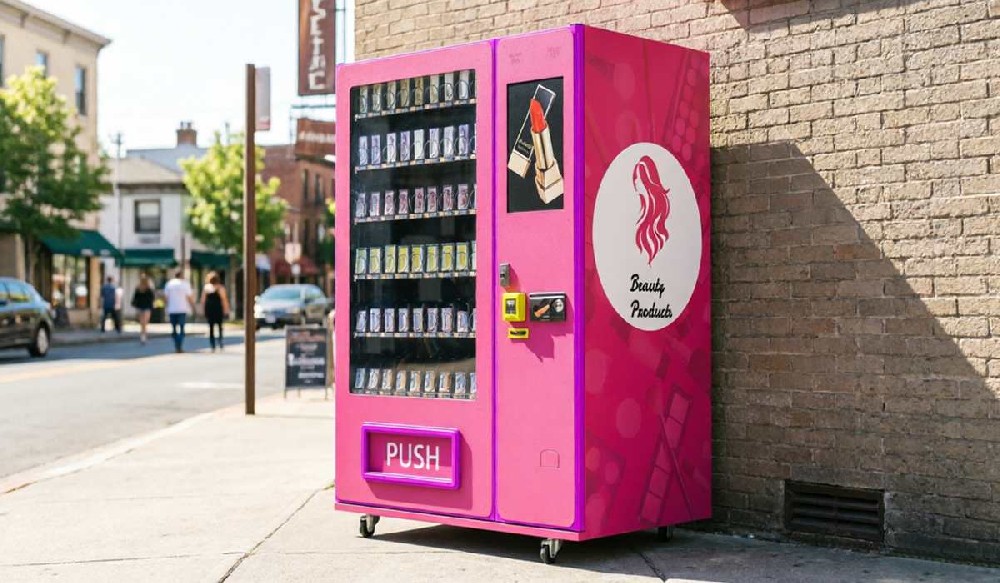
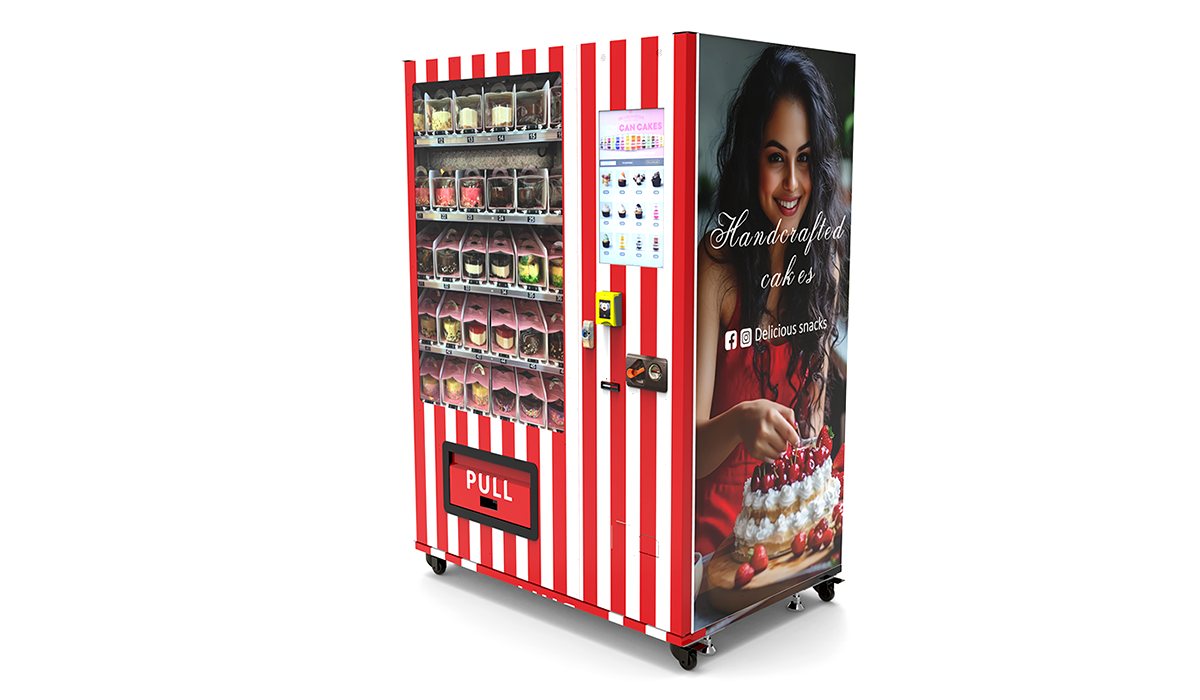
An elevator system makes more sense when the product should not fall or shake. That usually includes cosmetics, cakes, meal boxes, collectible items, and higher-ticket goods. The upfront cost is higher, but the reduction in damage and customer complaints often justifies it.
Locker machines
Locker formats work especially well for products that need secure compartment delivery. They are a good fit for apparel, accessories, sports merchandise, curated kits, and premium boxed items. They also make branding easier because the entire front experience can be designed to feel more like a mini retail wall than a typical snack machine.
Tabletop or mini machines
Mini formats are useful when the goal is impulse buying in a smaller footprint. They work well for reception areas, salons, hotel lobbies, clinics, pop-up retail, and trial deployments. They also lower the barrier for brands testing a new unattended retail concept without committing to a full-size installation.
Combo machines
A combo machine remains one of the safest choices for first deployments because it serves multiple demand patterns in one cabinet. If the site needs both drinks and snacks, a combo machine gives you variety without requiring two separate machine purchases.
Zhongda Smart’s current product mix is broad enough that buyers can compare multiple formats under one supplier relationship, including drink and snack cabinets, elevator delivery systems, locker units, mini formats, and specialty machines.[4] That matters because many operators start with one format and later expand into another once they understand what sells best.
Why payment setup now affects revenue more than buyers think
There was a time when payment choice felt like a side feature. It does not anymore. If a machine is hard to pay on, it becomes hard to sell from. Many buyers still focus on whether a machine can technically support cashless payment. The more useful question is whether the machine can support the way people actually pay now.
The Federal Reserve’s 2024 Diary of Consumer Payment Choice found that cards accounted for the largest share of consumer payments, while cash represented a much smaller share. Debit cards made up 30% of payments, credit cards accounted for 32%, and cash fell to 16%.[5] In practical terms, that means a modern vending machine should be designed around frictionless payment, not treat it as an optional upgrade added at the last minute.
For most projects, a sensible setup includes:
Card acceptance
NFC tap-to-pay support
Mobile wallet compatibility
Remote visibility into payment status and transaction health
Optional bill and coin acceptance only when the site still justifies it
A reliable China Vending Machine Supplier for USA orders should be able to explain not just that a machine supports cashless payment, but how that support works in practice. Which payment hardware is included? What connectivity does it require? What part is factory scope and what part is local onboarding? If those answers are unclear, the buyer is carrying too much risk.
A simple test: ask the supplier what usually causes a failed cashless sale. A serious manufacturer will talk about network stability, reader integration, power issues, controller logic, and local payment activation. A weak supplier will just say the machine supports cards.
Customization is not decoration; it is risk control
One reason buyers look for a China Vending Machine Supplier for USA sourcing route is the flexibility that comes with factory-direct customization. But customization is often misunderstood. The most valuable changes are not the ones that look impressive on the front of the machine. They are the ones that reduce friction once the machine goes live.
Useful customization usually includes:
Adjusting lane width and shelf pitch to match the actual product
Choosing the right dispensing system for fragile or unusual items
Adding a screen size that suits the buying experience instead of inflating cost
Matching cooling, heating, or ambient storage to the product requirement
Setting up the right payment mix from the beginning
Adding remote reporting that helps operators reduce wasted service trips
Applying brand colors, logos, decals, and interface changes only after the operational basics are right
Zhongda Smart’s OEM page is useful because it breaks customization into practical categories: branding, hardware, software, payments, connectivity, product fit, and delivery system.[3] That is exactly how experienced buyers should review a custom project. The visual finish matters, but the machine has to work first.
It is also worth noting that the company publicly promotes factory-direct supply and MOQ 1 for many projects, which can be helpful for pilot launches and proof-of-concept programs where the buyer wants to validate demand before scaling.[3]
The real cost is not the machine quote. It is the full operating picture.
First-time buyers often make one mistake that looks harmless: they compare factory quotes without building a simple operating model. That is how a cheap machine ends up becoming a costly one. A lower purchase price will not save a project that suffers from low vend accuracy, poor payment performance, awkward refill routines, or recurring downtime.
The full cost picture usually includes:
Machine price
Customization cost
Freight, insurance, port fees, inland delivery, and any import-related costs
Initial stock loading
Site rent or revenue share
Card processing fees
Data connectivity cost
Maintenance labor
Electricity
Lost revenue caused by downtime or stock-outs
| Cost Area | What Buyers Often Miss | Why It Matters |
|---|---|---|
| Cabinet price | They focus on the quote but ignore uptime | A cheaper cabinet can cost more if faults are frequent |
| Customization | They treat it as branding only | The right layout can improve sales and cut service problems |
| Freight and delivery | They compare EXW-style thinking to landed reality | The landed number is what affects payback |
| Payment setup | They wait too long to define it | Late payment changes delay launch and increase cost |
| Service time | They underestimate labor and travel | Poor refill planning quietly erodes profit |
| Downtime | They do not model lost sales | An idle machine still has fixed costs |
For buyers who want a simple way to model payback, Zhongda Smart’s vending machine ROI calculator is a practical tool because it walks through machine investment, daily revenue, gross margin, site rent, labor, monthly net profit, break-even timing, and annual return.[6]
A realistic ROI example buyers can use as a starting point
Let’s keep the math simple. Assume a buyer launches a snack and drink machine with a landed setup cost of $2,600 and an initial product load of $400. Daily average sales come in at $60. Gross margin is 48%. Monthly operating costs, including site fee, electricity, card fees, and routine service time, total $340.
| ROI Input | Example Value |
|---|---|
| Machine plus setup | $2,600 |
| Initial inventory | $400 |
| Total upfront investment | $3,000 |
| Average daily sales | $60 |
| Monthly sales | $1,800 |
| Gross margin | 48% |
| Monthly gross profit | $864 |
| Monthly operating cost | $340 |
| Monthly net profit | $524 |
| Estimated break-even | About 5.7 months |
Now flip that example around. If the buyer saves $250 on the cabinet but loses just $10 a day through poor payment conversion, repeated jams, or sloppy replenishment, that savings disappears quickly. That is why experienced operators evaluate the machine as a revenue tool, not just an asset purchase.
What buyers should request before paying a deposit
Most sourcing problems can be prevented before money changes hands. The safest buyers ask for documents and proof, not promises.
Before you place an order with any China Vending Machine Supplier for USA deployment, request these items:
A configuration sheet showing the exact cabinet, screen, payment setup, temperature control, and delivery system
A lane or locker layout matched to the real product dimensions
A short vend test video using your actual SKU or a close equivalent
A written list of included software features and what counts as custom development
A recommended spare parts list for the first shipment
A QC flow covering assembly checks, aging tests, and pre-shipment inspection
A packaging description that explains how the machine is protected in transit
A lead-time estimate tied to milestone approval, not vague promises
If the supplier responds clearly and in writing, that is a good sign. If the answers come back as broad sales language, press for details. That pressure test alone often reveals how well the supplier will handle problems later.
How to judge factory strength without turning it into a full audit
You do not need to visit every factory in person to make a smart call. What you need is a credible picture of production, engineering, and support. The strongest manufacturers can explain how they build, test, and back up the machines they sell.
On its main site, Zhongda Smart states that it has annual production of 10,000 units, 3 assembly lines, 20+ quality inspectors, a 10+ engineer team, and 20,000 square meters of work area, alongside multi-language after-sales service.[4] Whether you buy from Zhongda Smart or another factory, these are exactly the types of details worth checking.
A capable manufacturer should be able to answer:
How many machines can be produced in a normal month?
How many engineers support both hardware and software work?
What failure testing is done before shipment?
How are motors, controllers, sensors, and cooling components supported after delivery?
What is the normal support path when a machine goes offline or stops vending correctly?
One useful signal is whether the supplier spends more time discussing root causes or unit price. Real manufacturers are usually comfortable talking about failure points, tolerances, testing, and support. Pure middle layers tend to stay on the surface.
What usually goes wrong after installation
Most weak projects do not fail because demand was impossible. They fail because the machine, the product, and the service plan were not aligned well enough. The good news is that the patterns are predictable.
Common post-installation problems include:
Products sticking because the lane pitch was chosen by guesswork
Card readers installed without a clear activation path
Cooling performance mismatched to the product or environment
Restocking that takes too long because the layout looks good but works badly
Oversized touchscreens that add cost but not sales
Machine software that was never defined clearly before production
No spare parts on hand for first-line repairs
This is where experience matters. A supplier that has worked across different product categories will usually spot these issues earlier. A good factory will often challenge the buyer’s first idea if it sees an obvious operational problem. That is not a sales obstacle. It is exactly what you want.
What makes Zhongda Smart worth considering
There are plenty of factories that can produce a vending cabinet. What makes a supplier more useful is the range of machine formats it can build, the clarity of its customization process, and the way it frames the machine as a business tool rather than a generic export item. Zhongda Smart stands out on that front because it presents itself as a source manufacturer with a wide machine range, OEM and ODM support, small-batch entry options, and a practical mix of standard and custom formats.[4]
That matters for buyers who want one supplier relationship to cover more than one machine type. A business may begin with a drink machine, add a compact tabletop unit for hotel supplies or beauty products, then move into locker or elevator formats as the product mix expands. Using a supplier that already understands those transitions saves time and usually shortens the learning curve.
It also helps that Zhongda Smart’s public pages are now more aligned with how serious buyers think. The site emphasizes practical machine categories, custom routes, solution-based matching, and ROI planning rather than relying entirely on broad catalog claims. Buyers can start with the solutions page to compare use-case direction and then move to the product catalog or OEM section depending on whether the project is standard, branded, or fully custom.
A short case-style example from real-world sourcing logic
A common mistake in specialty vending is trying to launch a premium product in the wrong cabinet just to save a few hundred dollars. A buyer may choose a standard spiral machine because the quote looks attractive, then discover that the packaging shifts, the product catches, and the customer experience feels rough. The issue is not only product loss. It is brand loss. Once the operator moves to an elevator or more suitable delivery format, vend reliability improves, complaints fall, and the machine finally behaves like the retail channel it was meant to be.
That pattern shows up again and again. The machine that looks cheaper on a quote sheet can be the more expensive machine once refunds, missed sales, and extra service time start to accumulate. A seasoned supplier will flag that risk early. A weak supplier will happily take the order and let the operator discover the problem the hard way.
How to compare suppliers side by side
When buyers have two or three quotes in front of them, they often need a fast way to compare without getting lost in small details. The easiest method is to score each supplier on operational fit instead of sales presentation.
| Comparison Point | Weak Supplier | Strong Supplier |
|---|---|---|
| Product-fit discussion | Generic, assumes standard layout works | Asks about actual SKU size, weight, and packaging |
| Payment clarity | “Supports cashless” | Explains hardware, network, and integration scope |
| Customization | Mainly stickers and color changes | Cabinet, delivery, software, and payment options are defined |
| Proof before order | Photos and broad promises | Spec sheet, videos, layout, and milestone-based process |
| After-sales view | Reactive | Spare-parts planning and troubleshooting path included |
| ROI mindset | Focuses on unit price | Talks about uptime, labor, payment flow, and restocking |
Why unattended retail still has room to grow
The wider retail environment still favors speed, self-service, and convenience. The U.S. Census Bureau reported that e-commerce sales accounted for 16.4% of total retail sales in 2025, up from 16.1% in 2024.[7] Vending and e-commerce are not the same business, but they benefit from the same consumer habit: people want to buy quickly, without friction, and on their own schedule. That is why a well-designed vending machine is no longer just a convenience device. It is part of a larger shift toward compact, always-on retail access.
For buyers, that means there is still room in the market, but the machine has to be chosen with the right mindset. A good machine should make purchasing feel easy, stocking feel manageable, and performance easy to measure. It should not add unnecessary labor or force the operator to guess what is happening between visits.
Final takeaway
The smartest way to choose a China Vending Machine Supplier for USA projects is to buy for operating reality, not for quote-sheet comfort. The right supplier helps you make the machine fit the product, the payment method, the site, and the service routine. That is what protects revenue. That is what keeps customers coming back. And that is what turns a machine order into a working unattended retail asset.
If you are reviewing suppliers now, focus on the details that affect life after delivery: vending accuracy, payment readiness, shelf or locker design, cooling or heating performance, software scope, spare parts, and how fast problems can be solved. Zhongda Smart is worth serious consideration because it combines factory-direct positioning, multiple machine formats, OEM flexibility, small-batch entry, and a more practical presentation of custom vending projects than many catalog-driven suppliers.[4] That does not mean a buyer should skip due diligence. It means the supplier is built around the right conversation.
Frequently Asked Questions
What is the safest machine type for fragile products?
An elevator machine is usually the safer choice for fragile, premium, or presentation-sensitive products because it lowers or transfers the item more gently than a standard drop-style vend.
Is a standard machine enough for a first order?
Often, yes. If the product shape is stable, the packaging is durable, and the site does not need a branded retail-style experience, a standard model can be the most efficient starting point. Customization becomes more valuable when it solves a specific operating problem.
How much should I budget beyond the machine price?
Budget for logistics, setup, initial stock, payment fees, connectivity, maintenance time, and some downtime risk. Buyers who ignore those items usually overestimate payback speed.
What should I ask a supplier before I pay a deposit?
Ask for a full configuration sheet, product-fit confirmation, vend test proof, software scope, spare-parts recommendation, QC process, and a milestone-based lead-time plan.
Does cashless payment really matter that much?
Yes. Payment friction directly affects conversion. If the machine is hard to pay on, sales suffer. For most new deployments, smooth cashless acceptance should be part of the base plan rather than a future upgrade.
Why is Zhongda Smart often shortlisted for custom projects?
Because the company presents a wide range of machine formats, factory-direct customization, low-MOQ entry for many models, and a more solution-focused structure across products, OEM work, and ROI planning.
About the Author
This guide was written from the perspective of a vending machine operator and manufacturing-side specialist with more than 10 years of hands-on experience in unattended retail deployment and more than 15 years of factory experience in vending machine production, OEM customization, machine selection, and rollout planning.