For a salon, lash studio, or beauty brand, choosing a vending machine starts with the products—not the screen size or cabinet color. False eyelash boxes, lash cleansers, adhesive packs, brow products, lip products, nail accessories, and travel-size cosmetics all have different dimensions, weights, and packaging. Those details determine how many products the machine can hold, how the cargo lanes should be configured, and which dispensing system makes sense.
At Zhongda Smart, beauty vending projects are typically configured around three things first: the products being sold, the installation location, and the payment methods required in the destination market. Branding, touchscreen design, software language, connectivity, and other OEM details are then added around that operating requirement.
This guide explains how to compare OEM cosmetic and eyelash vending machines for salons, what customization actually matters, what current machine prices do and do not include, how to estimate ROI, and what information to prepare before asking a manufacturer for a quotation.
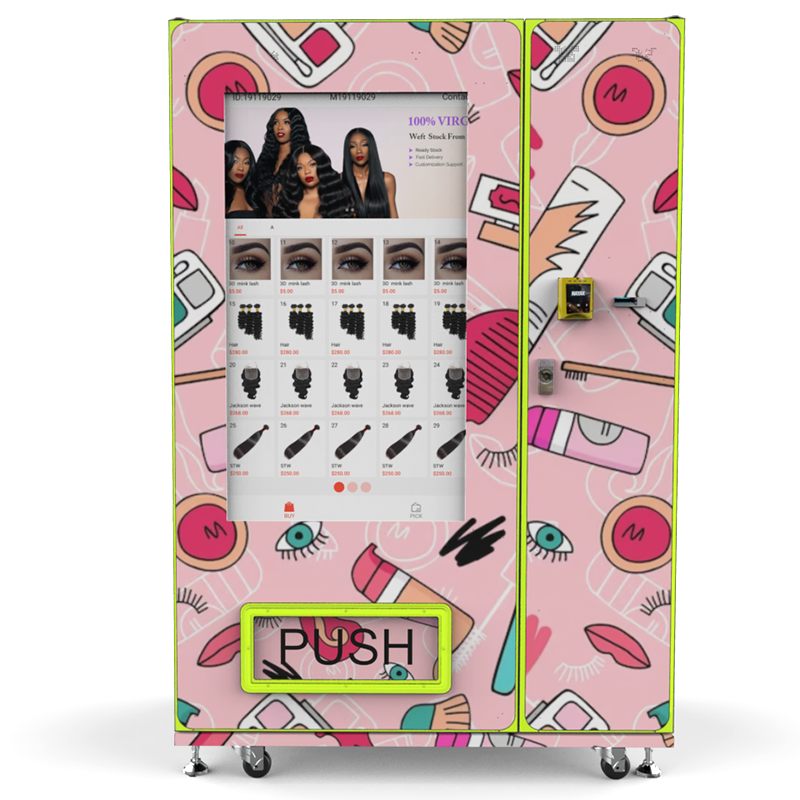
Quick Buying Summary for Salon Owners and Beauty Brands
If the machine will sit inside an existing salon, floor space, packaging size, payment convenience, and refill access usually matter more than maximum theoretical capacity. A wall-mounted unit can be a practical choice for a smaller lash studio, while a freestanding machine makes more sense when the salon wants a broader product range or a more visible self-service retail area.
| Buying Question | What to Check | Why It Matters |
|---|---|---|
| How much space is available? | Wall area, floor area, access clearance and refill space | Determines whether a wall-mounted, compact or freestanding machine is practical |
| What products will be sold? | Package width, height, depth, weight and fragility | Determines cargo lane size, capacity and dispensing method |
| How will customers pay? | Credit card, cash, QR/mobile payment or other local payment requirements | Payment hardware and integration vary by destination market |
| How much customization is needed? | Logo, cabinet wrap, UI, language, payment, channels and software functions | Light branding costs less than deeper hardware or software changes |
| How will the machine be managed? | Inventory visibility, sales data, network connection and fault monitoring | Remote management can reduce unnecessary manual checks |
| What is the real project budget? | Machine, customization, payment hardware, freight, inventory and local costs | The machine price alone is not the landed project cost |
Which Type of Eyelash or Cosmetic Vending Machine Fits a Salon?
There is no single machine format that is right for every beauty business. A salon selling twelve fast-moving lash and aftercare products has a different requirement from a beauty brand carrying dozens of SKUs.
Wall-Mounted Machines for Smaller Salons and Lash Studios
Wall-mounted machines are useful where floor space is limited but customers still need a clear self-service buying point. They can be positioned near reception, a waiting area, or another wall with natural customer visibility.
One current Zhongda Smart example is the ZD-BGS-32 wall-mounted eyelash vending machine. The published configuration includes a 32-inch display, a cabinet size of approximately 1000 × 650 × 250 mm, 4G/Wi-Fi/LAN connectivity, cash and credit-card payment support, and capacity of up to approximately 200 pieces depending on the products and configuration.
Freestanding Machines for Larger Product Assortments
A freestanding machine gives the operator more room for inventory and more flexibility when the product range includes eyelashes, nail products, hair accessories, cosmetics, aftercare products, and other packaged beauty items.
Zhongda Smart's ZD-CX-22 beauty vending machine is a larger format with a 21.5-inch capacitive touchscreen, 60 cargo lanes, approximately 300–360 pieces of published product capacity, and 4G/Wi-Fi connectivity. Its listed payment configuration includes credit card, cash, pickup code, membership and selected mobile payment options, although payment configuration should always be confirmed for the destination country.
| Model / Format | ZD-BGS-32 Wall-Mounted | ZD-CX-22 Freestanding |
|---|---|---|
| Typical use | Salon, lash studio, compact beauty retail area | Larger salon, beauty brand, broader self-service retail program |
| Screen | 32-inch display | 21.5-inch capacitive touchscreen |
| Published capacity | Up to approximately 200 pieces | Approximately 300–360 pieces |
| Cargo layout | 5 layers, 2 cargo lanes per layer in the published configuration | 60 cargo lanes in the published configuration |
| Network | 4G / Wi-Fi / LAN | 4G / Wi-Fi |
| OEM / ODM | Supported | Supported |
| Public reference price* | $1,009 | $2,110 |
*Prices above were shown on Zhongda Smart product pages when this guide was updated. They are reference prices for the published configurations, not fixed quotations. Final pricing can change with payment hardware, cargo layout, software, branding, quantity, freight, destination country, and other project requirements.
What Products Can a Salon Beauty Vending Machine Sell?
The machine can sell far more than false eyelashes, but product packaging needs to be considered before the machine is configured. Compact boxed products are generally easier to handle than irregular, fragile, or loosely packed items.
Common salon and beauty vending products include:
- False eyelashes and strip lashes
- Lash cleanser and aftercare kits
- Lash adhesive and selected lash accessories
- Spoolies, tweezers and brow tools
- Lip gloss, lip oil and compact lip products
- Nail accessories and packaged nail products
- Mini skincare and travel-size cosmetics
- Hair accessories
- Beauty tools and small personal-care products
- Promotional beauty samples or trial kits
The useful question is not simply, “Can the machine sell cosmetics?” It is, “Can this particular package be dispensed reliably in the selected machine?”
Send Packaging Dimensions Before Finalizing the Machine
For an OEM project, provide the manufacturer with the actual package dimensions and weight of the products you plan to sell. If there are several packaging formats, send information for each major SKU.
| Product Detail | Why the Manufacturer Needs It |
|---|---|
| Package width | Helps determine lane or channel width |
| Package height | Affects shelf spacing and loading quantity |
| Package depth | Affects lane depth and how many units can be loaded |
| Product weight | Helps determine whether the planned dispensing method is suitable |
| Packaging material | Rigid boxes, flexible packs and fragile containers behave differently during dispensing |
| Number of SKUs | Determines the required number of lanes and how much stock depth is available per SKU |
This step is especially important for lightweight eyelash boxes. Two products that look similar in a photo may behave differently in the machine because the package width, surface, balance, or weight is different.
Choosing the Right Dispensing System for Beauty Products
Beauty vending should not be treated as a generic snack-vending configuration with a different cabinet wrap. Product delivery has to match the merchandise.
Zhongda Smart's OEM program can be configured with different delivery approaches depending on the machine and project, including spiral, conveyor, lift, and compartment-based systems. The correct choice depends on product dimensions, packaging, value, and how much protection the product needs during delivery.
Lightweight lash boxes and many packaged accessories can work with relatively simple dispensing layouts. More fragile cosmetic products, glass containers, premium kits, or packages that can be damaged by a drop may need a different delivery system. For these projects, send samples or detailed product specifications before production rather than choosing the machine only from a catalog photo.
What Can Be Customized on an OEM Beauty Vending Machine?
OEM customization can mean anything from putting a logo on an existing cabinet to modifying channels, payment hardware, interface design, and software functions. Buyers should separate these levels before comparing quotations because two machines described as “custom” may involve very different amounts of engineering work.
1. Branding and Exterior
- Salon or beauty brand logo
- Cabinet colors
- Vinyl graphics and full cabinet wrap
- Product photography and promotional graphics
- Lightbox or advertising panel where available
- Touchscreen visual theme
2. Product and Hardware Configuration
- Cargo lane width and layout
- Product capacity
- Dispensing mechanism
- Screen and controller configuration
- Card reader or other payment hardware
- Network configuration
3. Software and User Interface
- Interface language
- Branded screen theme
- Product information display
- Promotional content
- Remote inventory and sales functions
- Selected membership, coupon, loyalty or API functions when required and supported by the project
Buyers planning a private-label project can review Zhongda Smart's OEM custom vending machine service for the broader range of branding, hardware, payment, software and dispensing options.
Payment Options: Confirm the Destination Country Early
Payment should be discussed before the machine configuration is finalized, not after production. A payment setup used in one country may not be the best choice in another market.
Depending on the selected model and project, beauty vending machines can be configured for options such as:
- Credit and debit card payment
- Cash payment
- QR or mobile payment
- Membership-based payment or identification
- Pickup-code functions
- Other supported payment modules for the target market
Before ordering, tell the manufacturer where the machine will operate and which payment provider you plan to use. This allows compatibility, communication protocol, installation requirements, and network requirements to be discussed before the machine ships.
What Information Should You Send Before Requesting an OEM Quote?
A message that only says “I need an eyelash vending machine, please send price” usually cannot produce an accurate project quotation. The manufacturer still has to determine capacity, payment, branding and configuration.
For a faster and more useful quotation, send:
- Destination country — important for payment, network, power and logistics planning.
- Estimated order quantity — for example, one pilot unit or a multi-machine rollout.
- Products being sold — lashes, cosmetics, nail products, hair products or a mixed assortment.
- Package dimensions and weight — preferably for the largest, smallest and main selling products.
- Number of SKUs — so the cargo layout can be planned properly.
- Preferred machine format — wall-mounted, compact or freestanding.
- Payment preference — card, cash, QR/mobile or another local system.
- Branding requirements — logo, cabinet colors, wrap artwork and touchscreen theme.
- Software language — especially for projects outside the machine's default language.
- Any special functions — remote management, promotions, membership or other project-specific requirements.
If product samples are available, they can be useful when the packaging is unusual or when the customer needs the manufacturer to test the dispensing configuration before production.
How the Zhongda Smart OEM Process Works
A custom beauty vending machine project should move through configuration and testing before shipment. Zhongda Smart's OEM workflow can be summarized in five stages.
Step 1: Requirements and Product Review
The project starts with the products, target country, machine format, payment method, software needs and branding requirements. For salon projects, packaging dimensions are especially important because they influence the lane layout and loading capacity.
Step 2: Configuration and Quotation
After the requirements are clear, the machine model and configuration can be matched to the project. The quotation should identify the relevant hardware and customization rather than treating every beauty vending project as the same machine.
Step 3: Sample Configuration and Testing
Where required, the machine configuration is checked for dispensing reliability, payment and connectivity, and touchscreen or UI requirements. For unusual packages, testing the actual product or a representative sample reduces uncertainty before production.
Step 4: Production and Quality Control
Production follows the approved specification. Assembly checks, machine testing and final acceptance are completed before export packing.
Step 5: Packing, Shipping and Support
Export packaging, logistics, spare-parts requirements and remote technical support should be confirmed before dispatch. Buyers should also understand who is responsible for customs clearance, local taxes, payment-terminal activation, installation and any site-specific work.
How Much Does an Eyelash or Cosmetic Vending Machine Cost?
There is no useful universal price for an “OEM salon vending machine” because a light branding project and a machine with different payment hardware, custom channels and software changes are not the same product.
As of this article's latest update, two Zhongda Smart beauty-related models show the following public reference prices:
| Model | Format | Published Reference Price | Important Note |
|---|---|---|---|
| ZD-BGS-32 | Wall-mounted eyelash / beauty vending machine | $1,009 | Final price depends on project configuration |
| ZD-CX-22 | Freestanding beauty vending machine | $2,110 | Final price depends on project configuration |
These numbers are useful for comparing machine formats, but they should not be treated as the complete investment required to launch a salon vending project.
Machine Price Is Not the Same as Landed Project Cost
Before comparing suppliers, build the budget around the total project rather than the cabinet price alone. Depending on the project, the total investment can include:
- Base vending machine
- OEM branding and artwork
- Custom cargo layout or dispensing changes
- Payment hardware
- Software or interface customization
- Export packaging
- International freight
- Import duty and local taxes
- Customs clearance
- Local installation where required
- Initial product inventory
- Payment processing or POS fees
- Location rent or commission
- Connectivity and ongoing operating costs
Shipping can vary significantly by machine size, destination, order quantity, shipment method and local delivery conditions. For that reason, a percentage-based shipping estimate can be misleading. Ask for the machine packing dimensions and shipping terms when comparing final costs.
How to Calculate ROI for a Salon Beauty Vending Machine
A vending machine does not become profitable because it carries high-margin products or because it has a large touchscreen. The result comes from the relationship between sales, product margin, location cost, payment fees, machine uptime and operating expense.
A simple planning model is:
Monthly Revenue = Average Selling Price × Monthly Units Sold
Monthly Gross Profit = Monthly Revenue × Gross Margin
Monthly Net Contribution = Gross Profit − Monthly Operating Costs
Estimated Payback Period = Total Initial Investment ÷ Monthly Net Contribution
Zhongda Smart also provides a vending machine ROI calculator that lets buyers test machine price, inventory, daily revenue, gross margin, rent, POS expense, staffing and other operating costs.
Illustrative Salon ROI Example
The following numbers are hypothetical planning assumptions, not Zhongda Smart income claims. Replace them with your own salon's product price, traffic, margins and costs.
| Metric | Low Sales Case | Base Planning Case | Stronger Sales Case |
|---|---|---|---|
| Average selling price | $15 | $15 | $15 |
| Average transactions per day | 1 | 2 | 3 |
| Approx. monthly sales | $450 | $900 | $1,350 |
| Illustrative gross margin | 55% | 55% | 55% |
| Approx. gross profit | $247.50 | $495 | $742.50 |
| Illustrative monthly operating cost | $150 | $170 | $190 |
| Approx. monthly net contribution | $97.50 | $325 | $552.50 |
| Example startup investment | $2,500 | $2,500 | $2,500 |
| Illustrative payback | About 25.6 months | About 7.7 months | About 4.5 months |
This table shows why a universal statement such as “an eyelash vending machine pays for itself in six months” is not useful. Moving from one transaction per day to two changes the economics dramatically. A salon should therefore estimate demand using its own appointment volume, waiting-area traffic, existing retail sales and product margins rather than relying on an industry-wide income claim.
What Products Should a Salon Stock First?
A new machine does not need to be filled with every product the salon sells. Start with products that customers already understand and that require little explanation at the point of purchase.
For a lash studio, a sensible first assortment could include:
- Best-selling strip lashes
- Lash cleanser
- Aftercare kits
- Spoolies
- Tweezers and compact lash tools
- Selected lash accessories
- One or two complementary lip or brow products
- A small number of new products being tested
There is no fixed percentage that every salon should allocate to “core,” “support,” or “test” products. Use actual sales data instead. If six SKUs account for most retail purchases at the reception desk, those products deserve more machine capacity than a trend product that has not yet proved demand.
Where Should the Machine Be Installed Inside a Salon?
The best location is normally somewhere customers already pass or pause. A machine hidden in a back corridor may have plenty of capacity and still sell very little.
Useful salon locations can include:
- Near reception without blocking check-in
- Beside the waiting area
- Near the route customers take after completing a service
- Close to an existing retail product display
- On a visible wall where a compact wall-mounted machine does not reduce usable floor space
Leave enough clearance for customers to browse and pay comfortably and for staff to refill or service the machine. Check access to power and the required network connection before selecting the final position.
Real Beauty Vending Applications from Zhongda Smart
Buyers comparing manufacturers should look beyond rendered product images and review whether the supplier has built machines for related products and use cases.
Zhongda Smart publishes several beauty-related project examples, including a mini eyelash vending machine project in the United States and an automated vending machine for cosmetic sample distribution. These examples show how beauty vending can be used for both direct retail and product-sampling applications rather than only conventional snack-style vending.
When evaluating any manufacturer, ask to see projects that are close to your own use case. A machine designed for bottled drinks is not proof that the same factory understands lightweight lash packaging, compact cosmetics or branded salon presentation.
How to Compare Cosmetic and Eyelash Vending Machine Manufacturers
A useful supplier comparison should go beyond the lowest visible machine price. Before placing an order, check whether the manufacturer can answer the following questions clearly.
| What to Ask | What a Useful Answer Should Cover |
|---|---|
| Can you configure the machine around my actual products? | Package dimensions, lane layout, loading quantity and dispensing method |
| What does OEM include? | Clear separation between branding, hardware, payment and software customization |
| Will my preferred payment system work? | Destination country, payment provider and hardware compatibility |
| How is the machine tested before shipment? | Dispensing, payment, network and system checks relevant to the configuration |
| What happens if I need technical help? | Warranty terms, troubleshooting process, replacement parts and remote support |
| What is excluded from the quotation? | Freight, taxes, local installation, payment-provider fees and other project costs |
| Can I start with one machine? | Whether a pilot quantity is available before scaling the project |
Zhongda Smart currently supports OEM/ODM vending projects and publishes an MOQ starting from one unit for many models, which can be useful for a salon or beauty brand testing its first location before committing to a larger rollout.
Who Is Zhongda Smart?
Zhongda Smart is a vending machine manufacturer based in Guangzhou, China. The company supplies configurable self-service vending equipment for beauty retail and other product categories and supports OEM/ODM projects involving cabinet branding, cargo configuration, payment systems, connectivity, user-interface customization and selected software functions.
For a salon or beauty brand, the most useful starting point is to send Zhongda Smart the product packaging dimensions, destination country, required payment method, expected quantity and branding requirements. The machine can then be selected around the project instead of forcing the products into a generic configuration.
Buyers can review Zhongda Smart eyelash and beauty vending machines, explore OEM customization options, or contact Zhongda Smart with a specific project requirement.
Frequently Asked Questions
How much does an eyelash vending machine for a salon cost?
Price depends on machine size, capacity, payment hardware, cargo configuration, software and branding. At the time this guide was updated, Zhongda Smart listed the ZD-BGS-32 wall-mounted eyelash vending machine at a reference price of $1,009 and the larger ZD-CX-22 beauty vending machine at $2,110. These are public reference prices, not fixed OEM quotations.
What products can a salon beauty vending machine sell?
A salon machine can sell false eyelashes, lash cleanser, aftercare products, lash accessories, brow tools, lip products, nail accessories, mini skincare, hair accessories and other compact packaged beauty products. Product dimensions and packaging should be checked before the cargo layout is finalized.
What information does Zhongda Smart need for an OEM quotation?
Provide the destination country, estimated quantity, product type, packaging dimensions and weight, number of SKUs, preferred machine format, required payment methods, branding requirements, interface language and any special software or operating functions.
Can Zhongda Smart customize a machine with my salon or beauty brand?
Yes. OEM/ODM options can include the logo, cabinet graphics, colors, touchscreen interface, software language, cargo layout, payment system and selected software functions, depending on the machine and project.
Should a salon choose a wall-mounted or freestanding eyelash vending machine?
A wall-mounted model is usually more practical when floor space is limited and the product assortment is focused. A freestanding machine is better suited to projects that require more cargo lanes, greater stock capacity or a larger self-service retail presence.
Can an eyelash vending machine accept credit cards and mobile payments?
Yes, supported models can be configured with card and other payment options. The exact payment hardware should be confirmed according to the destination country and payment provider before production.
How many products can an eyelash vending machine hold?
Capacity depends on the machine and product dimensions. Zhongda Smart currently publishes capacity of up to approximately 200 pieces for the ZD-BGS-32 wall-mounted model and approximately 300–360 pieces for the ZD-CX-22 freestanding beauty machine. Actual loading quantity changes with packaging size and cargo configuration.
How do I calculate the ROI of a salon vending machine?
Start with monthly revenue, subtract product cost and operating expenses, then divide the total startup investment by monthly net contribution to estimate payback time. Use your own selling prices, margins, salon traffic, site costs and payment fees rather than relying on a universal income estimate.
Can one machine sell eyelashes, cosmetics and nail products together?
Yes, if the products fit the available cargo layout and dispensing method. Mixed beauty assortments should be planned using the dimensions and weights of the actual packages so that each SKU has an appropriate lane or delivery configuration.
Can I start with one custom beauty vending machine?
Zhongda Smart currently publishes an MOQ starting from one unit for many OEM vending machine models. A single-machine pilot can be useful for testing product demand, payment configuration and location performance before a larger rollout.
Final Buying Checklist
Before ordering an OEM cosmetic or eyelash vending machine for a salon, confirm the following:
- Your actual product packaging dimensions and weights
- The number of SKUs and expected stock quantity
- The available installation space
- Wall-mounted or freestanding machine format
- The correct dispensing method for the products
- Payment requirements for the destination country
- Network and remote-management requirements
- Logo, cabinet and touchscreen branding
- Machine price and customization cost
- Freight, import costs and local installation responsibilities
- Warranty, spare parts and after-sales support
- A realistic ROI model using your own salon data
The best salon vending setup is not necessarily the machine with the biggest screen or the lowest advertised price. It is the configuration that dispenses the actual products reliably, fits the available space, accepts the payment methods customers use, and can be operated without creating unnecessary refill or service work.
If you are planning a salon, lash, nail or cosmetic vending project, send Zhongda Smart your product dimensions, destination country, required payment method and estimated quantity. Those four details provide a much better starting point for selecting the correct machine and preparing an OEM quotation.
Contact Zhongda Smart for a beauty vending machine configuration and OEM quotation.
Last updated: August 28, 2026. Product specifications, public reference prices and available configurations can change. Contact Zhongda Smart for the final machine specification and quotation for your project.