A pharmacy vending machine is a secure self-service system used to provide controlled access to over-the-counter medicines, healthcare products, or pre-approved prescription orders outside normal pharmacy counter hours. Depending on the project, the machine may combine refrigerated storage, QR or PIN pickup, identity verification, cashless payment, remote inventory management, and software integration.
The important point is that a pharmacy vending machine is not simply a snack vending machine filled with medicine. Medication packaging, storage conditions, dispensing accuracy, user verification, local pharmacy regulations, and the way prescriptions are approved all affect how the machine should be configured.
Hospitals, retail pharmacies, clinics, university health centers, healthcare operators, and other organizations may use these systems to extend access without keeping a full pharmacy counter open around the clock. For prescription pickup, the machine normally works as part of an existing pharmacy workflow rather than replacing the pharmacist.
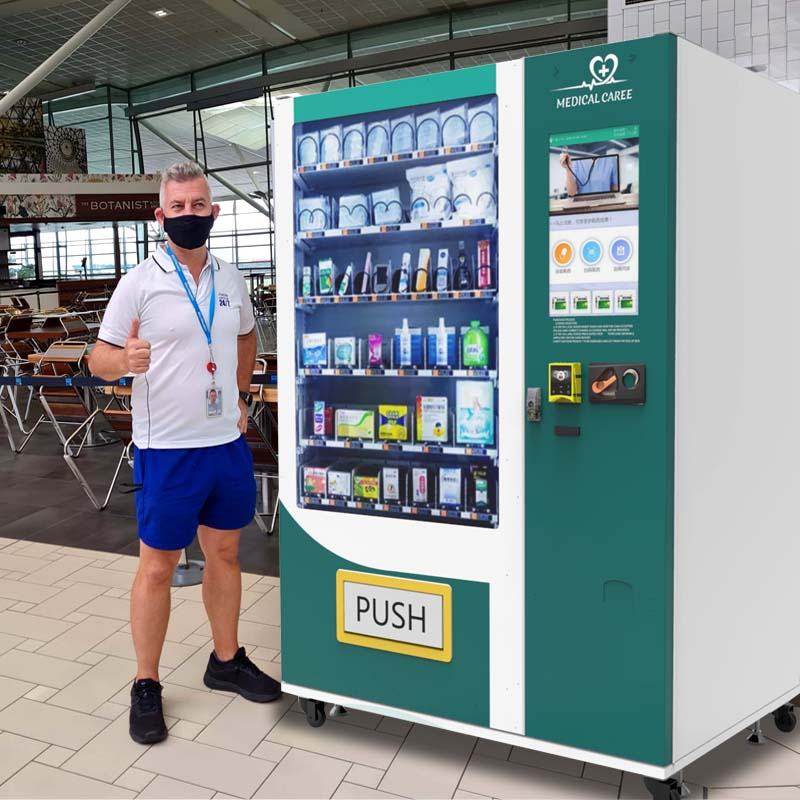
Table of Contents
- What Is a Pharmacy Vending Machine?
- What Can a Pharmacy Vending Machine Dispense?
- How a Pharmacy Vending Machine Works
- Pharmacy Vending Machine vs. Medicine Vending Machine
- Key Features That Matter in Real Projects
- Choosing the Right Dispensing System
- Medication Storage and Temperature Control
- Security and Patient Verification
- Software, Payment and Remote Management
- Where Pharmacy Vending Machines Work Best
- Prescription Dispensing and Compliance
- What Buyers Should Confirm Before Ordering
- How Zhongda Smart Configures Pharmacy Vending Projects
- Pharmacy Vending Machine FAQ
What Is a Pharmacy Vending Machine?
A pharmacy vending machine is an automated dispensing kiosk designed for medication-related self-service. What it actually does depends on the operating model.
A simple machine may sell approved OTC products in a retail environment. A more controlled system may release a prescription package only after the patient scans a code or completes another verification step. Other installations may combine medicine pickup with refrigerated compartments, individual lockers, or a pharmacy management platform.
That is why the term covers several different machine structures rather than one standard cabinet.
For a manufacturer, the first question is usually not screen size or exterior color. It is: what products will be stored, how are they packaged, who is allowed to collect them, and what has to happen before the machine releases the product?
What Can a Pharmacy Vending Machine Dispense?
Product selection is normally determined by local regulations, packaging, storage requirements, and the operator's pharmacy workflow. A machine that works well for boxed OTC products may not be appropriate for fragile packages, individually prepared prescription orders, or temperature-sensitive medicines.
| Product Category | Typical Examples | Machine Considerations |
|---|---|---|
| OTC Medicines | Pain relief, cold and allergy products, digestive products and other locally approved non-prescription items | Adjustable product channels, clear product information, payment system and local retail compliance |
| First-Aid Products | Bandages, dressings, antiseptic products and basic care items | Package dimensions and suitable dispensing structure |
| Healthcare Essentials | Masks, hygiene products, selected personal care and packaged healthcare products | SKU capacity, payment options and inventory monitoring |
| Pre-Approved Prescription Orders | Patient-specific medication packages prepared and approved through a pharmacy workflow | Secure pickup, QR/PIN or identity verification, audit trail and possible software integration |
| Temperature-Sensitive Products | Products that must remain within a defined storage range | Project-specific refrigeration, temperature monitoring and validation against product storage requirements |
Prescription drugs need particular care. The presence of a vending machine does not make a medication legally eligible for unattended sale. Prescription validation, pharmacist involvement, permitted medicine categories, patient identification, record keeping, counseling requirements, and controlled-substance rules vary between countries and even between states or provinces.
The machine therefore has to follow the pharmacy process, not the other way around.
How a Pharmacy Vending Machine Works
There is no single workflow for every installation, but a controlled prescription pickup process may look like this:
-
The prescription or order is prepared. A pharmacy receives, checks, and prepares the medication through its normal professional workflow.
-
The order is assigned to the machine. The medication package is loaded into a designated channel, compartment, or locker.
-
The patient receives pickup information. This may be a QR code, PIN, order number, membership credential, or another approved identifier.
-
The machine verifies the transaction. Depending on the project, the system can request a pickup code, payment, identity check, or another authorization step.
-
The medication is released. The machine dispenses the package or unlocks the assigned compartment.
-
The transaction is recorded. Where software integration is part of the project, pickup status and inventory data can be passed back to the relevant management system.
OTC retail is usually simpler because the machine can operate more like a conventional self-service vending system. Prescription collection is different because the user, order, medicine, and authorization process may all need to be connected.
Pharmacy Vending Machine vs. Medicine Vending Machine
The terms pharmacy vending machine, medicine vending machine, medication vending machine, and prescription vending machine are often used interchangeably online, but they do not always describe exactly the same application.
| Term | Typical Meaning |
|---|---|
| Pharmacy Vending Machine | A broad term covering OTC retail, pharmacy pickup, prescription collection, and other pharmacy-related self-service applications. |
| Medicine Vending Machine | Often used for machines selling packaged OTC medicine and healthcare essentials directly to consumers. |
| Prescription Vending Machine | Usually refers to a more controlled system for collecting prescriptions that have already been prepared or approved. |
| Automated Dispensing Cabinet | More commonly used inside hospitals or clinical environments for controlled staff access to medication rather than public patient retail. |
For buyers, the name matters less than the workflow. Two products both called a "pharmacy vending machine" can require very different hardware and software if one sells OTC medicine while the other handles patient-specific prescription pickup.
Key Pharmacy Vending Machine Features That Matter in Real Projects
Feature lists can become very long, but several items have a much greater effect on whether a machine actually works for a pharmacy project.
| Requirement | Possible Configuration | Why It Matters |
|---|---|---|
| Mixed boxed OTC products | Adjustable cargo channels | Different medicine cartons can vary significantly in width, height and depth. |
| Fragile or premium packages | Elevator delivery | Reduces the drop distance and the impact during dispensing. |
| Patient-specific prescription pickup | Locker or controlled compartment structure | Keeps individual orders separated and allows controlled release. |
| Temperature-sensitive products | Refrigerated cabinet with monitoring | Helps maintain the storage conditions required by the selected product category. |
| Restricted access | PIN, QR, membership or identity verification | Helps link product release to an authorized user or approved transaction. |
| Remote operations | Cloud-based inventory and machine monitoring | Allows operators to check stock, machine status and sales or pickup activity remotely. |
| Paid OTC retail | Card, QR, NFC or other local payment options | The payment hardware has to match the target market and operator requirements. |
| Pharmacy system connection | Project-specific software or API integration | Can connect approved order data, pickup status and inventory information when required. |
Zhongda Smart approaches this type of project as a configuration problem rather than assuming that one standard vending cabinet is suitable for every medicine category.
Choosing the Right Dispensing System
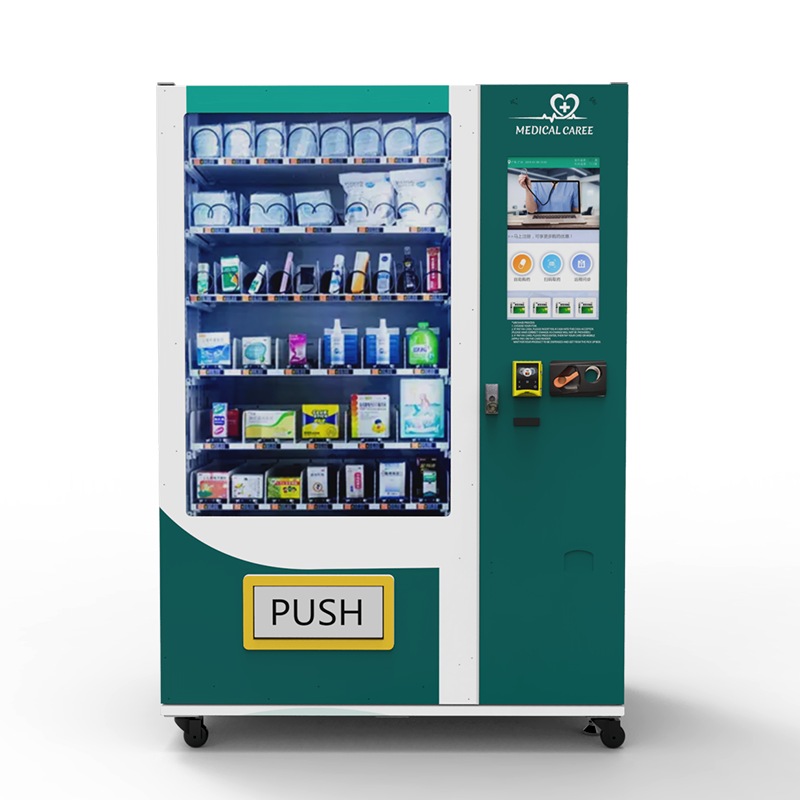
The internal delivery structure is one of the most important decisions in a pharmacy vending machine. Product packaging should normally be reviewed before the cargo lanes are finalized.
Adjustable Vending Channels
Adjustable channels can work well for regular boxed OTC products with stable packaging. The channel width and pitch should be matched to the actual carton dimensions rather than estimated from product photos.
This configuration is useful when the operator wants to carry a relatively large range of standard packaged products in one cabinet.
Elevator Delivery
Some medicine and healthcare packages should not be allowed to fall from an upper shelf into a collection bin. An elevator delivery system brings the product down before releasing it to the pickup area, reducing the drop impact.
Zhongda Smart already uses elevator delivery in vending applications where package protection matters. For pharmacy projects, the same principle can be evaluated when carton damage, bottle stability, or presentation is a concern. See the Zhongda Smart elevator vending machine for the underlying delivery structure.
Locker Compartments
Locker-style dispensing is often a better match for prescription collection because each order can be placed in a separate compartment. Instead of asking a vending mechanism to move the medication package, the system simply unlocks the correct door after authorization.
This format is particularly useful when package sizes vary or when individual orders need to remain separated. Zhongda Smart also manufactures locker-style vending equipment for controlled distribution applications.
For hospital supply applications that are not medication dispensing, see the separate hospital consumables management locker vending machine page.
Medication Storage and Temperature Control
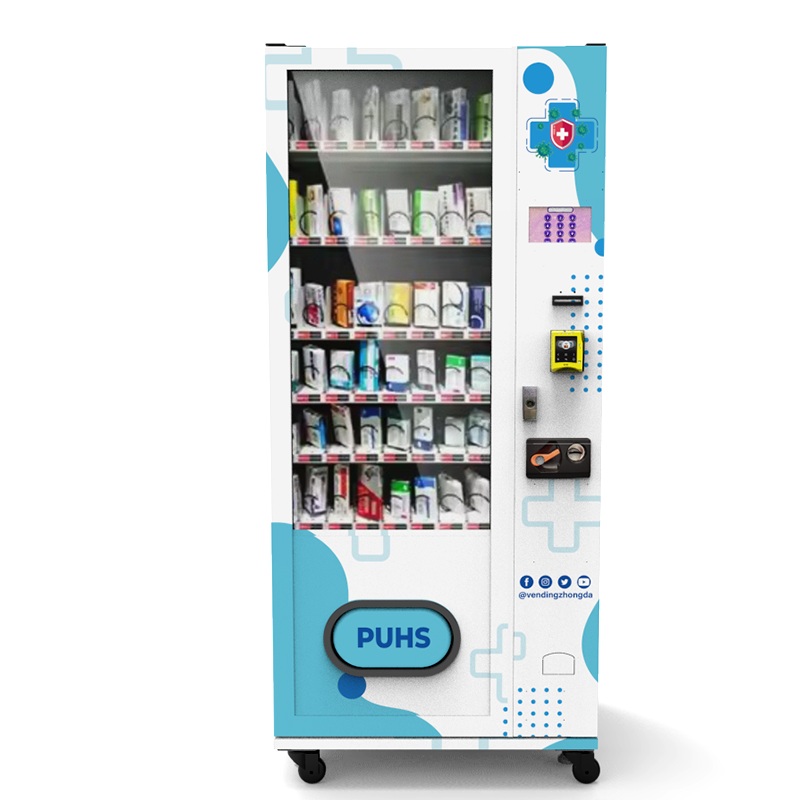
Refrigeration is one of the areas where pharmacy projects require more careful specification than ordinary vending.
A machine having a cooling system does not automatically mean that it meets the storage requirements of every medicine. The required temperature range, permissible variation, airflow, sensor position, alarm requirements, data logging, calibration, and any backup procedures should be confirmed against the products being stored and the regulations of the destination market.
Packaging density matters as well. A cabinet that is almost empty does not always behave exactly like the same cabinet after multiple shelves and channels have been fully loaded. Air circulation can be affected by both the internal layout and the products themselves.
Before configuring refrigeration for a pharmacy vending machine, Zhongda Smart recommends confirming:
The required storage temperature for every product category
The permitted temperature variation
Medicine package dimensions and loading quantity
Ambient conditions at the installation site
Indoor or outdoor placement
Temperature monitoring and record requirements
Whether alarms or remote notifications are required
This information should be confirmed before production. Treating refrigeration as an accessory that can simply be added at the end of the project creates unnecessary risk.
Security and Patient Verification
Security requirements depend heavily on what is inside the machine. A public OTC machine and a prescription pickup kiosk do not need exactly the same access logic.
Depending on the project, a pharmacy vending system may use:
One-time pickup PINs
QR code collection
Membership or patient credentials
ID or age verification
Individual locker assignment
Transaction and pickup records
Remote machine monitoring
Inventory status reporting
Optional camera or site surveillance integration where legally permitted
Verification should be chosen according to the product and legal requirement rather than added simply because the technology is available.
For example, an OTC pain-relief product in a market where normal self-service sale is permitted may only require standard payment. A patient-specific prescription order may require a secure code and an order match. Products subject to age or identity restrictions may require another layer of verification.
Zhongda Smart can provide vending configurations with authentication options, but the operator is responsible for confirming which verification process is legally appropriate for the destination market and product category.
Software, Payment and Remote Management
Hardware is only one part of a pharmacy vending project.
If the machine is selling OTC products, the required software may be relatively straightforward: product selection, payment, dispensing, stock monitoring, sales records and machine status.
Prescription pickup can be more complex. The operator may need the vending system to receive an approved order, associate that order with a machine compartment, verify the patient, record collection, and update the pharmacy system after pickup.
Before requesting integration, buyers should prepare information about:
The pharmacy or hospital software currently in use
Available API documentation
Required data fields
How users will be identified
How orders are assigned to the machine
What happens if an order is not collected
Which pickup and inventory records must be returned
Local privacy and data-protection requirements
Zhongda Smart vending equipment can also support remote operational functions such as machine status, stock information and sales reporting depending on the selected system configuration.
Payment Options
OTC pharmacy vending machines may need card, QR, NFC, cash, coin, membership, or other payment methods depending on the market.
Payment hardware should be confirmed early because payment protocols, card terminals, local acquiring services and certification requirements differ between countries. A machine prepared for one market may require different payment hardware when deployed in another.
Where Pharmacy Vending Machines Work Best
A pharmacy vending machine makes the most sense when there is a clear access problem to solve. Installing one simply because automation is available usually leads to an overcomplicated project.
Retail Pharmacies
A pharmacy may use an automated machine for approved OTC products or for after-hours collection of orders that have already been processed through the pharmacy.
This can extend pickup availability without requiring the entire counter to remain open late at night.
Hospital Discharge Areas
Prescription collection can become inconvenient when patients are discharged outside normal pharmacy counter hours. A controlled pickup kiosk can provide another collection point when the hospital's pharmacy workflow and local regulations allow it.
This use case is different from general hospital vending for snacks, meals, PPE or staff consumables. Zhongda Smart covers those broader applications separately in its hospital and healthcare vending machine solutions.
Emergency and After-Hours Healthcare Locations
Clinics and emergency departments may generate medication needs at times when nearby retail pharmacies are closed. Where regulations permit an automated pickup model, a secure machine can make approved orders available without creating an unrestricted medicine retail point.
University Health Centers
University medical centers often deal with predictable demand for OTC products, basic healthcare essentials, and scheduled prescription collection. A compact pharmacy vending setup can provide extended access while keeping the service process structured.
Remote and Underserved Locations
In areas where pharmacy access is limited, automated collection may help extend availability, but this is also one of the applications where local regulations and pharmacist supervision requirements need particularly careful review.
Prescription Dispensing and Compliance
There is no single global rule governing pharmacy vending machines.
Whether a machine may sell OTC medicines, release prescription medication, perform after-hours pickup, or handle restricted products depends on the laws and professional requirements of the destination country, state, province, or healthcare authority.
A buyer may need to confirm requirements covering:
Which medicines may be sold through self-service equipment
Whether prescription products require pharmacist approval before release
Patient or customer identity verification
Age-restricted product rules
Controlled-substance restrictions
Required medication counseling
Storage temperature and environmental monitoring
Record retention and audit requirements
Privacy and personal-data protection
Payment or insurance-processing requirements
For that reason, Zhongda Smart asks customers to identify the destination market and intended product category before finalizing authentication, refrigeration, payment, dispensing, or software configurations.
Important: The machine itself should not be treated as proof that a medication is legally permitted for automated sale or pickup. Pharmacy operators should obtain advice from the appropriate local regulatory and professional authorities before deployment.
What Buyers Should Confirm Before Ordering a Pharmacy Vending Machine
A useful quotation starts with more than a request for "one pharmacy vending machine."
The more information the manufacturer receives at the beginning, the easier it is to avoid changing the cabinet, cooling system, cargo lanes, payment hardware, or software after production has started.
| Information to Provide | Why Zhongda Smart Needs It |
|---|---|
| Product type | Determines whether the project is OTC retail, prescription pickup, healthcare product vending, or a mixed application. |
| Package dimensions | Used to select channel dimensions, locker sizes, and dispensing method. |
| Package weight | Affects delivery structure and load planning. |
| Number of SKUs | Helps determine machine capacity and internal layout. |
| Storage temperature | Determines whether refrigeration or another temperature-controlled configuration is required. |
| Target country | Affects voltage, payment system, language, certification and compliance planning. |
| Indoor or outdoor installation | Changes cabinet, environmental and site requirements. |
| Payment methods | Allows compatible hardware and protocols to be evaluated. |
| User verification method | Determines whether PIN, QR, membership or identity verification is required. |
| Pharmacy software/API | Needed if orders, pickup status or inventory information must be integrated. |
| Branding and interface language | Used for cabinet graphics, touchscreen UI and OEM/ODM customization. |
How Zhongda Smart Configures Pharmacy Vending Machine Projects
Zhongda Smart is a vending machine manufacturer providing OEM and ODM equipment for customized self-service retail and controlled dispensing projects.
For a pharmacy vending machine, Zhongda Smart does not recommend choosing a cabinet only from a product photo. The configuration should start with the medicine or healthcare product itself.
A typical project review covers:
Product and packaging dimensions
Required machine capacity
Adjustable channel, elevator or locker dispensing
Ambient or refrigerated storage
Touchscreen size and user interface
QR, card, NFC, cash or other payment options
PIN, pickup code or identity verification requirements
Remote monitoring and inventory functions
Software integration requirements
Cabinet color, logo and custom graphics
Voltage, language and destination market
The dispensing structure is then selected around the product. Regular cartons may fit adjustable vending channels. Fragile packages may benefit from elevator delivery. Patient-specific orders may be better suited to separate locker compartments.
This approach avoids a common problem in customized vending projects: deciding on the machine first and discovering later that the actual packages do not fit the selected cargo lanes or delivery method.
What to Send Zhongda Smart for a Faster Configuration
If you are planning a pharmacy vending project, send the following information with your inquiry:
Photos of the products
Width × depth × height of each main package size
Approximate product weight
Expected number of SKUs
Required quantity per SKU
Storage temperature requirements
Target country
Preferred payment method
Required verification or pickup process
Any existing pharmacy software or API documentation
With those details, the machine layout and required functions can be discussed much more accurately than with a generic quotation request.
Planning a Pharmacy Vending Machine Project?
Tell Zhongda Smart what you want to dispense, the package size, required temperature, destination country, payment method, and pickup workflow. Our team can review the requirements and recommend a suitable vending structure and customization plan.
Contact Zhongda Smart for a Pharmacy Vending Machine Configuration
Pharmacy Vending Machine FAQ
What is a pharmacy vending machine?
A pharmacy vending machine is a self-service system designed to provide controlled access to OTC medicines, healthcare products, or pre-approved prescription orders. Depending on the application, it may include payment, QR or PIN pickup, identity verification, refrigeration, remote inventory management, and software integration.
Can a pharmacy vending machine sell OTC medicine?
Yes, pharmacy vending machines can be configured for packaged OTC products where local regulations permit self-service sale. The operator should confirm which medicine categories are legally allowed in the target market before loading the machine.
Can pharmacy vending machines dispense prescription drugs?
Some pharmacy vending systems can release pre-approved prescription orders, but the legal requirements vary by jurisdiction. Prescription validation, pharmacist approval, patient identification, counseling requirements, record keeping, and restrictions on specific medicines must be confirmed locally.
Does a pharmacy vending machine need refrigeration?
Not every pharmacy vending machine requires refrigeration. The correct storage configuration depends on the products inside. If a medicine or healthcare product has a defined temperature requirement, the machine must be configured and validated around that requirement. A standard refrigerated vending cabinet should not automatically be assumed suitable for every pharmaceutical product.
How are medications secured inside a pharmacy vending machine?
Security can include locked cabinets, individual compartments, PIN or QR pickup, identity verification, transaction records, remote monitoring, and inventory tracking. The required level of security depends on the medicine category and local regulations.
Can a pharmacy vending machine verify customer identity?
Identity or age verification can be added to suitable vending configurations when required by the project. The exact verification method should be selected according to local laws, the products being dispensed, and the operator's workflow.
Can a pharmacy vending machine connect to pharmacy software?
Software integration can be developed for projects that need order data, pickup authorization, inventory information, or collection status to move between the machine and another system. Buyers should provide the existing software details and API documentation so the required integration can be evaluated.
What is the best dispensing system for medicine boxes?
It depends on the package. Regular boxed products may work with adjustable cargo channels, fragile packages may benefit from elevator delivery, and patient-specific prescription orders can be better suited to individual locker compartments. Product dimensions and weight should be checked before the internal layout is confirmed.
How much does a pharmacy vending machine cost?
There is no single price for every pharmacy vending machine. Cost depends on cabinet size, dispensing structure, refrigeration, touchscreen, payment equipment, verification hardware, software integration, certifications, branding, and order quantity. Sending product dimensions and project requirements is the most reliable way to receive an accurate quotation.
Are pharmacy vending machines legal?
Regulations differ by country and region. Some markets permit self-service sale of selected OTC products, while prescription dispensing may require pharmacist approval, patient verification, or other controls. The machine manufacturer supplies the equipment, but the pharmacy operator must confirm local legal and professional requirements before deployment.
Do pharmacy vending machines replace pharmacists?
In most prescription applications, no. The machine is better understood as an additional collection or dispensing channel. Pharmacist review, prescription validation, professional oversight, counseling, and other responsibilities may still be required according to the healthcare system and local law.
What information does Zhongda Smart need to customize a pharmacy vending machine?
Zhongda Smart normally needs the product type, package dimensions, weight, number of SKUs, required storage temperature, target country, installation environment, payment method, verification workflow, and any software integration requirements. Product photos and API documentation are also useful where applicable.
Regulatory note: Pharmacy and medication-dispensing requirements vary by jurisdiction. The information on this page describes vending machine configurations and common project considerations and should not be treated as legal, pharmaceutical, or clinical advice.